Sample Category Title
ECB Draghi: Euro’s international role in foreign reserves and debt market eroding
ECB President Mario Draghi appears in the Hearing of the Committee on Economic and Monetary Affairs of the European Parliament today. Regarding Euro's internal dimension, Draghi said "euro has indeed provided two decades of price stability". And, thanks to the "collective efforts of all European citizens, the euro area has emerged from" the global financial crisis, with "22 consecutive quarters of economic growth, the unemployment rate at its lowest level since October 2008, and wages and incomes on the rise."
But Draghi also repeated last week's cautious comments. He noted "over the past few months, incoming information has continued to be weaker than expected on account of softer external demand and some country and sector-specific factors. The persistence of uncertainties in particular relating to geopolitical factors and the threat of protectionism is weighing on economic sentiment." He reiterated that "significant monetary policy stimulus remains essential", and "the Governing Council stands ready to adjust all of its instruments".
On Euro's external dimension, Draghi said since the global financial crisis, "the euro's international role seems to have gradually eroded. While its importance as the currency of invoice for international trade transactions has remained broadly stable, its role in global foreign reserves and global debt markets has declined." And he urged that "the international role of the euro is supported by the pursuit of sound economic policies in the euro area and a deeper and more complete EMU. And this requires further efforts along the path of deeper integration."
USDCNH Touches 6-month Trough Again; Bearish Correction in Progress
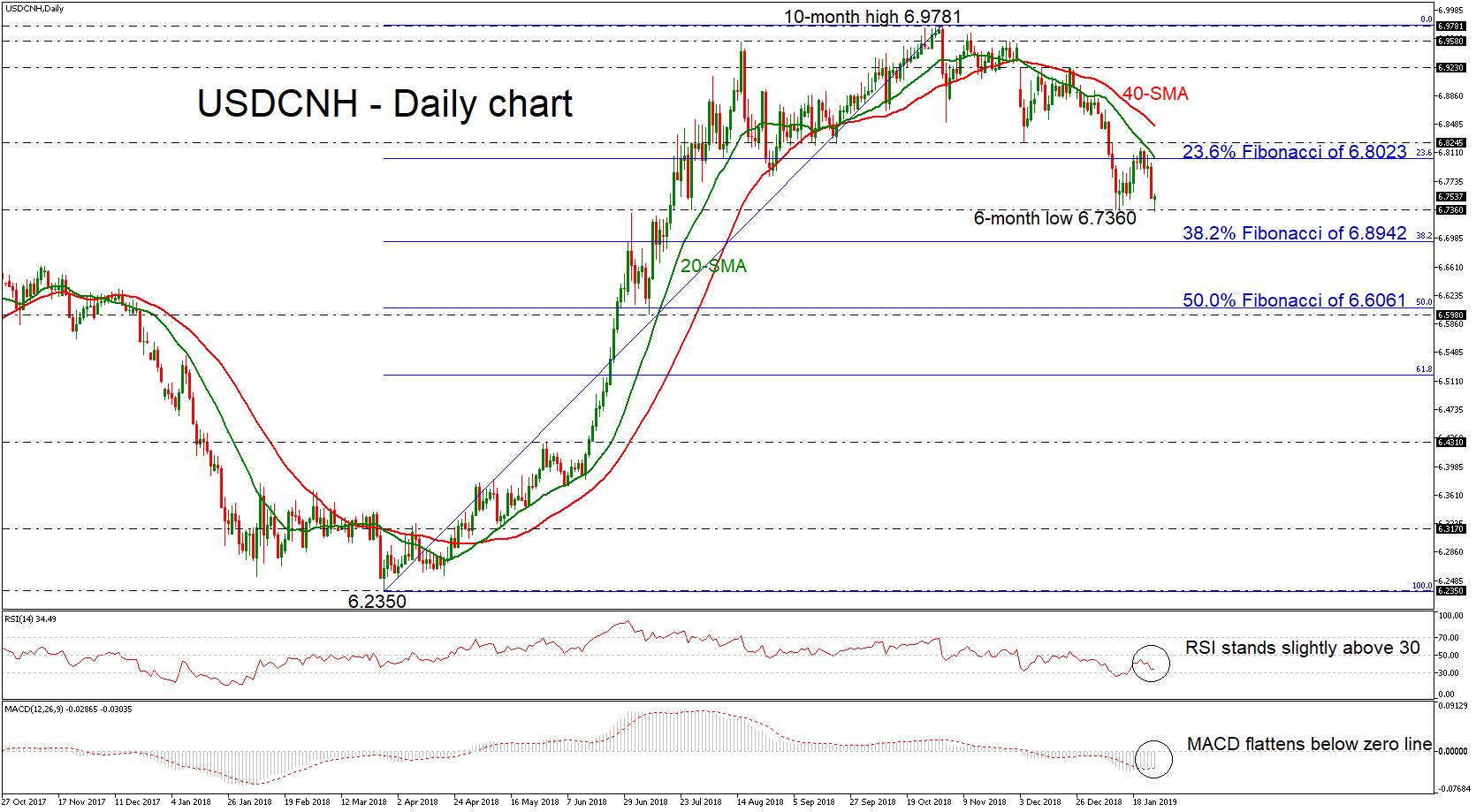
USDCNH had a bearish start on Monday, with the price touching a crucial support at the six-month low of 6.7360. The price dropped beneath the 23.6% Fibonacci retracement level of the upleg from 6.2350 to 6.9781, however, currently, it is paring some of the lost ground.
The RSI is pointing up near oversold levels, slightly above 30, indicating that the market could strengthen a little bit in the short-term until the index falls back below that threshold, while the MACD supports a bearish to neutral picture, since it continues to hold beneath the zero line.
If the market manages to pick up speed, the 23.6% Fibonacci which overlaps with the 20-day simple moving average (SMA) could offer nearby resistance ahead of the 6.8245 barrier, taken from the lows on December 4. A significant close above the latter would meet the 40-day SMA around 6.8464 before running towards 6.9230.
On the other side, should prices drop below the six-month low, they could hit the 38.2% Fibonacci of 6.8942 before the focus shifts towards the support area within 6.5980 – 6.6061, which encapsulates the 50.0% Fibonacci region.
In the short-term, the outlook remains negative since prices hold below all the moving average lines and the bearish cross between the 20- and the 40-day SMAs stays in place.
USD/JPY Mid-Day Outlook
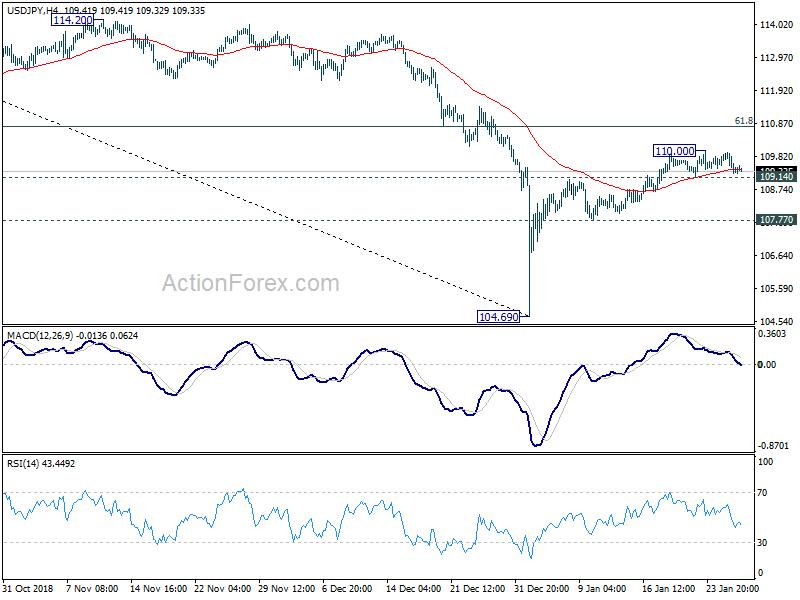
Daily Pivots: (S1) 109.35; (P) 109.65; (R1) 109.85; More...
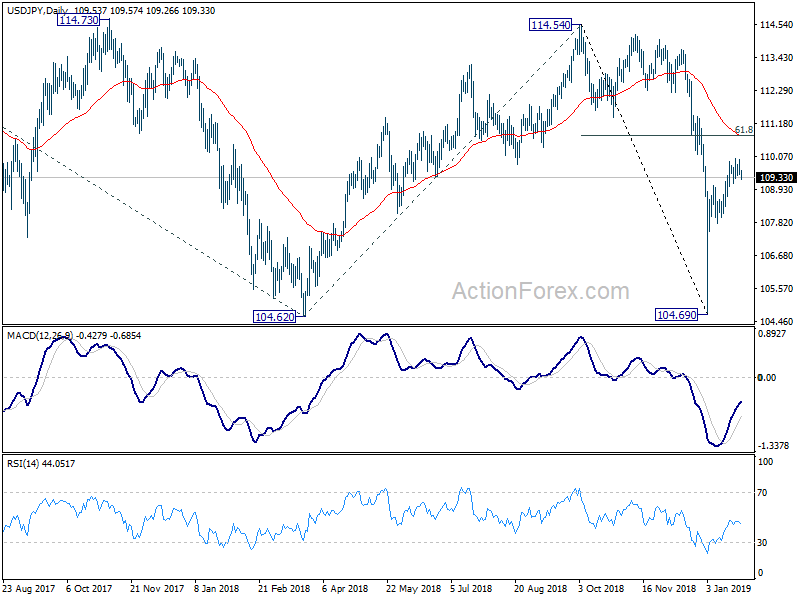
Intraday bias in USD/JPY is neutral for the moment. With 109.14 minor support intact, rebound from 104.69 might still extend further to 61.8% retracement of 114.54 to 104.69 at 110.77. But in that case, we'd look for topping signal above there. On the downside, break of 109.14 minor support will be the first sign of completion of the rebound. Intraday bias will then be turned back to the downside for 107.77 minor support first.
In the bigger picture, while the rebound from 104.69 is strong, there is no change in the view that it's a corrective move. That is, fall from 114.54, as part of the decline from 118.65 (2016 high), is not completed yet. Break of 104.62 will target 100% projection of 118.65 to 104.62 from 114.54 at 100.51, which is close to 100 psychological level. Nevertheless, sustained trading above 55 day EMA (now at 110.82) will dampen this bearish view and turn focus back to 114.54 resistance instead.
USD/CHF Mid-Day Outlook
Daily Pivots: (S1) 0.9910; (P) 0.9943; (R1) 0.9963; More....
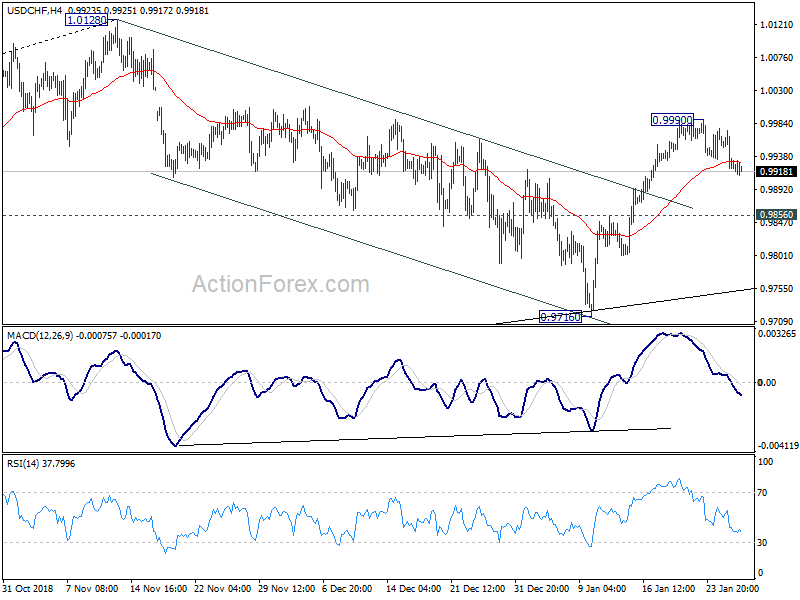
USD/CHF's consolidation from 0.9990 is in progress and intraday bias remains neutral. Deeper retreat cannot be ruled out. But downside should be contained by 0.9856 resistance turn support to bring another rally. As note before, corrective pull back from 1.0128 has completed at 0.9716 already. Above 0.9990 will extend the rise from 0.9716 to retest 1.0128 high.
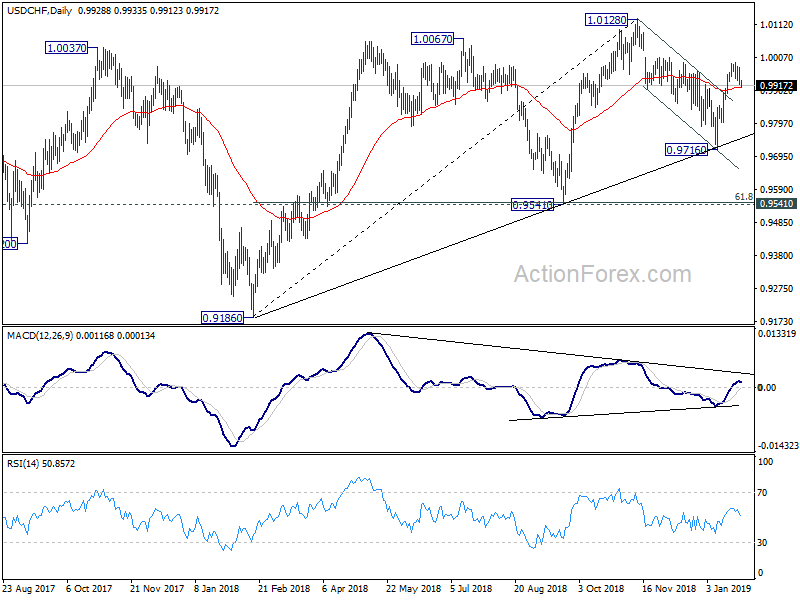
In the bigger picture, USD/CHF drew strong support from medium term trend line and rebounded. That suggests rise from 0.9186 is still in progress. Break of 0.9963 will affirm this bullish case. Further break of 1.0128 will confirm up trend resumption and target 1.0342 key resistance. Nevertheless, break of 0.9716 will dampen this bullish view and at least bring deeper fall to 0.9541 key support.
EUR/USD Mid-Day Outlook
Daily Pivots: (S1) 1.1332; (P) 1.1375; (R1) 1.1448; More.....
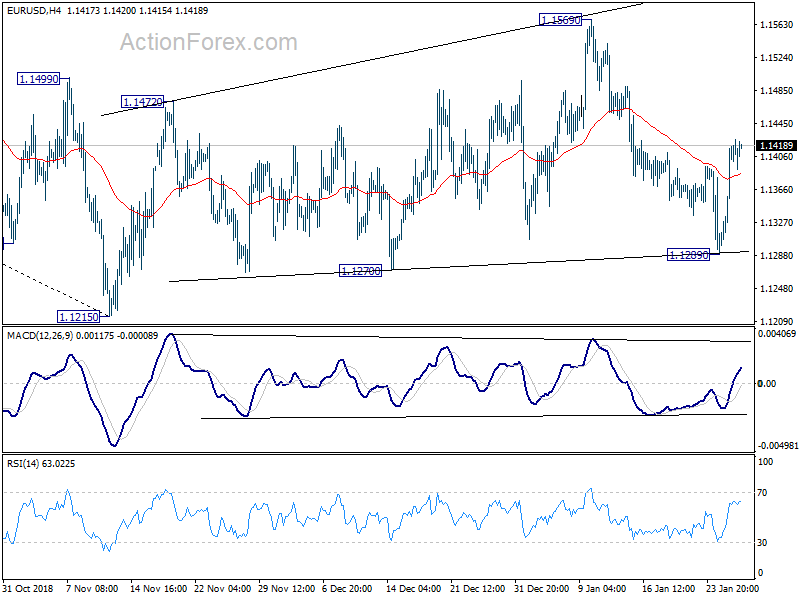
At this point, intraday bias in EUR/USD remains mildly on the upside for further rebound. Current development suggests that corrective pattern from 1.1215 is still extending, with rise from 1.1289 as another leg. Further rally would be seen to 1.1569 resistance and above. On the downside, break of 1.1289 is needed to confirm resumption of fall from 1.1569. Otherwise, risk will stay on the upside in case of retreat.
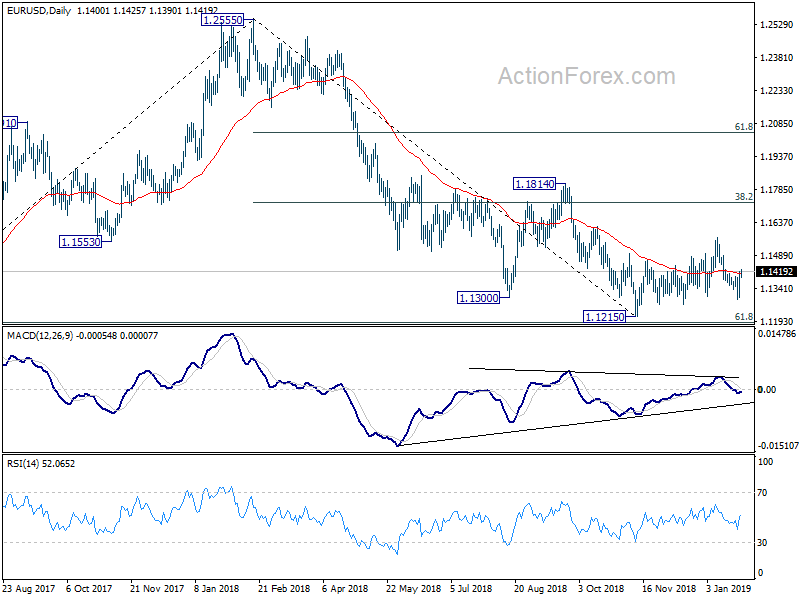
In the bigger picture, as long as 1.1814 resistance holds, down trend down trend from 1.2555 medium term top is still in progress and should target 61.8% retracement of 1.0339 (2017 low) to 1.2555 at 1.1186 next. Sustained break there will pave the way to retest 1.0339. However, break of 1.1814 will confirm completion of such down trend and turn medium term outlook bullish.
GBP/USD Mid-Day Outlook
Daily Pivots: (S1) 1.3096; (P) 1.3157; (R1) 1.3261; More....
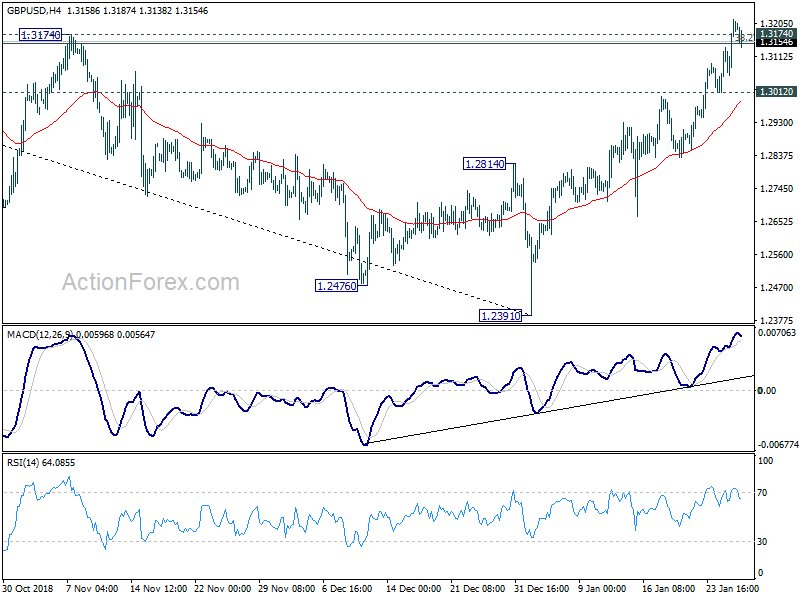
At this point, intraday bias in GBP/USD remains on the upside with focus on 1.3174 key resistance. Sustained break above 1.3174 will suggest that whole decline from 1.4376 has completed at 1.2391 on bullish convergence condition in daily MACD. Further rise should then be seen to 61.8% retracement at 1.3618. On the downside, however, break of 1.3012 support will suggest rejection by 1.3174 key resistance, and turn bias to the downside for 1.2814 support.
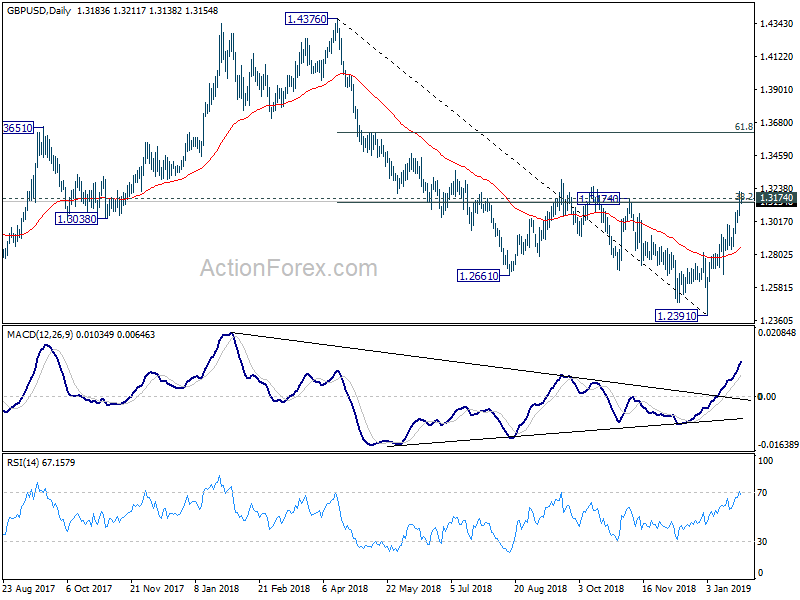
In the bigger picture, rise from 1.1946 (2016 low) to 1.4376 (2018 high) is seen as a corrective move. Similarly, fall from 1.4376 to 1.2391 also displace a corrective structure. Current development suggests that rise from 1.2391 is the third leg of the corrective pattern from 1.1946 and could extend beyond 1.4376 high. Firm break of 61.8% retracement of 1.4376 to 1.2391 at 1.3618 will affirm this case. On the downside, break of 55 day EMA (now at 1.2838) will turn focus back to 1.2391 low instead.
Sterling and Canadian Weaken in Quiet Markets, Dollar Mixed ahead of Key Events
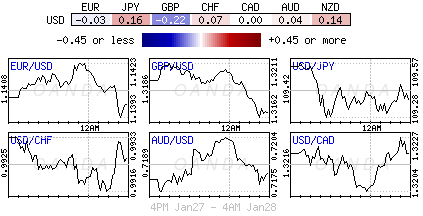
Trading in the forex markets has been rather subdued for most of the day. But there are signs of some additional weakness in Sterling and Canadian Dollar in early US session. Traders could be lightening up positions ahead tomorrow's Brexit votes and debates in the Commons. But the Pound could make a come back if amendments related to ruling out no-deal Brexit are being approved. Meanwhile, Canadian Dollar follows oil prices lower.
On the other hand, Dollar is mixed as the government agencies affected by the historic shut down reopen. There are enough high profile events for Dollar traders to pay attention to, including US-China trade meetings, FOMC rate decisions and non-farm payrolls reports. All these three events could trigger violence move in the greenback in either directions. But for now, Euro, Swiss Franc and Yen are the strongest ones for today.
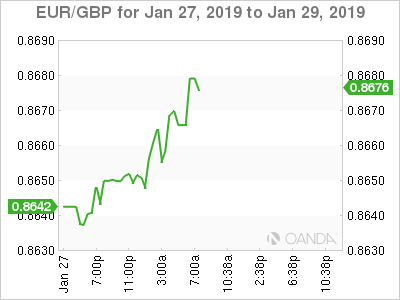
Technically, AUD/USD and USD/CAD are moving away from 0.7235 and 1.3180 levels respectively, suggesting recent consolidations are extending. EUR/GBP's recovery from 0.8617 is gather some momentum. Break of 0.8725 resistance will strong suggests that 0.8620 key support is depended and would bring stronger rebound in the cross. In that case, GBP/USD could be dragged down through 1.3012 minor support to indicate rejection by 1.3174 key resistance.
In other markets, FTSE is currently down -0.52%. DAX is down -0.38%. CAC is down -0.37%. German 10-year yield is up 0.027 at 0.222. Earlier in Asia, Nikkei dropped -0.60%. Hong Kong HSI rose 0.03%. China Shanghai SSE dropped -0.18%. Singapore Strait Times dropped -0.09%. Japan 10-year JGB yield dropped -0.0016 to -0.001.
US NABE: Majority of businesses expect no recession in the next 12 months
The National Association of Business Economics in the US released its quarterly business condition survey today. Nearly all respondents do not expect a recession in the US in the next 12 months. However, 64% expected growth to expect 2%, sharply lower than 90% in prior survey in October.
Regarding capital spending, 84% said the 2017 Tax Cuts and Job Act has not changed their investment of hiring plans. NABE President Kevin Swift said "the capex story is really a tale of two cities. Fewer firms increased capital spending compared to the October survey responses, but the cutback appeared to be concentrated more in structures than in information and communication technology investments."
77% indicated no impact from trade conflicts on their investment hiring and even pricing plans. However, from the goods-producing panelists, 36% said their raising prices and 27% delaying investments.
UK parliament Brexit committee: Managed no-deal cannot be government policy
UK Parliament's Brexit Committee said today that the government cannot have a "managed no-deal" Brexit as its policy. The committee's chairman Hilary Benn said "having taken a wide range of evidence on the implications of a no deal Brexit, the committee is clear that this cannot be allowed to happen."
He added "MPs must be able to vote on extending Article 50 if Parliament cannot reach agreement on a way forward before March 29."
May said to privately rule out no-deal Brexit
The Sun reported that UK Prime Minister has privately told the Cabinet that she will rule out no-deal Brexit. That came under influence of Remainer ministers and the under the worry that hard Brexit would cost UK lost of jobs. But for now, she won't do it publicly, as it could remove a key bargaining chip with EU.
Bob Sanguinetti, chief executive of the UK Chamber of Shipping, warned that "In the absence of a viable alternative to the Withdrawal Agreement, we continue to be heading for a no-deal scenario which is damaging, disruptive and chaotic to business, to manufacturers and consumers". And he urged to "put aside party politics and in the moment of need that we find ourselves in, we need to look at the bigger picture and look at what is best for the country".
Separately, Brexiteer Boris Johnson wrote in Telegraph on Sunday, saying May is seeking legally binding change to the Irish backstop fro the EU. However, Ireland has already make it clear they won't accept any change to the current backstop agreement.
BoJ minutes: Momentum towards 2% inflation target was being maintained
In the minutes of December 19/20 BoJ monetary policy meeting, most members shared that "although it would take time to achieve the 2 percent price stability target, it was appropriate to persistently continue with the powerful easing under the current guideline for market operations as the momentum toward achieving 2 percent inflation was being maintained".
Regarding Japan's economic outlook, members "concurred that it was likely to continue its moderate expansion". And they "shared the recognition that domestic demand was likely to follow an uptrend". However, one member warned that "exports, including those to China, had been weak as a whole". Another member pointed to "increasing number of firms held cautious views, mainly against the background of the prolonged US-China trade friction".
On prices, members shared the recognition that "CPI continued to show relatively weak developments compared to the economic expansion and the labor market tightening". But most agreed that CPI was "likely to increase gradually toward 2 percent".
On the data front
Japan corporate services price index rose 1.1% yoy in December, below expectation of 1.2% yoy. Eurozone M3 money supply rose 4.1% yoy in December versus expectation of 3.8% yoy.
GBP/USD Mid-Day Outlook
Daily Pivots: (S1) 1.3096; (P) 1.3157; (R1) 1.3261; More....
At this point, intraday bias in GBP/USD remains on the upside with focus on 1.3174 key resistance. Sustained break above 1.3174 will suggest that whole decline from 1.4376 has completed at 1.2391 on bullish convergence condition in daily MACD. Further rise should then be seen to 61.8% retracement at 1.3618. On the downside, however, break of 1.3012 support will suggest rejection by 1.3174 key resistance, and turn bias to the downside for 1.2814 support.
In the bigger picture, rise from 1.1946 (2016 low) to 1.4376 (2018 high) is seen as a corrective move. Similarly, fall from 1.4376 to 1.2391 also displace a corrective structure. Current development suggests that rise from 1.2391 is the third leg of the corrective pattern from 1.1946 and could extend beyond 1.4376 high. Firm break of 61.8% retracement of 1.4376 to 1.2391 at 1.3618 will affirm this case. On the downside, break of 55 day EMA (now at 1.2838) will turn focus back to 1.2391 low instead.
Economic Indicators Update
| GMT | Ccy | Events | Actual | Forecast | Previous | Revised |
|---|---|---|---|---|---|---|
| 23:50 | JPY | Corporate Service Price Y/Y Dec | 1.10% | 1.20% | 1.20% | |
| 23:50 | JPY | BoJ meeting minutes | ||||
| 9:00 | EUR | Eurozone M3 Money Supply Y/Y Dec | 4.10% | 3.80% | 3.70% |
Shutdown Deal Boost Canadian Dollar to 2-Week High
USD/CAD is showing little movement in the Monday session. Currently, the pair is trading at 1.3234, up 0.10% on the day. On the release front, there are no Canadian or U.S. events on the schedule, so we can expect a quiet day from the pair. On Tuesday, the U.S. releases CB Consumer Confidence, which is expected to drop to 125.0 points.
The Canadian dollar received an unexpected boost on Friday, courtesy of Donald Trump. The U.S. president signed a bill which provided funds for the U.S. government to operate for three weeks. The breakthrough has raised hopes that an agreement can be reached to end the shutdown, which has lasted over a month. Risk sentiment jumped on the news of a deal, and the Canadian dollar surged over 1.0% on Friday, hitting a 2-week high.
At the same time, last week’s soft Canadian data is a cause for concern. Manufacturing Sales declined by 1.4% in November, its sharpest decline in over a year. Consumer spending also sagged in November. Retail Sales and Core Retail Sales both recorded declines, with readings of -0.9% and -0.3%, respectively. The economy will receive a report card on Thursday, with the release of the monthly GDP report. This key event should be treated as a market-mover.
Into US session: Major pairs bounded in tight range, mild risk aversion
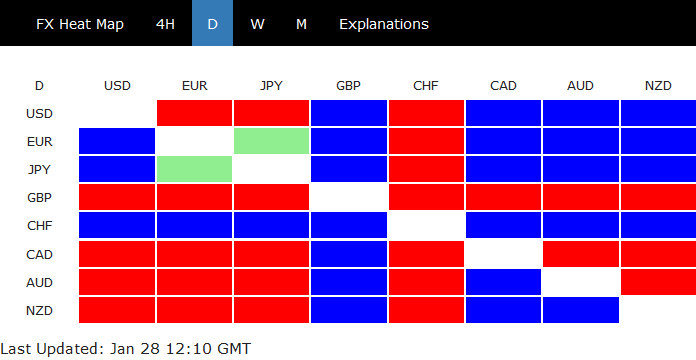
Entering into US session, the forex markets remain relatively quiet today. Major pairs and crosses are bounded inside Friday's range. Sterling turned soft as it continues to pare back recent gains ahead of tomorrow's Brexit debate. Canadian Dollar also turns weaker, following dips in WTI crude oil.
On the other hand, Swiss Franc is slightly higher on mild decline in European socks. Yen and Euro are the second strongest. But the picture is easy to change before weekly close.
In Europe, currently:
- FTSE is down -0.26%.
- DAX is down -0.19%.
- CAC is down -0.48%.
- German 10-year yield is up 0.0241 at 0.22.
Earlier in Asia:
- Nikkei closed down -0.60%.
- Hong Kong HSI rose 0.03%.
- China Shanghai SSE dropped -0.18%.
- Singapore Strait Times dropped -0.09%.
- Japan 10-year JGB yield dropped -0.0016 to -0.001.
Be Prepared, It’s an Action-Packed Week in Capital Markets
Monday January 28: Five things the markets are talking about
Global equities start the week on the back foot, as capital markets weigh political developments, from Sino-U.S trade to Brexit, against U.S corporate earnings, that have to date, surpassed many analysts expectations, and this despite ongoing signs of a global economic slowdown.
This is expected to be an action-packed week amongst the various asset classes where investors will face some key tests – Chinese President Xi’s top economic aide, Vice-Premier Liu He, will meet with Robert Lighthizer and Treasury Secretary Steven Mnuchin on Wednesday and Thursday.
There’s the U.S governments ongoing talks on border security and tomorrow, the U.K parliament is expected to vote on amendments to PM Theresa May’s Brexit deal with the E.U. On Wednesday, the E.U Parliament will debate Brexit.
Also Wednesday, investors will be digesting the Fed’s latest monetary policy meeting outcome. If the Fed is to be keep their views unchanged this week, it should maintain a “cautiously friendly environment” for risk assets. The market has priced in ‘no’ rate hikes stateside in 2019. Fed Chair Powell will hold a news conference after the FOMC rate decision.
While on Friday, the granddaddy of U.S economic indicators will be delivered – U.S non-farm payrolls (NFP).
Also, in the background there is a slew of corporate earning’s announcements – Tech giants Apple, Microsoft, Facebook, Alibaba, SAP, Qualcomm, Tesla, Samsung and Sony announce earnings.
1. Stocks see red
In Japan, the Nikkei fell overnight as a stronger yen (¥109.35) weighed on the broader market, however, losses were limited as investors remain reluctant to enter into larger positions ahead of Q3 corporate earnings reports this week. At the close the Nikkei share average dropped -0.6%, while the broader Topix shed -0.7% with 32 of the 33 subsectors in the red.
Down-under, Australia was closed for a bank holiday. In S. Korea, the Kospi stock index ended little changed overnight amid investor caution ahead of the FOMC rate decision and Sino-U.S trade talks. The index settled largely unchanged at -0.02%.
In China, equities ended lower on Monday as downbeat industrial profit and weaker GDP data last week reinforced concerns about a slowing economy and this despite the People’s Bank of China (PBoC) freeing up a potential +$37B for bank lending and while a new CEO was named to lead the country’s main securities regulator. At the close, the Shanghai Composite index was down -0.18%, while the blue-chip CSI300 index was down -0.02%. In Hong Kong, it was a similar story, the Hang Seng index ended nearly flat, while the Hang Seng China Enterprises index inched up +0.1%.
In Europe, regional bourses trade lower across the board after a lower session in Asia and lower U.S futures as the U.S Government again opens fully for business after 35-days.
U.S stocks are set to open down (-0.44%).
Indices: Stoxx600 -0.18% at 357.18, FTSE -0.05% at 6,805.96, DAX -0.09% at 11,271.65, CAC-40 -0.28% at 4,912.01, IBEX-35 -0.03% at 9,182.35, FTSE MIB -0.20% at 19,770.50, SMI -0.33% at 8,897.00, S&P 500 Futures -0.44%

2. Oil falls on U.S rig count and weaker China data, gold higher
Ahead of the U.S open, oil prices are under pressure, down over -1% after data from Friday showed that U.S companies added rigs for the first time this year, a sign that crude output may rise further, and as China reported additional signs of an economic slowdown.
Brent crude oil futures are at +$60.74 a barrel, down -90c, or -1.46%, while U.S crude oil futures are at +$52.84 per barrel, down -85c, or -1.58%, from Friday’s close.
A higher U.S production rate continues to eat away at OPEC+’s efforts to support crude prices.
U.S crude oil production rose to a record +11.9M bpd in Q4 2018 and there is evidence that U.S production rates will increase further, especially when you see data from Baker-Hughes showing that U.S energy firms raised the number of rigs looking for new oil for the first time this year to +862 – an addition of 10 rigs. The U.S is now the world’s largest oil producer.
A global economic slowdown supported by a persistent weakness in Chinese data and egged on by a trade dispute between U.S and China is also weighing on fuel demand-growth expectations.
China is trying to stem the slowdown with aggressive fiscal stimulus measures, however, there are concerns that these efforts may not have the desired effect as China’s economy is already burdened with massive debt.
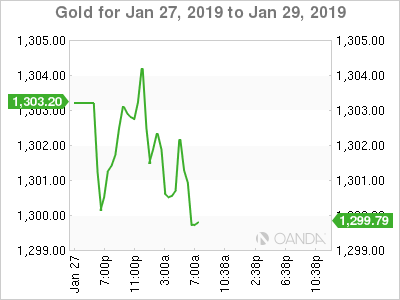
Gold prices are trading atop of their seven-month peak, on hopes that the Fed will keep interest rates unchanged during its two-day policy meeting this week. Spot gold is a tad lower at +$1,301.81 per ounce, while U.S gold futures have rallied +0.2% to +$1,300 per ounce.
Note: The Fed meets between Jan. 29 and Jan. 30, and Chairman Powell is expected to “acknowledge growing risks to the U.S economy as global momentum weakens.”
3. Eurozone bond yields expected to remain near month lows
Eurozone sovereign bond yields are expected to remain within striking distance of this month’s lows as a number of factors should be supportive of lower yields this week – ECB speakers are expected to deliver ‘dovish’ rhetoric, aided by the the Brexit vote, Wednesday’s FOMC decision, global mixed data and month-end index flows – these are all reasons enough to keep eurozone government bond yields atop of their two-year lows.
The slowdown in the eurozone’s economic growth is especially supportive of German Bunds – the 10-year Bund yield trades unchanged at +0.14% – coupled with last week’s decline in January PMI’s/Ifo is proof that investors should not be expecting an economic revival in the near-term.
Elsewhere, the yield on 10-year Treasuries have declined -1 bps to +2.75%, while in the U.K, the 10-year Gilt yield was unchanged at +1.317%.

4. Dollar under pressure
This is a very sensitive geo-political week for the FX market, with China-U.S trade talks, the Brexit vote, FOMC rhetoric, NFP and corporate earnings, the U.S investor should expect some nervous price moves to occur at inconvenient times with little liquidity.
The markets focus on Wednesday will be the Fed’s rate decision with dealers expecting the Fed to maintain the cautiously friendly environment for risk assets which has been the main trait in January so far.
GBP/USD (£1.3180) is a tad softer by -0.2% ahead of tomorrow’s U.K parliamentary vote on Brexit. The key focus will be on the possible “amendments” to PM May’s Brexit deal. Currently there were two rival visions that sought to take control of the Brexit process. An extension of Article 50 appears the be the most likely outcome in the current process.
EUR/USD (€1.1419) is little changed and is expected to continue to trade between €1.13 and €1.15 in the near term as concerns about the U.S economy and Fed’s policy offset eurozone economic weakness, which should curtail most dollar gains and the ‘single unit’s’ losses. The Fed is likely to reaffirm “patience on rates and its data dependency,” even as U.S Q4 GDP data is expected to highlight a stronger U.S economy.
5. Eurozone bank lending stable last month
Data from the ECB this morning showed that Bank lending to businesses and households in the eurozone was stable in December.
Lending to “non-financial” corporations grew at an annual rate of +4% m/m and was unchanged from the previous month. Lending to eurozone “households” was also steady, growing at an annual rate of +3.3% in December.
Note: The eurozone economy is heavily dependent on the availability of funding. However, lending rates have remained well below the pre-crisis levels. In 2007 and in H1 of 2008, bank lending to businesses was running at rates well above +12%.