Sample Category Title
Canadian Inflation Figures Due as Loonie Tracks Oil Prices
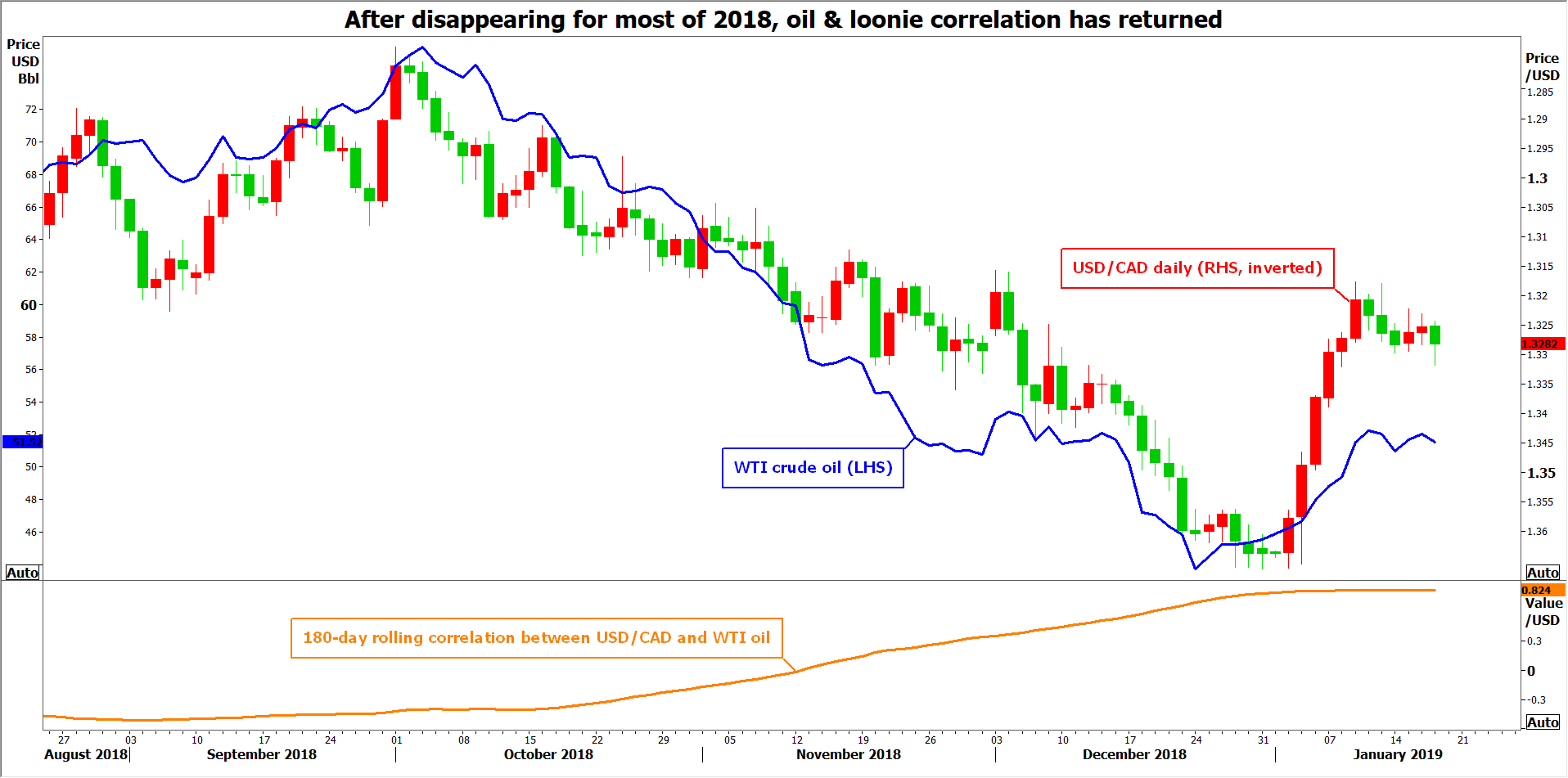
The latest inflation data out of Canada will hit the markets on Friday, at 1330 GMT. While these figures are always important for market expectations around future Bank of Canada (BoC) rate hikes, the loonie’s overall direction may depend mostly on how oil prices perform going forward, given the resurgent correlation between these two assets.
The loonie staged a remarkable rebound to start the new year, clawing back some of the losses it recorded in the final months of 2018, aided by a substantial recovery in oil prices. Recall that Canada is a major oil producer and exporter, so movements in crude tend to have a sizeable effect on the currency. While the correlation between these two assets had faded for most of 2018, it seems to have returned with a vengeance lately, with the loonie mostly taking its cue from movements in crude.
That said, expectations around monetary policy are always important for a currency and hence, traders will briefly turn their sights back to economic data on Friday, when the CPI data for December are released. The headline CPI rate is expected to have remained unchanged at 1.7% in yearly terms. Meanwhile, Underlying measures of inflation – core, trimmed mean, and weighted CPIs – are also due out, though no forecasts are available for any of these.
At its policy meeting last week, the BoC stuck to its forward guidance that further rate hikes will probably be needed over time, despite a weakening global outlook and the overall drop in oil prices, which is expected to hurt investment in Canada. Yet, market pricing suggests a mere 43% probability for just a single quarter-point rate increase by year-end according to Canada’s overnight index swaps, suggesting that investors remain skeptical such an action will indeed take place. Hence, economic data could attract even more attention going forward, as they could “make or break” market expectations around further BoC tightening.
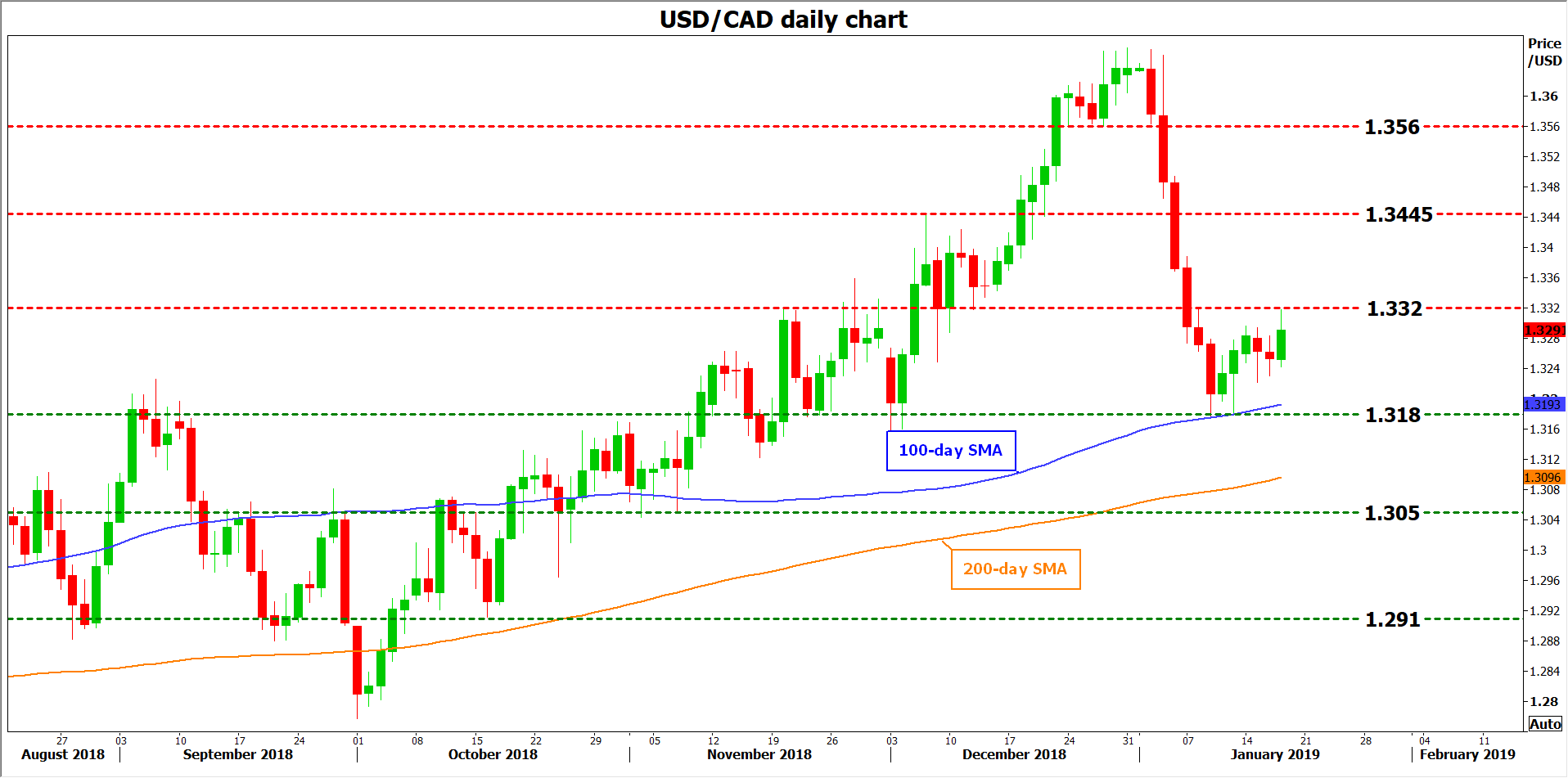
Turning to the market reaction, a stronger-than-expected data set could see the loonie extend its recent gains. Dollar/loonie could drop for a test of the 1.3180 zone, defined by the lows of January 9; the 100-day simple moving average (SMA) at 1.3186 is also part of this area. A downside break could open the way for the 200-day SMA at 1.3089, before the November 7 trough of 1.3050 comes into view.
On the other hand, a disappointment could see the pair break above the 1.3320 zone, marked by the highs of November 20, and potentially aim for a test of 1.3445, the peak of December 6.
EU Barnier open to more ambitious relationship with UK
UK Prime Minister May is working on an alternative Brexit deal to bring back to the EU. EU chief Brexit negotiator Michel Barnier said if UK wants a "more ambitious relationship, we are open". But he doesn't expect anything better than the current agreement.
Also, he said "if there is no deal, there will be contingency measures". But, he also emphasized "that will be very difficult and will not be done in a climate of confidence. The best guarantee is reaching an agreement."
How Much Money You Need to Start Trading on Forex
One of the most common complaints about Forex is the high barrier of entry. With a value of a standard lot being 10 000 USD, a lot of traders prefer to skip the market entirely. However, there is no legal minimum for day-trading Forex — unlike with stocks and most other commodities. In fact, you can start trading Forex completely for free.
On the other hand, it doesn’t mean that you should. There are lots of risks attached to the low-capital accounts, and they require a lot more skill to remain profitable. So let’s review the different Forex account types and see how much you really have to spend to start using each one.
You should never put into a single trade more than 1% of your starting capital.
Cent Account
Cent accounts have been made specifically for the traders with the low starting capitals. They “multiply” all investments by 100 and divide all the payouts by the same amount. At first glance, it seems like a gimmick, but that gimmick allows you to trade more freely and better calculate your strategy.
The Cent accounts are the cheapest among all the real-money accounts. They are also the only ones that allow you to trade without leverage from 100 USD — which becomes 10 000 USD, or the price of a complete Forex lot, as far as the trading terminal is concerned.
Of course, the profits will be rather small too. And not only due to the size of your trading capital but also because of the larger spreads on the Cent accounts. So, while it is technically possible to enter the Cent accounts with 10-20 USD, the best entry point would be around 100 USD.
Spread is the difference between the buying and the selling prices: the tighter the spreads, the more profit the Forex trader can make.
Practice Demo Account
It’s obvious that nobody likes loosing money. But what about those who are willing to try Forex trading as a side job, or an additional way to make money part-time. In addition to lack of experience, there are also lack knowledge of trading platform, for instance, such as MetaTrader 4.
The solution is invented already. Forex brokers have Demo accounts for beginners, where it has become real to trade with no investment. It’s a kind of a simulation with real conditions, existed markets, currencies, and real-time changes in the currency rates only with virtual money on it. Anyone can easily open practice Demo account simply by entering your email address, for instance, here.
Standard Account
Standard accounts are what they sound like. They provide the standard conditions for the traders and offer some advantages compared to the Cent accounts. The largest one is the tighter spreads — while the lowest spread on the Cent account is 0.3, the Standard accounts go down to 0.1 spreads on the major currency pairs.
While this might not seem much, consider that the most profitable trading strategy — scalping — requires you to close orders with only 0.5 pips of profit. Switching from the Cent account to the Standard account reduces the losses from 60% to 10% and allows scalpers to make twice as much profit.
On the downside, Standard accounts require larger investments. There is no multiplication, so you will need larger orders. The minimum deposit is 100 USD, but profitable trading with such low amounts will be rather hard. If that’s all you can afford to invest — you’d feel much better on a Cent account. For Standard, you should have at least 500 USD.
ECN Zero
ECN Zero is a special case — these accounts are created specifically for the scalpers and have 0 pips spreads. On the other hand, they carry a significant fee for each transaction and have a 500 USD minimum deposit.
ECN Zero accounts are meant for professional traders and aren’t recommended for the newcomers — even though they are more suitable for scalping, the risks and expenses are way too high. However, if your average order is 1000 USD or more, ECN Zero will provide you with better profit margins than any other account type.
Conclusion
It doesn’t actually matter how much money you have — you can start trading on Forex. And the best place to start is JustForex. Broker offers all account types, reliable analytics, and friendly support.
GER30 Stock Index En Route to Third Weekly Gain
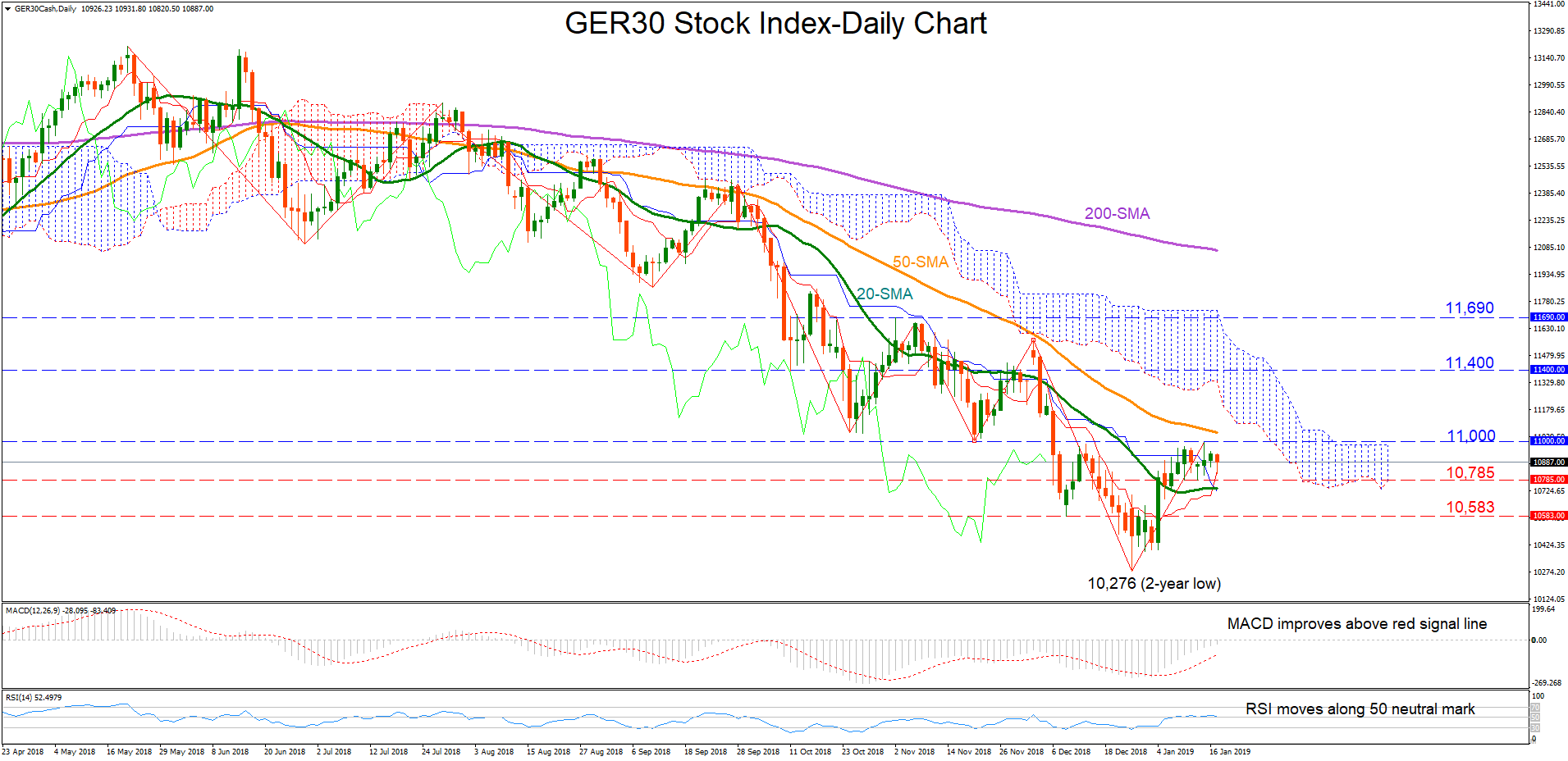
The German 30 stock index (DAX 30) has been on the rise since the day it dropped to a two-year low of 10,276 and is now set to register its third weekly gain slightly above the 20-day simple moving average. The short-term bias looks currently neutral to bullish as the RSI moves along the 50 line and the MACD keeps strengthening above its red signal line and towards zero.
On the upside, the bulls could push to break the 11,000 support-turned-resistance level which they failed to overcome earlier this week, while higher and above the 50-day MA, the index could test the 11,400 barrier, identified by the lows on October 11. Yet buying orders could only significantly increase if the market manages to surpass the 11,690 mark, violating the previous high of the eight-month old downtrend.
Should the index reverse south, immediate support could be found around 10,785 where the price paused recently. Under that obstacle, the trough on December 10 at 10,583 may attract attention before all eyes turn to the 10,276 bottom. Any step below the latter could trigger steeper declines, opening the way towards 10,000.
In the bigger picture, the index is trading increasingly bearish, printing lower highs and lower lows, with the falling 50-day MA erasing any hopes for a quick recovery.
Market Wrap: Stocks Slips Again , Safe Haven Jump
The Dollar index and the Japanese Yen are back in demand as stocks moves lower.
Stocks
- The S&P 500 Index dropped 0.3 percent as of 15:30 London time.
- The Stoxx Europe 600 Index fell 0.3 percent on the back of disaapointing economic data.
- The MSCI All-Country World Index dipped 0.1 percent, risk off theme remain intact
- The MSCI Emerging Market Index lost another 0.3 percent.
Currencies
- The Dollar Spot Index back in demand and jumped 0.05 percent to the highest in more than a week.
- The euro has gained due to the inflation number and jumped 0.45 percent to $1.1395, the strongest point in more than a week.
- The Japanese yen acting like a safe haven jumped 0.2 percent to 108.79 per dollar.
- The British pound looks strong after May’s victory and gained 0.2 percent to $1.2905, the highest in two months.
- The MSCI Emerging Markets Currency Index fell 0.3 percent to the lowest in more than a week
Bonds
- The yield on 10-year Treasuries eased off more than one basis point to 2.71 percent.
- Germany’s 10-year yield dropped one basis point to 0.22 percent.
- Britain’s 10-year yield fell one basis point to 1.301 percent.
- The spread of Italy’s 10-year bonds over Germany’s dropped two basis points to 2.508 percentage points to the narrowest in more than two weeks.
Commodities
- West Texas Intermediate crude is out of luck and dropped 2 percent to $51.28 a barrel.
- LME copper cant find demand and fell 0.4 percent to $5,947.50 per metric ton.
- Gold shockingly isn’t picking up the momentum either and fell 0.05 percent to $1,293.08 an ounce.
Sunset Market Commentary
Markets
Global core bonds lose ground today in a day characterized by a shaky risk sentiment. News that US prosecutors are advancing their investigation in China’s Huawei Technologies for allegedly stealing trade secrets weighed on investor sentiment this morning. European equities lost ground. In a day without any (EU) economic data important enough to guide investors, one would expect that the deteriorated sentiment supports core bonds. However, German Bunds are losing ground, pushing the German yield curve higher with changes in the range of +0.4 bps (30-yr) to +1.4 bps (5-yr). The support for sentiment yesterday by stronger than expected Q4 results (Goldman Sachs, BoA) was annulled today as first the Société Générale and later the Morgan Stanley result disappointed. Just before US openings, solid jobless claims and a strong Philly Fed Business Outlook reading positively surprised investors. The data triggered a fall in both German Bunds and US Treasuries. The US yield curve moved higher with the exception of the long-end of the curve. Changes vary between -0.2 bps (30-yr) to +1.9 bps (5-yr).
There was very little to report on USD trading today. The USD rebound from earlier this week stalled. The eco data were not able to steer USD trading. The US weekly jobless claims (213 k) and the Philly Fed outlook were OK (slightly better than expected), but didn’t help the dollar this time. Ongoing uncertainty on the impact of the government shutdown on growth might be in play. Swings on interest rate markets were also too small to inspire any directional price action in in the major USD cross rates. EUR/USD set a minor correction low for the week, but soon returned to the 1.14 area. Is this an indication that the EUR/USD correction has run its course? USD/JPY is little changed in the 108.85 area.
Sterling extended its recent rebound today. UK PM May started talks with MP’s which she hopes might lead to a new brexit proposal that will be presented in Parliament early next week. However, with Labour leader Jeremy Corbyn boycotting the talks, a break-through anytime soon is unlikely. Still, part of the market thinks that chances are rising for a delay of Brexit, for a new referendum or even for no Brexit at all. This is all about (perceived) probabilities. However, for now it is enough for investors to (gradually) reduce sterling shorts or even to consider some guarded sterling long exposure. As we don’t expect this brexit process to go really smooth in the coming days, we stay cautions on sterling long exposure. That said, avoiding the worst case scenario of a hard Brexit at this stage by some investors is seen enough a reason turn a bit more optimistic (or is it less negative?) sterling. EUR/GBP declined to currently trade in the 0.8825 area. Cable returned to the 1.29 area.
News Headlines
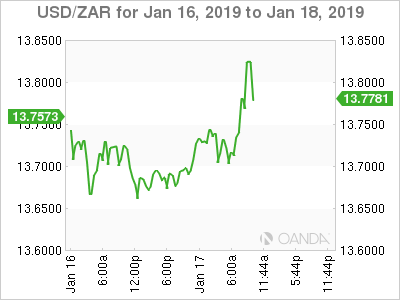
The South African central bank kept rates unchanged at 7.5% today. The bank cut inflation expectations as oil prices dropped and a stronger currency but warned risks remain to the upside. Growth for 2019 was revised downwardly to 1.7% (from 1.9%) as weak consumer and business confidence weigh. The rand loses almost 1% vs. the dollar.
US data beat consensus with jobless claims falling 3k (to 213k) while an increase to 220k was expected). The Philly Fed business outlook (January) recovered from 9.1 to 17.0 vs. 9.5 anticipated. New orders picked up but the employment component fell to the lowest since September 2017. General business conditions in six months from now are expected to improve further after the indicator slipped in November last year to the lowest since April 2016.
The Hungarian forint rallied for a second straight day as markets anticipate monetary tightening by the central bank soon. The bank’s deputy governor flagged the start of normalization on Wednesday if core inflation reaches 3%. The gauge had already risen to 2.9% in December, fuelled by consumption and strong wage growth.
USD/JPY Mid-Day Outlook
Daily Pivots: (S1) 108.58; (P) 108.89; (R1) 109.41; More...
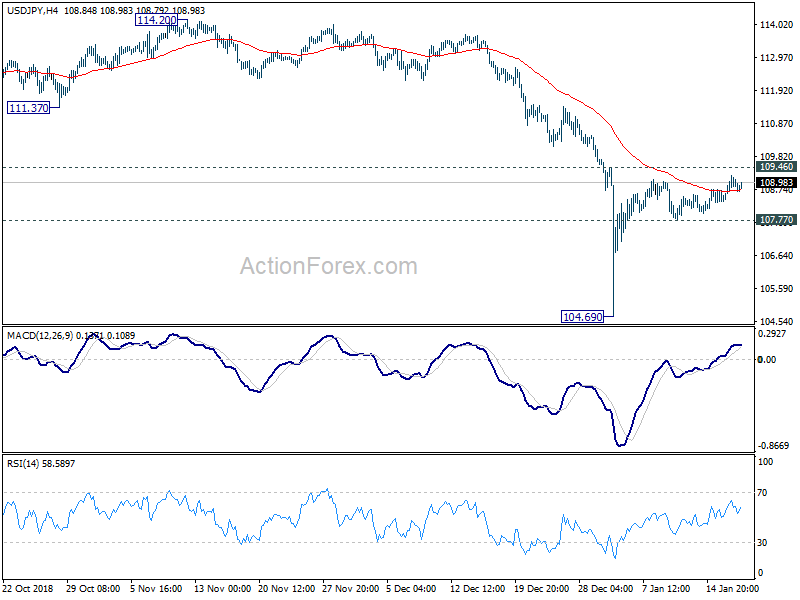
No change in USD/JPY's outlook. Rebound from 104.69 short term bottom might extend higher. But we'd still expect upside to be limited by 109.46 resistance to complete the rebound from 104.69 short term bottom. On the downside, below 107.77 will turn bias to the downside for retesting 104.69 low. However, sustained break of 109.46 will dampen our view and bring stronger rebound instead.
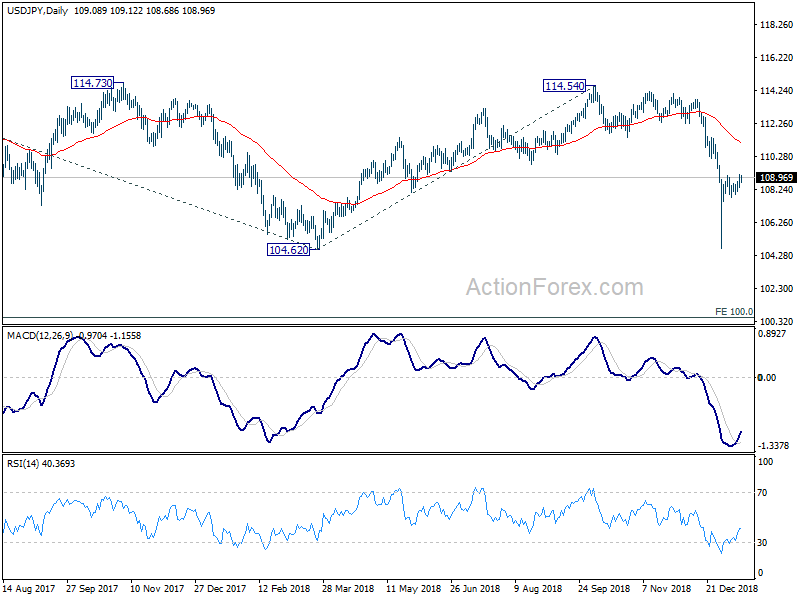
In the bigger picture, price actions from 125.85 (2015 high) are seen as a long term corrective pattern, no change in this view. Apparently, such corrective pattern is not completed yet. Fall from 114.54 is seen as part of the falling leg from 118.65 (2016 high). Break of 104.62 will target 100% projection of 118.65 to 104.62 from 114.54 at 100.51, which is close to 100 psychological level. But in that case, we'd expect strong support from 98.97 to contain downside to bring reversal. Also, this bearish case will remain the preferred one as long as 114.54 resistance holds.
USD/CHF Mid-Day Outlook
Daily Pivots: (S1) 0.9880; (P) 0.9896; (R1) 0.9919; More....
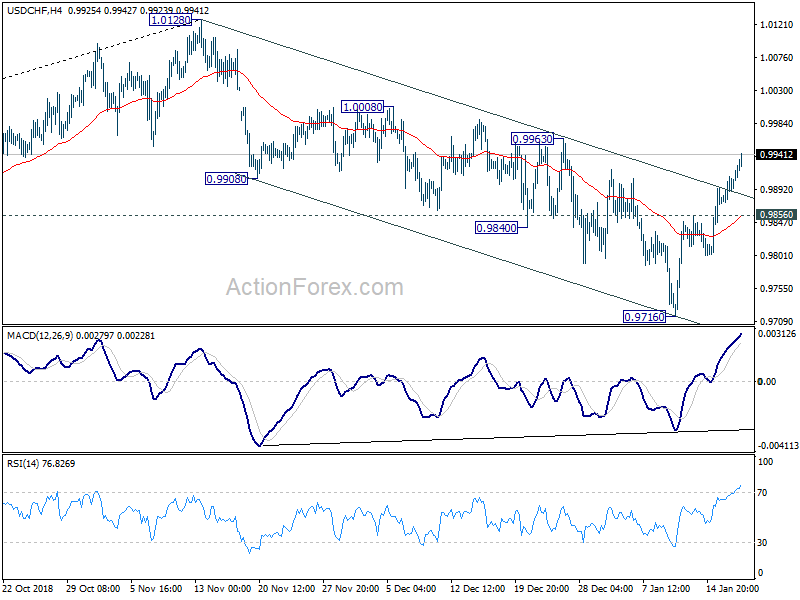
USD/CHF's rebound from 0.9716 extends to as high as 0.9941 so far. Intraday bias remains on the upside for 0.9963 resistance. Break there should confirm completion of corrective fall from 1.0128 to 0.9716. Further rise should then be seen to retest 1.0128. However, break of 0.9856 minor support will turn bias back to the downside for 0.9716 low.
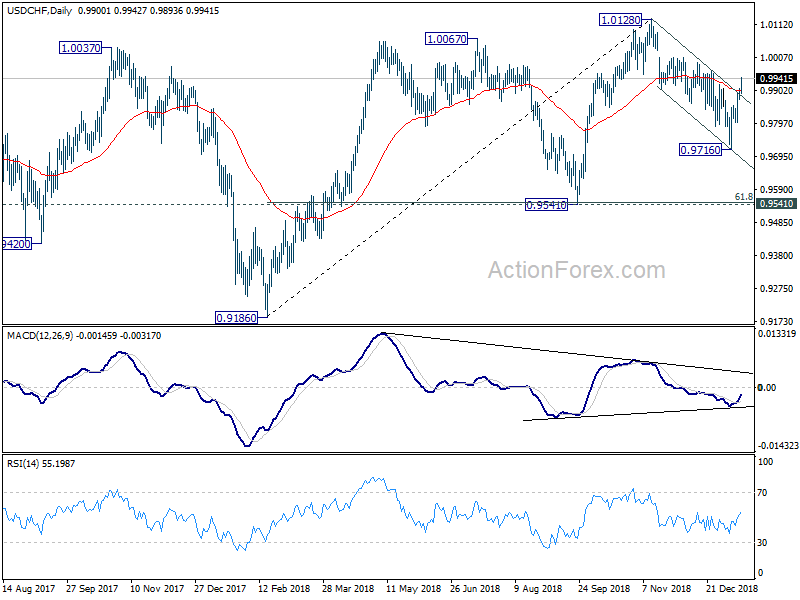
In the bigger picture, current development suggests that rise from 0.9186 has possibly completed with three waves up to 1.0128 already. Decline from 1.0128 could either be correcting this move, or reversing the trend. As long as 0.9541 support holds, we'd slightly favor the former scenario, and expect another rise through 1.0128 at a later stage. However, sustained break of 0.9541 will confirm trend reversal and bring deeper fall back to 0.9186 low.
EUR/USD Mid-Day Outlook
Daily Pivots: (S1) 1.1372; (P) 1.1398; (R1) 1.1419; More.....
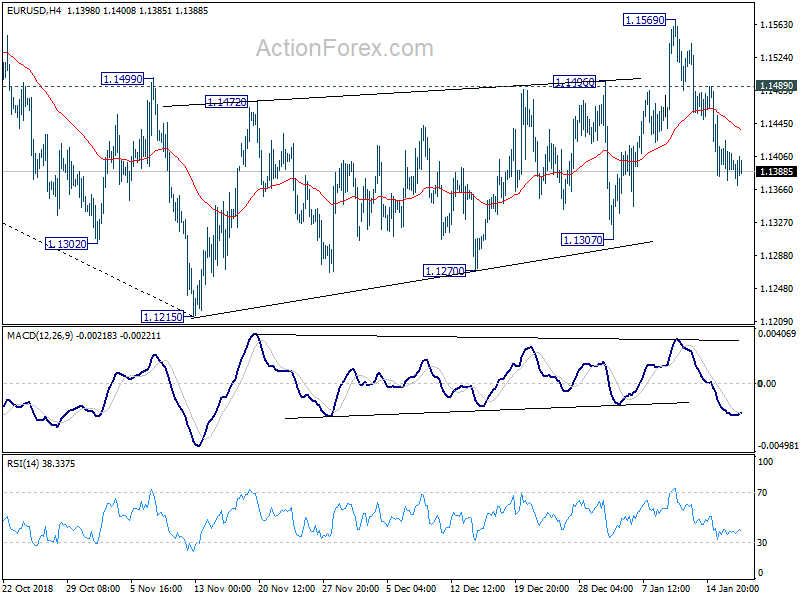
EUR/USD is losing some downside momentum as seen in 4 hour MACD. But further decline is expected as long as 1.1489 minor resistance holds. We're holding on to the case that corrective rise from 1.1215 has completed earlier than expected at 1.1569. Deeper fall should be seen to 1.1307 support. Break there will likely resume larger down trend from 1.2555 through 1.1215 low. On the upside, above 1.1489 minor resistance will turn bias back to the upside for 1.1569 instead.
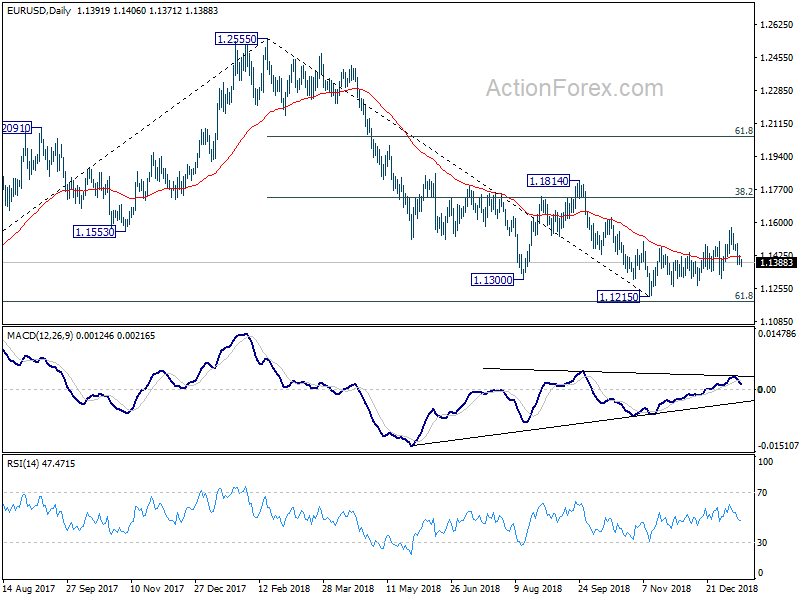
In the bigger picture, as long as 1.1814 resistance holds, down trend down trend from 1.2555 medium term top is still in progress and should target 61.8% retracement of 1.0339 (2017 low) to 1.2555 at 1.1186 next. Sustained break there will pave the way to retest 1.0339. However, break of 1.1814 will confirm completion of such down trend and turn medium term outlook bullish.
SARB Kept Interest Rates Unchanged
As expected, South Africa central bank kept rates unchanged at +6.75%.
- The decision to keep policy steady was unanimous.
- The MPC considers monetary policy to be moderately accommodative
- Overall risks to inflation remain tilted to the upside
- Economic challenges are structural, with access risks to be to the downside
- Policymakers cut its inflation forecasts, adding that inflation expectations have reduced since the previous monetary policy meeting
- SARB’s model shows implied rate path is for one +25 bps hike to +7.00% by end 2021 – prior the central bank model saw four-rate hikes of +25 bps by end 2020
- SARB does not automatically follow the Quarterly Projection Model (QPM), which is viewed as an ‘extra’ member of the MPC
USD/ZAR – The South African rand has fallen after the rate announcement. Prior to the release, many were expecting SARB to sound more ‘hawkish’ before the rate decision given the inflation increase in November. USD/ZAR has rallied to around $13.80, from $13.75 before the decision.