

Sample Category Title
USD/CHF Daily Outlook
Daily Pivots: (S1) 0.9880; (P) 0.9896; (R1) 0.9919; More....
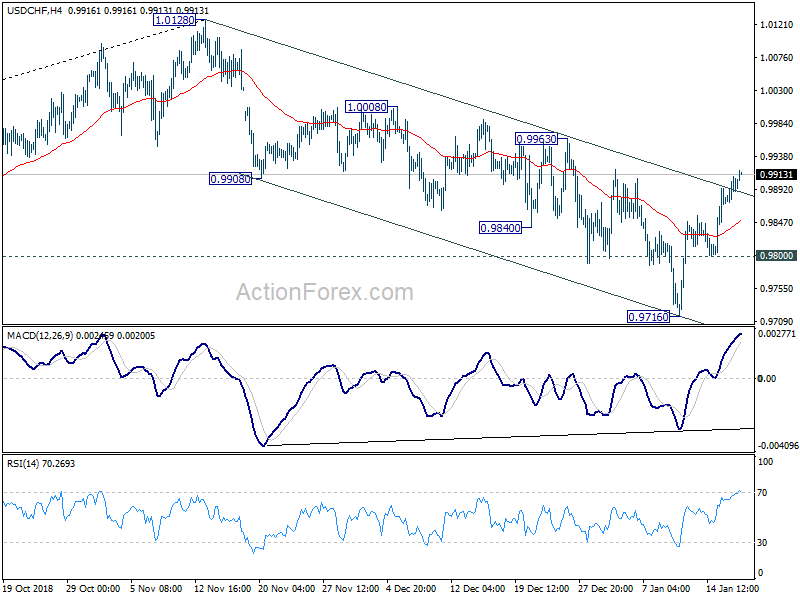
Intraday bias in USD/CHF remains cautiously on the upside for 0.9963 resistance. Break there should confirm completion of corrective fall from 1.0128 to 0.9716. Further rise should then be seen to retest 1.0128. However, break of 0.9800 minor support will turn bias back to the downside. Corrective fall from 1.0128 would extend through 0.9716 to 0.9541 cluster support (61.8% retracement of 0.9186 to 1.0128 at 0.9546) instead.
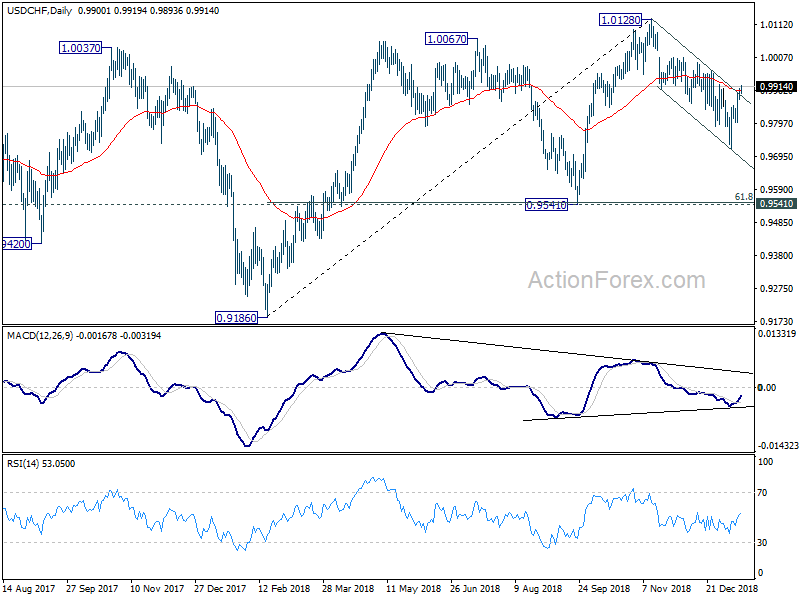
In the bigger picture, current development suggests that rise from 0.9186 has possibly completed with three waves up to 1.0128 already. Decline from 1.0128 could either be correcting this move, or reversing the trend. As long as 0.9541 support holds, we'd slightly favor the former scenario, and expect another rise through 1.0128 at a later stage. However, sustained break of 0.9541 will confirm trend reversal and bring deeper fall back to 0.9186 low.
Crude Oil: Oil Trading Lower In The Asian Session
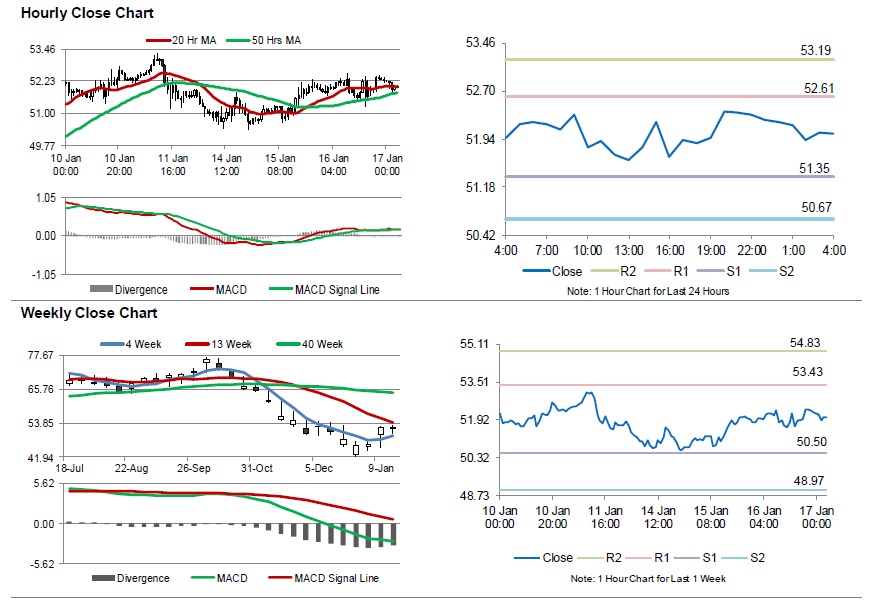
For the 24 hours to 23:00 GMT, Crude Oil rose 0.48% against the USD and closed at USD52.24 per barrel, amid OPEC supply cuts after the Energy Information Administration (EIA) report indicated that US crude oil stockpiles declined 2.7 million barrels to 437.0 million in the week ended 11 January 2019.
In the Asian session, at GMT0400, the pair is trading at 52.02, with oil trading 0.42% lower against the USD from yesterday’s close, as the US crude stockpiles grew more than expected.
The pair is expected to find support at 51.35, and a fall through could take it to the next support level of 50.67. The pair is expected to find its first resistance at 52.61, and a rise through could take it to the next resistance level of 53.19.
Crude oil is showing convergence with its 20 Hr moving average and trading above its 50 Hr moving average.
EUR/USD Daily Outlook
Daily Pivots: (S1) 1.1372; (P) 1.1398; (R1) 1.1419; More.....
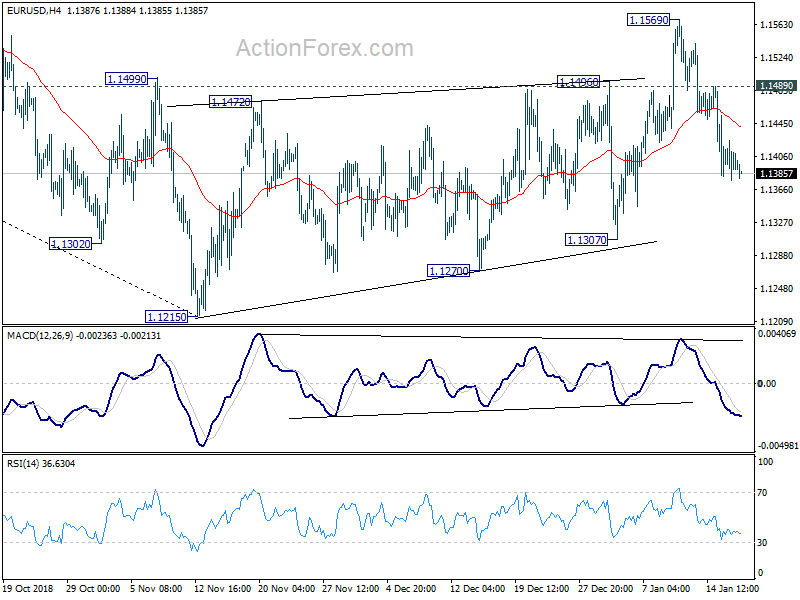
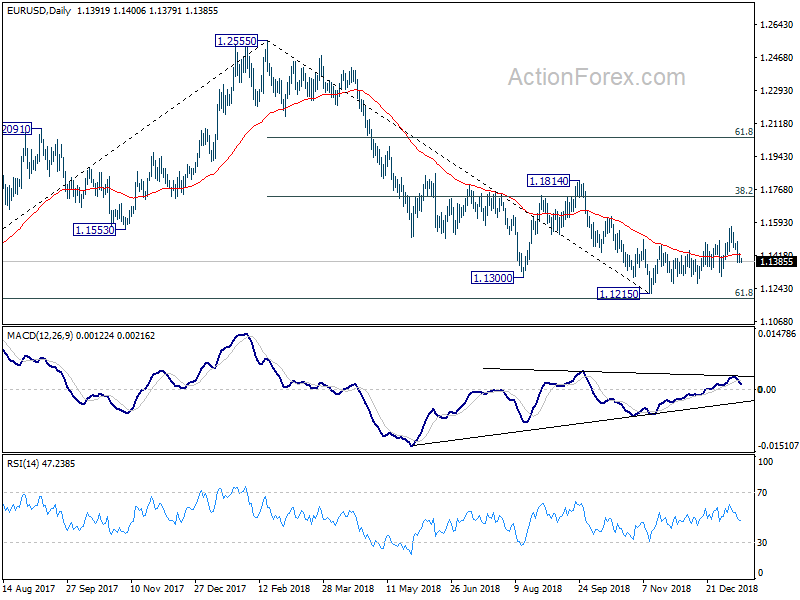
No change in EUR/USD's outlook. Corrective rise from 1.1215 has completed earlier than expected at 1.1569. Intraday bias stays on the downside for 1.1307 support. Break there will likely resume larger down trend from 1.2555 through 1.1215 low. On the upside, above 1.1489 minor resistance will turn bias back to the upside for 1.1569 instead.
In the bigger picture, as long as 1.1814 resistance holds, down trend down trend from 1.2555 medium term top is still in progress and should target 61.8% retracement of 1.0339 (2017 low) to 1.2555 at 1.1186 next. Sustained break there will pave the way to retest 1.0339. However, break of 1.1814 will confirm completion of such down trend and turn medium term outlook bullish.
GBP/USD Daily Outlook
Daily Pivots: (S1) 1.2836; (P) 1.2867; (R1) 1.2909; More....
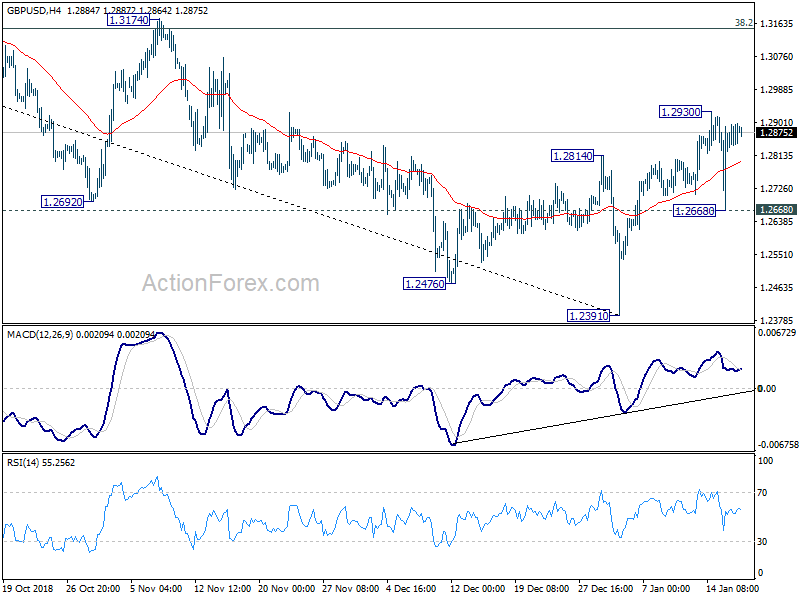
GBP/USD is staying in consolidation from 1.2930 and intraday bias remains neutral. Further rise is expected with 1.2668 minor support intact. On the upside, break of 1.2930 will extend the corrective rebound from 1.2391 to 1.3174 resistance, which is close to 38.2% retracement of 1.4376 to 1.2391 at 1.3149. We'd expect strong resistance from there to limit upside, at least on first attempt. On the downside, break of 1.2668 should now confirm completion of the rebound. In this case, intraday bias will be turned back to the downside for retesting 1.2391 low.
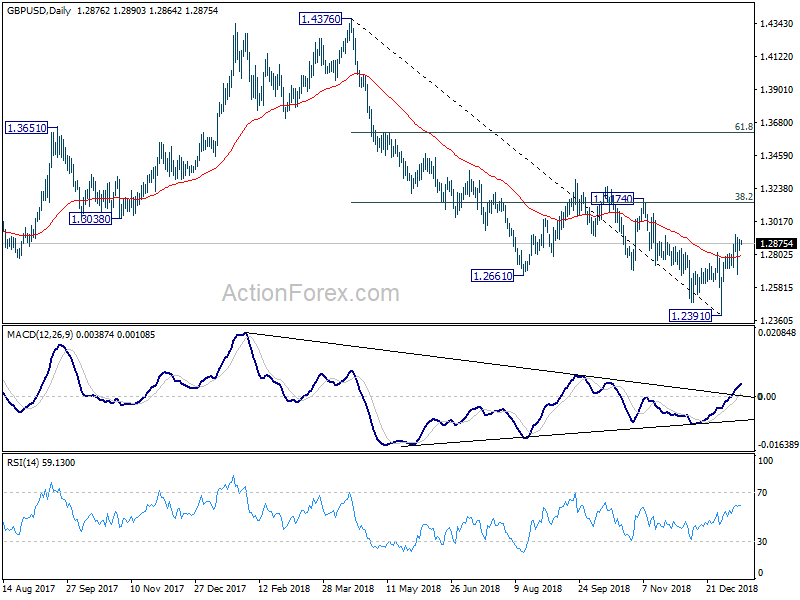
In the bigger picture, whole medium term rebound from 1.1946 (2016 low) should have completed at 1.4376 already, after rejection from 55 month EMA. The structure and momentum of the fall from 1.4376 argues that it's resuming long term down trend from 2.1161 (2007 high). And this will now remain the preferred case as long as 1.3174 structural resistance holds. GBP/USD should target a test on 1.1946 first. Decisive break there will confirm our bearish view. However, sustained break of 1.3174 will invalidate this case and turn outlook bullish.
Sterling Stays Firm after May Won Confidence Vote, Euro and Swiss Franc Turning Softer
Sterling is staying as the strongest one for the week after UK Prime Minister Theresa May narrowed survived the confidence vote in Commons. Though, there is no follow through buying against Dollar. Upside momentum in the Pound is also relatively weak against Euro and Yen. Traders would probably stay cautious until May tells us what's next on Monday.
Staying in the currency markets, Dollar and Yen are stronger today while Commodity currencies are generally. But fresh selling is seen in Euro and Swiss Franc as we enter into European session. Persistent worries over Eurozone slowdown, in particular in Germany and Franc, will weigh on Euro, which in turn drags down the Franc.
Technically, USD/CHF is sustaining well above near term falling channel, which carries bullishness implication. Focus will stay on 0.9963 resistance and break will confirm completion of corrective pull back from 1.0128. EUR/USD is on course to 1.1307 support. Break there will be an early sign of larger down trend resumption. USD/CAD is extending the consolidation from 1.3180 temporary low. But near term outlook will remain bearish as long as 1.3323 minor resistance holds. Similar, while AUD/USD is retreating, rebound from 0.6722 could still have another leg up as long as 0.7116 minor support holds.
In other markets, stocks markets in Asia are rather quiet. Nikkei is down -0.26%. Hong Kong HSI is up 0.07%. China Shanghai SSE is up 0.30%. Singapore Strait Times is down -0.21%. Japan 10-year JGB yield is down -0.0025 at 0.005, still positive. Overnight, DOW rose 0.59%. S&P 500 rose 0.22%. NASDAQ rose 0.15%. All three indices are now facing 55 day EMA resistance. 10-year yield rose 0.20 to 2.731 but 30-year yield rose just 0.006 to 3.077. Yield curve remain inverted from 1-year (2.579) to 2-year (2.545) to 3-year (2.525) and 5-year (2.542). But it's looking was better than just a few weeks ago.
UK PM May won confidence vote, to table way forward for Brexit next Monday
UK Prime Minister Theresa May won the confidence vote narrowly by 325-306 in the Commons, a day after her Brexit plan was rejected. Now, she has started meeting some party leaders to "find solutions that are negotiable and command sufficient support" from the House. May also plans to return to the House on Monday to "table an amendable motion and to make a statement about the way forward." And she reiterated the pledge to deliver Brexit.
However, there is no meeting with opposition Labour leader Jeremy Corbyn yet. Corbyn insisted that there will be not talks unless no-deal Brexit is ruled out. His spokesman said "Of course (Labour leader) Jeremy is prepared to meet the prime minister but if we're talking about substantive talks on how to resolve the crisis over Brexit ... then the starting point for that needs to be that no deal comes off the table."
Fed's Beige Book: Contacts had become less optimistic
According to Fed's Beige Book economic report, 8 of 12 districts reported modest to moderate growth in the period through January 7. Two districts reported flat or slight growth. Another two reported slower pace of growth.
The report noted that "outlooks generally remained positive, but many districts reported that contacts had become less optimistic in response to increased financial market volatility, rising short-term interest rates, falling energy prices and elevated trade and political uncertainty".
On prices, most Districts indicated that firms' input costs had risen due to :rising materials and freight prices". And, "a number of Districts said that higher tariffs were also a factor."
BoJ Kuroda: Japan is facing the most aged society in the world
In a keynote speech at the G20 symposium in Tokyo, BoJ Governor Haruhiko Kuroda said Japan is "facing the most aged society in the world." And he discussed the impacts of aging and declining population on macroeconomy, fiscal conditions and social security systems, and monetary policy and financial system.
On monetary policy market, Kuroda said "As a low interest rate environment persists and credit demands become stagnant amid declining population, banks might accelerate their search-for-yield activities such as expanding their exposures to overseas assets and increasing loans and investments to firms with higher credit risks. If that were the case, the entire financial system could become less stable."
On the data front
US RICS house price balance dropped to -19 in December, below expectation of -13. Australia home loans dropped -0.9% mom in November, better than expectation of -1.4% mom. Eurozone will release December CPI final. US will release Philly Fed survey and jobless claims. Housing starts and building permits will miss due to record government shutdown.
GBP/USD Daily Outlook
Daily Pivots: (S1) 1.2836; (P) 1.2867; (R1) 1.2909; More....
GBP/USD is staying in consolidation from 1.2930 and intraday bias remains neutral. Further rise is expected with 1.2668 minor support intact. On the upside, break of 1.2930 will extend the corrective rebound from 1.2391 to 1.3174 resistance, which is close to 38.2% retracement of 1.4376 to 1.2391 at 1.3149. We'd expect strong resistance from there to limit upside, at least on first attempt. On the downside, break of 1.2668 should now confirm completion of the rebound. In this case, intraday bias will be turned back to the downside for retesting 1.2391 low.
In the bigger picture, whole medium term rebound from 1.1946 (2016 low) should have completed at 1.4376 already, after rejection from 55 month EMA. The structure and momentum of the fall from 1.4376 argues that it's resuming long term down trend from 2.1161 (2007 high). And this will now remain the preferred case as long as 1.3174 structural resistance holds. GBP/USD should target a test on 1.1946 first. Decisive break there will confirm our bearish view. However, sustained break of 1.3174 will invalidate this case and turn outlook bullish.
Economic Indicators Update
| GMT | Ccy | Events | Actual | Forecast | Previous | Revised |
|---|---|---|---|---|---|---|
| 0:01 | GBP | RICS House Price Balance Dec | -19% | -13% | -11% | |
| 0:30 | AUD | Home Loans M/M Nov | -0.90% | -1.40% | 2.20% | 2.10% |
| 10:00 | EUR | Eurozone CPI M/M Dec | -0.20% | -0.20% | ||
| 10:00 | EUR | Eurozone CPI Y/Y Dec F | 1.90% | 1.90% | ||
| 10:00 | EUR | Eurozone CPI Core Y/Y Dec F | 1.00% | 1.00% | ||
| 13:30 | USD | Housing Starts Dec | 1256k | 1256k | ||
| 13:30 | USD | Building Permits Dec | 1300k | 1328k | ||
| 13:30 | USD | Initial Jobless Claims (JAN 12) | 218K | 216K | ||
| 13:30 | USD | Philadelphia Fed Business Outlook Jan | 10.1 | 9.4 | ||
| 15:30 | USD | Natural Gas Storage | -91B |
Into European session: Fresh selling in Swiss and Euro, Sterling firm as May’s position
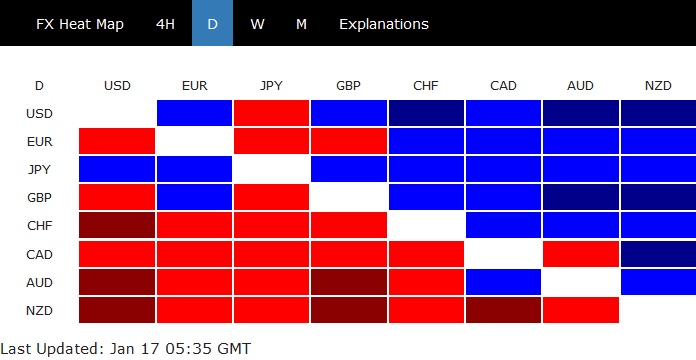
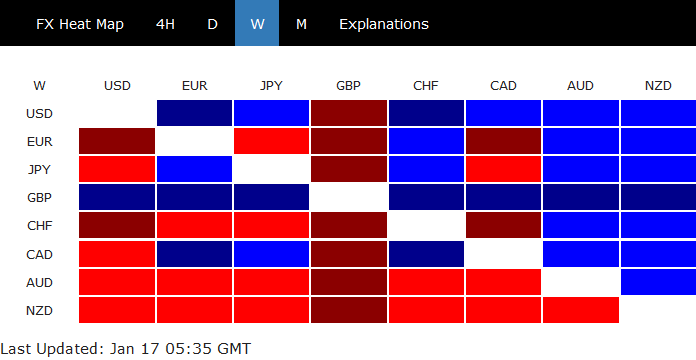
Dollar is trading generally higher together with Japanese Yen in Asian markets today. Sterling is also firm after UK Prime Minister Theresa May narrowly won the confidence vote in Commons. Commodity currencies are the weaker ones. But fresh selling is seen in Euro and Swiss Franc entering into European session. We won't be surprised to see Euro and Swissy overtake Aussie and Kiwi as weakest later in the day. Over the week, Sterling remains the strongest one. It's followed by Dollar and then Canadian. New Zealand and Australian Dollars are the weakest.
Stocks markets in Asia are rather quiet.
- Nikkei is down -0.26%.
- Hong Kong HSI is up 0.07%.
- China Shanghai SSE is up 0.30%.
- Singapore Strait Times is down -0.21%.
- Japan 10-year JGB yield is down -0.0025 at 0.005, still positive.
Overnight:
- DOW rose 0.59%.
- S&P 500 rose 0.22%.
- NASDAQ rose 0.15%.
- All three indices are now facing 55 day EMA resistance.
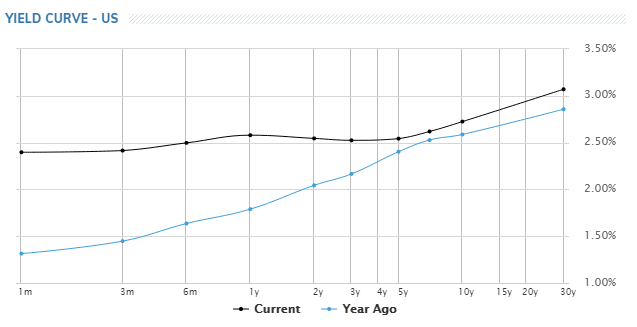
- 10-year yield rose 0.20 to 2.731 but 30-year yield rose just 0.006 to 3.077.
- Yield curve remain inverted from 1-year (2.579) to 2-year (2.545) to 3-year (2.525) and 5-year (2.542). But it's looking was better than just a few weeks ago.
CAD/JPY Starts Next Bullish Leg
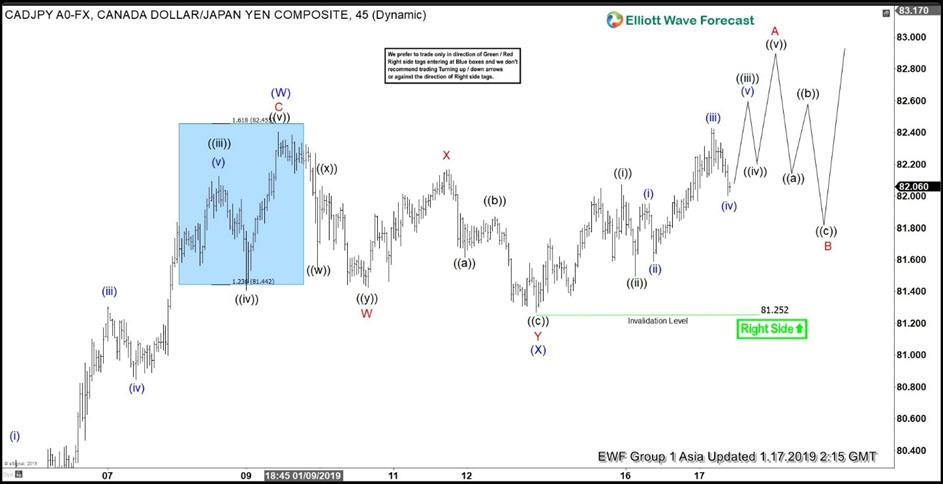
Short term Elliott Wave view on CADJPY suggests that the rally to 82.4 on Jan 9, 2019 ended wave (W). Pair then corrected in wave (X) as a double three Elliott Wave structure and the dip ended at 81.25. Down from 82.4, wave W ended at 81.42, wave X ended at 82.17, and wave Y of (X) ended at 81.25.
Since then pair has made a new high above wave (W) at 82.4 suggesting that the next leg higher in wave (Y) has started. The rally from 81.25 can unfold in various structures. We propose a 5 waves impulse Elliott Wave structure in the rally higher. Up from 81.25, wave ((i)) ended at 82.07 and wave ((ii)) ended at 81.5. Wave ((iii)) is in progress and should subdivide as another impulse of lesser degree. Two more highs in wave ((iii)) and wave ((v)) should happen before wave A ends.
Afterwards, it should pullback in wave B to correct the cycle from 1/14 low (81.25) before the next leg higher starts. As far as the pullback stays above 81.25, we expect pair to extend higher within wave (Y). Next potential target is 61.8 – 76.4 Fibonacci extension of (W)-(X) at 84.9 – 85.75.
CADJPY 1 Hour Elliott Wave Chart
Australia Housing Finance Dips on Investors, Smaller Loans
Owner-occupiers (no.) –0.9%mth, –7.9%yr (f/c –1.5%). Investors (value): –4.5%mth, –23.4%yr. Total ex own occ. refi (value): –2.9%mth, –16%yr
Housing finance approvals softened in November with weakness concentrated in investor loans and the value, as opposed to the number, of owner occupier loans.
The headline number of owner occupier loans held up a little better than expected in the month, recording a 0.9% decline vs consensus and Westpac forecasts of a 1.5% fall. Ex-refi, the number of approvals was down only 0.6%mth. Despite this slightly better than expected complexion to the latest month, weakness is still clear with the number of owner occupier approvals ex refi down 10%yr.
The detail points to weakening investor activity and shrinking average loan sizes as the main driver of weakness late last year – the latter likely reflecting reductions in borrowing capacity following a tightening in bank lending assessments. Notably, the six months to Nov saw a 5.8% drop in the value of owner occupier loans but just a 1.5% decline in the number of loans, the difference being the implied average loan size.
The value of investor loans dropped 4.5% in Nov to be down 23.4%yr to the lowest level since June 2013.
The combined total value of housing finance approvals including investors but excluding owner occupier refi, was down 2.9%, reversing the previous month's 2.9% rise to be down 16%yr.
Construction finance approvals declined 2.0% to be down 8.9%yr. Approvals for the purchase of newly built dwellings rose 3.4% but were coming off a 3yr low, down 18.7%yr.
The number of owner occupier loan approvals showed mixed moves across states, down in NSW (–1%mth) and Qld (–1.3%mth) but up in Vic (+1.9%mth), SA (+0.3%mth) and WA (+3%mth). All states have seen declines over the last 12mths with NSW, Vic and Qld recording the biggest falls, all around 10%yr. The aforementioned decline in average loan sizes over the last six months has been across all major states but more pronounced in NSW and Vic.
Australia's housing sector posted a weak finish to 2018 with auction clearance rates near historic lows and prices sliding into the close. While the finance data does not add much to this picture it suggests a further weakening in investor activity and tightening lending standards from banks were key drivers late in the year. Looking ahead, the holiday low season means there will be little or no reliable new information on housing until the market re-opens in mid-Feb.
BoJ Kuroda: Japan is facing the most aged society in the world
In a keynote speech at the G20 symposium in Tokyo, BoJ Governor Haruhiko Kuroda said Japan is "facing the most aged society in the world." And he discussed the impacts of aging and declining population on macroeconomy, fiscal conditions and social security systems, and monetary policy and financial system.
On monetary policy market, Kuroda said "As a low interest rate environment persists and credit demands become stagnant amid declining population, banks might accelerate their search-for-yield activities such as expanding their exposures to overseas assets and increasing loans and investments to firms with higher credit risks. If that were the case, the entire financial system could become less stable. "
Fed’s Beige Book: Contacts had become less optimistic
According to Fed's Beige Book economic report, 8 of 12 districts reported modest to moderate growth in the period through January 7. Two districts reported flat or slight growth. Another two reported slower pace of growth.
The report noted that "outlooks generally remained positive, but many districts reported that contacts had become less optimistic in response to increased financial market volatility, rising short-term interest rates, falling energy prices and elevated trade and political uncertainty".
On prices, most Districts indicated that firms' input costs had risen due to :rising materials and freight prices". And, "a number of Districts said that higher tariffs were also a factor."