Sample Category Title
Strategy Update: The Trade ‘Truce’, the Fed’s Possible Pause and May’s Brexit Woes
- Markets unconvinced by Trump-Xi trade rapprochement
- The Fed could slow rate hikes
- Market braces for Brexit turbulence as May struggles to convince Parliament
Markets unconvinced by Trump-Xi trade rapprochement
A major theme for global markets and the global economy is the uncertainty caused by the frictions between the United States and China. It was therefore an initially positive piece of news that the two countries would restart a new round of negotiations that would last for 90 days, that China would pledge to import more US products, and that the US would refrain from raising tariffs on 200 billion dollars’ worth of Chinese goods to 25% at the beginning of the 2019 from their current 10% level.
However, the initial optimism was quick to dissipate as even the announcements by the two sides seemed to be slightly at odds with each other. The gap separating US and China on trade issues, intellectual property, technology transfers and other non-trade barriers to investment is looking too large to bridge over dinner or indeed a 90-day period, according to experts.
So the question then becomes, is this truce the start of the de-escalation of the trade conflict or is it simply a buying of time during which the two sides gather forces for the next round? The second scenario looks a little more probable for now. While a compromise is in the short-term interest of both sides as well as the global economy, China and the US could also be beginning a long-term struggle about who will be the top global superpower in the decades ahead. Therefore this conflict could be less about some trade ‘misunderstandings’ and cultural differences and more about power politics.
Whatever the case, it seems that this trade conflict is going to be a key concern for a while longer, with important implications for global business confidence, investment and demand for commodities – particularly in China as well as the rest of Asia. Under the trade conflict scenario, woes about tariffs could be an extra headwind for a tired bull market for stocks. Furthermore, the dollar, the yen and maybe the Swiss franc stand to benefit as possible safe havens. It has been interesting that the traditional safe haven of the yen does not seem to be able to rally much against the dollar in the case of bad trade news in recent sessions, but the two currencies are able to outperform most other currencies in that case. The euro and commodity currencies – particularly the aussie and the kiwi, could suffer as they are more exposed to the global economy and global trade and thus stand to lose more.
The Fed could slow rate hikes
Monetary policy is never far from the market’s attention, as it is perhaps the single biggest factor that investors and traders like to focus on. Even when central banks have firmly pledged to keep policy constant for the foreseeable future – like the Bank of England or the Reserve Bank of Australia have done – their meetings and announcements can still be market-moving. But when the world’s most important central bank, the US Federal Reserve, hints that it might be readying a pause from its once-every-three-months’ quarter-point hikes, it is something that markets certainly sit up and take notice.
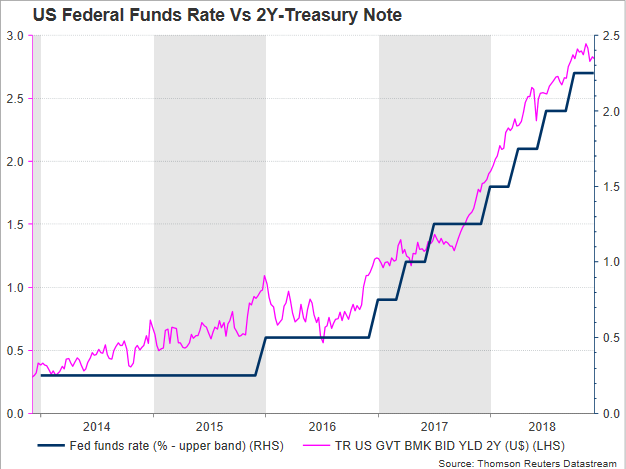
The Fed has been steadily increasing rates, albeit at a snail’s pace, since the end of 2015, taking its Fed Funds target to 2-2.25% from its low post-recession, near-zero target range of 0-0.25%. The view that is gaining in popularity however – as reflected by the 2-year US Treasury yield which is a measure of Fed rate hike expectations – is that the Fed has at most an extra 2 or 3 quarter-point hikes before it pauses to take stock.
Following a recent speech by Fed Chair Jerome Powell, the number of rate hikes expected for next year has dropped to just 1 – with an additional rate hike largely expected during the December 18-19 meeting in two weeks’ time. If the Fed ends its rate hike cycle sooner than expected, it could provide some support for risk assets while making it more difficult for the US dollar to continue to gain. This in turn could reduce the chances that the dollar will stage a meaningful breakout from its recent ranges against other majors – despite the fact that currencies such as the euro, the yen, the pound and the aussie, are unlikely to receive a boost from their respective central banks anytime soon.
To sum up, the Fed might become even more data-dependent the nearer rates come to the so-called ‘neutral rate’. Of course nobody knows what the neutral rate is with certainty, but some economists have suggested it lies between 2.75 and 4%. Therefore, unless inflation looks like getting out of hand, the Fed could be reluctant to push rates higher than say 2.75% for fear of hurting the economy. This in turn might take away some support from the dollar even though other major central banks are way behind the Fed in tightening policy.
Market braces for Brexit turbulence as May struggles to convince Parliament
As Prime Minister May struggles to have her Brexit deal approved by Parliament next, the story of Brexit continues to have many twists and turns which seem to defy predictions. It is not only May’s opponents and critics – both in her own coalition and the opposition – that have taken a negative view of the deal the UK reached with the EU, but the market is also pessimistic that the deal will get through Parliament. How else to explain the lack of enthusiasm for sterling and that pound/dollar just tested its August low, a break of which could lead to a fresh 20-month trough?
The market seems to have discounted a negative outcome from next week’s vote in Parliament but is reluctant to push sterling lower or indeed higher unless more clarity is achieved regarding the day after the vote. For example, the range of outcomes is particularly broad; from a repeat of the vote after a few days, to the collapse of the government and new General Elections to a ruling out of a no-deal Brexit and a fresh referendum with a number of options. If negative scenarios materialize such as a government collapse or a march towards a no-deal Brexit, there is still considerable downside for sterling, but more positive outcomes could lend some short-term support to the British currency. The market’s nervousness is evident as sterling jumps up or down with each new headline that comes out. Given that there are hard deadlines ahead however, such as the end of March, the next few weeks should bring some more clarity but for now the uncertainty is sizeable.
EUR/USD – Euro Quiet Ahead Of OPEC Meeting, U.S Job Data
EUR/USD is almost unchanged in the Thursday session. Currently, the pair is trading at 1.1337, down 0.07% on the day. On the release front, German Factory Orders posted a gain of 0.3%, beating the forecast of -0.4%. In the U.S, the spotlight will be on employment releases. ADP nonfarm payrolls is expected to drop to 195 thousand, down from 227 thousand a month earlier. The strength of the ADP release could provide a clue regarding the official NFP report on Friday, which is also expected to drop sharply. Unemployment claims spiked last week at 234 thousand, but are forecast to drop to 224 thousand. Later, the ISM Non-Manufacturing PMI is expected to dip to 59.1 points. Elsewhere, OPEC members are meeting in Vienna for a second straight day.
Friday also promises to be busy. Germany releases Industrial Production, and the eurozone will publish jobless claims and GDP. The U.S will release three key employment indicators – nonfarm payrolls, wage growth and the unemployment rate. The week wraps up with UoM consumer sentiment.
After a string of disappointing releases out of Germany, there was some good news on the manufacturing front. Factory orders posted a gain of 0.3% for a second straight month. This follows a lukewarm Manufacturing PMI release earlier in the week. Although the reading of 51.8 was within expectations, it marked a fourth monthly downturn and was the lowest reading since April 2016. The global trade war has taken a bite out of German exports and a slowdown in the eurozone economy has dampened manufacturing growth in Germany. On Friday, Germany releases industrial production, which is expected to edge up to 0.3%.
Now that there is a respite in the tariff war, can the U.S. and China narrow their differences in just a few weeks? There are a host of issues that need to be addressed, including repeated charges by the U.S. that China is engaged in theft of U.S. intellectual property. The markets have been very sensitive to the trade dispute, and the upcoming negotiations between the U.S. and China, with the likely ups-and-downs, promise to have a significant effect on the currency markets.
The ‘tariff truce’ between the U.S and China is welcome news after months of an escalating trade war, but the two super-economies remain far apart on a number of issues, including U.S. accusations that China has been stealing U.S. intellectual property. All indications are that reaching a deal will be difficult. The markets have been sensitive to development in the tariff tussle between the countries, and the likely ups-and-downs in the upcoming negotiations will likely affect the movement of gold prices in the coming weeks.
Into US session: Global rush to bonds as safe haven, AUD weakest and JPY strongest
Entering into US session, risk aversions remains the main theme of the day, and it's intensifying. At the time of writing, major European indices are down more than -2%. Also, German 10 year bund yields hit as low as 0.244, lowest since the one day spike low of 0.186 in June. If only daily close is considered, 10 year bund yield is at lowest since April 2017.
Some attributed stocks selloff to arrest of Chinese tech giant Huawei's CFO in Canada, on request by the US. There are worries that such act could jeopardize US-China trade truce. But we'd like to point out that the lift from the trade truce at the early part of the week was rather limited. And because stocks still dropped sharply on Tuesday with dovish turn in Fed Chair Jerome Powell and trade war ceasefire, there must be some deeper lying problem, like worry on slowdown. Such problems are reflected in massive flows from stocks to bonds, as seen globally, even in Japan. We're holding to to this view for now.
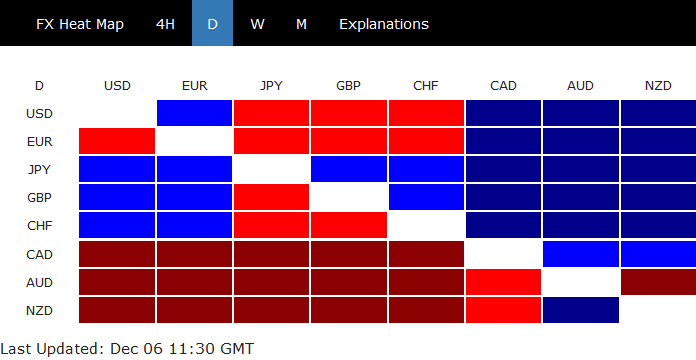
Anyway, in the currency markets, Australian Dollar, New Zealand Dollar and Canadian Dollar are the weakest ones without surprise. CAD is under renewed pressure as oil price dives on dim hope of any breakthrough in OPEC on production. Yen is clearly the stronger one. But Dollar, Euro, Sterling and Swiss Franc are in ties. In particular, Sterling is rather resilient as traders just don't know what do to with it. We're as confused as the British, their MPs and even Theresa May. Will there be a Brexit deal after parliamentary vote next Tuesday? Or no-deal? Or no Brexit at all? Or the vote would be postponed?
In European markets, at the time of writing:
- FTSE is down -2.36%
- DAX is down -2.30%
- CAC is down -2.14%
- German 10 year yield is down -0.027 at 0.250
- Italian 10 year yield is up 0.065 at 3.126. German-Italian spread remains below 300. It's not their problem this time.
Earlier in Asia:
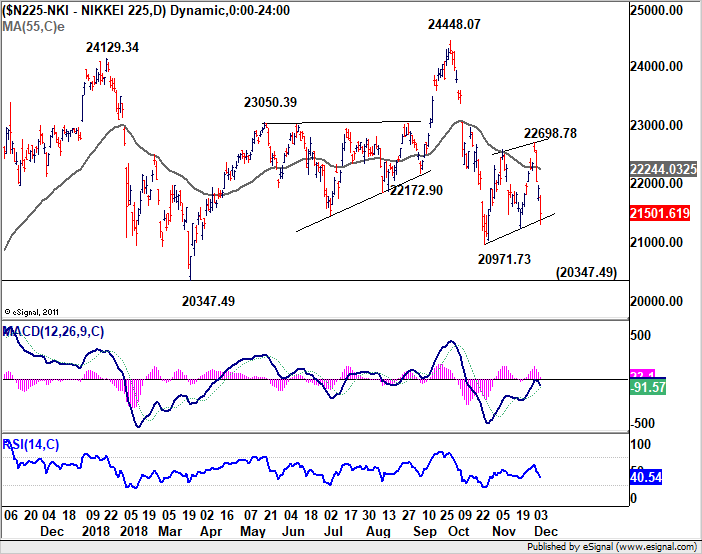
- Nikkei dropped -1.91% to 21501.62
- Hong Kong HSI dropped -2.47% to 26156.38
- China Shanghai SSE dropped -1.68% to 2605.18
- Singapore Strait Times dropped -1.28% to 3115.52
- Japan 10 year JGB yield dropped -0.0197 to 0.05, lowest close since July.
Bearishness in Nikkei has built up rather quickly in a matter of days. It now looks like the consolidation from 20971.73 has completed with three waves up to 22698.78. And, fall from 24448.07 is ready to resume any time to 20347.49 key support.
Microsoft Posts Steeper Declines, Neutral In Short Term
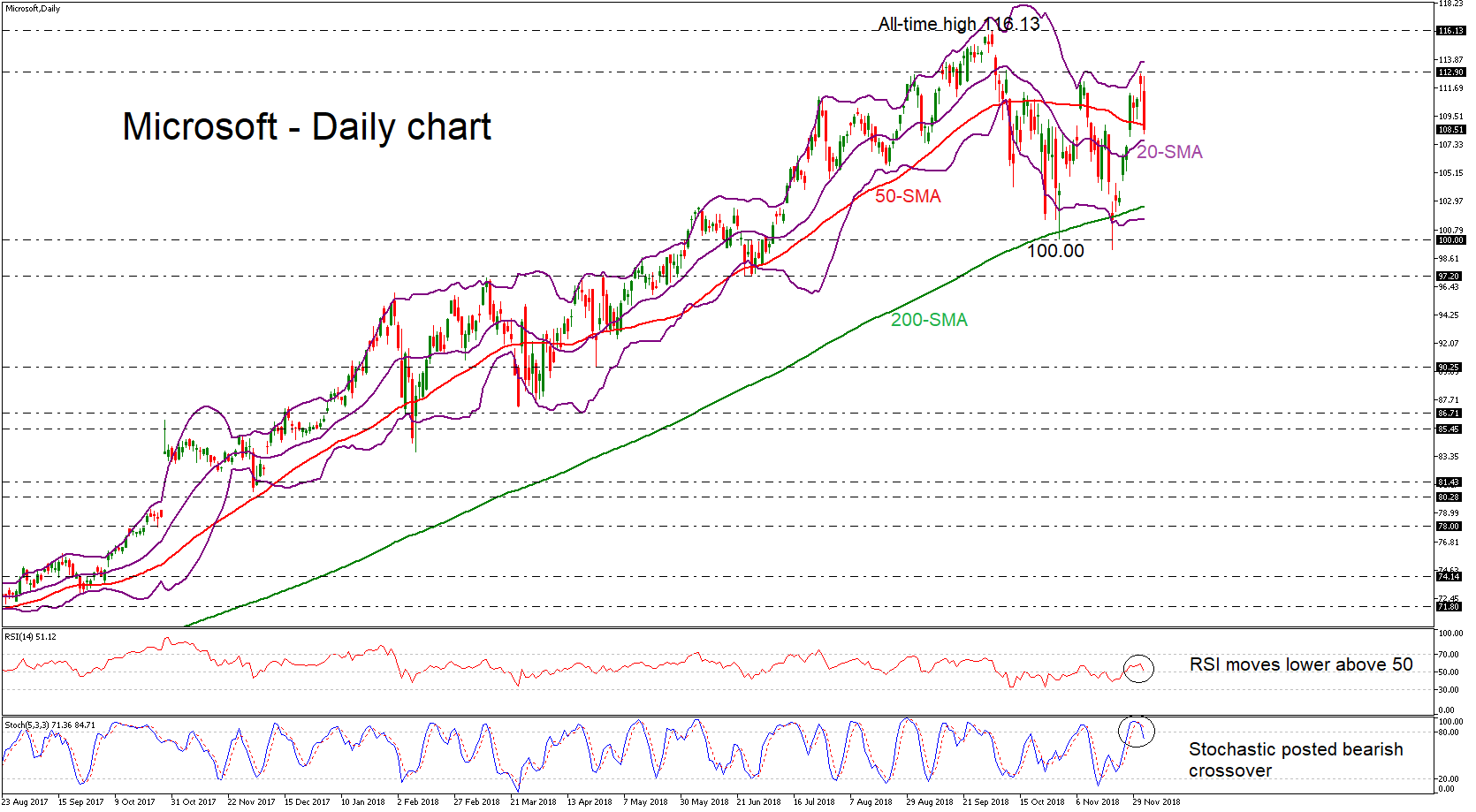
Microsoft stock price moved lower on Tuesday, hitting the 50-day simple moving average, after finding resistance on the 112.90 hurdle. Looking at the momentum indicators, the RSI is edging lower, slightly above its neutral threshold of 50, while the stochastic is falling and created a bearish crossover within the %K and %D lines in the overbought zone, signaling further losses.
In the event of further negative pressures, the market could meet immediate support at the mid-level of the Bollinger Band around 107.62 at the time of writing before slipping until the 200-day SMA and the lower Bollinger Band near 102.00. If the market faces steeper declines, the stock could touch the 100.00 strong psychological level.
On the other side, a move to the upside could find resistance at the 112.90 obstacle, which stands slighlty below the upper Bollinger Band. A rally and a violation above this barrier could increase chances for more advances towards the all-time high of 116.13 barrier, reached on October 3.
To conclude, Microsoft stock switched the bullish tendency to a more neutral one in the short-term after the drop until the 100.00 handle and the consolidation within the bands of the Bollinger.
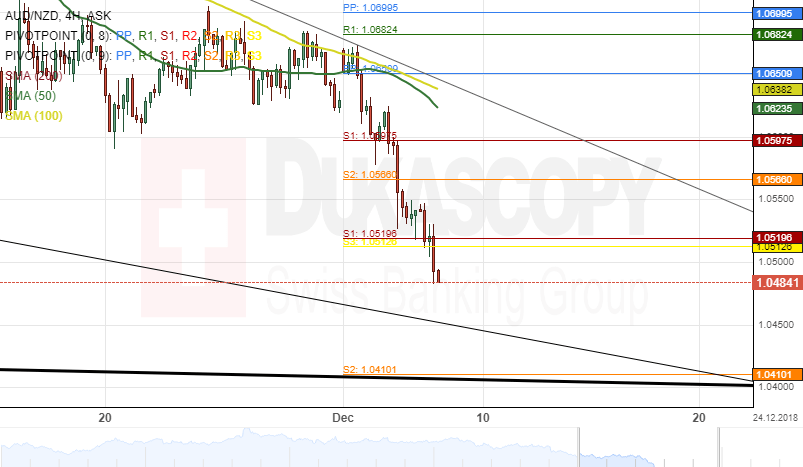
AUD/NZD 4H Chart: Pressure By 50– And 100-Hour SMAs
The AUD/NZD currency pair has been tended south since the middle of August when it made a U-turn from the upper boundary a dominant descending channel pattern at 1.1150.
The general direction is expected to remain south within the scope of the following week. Two important levels to watch out for are the lower boundary of a four-month descending channel at 1.0410 and the monthly S2 at 1.0230.
Furthermore, technical indicators suggest that this decline might not happen immediately, as some upside pressure is likely to push the currency exchange rate towards a resistance level at 1.0630.
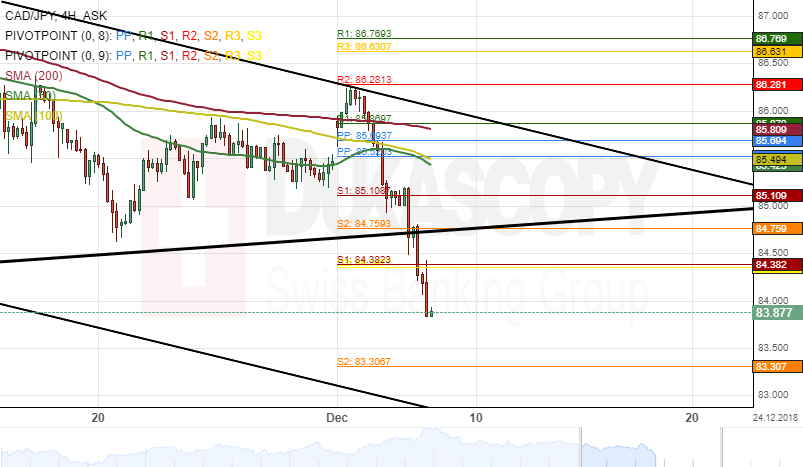
CAD/JPY 4H Chart: Pair Likely To Hits 83.50
The Canadian Dollar began to depreciate against the Japanese Yen after hitting the upper boundary of a dominant ascending channel pattern at 89.15 on October 3. During this two months of decline, the currency pair plunged by about 5.71%.
During the Asian session on Thursday, the exchange rate broke the dominant ascending channel at 84.75.
Given that a breakout had occurred, it is likely that the CAD/JPY currency exchange rate will continue to fall during the following week. The potential levels to look for will be at August 13 swing low of 83.50 and June 25 swing low of 81.99.
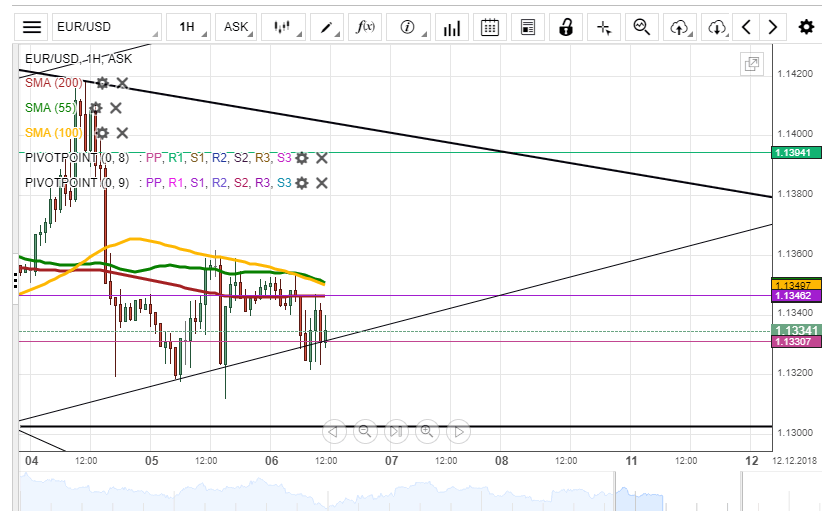
EUR/USD Trades Below Weekly PP
During Wednesday's trading session, the currency exchange rate was resisted by the 100-hour SMA to end the trading session at 1.1344. On Thursday morning, the European Single Currency was resisted by the 200-hour SMA to trade at 1.1324.
In regards to the near-term future, most likely, the European Single Currency will keep trading downside to reach the bottom boundary of the medium horizontal pattern at the 1.1300 level.
On the other hand, today's US ISM Non-Manufacturing PMI at 15:00 GMT could break the predictions for the currency pair. The fundamental event could push the rate to break the weekly PP and the monthly PP to trade at the 1.1360 level.
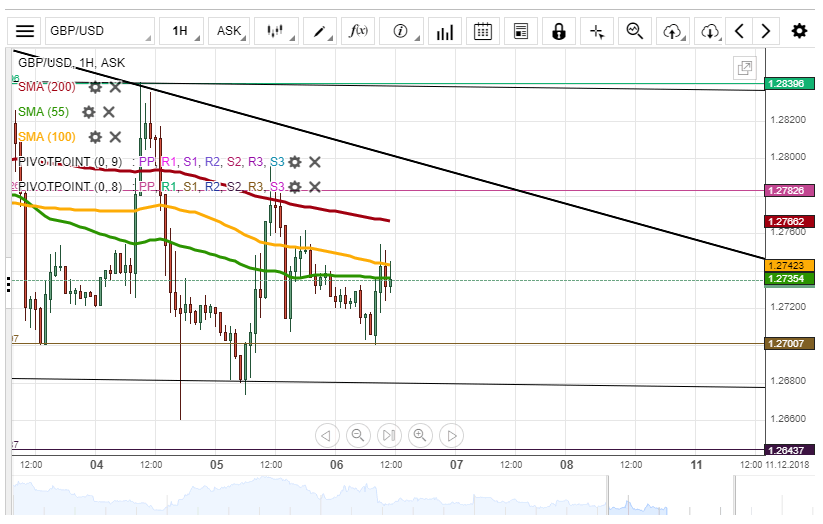
GBP/USD Is Supported By S1 At 1.2700
During Wednesday's trading session, the currency exchange rate passed through the SMA's to end the trading session at the 1.2719 mark. During Thursday's morning hours, the British Pound was trading near the weekly S1 at 1.2729.
In regards to the near-term future, most likely, the currency exchange rate will keep the trade downwards due to the resistance of the simple moving average. Besides, it is expected that the currency exchange rate will pass through the support of the weekly S1 at 1.2700 to trade below the bottom boundary of the previously drawn pattern at the 1.2680 mark.
However, during today's US fundamental events, the British Pound could appreciate against the US Dollar to trade at the 1.2740 level.
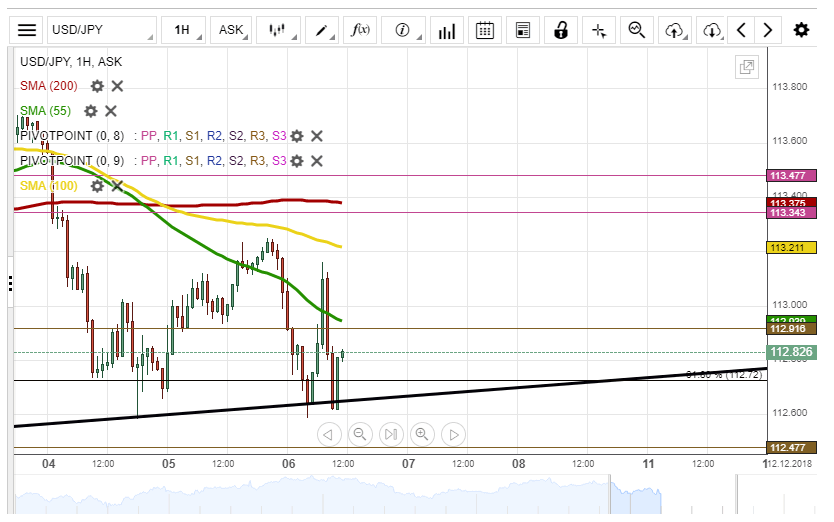
USD/JPY Is Supported By Large Pattern Line
During Wednesday's trading session, the rate was supported by the large pattern line at the 112.60 level. During Thursday's morning hours, the US Dollar was trading between the weekly S1 and the 61.80% Fibo to stay at the 112.82 mark.
In regards to the near-term future, most likely, the US Dollar will be supported by the bottom boundary of the ascending large pattern at the 112.60 level. However, the 55-hour SMA will try to resist the rate to push it to trade downside towards the monthly S1 at the 112.47 mark.
On the other hand, during today's US fundamental events, the US Dollar could appreciate against the Japanese Yen to trade at the 113.00 level
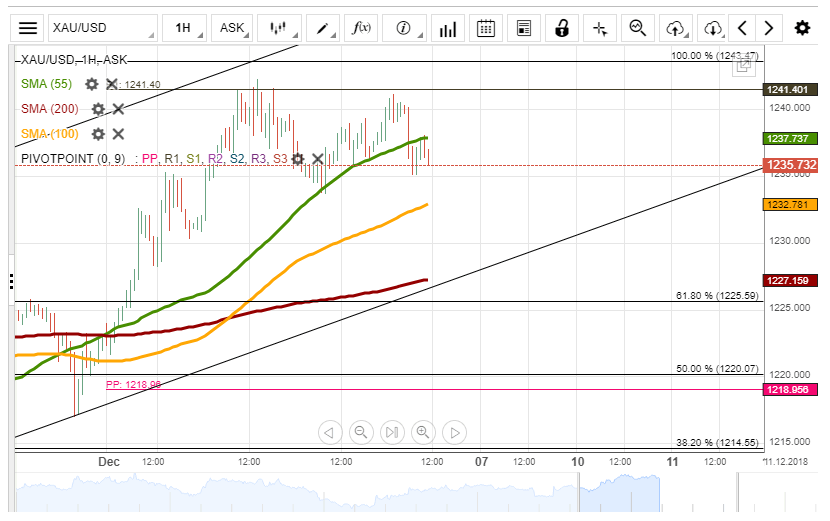
XAU/USD Trades At 1,235.00
During Wednesday's trading session, the yellow metal almost met the monthly R1 at the 1,241.40 level to end the trading session at the 1,237.49 mark. During Thursday's morning hours, the yellow metal passed through the support of the 55-hour simple moving average to trade at the 1,237.00 level.
In regards to the near-term future, the yellow metal will be retraced by the 55-hour simple moving average on Thursday. Moreover, it is expected that the gold could trade sideways to stay at 1,230.00 level during the trading session.
On the other side, during today's US fundamentals, the gold could appreciate against the US Dollar to break the resistance of the monthly R1 at 1,241.40 mark.