

Sample Category Title
GBP/USD Mid-Day Outlook
Daily Pivots: (S1) 1.2670; (P) 1.2735; (R1) 1.2797; More...
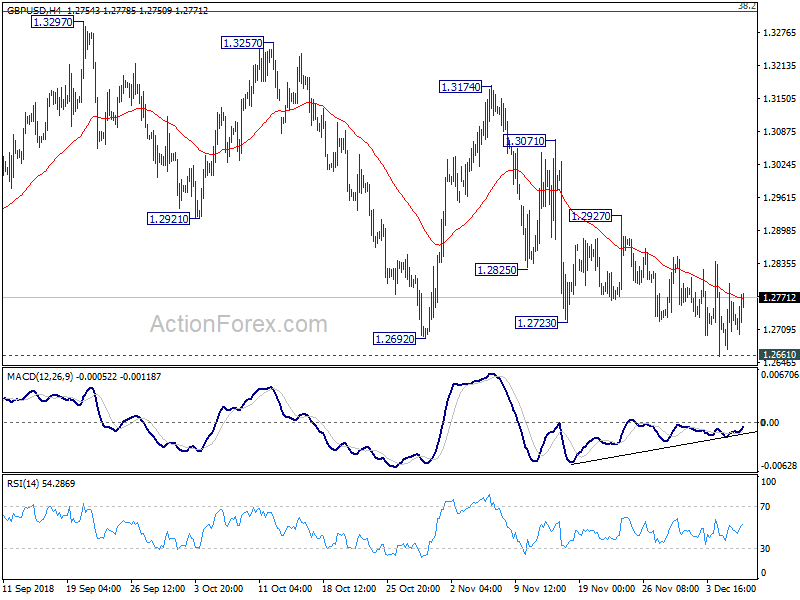
GBP/USD is staying in tight range for now and intraday bias remains neutral first. On the downside, sustained break of 1.2661 low will resume larger down trend from 1.4376. Next target will be 1.1946. On the upside, break of 1.2927 will extend the consolidation from 1.26661 with another rise. But even in case of strong rebound, upside should be limited by 1.3316 fibonacci level to bring down trend resumption eventually.
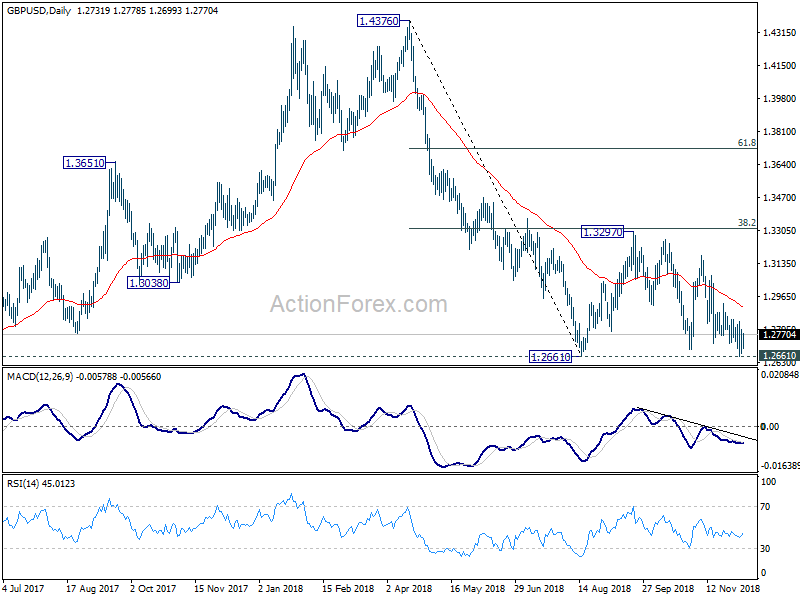
In the bigger picture, whole medium term rebound from 1.1946 (2016 low) should have completed at 1.4376 already, after rejection from 55 month EMA. The structure and momentum of the fall from 1.4376 argues that it's resuming long term down trend. And this will be the preferred case as long as 38.2% retracement of 1.4376 to 1.2661 at 1.3316 holds. However, firm break of 1.3316 would bring stronger rebound to 61.8% retracement at 1.3721. And, the eventual depth of the fall from 1.4376, and the chance of hitting 1.1946 low, will depend on the strength of the interim corrective rebound from 1.2661.
As UK Parliament Descends into Chaos, Pound Finds Support from Rising Chances of No Brexit
The completion of the Withdrawal Agreement between UK and EU negotiators was meant to signal the end of months of uncertainty, quell fears of a no-deal Brexit, and set the groundwork for talks on future relations. However, Prime Minister Theresa May’s hard-fought deal has come under heavy attack from all sides of the political spectrum in the UK, with Westminster descending into chaos amid a fractious parliament. The endless Brexit headlines have generated a lot of choppy trading for the pound. But the British currency appears to have, for the moment at least, found a floor around $1.2650, as a range of scenarios, including a reversal of Brexit, are still in play.
British MPs began five days of debate on the Brexit deal on Tuesday but the first day proved disastrous for the prime minister. Lawmakers forced the government to publish the full legal advice on the Withdrawal Agreement after resisting demands to do so. In a major humiliation for May, the government was found to be in contempt of Parliament for the first time in decades for refusing to publish the full legal advice. In a further setback, MPs voted in favour of giving Parliament a say on what happens next should May’s deal get rejected.
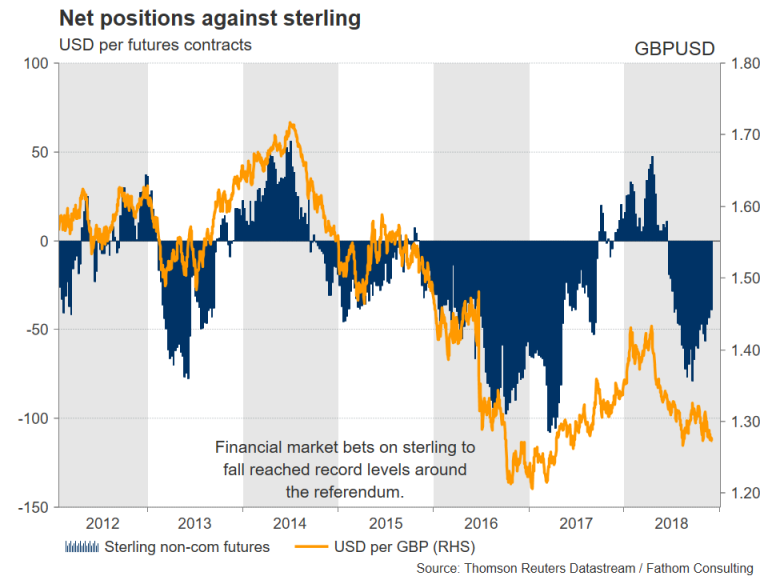
The latter has significantly reduced the odds of Britain crashing out of the European Union without a deal as Parliament is unlikely to allow the government to go ahead with its threat of a no-deal Brexit if MPs don’t back May’s plan. That prospect is possibly why the pound didn’t tumble much more sharply after the government’s defeats and found support just above the $1.2650 level, not too far from the August trough. The recent lows, while some distance below the 2018 high of $1.4376, are still significantly above the levels burrowed in 2016 and early 2017 when sterling dipped below $1.20 a couple of times as uncertainty about Brexit hit a peak. This suggests the markets see a reduced chance of a ‘hard’ Brexit even if the deal is voted down by the House of Commons.
One of the alternative options being talked about for a plan B is membership of the European Free Trade Association (EFTA), which would keep the UK inside the single market, hence, avoiding the need altogether for a backstop for the Northern Irish border issue. The backstop problem is being cited as the main reason why MPs are so opposed to May’s deal as it could keep the UK trapped inside the EU’s customs union for years after Brexit, if not indefinitely, if the British government cannot come up with a viable solution of maintaining no hard border that satisfies the EU’s concerns.
However, one potential flaw of joining EFTA is that the UK would be unable to end free movement of people, and therefore could struggle to win support from Brexiteers. A bigger threat though for Brexiteers from Parliament being able to instruct the government what to do in the event the deal doesn’t get passed is the possibility that MPs could force through a second referendum on EU membership. Remainers have long argued that the British public should get to decide on any final Brexit deal and be able to opt to stay in the EU if they don’t like what’s being put on the table.
Adding to the growing speculation that Brexit may not even happen is the expected ruling of the European Court of Justice (ECJ) that the United Kingdom can unilaterally revoke Article 50. On Tuesday, the advocate general of the ECJ issued an opinion on the case brought by Scottish lawmakers, saying that the UK does not need the permission of other EU member states to cancel Article 50, which triggers the withdrawal process. Although the opinion is non-binding, the ECJ judges usually follow the advocate general’s advice and the final ruling should come within days.
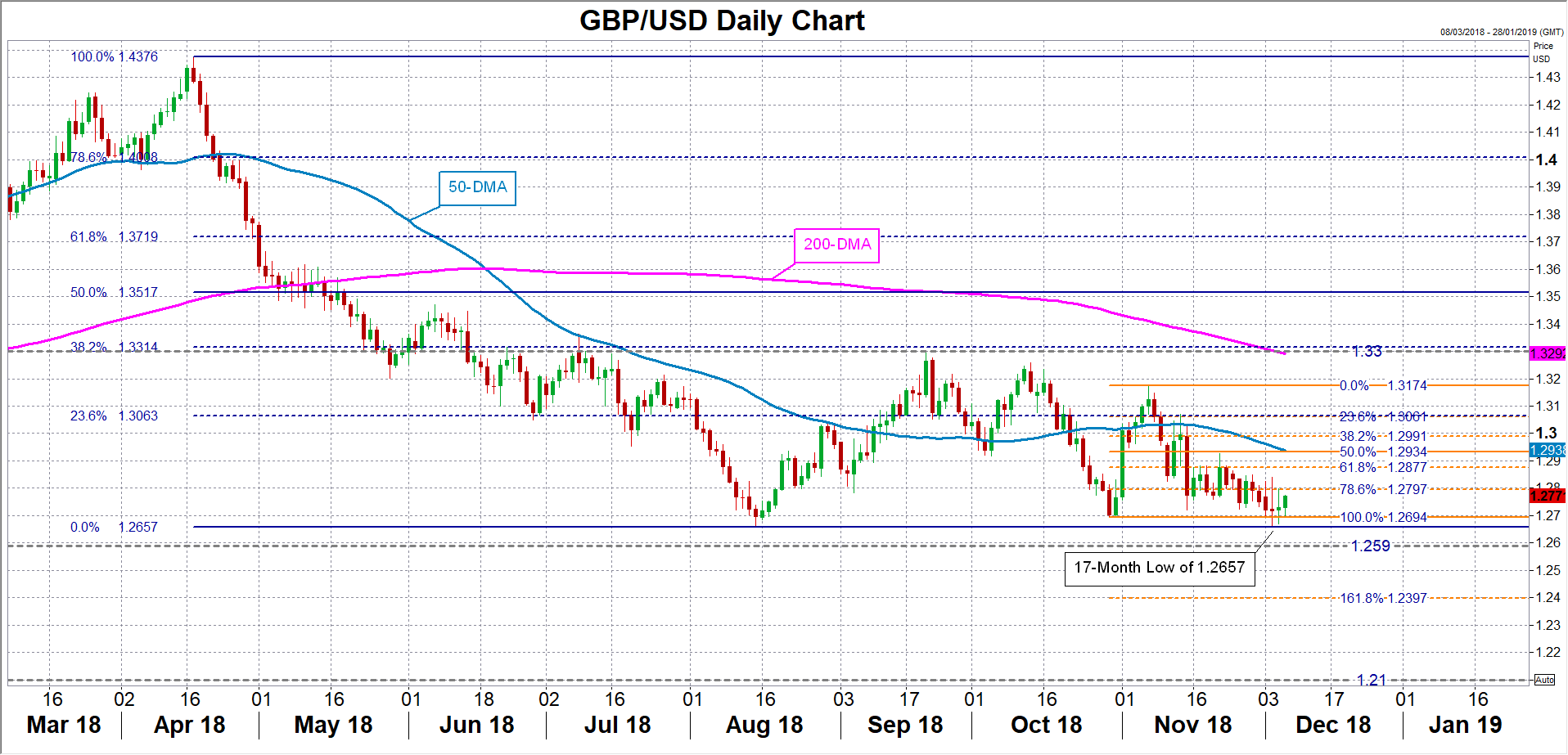
While the chances of May’s government revoking Article 50 are extremely low, the odds that there could be a new government in place (either from a leadership challenge or snap elections being called) should the Brexit deal get voted down are somewhat greater. The distinct possibility that Brexit can be reversed is likely to keep the pound bears at bay until at least the final vote due on December 11 (barring any last-minute delays to the vote). Still, the expected knee-jerk reaction to the Brexit deal failing to pass through Parliament is sharp sell-off. Sterling could initially seek support at $1.2590 – an important resistance and support area during 2017. A breach below this mark could see the declines accelerate towards the $1.24 handle, near the 161.8% Fibonacci extension of the upleg from $1.2694 to $1.3174. Further down, the $1.21 level would come into focus should market panic ensue.
In the highly unlikely scenario, though, that May manages to get her deal through the Commons, the pound could be set for a major upward correction. Investors shouldn’t discount the possibility of May offering late concessions to her Conservative MPs. The prime minister is reportedly considering giving MPs a vote on whether to initiate the backstop, meaning Parliament would be able to block the UK from entering the backstop arrangement. It’s also possible, though remote, the EU could be willing to make some further compromises to May to help her sell her deal so as to avert a ‘hard’ Brexit. Any improved offer on the backstop problem could be enough to persuade Conservative rebels to support the deal out of fear that voting against it could lead to a second referendum or fresh elections.
The pound could enjoy a substantial rally should the deal get voted through, with a move towards the 50-day moving average and the 50% Fibonacci at 1.2934 being an easy run. A break above this level could send the British currency as high as the $1.33 level, which is close to September’s peak. Higher up though, the pound could find it more difficult to get past the next major hurdle around $1.35, which represents the 50% retracement of the April-December downtrend.
USDCHF Lacks Clear Direction Movement in Very Short Term
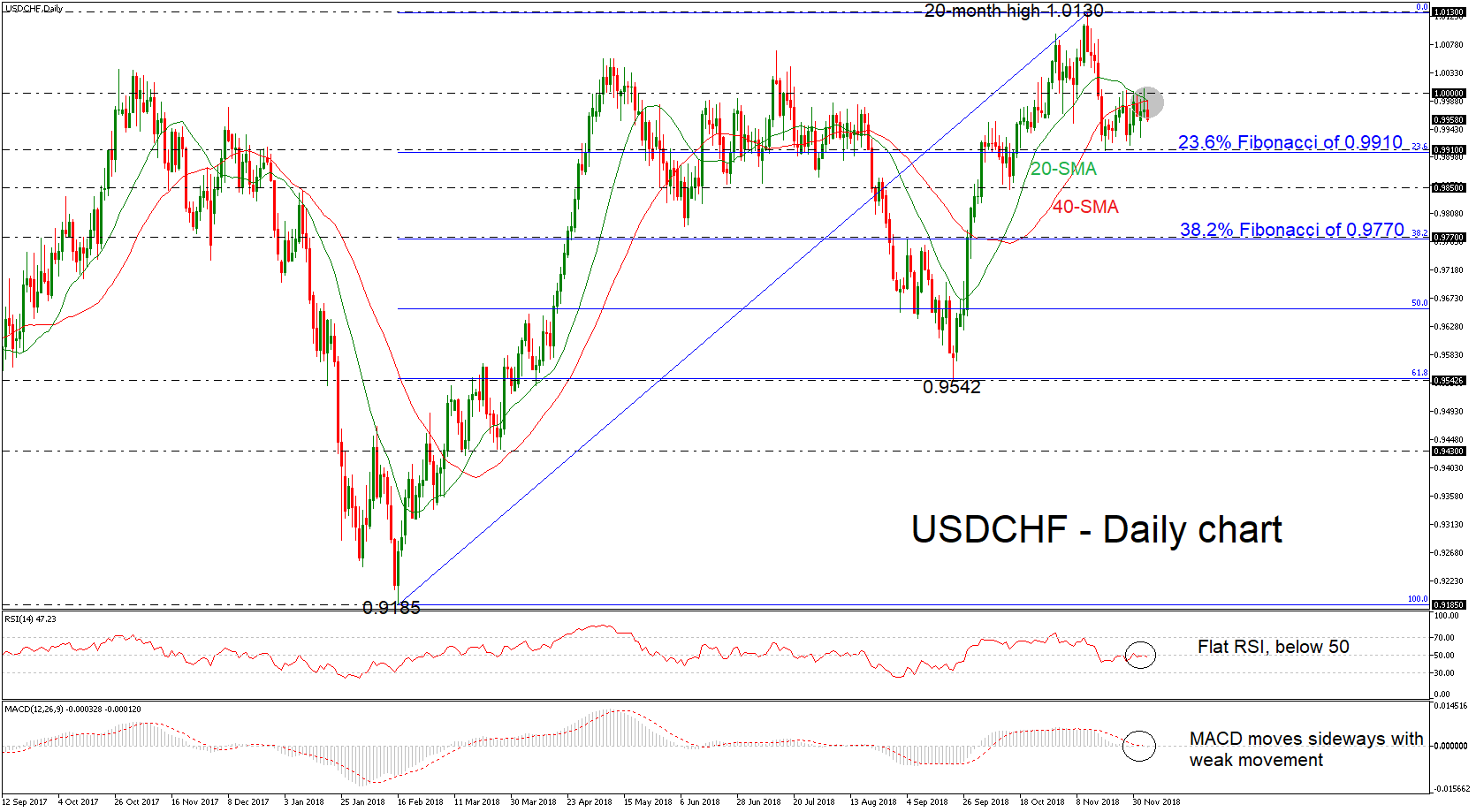
USDCHF has been struggling within a narrow range over the last couple of weeks in the very short term with upper band the 1.0000 level and lower band the 0.9910 support barrier. Additionally, the 20- and 40-simple moving averages (SMAs) are ready to post a bearish crossover, while the technical indicators are flattening. The short-term momentum turned to neutral as evident by the momentum indicators which are flattening. The RSI remains around 50 level and the MACD holds near zero line with weak movement.
Immediate support to declines may be coming around the 23.6% Fibonacci retracement level of the upleg from 0.9185 to 1.0130, around 0.9910. Further below, support could emerge around 0.9850, registered on October 15, while even lower the 38.2% Fibonacci near the 0.9770 support barrier could be a significant obstacle for the bears.
On the upside, resistance could take place around the immediate handle of 1.000 that may hold psychological importance. The focus would then tun to the 20-month peak of 1.0130 in the event of more bullish movement.
Concluding, despite the recent weakness, the medium-term outlook continues to look mostly positive.
Canadian Dollar Slide Continues as Risk Apprehension Grows
The downward spiral continues this week, as the Canadian dollar has lost more ground in the Thursday session. Currently, USD/CAD is trading at 1.3417, up 0.46% on the day. Earlier in the day, USD/CAD broke above the 1.34 level for the first time since June 2017.
In economic news, In the U.S, the spotlight will be on employment releases. ADP nonfarm payrolls is expected to drop to 195 thousand, down from 227 thousand a month earlier. The strength of the ADP release could provide a clue regarding the official NFP report on Friday, which is also expected to drop sharply. Unemployment claims spiked last week at 234 thousand, but are forecast to drop to 224 thousand. Later, the ISM Non-Manufacturing PMI is expected to dip to 59.1 points. In Canada, the trade deficit is expected to widen to C$0.7 billion. Elsewhere, OPEC members are meeting in Vienna for a second straight day. On Friday, Canada and the U.S. release key employment indicators, highlighted by U.S. nonfarm payrolls.
As expected, the Bank of Canada stayed on the sidelines and left the benchmark rate at 1.75%. There were a number of factors in favor of the bank staying on the sidelines. The escalating trade war between the U.S. and China has hurt the Canadian export sector, and oil prices have dropped in recent weeks. Domestically, GDP declined 0.2% in September, the first drop since January. As well, the Federal Reserve has hinted that it will reduce the number of rate hikes in 2019, which has eased pressure on the BoC to raise rates.
It’s been a dismal week for the Canadian dollar, which is down 1.0%. The downward spiral has mirrored movement in the global stock markets. Equities started the week with gains, but this proved to be short-lived, as investor optimism following the Trump-Xi meeting quickly dissipated. At the start of the week, the Canadian dollar jumped after President Trump and Chinese President Xi reached an agreement, whereby the U.S. agreed to suspend further tariffs until March 1. However, investors have sobered since, wondering if the 90-day truce is simply a pause in the trade war between the world’s two largest economies. the two super-economies remain far apart on a number of issues, including U.S. accusations that China has been stealing U.S. intellectual property. All indications are that reaching a deal will be difficult. The markets have been sensitive to development in the tariff tussle between the countries, and the likely ups-and-downs in the upcoming negotiations will likely affect market movement in the coming weeks.
EUR/USD Mid-Day Outlook
Daily Pivots: (S1) 1.1317; (P) 1.1339; (R1) 1.1368; More.....
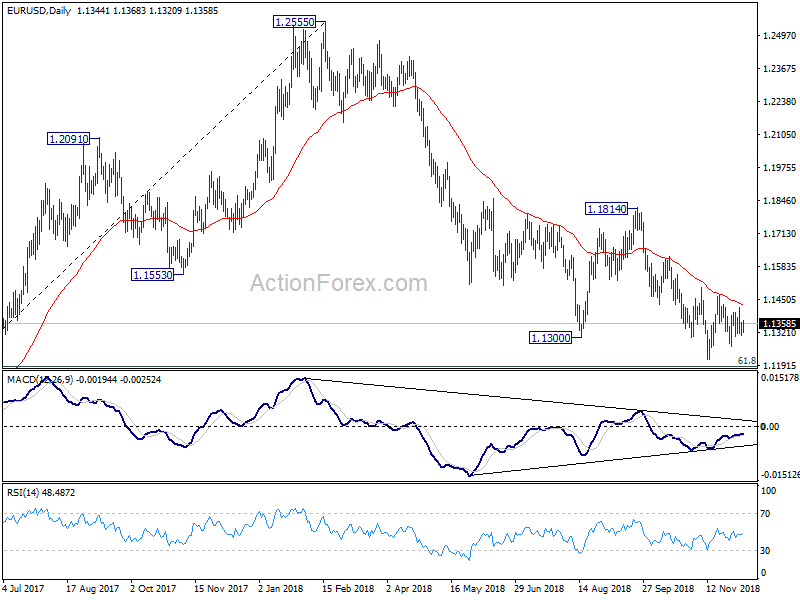
EUR/USD recovers mildly in early US session but it's bounded in range of 1.1267/1472. Intraday bias remains neutral at this point. As long as 1.1472 resistance holds, deeper decline is expected in the pair. On the downside, break of 1.1267 will target 1.1215 low first. Firm break there will resume larger down trend from 1.2555 for 1.1186 fibonacci level next. However, considering bullish convergence condition in daily MACD, firm break of 1.1472 will be suggest medium term bottoming and turn outlook bullish for 1.1814 resistance instead.
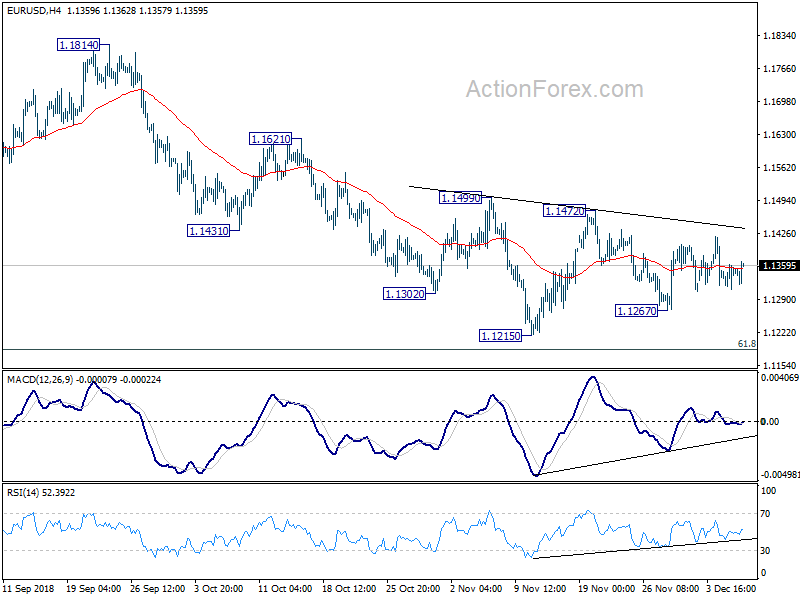
In the bigger picture, as long as 1.1814 resistance holds, down trend down trend from 1.2555 medium term top is still in progress and should target 61.8% retracement of 1.0339 (2017 low) to 1.2555 at 1.1186 next. Sustained break there will pave the way to retest 1.0339. However, break of 1.1814 will confirm completion of such down trend and turn medium term outlook bullish.
Dollar Slightly Lower on Job Data Miss, But Risk Aversion Still the Main Theme.
Dollar softens mildly against European majors in early US session after weaker than expected job data. But risk aversion remains the overall theme of the market. Australian Dollar stays the weakest one, followed by Canadian and New Zealand Dollar. WTI crude oil is back at 51.2 as even though OPEC+ might agree to a production cut next yet, the number could be more symbolic than substantial. Meanwhile, Yen remains the strongest ones, followed by Europeans. Sterling is somehow hibernating, waiting for next week's Brexit vote in UK Commons.
Some attributed stocks selloff to arrest of Chinese tech giant Huawei's CFO in Canada, on request by the US. There are worries that such act could jeopardize US-China trade truce. And there are talks that investors simply don't believe there's anything concrete out of the Trump-Xi meeting. But we'd like to point out again that US Trade Representative Robert Lighthizer was assigned to take over the negotiation. Lighthizer is the only one in the cabinet who knows how to make a trade agreement, like the USMCA. And he's now leaving EU Trade Commission Cecilia Malmtrom behind, with focus turned to China. That's strong enough a signal that both sides are going to deliver something solid in the next 90 days or so. Or at least, Trump believes so.
Instead, we'd point to the sharp decline in bond yields and stocks as sign of worry in global slow down. Japan 10 year JGB yield closed at 0.05 today, lowest close since July. And it hit as high as 0.166 just back in early October. German 10 year bund yield is now down -0.027 at 0.250. It hit as low as 0.244, lowest since the one day spike low of 0.186 in June. If only daily close is considered, 10 year bund yield is at lowest since April 2017. US 10 year yield opens lower again and breaks 2.9 handle to 2.887. DOW futures is currently down -400 pts.
Technically, EUR/USD, USD/CHF, GBP/USD, USD/JPY, EUR/JPY are bounded in familiar range. USD/CAD is showing some convincing to holding itself above 1.3385 key resistance. 1.3685 fibonacci level would be next target should WTI crude oil breaks below 50 handle again. AUD/USD is now pressing 0.7199 support. EUR/AUD is also smelling 1.5781 resistance. Break of these two level will prompt deeper selloff in the Aussie.
US ADP jobs missed expectation, growth still strong but likely peaked
US ADP report showed only 179k growth in private sector jobs in November, down from 225k and missed expectation of 200k.
In the release, Ahu Yildirmaz, vice president and co-head of the ADP Research Institute, noted that "although the labor market performed well, job growth decelerated slightly". Also, "Midsized businesses added nearly 70 percent of all jobs this month. This growth points to the midsized businesses' ability to provide stronger wages and benefits. It also suggests they could be more insulated from the global challenges large enterprises face."
Mark Zandi, chief economist of Moody's Analytics, said, "Job growth is strong, but has likely peaked. This month's report is free of significant weather effects and suggests slowing underlying job creation. With very tight labor markets, and record unfilled positions, businesses will have an increasingly tough time adding to payrolls."
US initial jobless claims dropped -4k to 231k in the week ending December 1, above expectation of 226k. Four-week moving average of initial claims rose 4.25k to 228.0k. Continuing claims dropped -74k to 1.631M in the week ending November 24. Four-week moving average of continuing claims rose 250 to 1.667M.
Also released, US trade came in at USD -55.5B in October, slightly wider than expectation of USD -55.2B. Non-farm productivity was revised down to 2.3% in Q3 and unit labor cost revised down to 0.9%. From Canada trade deficit came in wider than expected at CAD -1.2B in October.
UK PM May on Brexit vote: My deal, no deal, or no Brexit
In a BBC radio interview, UK Prime Minister Theresa May tried to play down the chance of delaying the December 11, Tuesday, Brexit vote in the parliament. And she added what she's doing is leading up to the vote, rather than talking about delaying it.
May said that there are three options for the MPs. The first one is leaving EU with a deal, that is her deal. Second is leading EU with no deal. And the final one is having no Brexit at fall. She also insisted that if the deal is voted down, it's up for those who opposed to propose a plan B.
Separately, the European Court of Justice said it will deliver the judgement, on December 10 at 0800GMT, on whether UK can unilaterally reverse Brexit. That would be a day ahead of the scheduled UK parliamentary vote. Earlier this week, ECJ's advocate general said that UK has the right to withdraw Brexit notice unilaterally, up to the point of formal conclusion of the deal. It's generally expected, while not binding, ECJ will follow the advocate's opinion.
MOFCOM: China and US working towards removing all "raised" tariffs
Chinese Commerce Ministry spokesman Gao Feng repeated in a regular press briefing that the meeting between Xi and Trump in Argentina was "very successful and has reached important consensus on economic and trade issues." He added both countries have "high degree of interest in economic and trade issues and have natural and complementary structural need". And team from both sides are working closely to reach an agreement within the next 90 days. He also added the "ultimate goal" is to cancel all "raised" tariffs. (He didn't say all tariffs).
Gao also explained that the agreement will start with agricultural products, energy, automobiles, etc. And both sides would "immediately implement specific issues that the two sides have reached consensus." During the 90 days period, there will be "conduct consultations on issues such as intellectual property protection, technical cooperation, market access, and trade balance", in accordance with a clear timetable and roadmap.
Besides, "in the fields of protecting intellectual property rights, promoting fair competition, and relaxing market access" Gao said "China and the United States and enterprises of both countries share common demands, which is also in line with China's consistent direction of deepening reform and opening up".
BoJ Kuroda: Risks tilted toward the downside
BoJ Governor Haruhiko Kuroda warned today that "risks to Japan's economy are tilted toward the downside" And BoJ policymakers "need to pay particular attention to protectionist moves such as Sino-U.S. trade friction."
Kuroda also warned that "raising interest rates now to create policy space for future economic downturns may risk delaying achievement of our inflation target."
Also, it's premature to reveal the exit strategy for the ultra loose monetary policy. Kuroda said "we need to debate an exit strategy and explain it to markets but only when inflation approaches our target."
RBA Debelle: There's scope to cut rates and QE is an effective option
RBA Deputy Governor Guy Debelle reiterated in a speech that the central bank's rhetorics that the "next move in monetary policy is more likely up than down, though it is some way off." But he also emphasized that there is "still scope for further reductions in the policy rate", referring monetary capacity.
Debelle also said RBA has learned from the experience of other central banks using other tools of monetary policy. And "QE is a policy option in Australia, should it be required." He added that "there are less government bonds here, which may make QE more effective." Besides, he added "floating exchange rate matters and remains an important shock absorber for the Australian economy."
Released from Australia, trade surplus came in smaller than expected at AUD 2.32B in October. Retail sales rose 0.3% mom in October, matched expectations.
EUR/USD Mid-Day Outlook
Daily Pivots: (S1) 1.1317; (P) 1.1339; (R1) 1.1368; More.....
EUR/USD recovers mildly in early US session but it's bounded in range of 1.1267/1472. Intraday bias remains neutral at this point. As long as 1.1472 resistance holds, deeper decline is expected in the pair. On the downside, break of 1.1267 will target 1.1215 low first. Firm break there will resume larger down trend from 1.2555 for 1.1186 fibonacci level next. However, considering bullish convergence condition in daily MACD, firm break of 1.1472 will be suggest medium term bottoming and turn outlook bullish for 1.1814 resistance instead.
In the bigger picture, as long as 1.1814 resistance holds, down trend down trend from 1.2555 medium term top is still in progress and should target 61.8% retracement of 1.0339 (2017 low) to 1.2555 at 1.1186 next. Sustained break there will pave the way to retest 1.0339. However, break of 1.1814 will confirm completion of such down trend and turn medium term outlook bullish.
Economic Indicators Update
| GMT | Ccy | Events | Actual | Forecast | Previous | Revised |
|---|---|---|---|---|---|---|
| 00:30 | AUD | Trade Balance (AUD) Oct | 2.32B | 3.00B | 3.02B | 2.94B |
| 00:30 | AUD | Retail Sales M/M Oct | 0.30% | 0.30% | 0.20% | 0.10% |
| 07:00 | EUR | German Factory Orders M/M Oct | 0.30% | -0.40% | 0.30% | 0.10% |
| 12:30 | USD | Challenger Job Cuts Y/Y Nov | 51.50% | 153.60% | ||
| 13:15 | USD | ADP Employment Change Nov | 179K | 200K | 227K | 225K |
| 13:30 | CAD | International Merchandise Trade (CAD) Oct | -1.2B | -0.7B | -0.4B | -0.9B |
| 13:30 | USD | Trade Balance Oct | -55.5B | -55.2B | -54.0B | -54.6B |
| 13:30 | USD | Initial Jobless Claims (DEC 1) | 231K | 226K | 234K | 235K |
| 13:30 | USD | Non-Farm Productivity | 2.30% | 2.40% | 2.20% | |
| 13:30 | USD | Unit Labor Costs | 0.90% | 1.00% | 1.20% | |
| 14:45 | USD | Services PMI Nov F | 54.4 | 54.4 | ||
| 15:00 | CAD | Ivey PMI Nov | 60.3 | 61.8 | ||
| 15:00 | USD | ISM Non-Manufacturing/Services Composite Nov | 59.5 | 60.3 | ||
| 15:00 | USD | Factory Orders Oct | -2.00% | 0.70% | ||
| 16:00 | USD | Crude Oil Inventories | -1.3M | 3.6M |
US initial jobless claims dropped to 231k, above expectation
US initial jobless claims dropped -4k to 231k in the week ending December 1, above expectation of 226k. Four-week moving average of initial claims rose 4.25k to 228.0k. Continuing claims dropped -74k to 1.631M in the week ending November 24. Four-week moving average of continuing claims rose 250 to 1.667M.
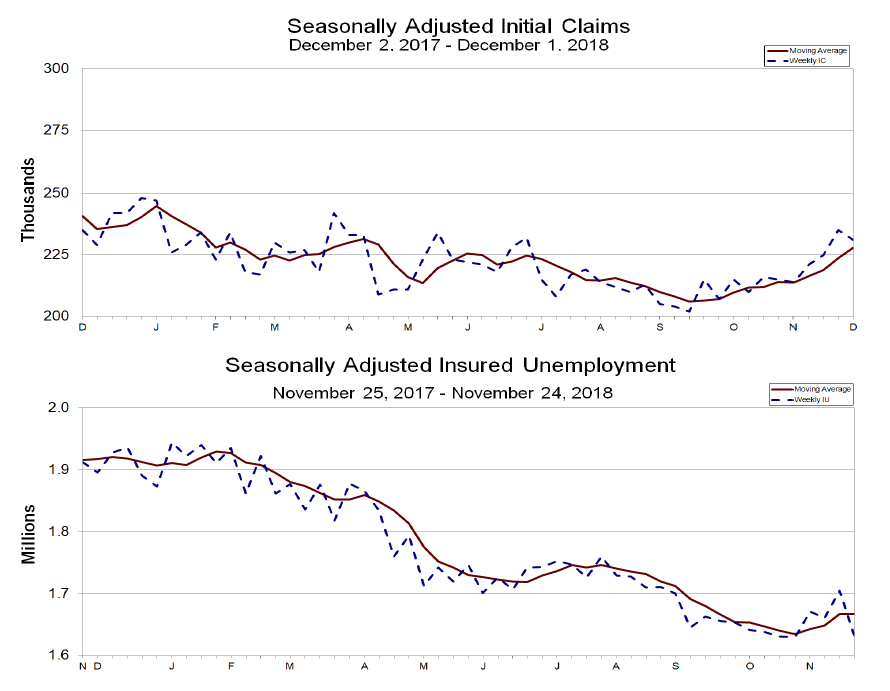
Also released, US trade came in at USD -55.5B in October, slightly wider than expectation of USD -55.2B. Non-farm productivity was revised down to 2.3% in Q3 and unit labor cost revised down to 0.9%. From Canada trade deficit came in wider than expected at CAD -1.2B in October.
US ADP jobs missed expectation, growth still strong but likely peaked
US ADP report showed only 179k growth in private sector jobs in November, down from 225k and missed expectation of 200k.
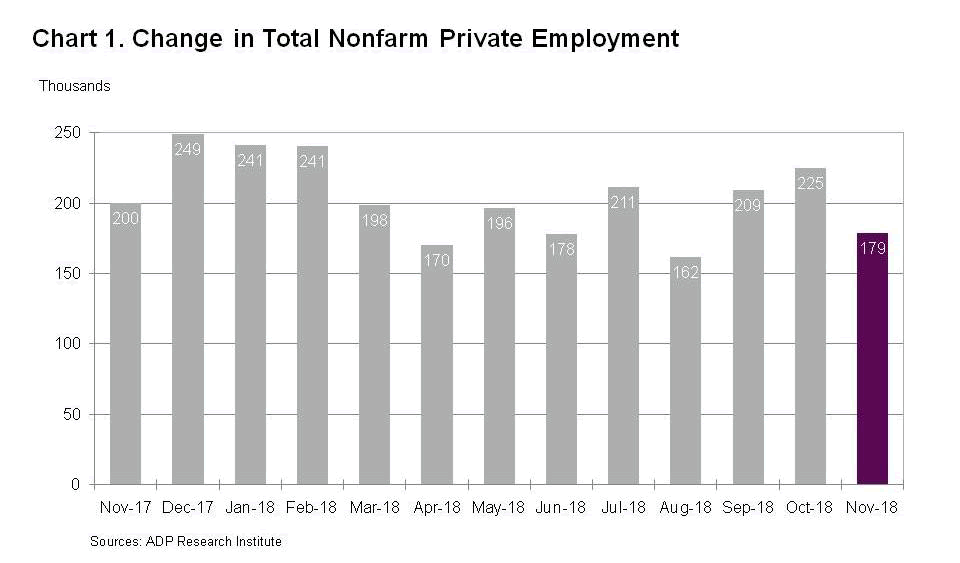
In the release, Ahu Yildirmaz, vice president and co-head of the ADP Research Institute, noted that "although the labor market performed well, job growth decelerated slightly". Also, "Midsized businesses added nearly 70 percent of all jobs this month. This growth points to the midsized businesses' ability to provide stronger wages and benefits. It also suggests they could be more insulated from the global challenges large enterprises face."
Mark Zandi, chief economist of Moody's Analytics, said, "Job growth is strong, but has likely peaked. This month's report is free of significant weather effects and suggests slowing underlying job creation. With very tight labor markets, and record unfilled positions, businesses will have an increasingly tough time adding to payrolls."
EUR/USD: Continues To Target The 1.1215 Support Zone
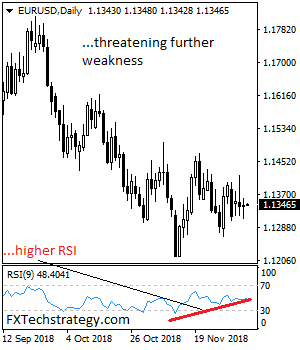
EURUSD continues to target the 1.1215 support zone as downside pressure remains intact. Support lies at the 1.1300 where a violation will aim at the 1.1250 level. A break below here will aim at the 1.1200 level. Further down, support lies at the 1.1150. On the upside, resistance resides at 1.1350 level with a break through there opening the door for further upside towards the 1.1400 level. Further up, resistance comes in at the 1.1450 level where a violation will expose the 1.1500 level. All in all, EURUSD continues to face downside pressure.
DAX Slips Below 11,000 as Bank, Auto Shares Slide
The DAX index has dropped sharply in the Thursday session. Currently, the index is at 10,932, down 2.4% since the Wednesday close. On the release front, German Factory Orders posted a gain of 0.3%, beating the forecast of -0.4%. OPEC members are meeting in Vienna for a second straight day. On Friday, Germany releases industrial production, and the eurozone will publish jobless claims and GDP. The U.S. will release nonfarm payrolls, which should be treated as a market-mover.
It’s been a dismal week for the DAX, which has nosedived 5.25%. Earlier in the day, the pair dropped below the 11,000 mark, for the first time since December 2016. Bank and automaker shares are dragging down the DAX on Thursday. Deutsche Bank has dropped 3.55%, Daimler is down 3.28% and Volkswagen has declined 2.73%. Investors remain jittery about global economic growth and the U.S- China trade war. President Trump has agreed to suspend further tariffs for 90 days, and this move gave a boost to equity markets at the beginning of the week. However, risk apprehension quickly returned, leading to sharp losses this week. Negotiations between the U.S. and China promise to be difficult, which could mean more headwinds for the DAX.
After a string of disappointing releases out of Germany, there was some good news on the manufacturing front on Thursday. Factory orders posted a gain of 0.3% for a second straight month. This follows a lukewarm Manufacturing PMI release earlier in the week. Although the reading of 51.8 was within expectations, it marked a fourth monthly downturn and was the lowest reading since April 2016. The global trade war has taken a bite out of German exports and a slowdown in the eurozone economy has dampened manufacturing growth in Germany. On Friday, Germany releases industrial production, which is expected to edge up to 0.3%.