

Sample Category Title
AUD/USD And NZD/USD Eyeing Upside Break
AUD/USD found support near 0.7190-0.7200 and it is currently consolidating. NZD/USD looks set to gain pace above the 0.6890 resistance area in the near term.
Important Takeaways for AUD/USD and NZD/USD
- The Aussie Dollar declined heavily recently before buyers appeared near 0.7190 against the US Dollar.
- There was a break above a key connecting bearish trend line with resistance at 0.7218 on the hourly chart of AUD/USD.
- NZD/USD is currently trading nicely above the 0.6870 support level, with a positive angle.
- There was a break above a short term bearish trend line with resistance at 0.6880 on the hourly chart.
AUD/USD Technical Analysis
After forming a top near the 0.7390 level, the Aussie Dollar declined sharply against the US Dollar. The AUD/USD pair declined and broke the 0.7300 and 0.7280 support levels.
The pair even traded below the 0.7220 level and the 50 hourly simple moving average. It even spiked below the 0.7200 handle and formed a low near the 0.7190 level on FXOpen. Later, the pair started a decent upward correction and traded above the 0.7200 level
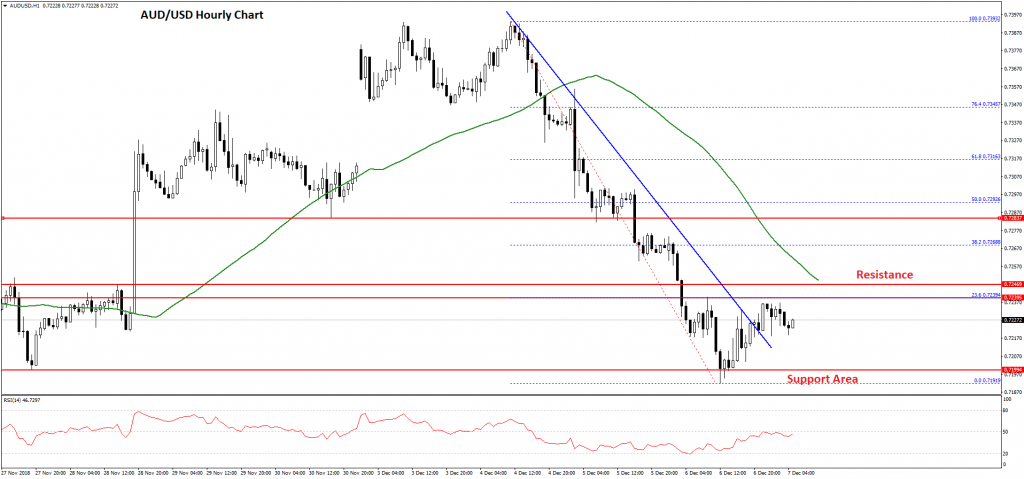
There was also a break above a key connecting bearish trend line with resistance at 0.7218 on the hourly chart. The pair is currently trading near the 0.7235 resistance and the 23.6% Fib retracement level of the recent decline from the 0.7393 high to 0.7191 low.
Above 0.7240, the pair is likely to face sellers near the 0.7250 level and the 50 hourly simple moving average. The main resistance for buyers is near the 0.7265 level and the 50% Fib retracement level of the recent decline from the 0.7393 high to 0.7191 low.
On the downside, an initial support is near the 0.7220 level followed by 0.7200. If there are more losses, the pair is likely to revisit the 0.7180 level.
The overall price action is positive and it seems like AUD/USD may continue to correct higher towards 0.7250 and 0.7265 in the coming sessions.
NZD/USD Technical Analysis
After a solid upward move, the New Zealand Dollar faced sellers near the 0.6970 level against the US Dollar. The NZD/USD pair started a downside move and traded below the 0.6940 and 0.6900 support levels.
There was even a close below the 0.6900 support and the 50 hourly simple moving average. The pair traded as low as 0.6856 and later started a fresh upward move. It climbed above the 0.6860 and 0.6870 levels with a positive angle.
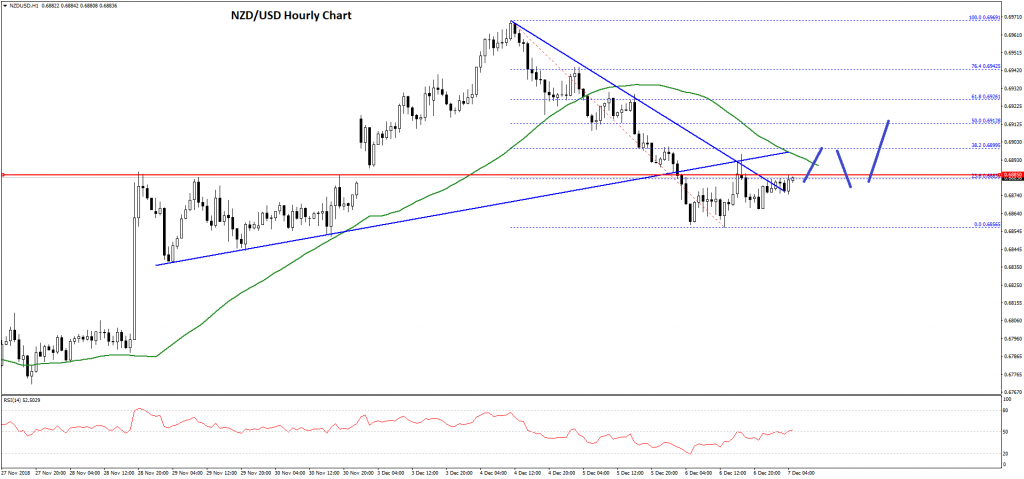
The pair broke the 23.6% Fib retracement level of the recent decline from the 0.6969 high to 0.6856 low. Moreover, there was a break above a short term bearish trend line with resistance at 0.6880 on the hourly chart, opening the doors for more gains.
A successful break above the 0.6840 level and the 50 hourly SMA could open the doors for more upsides in the near term. The next resistance may be near the 0.6910 level and the 50% Fib retracement level of the recent decline from the 0.6969 high to 0.6856 low.
On the downside, an initial support is at 0.6870, below which the pair may test the 0.6855 level. As long as the pair is above 0.6855, there are chances of more upsides above 0.6880 and 0.6900 in the near term.
Market Morning Briefing: Euro Tested 1.1412 In Line
STOCKS
Our warnings of a dip in most Indices seems to be working out. It is to be seen now whether the second leg of the expectation, of a bounce from Supports, works out.
Within this, the Dow (24947.67, -79.40, -0.32%) plunged to a low of 24242.22, just below the important/ strong Support of 24250 we had mentioned yesterday, and then bounced back to close just a wee bit below Tuesday's close. We can now expect the Dow to quieten down and move sideways between 24500-25500 for the next couple of weeks.
The Nikkei (21587) fell to a low of 21308 yesterday but has recovered a decent bit and trading above yesterday's close of 21501.62. We would look to approach this market from the Long side while it remains above 21200, looking for an eventual rise past 22000.
Now we need to see how the Shanghai trades today. Yesterday the Shanghai (2605.18, -44.62, -1.68%) closed just above Support at 2600. We have to see whether the recovery in the Dow last night triggers a bounce in the Shanghai as well. If that does not not happen and the the issue of the arrest of the Huwaei CFO worsens, then the Shanghai could be vulnerable to a decline towards 2500-2400. On the charts, the market has to show an immediate bounce to avert the fall.
The Nifty (10601.15, -181.75, -1.69%) closed just at important Support on the Weekly Candles. Let us see, maybe it recovers a bit towards 10700-800 today?
Among all the indices, the DAX (10810.98, -389.26, -3.48%) might be the most bearish, as it plunged to a low of 10762.41 and might be vulnerable to a further decline towards 10000 while below 11200.
COMMODITIES
OPEC meeting yesterday concluded with a no production cut deal while there were discussions of reducing output by 1mln barrel/day which was not consented by all. Non- OPEC allies are due to continue their talks today.
Overall crude prices plunged yesterday as the OPEC meet started and has continued to trade lower. No major movement is expected today as the prices may continue to remain lower.
Brent (59.54) is trading low and could fall towards immediate support at 58. Maximum downside that we expect is 56.50 (200 week MA) which looks less likely to be breached in the next 1-2 weeks, producing a bounce back towards 60 and higher by the end of this month.
WTI( 51.21) is trading above immediate support at 51 and while that holds, the price could remain stable. Break below 51, could take it down towards 50-49 in the medium term.
Gold (1243.80) is trading above immediate support at 1240 and looks bullish towards 1250/60. Trade within 1260-1240 is possible in the next 1-2 weeks.
Silver (14.53) is almost stable and could head towards 14.75 over the next few sessions.
Copper (2.7445) is stuck in the 2.70-2.85 region for quite some time now. While support at 2.70 holds, we could again see a bounce back to 2.85 in the near term. A break on either side is required to give some more clarity on further directions.
FOREX
Dollar Index (96.81) has fallen back to daily trend support levels and could trade in the 97.50-96.75 region today. Note resistance on the 3-day candles at 98 which could be tested in weeks time before a gradual fall is seen in the longer run.
Euro (1.1376) tested 1.1412 in line with our expectation. Narrow sideways movement seems to be over now with a break on either side of the 1.13-1.14 region due in the near term.
Dollar Yen (112.75) moved up from support at 112.50 but came off to close at lower levels. Currently trading above 112.50, we expect this immediate support to hold and take the pair higher towards 114 again in the near term. View is bullish above 112.50.
Pound (1.2770) has moved up a bit and looks bullish towards 1.29-1.30 in the medium term.
While below 0.7250, Aussie (0.7225) looks bearish and may decline towards 0.7150 in the near term. But there could be some Ma supports near 0.72 which if holds, could prevent further fall and produce a bounce back towards 0.730-0.735 in the medium term.
Dollar Rupee (70.91) is likely to open today with a gap down of 30-40paisa from yesterday’s close of 70.91. Although we were expecting trade within 71.20-70.70/60, fall in Brent crude prices could bring down Dollar Rupee today back towards 70.50 with a possible re-test of 70.40-70.30. Where the pair will close today would be important to get some cue for the movement next week. Important data watch: US NFP today
INTEREST RATES
Good dip in the US 2Yr (finally) to 2.76%. With the 10Yr at 2.89%, the 10-2 Spread (13bp) has bounced a bit from the important Support at 11-10bp. Now, as the 10Yr dips further towards 2.82%, it will be important to see if the 10-2 Spread moves up towards 15-16 bp (it can), as that will imply a faster decline for the 2Yr Yield.
A weak, but not too weak, US NFP number today might just be helpful to the charts. Let us see, for the danger of a proper Yield Curve inversion cannot be ignored at the moment.
The 10Yr GOI (7.42%) continues to fall and can target 7.30% (maybe not the 7.22% mentioned yesterday) and bounce a bit from there, as the Indo-US 10Yr Spread (currently 4.52%) has an important Support at 4.48%.
AUD/USD Daily Outlook
Daily Pivots: (S1) 0.7193; (P) 0.7233; (R1) 0.7275; More...
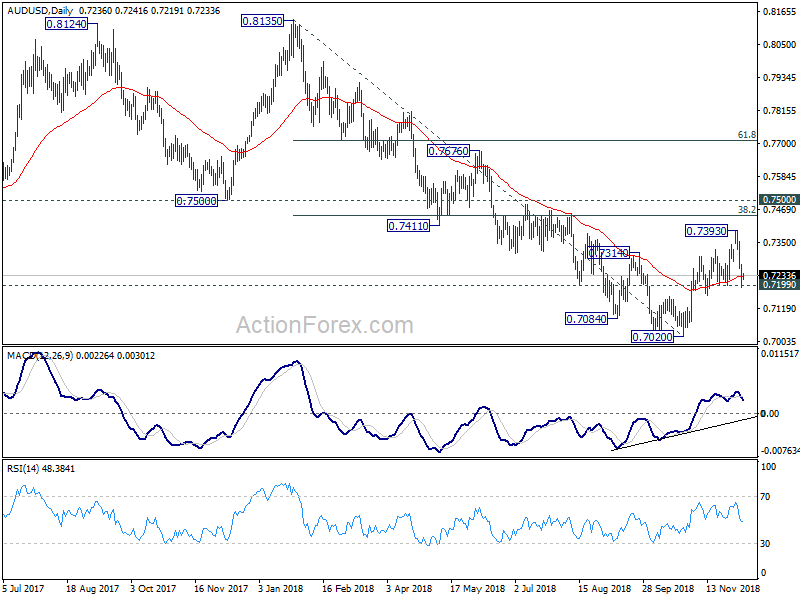
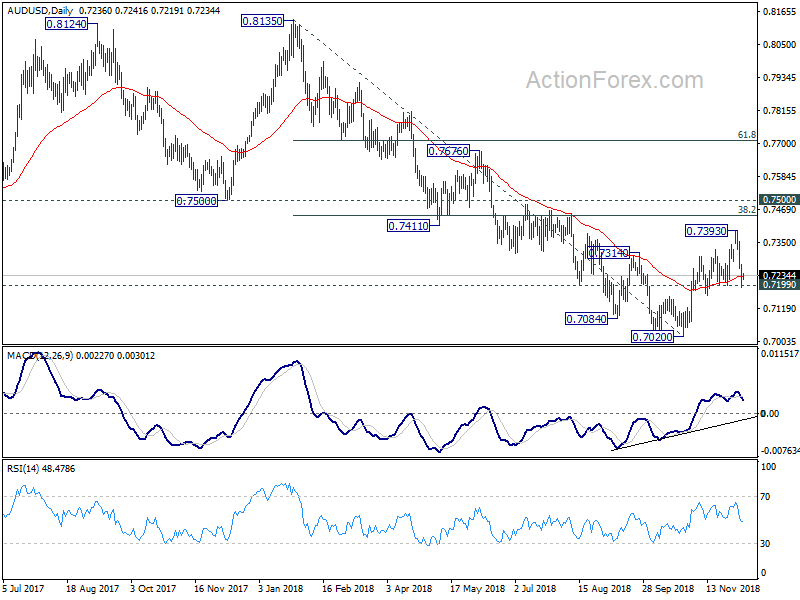
While the fall from 0.7393 was steep, AUD/USD drew support from 0.7199 and recovered. There is no confirmation on reversal yet and intraday bias is neutral for now. On the downside, firm break of 0.7199 will suggest that the corrective rebound from 0.7020 has completed earlier than expected. Deeper fall should then be seen back to retest 0.7020 low. On the upside, above 0.7300 minor resistance will turn bias back to the upside. In that case, corrective rise from 0.7020 would extend to 38.2% retracement of 0.8135 to 0.7020 at 0.7446 before completion.
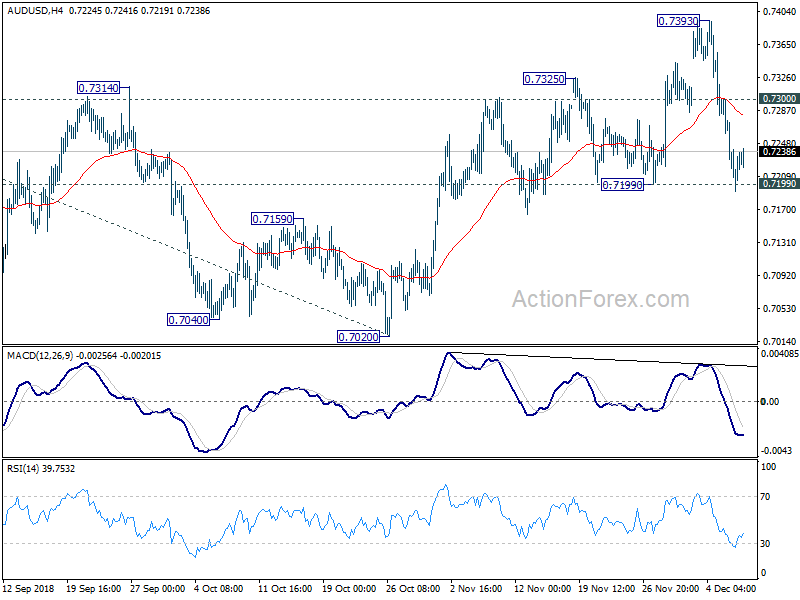
In the bigger picture, a medium term bottom is in place at 0.7020 ahead of 0.6826 key support (2016 low). Stronger rebound would be seen to corrective the whole fall from 0.8135 high. But we'd expect strong resistance from 0.7500 support turned resistance to limit upside. Medium term fall from 0.8135 should resume and extend to take on 0.6826 low at a later stage, after the correction from 0.7020 completes.
Sentiments Stabilized with DOW’s Late Rebound, Dollar Turns to Non-Farm Payrolls
Risk sentiments generally stabilized after the late rebound in US stocks overnight. DOW hit as low as 24242.22 but closed at 24947.67. Down just -0.32%. S&P 500 also hit as low as 2621.53 but closed at 2695.95, down only -0.15%. NASDAQ even reversed and closed up 0.42% at 7188.26. Treasury yield, however, closed deeper lower with 10-year yield losing -0.048 to 2.876. In Asian, all major indices are trading in black at the time of writing. Nikkei is up 0.48%, Singapore Strait Times up 0.41%, Hong Kong HSI up 0.27%. China Shanghai SSE lags behind and is up 0.08% only. 10 year JGB yield also recovers and is back at 0.059.
In the currency markets, Yen is trading as the weakest one for today, followed by Sterling and the Canadian. New Zealand Dollar is the strongest one for today, followed by Swiss Franc and then Australian. But for the week, Swiss Franc and Yen are overwhelmingly the strongest ones. Australian and Canadian are the weakest. The weekly picture is unlikely to change at close. Though, US non-farm payroll has the prospects to lift Dollar from the third weakest for the week to something better.
Technically, EUR/USD and GBP/USD are still bounded in familiar range. USD/CHF breached 0.9908 support overnight but recovered quickly. USD/JPY also breached 112.30 but then recovered. USD/JPY is indeed recovering further in Asian session. Thus, overall, there is no clear weakness in Dollar yet. Traders are just cautious ahead of NFP. Australian Dollar is digesting this week's sharp losses. AUD/USD recovers after touching 0.7199. EUR/AUD retreats after touching 1.5871. These two levels will remain the focus for today.
Fed Powell: Some communities yet to feel full benefits of strong economy
Fed Chair Jerome Powell said in a speech yesterday that "by many national-level measures, our labor market is very strong." However, he also noted that "aggregate statistics can mask important variations between different demographic and income groups, as well as significant regional differences." He pointed to statistics indicating unemployment rates in some persistently poor rural counties remain much higher than the national figures.
And, "while the economy is strong overall, we recognize that some communities have yet to feel the full benefits of the ongoing expansion." Fed is "conducting research, collaborating with communities, and assessing financial regulations so that our nation's current prosperity will benefit small towns and cities alike."
Fed Williams: Tariff is a negative for jobs
New York Fed John Williams said in a forum yesterday that the Trump's tariff war with other countries have "relatively small effect on the economy. But they created higher uncertainty for businesses.
Williams said "at least so far the tariffs that have been put in place, by the United States and other countries, when you roll that up into a $20-trillion economy it doesn't have a big effect overall on economic growth or inflation". And, the "much more important and larger" effect is higher uncertainty for businesses. As companies put off investments due to the uncertainties, "that's a negative for jobs in the short run...and a factor that slows the economy relative to what it could be."
BoC Poloz admits economy loss momentum going into Q4
BoC Governor Stephen Poloz admitted yesterday that "data released since our October Monetary Policy Report have been on the disappointing side ". And, "the economy has less momentum going into the fourth quarter than we believed it would."
Also, regarding recent oil price slump, Poloz added "it is already clear that a painful adjustment is developing for Western Canada and there will be a meaningful impact on the Canadian macroeconomy."
The comments echo BoC's cautious statement earlier this week and solidify the chance for BoC to pause its rate hikes if things don't improve.
BoJ Kuroda: No need for additional easing
BoJ Governor Haruhiko Kuroda told the parliament today that "the economy is sustaining its momentum for achieving our 2 percent target. But that momentum lacks strength, so we will carefully watch developments." For now, though, Kuroda added " I don't see the need to take additional monetary easing steps". And BoJ has no preset idea of what tools to use if more easing is needed, but policy makers will "carefully weigh the cost and benefit of any step we take."
Released from Japan, household spending dropped -0.3% yoy in October, much worse than expectation of 1.2% yoy rise. Labor cash earnings rose 1.5% yoy, higher than expectation of 1.0% yoy. The weak spending data highlights the fact that there is no condition for consumption to strengthen yet. It still take time for the rise in wages to pass though to consumption and then inflation.
Separately, according to a Reuters poll, 55% of Japanese companies expect 2019 growth to be around the same as 1% in 2018. 31% see it slowing and only 14% see it accelerating. Among the concerns of business, the planned sales tax hike in October and US-China trade war top. US-Japan trade negotiations, emerging markets and Middle East tensions are also seen as risks to growth.
Looking ahead
Germany will release industrial production in European session. Eurozone will release GDP revision. Swiss will release foreign currency reserves.
But US non-farm payroll will be the main focus. Fed's rate hike beyond December and March hike is highly data dependent. And strong jobs and wage data are needed to convince policy makers to raise interest rate, at least, to upper bound of estimated neutral. Canada will also release job data today.
AUD/USD Daily Outlook
Daily Pivots: (S1) 0.7193; (P) 0.7233; (R1) 0.7275; More...
While the fall from 0.7393 was steep, AUD/USD drew support from 0.7199 and recovered. There is no confirmation on reversal yet and intraday bias is neutral for now. On the downside, firm break of 0.7199 will suggest that the corrective rebound from 0.7020 has completed earlier than expected. Deeper fall should then be seen back to retest 0.7020 low. On the upside, above 0.7300 minor resistance will turn bias back to the upside. In that case, corrective rise from 0.7020 would extend to 38.2% retracement of 0.8135 to 0.7020 at 0.7446 before completion.
In the bigger picture, a medium term bottom is in place at 0.7020 ahead of 0.6826 key support (2016 low). Stronger rebound would be seen to corrective the whole fall from 0.8135 high. But we'd expect strong resistance from 0.7500 support turned resistance to limit upside. Medium term fall from 0.8135 should resume and extend to take on 0.6826 low at a later stage, after the correction from 0.7020 completes.
Economic Indicators Update
| GMT | Ccy | Events | Actual | Forecast | Previous | Revised |
|---|---|---|---|---|---|---|
| 23:30 | JPY | Overall Household Spending Y/Y Oct | -0.30% | 1.20% | -1.60% | |
| 0:00 | JPY | Labor Cash Earnings Y/Y Oct | 1.50% | 1.00% | 1.10% | 0.80% |
| 5:00 | JPY | Leading Index CI Oct P | 104.8 | 104.3 | ||
| 7:00 | EUR | German Industrial Production M/M Oct | 0.30% | 0.20% | ||
| 8:00 | CHF | Foreign Currency Reserves Nov | 753B | |||
| 10:00 | EUR | Eurozone GDP Q/Q | 0.20% | 0.20% | ||
| 13:30 | CAD | Net Change in Employment Nov | 10.0K | 11.2K | ||
| 13:30 | CAD | Unemployment Rate Nov | 5.80% | |||
| 13:30 | USD | Change in Non-farm Payrolls Nov | 200K | 250K | ||
| 13:30 | USD | Unemployment Rate Nov | 3.70% | 3.70% | ||
| 13:30 | USD | Average Hourly Earnings M/M Nov | 0.30% | 0.20% | ||
| 15:00 | USD | Wholesale Inventories M/M Oct F | 0.70% | 0.70% | ||
| 15:00 | USD | U. of Mich. Sentiment Dec P | 97 | 97.5 |
BoJ Kuroda: No need for additional easing
BoJ Governor Haruhiko Kuroda told the parliament today that "the economy is sustaining its momentum for achieving our 2 percent target. But that momentum lacks strength, so we will carefully watch developments." For now, though, Kuroda added " I don't see the need to take additional monetary easing steps". And BoJ has no preset idea of what tools to use if more easing is needed, but policy makers will "carefully weigh the cost and benefit of any step we take."
Released from Japan, household spending dropped -0.3% yoy in October, much worse than expectation of 1.2% yoy rise. Labor cash earnings rose 1.5% yoy, higher than expectation of 1.0% yoy. The weak spending data highlights the fact that there is no condition for consumption to strengthen yet. It still take time for the rise in wages to pass though to consumption and then inflation.
Separately, according to a Reuters poll, 55% of Japanese companies expect 2019 growth to be around the same as 1% in 2018. 31% see it slowing and only 14% see it accelerating. Among the concerns of business, the planned sales tax hike in October and US-China trade war top. US-Japan trade negotiations, emerging markets and Middle East tensions are also seen as risks to growth.
Fed Williams: Tariff is a negative for jobs
New York Fed John Williams said in a forum yesterday that the Trump's tariff war with other countries have "relatively small effect on the economy. But they created higher uncertainty for businesses.
Williams said "at least so far the tariffs that have been put in place, by the United States and other countries, when you roll that up into a $20-trillion economy it doesn't have a big effect overall on economic growth or inflation". And, the "much more important and larger" effect is higher uncertainty for businesses. As companies put off investments due to the uncertainties, "that's a negative for jobs in the short run...and a factor that slows the economy relative to what it could be."
Fed Powell: Some communities yet to feel full benefits of strong economy
Fed Chair Jerome Powell said in a speech yesterday that " by many national-level measures, our labor market is very strong." However, he also noted that "aggregate statistics can mask important variations between different demographic and income groups, as well as significant regional differences." He pointed to statistics indicating unemployment rates in some persistently poor rural counties remain much higher than the national figures.
And, "while the economy is strong overall, we recognize that some communities have yet to feel the full benefits of the ongoing expansion." Fed is "conducting research, collaborating with communities, and assessing financial regulations so that our nation's current prosperity will benefit small towns and cities alike."
USD/JPY Facing Uphill Task Ahead Of US NFP
Key Highlights
- The US Dollar declined recently and broke the 113.20 support against the Japanese Yen.
- There is a key bearish trend line formed with resistance near 113.30 on the 4-hours chart of USD/JPY.
- The US ADP Employment Change in Nov 2018 declined from 225K (revised) to 179K.
- Today, the US nonfarm payrolls figure for Nov 2018 will be released, which is forecasted to decline from 250K to 205K.
USDJPY Technical Analysis
After a solid upward move, the US Dollar faced sellers near the 114.00 zone against the Japanese Yen. Later, the USD/JPY pair started a fresh decline and traded below the 113.50 and 113.20 supports.
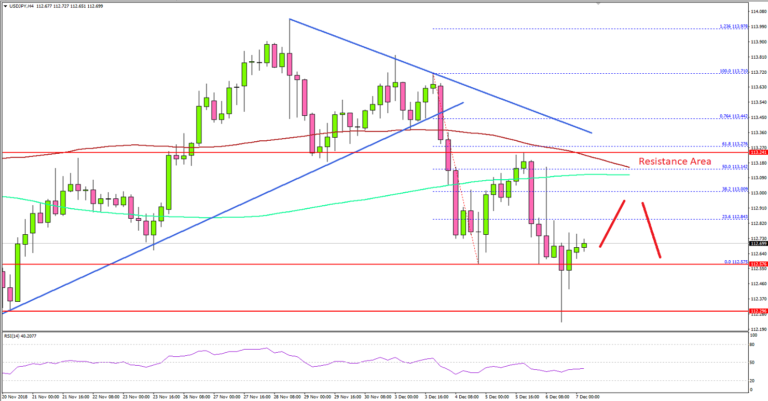
Looking at the 4-hours chart, the pair traded below a couple of important supports near 113.00 and even settled below both 200 simple moving average (green, 4-hours) and the 100 simple moving average (red, 4-hours).
It traded towards the 112.50 level and later bounced back above 113.00 and the 38.2% Fib retracement level of the last decline from the 113.71 high to 112.57 low. However, the recovery was capped near the 113.20 level and the 100 SMA.
Moreover, the 50% Fib retracement level of the last decline from the 113.71 high to 112.57 low acted as a resistance. Above 113.20, there is a key bearish trend line formed with resistance near 113.30.
Therefore, a convincing break above the 113.30 level and the 100 SMA is needed for buyers to gain traction in the near term. On the downside, the main supports are 112.50 and 112.30, below which there is a risk of more losses below 112.00.
Fundamentally, the US ADP Employment Change for Nov 2018 was released by the Automatic Data Processing, Inc. The market was looking for a change of 195K, less than the last 227K.
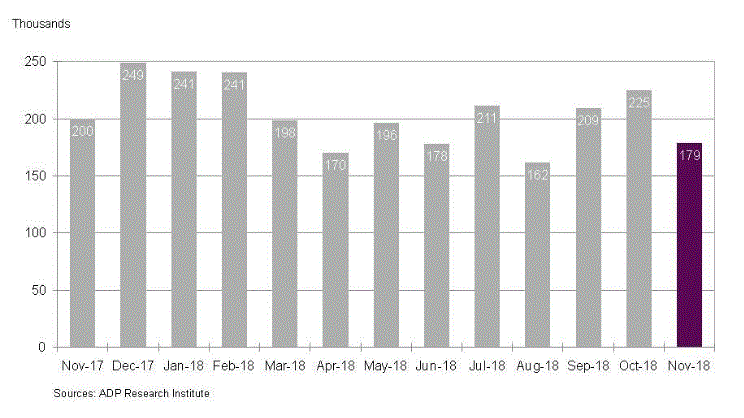
However, the result was disappointing as the change in the ADP Employment was 179K and the last reading was revised down to 225K.
The outcome was disappointing, which weighed on the US Dollar and USD/JPY. On the other hand, EUR/USD and GBP/USD staged a decent recovery.
Economic Releases to Watch Today
- Euro Zone Gross Domestic Product Q3 2018 (QoQ) – Forecast 0.2%, versus 0.2% previous.
- Euro Zone Gross Domestic Product Q3 2018 (YoY) – Forecast 1.7%, versus 1.7% previous.
- US nonfarm payrolls Nov 2018 – Forecast 205K, versus 250K previous.
- US Unemployment Rate Nov 2018 – Forecast 3.7%, versus 3.7% previous.
- Canada’s employment Change payrolls Nov 2018 – Forecast 10.0K, versus 11.2K previous.
- Canada’s Unemployment Rate April 2018 – Forecast 5.9%, versus 5.8% previous.
Dollar Stumbles As Fed Confidence Diminishes
The US dollar is mixed against majors on Thursday. The greenback is higher against commodity currencies (AUD, CAD and NZD) but depreciated against the rest as inflationary pressures are missing in action and Fed member comments lowered expectations of the number of rate hikes in 2019. The Fed is still highly anticipated to lift interest rates on December 19 by 25 basis points, but comments today from FOMC voting member Bosic might signal a neutral rate is closer than first thought. This shift in monetary policy could start appearing in the FOMC statement or the press conference. The biggest indicator in the market the U.S. non farm payrolls (NFP) will be published on Friday, December 7 at 8:30 am EST.
- US Jobs to rise by 198,000
- US wages to gain 0.3%
- Canada to add 10,000 jobs
Dollar Struggling Ahead of NFP Report
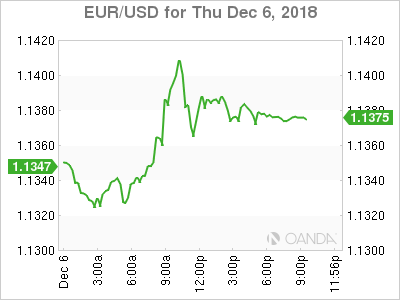
The EUR/USD rose 0.32 percent on Thursday. The single currency is trading at 1.1380 after falling US yields and dovish comments lowered the probability of more rate hikes in 2019. The CME FedWatch tool even showed a drop in daily expectations for the December FOMC meeting. The market is now pricing in a 68.9 percent probability, down from 79.2 percent 24 hours ago.
The private payrolls report missed the forecast with only a gain of 179,000 jobs in November putting more emphasis on the NFP report due Friday. Employment has been the strongest pillar of the economic recovery and continues to post solid numbers but the dollar is overtly sensitive to weak data at the moment.
The ceasefire agreed to by China and the United States on trade appears to have escalated beyond tariffs. The arrest of Huawei CFO Meng Wanzhou has been condemned by Chinese officials, but given the G20 agreement to not raise tariffs in 90 days the US dollar did not appreciate as tensions once again rose between the two economic super powers.
The stock market in the US was back in action after the memorial for US president George Bush and took the full brunt of the sell off, but recovered as the Fed slowing down narrative settled in near the close.
Oil Lower as OPEC Deal Short on Details
West Texas Intermediate fell 2.23 percent on Thursday. WTI is trading at $51.66 after the Organization of the Petroleum Exporting Countries (OPEC) wrapped its meeting without specific details on the highly anticipated oil production cut agreement. Crude fell despite US crude inventories showing a sharp drop of 7.3 million barrels while only 1.3 million was forecasted. The release of the US weekly crude stock data was pushed back by a day as Wednesday was a day of mourning in the US.
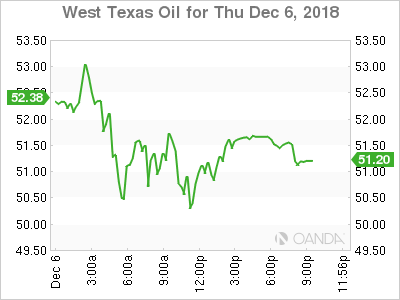
A meeting between OPEC and other major producers will happen on Friday with a growing sense that the announced cuts won’t be enough to stem the fall in crude prices.
A deal appears to have been struck already, but the numbers haven’t been disclosed and not all OPEC members were happy with the agreement with final production cuts still to be finalized.
Gold Flat After US-China Trade Agreement in Focus
Gold fell slightly by 0.06 percent on Thursday. The yellow metal is trading at $1,237 after a drop in the stock market drove investors to seek the safety of gold, but later more dovish comments from the Fed reduced the appeal. Investors went back to stocks as risk appetite was higher than the concerns of an escalation of trade retaliation by the US and China.
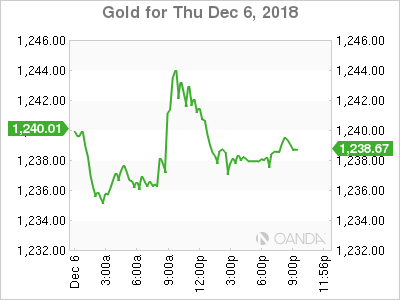
The yellow metal rose earlier in the week as the G20 depreciated the US dollar as the trade aversion risk unwound. While the move by China and the US is seen as punting the issue by 90 days gold will continue to be part of the conversation as the two largest economies start sitting down to settle their differences.
Market events to watch this week:
Friday, December 7
8:30am CAD Employment Change
8:30am USD Average Hourly Earnings m/m
8:30am USD Non-Farm Employment Change
Gold Gains Ground On Risk Apprehension, Weak U.S Employment Data
Gold has posted considerable gains in the Thursday session. In North American trade, the spot price for one ounce of gold is $1242.03, up 0.44% on the day. In economic news, ADP nonfarm payrolls plunged to 179 thousand, well off the estimate of 196 thousand. This was the lowest level since May. Unemployment claims edged lower to 231 thousand, but this was higher than the estimate of 226 thousand. There was better news from the services sector, as ISM Non-Manufacturing PMI improved to 60.7, easily beating the estimate of 59.1 points. On Friday, the U.S. releases wage growth and nonfarm payrolls.
A sharp downturn in global equity markets has been good news for gold prices, as investors have flocked to safe-haven assets like gold. The base metal has climbed 1.60% this week. Earlier on Thursday, gold broke above $1240 for the first time since the first week in July. In addition to disappointing job numbers out of the U.S., an inverted curve in U.S Treasuries has raised risk apprehension on Thursday, since it is often a sign that a recession is on the way.
Investor risk appetite jumped early in the week, after the announcement that President Trump had agreed to put a hold on any further tariffs against China. However, the optimism didn’t last long, as investors have questioned whether the 90-day reprieve will lead to an improvement in the deteriorating trade relations between the U.S and China. Unless the sides make significant progress, safe-haven gold could remain in demand for jittery investors.