

Sample Category Title
USD/CHF Daily Outlook
Daily Pivots: (S1) 0.8192; (P) 0.8232; (R1) 0.8278; More….
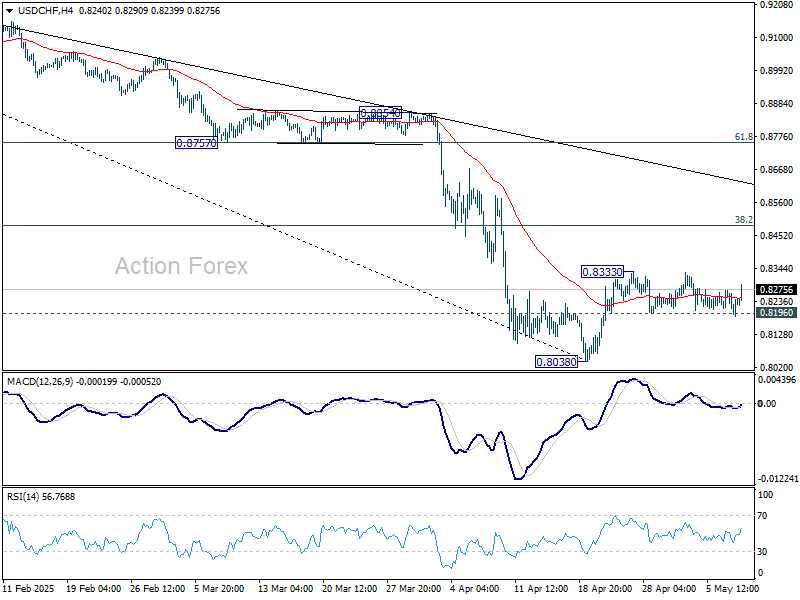
USD/CHF breached 0.8196 support but quickly recovered. Intraday bias remains neutral first. On the upside, above 0.8333 will resume the rebound from 0.8038. However, upside should be limited by 38.2% retracement of 0.9200 to 0.8038 at 0.8482. On the downside, firm break of 0.8196 will bring retest of 0.8038. Firm break there will resume larger down trend.
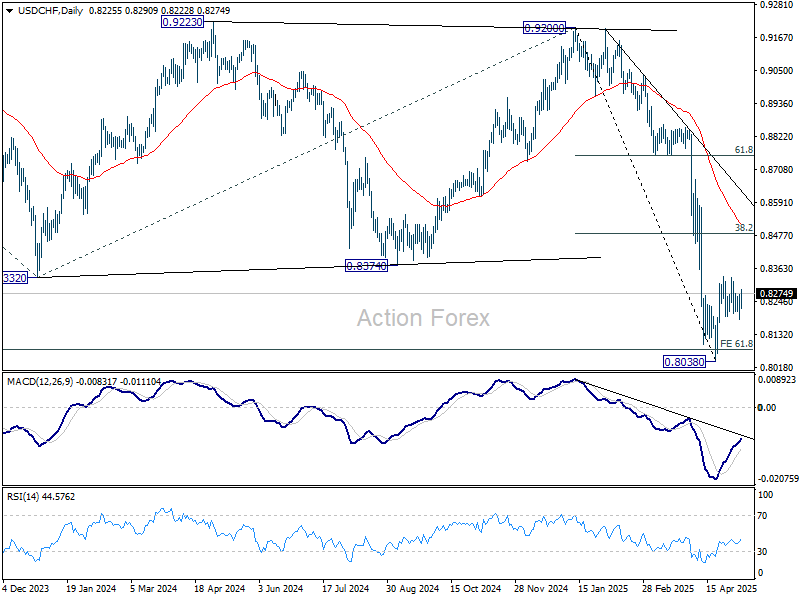
In the bigger picture, long term down trend from 1.0342 (2017 high) is still in progress and met 61.8% projection of 1.0146 (2022 high) to 0.8332 from 0.9200 at 0.8079 already. In any case, outlook will stay bearish as long as 55 W EMA (now at 0.8763) holds. Sustained break of 0.8079 will target 100% projection at 0.7382.
EUR/USD Daily Outlook
Daily Pivots: (S1) 1.1270; (P) 1.1324; (R1) 1.1356; More...
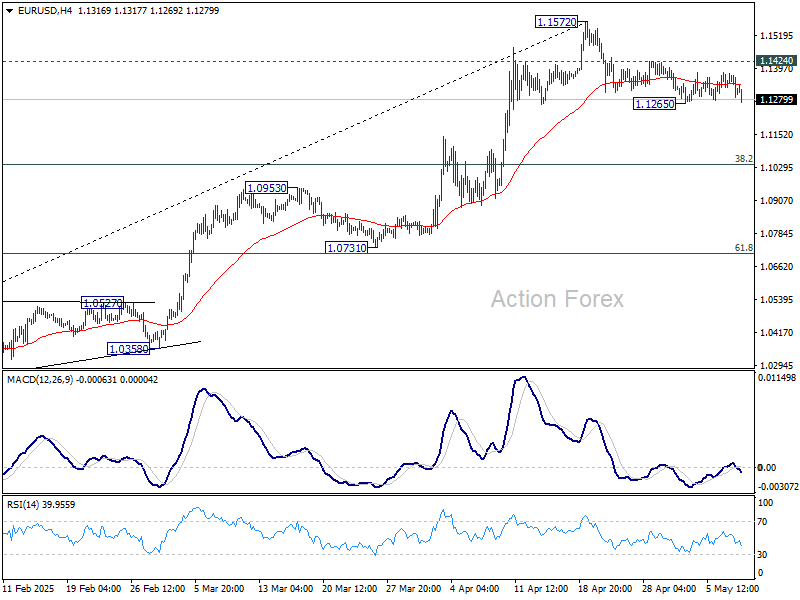
Intraday bias in EUR/USD remains neutral for the moment, as range trading continues. On the downside, below 1.1265 will resume the corrective fall from 1.1572 short term top. But downside should be contained by 38.2% retracement of 1.0176 to 1.1572 at 1.1039. On the upside, break of 1.1424 will suggest that the correction has completed and bring retest of 1.1572 high.
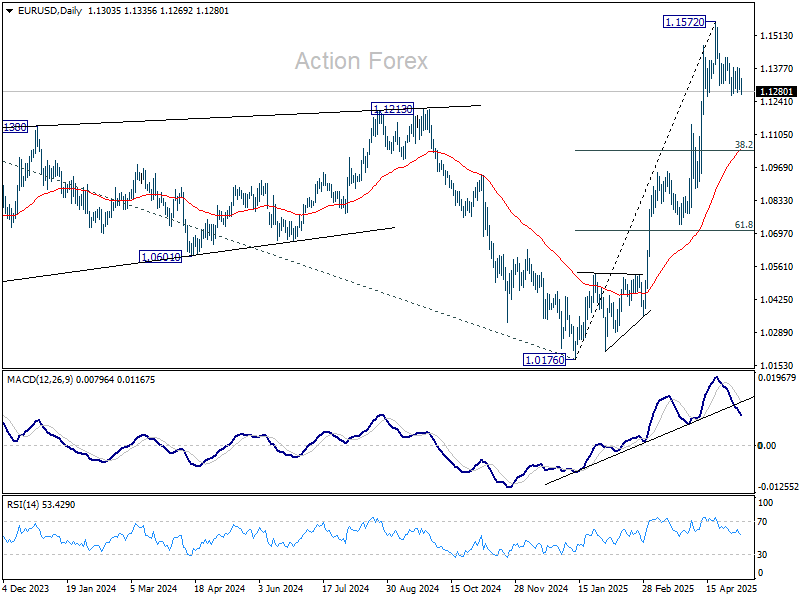
In the bigger picture, rise from 0.9534 long term bottom could be correcting the multi-decade downtrend or the start of a long term up trend. In either case, further rise should be seen to 100% projection of 0.9534 to 1.1274 from 1.0176 at 1.1916. This will now remain the favored case as long as 55 W EMA (now at 1.0808) holds.
Focus Turns to UK Today, Not Only Because of BoE Meeting
Markets
“We think we’re in the right place to wait and see how things evolve” wraps up yesterday’s press conference by Fed Chair Powell. Comments were very similar to the ones made on April 16 before the Economic Club of Chicago. The official statement pointed out that compared to March, uncertainty about the economic outlook has increased further and that risks of both higher unemployment and higher inflation have risen. If the dual-mandate goals are in tension, the US central bank will consider how far the economy is from each goal, and the potentially different time horizons over which those respective gaps would be anticipated to close. With inflation above target and the unemployment rate currently in line with the NAIRU-estimate from the March Summary of Economic Projections, this suggests a clear focus on inflation still. US economic activity has continued to expand at a solid place, although swings in net exports have affected the data. We stick with our call of a prolonged Fed pause, stretching at least over Summer. US money markets currently discount a 20% probability to a June cut and a 80% probability to action in July. Once risks to the labour market materialize, we think the Fed will immediately opt bigger (50 bps) rate cuts, using the policy room towards neutral levels. It’s hard to pinpoint that exact moment, if it even were to occur. As Powell said: “it’s not a situation where we can be pre-emptive because we actually don’t know what the right response to the data will be until we see more data.” Yesterday’s status quo didn’t really surprise. US Treasury yields yesterday lost 0.6 bps (2-yr) to 3.8 bps (7-yr) with the belly of the curve outperforming the wings. The dollar gained against the euro (EUR/USD 1.1301 close) but that move coincided more with news that the Trump administration plans to rescind Biden-era AI chip curbs as part of a broader effort to revise semiconduction trade restrictions. The latter helped a positive close for the likes of Nasdaq (+0.27%) and S&P 500 (+0.43%) as well, overturning earlier losses.
Focus turns to the UK today. Not only because of the scheduled BoE policy meeting, but also as US President Trump is expected to announce a framework of a trade deal with the UK. It’s the first such announcement which should start negotiations on tariff rates, non-tariff barriers, digital trade,… in coming months. Sterling welcomed the news with EUR/GBP dipping below the 0.85-handle this morning. The UK central bank is expect to deliver a 25 bps rate cut. A new Monetary Policy Report will balance growth and inflation risks and might put the BoE on a more activist future path compared to the quarterly cutting pace in place since August of last year.
News & Views
The Czech central bank (CNB) lowered policy rates by 25 bps yesterday to 3.5%. The cut was priced in, especially following a bigger-than-expected drop in April inflation to 1.8%, the slowest pace since 2018. The CNB noted, however, that services inflation remains elevated amid above-average wage growth and warned for significantly rising property prices. It beefed up its inflation forecast in the spring update for 2025 to 2.5% and for 2026 to 2.2% compared to the winter edition. The balance of risks is still modestly inflationary overall, with the CNB mentioning risks of inertia in services and food inflation, higher public spending, increased wage demands and an acceleration in (property) lending activity. Governor Michl in the presser later added that these inflation risks limit the room for further easing but also said that there was no agreement whether yesterday’s “very cautious” cut was the last one in the current cycle. The GDP forecast for this year remained unchanged at 2% while the one for next year was downgraded to 2.1%. The impact of the trade conflict on both inflation and growth could not “reliably assed at the moment”. Czech swap yields finished between 3.3-7.7 bps lower. The Czech koruna ended the day higher though (EUR/CZK 24.91).
“Taking into account incoming information, including lower current and forecasted inflation, decreasing wage growth and weaker data on economic activity, in the Council’s assessment, the adjustment of the level of the NBP interest rates became justified.” And with that, the National Bank of Poland (NBP) yesterday slashed interest rates for the first time since late 2023 by 50 bps to 5.25%. While making it sound like a no-brainer now, the decision does mean a sharp U-turn by the central bank, not least by its governor who up until a month ago suggested no rate cuts until 2026. Glapinski changed his tone dramatically following the April policy meeting, which took place after Trump’s Liberation Day announcement. It meant yesterday’s cut was also widely expected, resulting stoic PLN trading around EUR/PLN 4.265 afterwards. The NBP statement offered no guidance on future moves but Glapinski might during the presser later today.
Fed Who? Trade Hopes Fuel Risk Appetite
This week’s Federal Reserve (Fed) meeting went according to plan. It was hawkish—though just about as hawkish as expected. The Fed kept interest rates unchanged, as widely anticipated, and signalled it's in no rush to cut them before gathering more data to assess the real impact of the tariff policy. It believes tariffs could lead to higher inflation and higher unemployment. And even though the spike in inflation is expected to be temporary, there’s a chance it could linger.
The thing is, the Fed thinks that US unemployment remains low and demand steady enough to allow the Fed to sit on its hands until there's more clarity. Some members even stated they would not support pre-emptive rate cuts to shield against a slowing economy. ‘It’s not a situation where we can be pre-emptive, said Chair Powell. ‘Because we actually don’t know what the right response to the data will be until we see more data.’ Fair enough. He’s not Superman—he doesn’t have a crystal ball and can’t predict how the tariff situation will evolve, how other countries will react, or how it will all play out economically for the US.
So, yesterday’s FOMC decision and press conference made sense. The US 2-year yield rebounded after the decision, the probability of a June cut eased to 20%, and US equities came under pressure.
But the headlines shifted quickly: news that the Trump administration would scrap the AI chip curbs engineered by Biden gave a late boost to major indices in the final half-hour of trading. Nvidia—flat for most of the session—rallied over 3% in the last 30 minutes.
Yet—wait, yet—those AI curbs will not be scrapped. They’ll be replaced by “simpler” rules, said the Commerce Department’s Bureau of Industry and Security. As a result, Nvidia shares were flat to slightly negative in after-hours trading as investors digested the news.
Elsewhere, AMD—Nvidia’s biggest rival—jumped 1.76% after posting strong quarterly earnings and offering a bullish forecast for the current quarter, driven by demand for high-end personal computers capable of running AI software. I still believe AMD is in an interesting position to grow as investors warm up to the idea that cheaper chips can perform relatively well and may be chosen over Nvidia’s premium products. However, the fact that the Middle East could see AI chip restrictions eased is excellent news for Nvidia, as countries in the region have deep pockets and will likely opt for top-tier chips—Nvidia’s.
In other Big Tech news, Apple announced—during its testimony in the US Justice Department’s lawsuit against Alphabet—that it plans to revamp its Safari web browser to highlight AI-powered search engines. This move could mark the end of a $20-billion-a-year (yes, $20 billion per year) deal with Google to be the default search engine on Apple devices. AI search engines will now be part of a list, not the default.
Reaction? A hefty 7.5% slump in Google’s share price, amid rising concerns that AI-powered engines will increase competition and chip away at Google’s decades-long monopoly in online search. That said, Google remains a significant AI player—it has access to vast amounts of data that competitors lack, and it will do everything it can to preserve its dominance. But the arrival of ChatGPT clearly ended Google's uncontested reign in the sector, meaning the company now needs to work harder: invest, innovate, and reinvent. That sounds like the end of easy money.
Zooming out, equities in China and Japan are trading firmer this morning, while US and European futures are in the green ahead of an expected trade deal announcement with a ‘big’ country—reportedly the UK. While the UK isn’t a major exporter to the US, progress there could set the stage for more meaningful deals with heavyweight partners like India, China, Japan, or the EU. Consider it a promising appetizer before the main course.
We’ll get more details later today, but for now, trade optimism is outweighing yesterday’s Fed hawkishness and may help set the tone for the rest of the week—especially with the US and China preparing to meet in Geneva to discuss their unsustainable tariff situation. Reports suggest that Temu and Shein saw double-digit sales declines in the week following price hikes aimed at passing Trump’s tariffs on to US consumers. Positive developments on that front could give markets another boost. That said, anything short of a 50% cut in current tariffs probably won’t move the needle much.
Central Banks Announce Rates Amid Tariff Uncertainty
In focus today
The Bank of England is expected to cut the Bank Rate to 4.25%. Inflation has surprised to the downside over the past months and combined with elevated uncertainty and downside risks to growth from the trade war, we expect the MPC to deliver slightly dovish commentary. Read more in our Bank of England Preview, 2 May.
Norges Bank is expected to stay on hold at 4.50%, We do not expect NB to give any clear signals as to whether the rate outlook has changed since March, when they signalled the first cut in September. Focus will be on how they have adjusted their risk assessment around the global trade war and if they will be more concerned with the growth risk.
The Riksbank is expected to stay on hold, keeping the interest rate at 2.25% as they remain in a wait-and-see approach for now.
German industrial production and output is set for release this morning. We have already received GDP data that showed the economy climbed 0.2% q/q in Q1 and manufacturing PMI showed rising output, so the industrial production data should not lead to a market reaction. Consensus expects production to rise 1.0% m/m, but the data is likely to come in stronger than that, as data on factory orders released yesterday showed a larger-than-expected rise in March.
Economic and market news
What happened overnight
In the trade war, New York Times reported President Trump is expected to announce a trade deal between the US and the UK today. Trump also hinted at this on social media.
What happened yesterday
In the trade war, China and US agreed to initiate negotiations to de-escalate the trade war, with talks set to begin in Switzerland over the weekend. The first discussion will aim to deescalate the situation and bring tariffs down to a level where trade can resume. We expect that soon they will bring down tariffs to 50-60%, although negotiations will be challenging due to differing negotiation styles. China has the greatest interest in standing firm in the negotiations in the short term as they can react quickly with new stimuli, unlike Trump, who cannot control monetary policy himself - and also being dependent on Congress to get tax cuts through.
In the US, the Fed maintained an unchanged monetary policy keeping rates between 4.25% and 4.50%. Fed Chair Powell expressed no hurry to cut rates. Powell seemed to be suggesting the Fed is not looking to move pre-emptively, even if tariffs would pose a recession risk. There was a clear emphasis on the Fed being in a good place for now, but when asked, Powell did not explicitly close the door for a cut in June. Read more in our Research US - Fed review: Still in a good place, 7 May.
In the euro area, retail sales declined 0.1% m/m in March as expected. Retail sales thus continued the stagnation seen over the past six months. On the one hand, it is negative that retail sales are not rising amid a strong labour market, rising real wages, and lower rates. Although on the other hand, it shows that consumers have not scaled back consumption on the back of the significantly lower consumer confidence observed lately.
In Sweden, preliminary inflation numbers for April came in with CPIF at 2.3% and CPIF ex energy at 3.1%. The data was close to both expectations and the Riksbank's forecasts and will keep the Riksbank in a wait-and-see mode.
In Poland, the central bank opted for a 50bp cut, taking the key rate to 5.25%. Barely a month ago, Governor Glapinski stated that there was no room for cuts until late 2025. We will have to await today's press briefing for comments on the matter.
In Czechia, the central bank lowered the two-week repo rate by 25bp to 3.5%.
Equities: Equities finished higher yesterday following some fluctuating trading, particularly during the US session, where markets oscillated between gains and losses. It is worth noting however, that intraday movements and volatility continue to decline, with the VIX also closing lower. Hence, investors are increasingly accepting the noise from the US trade war. Cyclical stocks marginally outperformed defensives, and small caps outperformed large caps for the fourth consecutive day. In the US yesterday, Dow +0.7%, S&P 500 +0.4%, Nasdaq +0.3%, Russell 2000 +0.3%.
This morning, most Asian markets are trading in positive territory, and both European and especially US equity futures are pointing higher following comments from Donald Trump, who suggested he may announce a major trade deal at a press conference today - potentially with the UK.
FI&FX: There was a decent rally in both European government bonds as well as US Treasuries, where the curves flattened from the long end. Hence, the comments from the Federal Reserve did not change much for the market as they are on hold as expected. The Federal Reserve points to higher inflation from taxes, but also slowing demand given the significant uncertainty. In the currency market the dollar strengthened modestly versus both EUR and the JPY. This morning, we have seen a modest rise in US treasury yield in Asian trading and modest moves in the USD vs. both EUR and JPY. Today, we have central bank meetings in UK, Sweden and Norway.
GBP/USD Daily Outlook
Daily Pivots: (S1) 1.3254; (P) 1.3318; (R1) 1.3357; More...
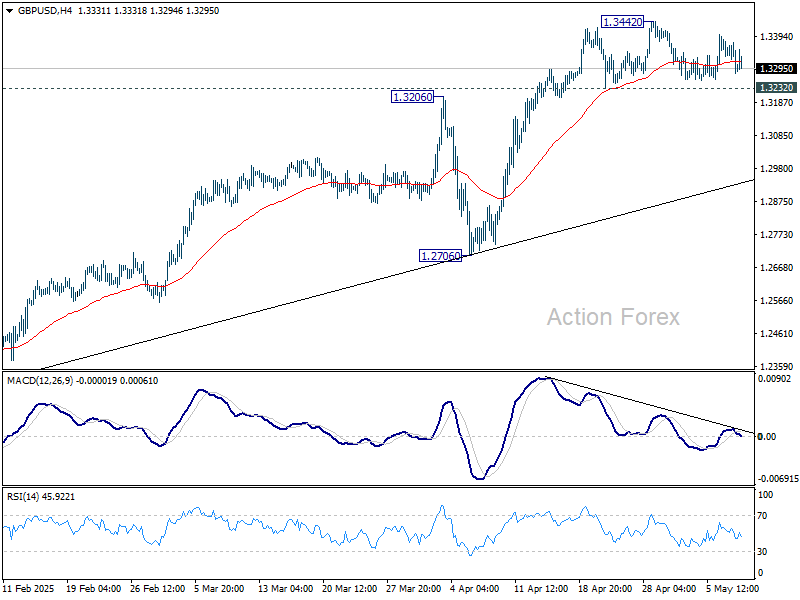
Range trading continues in GBP/USD and intraday bias remains neutral at this point. On the downside, firm break of 1.3232 support will indicate short term topping and rejection by 1.3433 key resistance. Intraday bias will be back on the downside for deeper pullback to 55 D EMA (now at 1.3051) and possibly below. On the upside, decisive break of 1.3433 key resistance will confirm larger up trend resumption.
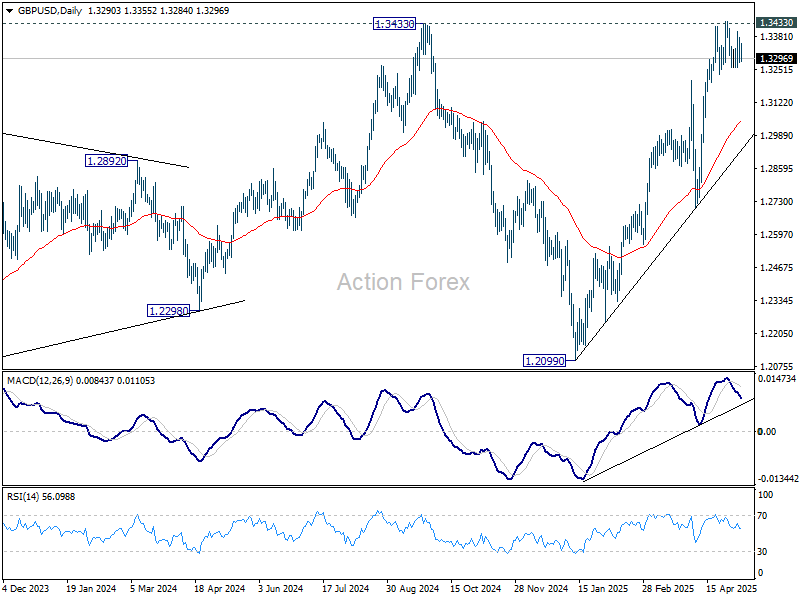
In the bigger picture, price actions from 1.3433 are seen as a corrective pattern to the up trend from 1.3051 (2022 low). Rise from 1.2099 could either be resuming the up trend, or the second leg of a consolidation pattern. Overall, GBP/USD should target 1.4248 key resistance (2021 high) on decisive break of 1.3433 at a later stage.
Sterling in Focus as BoE Decision and US-UK Trade Deal Speculation Loom
Trading in the forex markets remains subdued. Fed’s policy announcement overnight triggered minimal market reaction, as it delivered a widely expected hold at 4.25–4.50%. While Fed acknowledged that risks of both higher unemployment and higher inflation have increased, Chair Jerome Powell made it clear that rate cuts are not imminent.
“It’s not a situation where we can be preemptive,” Powell emphasized, reinforcing Fed’s data-dependent stance amid ongoing uncertainty from US tariff policies and their impacts.
As attention shifts away from Fed, focus turns squarely to the UK, where the BoE is expected to cut rates by 25 bps. Beyond the cut itself, traders will be parsing the vote split and updated economic projections for signals on the pace of future easing.
Adding a geopolitical dimension to the day’s event risk, there are growing market whispers that a US-UK trade deal will be announced. US President Donald Trump hinted in social media at a "MAJOR TRADE DEAL" to be announced today. While no country was named, sources cited by The Guardian said the deal involves the UK.
If formalized, it would be the first bilateral agreement by the current US administration since its sweeping tariff actions last month. A deal with Britain is seen as relatively straightforward, especially compared to more contentious and prolonged negotiations expected with the EU and China. For markets, such a development could inject fresh direction into an otherwise stagnant environment.
In terms of weekly performance, Yen continues to lead, followed by the Pound and Swiss Franc. On the other end, the Loonie is the weakest, followed by Aussie and Dollar. Euro and Kiwi sit in the middle. However, it should be emphasized that the overall mood remains indecisive, with major pairs and crosses largely trapped within last week's ranges.
In Asia, at the time of writing, Nikkei is up 0.53%. Hong Kong HSI is up 0.62%. China Shanghai SSE is up 0.21%. Singapore Strait Times is down -0.26%. Japan 10-year JGB yield is up 0.023 at 1.324. Overnight, DOW rose 0.70%. S&P 500 rose 0.43%. NASDAQ rose 0.27%. 10-year yield fell -0.033 to 4.275.
Looking ahead, BoE rate decision is the main focus in European session. Later in the day, US will release jobless claims and non-farm productivity.
BoE to cut, watch vote split and forecasts for dovish signals
BoE is widely expected to deliver a 25 bps rate cut today, bringing the Bank Rate down to 4.25%. Governor Andrew Bailey and fellow policymakers have consistently emphasized a cautious approach to cutting rates, and that tone is expected to persist amid lingering uncertainties.
Most economists surveyed by Reuters anticipated BoE will stick to a quarterly pace of easing, suggesting Bank Rate ends the year at 3.75%. However, market participants are slightly more dovish. Traders are now fully pricing in three more cuts by the end of 2025, projecting a rate of 3.50% at year-end.
There might be some hints on how dovish BoE is leaning to, from today's vote split and updated economic projections. In particular, focus will fall on whether known dove Swati Dhingra would push for a larger 50bps reduction, and whether there are material downgrades to both growth and inflation forecasts.
From a market perspective, EUR/GBP will be closely watched for signals on investor sentiment following the decision.
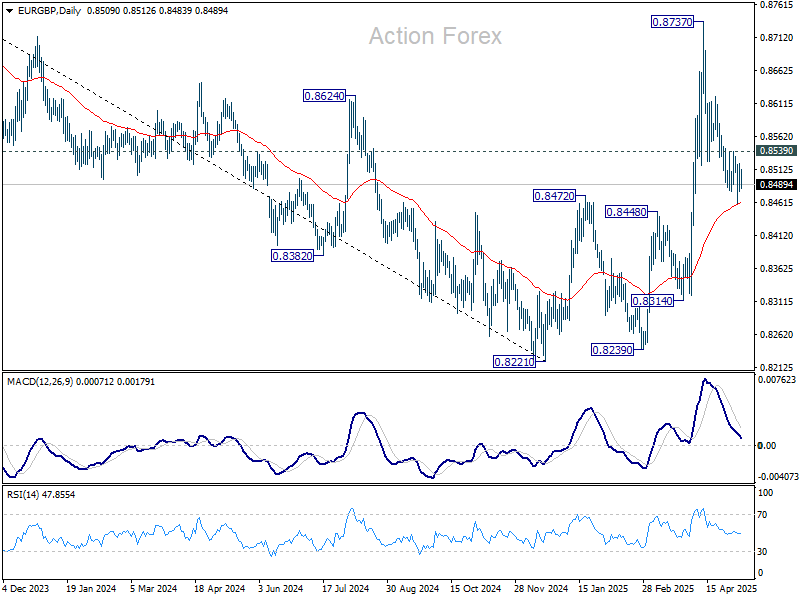
EUR/GBP is currently testing support at 55 D EMA (now at 0.8460). Strong rebound from current level would keep rally from 0.8239 alive. A break above 0.8539 resistance should confirm that fall from 0.8737, while deep, has completed as a correction. Retest of 0.8737 should be seen next.
On the flip side, sustained break below the 55 D EMA would raise the risk of near-term bearish reversal, and open the path back toward the 0.8221/0.8239 support zone.
RBNZ flags global growth risks as tariffs echo COVID-era disruptions
RBNZ Governor Christian Hawkesby warned today that rising global tariffs are having a clear and negative impact on global economic activity, prompting the central bank to revise down its projections for global growth.
Speaking to a parliamentary committee, Hawkesby called the effects of the tariff wave “unambiguously” harmful. He added that while New Zealand’s exposure to a 10% US tariff on exports poses challenges, the softer New Zealand Dollar may help cushion some of the blow. Nonetheless, weaker demand from key trading partners is now a growing concern for the country’s outlook.
Hawkesby drew a stark comparison between the supply-side disruptions caused by current tariffs and those seen during the COVID-19 pandemic, stressing that both are capable of delivering long-lasting economic distortions.
“We know from our experience, from the COVID experience, that supply side impacts are significant, and that are long-lasting and can create real challenges,” he said.
He added that the situation remains fluid, with considerable uncertainty about how the structural dynamics of the global economy will adjust to this new trade regime.
BoJ minutes: Caught between global uncertainty and domestic price pressures
Minutes from BoJ’s March meeting revealed growing concern among policymakers over the external risks posed by US tariff policies.
One member warned that downside risks from these policies had “rapidly heightened” and could significantly harm Japan’s real economy, suggesting BoJ should "be particularly cautious when considering the timing for the next rate hike."
However, not all board members advocated for a cautious stance. Another member stressed that even amid heightened uncertainty, BoJ should not automatically default to a cautious stance, stating that BOJ "might face a situation where it should act decisively".
A third voice on the board emphasized the importance of incorporating inflation expectations, upside risks to prices, and progress in wage growth into BoJ’s policy deliberations. Domestic developments could still justify tightening if conditions shift meaningfully.
Separately, BoJ Governor Kazuo Ueda reinforced this message in his remarks to parliament today, acknowledging that while food price volatility, particularly for rice, remains elevated, these pressures would ease over time.
Nonetheless, Ueda emphasized the importance of monitoring price developments closely, given the elevated uncertainty in the global economic environment.
GBP/USD Daily Outlook
Daily Pivots: (S1) 1.3254; (P) 1.3318; (R1) 1.3357; More...
Range trading continues in GBP/USD and intraday bias remains neutral at this point. On the downside, firm break of 1.3232 support will indicate short term topping and rejection by 1.3433 key resistance. Intraday bias will be back on the downside for deeper pullback to 55 D EMA (now at 1.3051) and possibly below. On the upside, decisive break of 1.3433 key resistance will confirm larger up trend resumption.
In the bigger picture, price actions from 1.3433 are seen as a corrective pattern to the up trend from 1.3051 (2022 low). Rise from 1.2099 could either be resuming the up trend, or the second leg of a consolidation pattern. Overall, GBP/USD should target 1.4248 key resistance (2021 high) on decisive break of 1.3433 at a later stage.
BoE to cut, watch vote split and forecasts for dovish signals
BoE is widely expected to deliver a 25 bps rate cut today, bringing the Bank Rate down to 4.25%. Governor Andrew Bailey and fellow policymakers have consistently emphasized a cautious approach to cutting rates, and that tone is expected to persist amid lingering uncertainties.
Most economists surveyed by Reuters anticipated BoE will stick to a quarterly pace of easing, suggesting Bank Rate ends the year at 3.75%. However, market participants are slightly more dovish. Traders are now fully pricing in three more cuts by the end of 2025, projecting a rate of 3.50% at year-end.
There might be some hints on how dovish BoE is leaning to, from today's vote split and updated economic projections. In particular, focus will fall on whether known dove Swati Dhingra would push for a larger 50bps reduction, and whether there are material downgrades to both growth and inflation forecasts.
From a market perspective, EUR/GBP will be closely watched for signals on investor sentiment following the decision.
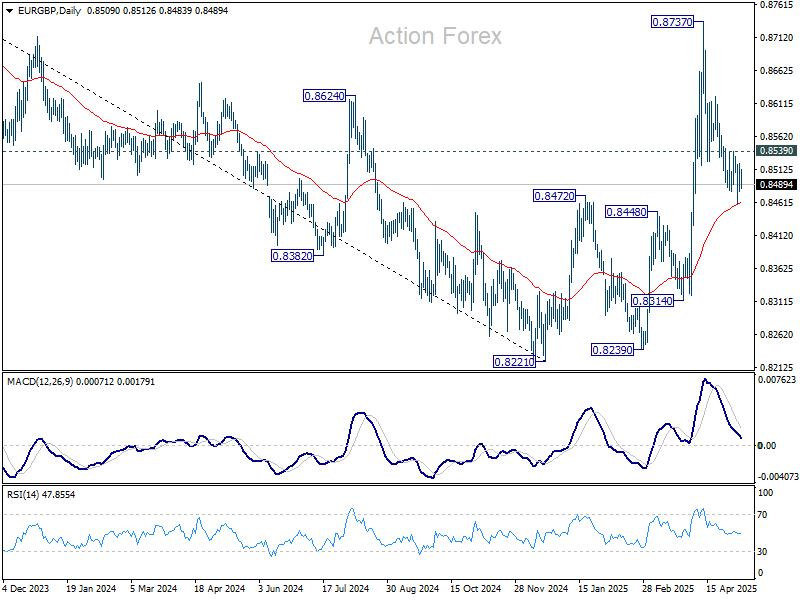
EUR/GBP is currently testing support at 55 D EMA (now at 0.8460). Strong rebound from current level would keep rally from 0.8239 alive. A break above 0.8539 resistance should confirm that fall from 0.8737, while deep, has completed as a correction. Retest of 0.8737 should be seen next.
On the flip side, sustained break below the 55 D EMA would raise the risk of near-term bearish reversal, and open the path back toward the 0.8221/0.8239 support zone.
BoJ minutes: Caught between global uncertainty and domestic price pressures
Minutes from BoJ’s March meeting revealed growing concern among policymakers over the external risks posed by US tariff policies.
One member warned that downside risks from these policies had “rapidly heightened” and could significantly harm Japan’s real economy, suggesting BoJ should "be particularly cautious when considering the timing for the next rate hike."
However, not all board members advocated for a cautious stance. Another member stressed that even amid heightened uncertainty, BoJ should not automatically default to a cautious stance, stating that BOJ "might face a situation where it should act decisively".
A third voice on the board emphasized the importance of incorporating inflation expectations, upside risks to prices, and progress in wage growth into BoJ’s policy deliberations. Domestic developments could still justify tightening if conditions shift meaningfully.
Separately, BoJ Governor Kazuo Ueda reinforced this message in his remarks to parliament today, acknowledging that while food price volatility, particularly for rice, remains elevated, these pressures would ease over time.
Nonetheless, Ueda emphasized the importance of monitoring price developments closely, given the elevated uncertainty in the global economic environment.
RBNZ flags global growth risks as tariffs echo COVID-era disruptions
RBNZ Governor Christian Hawkesby warned today that rising global tariffs are having a clear and negative impact on global economic activity, prompting the central bank to revise down its projections for global growth.
Speaking to a parliamentary committee, Hawkesby called the effects of the tariff wave “unambiguously” harmful. He added that while New Zealand’s exposure to a 10% US tariff on exports poses challenges, the softer New Zealand Dollar may help cushion some of the blow. Nonetheless, weaker demand from key trading partners is now a growing concern for the country’s outlook.
Hawkesby drew a stark comparison between the supply-side disruptions caused by current tariffs and those seen during the COVID-19 pandemic, stressing that both are capable of delivering long-lasting economic distortions.
“We know from our experience, from the COVID experience, that supply side impacts are significant, and that are long-lasting and can create real challenges,” he said.
He added that the situation remains fluid, with considerable uncertainty about how the structural dynamics of the global economy will adjust to this new trade regime.