Sample Category Title
DAX Dips to 3-Week Low as US-China Trade War Leave Investors with Sour Taste
The DAX index has lost ground in the Tuesday session. Currently, the DAX is trading at 11,336, down 0.44% on the day. On the release front, there are no German or eurozone indicators. German PPI dipped to 0.3%, matching the estimate.
Global stock markets remain under pressure, with the simmering U.S-China trade war a key factor. An Asia-Pacific Economic Cooperation summit in Papua New Guinea ended in discord on Sunday, with leaders unable to agree on a final communique. U.S Vice President Mike Pence, who headed the U.S. delegation, was blunt in his remarks, saying that China would have to drastically change its trade practices before the U.S. would remove current tariffs on $250 billion in Chinese goods. The DAX has declined 2.72% in November, and earlier on Tuesday dropped to its lowest level since late October.
The ECB remains on track to wind up its stimulus package in December, but policymakers may have to reassess this stance, based on recent eurozone growth numbers, which are the weakest since 2014. Germany, the locomotive of the eurozone, has hit some headwinds, after posting a decline in GDP in the third quarter. The simmering trade dispute between the U.S. and China shows no signs of being resolved anytime soon, which will continue to take a bite out of German and eurozone exports. If the eurozone economy continues to soften, there could be calls on the ECB to continue stimulus into 2019.
USD/JPY Mid-Day Outlook
Daily Pivots: (S1) 112.36; (P) 112.61; (R1) 112.81; More..
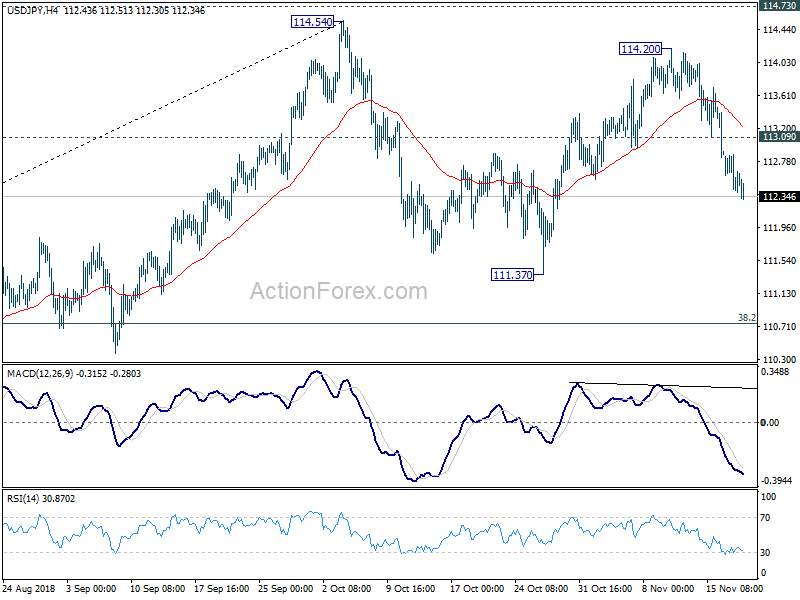
USD?JPY's fall from 114.20 is still in progress and intraday bias stays on the downside for 111.37 support and possibly below. Such decline is seen as the third leg of the consolidation pattern from 114.54. Downside should be contained by 38.2% retracement of 104.62 to 114.54 at 110.75 to bring rebound. On the upside, above 113.30 minor resistance will turn bias back to the upside for 114.54/73 key resistance zone.
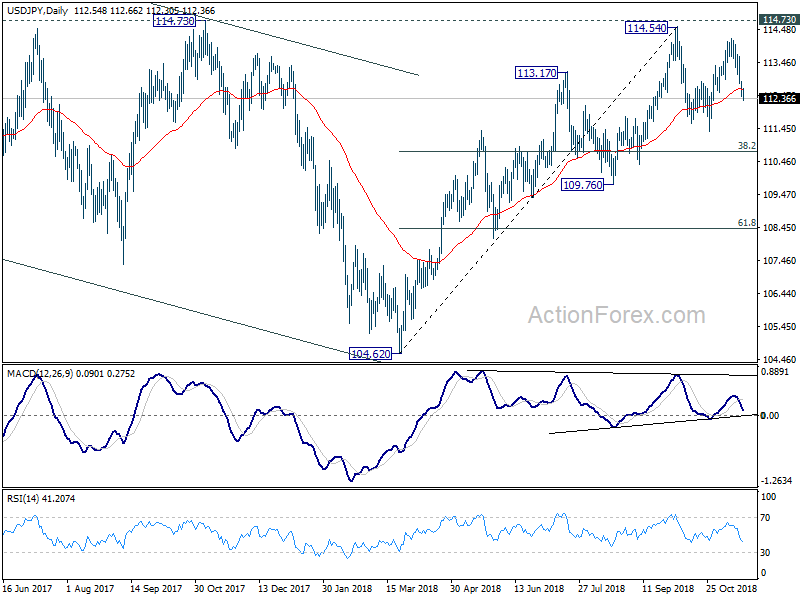
In the bigger picture, corrective fall from 118.65 (2016 high) should have completed with three waves down to 104.62. Decisive break of 114.73 resistance will likely resume whole rally from 98.97 (2016 low) to 100% projection of 98.97 to 118.65 from 104.62 at 124.30, which is reasonably close to 125.85 (2015 high). This will stay as the preferred case as long as 109.76 support holds. However, decisive break of 109.76 will dampen this bullish view and turns outlook mixed again.
Risk Aversion Intensifying, Yen and Swiss Franc Rally
Risk aversion dominates the global markets today and is intensifying. Major European indices are trading broadly lower with sign of downside acceleration. US futures also point to lower open, with DOW having triple-digit loss. In the currency markets, Australian Dollar is the weakest one for today. Euro follows as the second worst performing as German-Italian spread widens again. Swiss Franc and Japan Yen are the strongest one naturally. Sterling is mixed as UK Prime Minister Theresa May survived another day with no leadership challenge triggered yet.
Technically, there is no clear new development yet. Dollar could remain mixed as it's pressured by Swiss Franc and Yen. However, the greenback could pick up some strength against Euro and Canadian, and even Sterling and Aussie. Euro also seem to be losing upside momentum against both Dollar and Sterling. But most importantly, EUR/JPY is starting to feel heavy and could have a take on 127.49 minor support shortly.
In Europe, at the time of writing, FTSE is trading down -0.49%, DAX is down -1.17%, CAC is down -1.13%. German 10 year yield is down -0.021 at 0.355. Italian 10 year yield is up 0.004 at 3.605. Spread widens to 325. Earlier in Asia, Nikkei dropped -1.09%, Hong Kong HSI dropped -2.02%, China Shanghai SSE dropped -2.13%, Singapore Strait Times dropped -1.24%.
From the US, housing starts dropped to 1.23M annualized rate in October. Building permits dropped to 1.26M. Both matched expectations. Released earlier, UK CBI trends total orders rose to 10 in November, much better than expectation of -5. German PPI rose 0.3% mom, 3.3% yoy in October, matched expectations. Swiss trade surplus widened to CHF 3.75B in October.
BoE Carney: No-deal Brexit is not a financial crisis round two, but real economy shock
At the Treasury Committee BoE Inflation Report hearing, BoE Governor Mark Carney emphasized that a no-deal Brexit is "not a financial crisis round two" where central banks take center stage. Instead, " this is a real economy shock and therefore central banks have a role but we're more of a sideshow." He also added the real issues are going to be in the real economy. They'll be about "how well the logistics system works, where business confidence is, what access, if any, is there in a true, no-deal transition Brexit."
Carney acknowledged that "implied volatility in sterling is very high right now, much higher than it is for other major currencies" for "political discussions" with "importance" for the short to medium term outlook. And, "it will continue to be volatile for the next month at least".
Chief economic Andy Haldane said "notwithstanding the fact that details of the (Brexit) deal remain to be agreed, we are seeing somewhat greater impact on the behavior of companies in particular in the last month or two." And, "that could make for a somewhat weaker fourth quarter than we saw in the third quarter, and certainly a more volatile path for output I think over the next few months."
EU Centeno: Italy's growth and social issues can be achieved without putting fiscal consolidation at risk
Talking about Italy, Eurogroup President Mario Centeno expressed his empathy and said "I understand and share Italy's concerns about sluggish growth and complex social issues". However, he also emphasized that "this can be achieved without placing a trajectory of fiscal consolidation at risk."
He also emphasized that adhering to fiscal rules is "not only in each country's individual interest, but also in our collective interest". He pointed to the Eurozone debt crisis and said it "has taught us that in an economic and monetary union, the responsibility to conduct sound and responsible policy does not stop at national borders."
Regarding the Franco-German proposal of Eurozone budget, he said "a common fiscal capacity should not discharge countries from their obligation to conduct sound fiscal policies and respect the fiscal rules." On the other hand, Eurozone statement would be better on reacting to asymmetric shocks, without overburdening the ECB.
Separately, ECB Governing council member Ewald Nowotny said Italy is not "an immediate threat" but rather a "political problem". However, "in the longer term there is the question of whether I have enough trust on the capital markets."
RBA Lowe reiterated three central messages of the central bank
RBA Governor Philip Lowe reiterated the three central messages in the meeting minutes, in a speech titled "Trust and Prosperity". He noted:
"First, the economy is moving in the right direction and further progress is expected in lowering unemployment and having inflation consistent with the target.
Second, the probability of an increase in interest rates is higher than the probability of a decrease. If the economy continues to move along the expected path, then at some point it will be appropriate to raise interest rates. This will be in the context of an improving economy and stronger growth in household incomes.
Third, the Board does not see a strong case for a near-term change in interest rates. There is a reasonable probability that the current setting of monetary policy will be maintained for a while yet. This reflects the fact that the expected progress on our goals for unemployment and inflation is likely to be gradual. The Board's view is that it is appropriate to maintain the current setting of policy while this progress is made."
IMF: Australia's growth to continue but risks tiled to the downside
IMF noted in a report that Australia's recent strong growth is expected to "continue in the near term". Also, "further reducing slack in the economy and leading the way to gradual upward pressure on wages and prices." In particular, "private consumption growth is anticipated to remain buoyant, supported by strong employment gains." Also, "rebound in non-mining private business investment and further growth in public investment is envisaged to offset a softening in dwelling investment."
However, balance of risks is "tilted to the downside" with a "less favorable global risk picture". IMF noted "weaker-than-expected near-term outlook in China coupled with further rising global protectionism and trade tensions could delay full closure of the output gap". Also, "sharp tightening of global financial conditions could spill over into domestic financial markets, raising funding costs and lowering disposable income of debtors, with the impact also depending on the response of the Australian dollar".
Also, "domestic demand may equally turn out weaker if wage growth remained subdued or investment spillovers were smaller." Housing market downturn is "another source of risk". But under the baseline outlook, the housing correction "remains orderly". But negative risk developments could "amplify the correction and lower domestic demand."
BoJ Kuroda: Negative rate still necessary but no need to take extra easing
BoJ Governor Haruhiko Kuroda ruled out the need to ramp up stimulus today. He said that "there's no need to take additional steps. What's important is to ensure our policy is sustainable, with an eye on balancing its pros and cons."
But at the same time, he also ruled out an early end to the negative interest rate policy. He noted "I know there is various debate on the BoJ's negative rate policy", "but for the time being, it's a necessary step that is part of our large-scale monetary easing program."
Kuroda remained optimistic that "wage and price growth will likely accelerate" and lift inflation to 2% target eventually. But that change of doing that any time during fiscal 2020 is "slim".
USD/JPY Mid-Day Outlook
Daily Pivots: (S1) 112.36; (P) 112.61; (R1) 112.81; More..
USD?JPY's fall from 114.20 is still in progress and intraday bias stays on the downside for 111.37 support and possibly below. Such decline is seen as the third leg of the consolidation pattern from 114.54. Downside should be contained by 38.2% retracement of 104.62 to 114.54 at 110.75 to bring rebound. On the upside, above 113.30 minor resistance will turn bias back to the upside for 114.54/73 key resistance zone.
In the bigger picture, corrective fall from 118.65 (2016 high) should have completed with three waves down to 104.62. Decisive break of 114.73 resistance will likely resume whole rally from 98.97 (2016 low) to 100% projection of 98.97 to 118.65 from 104.62 at 124.30, which is reasonably close to 125.85 (2015 high). This will stay as the preferred case as long as 109.76 support holds. However, decisive break of 109.76 will dampen this bullish view and turns outlook mixed again.
Economic Indicators Update
| GMT | Ccy | Events | Actual | Forecast | Previous | Revised |
|---|---|---|---|---|---|---|
| 00:30 | AUD | RBA Minutes | ||||
| 07:00 | CHF | Trade Balance (CHF) Oct | 3.75B | 2.89B | 2.43B | 2.23B |
| 07:00 | EUR | German PPI M/M Oct | 0.30% | 0.30% | 0.50% | |
| 07:00 | EUR | German PPI Y/Y Oct | 3.30% | 3.30% | 3.20% | |
| 11:00 | GBP | CBI Trends Total Orders Nov | 10 | -5 | -6 | |
| 13:30 | USD | Housing Starts Oct | 1.23M | 1.23M | 1.20M | 1.21M |
| 13:30 | USD | Building Permits Oct | 1.26M | 1.26M | 1.24M | 1.27M |
Special Report: Bitcoin- How Low Can It Go?
Bitcoin has broken some key levels and serious questions are being raised about price stability. In addition to this, the concept of limited supply is under a huge threat, the developer community really need to stick together otherwise and stop the process of forking.
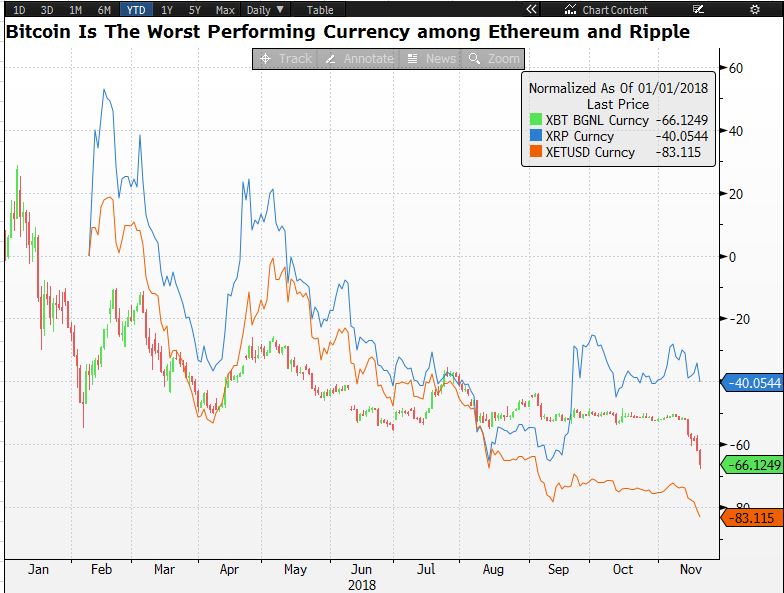
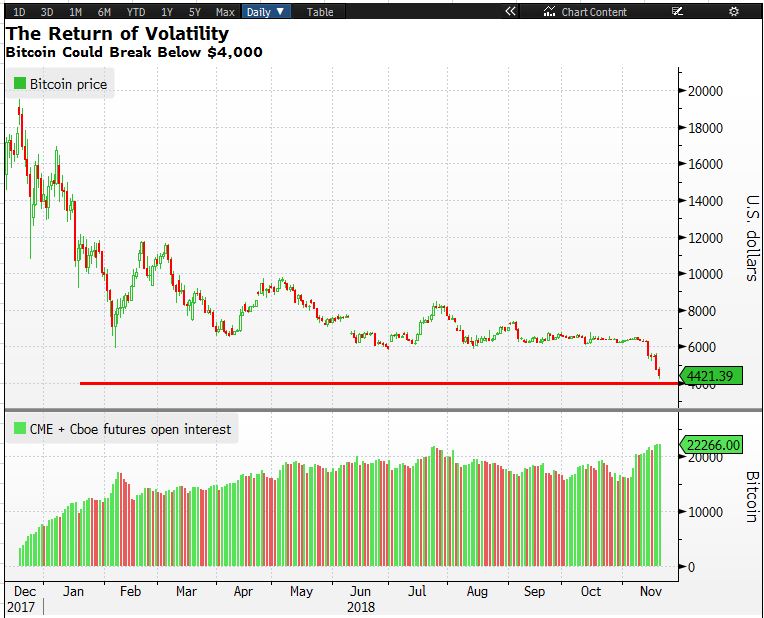
The crypto king is being hit hard and it is under tremendous selling pressure. Today marks the eighth consecutive day of sell off for Bitcoin. It is down nearly 78 percent from its all-time peak of nearly $20K (depending on which exchange you look at).
Year-to-date, the price is down nearly 69.26%. At the time of writing, the price is trading at $4,391. All other major cryptocurrencies are feeling the burnt. Ethereum, the second biggest cryptocurrency, has touched $121, a level not seen since May 2017. XRP, a token associated with Ripple, is by far the strongest coin now and it has gained the number 2 position once again (according to coinmarketcap.com).
The open interest for Bitcoin futures on CME group and CBOE exchanges has jumped to 22,266 hitting an all-time high. Open interest is by definition a measure of market activity, or simply put the flow of money into the futures market. Higher open interest means new money joining the market and lower open interest means fewer investors are interested in this market.
Bitcoin broke the $5,000 mark yesterday for the first time, breaking yet another psychological level. This made the sentiment sour. The break of $6,000 was the first major psychological level to be broken and now a violation of the $5,000-mark is further evidence that the bulls are not supporting the price. The next big support level is at $4,000. One can only pray that the price doesn’t break below this critical level because this would open the floor towards the $3,000 level.
Fundamentally speaking, the current sell-off is due to two main reasons; regulatory pressure and disagreement within the coin developer community, one of the biggest threats. The SEC reminded the crypto world that it has the final say over anything that smells like a security. The department issued civil penalties against two cryptocurrency companies because they failed to register initial coin offerings as securities. Investors will be given their refund and the firms will have to face fines. The fear is that the SEC may not stop here and might take similar action against several companies that adopted a similar path.
The community needs to stick together and work towards a more meaningful fork. This is because, developers, on the one hand, try to convince the world that the supply is limited and, on the other hand, they keep looking at ways of triggering another kind of forks. Forking has become so common that it puts at risk the notion of limited supply altogether.
Canadian Dollar Edges Higher, US Housing Reports Next
The Canadian dollar has posted slight losses for a second straight day. Currently, USD/CAD is trading at 1.3196, up 0.19% on the day. On the release front, there are no Canadian data releases on the schedule. In the U.S., the focus is on construction numbers. Building Permits is expected to improve to 1.26 million and Housing Permits is also forecast to rise to 1.23 million. On Wednesday, the U.S. releases durable goods orders, unemployment claims and consumer confidence.
The economic forecast calls for further raise rates in 2019, but the pace could be slower than anticipated just a few weeks ago. The U.S economy continues to fire on all cylinders, with unemployment at historically low levels and the $1.5 trillion tax cut package boosting economic growth. However, there are concerns that economic growth could soften in 2019. The U.S-China trade war is expected to take a bite out of U.S growth, and the stimulus from the Trump tax cut will fade over time. GDP has been slowing on an annualized basis – from a sizzling 4.2% in the first quarter, to 3.5% in Q2, with Q3 expected at just 2.7%. The downward trend is expected to continue into 2019, with a growth forecast of 2.0% to 2.5%. If these forecasts materialize, the Fed could decide to raise rates more slowly next year. Many analysts had expected a hike of 25 basis points each quarter, but that could be revised lower to three rates next year. A December hike stands at 70 percent, down from 75% just one week ago. This has made the U.S dollar less attractive to investors and boosted the euro and other major currencies.
The ongoing trade dispute between the U.S. and China shows no signs of being resolved anytime soon, which does not bode well for minor currencies like the Canadian dollar. An Asia-Pacific Economic Cooperation summit in Papua New Guinea ended in discord on Sunday, with leaders unable to agree on a final communique. U.S Vice President Mike Pence, who headed the U.S. delegation, was blunt in his remarks, saying that China would have to drastically change its trade practices before the U.S. would remove current tariffs on $250 billion in Chinese goods.
AUDJPY Challenges 23.6% Fibonacci Mark; Falls in Downward Sloping Channel in Long Term
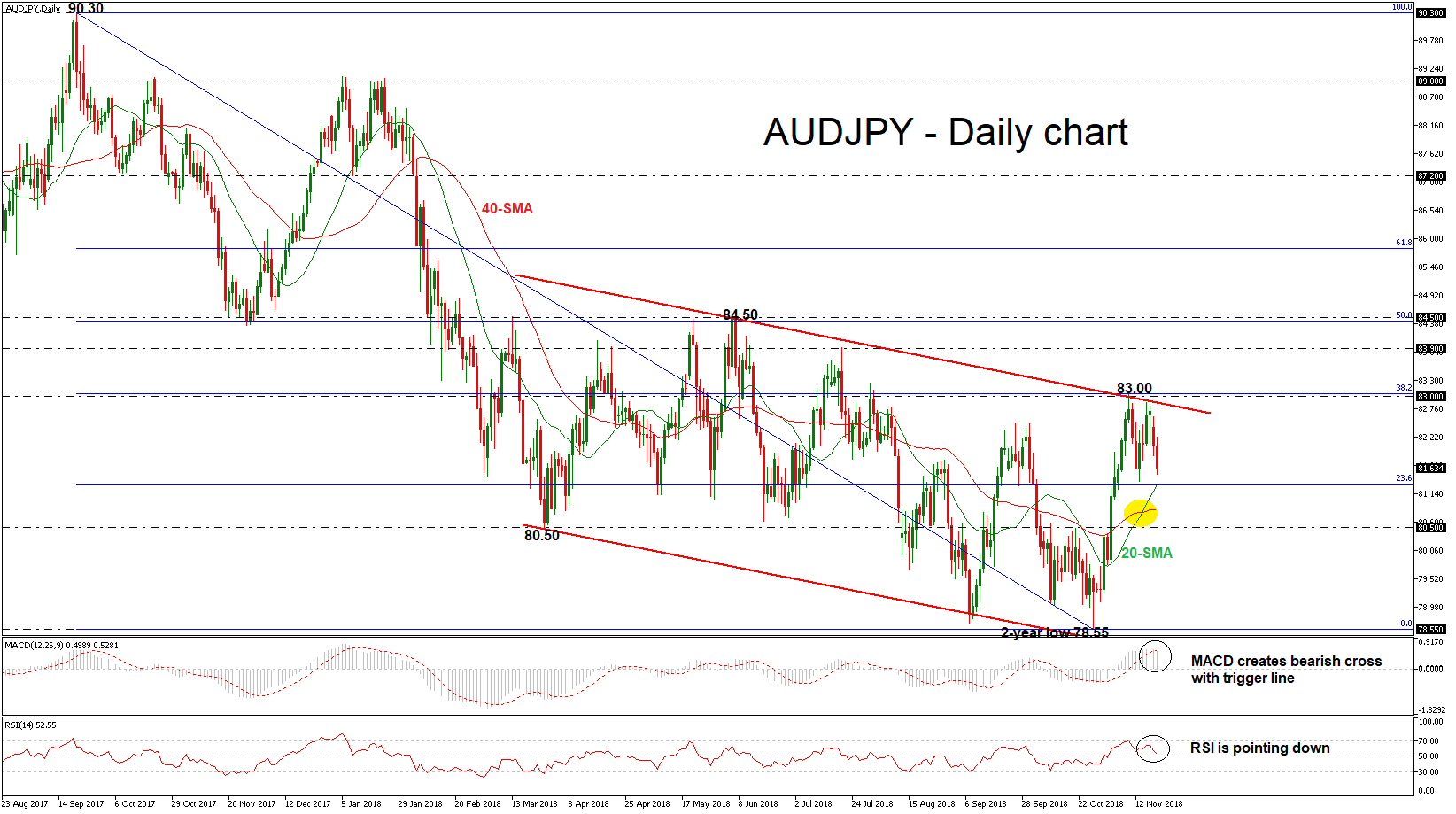
AUDJPY has reversed back down again after reaching resistance at the 83.00 handle, which coincides with the 50-week simple moving average (SMA). Momentum indicators are pointing to a neutral to bearish bias in the short-term. The MACD oscillator has slipped below the trigger line, indicating further losses and the RSI indicator is pointing down near the 50 region.
Further losses should bring into focus the 20-day SMA at 81.30 at the time of writing, which coincides with the 23.6% Fibonacci retracement level of the downleg from 90.30 to 78.55. A bit lower, the 40-day SMA could act as support around 80.80 as well. A drop below the SMAs would reinforce the recent bearish sentiment in the short-term and open the way towards the next key level of 80.50. More downside pressure could challenge again the two-year nadir of 78.55.
On the other side, immediate resistance to gains may come around 83.00, which overlaps with the 38.2% Fibonacci. Steeper increases would bring the pair around 83.90, taken from the high on July 19 within scope.
To sum up, in the long-term view, AUDJPY has been trading within a downward sloping channel since March and there are signs for further weakening in the near term too.
Into US session: Risk aversion dominates, Aussie and Euro suffer
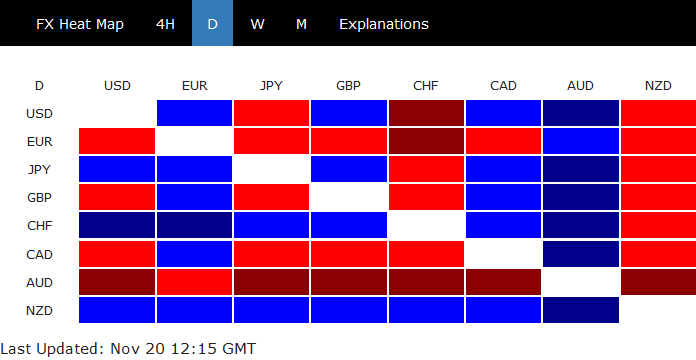
Entering into US session, risk aversion remain the main theme in the financial markets today. It started with selloff in tech stocks in the US yesterday, and spread to Asia and Europe. Australian Dollar suffers and is trading as the weakest one despite relatively upbeat RBA minutes. Euro follows as the second weakest as German-Italian spread widens to above 320.
New Zealand Dollar, though, decouples from others commodity currencies and is trading as the strongest one. the Kiwi is followed by Swiss Franc and Yen, rather normal. Sterling is mixed as BoE Mark Carney's inflation hearing provided nothing inspirational. There is also no special news on no-confidence vote on Prime Minister Theresa May yet.
In Europe, at the time of writing:
- FTSE is up 0.00%
- DAX is down -0.74%
- CAC is down -0.74%
- German 10 year yield is down -0.0117 at 0.364
- Italy 10 year yield is down -0.0062 at 3.595. German-Italian spread is now at 323.
Earlier in Asia, all major indices ended down:
- Nikkei dropped -1.09% to 21583.12
- Hong Kong HSI dropped -2.02% at 25840.34
- China Shanghai SSE dropped -2.13% to 2645.85
- Singapore Strait Times dropped -1.24% to 3026.99
- Japan 10 year JGB yield rose 0.0092 to 0.104, back above 0.1%.
EUR/USD – Euro Edges Higher As Fed May Slow Rate Increases
EUR/USD has posted slight gains in the Tuesday session, erasing the losses seen on Monday. In the European session, the pair is trading at 1.1431, down 0.17% on the day. On the release front, German PPI dipped to 0.3%, matching the estimate. In the U.S, the focus is on construction data. Building Permits is expected to improve to 1.26 million and Housing Permits is also forecast to rise to 1.23 million. On Wednesday, the U.S. releases durable goods orders, unemployment claims and consumer confidence.
The Federal Reserve remains on track to gradually raise rates in 2019, but the pace could be slower than anticipated just a few weeks ago. There’s no denying that the U.S economy is currently in great shape, with unemployment at historically low levels and the $1.5 trillion tax cut package boosting economic growth. However, the rosy picture could change next year. The U.S-China trade war is expected to take a bite out of U.S growth, and the stimulus from the tax cut will fade over time. GDP has been slowing on an annualized basis – from a sizzling 4.2% in the first quarter, to 3.5% in Q2, with Q3 expected at just 2.7%. The downward trend is expected to continue into 2019, with a growth forecast of 2.0% to 2.5%. If these forecasts materialize, the Fed could decide to raise rates more slowly next year. Many analysts had expected a hike of 25 basis points each quarter, but that could be revised lower to three rates next year. A December hike stands at 70 percent, down from 75% just one week ago. This has made the U.S dollar less attractive to investors and boosted the euro and other major currencies.
Bitcoin Loses 30% In A Week
Global equities remain on the back foot; with Asian and Euro bourses tracking North American equities lower overnight amid investor fears over global trade and FAANG stocks.
The ‘big’ dollar is little changed in Euro trading, Euro bonds are a tad lower, while U.S 10-year notes trade atop of +3.06% ahead of a holiday shortened U.S Thanksgiving week.
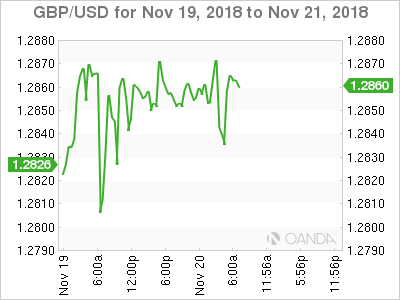
Elsewhere, sterling (£1.2839) trades relatively stable in a tight range as PM Theresa May reaches out to the business community to help her deliver ‘her’ Brexit deal. Also, there is mounting evidence that a plot to try and oust her from power is waning. Nevertheless, uncertainty is likely to loom for the foreseeable future, given that no date has been set for the U.K Parliament to vote on the Brexit deal and PM could still face a no-confidence vote.
Bitcoin is trading well below the psychological $5,000 ($4,382) for the first time in 13-months, crude trading around $57 a barrel.
1. Stocks see red
Yesterday, U.S equities came under heavy selling, as investors dumped Apple, internet and other tech stocks, aided by conflicting signals between the Sino-U.S trade dispute. The theme remains the same in overnight trading.
In Japan, the Nikkei fell to a three-week low as a drop in Nasdaq dragged down Japanese tech names, and while Nissan Motor plummeted on news of Chairman Carlos Ghosn’s arrest and dismissal. Also, gains in the yen and bond prices have pressured equities. The Nikkei share average ended -1.1% lower, while the broader Topix shed -0.7%.
Down-under, Australia’s ASX 200 dropped -0.38% though managed to pare majority of the losses as financials and miners notched surprise gains late in the day. In S. Korea, the Kospi was -0.8% lower, with Samsung and Hynix down -2-3% after the tech-led slide stateside.
In China, stocks dropped the most in three-weeks overnight, led by financial and tech shares. The blue-chip CSI300 index fell -2.3%, while the Shanghai Composite Index lost -2.1%. In Hong Kong, stocks gave up -2% to log their biggest one-day loss in more than a week.
Note: Chinese stock markets had been largely insulated from recent negative market moves on hopes of further stimulus measures from authorities.
In Europe, regional bourses trade lower on Brexit uncertainty as well as continuing trade tensions.
U.S stocks are set to open deep in the ‘red’ (-0.8%)
Indices: Stoxx600 -0.9% at 352, FTSE -0.6% at 6958, DAX -1.3% at 11095, CAC-40 -1.0% at 4935, IBEX-35 -1.1% at 8909, FTSE MIB -0.7% at 18655, SMI -0.4% at 8780, S&P 500 Futures -0.8%.
2. Oil prices slip despite expected OPEC cuts, gold unchanged
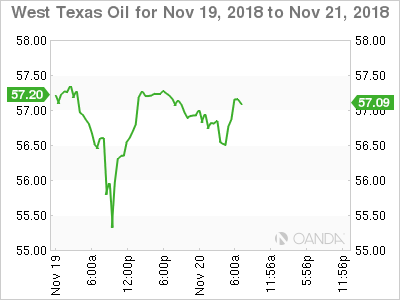
Understanding the oil market has become a tad more difficult due to rising geopolitical uncertainties and U.S foreign policies concerning OPEC and other top producers. The ‘black stuff’ has again come under pressure despite expectations that OPEC will introduce new output curbs.
Brent crude oil futures are at +$66.37 a barrel, down -42c, or -0.6% from Monday’s close, while U.S West Texas Intermediate (WTI) crude futures are at +$56.94 per barrel, -26c, or -0.5%, below their last settlement.
Market consensus sees oil-demand growth over the next couple of quarters will help balance rising supplies, but demand could structurally slow further into 2019-2020.
In this scenario, OPEC and company will be required to act decisively and quickly with a combined supply cut if they want to avoid a much deeper pull back in oil prices.
The North American crude ‘bears’ continue to see further price downside risks from the growth in U.S shale production as well as the deteriorating economic outlook.
Note: U.S crude oil production has climbed by almost +25% this year, to a record of +11.7M bpd.
Concerned about an emerging production overhang, OPEC is expected to push for cuts at its December 6 meeting – expectations for a supply cut are in the region of -1M to -1.4M bpd.
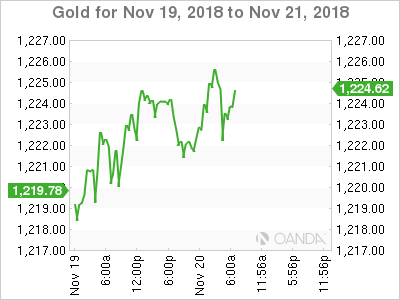
Ahead of the U.S open, gold prices are trading steady, after moving in a tight range in holiday-thinned trading. The ‘yellow’ metal is holding above the psychological +$1,220 level as the ‘big’ dollar was pressured by weaker U.S economic data and a clouded interest rate outlook.
Spot gold is little changed at +$1,224.45 per ounce, while U.S gold futures are flat at +$1,224.8 per ounce.
3. Italian government bond yields soar
Italian BTP yields have jumped to a one-month highs earlier this morning, pushed higher on risk aversion triggered by sharp tech equity losses, tensions over Brexit and concerns about the Italian budget.
Italian BTP yields have backed up as much as +13 bps, with five-year yields rising to +2.97%, and those on 10-year bonds reaching a one-month high of +3.70%.
Germany’s 10-year Bund yield has hit a three-week low at +0.347%.
With little sign of any easing in the Italian government’s budget dispute with the E.U Commission and with the vulnerability of the Italian bond market likely to remain very high has widened the BTP/Bund spread. The 10-year Italy/German Gov’t bond spread has widened by over +10 bps to +333 bps for a one-month high.
Note: The market is waiting for the E.U Commission’s expected response to the Italian budget draft tomorrow, Wed Nov 21.
Elsewhere, the yield on U.S 10-year notes has dipped -1 bps to +3.06%, hitting the lowest in more than seven-weeks with its eighth straight decline. In the U.K, the 10-year Gilt yield has gained +1 bps to +1.378%.
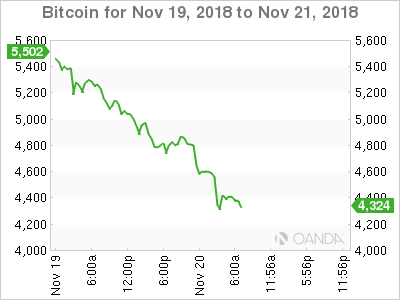
4. Bitcoin loses 30% in a week
Bitcoin (BTC) has fallen -18% in the last day. Since the market began to drop last Wednesday, it’s down -30% and in the context of BTC all-time high of $19,783.06 in mid-December of last year, the cryptocurrency is down -75% from its high print. A new version of Bitcoin cash was introduced last week (Bitcoin ABC) and this has provided some of the immediate weakness.
EUR/USD (€1.1433) initially tested the €1.1470 area overnight before running into strong resistance – widening of the Italian/Bund spread has aided the EUR ‘bear’ as they see little sign of an easing in the Italian government’s budget dispute with the E.U Commission. The E.U Commission is expecting a response to the Italian budget draft tomorrow.
GBP/USD (£1.2862) remain in a tight range. No date has been set yet for the U.K Parliament to vote on the Brexit deal and PM May could still face a no-confidence vote before then. BoE Carney is currently testifying to the Treasury select committee on its Brexit preparations.
Note: Brexiteers remain short of the 48 signatures needed to trigger a no confidence vote in PM May. The confidence vote now appears to be on hold until after Parliament votes next month on PM May’s Brexit deal, which will itself be seen as a referendum on her leadership.
5. BoE’s Carney says central bank a sideshow in “No Deal” Brexit
This morning, BoE Governor and several MPC members are testifying on U.K inflation and the economic outlook before Parliament’s Treasury Committee.
Governor Carney has noted that if the U.K crashes out of the E.U without a deal on its future relationship with the bloc the central bank’s response will be “a sideshow.”
In testimony to lawmakers, Carney says whether the BoE cuts or raises interest rates are of less importance that what such an outcome would mean for the economy.
“This is not the financial crisis round two, where the Bank of England and other central banks were center-stage,” he says. “This is a real economy shock and therefore central banks have a role but we’re more of a sideshow.”
EUR/JPY Bearish Sentiment Today
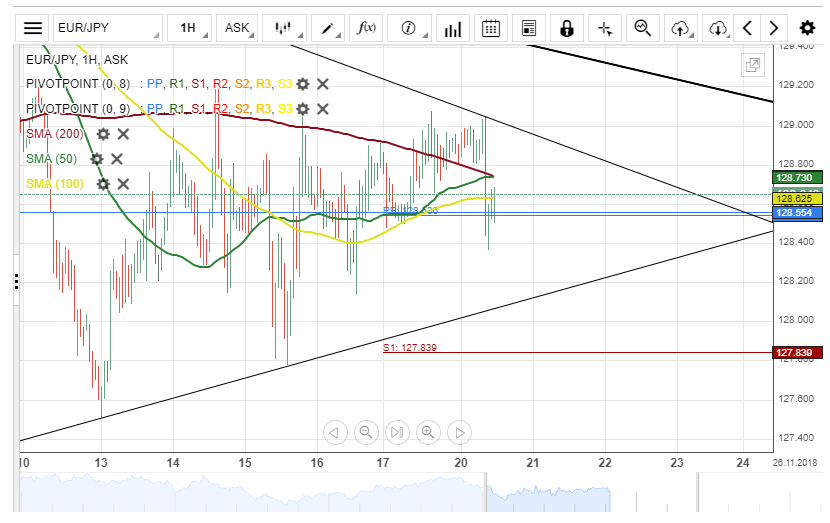
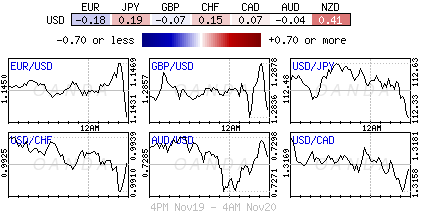
The single European currency appreciated about 60 base points against the Japanese Yen on Monday. The exchange rate breached the 200-hour simple moving average at 128.88 during the end of the previous session.
Today's session begins with a bearish sentiment and by the middle of the European trading session on Tuesday, the currency pair has dashed through all three SMAs and a support level formed by the weekly PP at 128.53.
By and large, it is likely that the bearish momentum continues to dominate the EUR/JPY pair within this session and potentially aim at a swing low of 127.60 during the following trading session