Sample Category Title
Silver: White Metal Trading On A Negative Footing This Morning
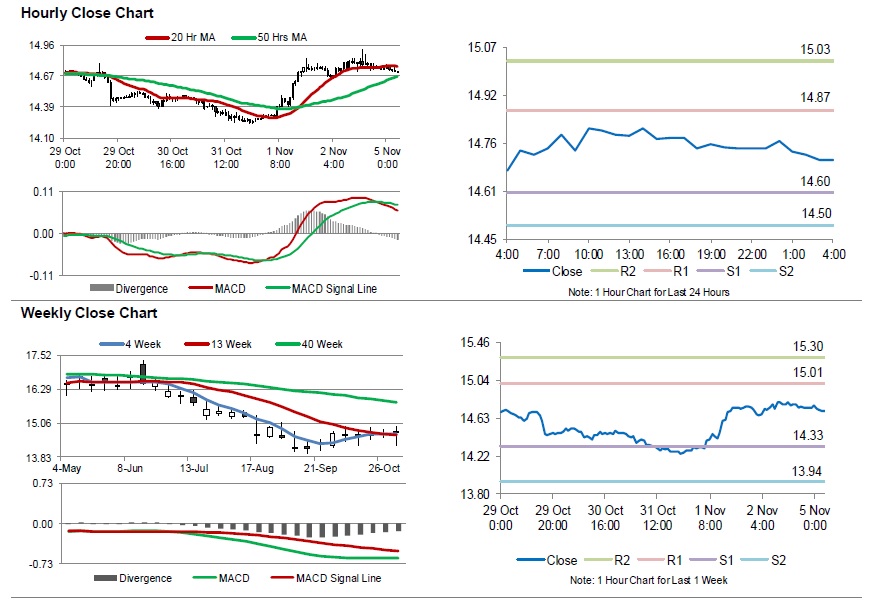
For the 24 hours to 23:00 GMT, Silver marginally declined against the USD and closed at USD14.75 per ounce on Friday, tracking losses in gold prices.
In the Asian session, at GMT0400, the pair is trading at 14.71, with silver trading 0.27% lower against the USD from Friday’s close.
The pair is expected to find support at 14.60, and a fall through could take it to the next support level of 14.49. The pair is expected to find its first resistance at 14.89, and a rise through could take it to the next resistance level of 15.03
The white metal is trading between its 20 Hr and 50 Hr moving average.
Crude Oil: Oil Trading Lower In The Morning Session
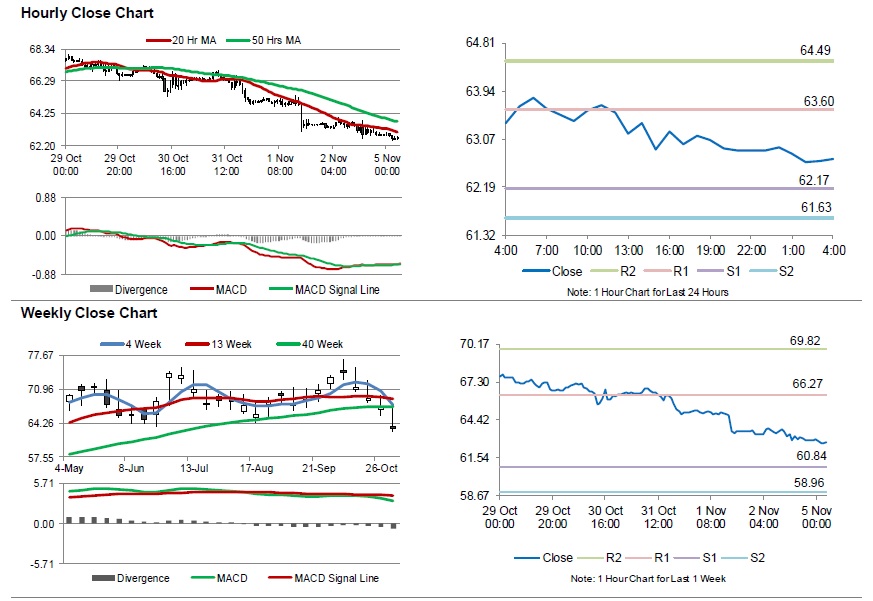
For the 24 hours to 23:00 GMT, Crude Oil declined 1.04% against the USD and closed at USD62.90 per barrel on Friday, amid concerns over America’s plans to issue waivers on Iranian oil sanctions and growing global crude production. Meanwhile, fresh figures from Baker Hughes disclosed that the number of active oil rigs fell by 1 to 874, declining for the first time in four weeks in the week ended 02 November.
In the Asian session, at GMT0400, the pair is trading at 62.71, with oil trading 0.30% lower against the USD from Friday’s close, as US granted Iran sanction waivers to 8 importers.
The pair is expected to find support at 62.17, and a fall through could take it to the next support level of 61.63. The pair is expected to find its first resistance at 63.60, and a rise through could take it to the next resistance level of 64.49.
Crude oil is trading below its 20 Hr and 50 Hr moving averages
Eurozone FMs to discuss Italy’s recipe for reviving growth
Italy's budget will certainly be a hot topic in the summit of Eurozone finance minister meeting in Brussels today. It comes at time time after European Commission rejected the country's 2019 budget, with deficit target at 2.4% of GDP. The Commission demand Italy to revise the plan by November 13, But Prime Minister Giuseppe Conte insisted there is no "Plan B" for the program and indicated no intention to comply with EU's demand.
Italian Deputy Prime Minister Luigi Di Maio, leader of the 5 Star Movement, said over the weekend that the coalition government "will not cede an inch" on the budget. He also hailed that their own plan will become a "recipe" for reviving European growth.
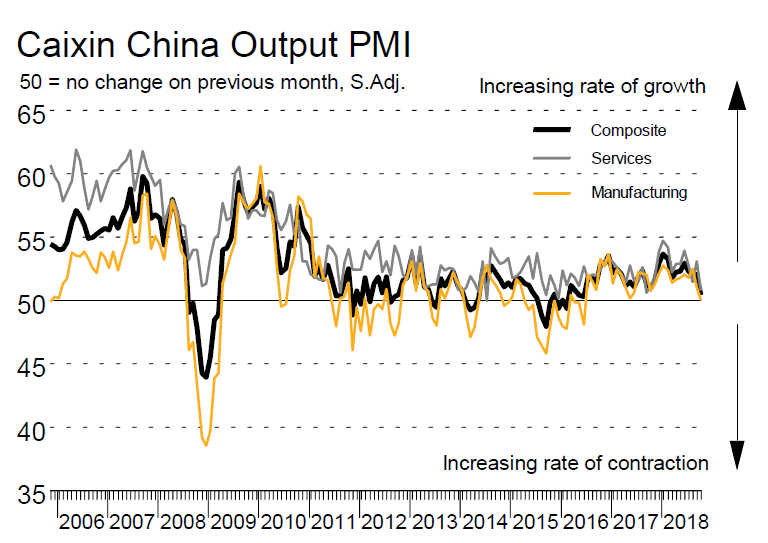
China Caixin PMI composite dropped to 28-month low, mounting downward pressure on the economy
China Caixin PMI services dropped to 50.8 in October, down from 53.1 and missed expectation of 52.9. That's the lowest level in 13 months.
PMI composite output index dropped from 51.2 to 50.5, hitting a 28-month low, lowest since June 2016.
Commenting on the China General Services PMI™ data, Dr. Zhengsheng Zhong, Director of Macroeconomic Analysis at CEBM Group said:
"The Caixin China General Services Business Activity Index slipped significantly to 50.8 in October from the previous month, marking its lowest level since September 2017. The subindex for new business dropped to its lowest point since November 2008, despite staying in expansionary territory, indicating an obviously weakening demand for services. The employment subindex returned to positive territory following a drop in the previous month. The subindex for prices charged by service providers also returned to positive territory, while the one for input costs dropped despite staying in positive territory, suggesting easing pressure on company profit margins. The subindex for business expectations, which gauges services providers' confidence toward operation prospects over the next 12 months, edged down mildly.
"The Caixin China Composite Output Index dipped to 50.5 in October from the previous month, reaching its lowest level since June 2016, indicating mounting downward pressure on China's economy. The subindex for new orders fell, pointing to softening overall demand conditions. The employment subindex edged up despite staying in negative territory, which could possibly be due to government efforts to stabilize the labor market. The subindex for input costs remained unchanged from the month before, while the one for output charges inched up, indicating easing pressure on company profit margins — though upward price pressure remained. The subindex for future output edged down, reflecting weakening confidence among companies."
China Xi pledged unambitious USD 30T imports at CIIE
China is holding a week-long China International Import Expo, or CIIE, in Shanghai, starting today. President Xi Jinping said "CIIE is a major initiative by China to pro-actively open up its market to the world." And, he noted "economic globalization is facing setbacks, multilateralism and the free trade system is under attack, factors of instability and uncertainty are numerous, and risks and obstacles are increasing." That's the usual rhetorics that China has been using to position itself as defender of free trade.
Nevertheless, Xi also pledged to cut import taxes further and spend more on foreign goods and services. He said China's goods import will exceed USD 30T over the next 15 years. Meanwhile, Services import will exceed USD 10T. The figure on goods was somewhat raised from Xi's prior promise of USD 24T. But the fact is, USD 30T over 15 years means only USD 2T per annum, which Chin has already nearly met back in 2013 and 2014. After a dip to USD 1.6T in 2016, import has already bounced back to USD 1.8T in 2017. So, Xi's target is not that ambitious.
BoJ minutes: Need to explain thoroughly the intention to continue with powerful easing
BoJ released minutes of September 18-19 monetary policy meeting. The minutes reiterated that the measures taken back in July, including introduction of forward guidance, were for strengthening the framework for "continuous" powerful monetary easing. However, A few members noted some market participants still viewed BoJ's intention as "unclear". Thus, "it was important to continue to thoroughly explain that the measure was intended to make clearer the Bank's policy stance that it would persistently continue with powerful monetary easing while taking into account its side effects.
One member also pointed out that allowing long term yields to move in a "more flexible manner" prompted "heightened" volatility in JGB market. And, since it's only two months past that meeting, with small transactions volume of JGB in summer, "it was necessary to continue to carefully examine the effects on financial markets".
BoJ Kuroda: It’s necessary to persistently continue with powerful monetary easing
BoJ Governor Haruhiko Kuroda delivered a speech to business leaders in Nagoya today. There he acknowledged that "the BOJ fully recognizes that, by continuing monetary easing, financial institutions' strength will be cumulatively affected." And, even though, "these risks are judged as not significant at this point", he pledged to "scrutinize developments and encourage financial institutions to take action as necessary."
US-China trade war is one of the risks surrounding Japan's outlook. Kuroda said "the impact of such problems on Japan's economy is limited for now ... ut if the problems persist, the effect on Japan's economy could become bigger".
Overall, Kuroda reiterated that "it's necessary to persistently continue with powerful monetary easing, while considering both the positive effects and side effects in a balanced manner." But BoJ will "of course" exit ultra-easy monetary policy when the 2% price target is reached.
CFTC Commitments of Traders – GBP Got Biggest Increase in NET SHORT, Ahead of BOE Comments
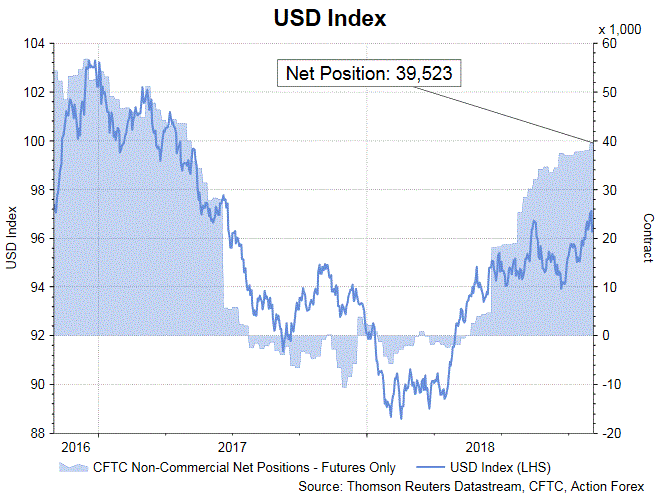
The CFTC Commitments of Traders report in the week ended October 30 shows that all major currencies (except USD) were in NET SHORT positions. Speculative longs on USD index added +1 040 contracts while shorts dropped -455, sending the NET LENGTH higher, by +1 495 contracts, to 39 523 contracts. The greenback generally strengthened against major currencies with the exception of Aussie and kiwi.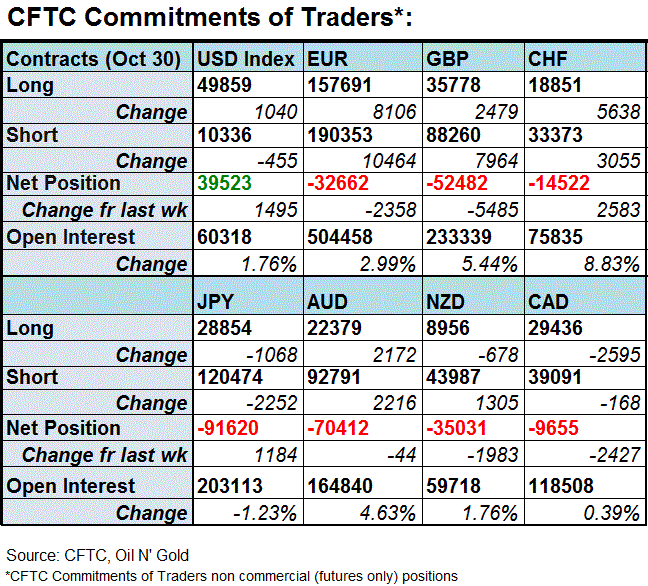
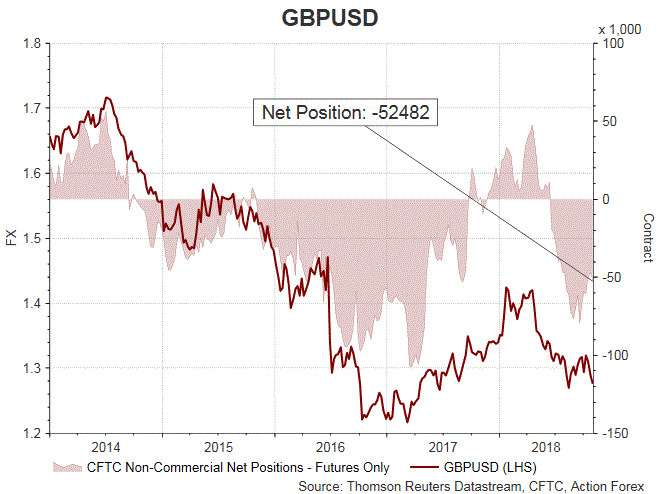
 NET SHORTS for both European currencies remained. For EUR futures, speculative long positions gained +8 106 contracts while shorts rose +10 464 contracts, deepening NET SHORT to 32 662 for the week. NET SHORT for GBP futures increased +5 485 contracts to 52 482. Traders should have turned more optimistic on British pound after BOE's indications of faster rate hike path under the assumption of smooth Brexit. Meanwhile, UK's Brexit representative Dominic Raab signaled a deal on Irish border could be reach later this month.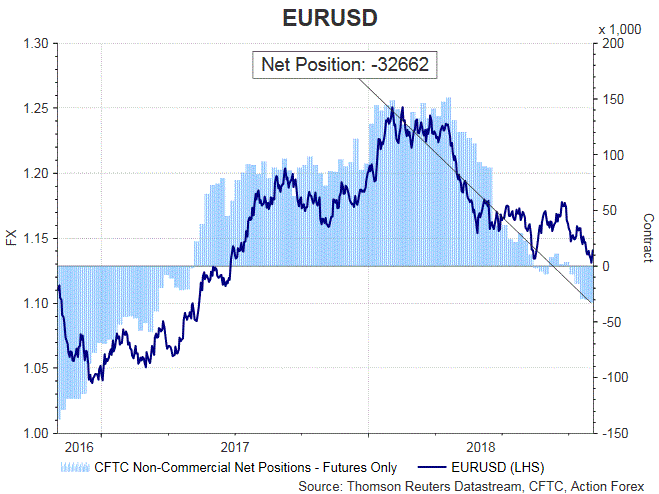
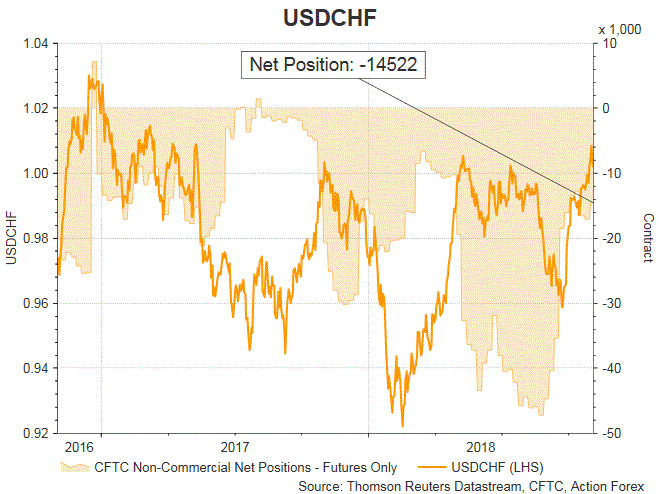
 On safe-haven currencies, Net SHORT for CHF futures plunged -2 583 contracts to 14 522 while that for JPY futures gained +1 184 contracts, to 91 620 during the week. Bets on the latter dropped on both sides.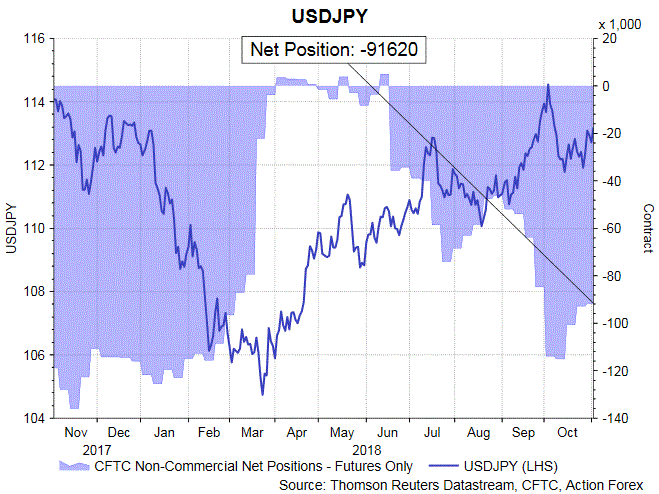
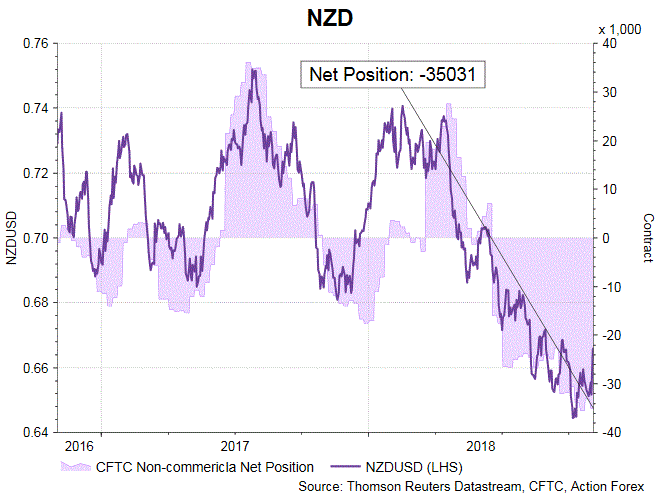
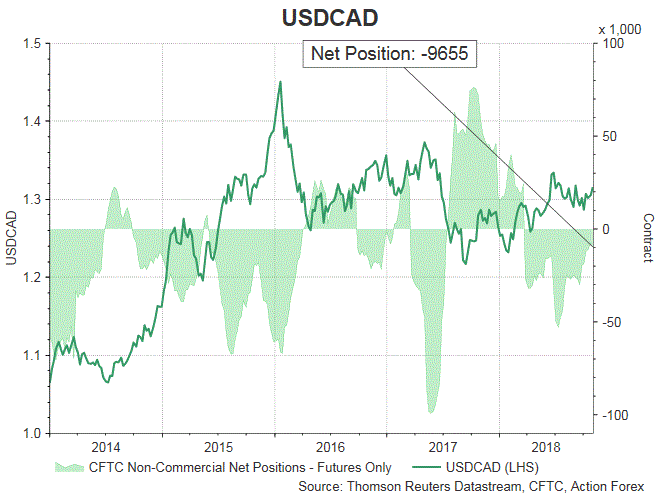
All commodity currencies stayed in NET SHORT positions. NET SHORT for AUD futures added +44 contracts to 70 412, while that for NZD futures gained +1 983 contracts to 43 987. NET SHORT for CAD futures rose 2 427 contracts to 9 655.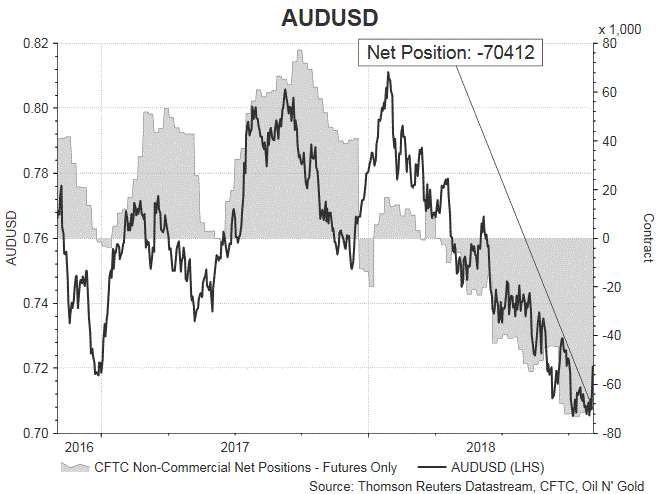
Forex Forecast And Cryptocurrencies Forecast
First, a review of last week's events:
EUR/USD. Recall that most experts (55% vs. 45%) voted for further strengthening of the dollar, calling the year's low of 1.1300 recorded on August 15 as the goal. This forecast came completely true, and the pair touched the bottom at this point on the last day of October, which was also facilitated by the optimism of the US President regarding the negotiations with China. True, in contrast to D. Trump, Larry Fink, head of one of the largest BlackRock investment funds, said he expected a full-scale trade war with China in the coming weeks.
The joy of the bulls was short-lived. The market met November with growing thirst for risky investments, which was supplemented by news of progress in the Brexit negotiations. As a result, the pair flew up to the height of 1.1455, after which everyone froze in anticipation of data on the American labor market, which, as we expected, somewhat strengthened the dollar. Thus, the number of new jobs created outside the agricultural sector (NFP) more than doubled (from 118K to 250K), which allowed the dollar to win back about 65 points. As a result, the pair completed the week in the same place where it began, in the zone 1.1390;
GBP/USD. As the experts expected, the British currency fell in the first half of the week, trying to reach the 2018 low, 1.2660. However, n the November start was turning for this pair as well. On the background of the news on possible signing of an agreement with the EU on Brexit soon, the pound showed an impressive growth, soaring by 340 points. The pair finished the week at 1.2960, in the zone which can be conditionally defined as the Pivot Point of the last three months;
USD/JPY. The forecast for this pair was also absolutely accurate. Recall that the majority of experts (70%), supported by graphical analysis, voted for the strengthening of the dollar and the growth of the pair. The heights of 112.85 and 113.35 were named as targets. And It all happened. On Tuesday, the pair reached the resistance of 112.85, broke through it and fixed the weekly high at 113.38. After that, there was a retreat to the level of 112.55, and the last chord of the week sounded at the level of 113.20;
Cryptocurrencies. Our forecast said that in the absence of really important news, the BTC/USD will continue to move in the narrow range of $6,325-6,660 with a predominance of the bearish sentiment. The next support was around $6,100. This scenario was realized with a small tolerance: pushing off from the resistance of 6.550, the pair went to the lower border of the lateral channel 6.320. The bears managed to break through it in the middle of the week, and the bitcoin dropped to the horizon of 6,240, but quickly turned around and climbed to the center of the side channel in the 6.425 zone. This confirmed the assumption that, knocking the rate down to the mining profitability level, the major players are beginning to actively buy coins, as a result of which the quotes are quickly returning to the initial level.
The bitcoin's fate was repeated by most of the top altcoins: many coins, such as Ethereum (ETH/USD) and Litecoin (LTH/USD), finished the week with a slight, barely noticeable, decrease, while others, like Ripple (XRP/USD), ended the week with a zero result.
As for the forecast for the coming week, summarizing the opinions of a number of analysts, as well as forecasts made on the basis of a variety of methods of technical and graphical analysis, we can say the following:
EUR/USD. We await two major events that can dramatically affect the fate of all dollar pairs this week. These are the mid-term elections in the USA on November 6 and the Fed's decision on the interest rate on November 8, followed, as usual, by the comment of the head of the Federal Reserve. One can also add to this the falling oil prices, quite unexpected statements by the US President and optimism about the agreement on British withdrawal from the EU, which has a positive effect on quotes not only for the pound, but also for the euro.
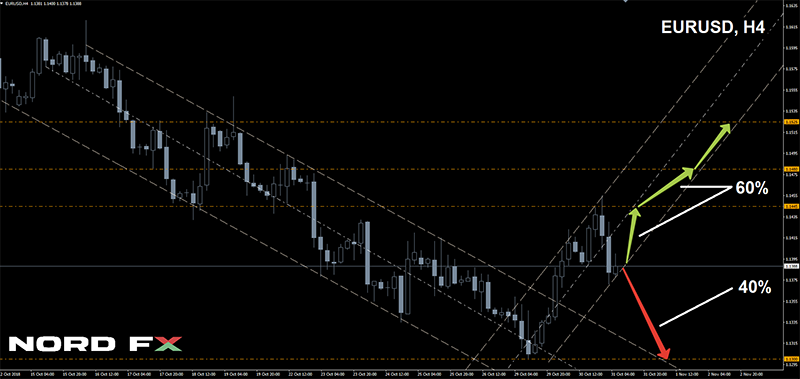
On this motley background, most experts (60%), supported by graphical analysis, sided with the European currency, waiting for the pair to rise to the zone 1.1480-1.1525. The nearest resistance is 1.1445.
The opposite point of view is supported by 40% of analysts and the overwhelming number of oscillators and trend indicators on D1. The bears' supporters talk about weak economic indicators of the Eurozone, problems of Italy and expect that the pair will again test the support of 1.1300, and, in case of its breakthrough, will sink to the horizon of 1.1210. The next target is at 1.1100;
GBP/USD. In addition to advancing Brexit negotiations, last week's pound growth was supported by the statement from Bank of England CEO Mark Carney that the regulator is ready to raise the interest rate in any event, including even the “complicated Brexit”. This is about raising the rate to 1.5% within three years (previously 1% was mentioned).
However, the positive effect of Carney's promises was short-lived, and 50% of experts expect the British currency to weaken already this week. In their opinion, the pair should strive again to the low of October 30 in the zone of 1.2700, and then even lower, to the minimum value of August, 1.2660.
An alternative point of view is expressed by 40% of experts. Supported by graphical analysis and almost 90% of oscillators and trend indicators on H4, they have voted for ongoing growth of the pair at least to the height of 1.3100. The next target is 1.3220.
Finally, the remaining 10% of the experts, together with the indicators on D1, have taken a neutral position, waiting for the sideways movement of the pair, basing on the support of 1.2820;
USD/JPY. On Monday, November 5, a meeting of the monetary policy committee of the Bank of Japan and a speech by the head of Bank Kuroda will take place. However, {1the market doesn't expect any surprises from either of these events. The bulls have a slight advantage (55% vs. 45%) among experts.
The overwhelming majority of oscillators and trend indicators on both H4 and D1 are also colored green, although 10% of oscillators on D1 are already giving signals that the pair is overbought. The support levels are 112.55, 111.80 and 110.75, the resistance levels are 114.05 114.55;
Cryptocurrencies. Despite the fact that the price of the bitcoin and of other top coins has been fluctuating in a fairly narrow range for a long time, it's too early to say that this market has died. And although the total capitalization is still close to $200 billion, the daily trading volume remains quite impressive, about $4.2 billion. And the number of transactions (250 thousand per day) shows that traders are in no hurry to part with their digital assets.
Of course, there has been no influx of new large investors for a long time, but in the future, we can expect a growth of the quotes. It is expected that such large companies as ICE (the parent company of the NYSE) and Fidelity Investment will launch their trade crypto platforms by the end of the year, which will undoubtedly contribute to an increase in the investment flow. The specialists of such a respected bank as Morgan Stanley are rather optimistic about the future of the crypto market, they have published a relevant research.
In the meantime, on a relatively neutral news background, the forecast remains almost unchanged: the BTC/USD will continue to move in a narrow range of $6,200-6,660 with a predominance of the bearish sentiment. The next resistance is $6,780, the next support is around $6,100.
CFTC Commitments of Traders – Longs on Oil Continued to Shrink
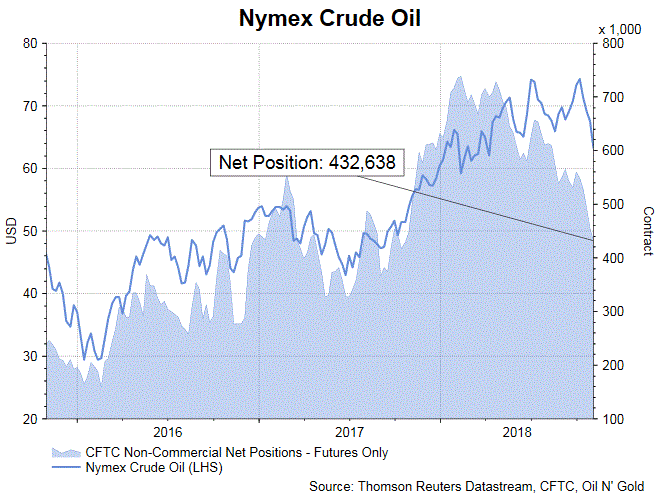
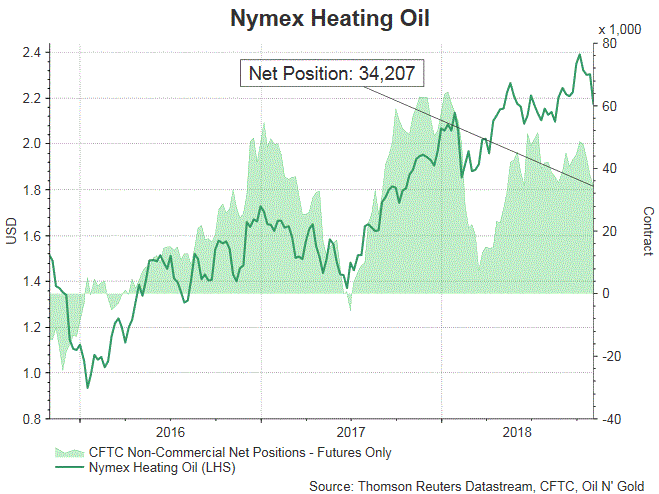
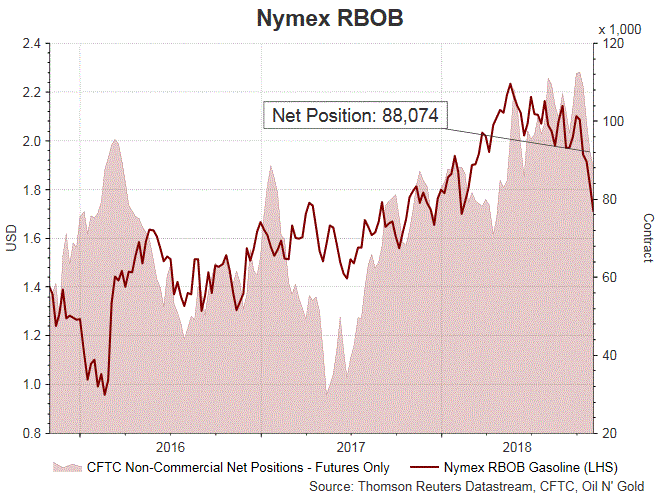
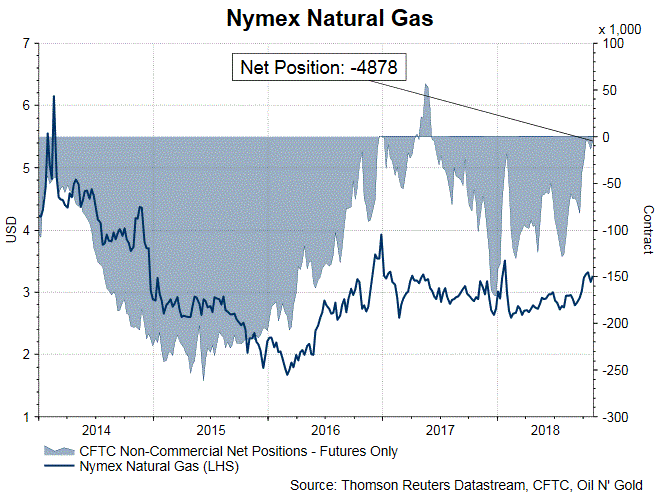
According to the CFTC Commitments of Traders report for the week ended October 30, NET LENGTH for crude oil, heating oil and gasoline futures all continued to drop. Oil prices dived during the reporting week, with the front-month WTI crude oil contract dipping -0.38% while the Brent contract was down -0.69%. Speculative long positions of crude oil futures declined -19 741 contracts, while shorts rose +2 899 contracts, resulting in a fall in NET LENGTH, by -22 640 contracts, to 432 638 contracts. For refined oil products, Net LENGTH for heating oil futures plunged -3 640 contracts to 34 207, while that for gasoline was down -4 131 contracts to 88 074. During the reporting week, correction of prices of refined oil products was remarkable. the front-month RBOB gasoline contract dropped -1.68% while the heating oil contract was down -0.78%. Net SHORT for natural gas decreased -8 315 contracts, to 4 878 contracts for the week.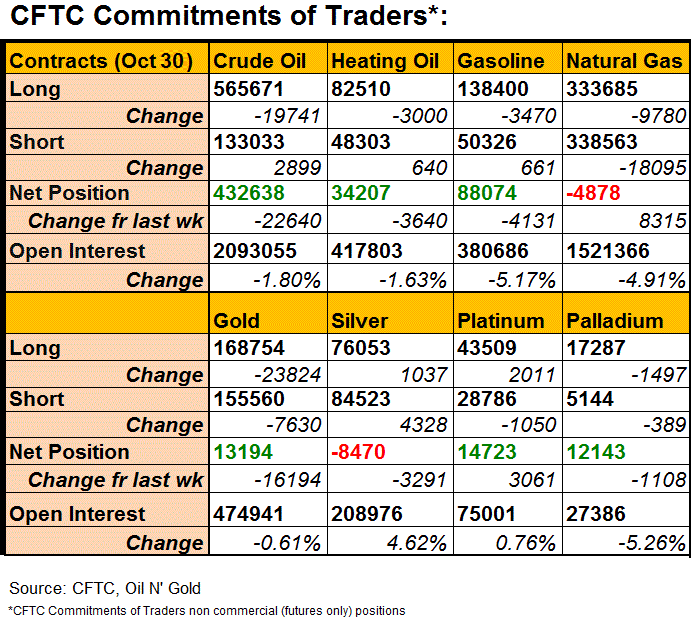
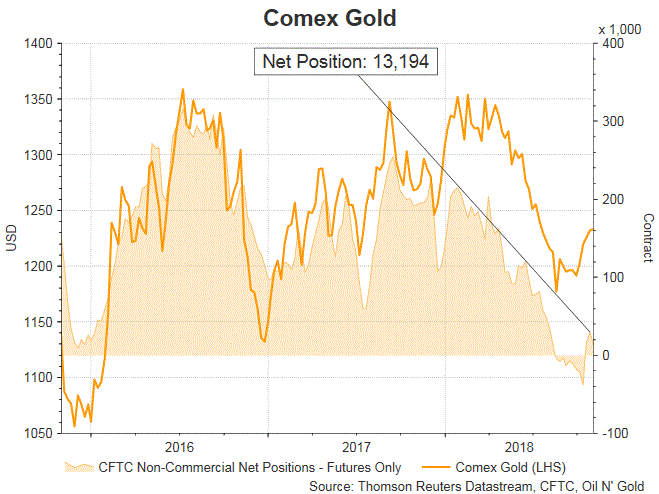
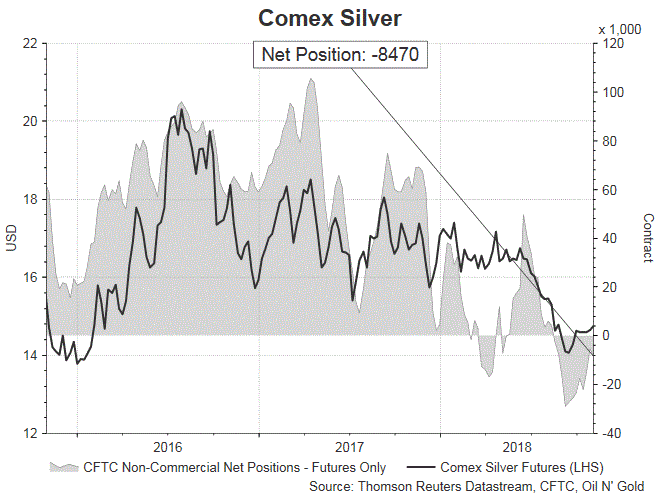
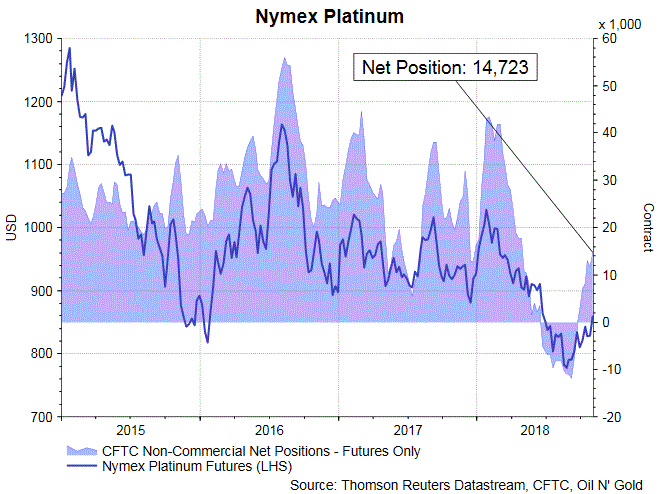
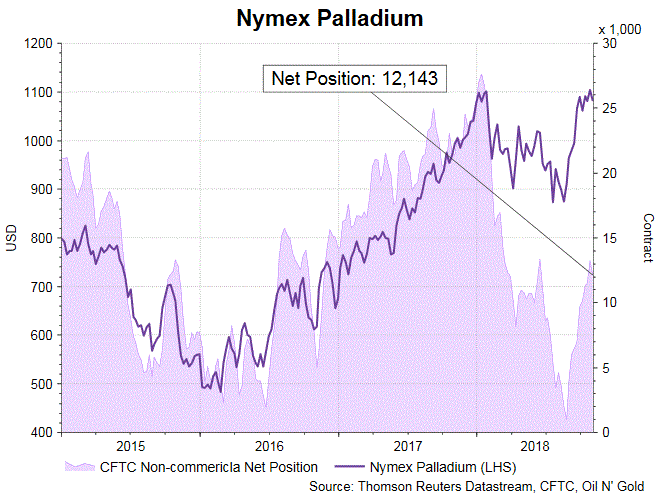
On the precious metal complex, NEW LENGTH for gold futures declined while silver futures deepened in NET SHORT. Speculative long positions for the former fell -23 824 contracts, while shorts sank -7 630, resulting in a NET LENGTH of 16 194 contracts. The benchmark Comex contract climbed +0.5% during the week in concern. For the latter, speculative long positions added +1 038 contracts while shorts rose +4 328, raising NET SHORT, by -3 291 contracts, to 8 470 contracts. For PGMs, NET LENGTH of Nymex platinum futures gained +3 061 contracts to 14 723 while that for palladium slipped -1 108 contracts to 12 413.