Sample Category Title
Why Oil Prices Are Plunging Despite U.S. Sanctions On Iran’s Energy Sector
The oil market has had nearly six months to assess the possible effect of U.S. sanctions on Iranian oil exports. Surprisingly, the prospect of significantly tighter global supplies has resulted in lower prices. President Donald Trump announced on May 8 that he would end the participation of the United States in the Joint Comprehensive Plan of Action, a 2015 pact aimed at curbing Iran’s nuclear activities, signed by Iran, the five permanent members of the United Nations Security Council, and the European Union.
That set the U.S. on a path to reimpose sanctions on Iranian petroleum after a 180-day wind-down period for entities to end their dealings with Tehran’s energy sector. By early October, oil had climbed to its highest level since 2014. From that recent peak, however, front-month futures prices for U.S. benchmark crude CLZ8, -0.08% have declined by about 14%, as of Wednesday. At $65.31 a barrel, they’re also down more than 5% from the day Trump announced the sanctions.
Worried about a potential shortage, the Organization of the Petroleum Exporting Countries, as well as nonmember Russia, agreed in June to rein in the output cuts they had implemented a year and a half earlier—essentially lifting production ahead of sanctions on Iran. OPEC oil production rose by 100,000 barrels a day in September, to a one-year high of 32.78 million barrels a day, according to the International Energy Agency. “Producers have increased production to fill the void, and capital expenditures are being made to add more production sources,” says Jerry Bailey, president of oil sands extractor Petroteq Energy.
At the same time, China, India, and Russia “will seek ways to avoid the sanctions,” says Bailey, also a former president of Exxon Arabian Gulf. “Those countries are close enough to Iran to see land transfer of oil, likely through black-market operators. This is influenced by the need for product and the monetary gains by taking this risk.”
NZDJPY Challenges 3-Month Highs, Short-Term Outlook Still Neutral
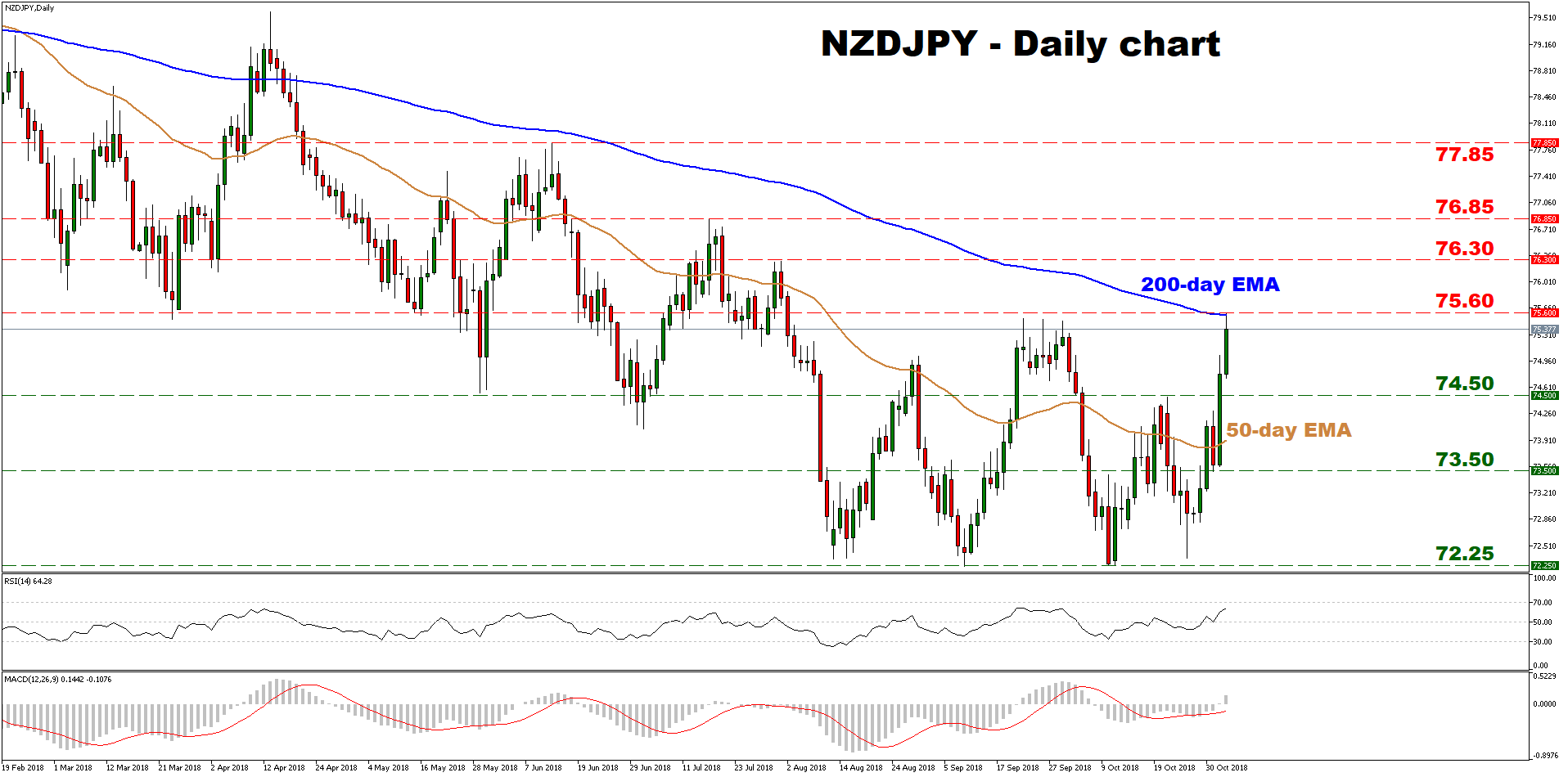
NZDJPY soared in recent sessions, before it met resistance near the crossroads of the 75.60 zone and its 200-day exponential moving average (EMA), and subsequently pulled back somewhat. The inability of the bulls to break above this crossroads suggests that the short-term outlook is still neutral, with a break above that zone needed to shift it to positive.
Taking a look at short-term momentum oscillators, they detect accelerating upside speed. The RSI – already above its neutral 50 line – is pointing higher and looks to be headed for a test of its overbought 70 level. Similarly, the MACD is both in positive territory and above its red trigger line.
Further advances in the pair could encounter immediate resistance near the intersection of the 75.60 barrier and the 200-day EMA that is currently a few pips below, at 75.56. An upside break may shift the near-term bias to positive, setting the stage for a test of the 76.30 area, marked by the July 31 peaks. Even higher, the bulls could stall around 76.85 – this being the June 13 high.
On the flipside, a pullback in the pair could meet a first wave of support at 74.50, defined by the inside swing high on October 23. If the bears pierce below it, the next obstacle may be the October 31 low of 73.50 (that is much more visible on the 4-hour chart), assuming the 50-day EMA at 73.90 is violated first. Lower still, buy orders may be found around 72.25, a two-year low and a territory which capped several declines in recent months.
Overall, the short-term bias is still neutral, with a clear close above 75.60 and the 200-day EMA needed to turn it positive.
GER 30 Index Bullish In Short-Term At 11-Day High, Remains Bearish In Medium Term
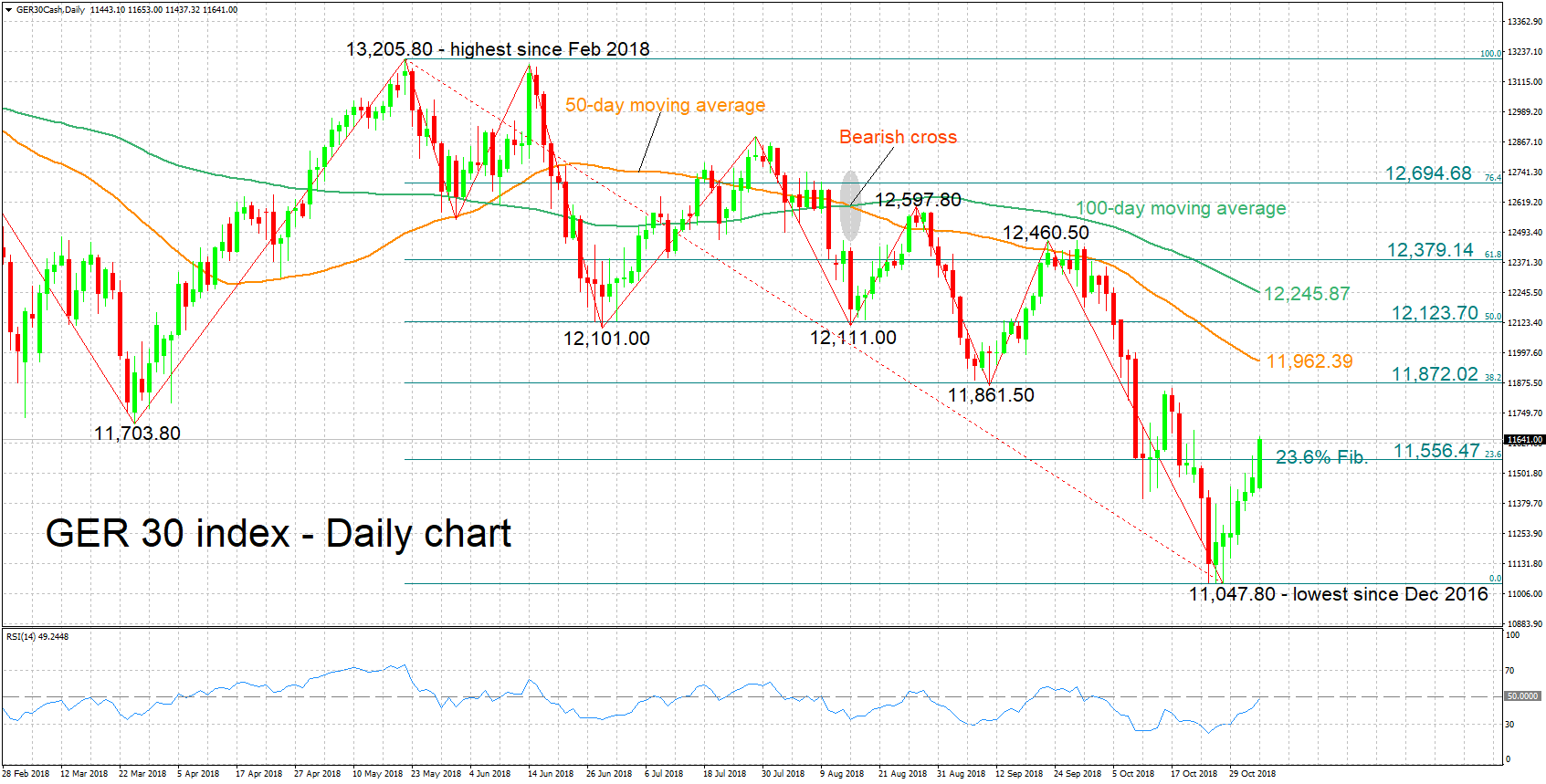
The Germany 30 index advanced by roughly 600 points after hitting its lowest since December 2016 at 11,047.80 in late October. Moreover, the benchmark is looking set to record its seventh straight day of gains on Friday, having touched an 11-day high of 11,660.30 earlier in the day.
Indicative of the bullish bias in the short-term is the upward-sloping RSI; the indicator sharply reversed course after entering oversold territory below 30.
Stronger gains may meet resistance around 11,872.02, the 38.2% Fibonacci retracement level of the downleg from 13,205.80 to 11,047.80. Notice that the region around this point captures a couple of bottoms from previous months as well as the current level of the 50-day moving average line at 11,962.39. A decisive move above, which would also allow the index to break above the 12,000 handle, would turn the focus to the zone around 12,123.70, the 50% Fibonacci mark.
On the downside, immediate support could occur at 11,556.47, this being the 23.6% Fibonacci level. Steeper losses would again bring within scope the benchmark’s near two-year nadir of 11,047.80.
Despite the recent advances, the medium-term picture remains bearish: the index is in a downtrend, recording lower highs and lower lows, while trading activity is taking place below the 50- and 100-day MAs, which maintain a negative slope.
Overall, the near-term outlook is looking bullish at the moment and the medium-term one continues to be negative.
EURUSD Now Bullish Above 1.1431 Level
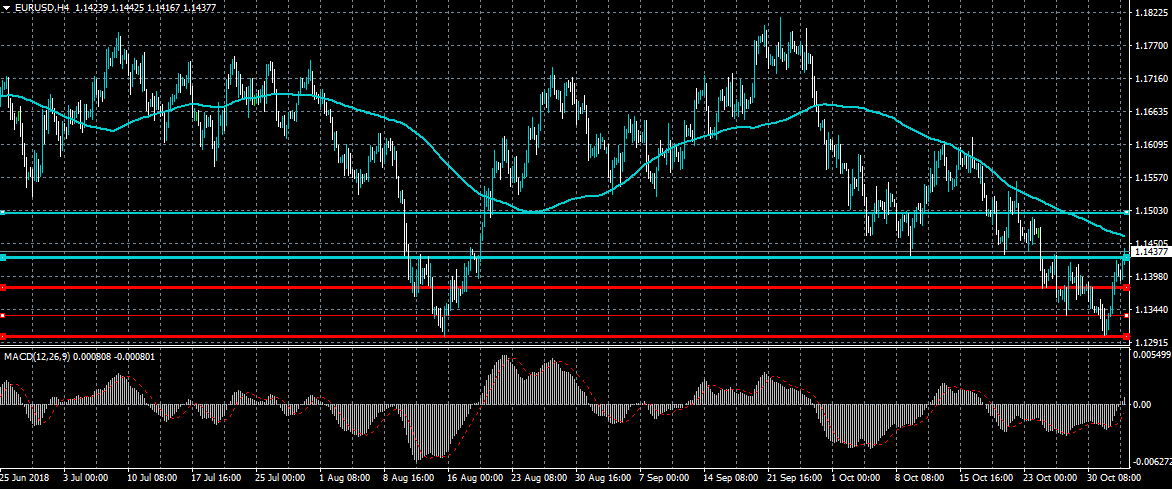
The euro currency has continued to recover higher against the US dollar, with the price now trading firmly above the 1.1400 level ahead of the release of the US monthly jobs report. The intraday bias surrounding the EURUSD pair is strongly bullish while trading above the 1.1431 level. Buyers will likely aim for the 1.1500 resistance level, while sellers will likely target the 1.1380 support level.
The EURUSD pair is strongly bullish while trading above the 1.1431 level, key resistance is found at the 1.1460 and 1.1500 levels.
If the EURUSD pair moves below the 1.1431 level, sellers are likely to test towards the 1.1380 and 1.1301 support levels
USDJPY Key Levels To Watch Into The US Session
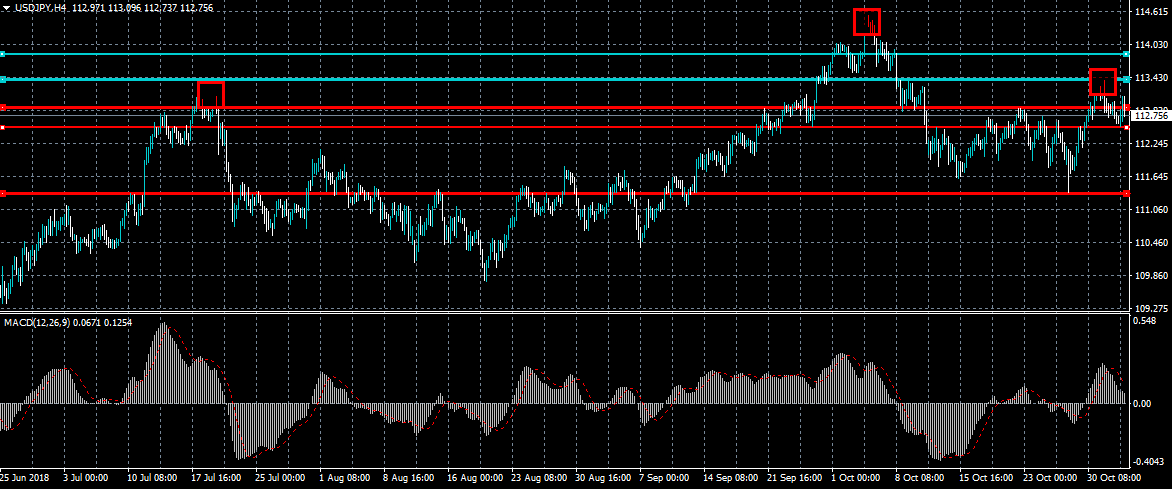
The US dollar is trading lower against the Japanese yen, ahead of the release of the US Nonfarm Payrolls job report for the month of October. Price has once again been rejected from the 113.00 level, with the intraday bias surrounding the USDJPY pair strongly bearish while price trades below the 112.87 level. A clear loss of the 112.45 support level exposes the USDJPY pair to further technical selling towards 111.30, while the 113.40 level is the key breakout level to watch to the upside.
The USDJPY pair is strongly bearish while trading below the 112.87 level, key support is now found at the 112.45 and 111.30 levels.
If the USDJPY pair trades above the 112.87 level, buyers are likely to test the 113.40 and 113.90 resistance levels.
NZD/USD Analysis: Awaits Non-Farm Payrolls
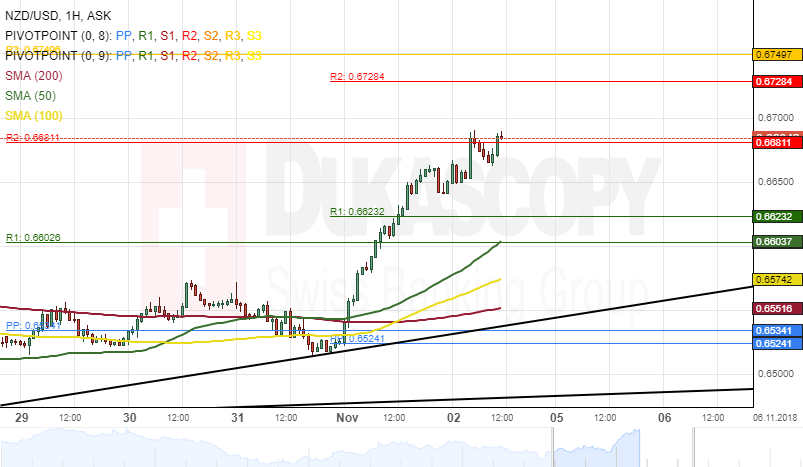
The New Zealand Dollar appreciated about 130 base points against the US Dollar on Thursday. The currency dashed through the weekly R1 at 0.6623 during the end of the previous session.
By the middle of the European trading session on Friday, the exchange rate has tested the monthly R2 at 0.6681.
If that resistance level holds, the currency exchange rate could make a brief retracement south towards the weekly R1 0.6602.
Today's macroeconomic data releases scheduled at 12:30 GMT could play a significant role in the movement of the currency pair.
USD/CAD Analysis: Awaits Fundamental Releases
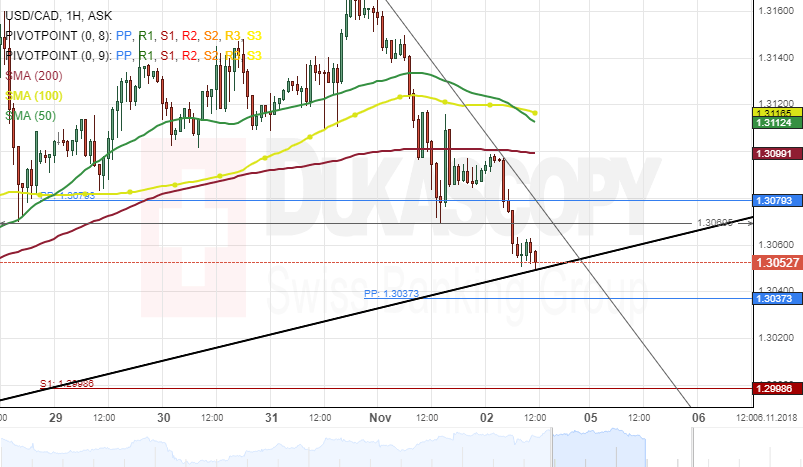
The Greenback has continued its decline against the Canadian Dollar. The currency pair tested the lower boundary of an ascending trendline at 1.3054 during the Asian session on Friday.
Everything being equal, it is likely that the downside momentum will continue within this session. The potential target for the USD/CAD exchange rate will be near the monthly S1 at 1.2998.
Although, it is important to note that the US fundamental events scheduled at 12:30 GMT could play an important role in the price movement direction today.
WTI Oil Outlook: Bears Take A Breather Ahead Of Fresh Downside
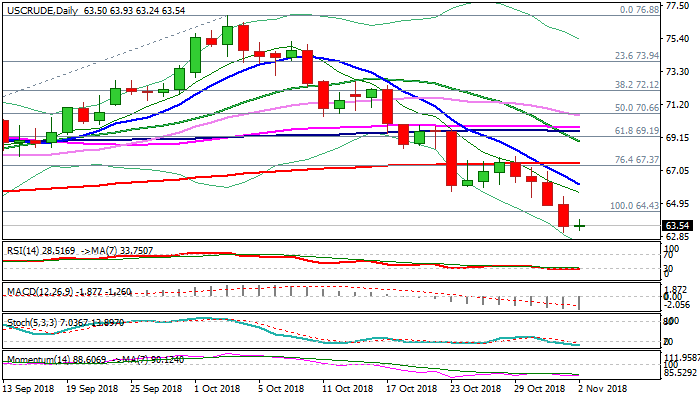
WTI oil is consolidating above new seven-month low at $63.10, hit on Thursday after steep four-day fall from $67.93 lower top.
Easing global supply concerns on increased production of world’s top oil producers, which aim to offset negative impact from shortage when US sanctions on Iran start, kept oil prices under increased pressure.
Rising US crude stocks added to negative sentiment, pushing oil prices to new multi-month lows.
Fresh news about easing global trade tensions lifted markets on Friday and could diminish fears of weaker global demand on escalation of crisis, with oil prices holding in directionless mode and keeping the downside vulnerable after the US permitted eight countries to keep buying Iranian oil.
WTI contract is on track for the fourth straight strong bearish weekly close which continues to weigh heavily on oil prices, along with bearish techs and strong negative sentiment.
Weekly close below cracked pivotal Fibo support at $63.57 (38.2% of $42.04/$76.88) would generate bearish signal for extension of downtrend from $76.88 high towards $60 zone (mid-March 2018 higher base) and $59.46 (Fibo 50% of $42.04/$72.88).
Negative stance would be additionally confirmed by close within thick weekly cloud, which was penetrated on Thursday’s extension lower (cloud top lays at $63.66).
Broken former key support at $64.43 (16 Aug low) now marks solid resistance, followed by falling 10SMA ($66.14) which is expected to limit extended upticks.
Res: 63.93, 64.43, 65.73, 66.14
Sup: 63.10, 61.80, 60.00, 59.46
Risk Appetite Buoyed By Optimism On Brexit And Trade Fronts
Notes/Observations
- Positive signals from the phone call between US and Chinese leaders could reduce the probability of further US tariff increases in January and beyond; safe-haven flows recede; risk-on appetite buoyed
- Major European PMI Manufacturing data mixed (Beats: Spain, Misses: Euro Zone, Germany, Italy, Unrevised: France); Italy moves into contraction while new order components contracted for Euro Zone, Germany and Italy
- Sweden Central Bank (Riksbank) Oct Minutes gave no indications of an interest rate increase being preferred in December or February
- Focus turns to US Payroll data in session
Asia:
- Australia Q3 retail sales were weaker than expected (MoM: 0.2% v 0.4%e); suggests that households are starting to feel the pinch from rising petrol prices and the slowdown in the property market
- Japan PM Abe: Conditions for postponing 2019 sales tax increase include global economic crisis and 'huge' natural disaster; Wrong to persist in raising sales tax in 2019 if economy hit by 'big shock on scale of Lehman crisis' (Reminder: The sales tax is expected to rise from 8% to 10% in Oct of 2019. Japan's govt has twice delayed the 2nd phase to raise the sales tax to 10% after an earlier hike from 5% to 8% hurt consumption and growth).
Europe:
- EU Brexit negotiators reportedly mulling a Northern Ireland compromise plan to give UK stronger guarantees that customs border won't be necessary along Irish Sea. Would give upfront the full terms of a 'bare bones' all-UK customs union, which would negate the need for a second customs treaty post-Brexit
- Italy PM Office spokesperson: govt has had productive and constant dialogue with the EU Commission
Americas:
- US President Trump said to have asked cabinet to draft possible China trade deal. The push said to have been prompted by a recent call between Xi and Trump
Energy:
- US reportedly to give 8 countries oil waivers under Iran sanctions (said to include the likes of Japan, China, India and South Korea). US and China said to be still in discussion on the terms
Macro
- (US) United States: Chinese Premier Xi is willing to meet with Trump at the G-20 in Argentina and hopes that the U.S. and China can promote a steady, healthy relationship based on important mutual understanding achieved with Trump. He said that both he and Trump wish to expand China-U.S. trade cooperation. It's likely going to be a bit more difficult for Trump going forward to lay the blame on the stock market sell-off solely on the Fed given the positive reaction in the market to reports of a potential trade deal with China.
- (CN) China: According to domestic reports the Chinese economy is slowing faster than expected and risk is growing that the country will have to backstop the economy with further measures to arrest the slowing tide, risking increased debt to do so. Declining export demand has been masked by front-running of exports ahead of the imposition of tariffs, suggesting that recent manufacturing indicators are understating the rate of decline. With $200B in tariffs set to jump to 25% in January if no agreement is struck, and another round on the balance of exports, China's woes could be deeper than seen on the surface. This may be why Trump cited a friendlier tone in recent dialog with Xi, though a deal as soon the G20 meeting later this month in Argentina still seem unlikely.
- (EU) Eurozone: Manufacturing PMI hit 26 month lows in October. Trade concerns were the biggest reason for the drop in confidence to the lowest level since December 2012, with companies reporting the first decline in export orders for nearly five-and-a-half years. Most notably Italy slipped into contraction territory, which will pressure the government after the unexpectedly weak Q3 GDP number that showed the economy stagnating. Italy's budget plan is banking on stronger growth to cut deficit and debt levels, but without meaningful structural reform, just injecting cash into the economy and boosting consumption won't help generate sustainable underlying growth.
SPEAKERS/FIXED INCOME/FX/COMMODITIES/ERRATUM
Equities
- Indices [Stoxx600 +1.1% at 366.9, FTSE +0.8% at 7172, DAX +1.4% at 11622, CAC-40 +1.3% at 5153, IBEX-35 +1.0% at 9047, FTSE MIB +1.3% at 19438, SMI +0.2% at 9037, S&P 500 Futures +0.8%]
- Market Focal Points/Key Themes: Equities European Indices trade higher across the board with reported positive China-US trade talks helping lift the market. Asian Indices traded sharply higher with the Hang Seng posting its biggest gain in 3 years, as export names outperformed. US futures reversed earlier Apple inspired losses to turn positive on risk on flows. On the corporate front Paddy Power trades higher after earnings, International Consolidated Airlines also rises after raising long term EBITDAR outlook. Comet Holding, Senvion and SLM Solutions trade sharply lower after cutting full year outlook. In the US Apple shares trade lower after weaker Q1 guidance, citing $2B of FX headwinds, macroeconomic weakness in some Emerging Markets, and some supply/demand timing uncertainties given the large range of new products. Looking ahead notable earners include Oil giants Exxon and Chevron, Alibaba, Abbvie and Newell Brands.
- Consumer discretionary: IAG [IAG.UK] +1% (raises long-term guidance), Paddy Power Betfair PLC [PPB.UK] +1.5% (earnings, narrows up outlook), Millenium & Copthorne Hotel [MLC.UK] -0.5% (earnings), Edenred [EDEN.FR] +3% (analyst action), Brunel International [BRNL.NL] +17% (earnings)
- Energy: Senvion [SEN.DE] -9% (outlook cut)
- Financials: TP ICAP Pllc [TCAP.UK] +1.5% (trading update; confirms acquisition), Erste Group AG [EBS.AT] -1.5% (earnings, outlook raise)
- Healthcare: Comet Group [COTN.CH] -9.5% (outlook cut)
- Industrials: Parity Group [PTY.UK] -31% (profit warning)
- Technology: SLM Solutions Group [AM3D.DE] -14% (outlook cut, CEO to step down), ProPhotonix [PPIX.UK] -25% (profit warning), Lehto Group [LEHTO.FI] +11% (earnings; announces business division reorganization)
Speakers
- Sweden Central Bank (Riksbank) Oct Minutes reiterated stance that was appropriate to soon begin to raise rates at a gradual pace
- Italian banks said to have passed the EBA's stress test. Unicredit, UBI and Banco BPM CET1 ratios were said to be well above 5.5% threshold. Carige the only cause for alarm.
- German IFW Institute: German economy probably fell 0.3% in Q3
- China PBOC 2018 Financial stability report: System faces more external uncertainties. Trade frictions initiated by US was bringing negative impact to China, global economy and financial markets. Reiterated that economic and financial risks were controllable; systemic risks would not occur in China. 'Grey Rhino' type financial risks could still surface in 2019
- Malaysia Fin Min Lim Guan 2019 budget speech saw the 2019 budget deficit to GDP seen at 3.4%. Revised 2018 budget deficit to GDP from 2.8% to 3.7
- India Govt could infuse an additional INR200B into State-run banks this year. Additionally reports circulated that India expected shadow banking default within 6 weeks amid a cash crunch and would soeek immediate liquidity to avoid default
Currencies/Fixed Income
- USD was softer against the major European and emerging market currencies as several factors aided the risk appetite over the past 24 hours. Initially hope of Chinese stimulus was a factor for the USD retracement of recent strength then optimism has appeared on Brexit and Trade fronts.
- EUR/USD back above the 1.14 level on a technical bounce but softer EU data continued to be a headwind.
- GBP/USD holding above the 1.30 level and some 300 pips off its weekly lows on Brexit optimism. The key trend resistance remains quite a distance away at 1.36
Economic data
- (DE) Germany Sept Import Price Index M/M: 0.4% v 0.4%e; Y/Y: 4.4% v 4.5%e
- (CH) Swiss Q3 UBS Real Estate Bubble Index: 0.87 v 0.92 prior
- (CN) Weekly Shanghai copper inventories (SHFE): 147.5K v 148.9K tons prior
- (FR) France Sept YTD Budget Balance: -€87.1B v -€97.3B prior
- (PL) Poland Oct PMI Manufacturing: 50.4 v 50.2e (46th month of expansion)
- (RU) Russia Narrow Money Supply w/e Oct 26th: 10.30T v 10.41T prior
- (ES) Spain Oct Manufacturing PMI: 51.8 v 50.9e (60th month of expansion)
- (CH) Swiss Sept Real Retail Sales Y/Y: -2.7% v -0.1%e
- (IT) Italy Oct Manufacturing PMI: 49.2 v 49.7e (first contraction in 25 months and lowest since Dec 2014)
- (FR) France Oct Final Manufacturing PMI: 51.2 v 51.2e (confirmed its 25th month of expansion but the but lowest since Sept 2016)
- (DE) Germany Oct Final Manufacturing PMI: 52.2 v 52.3e (confirmed 46th month of expansion but lowest since May 2016)
- (EU) Euro Zone Oct Final Manufacturing PMI: 52.0 v 52.1e (confirmed 63rd month of expansion and lowest since Aug 2016)
- (NO) Norway Oct Unemployment Rate: 2.2% v 2.2%e
- (UK) Oct Construction PMI: 53.2 v 52.0e (7th month of expansion)
Fixed Income Issuance
- (IN) India sold INR110B vs. INR110B indicated in 2020, 2026, 2028, 2034 and 2046 bonds
Looking Ahead
- 06:00 (EU) Daily Euribor Fixing
- 06:00 FR) France Debt Agency (AFT) announces upcoming issuance
- 06:30 (PL) Poland to sell Bonds
- 07:00 (UK) DMO to sell €3.5B in 1-month, 3-month and 6-month bills (£0.5, £1.0B and £2.0B respectively)
- 07:00 (IE) Ireland Oct Live Registry Monthly Change: No est v +1.6K prior; Live Registry Level: No est v 212.6K prior
- 07:30 (IN) India Weekly Forex Reserves w/e Oct 26th: No est v $393.5B prior
- 07:45 (US) Daily Libor Fixing
- 08:30 (US) Oct Change in Nonfarm Payrolls: +200Ke v +134K prior; Change in Private Payrolls: +195Ke v +121K prior; Change in Manufacturing Payrolls: +16Ke v +18K prior
- 08:30 (US) Oct Unemployment Rate: 3.7%e v 3.7% prior; Underemployment Rate: No est v 7.5% prior
- 08:30 (US) Oct Average Hourly Earnings M/M: 0.2% v 0.3% prior; Y/Y: 3.1%e v 2.8% prior; Average Weekly Hours: 34.5e v 34.5 prior
- 08:30 (CA) Oct Net Change in Employment: +15.0Ke v +63.3K prior; Unemployment Rate: 5.9%e v 5.9% prior; Full Time Employment Change: +20.0Ke v -16.9K prior; Part Time Employment Change: -4.1Ke v +80.2K prior; Hourly Earnings Y/Y: 2.3%e v 2.2% prior; Participation Rate: 65.4%e v 65.4% prior
- 08:30 (US) Sept Trade Balance: -$53.6Be v -$53.2B prior
- 08:30 (CA) Canada Sept Int'l Merchandise Trade (CAD): 0.2Be v 0.5B prior
- 08:30 (JP) Bank of Japan (BoJ) Gov Kuroda:
- 09:00 (SG) Singapore Oct Purchasing Managers Index (PMI): 52.2e v 52.4 prior; Electronics Sector Index: No est v 51.4 prior - 09:00 (ES) Spain Debt Agency (Tesoro) announces upcoming bond issuance
- 09:05 (UK) Baltic Dry Bulk Index
- 10:00 (US) Sept Factory Orders: 0.5%e v 2.3% prior; Factory Orders (Ex-transportation): No est v 0.1% prior
- 10:00 (US) Sept Final Durable Goods Orders: No est v 0.8% prelim; Durables Ex-Transportation: No est v 0.1% prelim; Capital Goods Orders (Non-defense/ex-aircraft): No est v -0.1% prelim; Capital Goods Shipments (Non-defense/ex-aircraft): No est v 0.0% prelim
- 12:00 (EU) potential sovereign ratings after EU close (Slovenia Sovereign Debt to Be Rated by Moody's)
- 12:00 (DK) Denmark Oct Foreign Reserves (DKK): No est v 467.9 prior
- 13:00 (US) Weekly Baker Hughes Rig Count data
- 13:00 (IT) Italy Oct New Car Registrations Y/Y: No est v -25.4% prior
- 14:00 (C0) Colombia Central Bank Oct Minutes
- (RU) Russia Sept Sovereign Wealth Funds: Wellbeing Fund: No est v $76.3B prior
- (IT) Italy Oct Budget Balance: No est v -€19.8B prior
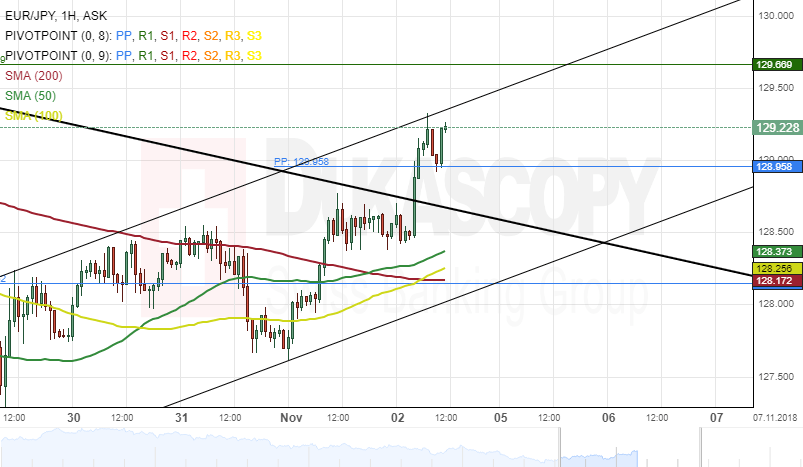
EUR/JPY Analysis: Brief Pullback Likely
Upside risks dominated the common European currency against the Japanese Yen on Thursday. The EUR/JPY exchange rate ended yesterday's session with 0.92% gains.
The currency pair breached the upper boundary of a medium-term descending channel at 128.78 during the morning hours of Friday's trading session.
Given that a breakout had occurred, the currency exchange rate could continue its bullish movement today.
However, it is expected that the pair makes a brief retracement south towards the 128.50 area within the coming hours.