Sample Category Title
GBP/USD Mid-Day Outlook
Daily Pivots: (S1) 1.2825; (P) 1.2925; (R1) 1.3099; More...
Intraday bias on GBP/USD remains on the upside as rebound from 1.2692 is in progress. Further rise should be seen to 1.3297 resistance. For now, price actions from 1.2661 are seen as a consolidation pattern. We'd expect strong resistance from 1.3316 fibonacci level to limit upside to bring down trend resumption eventually. On the downside, below 1.2908 minor support will turn bias back to the downside for 1.2692 instead.
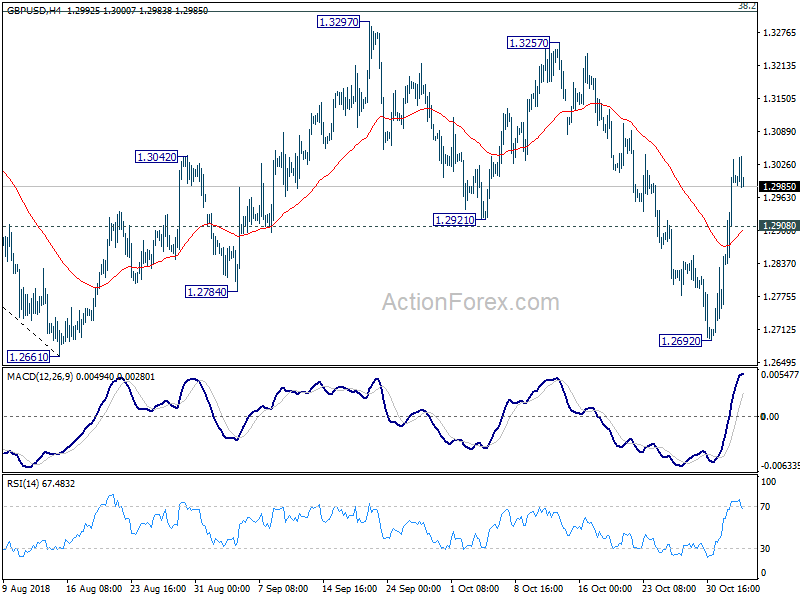
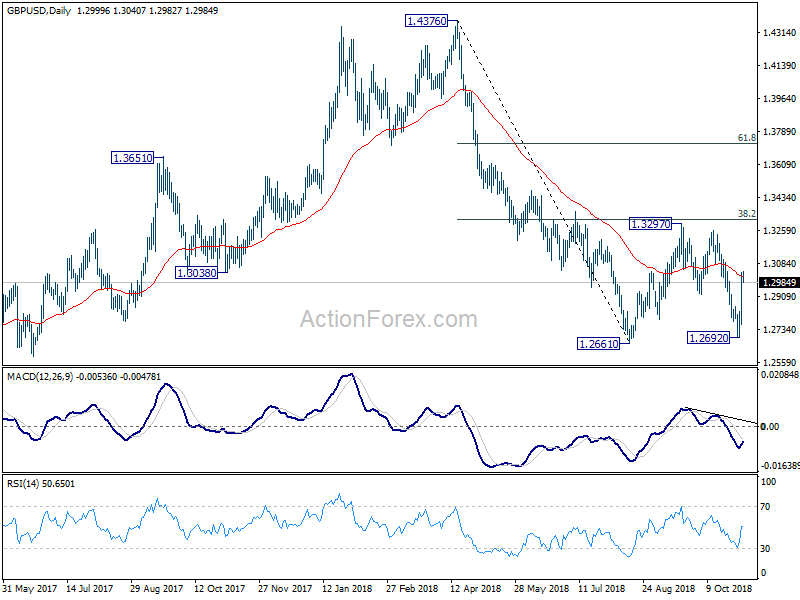
In the bigger picture, whole medium term rebound from 1.1946 (2016 low) should have completed at 1.4376 already, after rejection from 55 month EMA. The structure and momentum of the fall from 1.4376 argues that it's resuming long term down trend. And this will be the preferred case as long as 38.2% retracement of 1.4376 to 1.2661 at 1.3316 holds. However, firm break of 1.3316 would bring stronger rebound to 61.8% retracement at 1.3721. And, the eventual depth of the fall from 1.4376, and the chance of hitting 1.1946 low, will depend on the strength of the interim corrective rebound from 1.2661.
USD/CHF Mid-Day Outlook
Daily Pivots: (S1) 0.9984; (P) 1.0038; (R1) 1.0076; More...
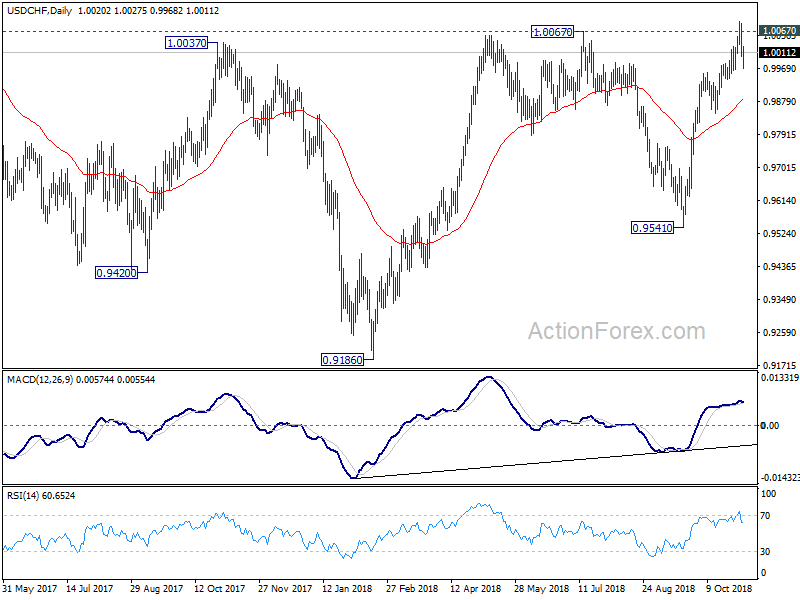
Current development suggests that 1.0094 is at least a near term top, after failing to sustain above 1.0067 resistance. Intraday bias will remain mildly on the downside for 0.9848/9954 support zone. On the upside, though, break of 1.0094 and sustained trading above 1.0067 will confirm resumption of larger rise from 0.9186 and should target 1.0342 key resistance next.
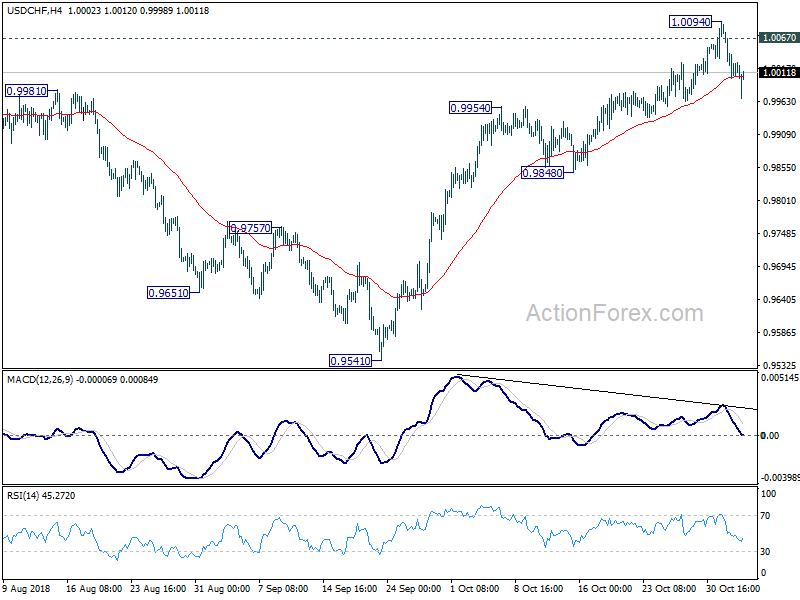
In the bigger picture, the pullback from 1.0067 has completed at 0.9541 already. And rise from 0.9186 is likely resuming. Firm break of 1.0067 will pave the way to retest 1.0342 key resistance. We'd be cautious on strong resistance from there to limit upside to bring another medium term fall to extend long term range trading.
USD/JPY Mid-Day Outlook
Daily Pivots: (S1) 112.53; (P) 112.78; (R1) 112.95; More..
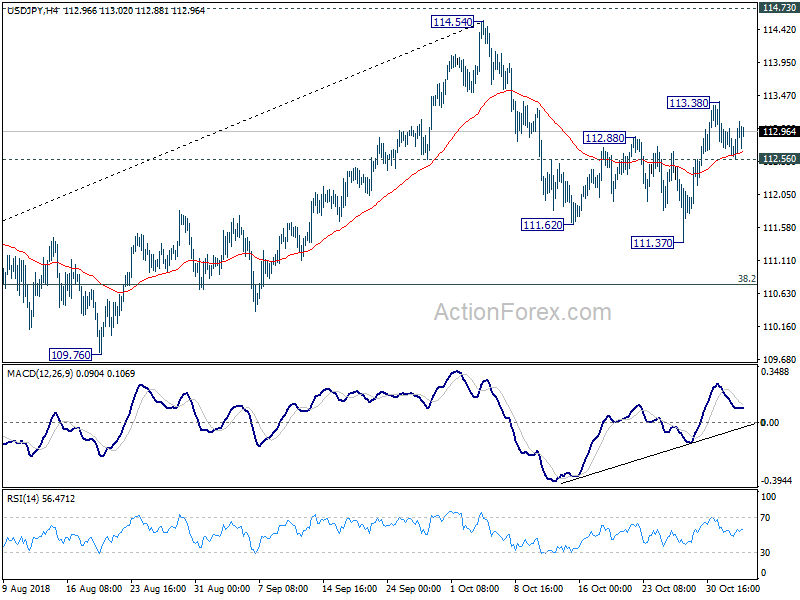
No change in USD/JPY's outlook. Intraday bias stays neutral for the moment. With 112.56 minor support intact, further rise is mildly in favor. On the upside, above 113.38 will extend the rebound from 111.37 to 114.54/73 key resistance zone. On the downside, break of 112.56 will likely extend the correction from 114.54 to 38.2% retracement of 104.62 to 114.54 at 110.75 before completion.
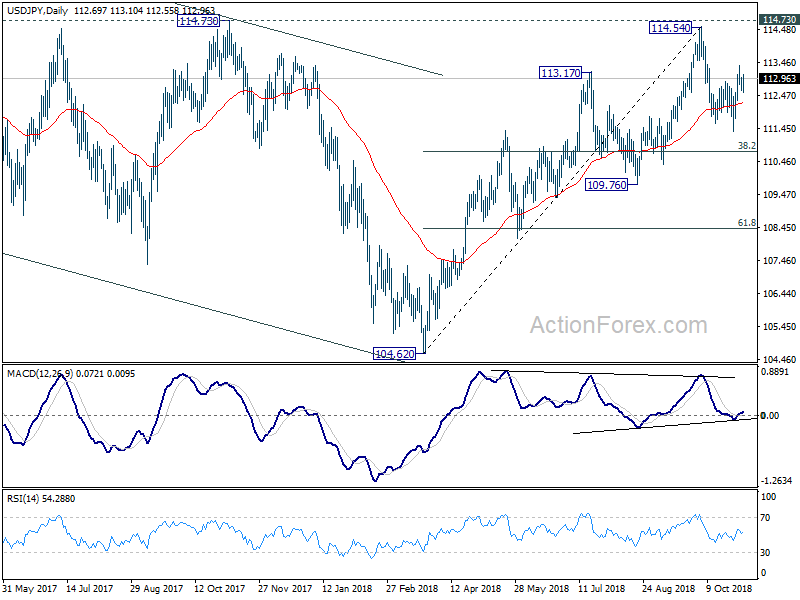
In the bigger picture, corrective fall from 118.65 (2016 high) should have completed with three waves down to 104.62. Decisive break of 114.73 resistance will likely resume whole rally from 98.97 (2016 low) to 100% projection of 98.97 to 118.65 from 104.62 at 124.30, which is reasonably close to 125.85 (2015 high). This will stay as the preferred case as long as 109.76 support holds. However, decisive break of 109.76 will dampen this bullish view and turns outlook mixed again.
NFP Recap: Impressive Growth Continues, but Is the “Breakout” in Wages Legit?
Much like we saw with the Bank of England meeting getting overshadowed by Brexit developments earlier this week, traditional market-moving economic releases are taking a back seat to geopolitical developments in the US as well.
Today’s Non-Farm Payroll report, usually the marquee economic release of every month, has been partially overshadowed by news that President Trump asked his cabinet to draw up a possible trade deal with China. The prospect of a truce in the escalating trade war has taken some of the sheen off today’s labor market data.
Nonetheless, today’s US jobs report offered some strong news for US economic data watchers. On a headline basis, the US economy created 250k jobs in October, well above the 190k expected by economists. Despite fears of hurricane-induced distortions to last month’s report, there were 0 net revisions to the previous two months’ reports.
Meanwhile, the unemployment rate held steady at 3.7%, its lowest level in nearly 50 years. Making this figure more impressive, we saw the Labor Force Participation Rate tick up 0.2% to 62.9%, signaling that the labor market was able to draw in previously discouraged workers and comfortably assimilate them into new jobs.
The figure that will draw all the headlines on the evening news is the change in average hourly earnings, which rose 3.1% year-over-year, its highest clip since the Great Financial Crisis in 2009. That said, we encourage readers to tap the brakes on the “breakout” in wages, as this month’s reading benefitted from a favorable comparison to the reading twelve months ago, meaning that it may be a one-off outlier. If next month’s wage growth figure holds above 3.0%, it would solidify the impression that wage growth is sustainably accelerating.
If I may editorialize a bit here, it’s truly astounding to see the US labor market continue to create jobs at this clip, and while there’s still evidence of some “slack,” we may start to see fewer jobs created, but more acceleration in wages (i.e. “full employment” jobs reports) as we flip the calendars into 2019…though many have made similar calls over the past half-decade!
Notwithstanding the swoon in global equity markets over the last month, traders continue to price in another interest rate hike from the Federal Reserve in December. According to the CME’s FedWatch tool, Fed Funds futures traders were discounting about an 80% chance of a rate increase at the start of October; in the wake of today’s release, that figure sits at 77%. In other words, a December rate hike isn’t quite fully priced in to the market, but there’s relatively little blood to squeeze from that stone. Assuming no surprises, traders will soon start to turn their attention to Fed policy in 2019.
Market Reaction
The battered buck caught a bid in the wake of the jobs report, with the US dollar rising by 20-30 pips against most of its major rivals. Meanwhile, US stock index futures ticked lower on the release, though the Dow Jones Industrial Average and S&P 500 are both pointing toward higher opens; the NASDAQ is set to open near flat after disappointing earnings from Apple after the close yesterday. Finally, the yield on the benchmark 10-year Treasury bond is ticking up 4bps to 3.18% on the day.
Welcome Mild Response to US Jobs Data
In perhaps another sign that investors have gathered their composure after a tumultuous few weeks, market reaction to today's stellar US jobs report has been relatively mild.
When you consider that the apparent catalyst for the market sell-off was Jay Powell's comments on interest rates rising a lot further, today's report always had the potential get an explosive response. Early signs suggest that particular bullet has been dodged leaving only the small issues of the mid-term elections and Fed interest rate decision next week to worry about, what could go wrong?
The reaction to today's report has actually been very reassuring under the circumstances and coming on the back of a decent recovery this week. The highest wage growth since 2009 and 250,000 new jobs which is well ahead of expectations, could have easily got a stronger response but instead it's been quite tame, which I don't think many will complain about.
Obviously the caveat to this is that the earnings number was in line with expectations whereas the increase in jobs was partially offset by last month's revision and likely partly due to the extreme weather conditions in September. Still, we got through the report relatively unscathed, hopefully clearing the way for a relaxed end to the week which will provide an additional layer of comfort heading into what could be a big week for the US.
USD/CAD Mid-Day Outlook
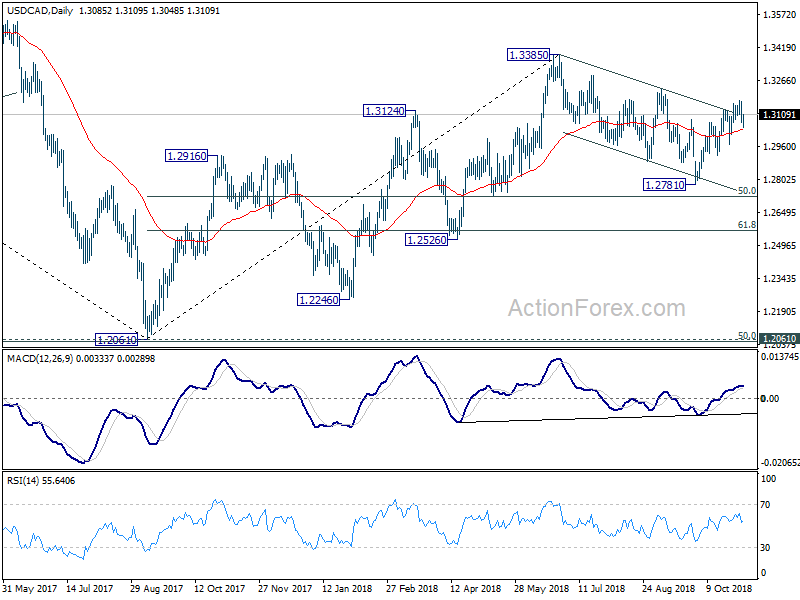
Daily Pivots: (S1) 1.3047; (P) 1.3109; (R1) 1.3149; More...
Despite breaching 1.3068 minor support to 1.3048, USD/CAD quickly recovered. Intraday bias stays neutral first. On the upside, break of 1.3170 will reaffirm the bullish case and target 1.3225 key near term resistance. Break will confirm completion of choppy fall from 1.3385 and target a retest on this high. Though, break of 1.3048 will turn focus to 1.2969 support. Firm break there will indicate completion of whole rebound from 1.2781. In that case, whole fall from 1.3385 might extend through 1.2781 support before completion.
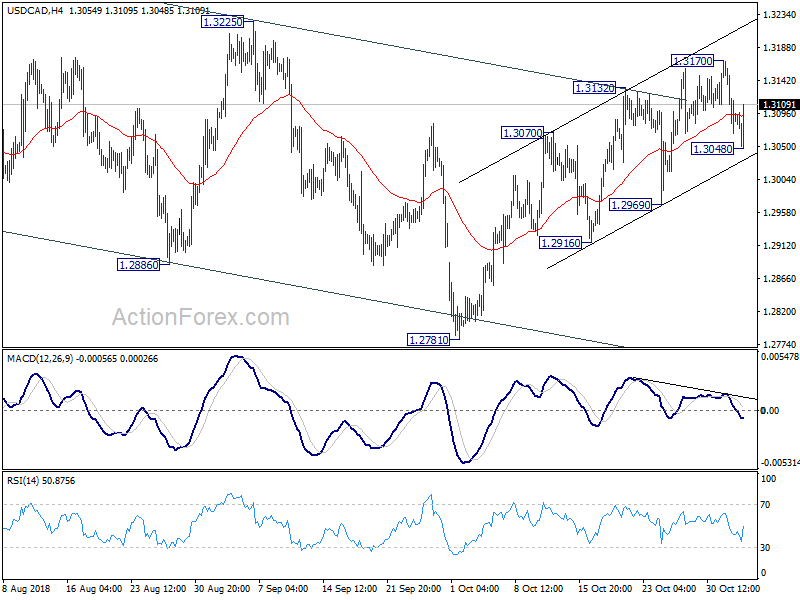
In the bigger picture, current development revives the case that corrective fall from 1.3385 has completed at 1.2781 already. And whole up trend from 1.2061 (2016 low) is ready to resume. Break of 1.3385 will target 61.8% retracement of 1.4689 (2016 high) to 1.2061 at 1.3685. This will now be the favored case as long as 1.2781 support holds.
Dollar Trying to Recover as NFP Beat Expectations, Euro Strong as German-Italian Spread Narrows
After being pressured for most of the day, Dollar is trying to recover in early US session after better than expected job data. Though, momentum remains weak so far, and the greenback is trading mixed only. On the other hand, there is little change in Yen's fortune, which remains the weakest one on return of global risk appetite. Canadian Dollar is the second weakest after employment data missed expectations. Swiss Franc and Euro are the strongest ones today as they're paring losses against Australian and New Zealand Dollar. Also, Euro is lifted as German-Italian yield spread narrows.
Global risk appetite is boosted by the positive developments in US-China trade war after the phone call between Trump and Xi. In addition to nice words, both sides are working towards a the meeting of the two presidents as sideline of G20 summit in Argentina on Nov 30 – Dec 1. Ahead of that, it's also reported that Trump asked his key cabinet secretaries to draw up a potential agreement to sign during the meeting, as cease-fire in escalating trade war. Multiple agencies are believed to be involved in drafting the plan.
At the time of writing, US futures point to another day of strong rebound. Major European indices are trading in black, with FTSE up 0.75%, DAX up 1.56%, CAC up 1.34%. German 10 year yield is up 0.0253 at 0.427. Italian 10 year yield is down -0.054 at 3.326. Spread continues to narrow. Earlier in Asia, Nikkei closed up 2.56%, Hong Kong HSI rose 4.21%, China Shanghai SSE gained 2.70%, Singapore Strait Times added 1.81.
US NFP rose 250k, unemployment rate at 3.7%, average hourly earnings rose 0.2% mom
US non-farm payrolls rose 250k in October, above expectation of 200k. Prior month's figure was revised down from 134k to 118k. Unemployment rate was unchanged at 3.7%, matched expectations. Average hourly earnings rose 0.2% mom in October, matched expectations. Also from US, trade deficit widened to USD -54.0B in September.
From Canada, employment market grew 11.2k in October, below expectation of 25.0k. Unemployment rate dropped to 5.8%, below expectation of 5.9%. Trade deficit narrowed to CAD -0.4B but missed expectation of CAD 0.2B surplus.
UK construction PMI rose to 53.2, but underlying data paints less rosy picture
UK PMI construction rose to 53.2 in October, up from 52.1 and beat expectation of 52.1. Markit noted "fastest growth in civil engineering since July 2017". However, there was "slower rise in new projects at construction companies:" and "business optimism weakest in nearly six years". Trevor Balchin, Economics Director at IHS Markit said in the release "although total UK construction activity rose at a stronger pace in October, the underlying survey data paint a less rosy picture for the sector towards the end of the year."
Eurozone PMI manufacturing finalized at 52.0, risks shifting to the downside
Eurozone PMI manufacturing was finalized at 52.0 in October, down from prior month's 53.2. Markit noted "fall in order books as exports decline for the first time in nearly five-and-a-half years". Also, "trade concerns push confidence down to lowest level since December 2012". Among the countries, Italy PMI manufacturing dropped to contraction at 49.2, hit a 46-month low. France reading dropped to 51.2, a 25-month low. German reading dropped to 52.2, a 29-month low.
Chris Williamson, Chief Business Economist at IHS Markit said in the release, "concerns about the Eurozone manufacturing sector intensified at the start of the fourth quarter." And, "the combination of destocking, deteriorating order books and drop in business optimism will add to concerns that growth risks are shifting to the downside rather than being "broadly balanced", as indicated by the ECB."
Japan PM Abe: Won't proceed with sales tax hike if there's global crisis
Japanese Prime Minister Shinzo Abe appeared to be backing down on his stance regarding the planned sales tax hike next year. For now, he's still on track to raise sales tax from 8% to 10% in October 2019. He also pledged to mitigate any impact on the economy by providing counter measures.
However, he told parliament that "Our basic stance is that we will proceed with the sales tax hike. But it's wrong to be too rigid about this and raise the tax rate no matter what." And, "we will proceed with the tax hike unless the economy is hit by a shock of the scale of the collapse of Lehman Brothers", which "would be something like a global economic crisis or a huge earthquake."
Elsewhere
Swiss retail sales dropped -2.7% yoy in September. Japanese Prime Minister Shinzo Abe appeared to be backing down on his stance regarding the planned sales tax hike next year. For now, he's still on track to raise sales tax from 8% to 10% in October 2019. He also pledged to mitigate any impact on the economy by providing counter measures.
USD/CAD Mid-Day Outlook
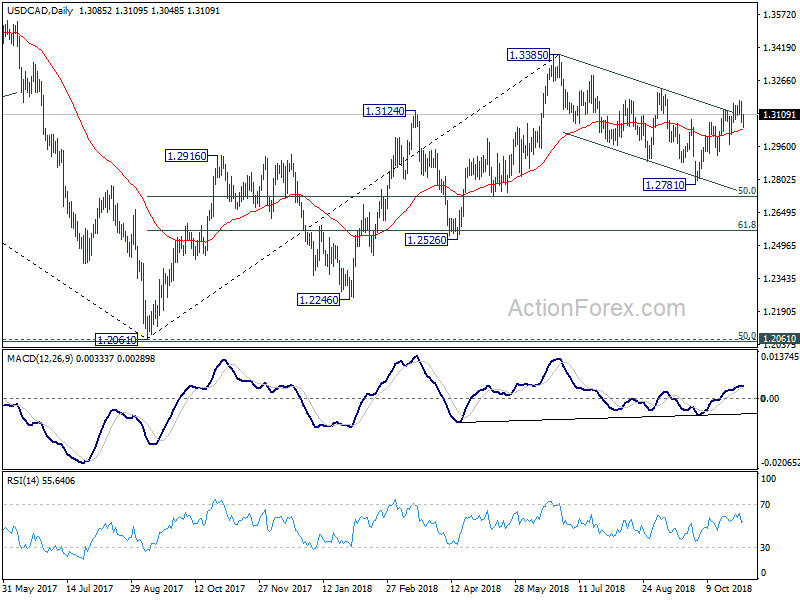
Daily Pivots: (S1) 1.3047; (P) 1.3109; (R1) 1.3149; More...
Despite breaching 1.3068 minor support to 1.3048, USD/CAD quickly recovered. Intraday bias stays neutral first. On the upside, break of 1.3170 will reaffirm the bullish case and target 1.3225 key near term resistance. Break will confirm completion of choppy fall from 1.3385 and target a retest on this high. Though, break of 1.3048 will turn focus to 1.2969 support. Firm break there will indicate completion of whole rebound from 1.2781. In that case, whole fall from 1.3385 might extend through 1.2781 support before completion.
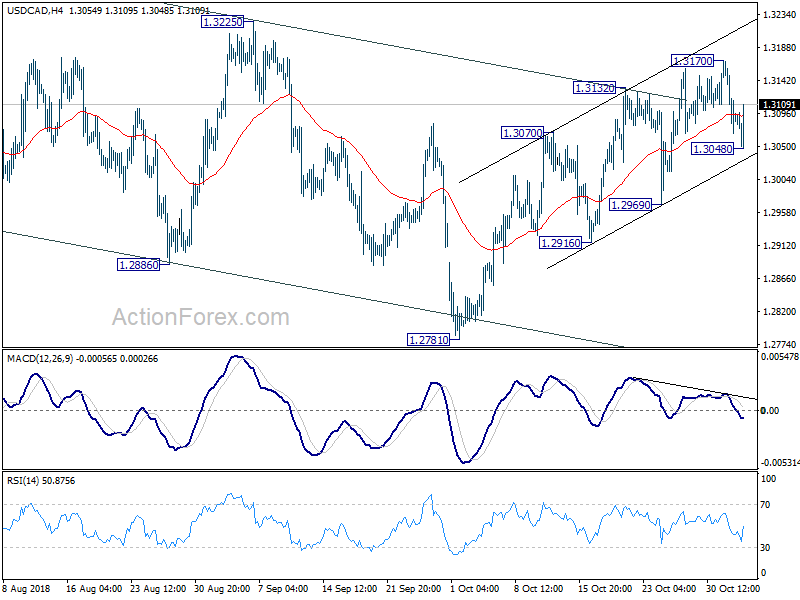
In the bigger picture, current development revives the case that corrective fall from 1.3385 has completed at 1.2781 already. And whole up trend from 1.2061 (2016 low) is ready to resume. Break of 1.3385 will target 61.8% retracement of 1.4689 (2016 high) to 1.2061 at 1.3685. This will now be the favored case as long as 1.2781 support holds.
Economic Indicators Update
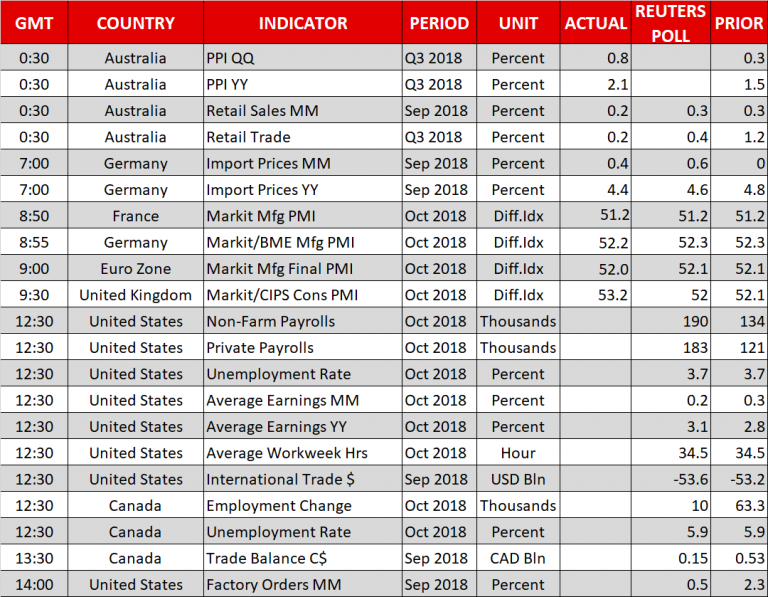
| GMT | Ccy | Events | Actual | Forecast | Previous | Revised |
|---|---|---|---|---|---|---|
| 23:50 | JPY | Monetary Base Y/Y Oct | 5.90% | 6.20% | 5.90% | |
| 00:30 | AUD | PPI Q/Q Q3 | 0.80% | 0.20% | 0.30% | |
| 00:30 | AUD | PPI Y/Y Q3 | 2.10% | 1.50% | ||
| 00:30 | AUD | Retail Sales M/M Sep | 0.20% | 0.30% | 0.30% | |
| 08:15 | CHF | Retail Sales Real Y/Y Sep | -2.70% | -0.30% | 0.40% | |
| 08:45 | EUR | Italy Manufacturing PMI Oct | 49.2 | 49.7 | 50 | |
| 08:50 | EUR | France Manufacturing PMI Oct F | 51.2 | 51.2 | 51.2 | |
| 08:55 | EUR | Germany Manufacturing PMI Oct F | 52.2 | 52.3 | 52.3 | |
| 09:00 | EUR | Eurozone Manufacturing PMI Oct F | 52 | 52.1 | 52.1 | |
| 09:30 | GBP | UK Construction PMI Oct | 53.2 | 52 | 52.1 | |
| 12:30 | CAD | Net Change in Employment Oct | 11.2K | 25.0K | 63.3K | |
| 12:30 | CAD | Unemployment Rate Oct | 5.80% | 5.90% | 5.90% | |
| 12:30 | CAD | International Merchandise Trade (CAD) Sep | -0.4B | 0.2B | 0.5B | -0.6B |
| 12:30 | USD | Change in Non-farm Payrolls Oct | 250K | 200K | 134K | 118K |
| 12:30 | USD | Unemployment Rate Oct | 3.70% | 3.70% | 3.70% | |
| 12:30 | USD | Average Hourly Earnings M/M Oct | 0.20% | 0.20% | 0.30% | |
| 12:30 | USD | Trade Balance Sep | -54.0B | -53.4B | -53.2B | -53.3B |
| 14:00 | USD | Factory Orders Sep | 0.30% | 2.30% |
US NFP rose 250k, unemployment at 3.7%, average hourly earnings rose 0.2%, Dollar trying to recover
US non-farm payrolls rose 250k in October, above expectation of 200k. Prior month's figure was revised down from 134k to 118k. Unemployment rate was unchanged at 3.7%, matched expectations. Average hourly earnings rose 0.2% mom in October, matched expectations. Also from US, trade deficit widened to USD -54.0B in September. Dollar is trying to recover after the release
From Canada, employment market grew 11.2k in October, below expectation of 25.0k. Unemployment rate dropped to 5.8%, below expectation of 5.9%. Trade deficit narrowed to CAD -0.4B but missed expectation of CAD 0.2B surplus.
USD/CAD – Canadian Dollar Improves To One Week High Ahead Of Key Job Data
The Canadian dollar has edged higher in the Friday session. Currently, USD/CAD is trading at 1.3064, down 0.17% on the day. On the release front, traders should be prepared for volatility from USD/CAD, with key employment releases on both sides of the border. In Canada, employment change is expected to drop sharply to 12.3 thousand and the unemployment rate is forecast to remain unchanged at 5.9%. Over in the U.S, Nonfarm payrolls are expected to climb sharply to 194 thousand, but wage growth is forecast to ease to 0.2%. The unemployment rate is expected to remain at 3.7%.
Global equity markets are sharply higher on Friday, after a report that a trade deal between the U.S and China could be in the works. After a brutal October, the DAX has rebounded with gains at the start of November. The DAX plunged 6.7% in October, its worst monthly performance since December 2016. However, the picture has brightened considerably, with the DAX climbing 3.2% this week. Asian equity markets posted strong gains on Friday, buoyed by a report that U.S President Trump is working on a trade agreement with China, which Trump will present to Chinese President Xi Jinping at a Group of 20 summit in Argentina later this month. If the two economic giants are able to reach an agreement, the result would be a boon for global trade. The Canadian economy is heavily reliant on its export sector, so a stronger global economy would be good news for the Canadian dollar.
The Canadian economy grew 0.1% in August, marking a seventh straight month of expansion. Higher oil production in Alberta and higher oil prices fueled the modest gain. The economy has been performing well and remains on track for annualized growth of 2% in 2018. Unemployment is at low levels and is expected to remain pegged at 5.9% for October. The Bank of Canada raised rates last week to 1.75%, and the hawkish message from the bank was a broad hint to the markets that further rate hikes are in store. With the economy operating close to full capacity, rate hikes are an effective method of ensuring that the economy does not overheat. The BoC is also mindful that the Federal Reserve is expected to raise rates again in December, which would mark a fourth rate hike in 2018. Policymakers do not want to see divergence widen between U.S and Canadian rates, and another rate hike from the BoC would be bullish for the Canadian dollar.
Dollar Holds Up Versus Yen Ahead Of NFP Job Report
Here are the latest developments in global markets:
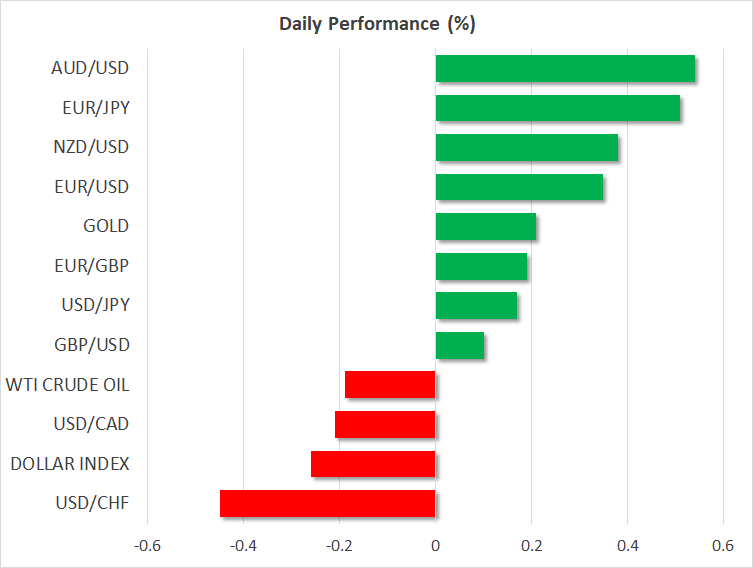
FOREX: Dollar/yen eased to 112.81 but remained up on the day (+0.12%) after rising as high as 113.10 early in the European session as investors were looking for details to confirm that the US President and the Chinese leader will attempt to reach a trade agreement at the G20 summit in Argentina later this month. This came after reports that the government heads had a constructive phone call yesterday, with China’s foreign ministry providing some support to the optimism today, saying that the sides want to enhance their trade relations. The dollar index, though, was weaker around 96 (-0.24%) as the euro and the pound continued to strengthen. The NFP job report is likely to give further direction to the dollar later today. Euro/dollar increased positive momentum towards 1.1443 (+0.32%), shrugging off disappointing manufacturing PMIs out of Eurozone; October’s index was revised slightly downwards to 52 from 52.1 forecasted and 53.2 seen in September, to the lowest since August 2016. Euro/yen posted stronger gains, jumping by 0.43%. In the UK, prospects that the EU and the UK have trucked a tentative deal to allow British financial services companies to access European markets after Brexit were somewhat downplayed. Yet governmental officials said that negotiations continue progressively. On Wednesday a letter revealed that the British Brexit Secretary is hoping for an agreement by November 21. Pound/dollar extended yesterday’s bullish move to 1.3045 before inching down to 1.3024 (+0.12%). The trade-sensitive antipodean currencies were overperforming at one-month highs, with aussie/dollar bouncing by 0.60% and kiwi/dollar winning 0.38%. Dollar/loonie and dollar/swiss franc were on the back foot, losing 0.45% and 0.25% respectively. In emerging currencies, the Chinese onshore yuan was in bullish mode, crawling up by 0.75%.
STOCKS: European equities joined the rally in Asian stock markets on Friday on hopes that the US and China are looking to resolve their trade standoff despite worse than expected earnings results from the giant tech Apple on Thursday. The pan-European STOXX 600, climbed by 1.04% to two-week lows at 0940 GMT, while the blue-chip Euro STOXX 50 gained 0.75%. The German DAX 30 improved by 1.15%, the French CAC 40 rose by 1.20% and the Italian FTSE MIB added 1.33% to its performance. UK’s FTSE 100 was up by 0.67%. In the US, futures tracking Dow Jones. Nasdaq 100 and S&P 500 were in the green, pointing to a positive open.
COMMODITIES: Crude markets are set to close lower for the fourth straight week as concerns over rising inventories keep sentiment subdued. News that the US government has spared waivers to some of Iran’s closest trade partners such as South Korea, Japan and India before US sanctions take effect on Sunday added pressure to prices today. WTI crude and Brent were mixed, trading at $63.49/barrel (-0.36%) and $72.92/barrel (+0.04%) respectively. In precious metals, gold is on track to post its fifth weekly gain today, last seen at $1,236/ounce (+0.25%).
Day Ahead: US nonfarm payrolls & wage data and Canadian jobs figures on the agenda
US nonfarm payrolls will take center stage on Friday with the potential to shake the US dollar which has been losing ground against a basket of six major currencies so far in the day. Canadian employment figures will attract interest as well.
Following Wednesday’s upbeat ADP employment report which tracks changes in the private sector, the government’s comprehensive nonfarm payrolls due at 1230 GMT are expected to come higher at 190k new positions in October compared to 134k seen in September. The unemployment rate is forecast to have stayed unchanged at 3.7%, at the lowest since 1969. Analysts believe that average hourly earnings have risen by 3.1% y/y compared 2.8% in the previous month, reaching the highest growth pace since April 2009, while on a monthly basis they see a softer increase of 0.2% m/m versus 0.3% before. Should the report beat expectations especially on the wage front, buying interest for the greenback may accelerate. Meanwhile better wage numbers could hurt equities. However, given the upbeat sentiment surrounding the US-China trade conflict, we don’t expect a major tumble in case the figures dissapoint.
In other data releases out of the US, trade stats for the month of September (1230 GMT) are expected to show a slightly wider decifit, while September’s factory orders (1400 GMT) are anticipated to grow by 0.5% m/m after marking a 2.3% expansion in the previous month.
At the same time, Canada will be also publishing its own employment data for October. The unemployment rate is forecast to have held steady at 5.9%, while the number of employees are expected to have risen by 10k, by less than in September when the measure showed a gain of 63.3k. At its latest policy meeting in the prior week, the Bank of Canada raised interest rates to 1.75% and removed the part mentioning that officials will “take a gradual approach” with regards to rate hikes. Moreover, they simply noted that “in determining the appropriate pace of rate increases, Governing Council will continue to take into account how the economy is adjusting to higher interest rates”. Therefore, a decent employment report combined with a decent GDP growth number on Wednesday could keep bets for further and faster rate increases elevated.
Separately, Canadian trade surplus (1330 GMT) is said to have narrowed in September.
In corporate news, the Chinese online retailer Alibaba Group Holdings will be publishing earnings results before the US market open.