Sample Category Title
Yen Recoups Losses Despite Dollar Strength; Oil & Gold on Slippery Road
Here are the latest developments in global markets:
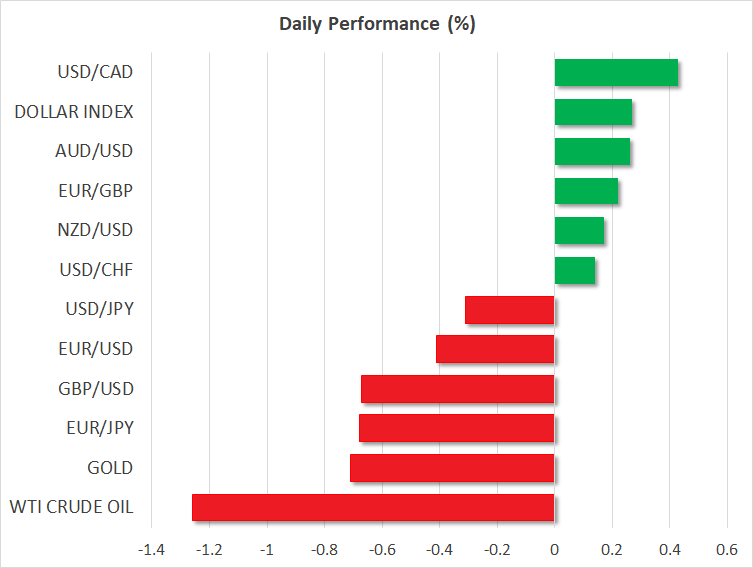
- FOREX: With Japan being shut for the Health and Sports public day and risk-off sentiment strengthening amid trade uncertainties and political noises in the Eurozone, the Japanese yen managed to rebound, sending dollar/yen straight down to a 1 ½ -week low of 113.33 (-0.33%). Yesterday, the People’s Bank of China slashed the amount of cash banks must hold as reserves, stepping up efforts to set free some liquidity and thus boost growth in the economy. The move was considered as a defense against US import tariffs. The offshore yuan declined by 0.47%. The dollar index, though, was on the recovery after two straight negative days, gaining on the back of a weaker euro and pound. Euro/dollar was struggling below 1.1500, last seen at 1.1478 as the Italian Deputy Prime Minister, Matteo Salvini continued his verbal attack against the European commission. His threats to block migrant repatriates from Germany during the weekend were probably affecting trade appetite as well. The news came after reports that 40,000 migrants could be repatriated from Germany to Italy. Yet the German government hinted that such an agreement was not signed between the two sides. In terms of data out of the eurozone, October’s Sentix investor confidence index disappointed, dropping to 11.4 from 11.7 expected and 12.0 seen in September, adding further pressure to the euro. Pound/dollar fell back below 1.31 to trade at 1.3064 as the dollar was gaining ground despite rising Brexit optimism. Euro/pound was moving higher by 0.20%, while euro/yen and pound/yen sank by 0.67% and 0.90% respectively. Dollar/loonie was increasing momentum for the fifth day, jumping by 0.43% to 1.2990, the highest since September 28. The antipodean currencies were up, with aussie/dollar and kiwi/dollar changing hands at 0.7069 (+0.26%) and 0.6451 (+0.16%) respectively.
- STOCKS: European stocks opened lower on Monday as the monetary stimulus move in China raised fears that China might be taking US trade tariffs more seriously than markets think. Concerns that the European Commission could ask Italy to change its spending plans were also weighing on the sentiment. The pan-European STOXX 600 and the blue-chip Euro STOXX 50 were losing 0.86% and 0.75% respectively at 1200 GMT, with all sectors being in the red. The German DAX 30 and the French CAC 40 retreated by 0.85%, UK’s FTSE 100 declined by 0.56%, while the Italian FTSE MIB tumbled by 0.72%. In Asia, equities closed in negative territory with Chinese stocks falling sharply, by more than 3.0%. South Korean markets will be closed for a public holiday on Tuesday. In the US, futures tracking the Dow Jones, S&P 500 and Nasdaq 100 were trading lower as well, pointing to a negative open.
- COMMODITIES: Reports that the US may grant some countries waivers to sanctions against Iranian oil exports next month and Saudi Arabia’s willingness to meet US demands by replacing output shortfalls in Iran pressured the crude market on Monday. The Iranian energy minister said today the Iranian oil will see a severe downside in coming months, though his words did not provide mush support to crude prices. WTI crude oil was down by 1.29% at $73.38/barrel and the London-based Brent was weaker by 1.38% at $83.00/barrel, both declining for the third consecutive day. Gold reversed deeply to the downside to touch $1,194/ounce (-0.70%).
 Day Ahead: Quiet day with some developments in Italian politics and Brexit negotiations
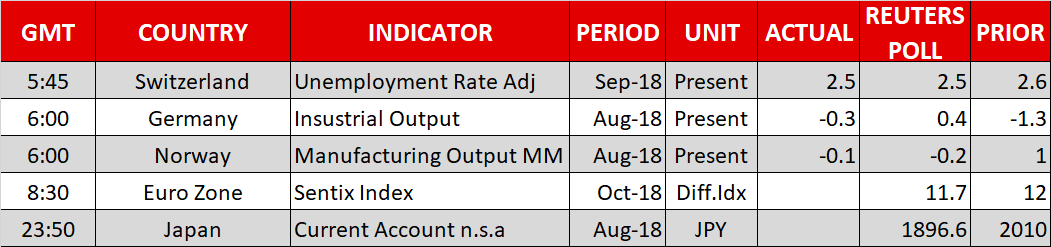
Economic releases will be light in the remainder of the day, with Japanese current account figures being next in focus on Tuesday. US bond markets will remain closed in celebration of Columbus Day on Monday, though Wall Street will be open.
One of the major releases this week will be the minutes of the latest European Central Bank policy meeting on September 13. Following the upbeat remarks of President Draghi at the conference, it will be interesting to see on Thursday whether other ECB officials are on the same page. Investors could turn sensitive to any comments regarding future rate hikes after the ECB member Klaas Knot said on Monday that policymakers will start discussing on the timing of rate rises in January. He also admitted that increases in borrowing costs might come sooner or later than guided, but the euro continued to move lower.
Any developments related to the Italian fiscal policy could move the euro during the week as well. Note that the Italian government published a draft of its spending plans for 2019 and announced its deficit targets for the subsequent two years. Although Italy kept its deficit goal below EU’s debt threshold of 3.0% of GDP, EU officials showed dissatisfaction, arguing that Italy’s budget plans deviated significantly from previous commitments. Rome said that deficit goals for 2020 and 2021 will be lowered but investors worry that the EU might maintain a hardline against the final plan, that is to be handed to the European Commission by October 15.
In terms of Brexit negotiations, optimism for the EU and the UK finding a common ground regarding divorce terms resurfaced at the end of the previous week. It is hoped that a deal could be struck on the Irish border issue, a sticking point in Brexit talks, before a relevant summit on October 17. Sterling will likely stay sensitive to any hints of progress in these talks. This week, the UK Brexit Secretary, Dominic Raab will fly to Brussels to present new proposals on the Irish border as promised by the British Prime Minister. On Tuesday the British Parliament will hold a meeting, though Brexit will not be on the agenda this time despite next week’s deadline. Lawmakers are scheduled to discuss on the budget instead, which is due at the end of the month.
AUDUSD Outlook: Bears are Taking a Breather above Psychological 0.70 Support
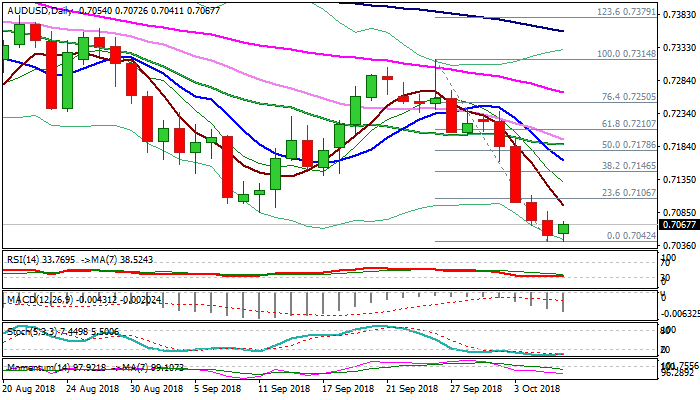
The Australian dollar bounces from new low at 0.7041 (the lowest since Fed 2016, which was hit on Friday and retested today), as larger bears are taking a breather after last week's 2.4% loss ( the biggest one week fall since the last week of January).
The Aussie was pressured by risk aversion, as well as strong fall in China stocks and yuan as the central bank loosened the policy.
Bears face headwinds from strong supply at psychological 0.70 support and may consolidate before eventual break lower.
Oversold daily studies suggest such scenario but lacking stronger signal for now.
Recovery attempts penetrated very thick hourly cloud (0.7072/0.7111) which acts as strong barrier but were so far unable to extend deeper into cloud, as former low at 0.7085 (11 Sep) marks next strong obstacle and fresh bulls show hesitation on approach.
Stronger recovery could stretch towards pivotal 0.7146 resistance (Fibo 38.2% of 0.7314/0.7042 bear-leg before bears regain control.
Only break here would sideline downside risk and open way for stronger correction.
Res: 0.7085; 0.7111; 0.7146; 0.7163
Sup: 0.7041; 0.7000; 0.6972; 0.6906
AUD/USD short strategy reinstated after China’s RRR cut ignored
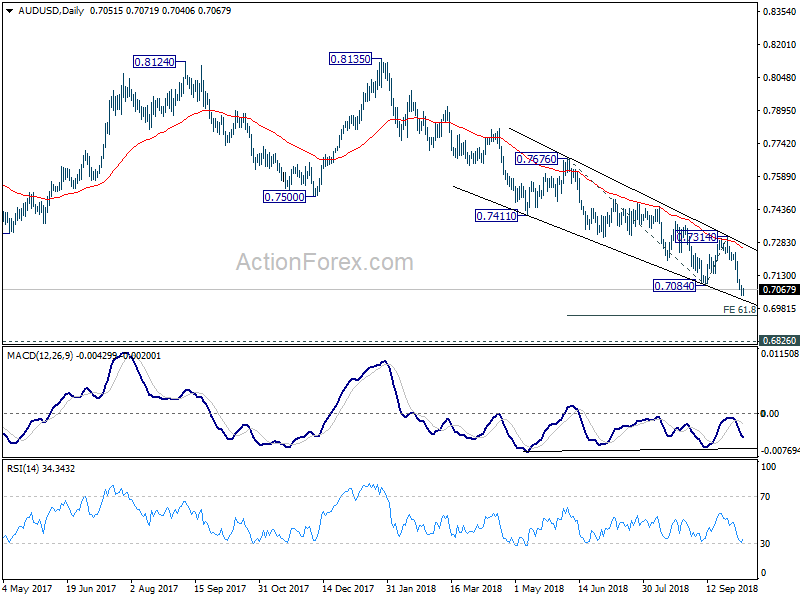
The impact of PBoC's RRR cut on the market was rather muted today. Or actually, it's done it job of preventing more serious selloff in the stock markets. Shanghai SSE's -3.72% loss today is rather reasonable considering the selloff in other Asian markets last week. Anyway, AUD/USD was rather unmoved and the overall technical outlook is unchanged. That is, the down trend from 0.8135 is in progress for a test on 0.6826 key support level.
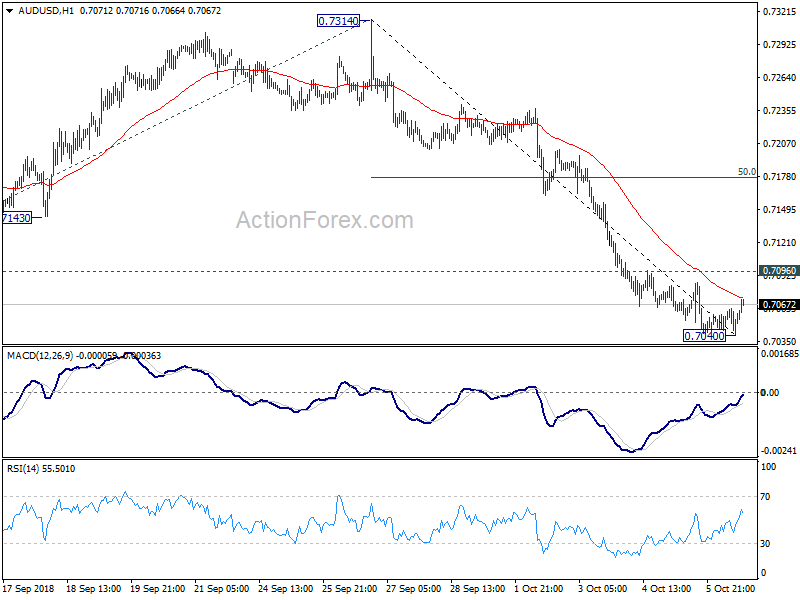
As the volatility risk is now past, we'd reinstate our strategy discussed in the week report. That is, we'll sell AUD/USD at 0.7100, slightly above 0.7096 minor resistance. Stop will be placed at 0.7185, slightly above 50% retracement of 0.7314 to 0.7040 at 0.7178. 0.6826 is the first target, which gives risk/reward at 1/3.22. We'll decide if we'll get out earlier, or hold through the target, after looking at the momentum of the next fall.
DAX – Bank Shares Drag DAX To 4-Week Low
The DAX index has posted sharp losses in the Monday session. Currently, the index is at 11,993 points, down 0.93% on the day. There are no key events in Germany or the eurozone. German Industrial Production declined 0.3%, missing the estimate of 0.4%. The indicator has now declined four times in the past five months. In the eurozone, Sentix Investor Confidence dropped to 11.4 points, matching the estimate. On Tuesday, Germany releases trade balance.
High yields on U.S treasury bonds continue to weigh on global equity markets. On Thursday, the yield on 10-year treasury notes hit 3.23%, the highest yield since May 2011. Eurozone bond yields have also risen, putting pressure on European stock markets. On Monday, the DAX has dropped to its lowest level since October 12. Bank shares continue to struggle and are down sharply on Monday. Commerzbank has plunged 5.98% and Deutsche Bank has dropped 2.38%.
Another factor weighing on European stock markets is the crisis over the controversial Italian budget. Last week, the new populist government proposed a controversial budget which increases spending, lowers taxes and set the budget deficit at 2.4% of GDP for the next three years. Italy has a massive debt, and the European Union doesn’t want Rome to expand the current deficit, which stands at 1.6% of GDP. The populist Italian government has tried to lower the flames, and last week said that the budget deficit could be lowered in 2020 and 2021. Still, the budget remains a sore point for the EU, and the risk appetite could slide if the EU and Italy remain at loggerheads over Italy’s fiscal policy. The budget must first be approved by Italy’s parliament and then by the European Commission, so this crisis could continue for some time.
Fed Bullard: Growth surprise allowed Fed to normalize as planned
St. Louis Fed President James Bullard said in at a forum in Singapore that growth in US is on track to beat forecast for three consecutive years from 2017 to 2019. And he discussed a few consequences of the growth surprise. Firstly, it allowed Fed to normalize monetary policy along its projected path. Secondly, it helped profitability of U.S. firms, helping to drive U.S. equity markets higher. Thirdly, Dollar has naturally strengthened in 2018 (due in part to the larger growth surprise domestically).
Bullard added that "faster productivity growth" is needed to maintain the current real GDP growth rate. "A switch to the high state for labor productivity growth would raise the U.S. potential growth rate to a stunning 3.4 percent." However, he noted "this switch is a possibility, but it has not materialized so far."
EUR/USD – Euro Starts Week With Losses, U.S Banks Closed For Holiday
EUR/USD has lost ground at the start of the trading week. Currently, the pair is trading at 1.1477, down -0.39% on the day. There are no U.S events on the schedule, as U.S banks are closed for Columbus Day (however, stock markets are open). On the release front, German Industrial Production declined 0.3%, missing the estimate of 0.4%. The indicator has now declined four times in the past five months. In the eurozone, Sentix Investor Confidence dropped to 11.4 points, matching the estimate. On Tuesday, Germany releases trade balance.
In the U.S, the labor market remains hot, but September’s numbers were mixed. Nonfarm payrolls dropped sharply to 134 thousand, its smallest gain in a year. This was well short of the estimate of 185 thousand. However, one factor in the disappointing release is Hurricane Florence, which led to many employees being unable to report to work during the storm. Wages appear headed in the right direction – Average Hourly Earnings gained 0.3% in September, and are up 2.9% on a year-to-year basis. The unemployment rate fell to 3.7%, its lowest level since 1969. The mixed numbers put a slight damper on the odds of a December hike, which dipped to 76% after the job releases, down from 80% prior to the releases. A December rate hike would be the fourth this year, with the Fed expected to raise rates another three times in 2019.
Fed Chair Jerome Powell had a hawkish message for the markets last week. Powell said that interest rates were still accommodative, but were “gradually moving to a place where they will be neutral”. Powell said that extremely accommodative low interest rates were no longer needed, since the economy has strengthened. The hawkish comments helped push the U.S dollar higher on Wednesday. Analysts have noted that there is no precise definition of a neutral rate, but the Fed tends to use the 3 percent level as its yardstick. With the Fed expected to continue its gradual increase in rates, this level could be reached in 2019.
XAUUSD Analysis: Passes Monthly PP At 1,195.43
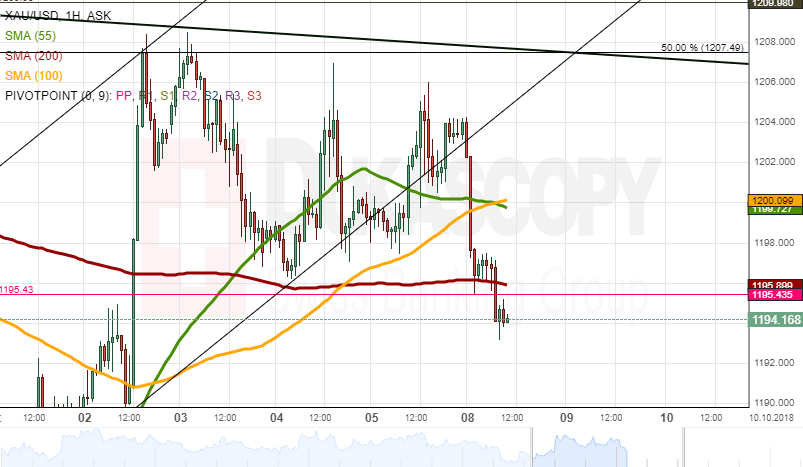
The gold price depreciated 0.33 % since Friday's session. On Friday, the yellow metal passed the monthly pivot point to trade at the 1,194.31 mark.
In regards to the near-term future, most likely, the rate will move downwards due to the resistance of the monthly pivot point at the 1,195.43 and the resistance of the 200-hour simple moving average. It is expected that the rate will trade at the 1,192.00 level during the day.
On the other side, the rate might surge upwards to break the resistance of the monthly pivot point to take its support to surge upwards to trade at the 1,198.00 level on Monday.
USDJPY Analysis: Will Trade Sideways At 113.80
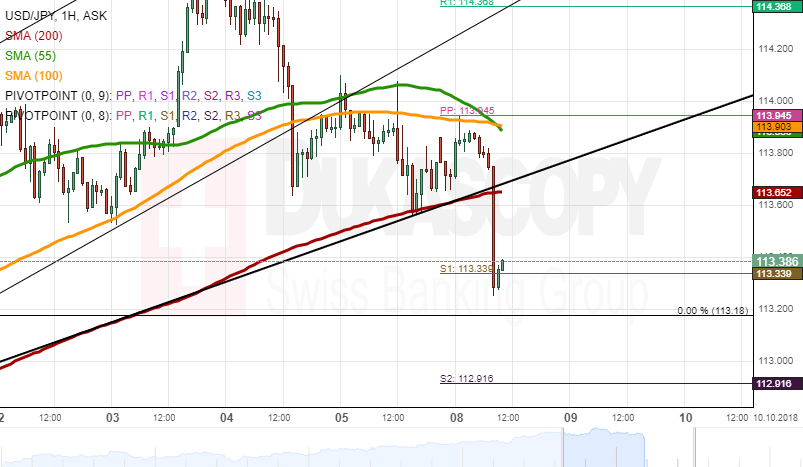
The US Dollar depreciated 0.12% against the Japanese Yen since Friday's session. On Monday, the US Dollar was located at the 113.79 mark.
In regards to the near-term future, the US dollar will trade sideways due to the resistance of the 55-hour and the 100-hour SMAs together with the resistance of the weekly PP at the 113.94 mark. Moreover, the rate is supported by the 200-hour SMA and the medium ascending pattern's bottom line, which should not let the rate to go downwards during the day.
However, the strong resistances may let the rate to pass the supports, and on the other side, the strong supports may let the rate to break the resistances.
Italy Salvini vows “we will not backtrack” as German-Italian spread stays above 300
Italian Deputy Prime Minister, League leader Matteo Salvini insisted today that "we will not backtrack, we will not backtrack" referring to the 2019 budget deficit target. He blamed the volatility in the markets on speculators that are taking advantages. Salvini said "If one had evil thoughts, he would think there are people betting on the spread because they don't want Italy to grow and create jobs". And, "speculators acting like (George) Soros are betting on Italy's collapse to buy at discount prices the healthy companies, and there are many of them, that have remained in this country."
Salvini also warned that credit agencies have to be fair on Italy. He said "I hope no one has prejudice toward this government, or strange intentions." Moody's is going to review Italy's Baa2 rating, with negative outlook, by the end of October. S&P will also review the BBB with stable outlook rating on October 26.
At the time of writing, Italian 10 year yield is up 0.1838 at 3.59. German 10 year bund yield is down -0.044 at 0.533. Spread is larger than the alarming 300 level.
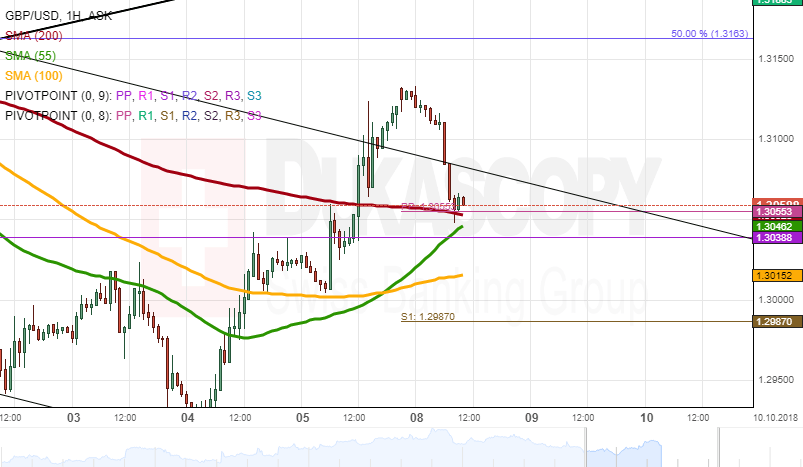
GBPUSD Analysis: Returns Back In Pattern
The British pound appreciated 0.38 % against the US Dollar since Friday's session. On Monday morning, the British pound returned in the pattern to trade at the 1.3077 mark.
During Monday's session, most likely, the rate will surge upwards to the 1.3080 level due to the support of the weekly pivot point at the 1.3055 mark and the 200-hour simple moving average.
Moreover, the 55-hour simple moving average will catch the rate to give additional support for the currency pair to surge during the trading day.