Sample Category Title
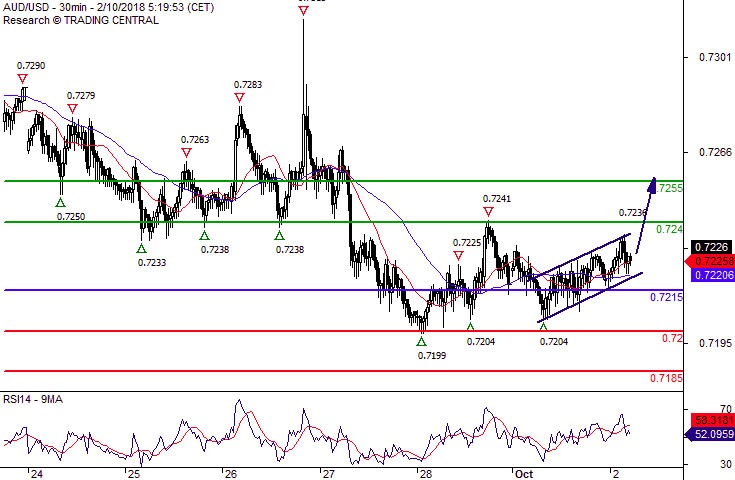
AUD/USD Bullish Bias Above 0.7215
Pivot (invalidation): 0.7215
Our preference Long positions above 0.7215 with targets at 0.7240 & 0.7255 in extension.
Alternative scenario Below 0.7215 look for further downside with 0.7200 & 0.7185 as targets.
Comment The RSI is above its neutrality area at 50%.
Risk aversion dominates as Italian bond and Hong Kong stocks dumped
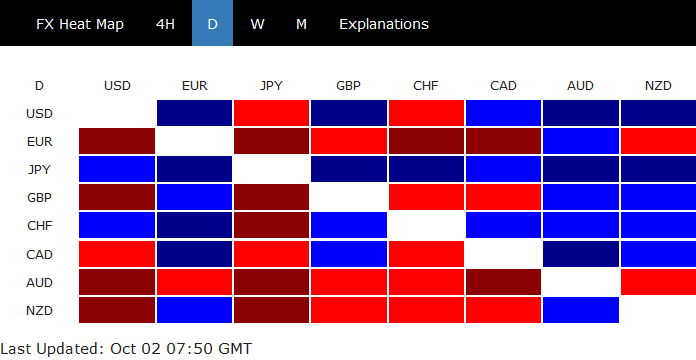
Risk aversion dominates the markets in the early part of European session. Australian Dollar is currently the biggest loser, followed by Euro. Yen is the clear gainer followed by Swiss Franc and Dollar.
 On the one hand, Italy's budget is a key focal point after EU officials basically rejected it. At the same time Deputy Prime Minister, 5-Star movement leader, Luigi Di Maio insisted today that "We are not turning back from that 2.4 percent target, that has to be clear ... We will not backtrack by a millimeter."
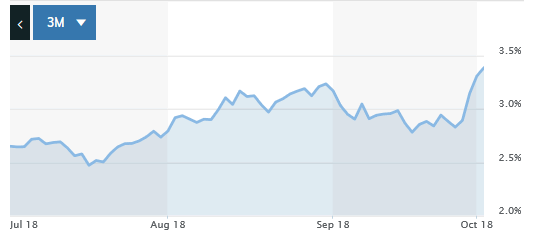
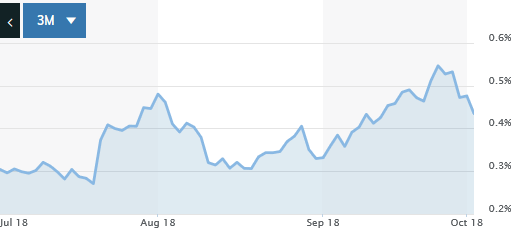
Italian 10 year yield surges as open and hit as high as 3.444, highest level since 2014. It's staying up 0.079 at 3.384 at the time of writing.
On the other hand, German 10 year yield is down -0.031 at 0.435. Spread is now very close to 300 again.
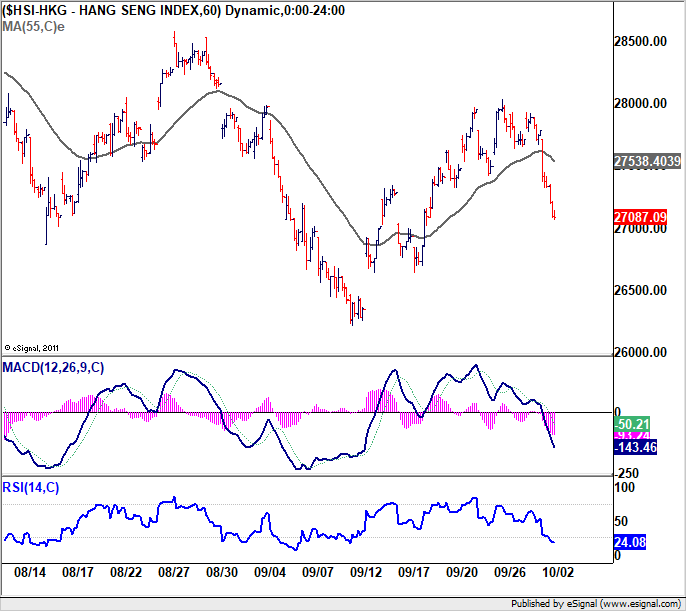
On the other hand, Hong Kong HSI suffers steep selling back from holiday. It's current down -2.55% and 27000 handle looks vulnerable. China is still on holiday. But selloff in HSI could be a prelude to SSE. US is now more ready to take on full trade war with China as settling Canada.
Trump’s USMCA – NAFTA 2.0 or Old Wine in New Bottles? And, Prepared for China Too?
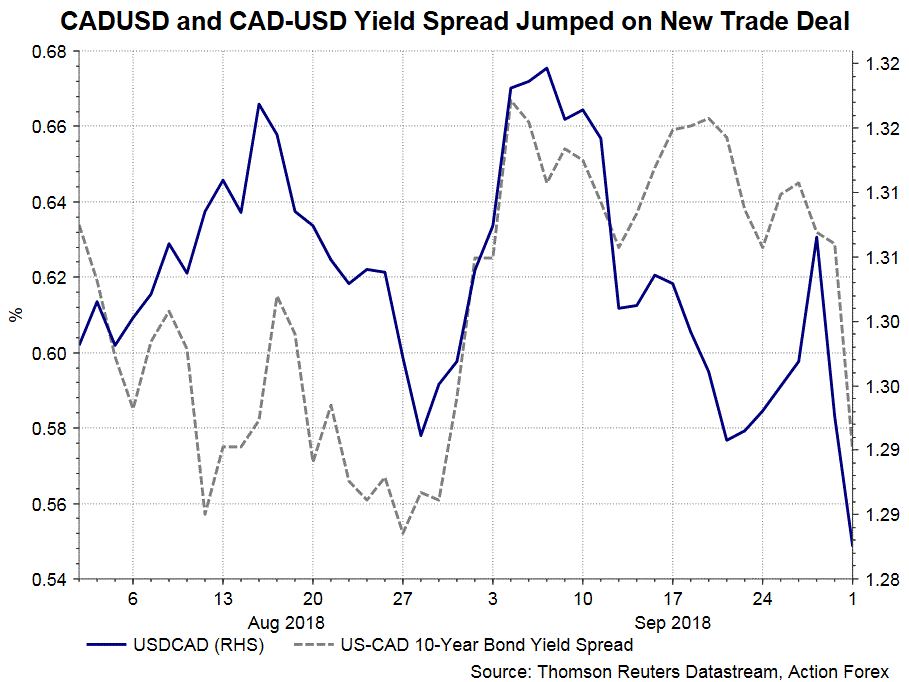
Canada and the US eventually reached a preliminary trade deal, named USMCA, just a few hours before the US-imposed negotiation deadline. Obviously, the market was thrilled by the “breakthrough”, evidenced by the rally of Canadian dollar and, to a lesser extent, Mexican peso against the greenback. While there are new ingredients in the trade deal, we see it as largely a repackaged NAFTA.
The optimistic market reaction was mainly on elimination of uncertainty, instead of enhanced mutual benefit on trade. The agreement will need the US Congressional vote, which will not materialize. Therefore, the overhang is now the November midterm election. The hurdle to pass the bill would increase should the Democrats regain control of the House of Representatives.
Canada’s Red Line Not Crossed
As we mentioned shortly after the Mexico-US deal was reached, Canada would not compromise on Chapter 19 (Dispute settlement mechanism for countervailing and antidumping duties) in the original NAFTA. While not part of the Mexico-US deal, Chapter 19 is retained and has become Chapter 10 in USMCA.
Yet, Canada has made some concessions. It had agreed to open 3.5% of the dairy market for US access and to remove Class 6 and Class 7 milk categories within 6 months and the import quotas will be phased in over 6 years. Indeed, the US is already to access to 3.25% of Canada’s dairy market under the Comprehensive and Progressive Agreement for Trans-Pacific Partnership (CPTPP). Meanwhile, Class 7 of Canada’s milk category was just introduced last year for pricing milk ingredients like protein concentrates, skim milk and whole milk powder.
The US guarantees not to impose tariffs on automotive products (Section 232) as long as Canada caps is passenger vehicles exports at 2.6M per year and US$32.4B in parts (light trucks are exempt). These figures would not affect Canada’s auto market in reality as the country currently produces just under 2M light vehicles for domestic and export markets although. It exports about US$16B in parts. Note that the US has retained the threat on tariffs on steel and aluminium. It might be resolved with the quota system as in auto tariffs.
The new deal has touched upon issues on intellectual property laws with regards to ecommerce and pharmaceuticals. This can be considered as extension of the original plan. All in all, the new deal has returned the trade relations of the countries to the pre-Trump era with limited enhancement.
Endeavor to Curb China’s Exchange Rate Depreciation?
We are, however, astonished by Chapter 33, a clause to deal with “Macroeconomic Policies and Exchange Rate Matters”. According to Article 33.5, each party shall disclose publicly:
- monthly foreign-exchange reserves data and forward positions according to the IMF’s Data Template on International Reserves and Foreign Currency Liquidity, no later than 30 days after the end of each month;
- monthly interventions in spot and forward foreign exchange markets, no later than seven days after the end of each month;
- quarterly balance of payments portfolio capital flows, no later than 90 days after
the end of each quarter; and - quarterly exports and imports, no later than 90 days after the end of each quarter.
We doubt if the rules target the three parties involved as all of them are adopting free floating exchange rate regime. Trump’s administration probably tries to make it a precedent in negotiating trade deals with countries it deems are keen on currency manipulation. To be more explicit, we believe the White House has prepared to use similar terms as it negotiates trade deal with China in the future.
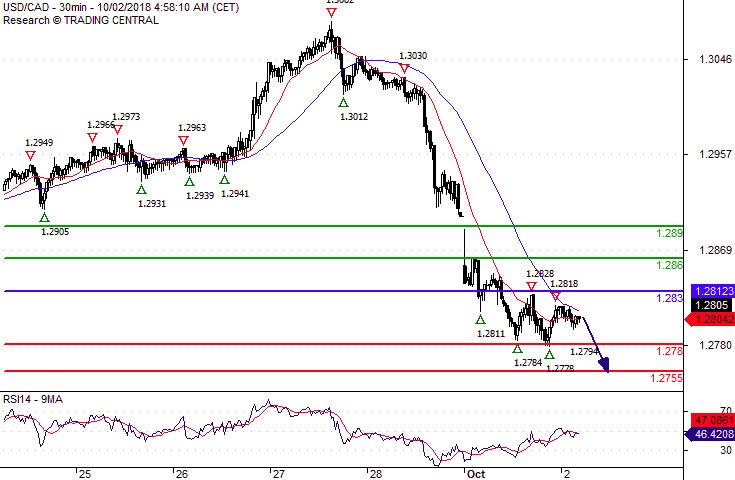
USD/CAD Key Resistance At 1.2830
Pivot (invalidation): 1.2830
Our preference Short positions below 1.2830 with targets at 1.2780 & 1.2755 in extension.
Alternative scenario Above 1.2830 look for further upside with 1.2860 & 1.2890 as targets.
Comment Technically the RSI is below its neutrality area at 50.
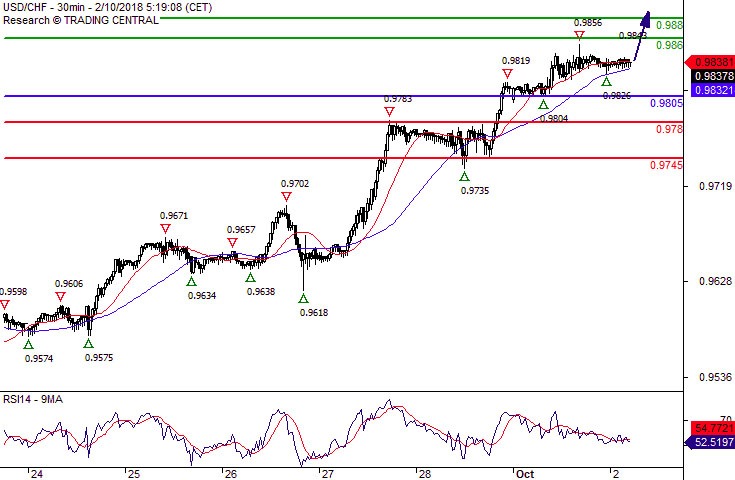
USD/CHF Further Upside
Pivot (invalidation): 0.9805
Our preference Long positions above 0.9805 with targets at 0.9860 & 0.9880 in extension.
Alternative scenario Below 0.9805 look for further downside with 0.9780 & 0.9745 as targets.
Comment The RSI lacks downward momentum.
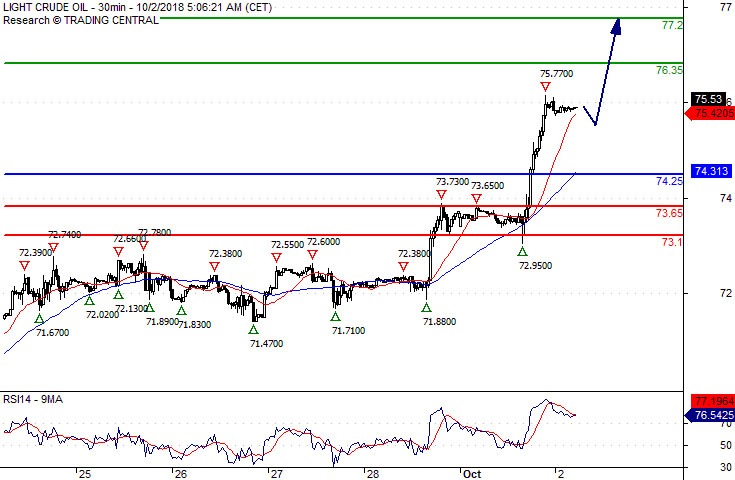
Crude Oil Further Advance
Pivot (invalidation): 74.25
Our preference Long positions above 74.25 with targets at 76.35 & 77.20 in extension.
Alternative scenario Below 74.25 look for further downside with 73.65 & 73.10 as targets.
Comment The RSI shows upside momentum.
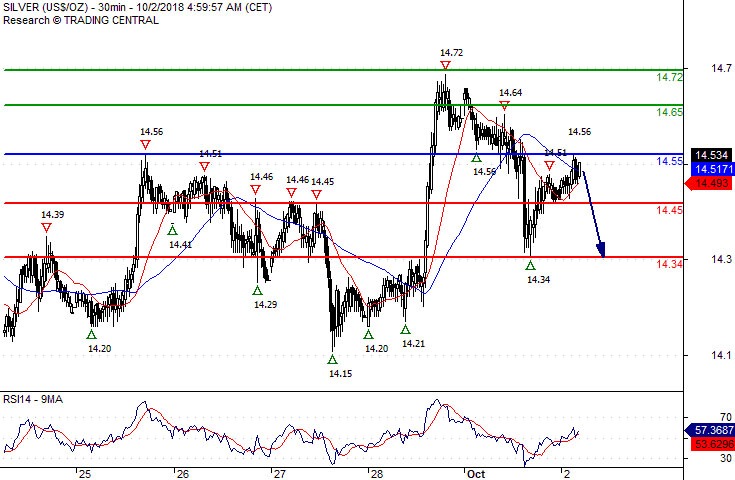
Silver Spot Caution
Pivot (invalidation): 14.5500
Our preference Short positions below 14.5500 with targets at 14.4500 & 14.3400 in extension.
Alternative scenario Above 14.5500 look for further upside with 14.6500 & 14.7200 as targets.
Comment The RSI is mixed and calls for caution.
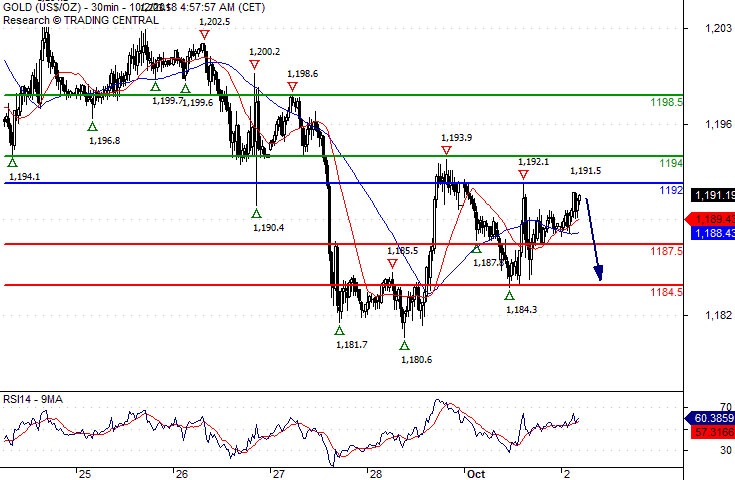
Gold Spot Caution
Pivot (invalidation): 1192.00
Our preference Short positions below 1192.00 with targets at 1187.50 & 1184.50 in extension.
Alternative scenario Above 1192.00 look for further upside with 1194.00 & 1198.50 as targets.
Comment The RSI is mixed and calls for caution.
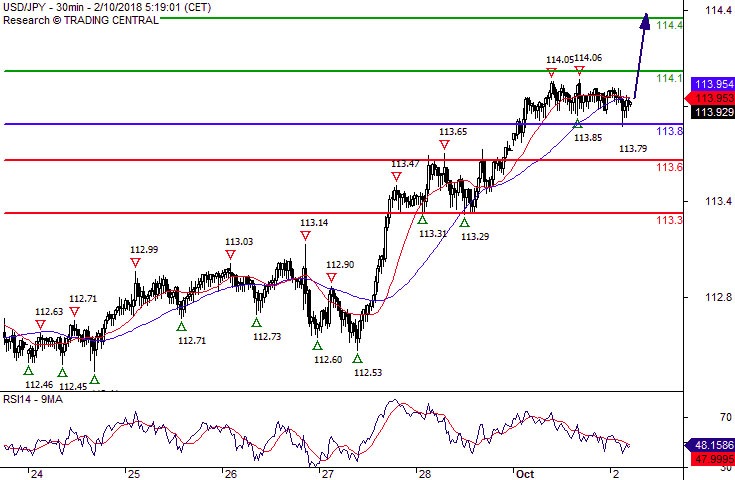
USD/JPY Bullish Bias Above 113.80
Pivot (invalidation): 113.80
Our preference Long positions above 113.80 with targets at 114.10 & 114.40 in extension.
Alternative scenario Below 113.80 look for further downside with 113.60 & 113.30 as targets.
Comment Even though a continuation of the consolidation cannot be ruled out, its extent should be limited.
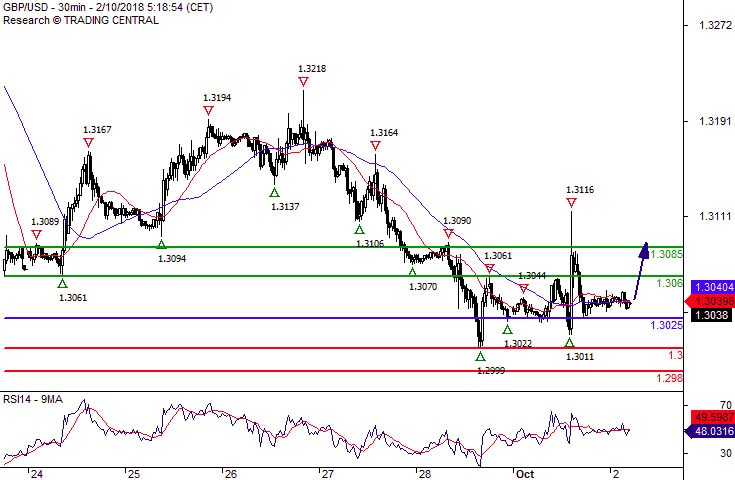
GBP/USD Limited Upside
Pivot (invalidation): 1.3025
Our preference Long positions above 1.3025 with targets at 1.3060 & 1.3085 in extension.
Alternative scenario Below 1.3025 look for further downside with 1.3000 & 1.2980 as targets.
Comment A support base at 1.3025 has formed and has allowed for a temporary stabilisation.