Sample Category Title
Risk Sentiment Is Shifting And Headline-Driven
Tuesday Oct 2: Five things the markets are talking about
Capital markets are in a sombre mood as a number of reasons for caution come to the fore.
Brexit rhetoric and the Italian government’s fiscal plans top the agenda, followed closely by trade deals and tariffs and political drama in Washington.
Amid the risk-off mood the ‘big’ dollar again has found support against G10 pairs. Euro stocks and U.S futures are currently following Asian declines, as Treasuries and bund prices advance.
The EUR (€1.1517) remains under pressure for a fifth consecutive day, pressured by remarks from Italy’s Deputy PM Luigi Di Maio that they will not change its budget deficit targets despite pressure from Brussels and its E.U partners.
Elsewhere, the pound (£1.2960) succumbs to Brexit rhetoric at the Conservative Party annual conference.
On tap: Fed Chair Powell is due to speak (12:45 pm EDT) about the outlook for employment and inflation at the National Association for Business Economics Annual Meeting, in Boston. Audience questions expected.
1. Stocks mostly see ‘red’
Asian equity markets traded generally lower as China remains on holiday, with Japan being the exception.
In Japan, the Nikkei edged up to a fresh 27-year high overnight, building on recent strength thanks to upbeat earnings hopes, mostly on the back of a weaker yen. The Nikkei share average ended +0.1% higher, while the broader Topix was up +0.3%.
Down-under, Aussie shares closed at their lowest in more than three-months overnight as financial stocks extended losses following a Royal Commission interim report on the sector. The S&P/ASX 200 index fell -0.8%, after dropping -0.6% on Monday. In S. Korea, stocks saw their worst day in nearly two-months on heightened U.S-China tensions. The Kospi fell -1.25%, marking its biggest percentage loss since August 13.
In Hong Kong, stocks also fell overnight on signs of weakness in China’s manufacturing sector. Resuming trade after a public holiday yesterday, the benchmark Hang Seng Index was down -1.64%.
In Europe, regional bourses open down across the board with Italy at the fore, as concerns over Italian finances keeps risk sentiment depressed. Four year high Brent prices are supporting energy stocks. The financial sector remains the worst performer.
U.S stocks are set to open in the ‘red’ (-0.4%).
Indices: Stoxx50 -1.2% at 3,374, FTSE -1.1% at 7,447, DAX -1.0% at 12,220, CAC-40 -1.1% at 5,449, IBEX-35 -1.2% at 9,297, FTSE MIB -1.4% at 20,324, SMI -0.7% at 9,060, S&P 500 Futures -0.4%
2. U.S oil hits four-year peak ahead of sanctions on Iran, gold higher
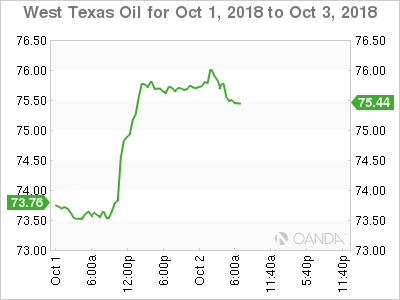
Earlier this morning, U.S oil prices hit their highest level since November 2014, while Brent crude trades atop of yesterday’s four-year high print, as markets prepare for tighter supply once U.S sanctions against Iran begin to hit in November.
U.S West Texas Intermediate (WTI) crude futures are at +$75.90 a barrel – WTI has rallied +18% since mid-August, while Brent crude oil futures are at +$85.28 per barrel, up +30c, or +0.4%, from Monday’s close. Brent has risen by more than +20% from its lows in August.
Market sentiment also got a boost from yesterday’s announcement of a “new” trilateral pact between the U.S, Mexico and Canada (USMCA), saving a +$1.2T a year open-trade zone that had been on the verge of collapse.
Iran’s oil industry, which at its most recent peak this year, supplied +3% of the world’s almost +100M barrels of daily consumption. U.S sanctions are set to start on Nov. 4.
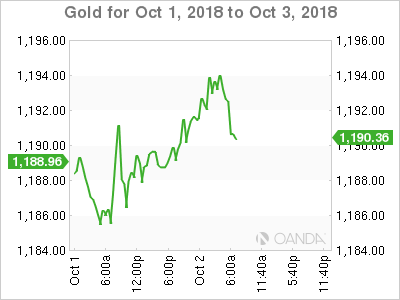
Ahead of the U.S open, gold prices have found some support as risk appetite wanes, one day after getting a boost from the USMCA deal. Spot gold is up +0.5% at +$1,193.80, after declining about -0.3% in yesterday’s session. U.S gold futures are +0.5% higher at +$1,197.60 an ounce.
3. BTP/Bund yield gap at its widest in five-years
The Italian/German 10-year bond yield spread trades atop of its five-year highs as eurozone officials warned of a return to crisis days and an Italian lawmaker said most of Italy’s problems would be solved if it returned to its own currency.
As Italian bond yields surged +11-20 bps, the yield premium investors demand to hold Italian paper over German debt shot higher. The BTP/Bund 10-year bond yield gap has widened out to +302 bps.
Note: Bunds remain exposed to opposing forces, with safe-haven runs triggered by Italy jitters pushing German yields lower, but expectations of rate raises by the ECB next year is pointing to higher Bund yields.
The yield on U.S 10’s has decreased -2 bps to +3.06%. In Germany, the 10-year Bund yield has decreased -3 bps to +0.44%, the lowest in almost three weeks, while Italy’s 10-year yield has gained +12 bps to +3.421%, the highest in more than four-years.
4. Pound under pressure
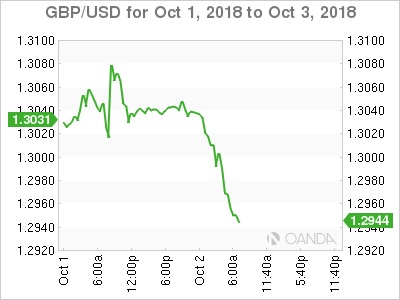
As the market waits for PM May’s new Brexit draft proposal on the Irish border, uncertainties continue to threaten sterling (£1.2966) and this morning’s weaker construction PMI survey has caused it to fall further. Sterling fell to a three-week low of £1.2957, from 1.2987 beforehand, after data showed construction PMI fell to 52.1 in September from 52.9 in August, signalling “the weakest upturn in output for six-months.”
The EUR (€1.1517) continues to decline falling over -0.4% against the U.S dollar and -0.6% against the Yen (€130.98) on Italian Budget uncertainty.
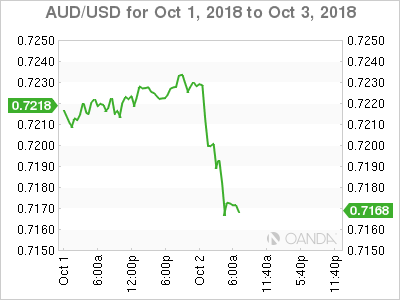
Down-under, AUD/USD (A$0.7173 down -0.77%) has retraced earlier gains after the Reserve Bank of Australia (RBA) left rates on hold (see below), while the NZD/USD has declined after yesterday’s NZIER Business Confidence (-30 vs. -20) fell to the lowest level in nine-years.
5. RBA rate statement
It was as expected from the Reserve Bank of Australia (RBA), leaving the key policy rate at record lows (+1.5%) and traders with the impression that the RBA plans to remain sidelined for some time.
Nevertheless, Governor Lowes’s big concerns remain low wage growth and higher debt levels – a potential combo that could dissuade consumer spending and in turn ‘slows’ the country’s economy.
However, global expansion and recent domestic growth are positives and the RBA continues to expect GDP growth of more than +3% through 2019 and for the unemployment to drift down towards +5% over time.
EUR/USD – Italian Budget Crisis Pulls Euro Lower
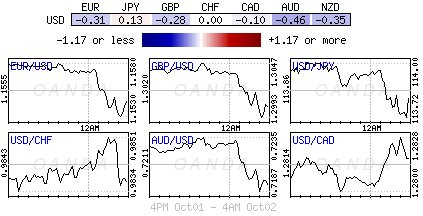
EUR/USD continues to lose ground this week. In the Tuesday session, the pair is trading at 1.1521, down 0.50% on the day. In economic news, Eurozone PPI edged lower to 0.3%, above the estimate of 0.2%. In the U.S, there are no major releases on the schedule. On Wednesday, Germany and the Eurozone release Services PMI and the Eurozone will publish retail sales. The U.S publishes ADP nonfarm payrolls and ISM Non-Manufacturing PMI.
The euro declined 1.2% last week, and the downward spiral continues. The EUR/USD is at its lowest level since mid-August, as it struggles to stay above the 1.15 level. With Italy and the EU on a possible collision course over Italy’s budget, the euro remains under strong pressure. The budget increases spending and cuts taxes and sets the budget deficit at 2.4% for 2019, 2020 and 2021. The European Commission must approve the budget, and EU policymakers are unhappy with the budget, as they have been pushing Rome to reduce the current deficit, which stands at 1.6% of GDP. EU Commissioner Pierre Moscovici said last week that the budget could breach EU fiscal regulations and called the Italian deficit “explosive”. However, the Italian government strongly backs the budget, so this crisis could continue to weigh on the struggling euro.
In the U.S, consumer spending and confidence levels remain strong. Consumer spending rose 0.3% in August, matching the forecast. The UoM Consumer Sentiment report pushed above the 100-level for the first time since March, although the reading of 100.1 missed the estimate of 100.5 points. On the inflation front, the Core PCE Price Index, which is the Federal Reserve’s preferred inflation indicator, dipped to 0.0% in August, shy of the estimate of 0.1%. This was the first time the indicator failed to post a gain since March 2017. Still, inflation remains close to the Fed’s target of 2%, so a December rate hike remains likely.
CAD/JPY 4H Chart: Meets Resistance Cluster At 89.55
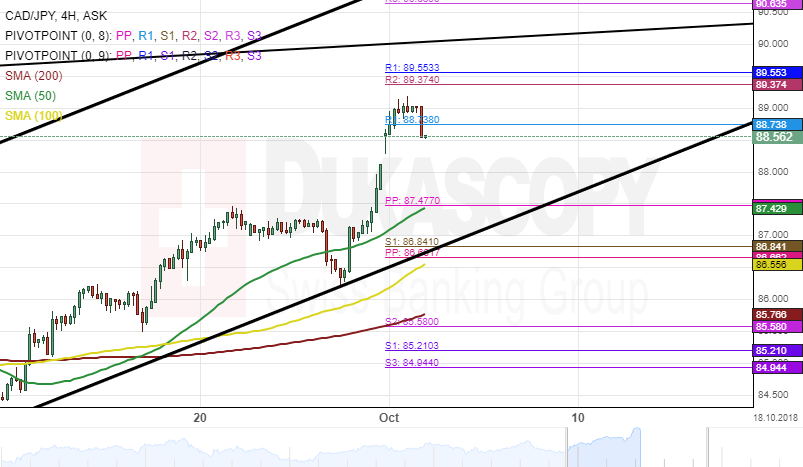
A three-week ascending channel has guided the Canadian Dollar higher against the Japanese Yen. The exchange rate bounced off the bottom border of the channel on September 9 and had since reached ten months high level at 89.00.
The currency pair is trading near a resistance cluster formed by the combination of the weekly and the monthly PPs at 89.55 during the morning hours of Tuesday's session. From a theoretical point, this could provide a significant resistance level for the rate and push the pair towards the weekly pivot point at 87.47.
However, if this resistance cluster is unable to hold, the next target for the CAD/JPY currency exchange rate will be at the upper boundary of a long-term ascending channel near 90.00.
AUD/CHF 4H Chart: Moving Towards Target
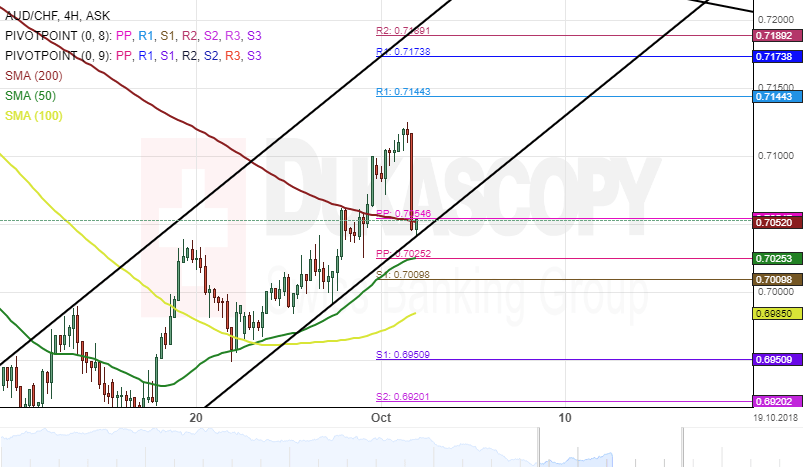
The Australian Dollar has been appreciating against the Swiss Franc since the middle of September. This movement is bounded by a two-week ascending channel.
Currently, the currency pair is trading above the 50-, 100-, and 200-hour simple moving averages. From a technical point of view, the rate could continue moving north until it reaches a resistance cluster formed by the weekly and the monthly PPs at 0.7173.
However, the weekly R1 at 0.7144 could hinder the AUD/CHF currency exchange rate from reaching the targets within the next 48 hours.
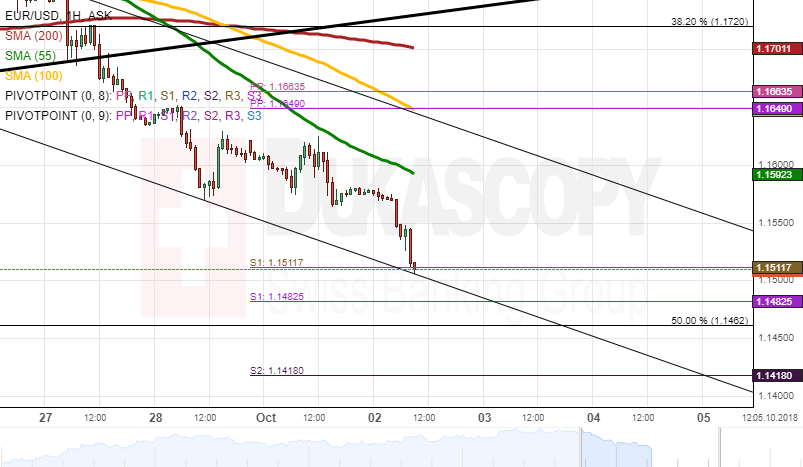
EURUSD Analysis: Will Trade At 1.1500
The European Single Currency depreciated 0.67% against the US Dollar since Monday's session. On Tuesday morning, the rate was located near the weekly S1 at the 1.1534 mark.
In regards to the near future, the rate will keep moving downwards until the currency pair will reach the weekly S1 at the 1.1511 mark. Most likely, the rate will bounce off the weekly S1 due to its support. The rate might trade at the 1.1500 level on Tuesday.
Besides, none of the technical indicators can prevent the trading pair from downside movements during the trading session.
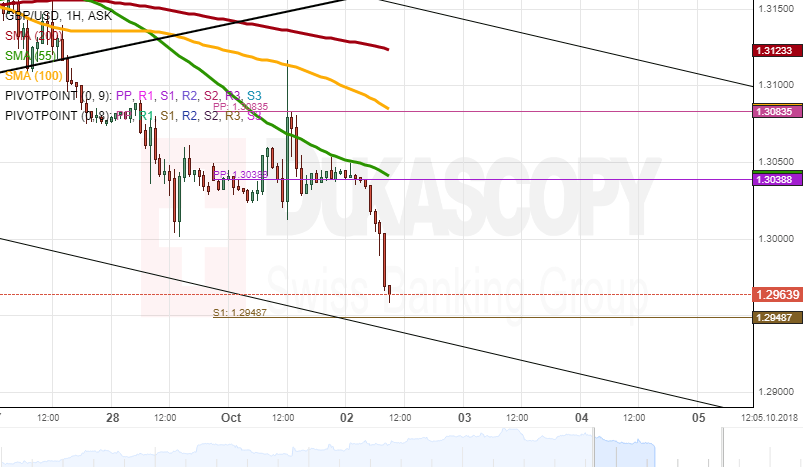
GBPUSD Analysis: Passes 1.30
The British pound depreciated 0.38% against the US Dollar since Monday's session. On Tuesday, the rate was located at the 1.3000 mark.
In the near-term future, most likely, the rate will move downwards to the weekly S1 at the 1.2948 mark during the trading session. The 55-hour simple moving average will try to catch up the rate to give additional resistance to break the weekly S1.
Moreover, the UK Construction PMI data release at 8:30 GMT on Tuesday did not help the rate to change its direction to trade upwards. The release was flat and did not affect the market much to keep the rare to go downwards to the weekly S1.
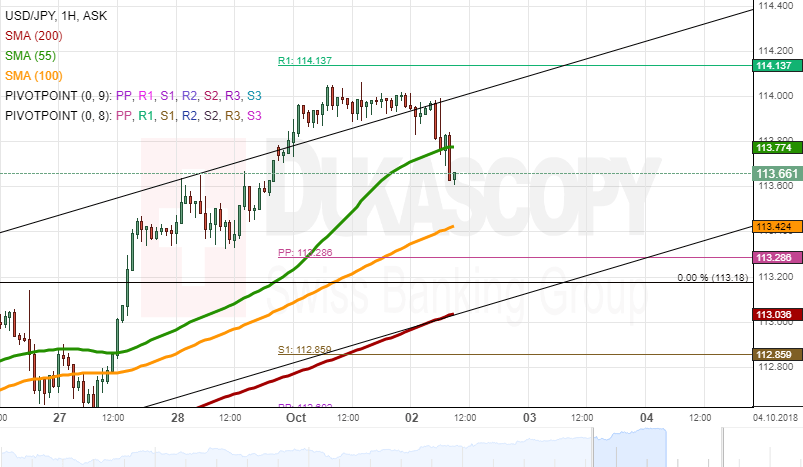
USDJPY Analysis: Trades Towards PP
The US Dollar depreciated 0.09% against the Japanese Yen since Monday's session. On Tuesday, the US Dollar was resisted by the 55-hour simple moving average to allocate the rate at the 113.74 mark.
In regards to the near future, most likely, the rate move downside towards the weekly PP at the 113.28 mark. The 200– hour simple moving average should catch up the rate to give support to push US Dollar upwards during the trading session.
On the other hand, the rate might change its direction, and the 55-hour simple moving average could play a role of support for the currency pair to push it towards the weekly R1 at the 114.13 mark.
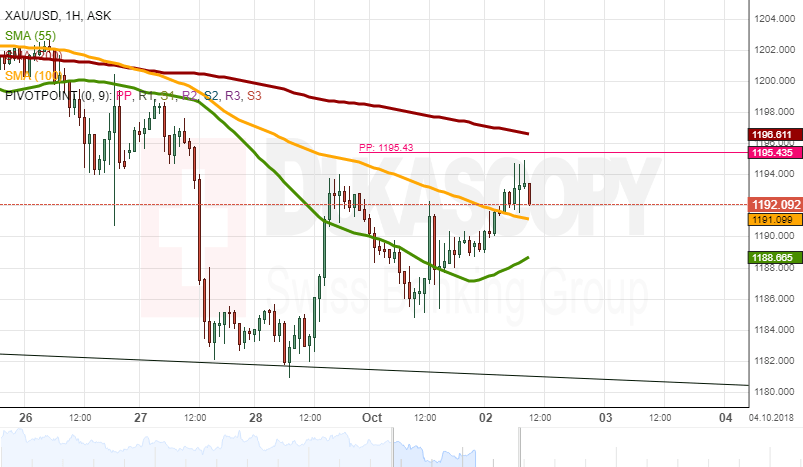
XAUUSD Analysis: Squeezed Between SMAs
The gold price appreciated 0.38 % since Monday's trading session. On Tuesday, the yellow metal was trading between the 200– hour and the 100– hour simple moving averages at the 1,194.09 mark.
In regards to the near-term future, most likely, the monthly pivot point at the 1,195.43 mark together with the 200-hour simple moving average will retrace the gold to trade 1,190.00 mark during the day.
On the other hand, the 100-hour simple moving average might support the yellow metal to break the monthly PP and the 200-hour simple moving average to let the gold to trade at the 1,196.00 level on Tuesday.
WTI OIL Outlook: Bulls Are Expected To Consolidate Before Continuing
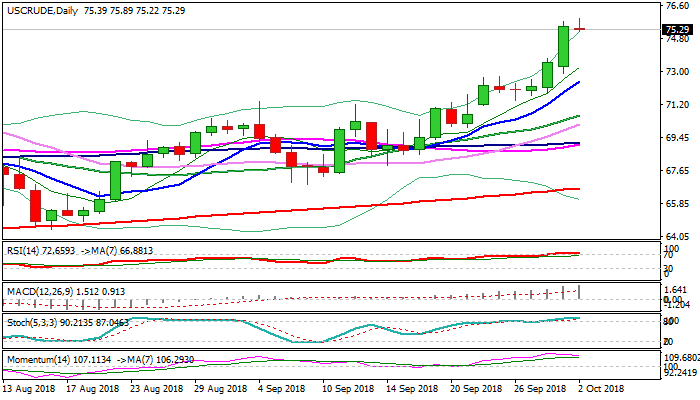
WTI oil is consolidating within tight range under new four-year high at $75.89 on Monday, after strong rally last Thu-Fri resulted in weekly close above former 2018 high at $75.34, posted on 04 July.
Completion of $75.34/$64.43 corrective phase was bullish signal for continuation of broader uptrend from $26.04 (Feb 2016 low).
Strong bullish sentiment is driven by rising concerns about tighter global supply after US sanctions on Iran kick next month.
Meanwhile, bulls are expected to enter consolidative/corrective phase before continuing, with overbought daily RSI/slow stochastic and weakening momentum, supporting the notion. Former lower top at $74.67 (10 July) marks solid support, violation of which would allow for dip towards $74.20 (Fibo 38.2% of $71.47/$75.89 upleg) and $73.68 (50% retracement), where extended dips should find ground to keep bulls intact.
Corrective action is seen as positioning for further upside and test of next key barriers at $76.35 (Fibo 61.8% of $107.45/$26.04 fall) and $76.53 (Fibo 138.2% expansion of current wave C of five-wave sequence from $64.43, 16 Aug low).
Res: 75.89; 76.35; 76.53; 77.00
Sup: 75.22; 74.67; 74.20; 73.68
Elliott Wave Analysis: EURUSD And EURAUD At Support, A Rally In View
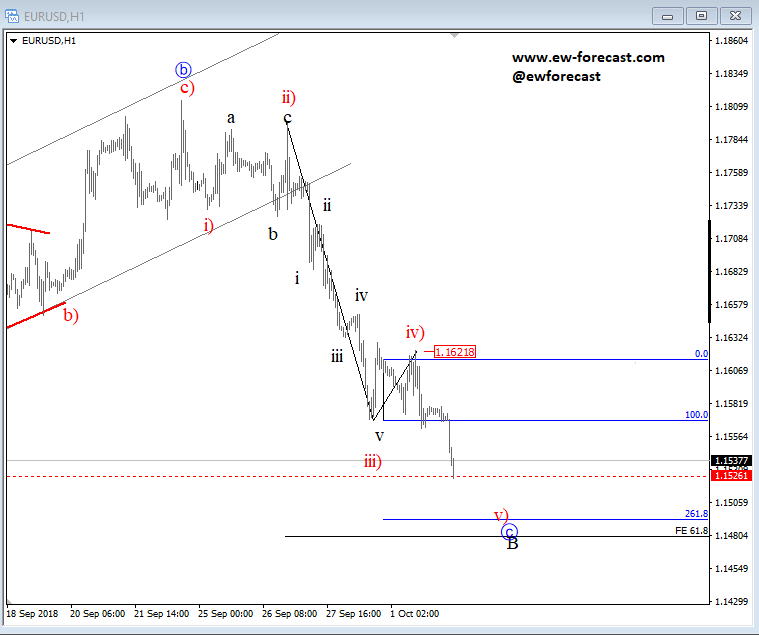
Some of XXXUSD pairs came down aggressively this morning, but I have said many times that strong early session flows are normally reversed later, so don’t be surprised if euro will rally. In fact, EURUSD pair hits very interesting support area around 1.1520 back from Sep 10 which can be a zone of a new turning point, especially as we can count five waves down so at least a three wave rally may occur. Next interesting support is around 1.1500.
EURUSD, 1h
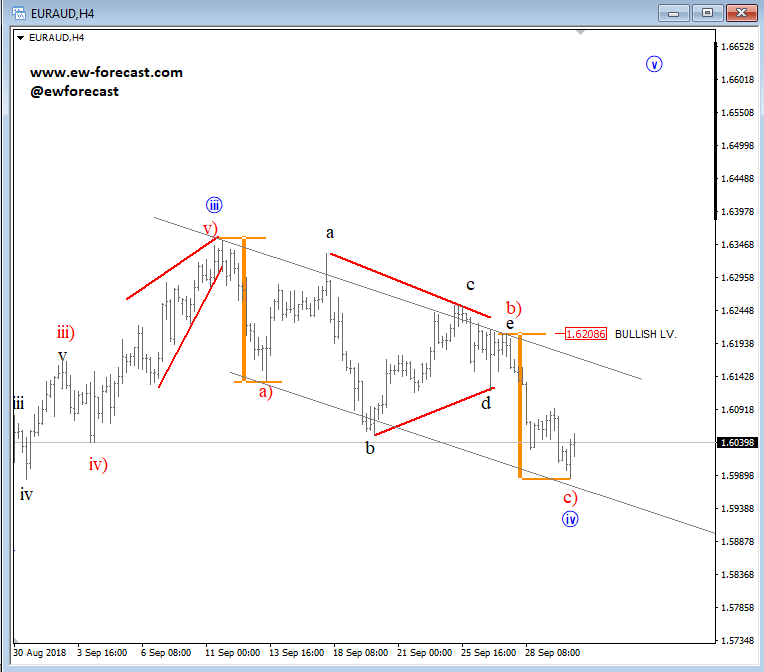
Now when EURUSD may trade at support, it can be time to look at EURAUD again. Pattern can still send prices higher with this three legs down into 1.600 area, but we need 1.6200 for a turn.
EURAUD, 4h