Sample Category Title
EUR/USD Mid-Day Outlook
Daily Pivots: (S1) 1.1552; (P) 1.1588; (R1) 1.1616; More.....
EUR/USD reaches as low as 1.1504 so far. Break of 1.1525 support confirms that corrective rise from 1.1300 has completed with three waves up to 1.1814 already. Intraday bias stays on the downside for retesting 1.1300 low first. On the upside, above 1.1623 minor resistance will turn intraday bias neutral and bring recovery. But upside should be limited well below 1.1814 to bring fall resumption.
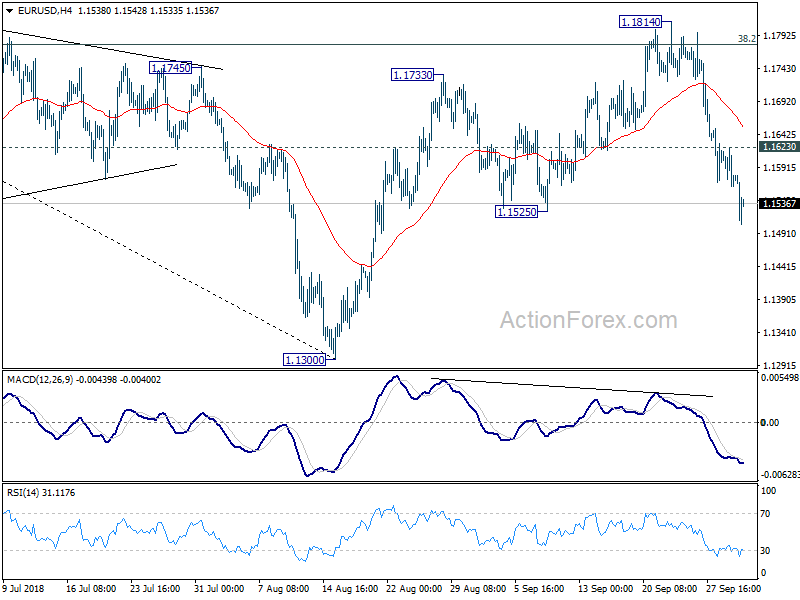
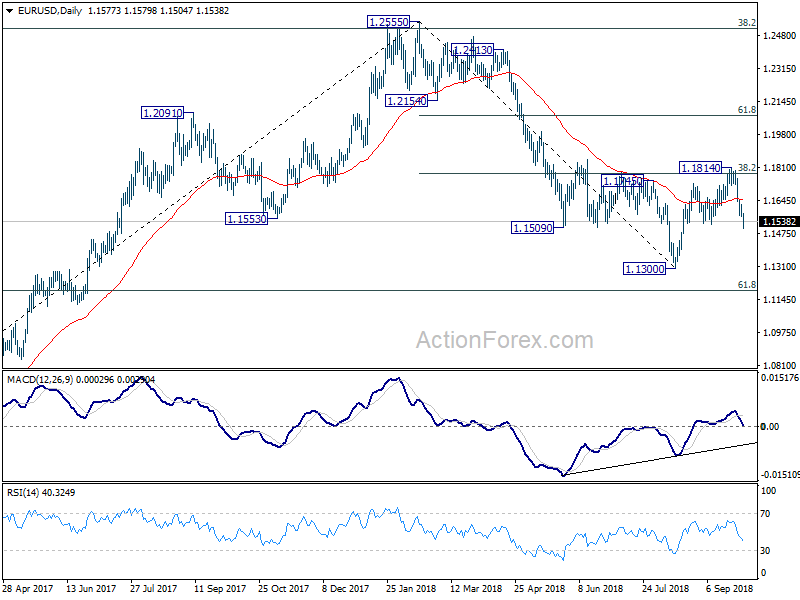
In the bigger picture, a medium term bottom should be in place at 1.1300, on bullish convergence condition in daily MACD and some consolidations would be seen. But still, note that EUR/USD was rejected by 38.2% retracement of 1.6039 (2008 high) to 1.0339 (2017 low) at 1.2516. That carries some long term bearish implications. Thus, we'd expect fall from 1.2555 high to resume after consolidation completes. Below 1.1300 should send EUR/USD through 61.8% retracement of 1.0339 to 1.2555 at 1.1186. And, in that case, EUR/USD would head to retest 1.0339 (2017 low).
Risk Aversion Dominates as Australian Dollar, Sterling and Euro Slide
Euro suffered heavy selling today as Italy and EU stepped up rhetorics on budget clashes. But even heavier selling is seen in Australian, New Zealand Dollar and Sterling. Steep decline in Hong Kong stocks hints that China markets will likely come back from holiday next week facing much troubles. Sterling, on the other hand, is pressured as PM Theresa May faces criticisms on from all sides, including EU and her own Brexiteers over her Chequers Plan. Yen is so far the strongest ones, followed by Swiss Franc and Canadian. Dollar is mixed.
Risk aversion clearly dominates the European markets today. DAX dropped to as low as 12203.6 and is now at 12255, down -0.68%. CAC is trading down -0.75% while FTSE is down -0.37%. Italian 10 year yield hit 4-year high at 3.444 before dipping mildly. It's currently up 0.058 at 3.364. German 10 year bund yield dropped to as low as 0.41and is now down -0.032 at 0.444. That is. German-Italian yield at 300 level is again closer than ever.
Earlier in Asia, Nikkei closed up 0.1% after paring all earlier gains. Singapore Strait Times dropped -0.39%. Hong Kong HSI tumbled -2.38% to close at 27126.38. USD/CNH hit as high as 6.9047 earlier today and breached 6.8959 resistance. Though, it's now back at 6.8848. All in all, the markets in Hong Kong and Yuan could hit that China market will respond negatively to the USMCA trade deal.
Technically, EUR/USD's break of 1.1525 should have confirmed our bearish view and the pair is heading back to 1.1300 low. There are two developments to watch that would tell how weak the Euro is. Firstly, we'll see if EUR/GBP could stage a sustainable rebound ahead of 0.8847 support. That would reaffirm that Sterling is the more pathetic one. Secondly, EUR/CHF is losing much upside momentum ahead of 1.1452 near term resistance. Break of 1.1280 will invalidate the bullish reversal case and turn focus back to 1.1178 low. That is, Euro won't be too much better than the Pound in this case.
Fresh selling in Euro in budget spats, slowed after PM Conte's calming messages
Fresh selling in Euro was triggered earlier today after president of the lower house budget committee Claudio Borghi, economics spokesman of the League, told Reuters that " I am personally convinced that Italy would be better off with its own currency". Though, he also repeated again and again that "leaving the euro is not in the government's program and it has no plans to do so." Borghi's position is well known and it's actually nothing new.
5-Star Movement Leader, Deputy PM Luigi Di Maio, insisted that "We are not turning back from that 2.4 percent target, that has to be clear … We will not backtrack by a millimetre". Another Deputy PM Matteo Salvini, leader of the League also said yesterday that "No-one in Italy is taken in by Juncker's threats."
However, the selloff slowed a bit after Prime Minister Giuseppe Conte's Facebook post. He said "the euro is our currency and it is for us indispensable. " He emphasized that "any other declaration that makes a different assessment is to be regarded as a free and arbitrary opinion that has nothing to do with the government policy I chair".
Also, he defended the budget plan and said "the package of measures that we are developing aims to combine fairness and efficiency". Also, he added large investment plan is set up to "give the country modern and secure infrastructure, making it a permanent laboratory for innovation and development."
Conte also added "We respect our sovereign prerogatives and we also respect the institutions of the European Union that we have helped to establish and remain our common home." And, "We are going to talk to the European institutions with serenity and respect for roles, confident that we can prove, hand cards, the goodness of work so far.
EU clearly reject Italy's 2.4% budget deficit target
On the EU side, European Commission Vice President Valdis Dombrovskis reiterated today that "what we see currently now seems to be not compliant with the Stability and Growth Pact but we are open to dialogue with the Italian authorities and hope that the budget will be brought in line with the requirements of the Stability and Growth Pact."
European Commission President Jean-Claude Juncker said yesterday that "Italy is distancing itself from the budgetary targets we have jointly agreed at EU level." He warned "one crisis was sufficient, one crisis was enough" and "after the toughest management of the Greece crisis, we have to do everything to avoid a new Greece — this time an Italy — crisis." He added "we have to prevent Italy from being able to get a special treatment here that, if everybody were to get it, would mean the end of the euro."
The chairman of Eurozone finance ministers Mario Centeno said after the group's meeting that "recent announcements by the Italian government have raised concerns over its budgetary course, concerns that need to be addressed soon." He added "we are all bound by the euro and we need sound policies to protect it. It is up to the Italian government to show it has a sustainable and credible budgetary plan."
Sterling pressured as Brexit rebels gather at alternative conference against May's Chequers plan
Sterling is pressured on report that while UK Prime Minister Theresa May is trying to unite her party at the Conservatives annual conference, Brexit rebels are gathering a few streets away on an "alternative Brexit Advance Coalition Conference". May's Chequer's plan was brutally criticized by the Brexiteers as "failing to deliver the referendum mandate". And the rebels threatened to vote down the deal even if May could agree to one with the EU. In the meeting, it's reported that 96% of those attended opposed to the Chequer's plan.
Perhaps words from Andrea Jenkyns, a former parliamentary private secretary, best described the situation. "Our party members don't want it, the public doesn't want it, the opposition aren't going to vote for it, the EU doesn't want it, so we must chuck Chequers," she said.
UK PMI construction: Year-ahead business outlook at second lowest since 2013
UK PMI construction dropped to 52.1 in September, down fro 52.9 and missed expectation of 52.6. The key points are "all three sub-sectors record a loss of momentum", "solid increases in new work and employment", but "business optimism at second-lowest level since February 2013".
Tim Moore, Associate Director at IHS Markit, noted in the release that "latest data showed that overall confidence about the year-ahead business outlook was among the lowest seen since the start of 2013." "Construction companies continued to note that political uncertainty acted a key drag on decision-making, with Brexit worries encouraging a wait-and-see approach to spending among clients."
RBA left cash rate unchanged at 1.50%, maintained neutral stance
The accompanying statement is very much a carbon copy of the prior one. A change is in noting the cause of pickup in global inflation on higher oil prices and wage growth. And further pickup is expected on tightening labor markets and the sizeable fiscal stimulus of the US. But RBA also reiterated that risk to global outlook from "direction of international trade policy in the United States."
Domestically, RBA said latest data confirmed strong growth in the past year. And GDP is expected to average a bit above 3% in 2018 and 2019. Meanwhile, "one continuing source of uncertainty is the outlook for household consumption. Labor market outlook remains "positive" and lift in wage growth will be a "gradual process". Inflation is expected to decline in September quarter due to once-off factors, but should climb to above 2% in 2019 and 2020.
Overall, the RBA maintained a neutral stance with the statement and hinted again that it's in no rush to rate hike.
EUR/USD Mid-Day Outlook
Daily Pivots: (S1) 1.1552; (P) 1.1588; (R1) 1.1616; More.....
EUR/USD reaches as low as 1.1504 so far. Break of 1.1525 support confirms that corrective rise from 1.1300 has completed with three waves up to 1.1814 already. Intraday bias stays on the downside for retesting 1.1300 low first. On the upside, above 1.1623 minor resistance will turn intraday bias neutral and bring recovery. But upside should be limited well below 1.1814 to bring fall resumption.
In the bigger picture, a medium term bottom should be in place at 1.1300, on bullish convergence condition in daily MACD and some consolidations would be seen. But still, note that EUR/USD was rejected by 38.2% retracement of 1.6039 (2008 high) to 1.0339 (2017 low) at 1.2516. That carries some long term bearish implications. Thus, we'd expect fall from 1.2555 high to resume after consolidation completes. Below 1.1300 should send EUR/USD through 61.8% retracement of 1.0339 to 1.2555 at 1.1186. And, in that case, EUR/USD would head to retest 1.0339 (2017 low).
Economic Indicators Update
| GMT | Ccy | Events | Actual | Forecast | Previous | Revised |
|---|---|---|---|---|---|---|
| 23:50 | JPY | Monetary Base Y/Y Sep | 5.90% | 5.40% | 6.90% | |
| 4:30 | AUD | RBA Rate Decision | 1.50% | 1.50% | 1.50% | |
| 5:00 | JPY | Consumer Confidence Index Sep | 43.4 | 43.4 | 43.3 | |
| 8:30 | GBP | Construction PMI Sep | 52.1 | 52.6 | 52.9 | |
| 9:00 | EUR | Eurozone PPI M/M Aug | 0.30% | 0.00% | 0.40% | 0.70% |
| 9:00 | EUR | Eurozone PPI Y/Y Aug | 4.20% | 3.90% | 4.00% | 4.30% |
Risk Appetite Dwindles as NAFTA Cheer Fades
There was a risk-off vibe across financial markets today as the initial euphoria over the revamped NAFTA deal faded away.
Asian stocks ended mostly lower while European equities are a sea of red this afternoon amid the lack of appetite for riskier assets. Although the new United States-Mexico-Canada (USMCA) deal came as a relief to markets, sentiment clearly remains gripped by uncertainty over Italy’s budget and ongoing US-China trade disputes. Any potential signs of trade tensions escalating between the world’s two largest economies could fuel risk aversion consequently accelerating the flight to safety.
Japanese Yen fights back…
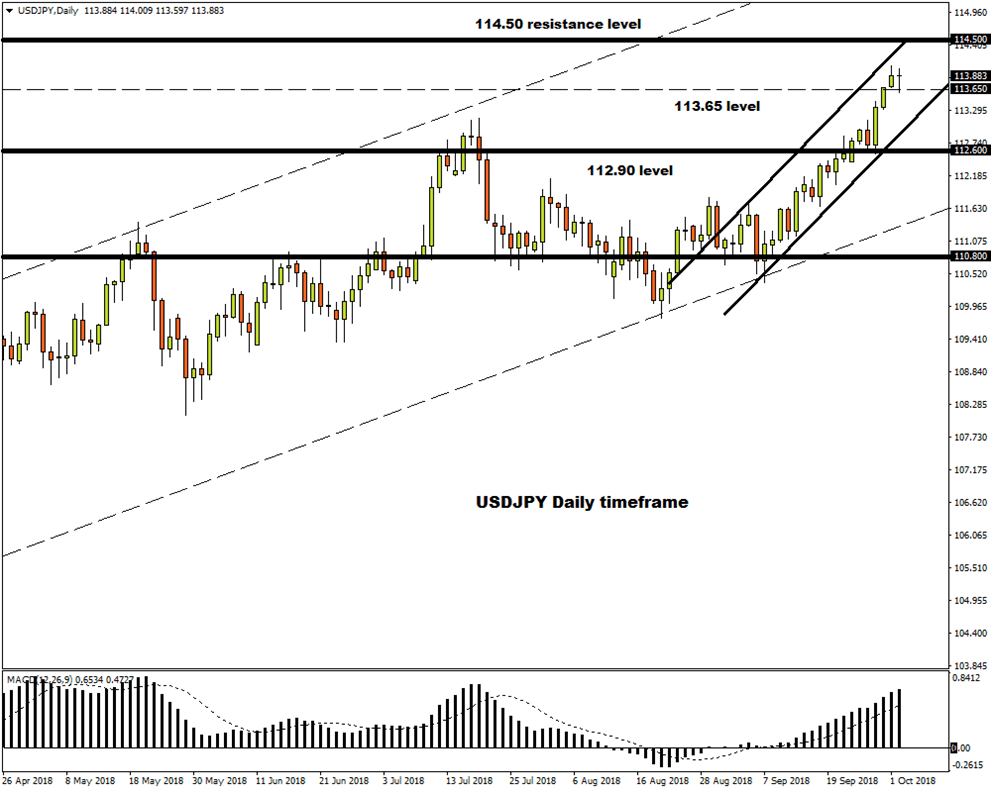
Speaking of safety, the Japanese Yen fought back against a broadly stronger Dollar on Tuesday with prices sinking back towards 113.65.
While the current market conditions could elevate the Yen higher, longer-term gains remain threatened by widening interest rate differentials between the Federal Reserve and Bank of Japan. In regards to the technical picture, the USDJPY remains in a healthy uptrend on the daily charts with bulls greedily eyeing 114.00. A solid daily close above this level may trigger a move towards 114.50. Alternatively, sustained weakness under 113.50 is likely to trigger a technical correction back to 112.90.
Dollar remains king of the hill
The Dollar has steamrolled against its major competitors today with prices punching above 95.70 thanks to the risk-off mood.
Market expectations over higher U.S. interest rates coupled with the overall bullish sentiment towards the U.S. economy remain themes that have buoyed the Greenback. Taking a look at the technical picture, the Dollar Index is powering higher on the daily charts. The current upside momentum suggests that bulls could remain in the driver’s seat ahead of the U.S. jobs report on Friday. A solid daily close above 95.50 could trigger a move of 95.83 and 96.00, respectively.
British Pound is having a bad day
The British Pound was an easy target for sellers to ruthlessly attack following reports the UK construction sector expanding at its slowest pace in six months in September.
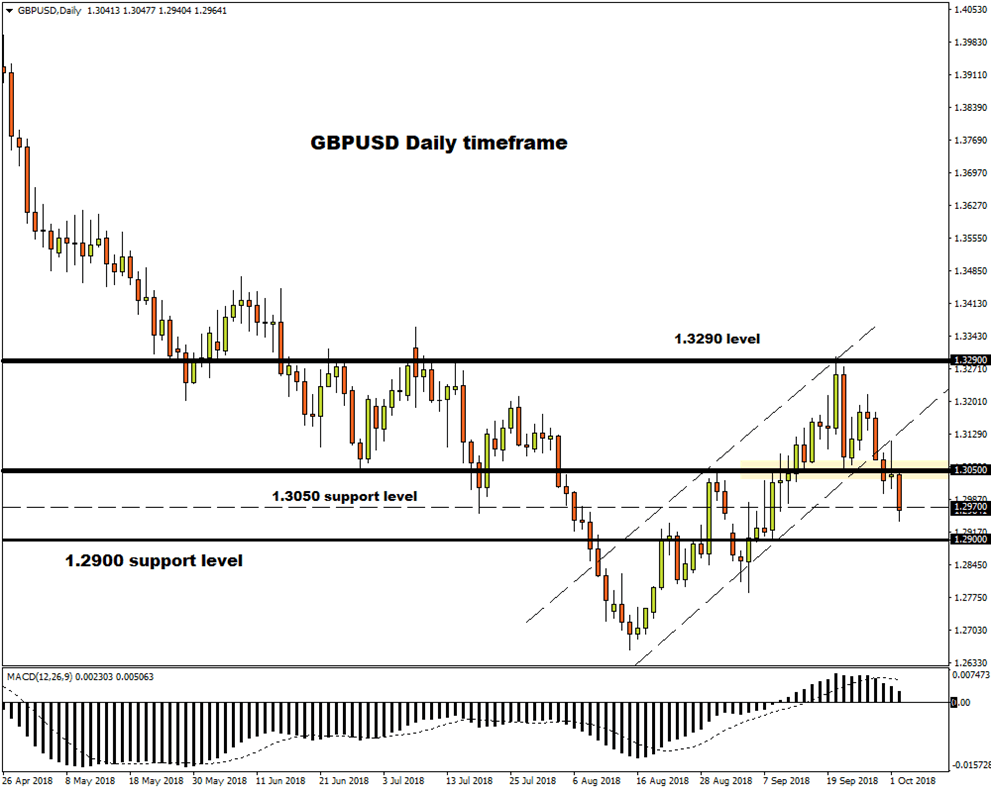
Brexit uncertainty and a broadly stronger U.S. Dollar compounded the Pound’s woes with the GBPUSD sinking below the 1.3000 during Tuesday’s trading session. With prices already breaking below the 1.2970 level, bears could be inspired to challenge 1.2900 in the short term.
Gold entangled in losing a battle
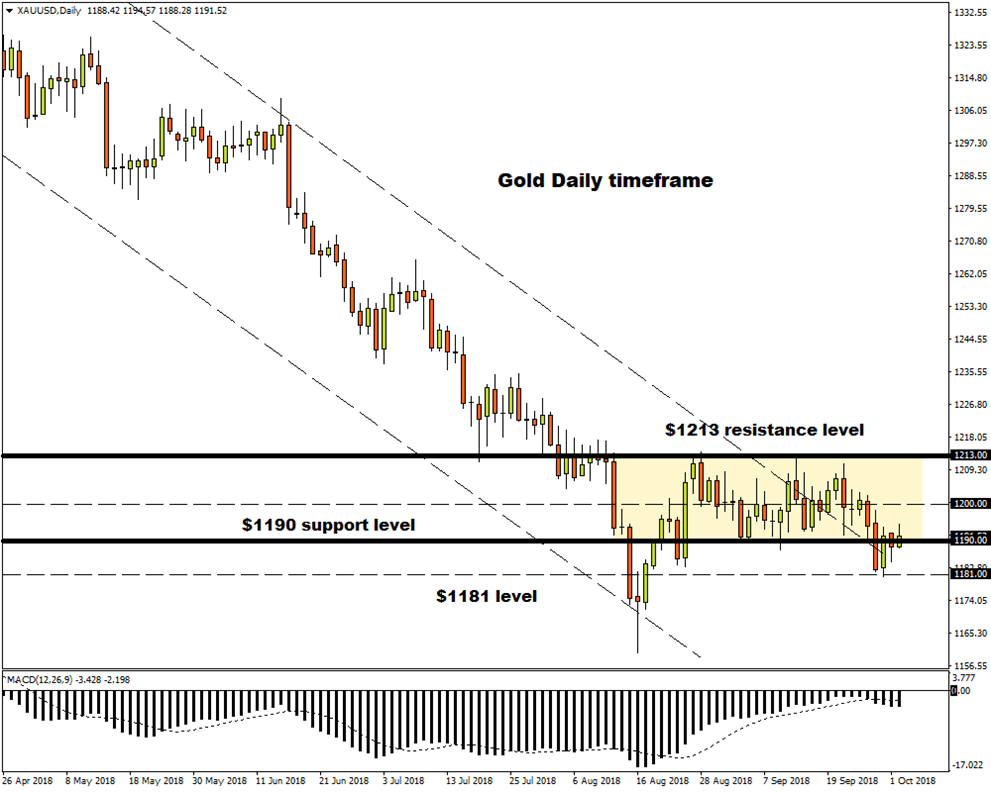
Gold is currently engaged in a losing battle with an appreciating Dollar and expectations of higher US interest rates.
Although a technical bounce from the $1,181 level could inspire short-term bulls to challenge $1,200, the weekly and monthly timeframe remains a bear story. The yellow metal could trade within a modest range ahead of the U.S. jobs report on Friday. A blockbuster NFP figure coupled with signs of accelerating wage growth in the United States could be the catalyst Gold needs to break below $1,181.
Euro, Pound Hit Fresh Lows; Powell’s Speech Awaited
Here are the latest developments in global markets:
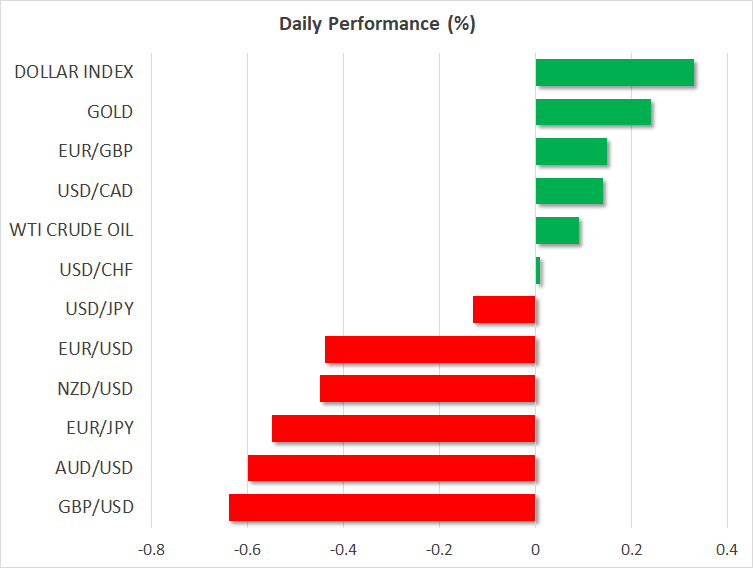
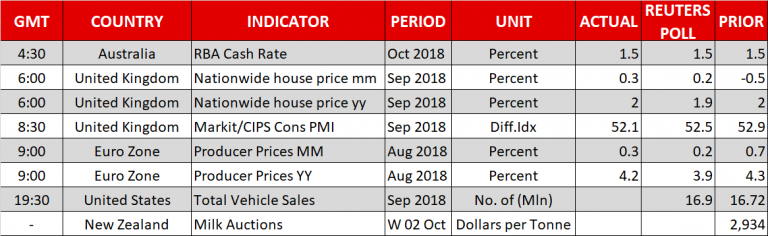
FOREX: The US dollar index was trading bullish on Tuesday (+0.35%), posting 1-month highs at 95.70, while dollar/yen weakened to 113.76 (-0.15%) after an impressive rally towards the more than a 10-month high of 114.06 on Monday. The Canadian dollar, which surged to four-month highs yesterday in the wake of news that the US and Canada finally reached common ground over NAFTA, was slightly weaker today, with dollar/loonie inching up to 1.2834 (+0.20%). Note that the trade accord will be signed as a trilateral agreement between Canada, Mexico and the US by late November. The release of the UK construction PMI earlier today endorsed the negative movement of pound/dollar, sending the pair down to 1.2946 (-0.75%). The index declined to 52.1 in September, below expectations of 52.5 and the previous mark of 52.9. Meanwhile, producer prices in the Euro area increased by 4.2% y/y in August, surpassing forecasts of a growth of 3.9%. However, euro/dollar failed to gain on the data, diving by 0.52% to a 6-week low of 1.1504 as the Italian budget announced in a draft form last week did not bring smiles to EU officials. Remarks by Claudio Borghi, the head of the Italian lower house budget committee, also weighed on the currency after Borghi expressed that the euro was “not sufficient” to solve Italy’s fiscal issues.Turning to antipodean currencies, aussie/dollar plunged by 0.76% on the back of a stronger dollar as the RBA kept its interest rates steady earlier on Tuesday, with no new signals on policy. Kiwi/dollar lost ground as well (-0.57%). In emerging marekts, the Turkish lira and the South African rand came under renewed pressure, losing more than 1% in the day versus the greenback.
STOCKS: European equities opened sharply lower today, on fears that the EU would likely reject Italy’s fiscal plans. The pan-European STOXX 600 and the blue-chip Euro STOXX 50 plummeted by 0.59% and 0.46% respectively at 1130 GMT, with almost all sectors involved in the indices flashing red. The German DAX 30 dived by 0.70%, the French CAC 40 tumbled by 0.66%, while the Italian FTSE MIB declined by 0.40%. UK’s FTSE 100 saw a softer loss of 0.38%. In the US, futures tracking the major stock indices were pointing to a negative open
COMMODITIES: Oil prices pulled back from a fresh 4-year high reached earlier. WTI crude slipped to $75.38/barrel but remained up on the day (+0.07%), while Brent dropped by 0.39% to $84.65/barrel. Gold was slowly rising during the early European session, last seen at $1190.22/ounce (+0.20%).
 Day Ahead: Italian budget to weigh on the euro; Brexit to remain under the spotlight
Tuesday’s economic calendar will be lacking important data releases later in the day, with the Italian budget story remaining in the center of attention, while Brexit will continue to affect investors’ sentiment.
On Monday, comments by Pierre Moscovici triggered a fresh wave of selling in the euro market as the EU’s commissioner for Economic and Financial Affairs said that the Italian budget which aims for a deficit of 2.4% is “a very significant deviation” from earlier commitments given the country’s massive public debt of 133% of GDP. The remarks flagged that conflicts between Italy and the EU are not close to cooling down, with the euro slipping to a more-than-a-month low of 1.1504 today. Adding to the negative sentiment were recent headlines messaging that the Italian government is not willing to change its fiscal plans, a sign that the common currency is not near to recover yet. Note that the Italian Deputy Prime Minister, Luigi Di Maio will be holding further meetings in the next few days with the Italian Minister of Economy, Giovanni Tria, the Prime Minister Giuseppe Conte, and the Deputy Prime Minister and League Leader Matteo Salvini. A formal presentation of the budget to the EU, though, is anticipated by October 15.
Meanwhile in the UK, the annual Conservative Party Conference continues for the third day with the UK Prime Minister, Theresa May, preparing to make new proposals on the Irish border to the EU in an attempt to bring the sides closer before Brexit negotiations resume on October 18. While May’s fresh efforts to solve disagreements on the Irish border provided some support to sterling on Monday, the positive effect soon faded, and the pound reversed back to the downside ahead of May’s scheduled speech at the conference on Wednesday. As for today, investors will look to comments by former foreign secretary Boris Johnson at 1200 GMT, as he has been spearheading the “opposition” to May’s Chequers plan within the Tory party.
In terms of data releases, total vehicles sales for the month of September will come out of the US at 1930 GMT, while in New Zealand the outcome of the bi-weekly milk auction will hit the markets at a tentative time. Energy markets will be in focus as well as the American Petroleum Institute is due to publish its weekly report on US crude oil inventories today at 2030 GMT.
Elsewhere, Services PMI for the month of August will be available in Japan at 0030 GMT on Wednesday, while an hour later, Australian building approvals will gather some interest.
As for today’s, public appearances, the Fed chair Jerome Powel will be speaking on the outlook for Employment and Inflation” before the National Association for Business Economics 60th Annual Meeting at 1645 GMT. At 1800 GMT, Dallas Fed President Robert Kaplan (non-voting member) will be participating in Q&A session before a community luncheon. Earlier at 1400 GMT, Fed Vice Chair for Supervision Randal Quarles (permanent voter in the FOMC) will be testifying on “Implementation of the Economic Growth, Regulatory Relief and Consumer Protection Act” before the Senate Banking Committee. In the Eurozone, ECB member Francois Villeroy is preparing to make remarks at 1430 GMT.
Chinese, South Korean and German markets will be closed on Wednesday for a public holiday.
DAX Slips as Italian Budget Irks EU
The DAX index is down sharply in the Tuesday session. Currently, the index is at 12,242 points, down 0.78% on the day. In economic news, Eurozone PPI edged lower to 0.3%, above the estimate of 0.2%. In the U.S, there are no major releases on the schedule. On Wednesday, Germany and the Eurozone release Services PMI and the Eurozone will publish retail sales.
With Italy and the EU on a possible collision course over Italy’s budget, Italian stock markets were in the red last week and dragged down the German equity markets as well. The DAX slipped 1.1%, as risk appetite has decreased. Last week, the Italian government voted to increase spending and cuts taxes and set the budget deficit at 2.4% for 2019, 2020 and 2021. The European Commission must approve the budget, and EU policymakers are unhappy with the budget, as they have been pushing Rome to reduce the current deficit, which stands at 1.6% of GDP. EU Commissioner Pierre Moscovici said last week that the budget could breach EU fiscal regulations and called the Italian deficit “explosive”. However, the Italian government strongly backs the budget, so this crisis could continue and weigh on the DAX.
The week started off on a sour note, as German data pointed lower. German retail sales declined 0.1%, marking a second straight decline. This reading missed the estimate of a gain of o.4%. There was more disappointing news as Final Manufacturing PMI dipped to 53.7, its weakest level since July 2016. Germany is the largest economy in the eurozone, and German readings act as a bellwether for eurozone releases. The markets will be hoping for better
The Yen Is Growing; Investors Are Looking For “Safe Haven”
On Tuesday afternoon, the Japanese Yen is rising against the USD and it seems that investors are showing a little bit of interest in “safe haven” assets for the first time in a long period. There are no reasons for stresses and massive sell-outs at the moment, but it can be clearly seen even now that investors’ interest in the Yen is growing.
It became known today that all major ministers of the Japanese government would stay on their positions. The Prime Minister of Japan Shinzō Abe said he would keep at least three politicians, who were involved in trade talks with the USA. Most likely, they are ministers for METI (Minister of Economy, Trade and Industry), Foreign Affairs, and Finance.
This is very important, because in the nearest future Japan will have to reach an agreement in trade talks with Washington in order to keep the economic balance: unlike China, which is very persistent in its resistance to the US trade aggression, Japan can’t afford to have such “trade wars”. It’s very essential for Japan to make the cars produced in the country available for export, because earlier both countries agreed on keeping duties on exports intact. However, the Japanese government understands that the Trump’s office may easily change their mind, that’s why Japan needs assurance that export duties on cars won’t be increased.
The statistics published today showed that the Consumer Confidence in Japan rose up to 43.4 points in September after being 43.3 points the month before and against the expected reading of 43.0 points. It’s a good signal: as a rule, the country’s population is very careful in estimating the economic outlook and everything that is happening in the Japanese economy.
The current demand for the Yen as a “safe haven” asset may be influenced by political aggression that comes from the White House.
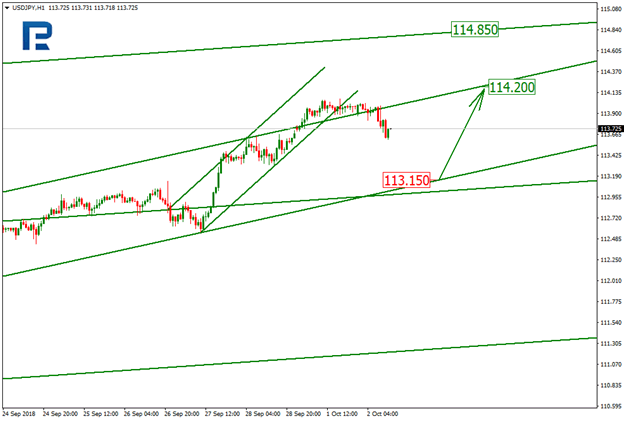
After finishing the mid-term correction, USDJPY formed another impulse of the long-term uptrend. The H1 chart shows that the pair reached the resistance line of the mid-term ascending channel and rebounded from it. Apart from this, one can see that the price broke the support line of the short-term channel as well. Taken together, these factors indicate a correctional downtrend with the possible target near the support line of the mid-term channel at 113.15. After reaching it, the instrument may start forming a new rising wave with the targets close to the resistance levels at 114.20 and 114.85.
Into US session: Aussie and Sterling weakest, not Euro
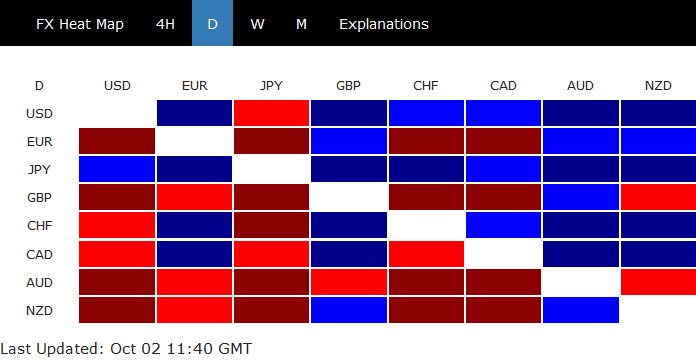
Entering into US session, while Euro's sell and Italy catches a lot of headlines today, it's actually not the weakest one. Selloff in Euro slows a little bit after Italian PM Conte's FB post, pledging that Euro is indispensable. Australian Dollar is indeed the worst performing on risk aversion, following the sharp selloff in Hong Kong stocks and weakness in offshore Chinese Yuan. Sterling is the second worst as UK PM May continues get criticism on her Chequers plan from EU as well as Brexiteers. Yen is the strongest one on risk aversion, followed by Dollar and Swiss Franc.
At the time of writing, DAX is trading down -0.77% at 12244.13, recovered mildly after hitting as low as 12203.60. CAC is down -0.78% and FTSE is down -0.45%. German 10 year bund yield hit as long as 0.41 earlier today but it's now back at 0.441, down -0.035. Italian 10 year yield is up 0.066 at 3.371, after hitting as high as 3.444.
Earlier today, Nikkei pared back almost all earlier gains and closed up just 0.10%. Singapore Strait Times lost -0.39%. Hong Kong HSI is in crisis mode, lost -2.38%. China is still on holiday but could very much face some troubles when they're back next week. Gold is hovering around 1190 despite Dollar strength.
EURJPY Analysis: Moving Towards Target At 130.15
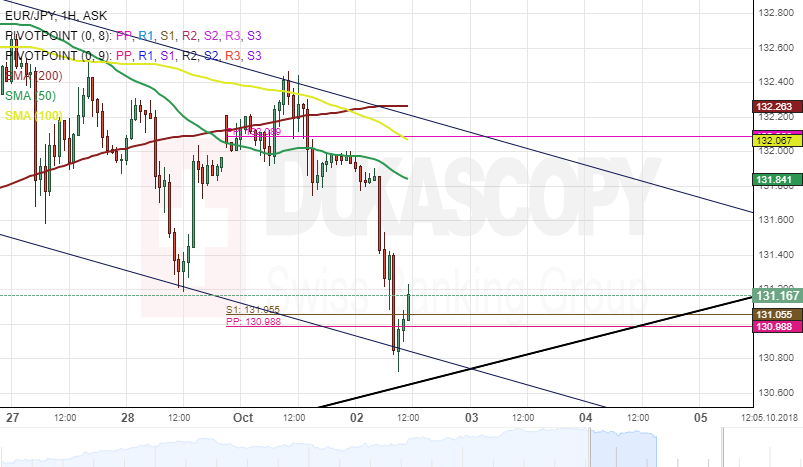
The single European currency has depreciated about 160 base points against the Japanese Yen since yesterday. The currency pair breached a support cluster formed by the combination of the weekly and the monthly PPs at 131.05 and also tested the lower boundary of a descending channel at 130.84 during the first part of today's session.
Everything being equal, it is likely that the currency exchange rate will continue moving south within this session. The psychological targets for the rate will be at the monthly S2 near the 130.00 mark.
A potential U-turn north is likely to occur at that support level during the following trading session.
AUDUSD Analysis: Potential Reversal
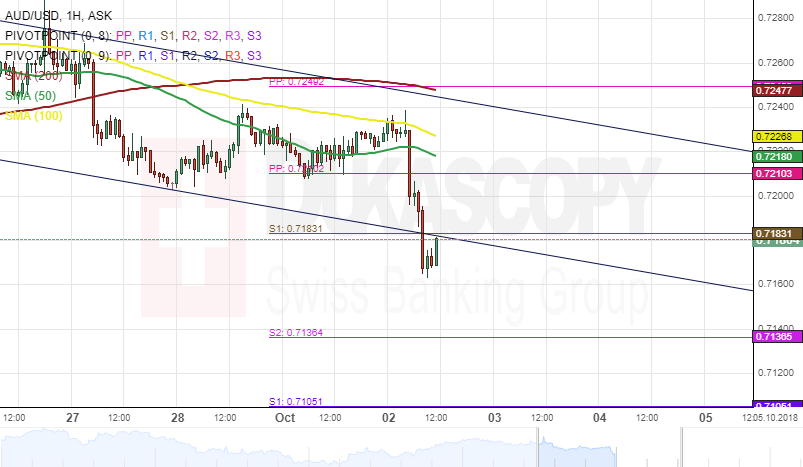
The Australian Dollar has depreciated about 70 base points against the US Dollar since Monday's session. The currency pair breached the lower boundary of a one-week descending channel at 0.7183 during the first part of today's session.
Given that the AUD/USD currency pair has broken the one-week descending channel, the exchange rate will continue its bearish sentiment within this session and aim at a support level formed by the monthly S2 at 0.7136.
From a technical point of view, the currency exchange rate could reverse from that support level and aim for the resistance level formed by the upper boundary of a descending channel pattern at 0.7183.
USDCAD Analysis: Supported By Weekly And Monthly PPs
No significant changes occurred to the US Dollar against the Canadian Dollar on Monday. The currency pair was trading sideways during the previous session.
The USD/CAD exchange rate is presently trading near a support cluster formed by the weekly and the monthly PPs at 1.2786. This support level could push the rate towards the 200-hour simple moving average at 1.2938 within this session.
However, a resistance line formed by the weekly pivot point at 1.2849 and the 50-hour SMA at 1.2857 could hinder the currency exchange rate from reaching its target today.