

Sample Category Title
THE USMCA: Manageable Concessions, Less Uncertainty
Canada late Sunday joined a reworked, trilateral NAFTA replacement deal. While the United States-Mexico-Canada agreement came somewhat sooner than we were expecting, the details we've seen so far point to an outcome with few surprises. The concessions that Canada made, such as on rules of origin in the auto sector and in granting the U.S. more access to the domestic dairy market, had been well telegraphed. And even some of Canada's wins, like getting an exemption from potential U.S. auto tariffs, weren't surprising. While it's possible to conclude that the deal consists largely of tweaks to the old agreement, we believe reduced uncertainty about the U.S.-Canada trade relationship could prompt businesses to put more investment dollars to work and will support exports. Overall, however, the new deal doesn't much change our base-case economic outlook. And we believe the USMCA won't alter the Bank of Canada's thinking on the pace and extent of future interest rate hikes.
What did Canada concede?
- Rules of origin: As expected, Canada was okay with new auto rules of origin agreed to bilaterally between Mexico and the U.S. that upped required North American content and included a new 'high-wage' component. Canada likely wouldn't have asked for the changes at the outset of negotiations but the new rules will be more significant for Mexico than for Canada.
- Sunset clause: The original U.S. demand for a 5-year termination of the new deal softened into essentially a 16-year agreement with an option to extend after 6 years. Given any party already has the option to terminate NAFTA with 6 months' notice, a 16-year 'sunset clause' with high likelihood of extension probably doesn't change the calculus from a long-run business investment perspective all that much relative to the status quo.
- Dairy trade: Also as expected, Canada made some concessions on dairy trade and will allocate the U.S. ~3 ½% of the Canadian dairy market - but leave the existing dairy supply management system largely in place. Canada had already made similar conces-sions in agreements with Europe (CETA) and partner countries in the CPTPP. As in past agreements, the government is likely to provide some compensation to Canadian farmers for this latest market share concession.
- Biologic drugs and 'de minimis' thresholds: Canada also gave into demands to lengthen patent protection for biologic drugs to 10 years from 8 years and will reportedly boost the amount of cross-border online purchases available for duty-free import to $C 150 from $C 20. The latter could cause some consternation among Canadian retailers, but probably will be welcomed by consum-ers.
What did Canada get?
- Exemption from potential auto tariffs: Perhaps the most important measure for the near-term economic outlook was the inclu-sion of measures to protect the Canadian auto sector from potentially significant U.S. auto tariffs - along the lines of the 10%-25% aluminum and steel product tariffs already implemented - pending the conclusion of an ongoing U.S. investigation into trade in the sector. Those tariffs against Canada were always viewed as unlikely because close industrial integration across the border means U.S. producers would also be hurt. Nonetheless, if implemented, they would probably have a larger near-term negative impact on the economy than a NAFTA tear-up itself .
- Dispute resolution: In somewhat of a coup for the Canadian side, Canada was successful in keeping NAFTA's so-called Chapter 19 dispute settlement mechanism largely intact - a measure that the Canadian side had argued was indispensable, particularly giv-en the seemingly erratic approach of the current U.S. administration to tariff actions.
- Tariff cool-down period: Canada will get a 60-day exemption from any further US tariffs or import restrictions imposed under Section 232 to allow the two parties to work toward a negotiated outcome.
- Less uncertainty: Canadian business investment has been on the soft side despite low financing rates and production running close to capacity limits already. This agreement doesn't entirely eliminate uncertainty - new trade frustrations could yet emerge and broader U.S. trade tensions globally remain. Nonetheless, less uncertainty sets the stage for Canadian businesses to put more investment dollars to work.
- Steel and aluminum tariffs: The so-called 'Section 232' tariffs on U.S. imports of Canadian steel and aluminum remain. White House rhetoric suggests an agreement to eliminate those could follow. The fact that those tariffs remain - even with NAFTA and the chapter 19 dispute mechanism that Canada fought so hard to maintain in the new USMCA still in force - shows there are still limits to Canada's protection from aggressive trade actions from the U.S.
- Ratification: The agreement will also still have to be passed by each country's central government. We think it will be ratified in Canada and Mexico. It is also much more likely to make its way through the U.S. Congress now that Canada has joined - even potentially a different Congress controlled by Democrats after the November midterm elections.
What does this mean for the Bank of Canada?
- The Bank of Canada has emphasized both upside and downside risks from trade policy and while the successful resolution of trilateral talks certainly counts as the former, we don't think it will change the bank's thinking on the future pace and ex-tent of rate hikes.
- In their July Monetary Policy Report, the BoC estimated that trade uncertainty and US trade actions already taken would sub-tract 2/3 per cent from Canadian GDP by the end of 2020. While Canada appears to have avoided Section 232 tariffs on autos, the USMCA agreement did not provide relief on steel and aluminum tariffs. Canada's retaliatory tariffs will also remain in place for now. So the BoC is likely to maintain some drag on growth from US trade actions.
- Where we could see an upward revision to their GDP forecasts would be from a reduction in trade uncertainty. But the BoC has indicated they will be guided by how businesses react to new trading arrangements—in the past Governor Poloz has suggested he would want to see investment intentions picking up in response to a positive resolution in Nafta talks. The bank's Business Outlook Survey will once again be key, but the survey period for the upcoming October 15 release will have closed prior to the USMCA deal. The BoC could do some quick follow up to gauge the impact of the new deal, but we might have to wait until the December edition to get a better sense of how businesses are responding.
- So there is risk that the BoC marks their growth forecasts slightly higher on the back of this deal. However, with the economy already running at capacity limits, there is limited scope for a bump up in growth. The bank is still likely to favour a gradual pace of rate hikes.
- On the extent of rate hikes, several months ago the BoC was saying that they might need to maintain some level of accommoda-tion over the medium term to counteract headwinds from high household debt, competitiveness challenges and trade uncertainty. In recent months, the Bank has shied away from an explicit commitment to keep monetary policy below neutral - and neutral rates themselves are subject to changes in potential growth and productivity - but we do think household debt will remain a fac-tor arguing for a pause in hikes next year as rate increases feed through more fully to effective borrowing costs. While there have been recent, positive debt developments, households' increased sensitivity to rate hikes is here to stay.
- All told, our BoC forecast has not changed following these latest trade developments. We continue to expect a rate increase at the bank's next meeting in October, and two further moves next year that will lift the overnight rate to 2.25%.
Italy Takes Another Step Towards Fiscal Easing
Executive Summary
Against a backdrop of high sovereign debt levels and slow growth, the Italian elections held earlier this year eventually produced a coalition government between two parties generally perceived to have a populist tilt: the Five Star Movement (5SM) and the Lega (the League). Both parties have expressed some Euroscepticism and a strong desire to enact expansionary fiscal policies, though the specific policy proposals originate from opposite ends of the political spectrum. The first big step in the budget process occurred on September 27, when Italian policymakers set their top-line budget figures. The key number was a deficit target of 2.4% of GDP for 2019, above the 0.8% target set by the previous government back in April. The 2.4% target still technically complies with the 3% limit imposed by the European Union (EU), but given Italy's large stock of debt EU policymakers may still be wary. In our view, Italy's proposed deficit target of 2.4% in 2019 is probably just small enough to avoid a major showdown with Brussels. If that deficit target is realized, nominal GDP would have to grow at roughly a 3% pace next year to keep the debt-to-GDP ratio steady, a key factor given that Italy is already in clear violation of the EU's limit of a 60% debtto- GDP ratio. While 3% is a bit faster than the current 2.7% pace, it is at least a feasible outcome.
However, the Italian government will need to go from high-level projections to concrete policy proposals in the coming weeks. Should the Italian coalition have trouble fitting its outsized policy wishes into that deficit target, the two most likely outcomes in our view would be an increase in the target or a collapse of the government coalition. A collapse of the current coalition would probably bring about a rally in Italian bonds, as the current champions of Euroscepticism and fiscal profligacy lose their grip on power. An increase in the deficit target to 3% or more, however, would likely fuel a further sell-off in Italian debt, in our view, as a breach of the 3% target and/or a rising debt-to-ratio is far more likely to prompt a showdown between Brussels and Rome.
How Did Italy Get Here?
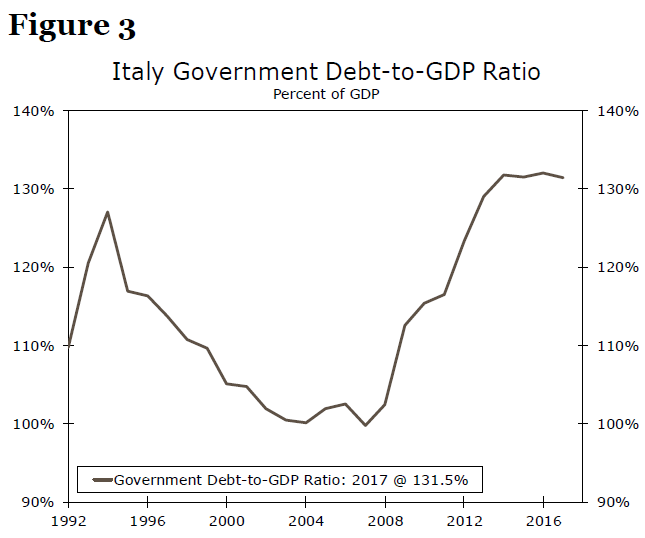
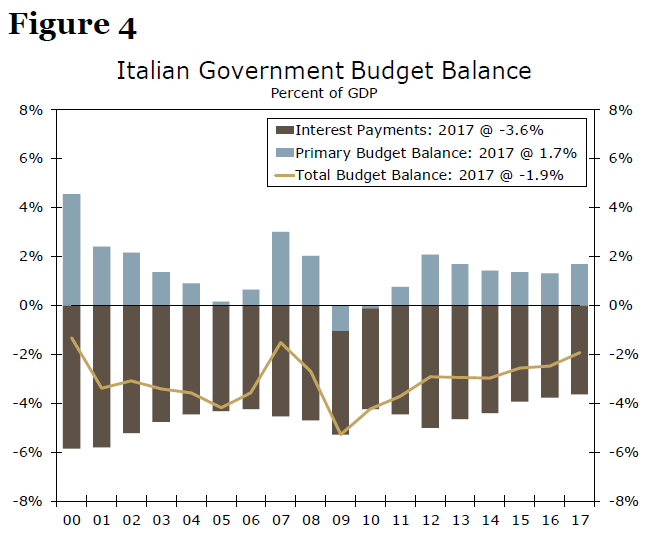
To understand the challenges facing policymakers in Italy, it is helpful to understand how we got here in the first place. Italy's fiscal woes go back several decades; the general government debt-to- GDP ratio has been above 100% for decades (Figure 3). As a point of comparison, the corresponding metric in the United States is 108% today and was just 65% back in 2007. However, unlike some other countries whose fiscal situation has deteriorated in recent years amid new spending/tax cuts, Italy has run a primary budget surplus (revenues less noninterest spending) for years (Figure 4). Why then has the Italian debt situation not seen more improvement? For one, the sizable interest payments on the large stock of Italian debt have been a major driver. Interest spending amounted to 3.6% of GDP in 2017 and was as high as 5% as recently as 2012. Thus despite fairly prudent fiscal policy over the past few years, interest costs have been a big factor keeping Italian policymakers from driving down the debt-to-GDP ratio very quickly.
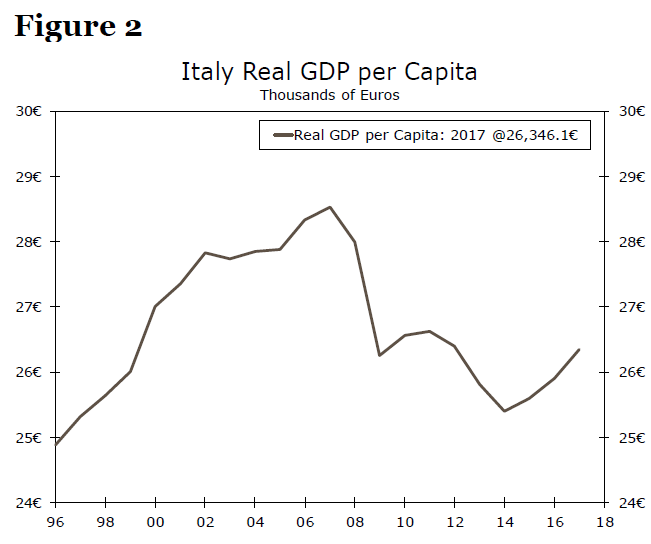
Vexing policymakers further has been the remarkably slow growth environment in Italy. Real GDP per capita in Italy is lower today than it was in 2000 (see chart on front page). While nominal GDP growth has been a bit stronger of late (up 2.7% year over year through Q2-2018, the fastest pace in seven years), it has been not been strong enough to provide a significant bump to the denominator portion of the debt-to-GDP ratio. Without faster nominal GDP growth, the primary budget surplus would need to be even larger than it already is to reduce the debt-to-GDP ratio meaningfully. Public investment, an area where high levels of spending today might translate into faster long-run growth down the road, has been far from robust. Government investment as a percent of GDP was just 2.3% in 2015, down from 2007 levels and nearly a percentage point below the OECD average.1
Against this backdrop of high debt levels and slow growth, the Italian elections held earlier this year eventually produced a coalition government between two parties generally perceived to have a populist tilt: the 5SM and the League. Both parties have expressed some Euroscepticism and a strong desire to enact expansionary fiscal policies, though the specific policy proposals originate from opposite ends of the political spectrum. The more 'left-wing' 5SM has advocated for more public investment, a lower retirement age and some form of universal basic income for low-income individuals, while the more 'right-wing' League has pushed for tax cuts primarily via a 15% acrossthe- board flat tax. Details on these policies have been somewhat vague, and as a result estimates of how costly these policies would be have varied, but it appears likely that full implementation of each party's platform would push the budget deficit up by multiple percentage points of GDP.
What Is Stopping Italy from Going Full Steam Ahead on Fiscal Policy?
As the United States has proved recently, a challenging long-run fiscal outlook is not necessarily an insurmountable obstacle to passing a major fiscal stimulus. Yet Italy faces a few additional hurdles that make passing a budget-busting bill into law difficult. First, as a member of the EU, Italy is subject to the Stability and Growth Pact, an agreement among those countries that, among other things, limits each country's government budget deficit to 3% of GDP.2 Though the 3% limit is really more of a "soft" rather than "hard" limit in practical terms, an egregious breach of the target would likely subject Italy to a process known as the Excessive Deficit Procedure (EDP), which in short involves the European Commission engaging with the member state in an effort to reign in the deficit. A deep dive into this procedure is beyond the scope of this report, but the key takeaway is that under this scenario EU policymakers would likely attempt to bring profligate Italian policymakers to heel in a long, drawn out process that could theoretically involve financial penalties on the country. Whether or not the EU would succeed in altering the path of Italian fiscal policy is an open question, but even just the headline risk over such a showdown could push up Italian bond yields, squeezing Italy further as interest costs rise.
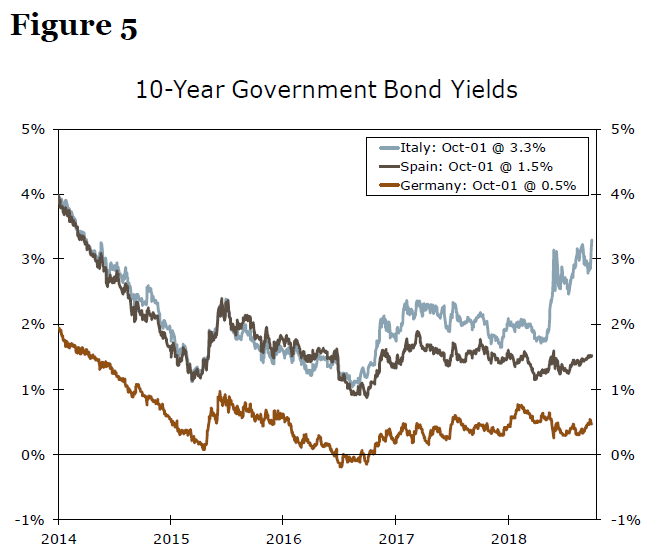
Second, as discussed earlier, Italy's high stock of debt makes it particularly sensitive to an increase in interest rates. As recently as 2012, Italy was spending 5% of GDP on interest payments. This has fallen to 3.6% today as interest rates on Italian sovereign bonds have fallen. With yields on the 10-year benchmark Italian sovereign bond up about 150 basis points since May, Italy may begin to see some budget deficit pressure even in the absence of fiscal stimulus.3 Third, the old saying that "politics makes for strange bedfellows" has been proved once again by the current Italian coalition government. Since the coalition was formed in May, there have been at times signs of disagreement between the two major ruling parties over how to prioritize the cornucopia of fiscal easing measures. The current government is the 66th Italy has had since World War II, and this is an unusual coalition even by Italian standards, so it is no guarantee that the current government will be able to withstand the challenges of passing major budget changes.
What Are the Implications of the Budget Process?
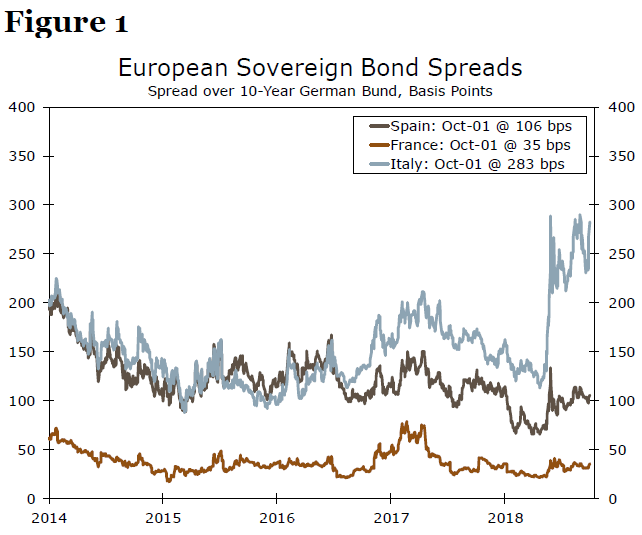
Yields on Italian bonds jumped in May after the coalition government was formed, with the 10-year Italian sovereign bond yield reaching 3.24% in late August, the highest level since 2013. Spreads over the German bund also jumped, but so far the contagion to yields in other core European countries has been fairly limited (see chart on front page). In recent weeks, Italian bonds rallied as markets awaited the release of the Economic and Financial Document (DEF), which proposes top-line budget figures like the deficit target. The release finally came late on September 27 in what was the first key step in what will likely be a protracted process over the next few months. In that document, the government set a deficit target of 2.4% of GDP for 2019, above the 0.8% target set by the previous government back in April. The figure of 2.4% of GDP still complies with the 3% limit imposed by the EU, but given Italy's large stock of debt EU policymakers may still be wary. Italian sovereign bonds once again sold off on the news as the deficit target was a bit larger than initial reports had indicated (Figure 5). It appears that at the eleventh hour members of the 5SM/League demanded a bit more fiscal stimulus than had been originally baked into the projections.
In terms of next steps, Italy must submit a draft budget to the European Commission (EC), the executive arm of the EU by October 15. The draft budget will provide more specific policy details than the more high-level, top-line targets released in the DEF. If the EC takes issue with Italy's proposed budget, including as it relates to the EU budget rules, it has until November 30 to ask Italy's government for a revision. Though the EC can attempt to alter the path of Italian fiscal policy, it is important to remember that Italy remains a sovereign nation with ultimate control over its budget.
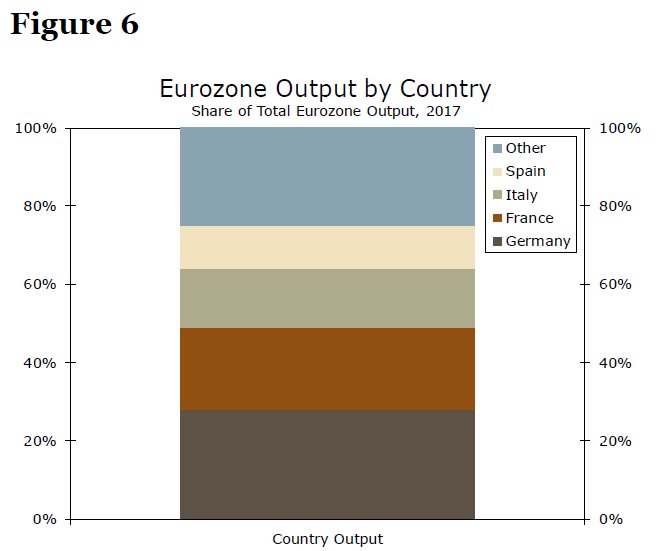
What does this mean for the outlook for bond yields in Italy and in the rest of the world? There are two primary avenues through which yields will respond to the Italian budget: a possible "reflation" trade and concerns over the future of the Eurozone. To the first point, the traditional response to a deficit-financed fiscal stimulus should be higher rates across the curve, all else equal, as bond issuance ramps up, there is some near-term bump to economic growth/inflation and central banks respond to these stronger macroeconomic conditions. This has been most clearly seen in the United States over the past year or so. Might fiscal stimulus and thus faster growth/inflation in Italy spur a broader pick-up in the Eurozone and a more hawkish European Central Bank (ECB), thus causing the increase in Italian bond yields to spread to the rest of Europe? While this is a possibility, we are skeptical an Italian fiscal stimulus would be enough to spur a reaction similar to what has occurred in the United States. Italy represents just 15% of economic output in the Eurozone (Figure 6). In a sense, a fiscal stimulus in Italy would be similar to a fiscal stimulus in a major U.S. state; probably not enough to meaningfully move the needle much for the ECB in the near-term.
Perhaps more fundamentally, yields on Italian sovereign bonds have also risen as investors price in a risk premium that a fiscal showdown between Italy and the rest of Europe could put the future of the Eurozone at risk. Italy is among the 10 largest economies in the world, and its government debt outstanding totals €2.3 trillion, making its sovereign debt market roughly seven times larger than Greece's. In our view, Italy's proposed deficit target of 2.4% in 2019 is probably just small enough to avoid a major showdown with Brussels. If that deficit target is realized, nominal GDP would need to grow at roughly a 3% pace next year to keep the debt-to-GDP ratio steady, a key factor given that Italy is already in clear violation of the EU's limit of a 60% debt-to-GDP ratio. While 3% is a bit faster than the current 2.7% pace, it is at least a feasible outcome.
That said, the Italian government will need to go from high-level projections to specific policy proposals in the coming weeks. Triangulating the course that satisfies the starkly different partners in the coalition will not be an easy task, and we view the long-term stability of the current coalition as a large question mark. Crafting a budget when the deficit target is increasing is always easier than meeting austerity goals, however, and our base case is that Italy will in the end more or less stick to the proposed 2.4% target. To use the United States as an example, the recent tax reform bill had its moments of peril, and Republican policymakers in the United States had to abandon some initial proposals for budget reasons, such as making the individual tax cuts permanent. From a political standpoint, a smaller-than-promised stimulus is still often a better alternative than no stimulus at all. Under this scenario, Italian bond yields might rise a bit further as markets consider what this inflection point means for the longer-run financial health of the country, but most of the damage has likely already occurred, so long as a full-blown showdown with the EU is avoided.
However, should the Italian coalition run into trouble in the coming weeks as it tries to fit its outsized policy wishes into the deficit target, the two most likely outcomes in our view would be an increase in the target or a collapse of the government coalition. A collapse of the current coalition would probably bring about a rally in Italian bonds, all else equal, as the current champions of Euroscepticism and fiscal profligacy lose their grip on power. An increase in the deficit target to 3% or more, however, would likely fuel a further sell-off in Italian debt, in our view, as a breach of the 3% target and/or a rising debt-to-GDP ratio is far more likely to prompt a more pronounced showdown between Brussels and Rome.
Taking a longer-run view, the challenges of stagnant living standards and high debt levels that have sparked the current political situation are unlikely to abate anytime soon. Even if Italian policymakers thread the needle on fulfilling their campaign promises while avoiding sanctions from Brussels, rising rates in Europe in the years ahead will likely put additional pressure on the sustainability of Italian debt, making future policy choices even more daunting. Furthermore, unless real GDP per capita rises in a meaningful and sustained way, the populist rumblings in the Italian political system are unlikely to completely fade away. Thus, we believe Italian budget drama is likely to periodically come into focus for financial markets for years to come.
1 OECD. (2017). "Government investment as percentage of GDP, 2007, 2009, 2015 and 2016", in Public Finance and Economics, OECD Publishing, Paris, https://doi.org/10.1787/gov_glance-2017-graph36-en.
2 For more detail on the Stability and Growth Pact and how the European Commission deals with breaches of the deficit/debt targets, see: https://ec.europa.eu/info/business-economy-euro/economic-and-fiscal-policy-coordination/eu-economic-governance-monitoring-prevention-correction/stability-and-growth-pact_en
3 Bryson, H. J., Quinlan, T. & Nelson, E. (March 2016). "How Sustainable Is European Sovereign Debt?" Wells Fargo Economics. Available upon request.
GBP/USD Testing Key Support Near 1.3000
Key Highlights
- The British Pound started a downside move from 1.3280 and declined towards 1.3000 against the US Dollar.
- There is a declining channel formed with resistance at 1.3100 on the 4-hours chart of GBP/USD.
- The US ISM Manufacturing Index for Sep 2018 declined from 61.3 to 59.8.
- Today, the US ISM NY index – Business Conditions Index for Sep 2018 will be released, which is forecasted to decline from 76.5 to 75.8.
GBPUSD Technical Analysis
The British Pound started a fresh downside move from the 1.3298 high against the US Dollar. The GBP/USD pair broke the 1.3250, 1.3180 and 1.3080 support levels to move into a bearish zone.
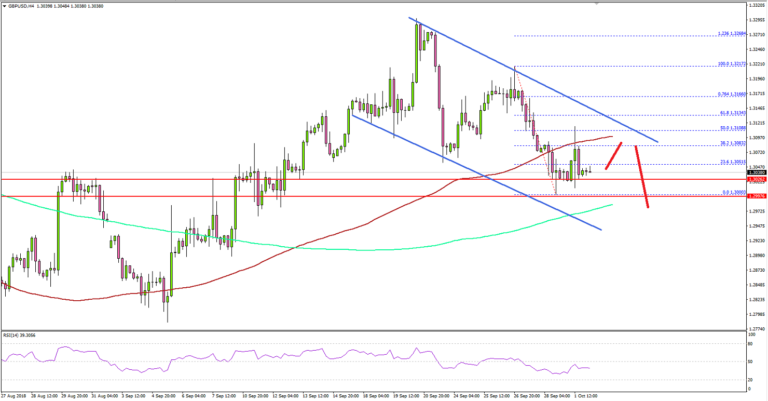
Looking at the 4-hours chart, the pair faced an increased selling pressure from the intermediate high at 1.3217. It fell sharply and settled below the 1.3080 support and the 100 simple moving average (red, 4-hours).
The pair tested the 1.3000 support and it is currently consolidating losses. It recently corrected above the 23.6% Fib retracement level of the recent decline from the 1.3217 high to 1.3000 swing low.
However, the pair failed to settle above the 100 SMA and the 50% Fib retracement level of the recent decline from the 1.3217 high to 1.3000 swing low. More importantly, there is a declining channel formed with resistance at 1.3100 on the same chart.
If the pair gains traction and breaks the channel resistance, there could be a correction towards the 1.3150 level in the near term.
On the other hand, a downside break below the 1.3000 support may push the price towards the 1.2975 level and the 200 SMA (green, 4-hours). Below the 200 SMA, GBP/USD could even trade towards the 1.2840 support area.
Fundamentally, the US ISM Manufacturing Index for Sep 2018 was released recently. The market was looking for a decline from the last reading of 61.3 to 60.3.
However, the result was disappointing as the ISM Manufacturing Index declined to 59.8. It helped the GBP/USD pair in holding the 1.3000 support, but there is still a risk of more losses in the near term.
Economic Releases to Watch Today
- Euro Zone PPI for August 2018 (YoY) – Forecast +3.8%, versus +4.0% previous.
- Euro Zone PPI for August 2018 (MoM) – Forecast +0.2%, versus +0.4% previous.
- UK’s Construction PMI for Sep 2018 – Forecast 52.5, versus 52.9 previous.
Oil’s The Word
Oil markets: frenzied action
Oil has sprung another gusher overnight, and in roaring fashion clocked an eye-watering 3 % surge. Brent has hit $85 while WTI has hit $75.40 – the highest levels in over four years.
There haven't been any new significant near-term catalysts per se to drive the price action. Mind you given the bullish headlines, of late; it's not like the market needs one to keep the momentum going. But the Baker Hughes oil count dropped suggesting a slow down in US production, which I forgot to mention yesterday while caught up in the Sinopec and Saudi spare capacity debate.
But one barometer that's hard to ignore, Oman oil prices spiked to $90 a barrel, which could be a foreshadowing of things to come on Brent. Indeed, this high-water market has intensified the bullish fervour and triggered a buying frenzy across oil markets.
Ultimately the markets remain singularly focused on the prospect of supply disruptions from Iran which is the primary driver of oil prices. And of course, the US/Mexico/Canada trade agreement will have a longer-term positive impact on oil prices in a broader macro context.
Brent by the numbers
Iran sanctions go into effect on for Nov 4, and while there's significant variance in estimates, I think its safe to assume that approximately 1.5 million barrels per day of Iranian crude will go offline Despite that projected decline and falls in Venezuelan output. OPEC total production still edged higher during September suggesting the markets are anticipating future supply scarcity rather than a current shortage
Looking to last week's data, bullish bets in Brent continued to build with net longs increasing 28,465 contracts to 496,343 contracts. But the extensions in WTI, on the other hand, was trimmed with net longs in the US crude declining some -965 to 332,143 contacts. Confirming that Brent is leading the charge as suggested by step by step rotation in contracts and indicates the Brent -WTI spread could widen significantly in the weeks ahead.
Risk sentiment
Asia markets
Risk traded mixed in Asia yesterday as it so often does when a strong USD dollar begins to emerge while regional sentiment turned downcast after China manufacturing PMI over the weekend disappointed. But outside of some clear-cut distinctive developments in the INR, it will be tough to form any definitive conclusions in Asia markets given the diminished mainland liquidity because of Golden Week. Frankly, all the local focus remains on China, so their absence is telling.
US markets
US stocks rose as US-Mexico-Canada trade deal sparked an initial rally on Wall Street. But as the session wore on it quickly became apparent that investors were more relieved than anything else, early enthusiasm gave way to the reality that some contentious trade issues have yet to resolved, suggesting a significant source of tension does remain. None the less the framework does remove at least one massive tariff related risk from the global financial market, and just as significantly it allows the US administration to now focus exclusively on its escalating economic dispute with China.
EU markets
Italian assets are back in the fore as uncertainty over how the EU will receive Italy's budget rears its ugly head. The BTP-Bund spread has widened out, Italian banks have led loss in European equities, and the EURUSD plumed the 1.1565 support levels overnight. Despite reversing some earlier losses on the back of NAFTA euphoria, as excitement quickly fades on that front, investors remain on a razor edge ahead of the October 15 when the budget is submitted. It should be a challenging few weeks for European investors as EU markets remain extremely sensitive to headline risk as the lingering fear of European contagion continues to percolate.
Gold Markets: For whom the bell tolls
Any which way but up. A strong US dollar, higher US interest rates and resurgent risk appetite on back of the North America trade agreement suggest the bell tolls for gold prices. However, the primary drag for gold prices will be the repricing higher of FED rate hike expectations. With that in mind, Friday's NFP will go a long way to cement or rebuff the markets current hawkish FOMC lean.
Between now and then, unless there is an unlikely colossal dollar positive trigger ahead of Friday critical economic print, I suspect last Friday low water mark around $1181, could be a bridge too far while offer offers are lined up at $1195. So effectively Gold is consolidating ahead of NFP in a new $1185- $1195 range on a bearish tangent.
Currency Markets
Please curb your enthusiasm and get ready to sit on your hands until NFP. Reactions have been muted overnight to US data suggesting focus is squarely on Friday's wage component of NFP, so it could be a relatively muted week as currency traders try to navigate a myriad of risks.
The USD was relatively quiet overnight, but not unexpectedly so. The USDJPY edges toward 114 and consolidates while the EURUSD continues to hold on by a thread. Currency markets are playing out pretty much as scripted.
The Canadian Dollar
The Canadian dollar easily held onto gains but with chatter about reserve manager demand around 1.28 suggests traders will be more inclined to sell on upticks as this could be a specific short-term obstacle if they do sit on the bid. Despite the ducks lining up for a stronger CAD, markets are not entirely out of the weeds just yet. While my Bay street colleagues, who tend to side with the Canadian Dollar Perma Bears anyway, didn't exactly run with the baton overnight and greeted the deal with relief rather than enthusiasm. I still think we move lower and test 1.2720, but it's going to need a little bit of help from BoC guidance or a miss on this weeks NFP. The former a possibility the latter unlikely.
Convictions
Japanese Yen and the Euro
But overall the USDJPY higher remains the most robust conviction trade with the NKY and US bond yields looking higher. USD bulls remain cautious about selling the Euro at these levels and effectively chasing the EU political wobbles. I think the EURO will struggle to gain traction anyway after last weeks tepid EU inflation print, but towards 1.1500 the risk rewards on a short position tend to diminish in my view, given that politically inspired moves on the Euro typically tend to have a very short half-life.
EM Asia
Indian Rupee
In another case of “say it ain't so” the Indian rupee has melted. With Brent setting sights on $ 90 per barrel with the vapid chatter of even $100 per barrel extension, the one-month USDINR NDF is trading at an all-time high. The oil move coupled with a possible RBI rate hike to ” defend the rupee at all cost” has dented local equity sentiment as well. Frankly, at this point, an RBI rate would be ineffective and would provide about as much relief as a band-aid would for a broken leg. But the big problem now if the move extends to USDINR 74 or even 75 at some point this will ultimately weigh in India's ability to service foreign debt. This is shaping up to be a brutally negative story line for India's capital markets.
Malaysian Ringgit
On the opposite side of the regional oil spectrum, the MYR remains supported by oil, but the Ringgit is not entirely embracing the move.
The resurgent USD and higher US bond yields are weighing on local sentiment. Not to mention yesterdays weaker than expected China PMI has soured sentiment. But with regional liquidity running low due to Golden week, trading could remain muted ahead of this week's essential US NFP release.
USD/CAD Hits Four-Month Lows
The lesson from the weekend drama was that deals can come together in a heartbeat and that deep pessimism might be the time to buy. The Canadian dollar was the top performer Monday while the yen lagged. The US September ISM manufacturing survey was at 59.8 compared to 60.0 expected.The RBA decision is up next. A new CAD trade was issued, while the JPY trade was stopped out.
Yesterday Ashraf noted that it wasn't too late to sell the Canadian dollar and that was the case as the declines continued throughout the trading day as USD/CAD broke the 200-DMA to hit a four-month low late in North American trade. Also note USDCAD is among the most inversely related pairs with equity indices.
The quick turnaround on the NAFTA deal may prove to be a helpful lesson for sterling traders as Brexit negotiations continue. Algos bought GBP heavily on Monday on a newswire headline that gave the impression of May offering something that would likely lead to a deal. Cable instantly jumped a full cent but later gave back nearly all the gains with the text of the report showing that this was a backstop deal contingent on getting full access to the EU; something that's a longshot. Also watch EURGBP closely for GBP's Brexit-related reactions rather than only GBPUSD.
In economic news, IMF leader Lagarde said a downgrade to global growth forecasts would be coming this month.
Italy remains an overhand for the euro as it fell to the lowest in three weeks at 1.1564. We can't envision a major blowup over 0.4 pp on the deficit-to-GDP target but the Italian bond market certainly hasn't been impressed.
Perhaps the news that could reverberate the longest was a roughly 3% rise in WTI and Brent crude with both at the highest in four years. India said it won't import oil from Iran and Japan and South Korea have already made similar announcements.
Looking ahead, the RBA decision is at 0430 GMT (05:30 BST) with no change widely expected. Some economists expect the RBA to hold rates unchanged through 2020 in a sign of the deep complacency that surrounds the central bank.
Eco Data 10/2/18
[php_everywhere instance="1"]
Breakthrough Trade Deal a Major Sigh of Relief
Last night's agreement in principle to update NAFTA under the new banner of the US-Mexico-Canada Agreement (USMCA) may yet contain some surprises buried in its fine details. But, similar to the immediate investor response, we are breathing a sigh of relief this morning. The deal is far from perfect, but other, decidedly more negative potential outcomes – such as Canada's exclusion from a revised agreement, a "zombie" NAFTA, and steep tariffs on Canadian auto exports to the U.S. – have likely been avoided.
Facing a major U.S. swing towards protectionism, Canada negotiators had clearly set out to limit the damage and buy some security with the U.S. and they appear to have achieved that goal.
- Notably, two of three dispute mechanisms – Chapter 19 and Chapter 20 – have been preserved in the deal, which is a win for both Canada and Mexico. The former lays out a special appeals process through an independent panel to challenge anti-dumping or countervailing duties, while the latter allows one country to sue another if it believes terms of the agreement are not being complied with.
- A third dispute mechanism – Chapter 11 – that allows companies to sue the government if it believes it has been mistreated – was eliminated for Canada, and mostly for Mexico with the exception of certain industries. Ironically, it was the U.S. that demanded Chapter 11 be scrapped even though its companies had more frequently sought damages under that mechanism.
- Canada and Mexico have won assurance that the U.S. administration won't levy steep auto tariffs under Section 232 national security provisions. Similar to Mexico, Canada has signed a side letter that exempts auto and parts exports of Section 232 tariffs below specified quotas, which are well above current production levels. Even if quotas are exceeded, the tariffs won't apply if it is shown that the countries meet revised rules of origin. In short, the Canadian auto sector appears well positioned to weather these changes.
- On the flip side, the steel and aluminum tariff issue was not addressed in yesterday's agreement. That issue has been left for another day.
As expected, Canada had to make some concessions. Most importantly, it agreed to provide U.S. dairy farmers access to about 3.5% of its dairy industry, though that access is well below the 10% that some had feared. Canada will also eliminate its controversial Class 7 pricing system.
A similar story holds for the de minimus threshold, which is the level below which goods are given exemption from duty and sales tax. The duty limit was raised from $20 to $150 (exemption for sales tax is raised to $40), which will not be welcomed by the Canadian retail sector. However, given that the comparable U.S. duty level is $800, it could have been worse. Lastly, Canada did concede some expanded intellectual property rights that will benefit the U.S., including prescription drugs where protection increases from 8 to 10 years.
On the winning side, there was no change to government procurement rules, which had been an early demand of the U.S. administration. Also, it appears to be very much business as usual for Canadian cultural protections as well as financial services regulation.
There are no doubt likely to be some surprises hiding in the details. For example, it appears that the U.S. administration added a provision that would effectively bar any of the three members from negotiating a trade deal with a "non-market economy." This could hinder Canada's exploration of an FTA with China.
A downside of the agreement is that it appears to have created a more complex regulatory burden around trade in goods and services rather than making trade more seamless. Case in point are the new rules around the local content in the auto sector.
Next steps
By reaching the deal on Sunday, the goal is to provide Congress with the full text to meet the 60 day notice period and allow Mexico's outgoing president to sign by November 30th before he leaves office. However, Congress will still need to ratify the agreement which will occur in the New Year. Congressional passage is not a slam dunk, especially since there may be a shift in political winds post mid-terms. In Canada, Quebec's incumbent government, which faces an election today, has vowed to challenge the deal in court.
Economic and financial market implications
Despite that deal's pitfalls and hurdles that it could face before implementation, general reaction has been swiftly positive. By removing a significant cloud of uncertainty around trade, it is very likely to be growth positive, especially for Canada and Mexico.
The deal could open the door to a faster pace of rate increases in Canada in 2019. The Bank of Canada had embedded a trade risk discount into their growth forecast of around half a percentage point. With this risk removed, a rate hike later this month looks virtually cemented, while we see the balance of risks shifting toward three additional hikes in 2019 (from two). Fixed income investors have come to the same view, as evidenced by a backup in yields – Canada government 10-year yield is up 6 bps today and 40 bps from late-June lows. That said, since the central bank is data dependent, officials will remain in a "believe-it-when-I-see it" mode when it comes to the investment data and the impact of reduced trade risk on overall growth.
The Canadian dollar is already benefitting from the news, reaching a four-month high of 78 US cents. In the coming days, it could test its fair value of roughly 80-82 US cents if the trade discount gets further reversed and if more rate hike expectations are priced in.
From a broader global risk perspective, this weekend's announcement spells good news. It shows that the U.S. can negotiate a trade deal rather than merely toss around threats and impose duties. It builds on recent positive signals around negotiating with Europe and Japan.
IMF Lagarde hints at global outlook downgrade on trade disputes
IMF Managing Director Christine Lagarde hinted today that the organization may downgrade growth outlook next week. She said, "In July, we projected 3.9 percent global growth for 2018 and 2019. The outlook has since become less bright, as you will see from our updated forecast next week."
Lagarde added "A key issue is that rhetoric is morphing into a new reality of actual trade barriers. This is hurting not only trade itself, but also investment and manufacturing as uncertainty continues to rise." Though she also tried to tone down and said "we are not seeing broader financial contagion — so far — but we also know that conditions can change rapidly. If the current trade disputes were to escalate further, they could deliver a shock to a broader range of emerging and developing economies."
On WTO reform, she said "The immediate challenge is to strengthen the rules. This includes looking at the distortionary effects of state subsidies, preventing abuses of dominant positions and improving the enforcement of intellectual property rights."
Criticisms on Italy’s budget plan continue
EU officials continue to criticize Italy's budget plan today. Vice President of the European Commission Valdis Dombrovskis said "Our assessment so far from what is currently emerging is that this is not compatible with the Stability and Growth Pact." Though, he also noted full and formal assessment could only be done after the budget plan is submitted in mid-October.
French Finance Minister Bruno Le Maire emphasized "all states have to do their best to stick to commitments" referring to Italy's budget plan. But things "have to go step by step". After getting the budget plan formally, Le Maire said Eurozone members could could put pressure within "the political framework". And such rules are more important now as EU was "facing a serious threat as "populist and nationalist movements are on the rise."
Separately, Italy newspaper La Repubblica reported that European Commission is set to reject Italy's budget plans in November and open a procedure against the country's public accounts in February.
US: Manufacturing Confidence Resilient in September
The Institute for Supply Management (ISM) manufacturing index dipped 1.5 percentage points to 59.8 in September, still in line with the healthy levels seen over the past year. Markets were expecting a weaker reading, and this was only a hair worse.
The main subcomponents of the index were a mixed bag in September. The largest declines were in prices paid (-5.2) Supplier deliveries (-3.4) and new orders (-3.3). Increases were posted in new export orders (+0.8), production (+0.6), imports (+0.6) and employment (+0.3).
Pulling back the lens on the trade-related components, new export orders and imports gained some ground after August weakness, but both remain below their levels six months ago when Washington levied tariffs on steel and aluminum.
Of note, the decline in prices paid was the biggest one-month decline since June 2017, and the index stands at a 10-month low. There was also a decline in the backlog of new orders and supplier delivery times, signaling factories are catching up with demand, helping to dissipate price pressures.
Key Implications
The U.S. manufacturing sector may have come off the boil a bit in September, but it is still expanding at a healthy pace. While trade distortions appear to have eased somewhat in September, the survey was likely conducted before the latest round of tariffs on Chinese imports and corresponding retaliation were finalized, therefore we are not out of the woods yet on tariffs playing havoc on supply chains.
The newly minted USMCA (the rebranded NAFTA deal reached last night) will likely assuage some fears for more North American-oriented manufacturing sectors, in particular the auto sector. It remains to be seen how this positive development will weigh against the ratcheting up of trade tensions with China.