Sample Category Title
EUR/USD Trades Below Monthly PP
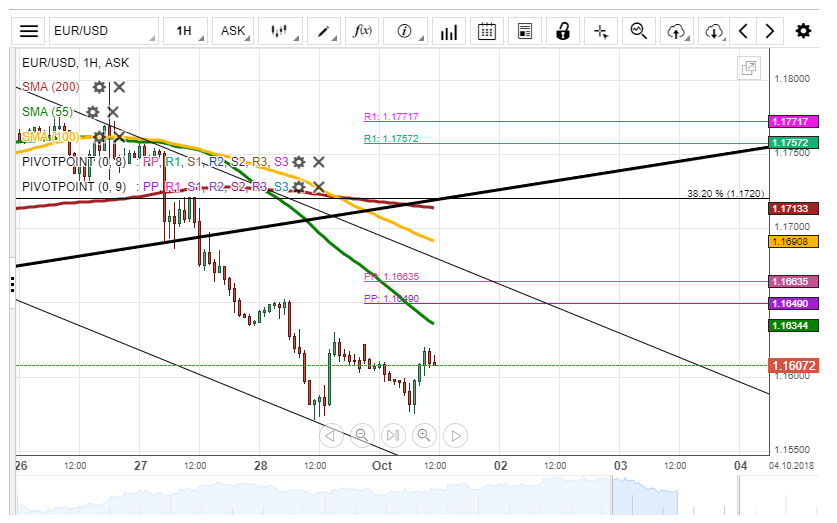
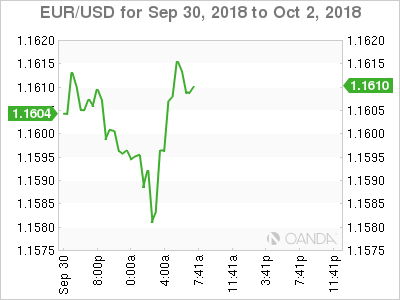
The European Single Currency depreciated 0.33% against the US Dollar since Friday's session. On Monday morning, the rate was located below the monthly PP and the weekly PP at the 1.5878 level.
In regards to the near future, the rate will move downwards to the weekly S1 at the 1.1511 level during the session. Most likely, the 55-hour simple moving average will give an additional resistance for the rate to downtrend.
However, the ISM Manufacturing PMI data release at 14:00 GMT could push the rate to go upwards to the monthly PP at 1.1649 or pass the support of the weekly S1 at the 1.1511 level on Monday.
Into US session: CAD strong on USMCA, DAX and German yield too
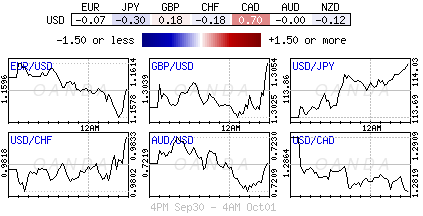
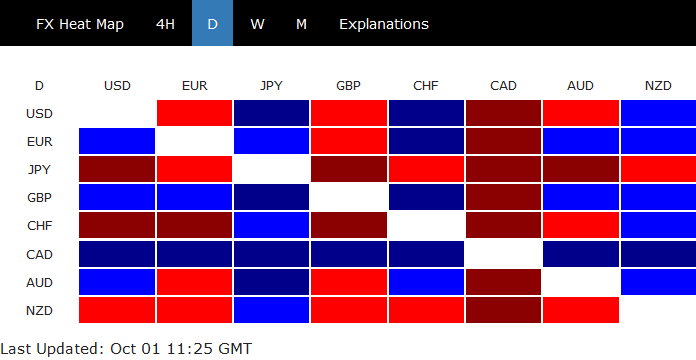
Entering into US session, Canadian Dollar remains the strongest one for today as boosted by the new USMCA that replaced NAFTA. If should be reminded that the Loonie's rally took off last week after stronger than expected GDP boosted the chance of October BoC hike. Additional, WTI crude oil stays firm above 73 hand after OPEC triggered rally. All three factors are Loonie positive. Sterling and Euro follow as the second and third strongest ones. On the other hand, Yen, Kiwi and Swiss Franc are the weakest ones for now. Dollar is mixed.
European stocks seemed to be lifted by the USMCA news too, in particular DAX. At the time of writing,DAX is up 0.58%, CAC up 0.28% and FTSE up 0.06%. German 10 year bund yield also rises 0.028, back at 0.500. However, Italian 10 yield also continues last week's rally and is up 0.036 at 3.178. The sky is not all cleared for the Eurozone.
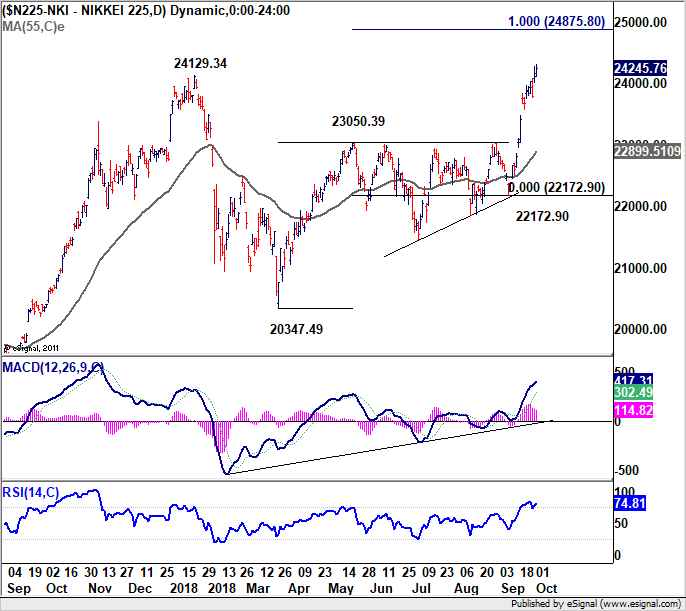
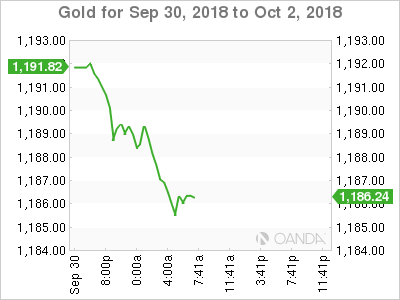
Earlier today, Nikkei extended recent strong rise and closed up 0.52% at 24245.76. Singapore Strait Times reversed earlier gains and closed down -0.05% at 3255.46. Gold's rebound lost steam quickly and is back at 1186.36.
Today's rally in Nikkei is in line with bullish view that the long term up trend is resuming after taking out 24129.34 resistance. Further rise should be seen to 100% projection of 20347.49 to 23050 from 22172.90 at 24875.8 next. This will be a positive factor for USD/JPY. In particular, if US treasury yields follow German yield higher today, we'll see more strength in USD/JPY.
GBP/USD Is Supported By Monthly PP
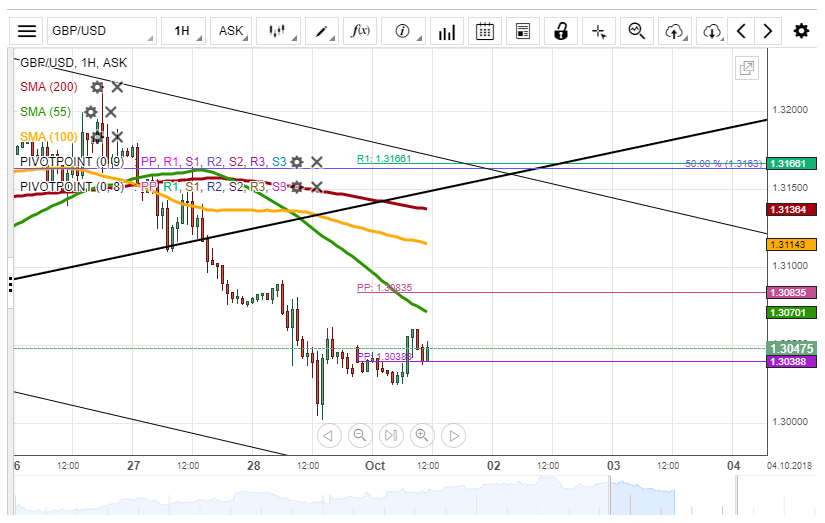
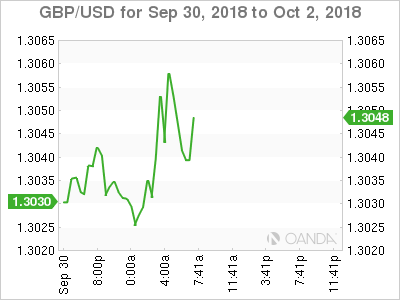
The British pound depreciated 0.20% against the US Dollar since Friday's session. On Monday morning, the rate was located above the monthly PP at the 1.3046 mark.
In the near-term future, most likely, the rate will surge upwards to the weekly PP at the 1.3083 mark but will bounce off it due to the resistance of the 55-hour simple moving average. It seems that the British pound will trade at the 1.3040 level during the session.
On the other side, the rate might break the weekly PP resistance and ignore the resistances of the simple moving averages to trade at 1.3100 level on Monday.
USD/JPY Breaks Pattern
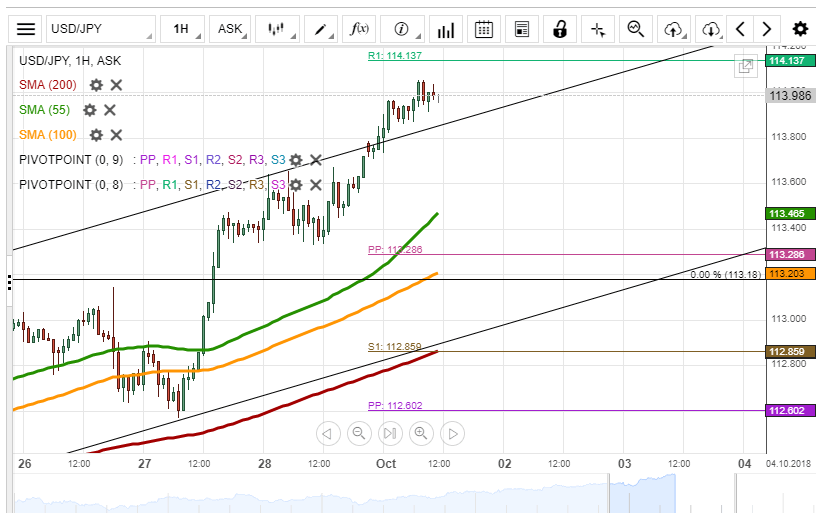
The US Dollar appreciated 0.66% against the Japanese Yen since Friday's session. On Monday, the US Dollar was located above the trend-line near the weekly R1 at the 113.98 mark.
In regards to the near future, the rate will surge to the weekly R1 at the 114.13 mark but should bounce off it due to its resistance. Most likely, the rate will move back to the pattern to trade at the 113.60 level during the day.
On the other hand, the might break the resistance of the weekly R1 at the 114.13 level to move upwards to the weekly R2 at the 114.56 mark.
XAU/USD Is Located At 1,185.00
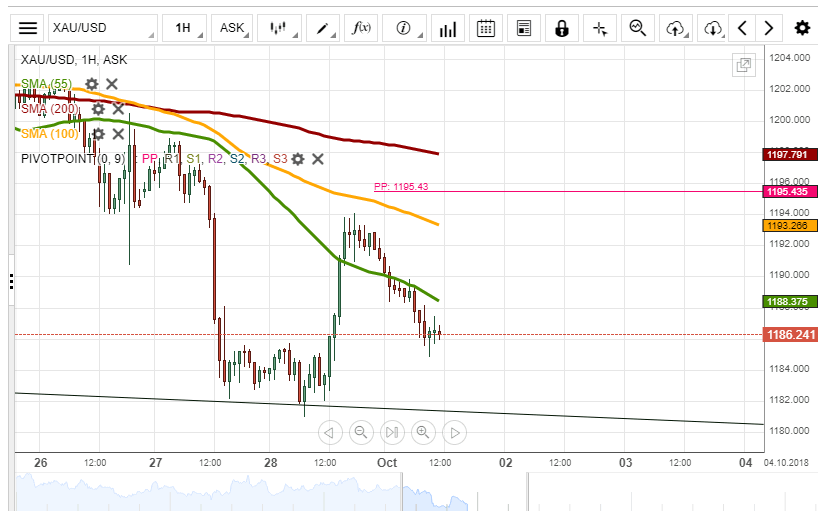
The gold price appreciated 0.19 % since Friday's trading session. On Monday, the yellow metal was located below the monthly pivot point at the 1,185.75mark.
In regards to the near-term future, most likely, the yellow metal will move downwards to the bottom boundary of the pattern due to the resistance of the 55-hour simple moving average. It seems that the rate will bounce off the pattern line to trade at the 1,182.00 level on Monday.
In addition, if the gold will pass the pattern line, most likely, the yellow metal will be stopped from the decrease by the monthly S1 at the 1,178.08 level.
EUR/JPY Remains Near 132.22
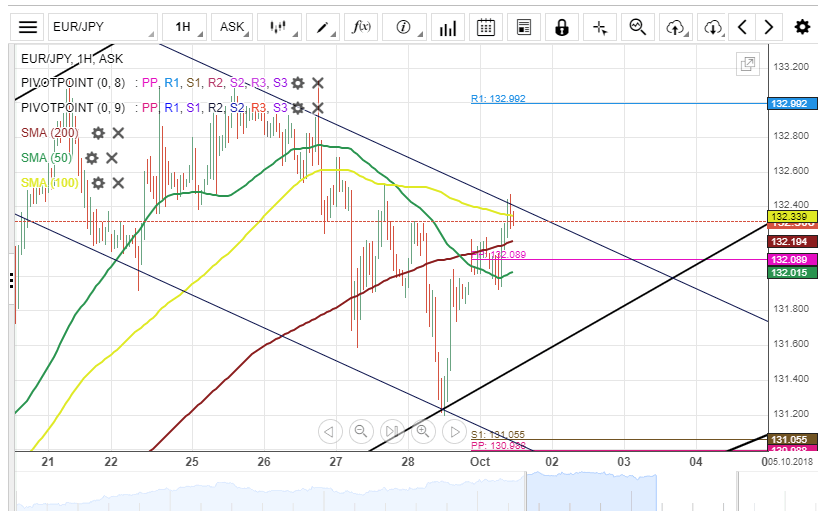
The common European currency appreciated about 100 pips against the Japanese Yen on Friday. The currency pair breached the 50– and 200-hour SMAs at 132.17 during the end of Friday's session.
The exchange rate was trading near the upper boundary of a descending channel at 132.35 during the first part of Monday's trading session and could be set for a breakout.
If the rate passes the 132.35 mark, the next target for the currency exchange rate will be near the weekly R1 at the 132.99.
However, technical indicator on the 4(H) time frame suggests that the surge might not be immediate.
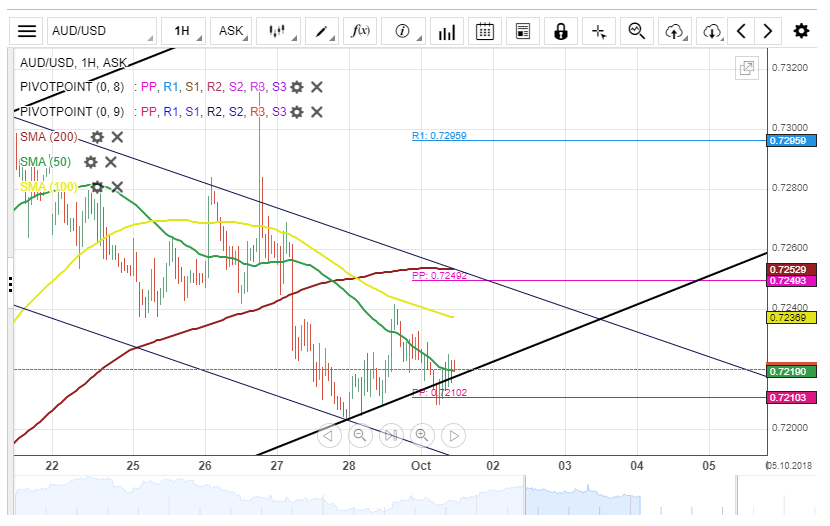
AUD/USD Breaches Weekly PP At 0.7210
The Australian Dollar has been trading in a one-week descending channel against the US Dollar.
The currency pair breached the lower boundary of an ascending channel and the weekly PP at 0.7210 during the first half of Monday's trading session.
If the AUD/USD exchange rate passes this support level, the next target for bearish traders will be the bottom border of the one-week descending channel pattern at 0.7173.
On the other hand, if the support line holds, the currency exchange rate could pullback towards the 100-hour simple moving average within this session.
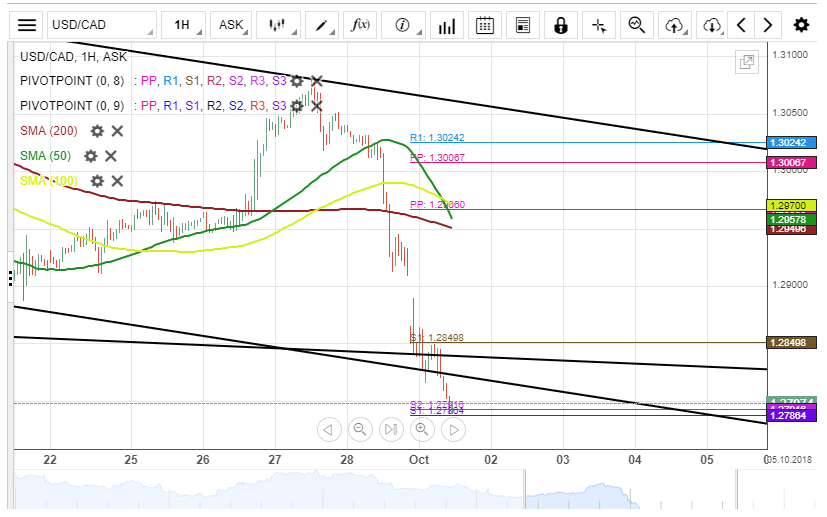
USD/CAD Nears Support Cluster At 1.2791
Downside risks prevailed in the market on Friday, thus sending the US Dollar to plunged by 200 base points against the Canadian Dollar.
Everything being equal, the decline of the currency pair could continue within this session until it reaches a support cluster formed by the weekly and the monthly pivot points at 1.2791.
If this support cluster holds, the currency exchange rate could make a brief retracement towards the 200-hour simple moving average at 1.2952 during the following trading session.
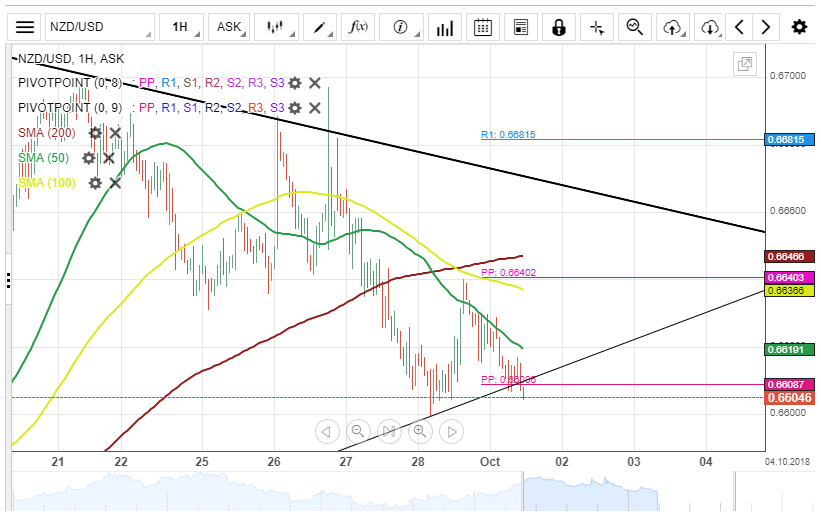
NZD/USD Tests Weekly PP At 0.6608
The decline of the NZD/USD currency pair has been guided by the 50-hour simple moving average.
Currently, the exchange rate is trading near the lower boundary of an ascending trend line at 0.6608. From a theoretical point of view, a pullback towards the 100-hour SMA at 0.6637 could be expected within this session.
However, technical indicators suggest that the currency exchange rate might continue its decline during today's session. The potential targets for bearish traders could be near the monthly S2 at 0.6558.
New Nafta Supports Loonie
Monday October 1: Five things the markets are talking about
Canada's loonie, the Mexican peso, along with North American stock futures have gained overnight after the U.S and Canada confirmed a deal to save the ‘old' Nafta, now named USMCA – United States, Mexico, Canada agreement.
In Asia, trading volumes were below normal overnight, with Labor Day in Australia, Hong Kong shut and China out through Oct. 7.
However, data from China over the weekend showed that the manufacturing sector weakened in September as domestic and export demand softened. Their manufacturing PMI reading fell to 50 – a strong reminder that the trade disputes are starting to have real consequences on China's economy.
In Japan, the tankan survey showed business confidence among Japan's big manufacturers has worsened in the September for the third quarter in a row.
Elsewhere, on the central bank front, the Reserve Bank of Australia (RBA) is expected to leave its monetary policy unchanged at +1.5% (Oct 2), while the Reserve Bank of India (RBI) is to potentially hike to support a weakening INR (Oct 4). Throughout the week, the final manufacturing and services PMI's for September will be posted.
North American employment data will close out the week with Friday's U.S non-farm payroll (NFP) and Canada jobs report (Oct 5).
1. Stocks mixed start
Emerging markets began Q4 in a mixed mood as signs of weakness in manufacturing activity in China limited the optimism from a revamped USMCA deal.
Japan's Nikkei share average rallied to a near three-decade high overnight, as an extended weakening in yen (¥114) helped improved export earnings for Japanese corporations. The Nikkei ended the day up +0.52%, its strongest since November 1991. The Nikkei has rallied +7% since the beginning of September, supported by the yen's depreciation and buying by foreign investors.
Note: The Bank of Japan's quarterly “tankan” survey of business sentiment showed big manufacturers saw the dollar averaging $107.40 yen for the 2018/2019 financial years.
Down-under, Aussie stocks slipped to their lowest close in a fortnight in a lightly traded session overnight as financial again slipped pressured by scathing interim findings of a high-profile inquiry into the sector. The S&P/ASX 200 index fell -0.6%. In S. Korea, the Kospi stock index fell on Monday, amid muted broader Asian peers, as foreign investors trimmed their equity exposure. The index was down -0.18%.
Note: Chinese markets were closed for a public holiday.
In Europe, Italy's FTSE MIB index has rallied +0.5%, regaining some of Friday's steep losses (-3.7%) on news that the country's anti-establishment government had widened its budget-deficit target.
U.S stocks are set to open deep in the ‘black' (+0.6%).
Indices: Stoxx50 +0.6% at 3,421, FTSE +0.1% at 7,520, DAX +0.7% at 12,335, CAC-40 +0.4% at 5,513, IBEX-35 +0.6% at 9,448, FTSE MIB 1.5% at 21,021, SMI +0.3% at 9,118, S&P 500 Futures +0.6%
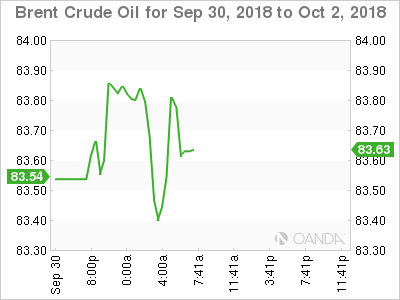
2. Brent oil hits four-year high ahead of Iran sanctions, gold lower
Oil prices have gained, with international benchmark Brent hitting a four-year high, as U.S sanctions on Tehran squeezed Iranian crude exports, tightening supply even as other key exporters increased production.
Note: Sanctions against Iran – will start targeting its oil sector from Nov. 4.
Brent crude oil futures are at +$83.09, up +36c, or +0.4% above Friday's close. U.S West Texas Intermediate (WTI) crude futures are up +19c, or +0.3%, at +$73.44 a barrel.
WTI is supported by Friday's report of a stagnant rig count in the U.S, which could suggest a slowdown in U.S crude production.
Over the weekend, it was reported that President Trump called Saudi Arabia's King Salman on Saturday to discuss ways to maintain sufficient supply once Iran's exports are hit by sanctions.
Note: It's expected that -1.5m bpd of Iranian oil is effectively going offline on Nov. 4.
Ahead of the open, gold prices have dipped as the ‘big' dollar firms against G10 pairs in the wake of indications from the Fed last week that it will pursue a tighter monetary policy – after hiking rates +25 bps, the Fed said it has planned for four more increases by the end of 2019 and another in 2020.
Spot gold is down -0.5% at +$1,186.29. On Friday, gold touched its lowest since Aug. 17 at +$1,180.34 an ounce. U.S gold futures have slipped -0.5% to +$1,190.60 an ounce.
3. Italian bond yields extend last week's rise on budget concerns
Italian bond yields have aggressively backed up this morning, extending last week's move, as a news report suggested Italy's budget proposal was to be rejected by the European Commission.
Italy's 2-year BTP bond yield has surged +18 bps to +1.23%, while the yield on its longer 10-year BTP bond was up +9 bps at +3.24%, while the premium investors demand for holding Italian paper over German Bunds is +274 bps, having been as tight as +225 bps last week.
Elsewhere, the yield on U.S 10-year Treasuries has climbed +1 bps to +3.07%, while the yield on the 2-year note increased +1 bps to +2.82%. Germany's 10-year Bund yield has gained +1 bps to +0.48%.
4. Dollar finds some traction, but risk back in vogue
With USMCA delivered, its no surprise to see the respected countries currencies strengthen a tad. The MXN has gained +0.9% to $18.548, the strongest in almost two-months and on the biggest rise in more than a fortnight. The CAD has climbed +0.75% to C$1.2800, the strongest in five-months.
The EUR (€1.1614) continues to be dogged by worries about a rise in Italy's fiscal deficit after the Italian government agreed to set a higher than expected budget deficit target that could put Italy on a collision course the European Commission.
The Japanese yen has fallen -0.2% to ¥114, the weakest in about 11-months.
5. U.K consumer borrowing rose last month
Data this morning showed that the U.K consumer borrowing on credit cards increased in August, suggesting another month of growth in spending.
Bank of England (BoE) data showed borrowing on credit cards and other unsecured forms of lending rose to +£1.1B from +£0.8B in July. The market was expecting a headline print of +£1.4B.
British consumer borrowing climbed, too, with banks lending +£4B to consumers in August, net of repayments, up from GBP3.8 billion in July, in a further signal of steady growth in household spending.
The number of new home loans approved by lenders in August also rose slightly compared with July, to +66,440.
Other European data showed that the final Eurozone manufacturing PMI's for September was revised slightly lower to 53.2 from 53.3 in the flash reading and down from 54.6 in August.
Markit highlighted that exports rose only slightly, which weighed on total orders growth as well as production, with global trade concerns pushing confidence down to a near three-year low.