Sample Category Title
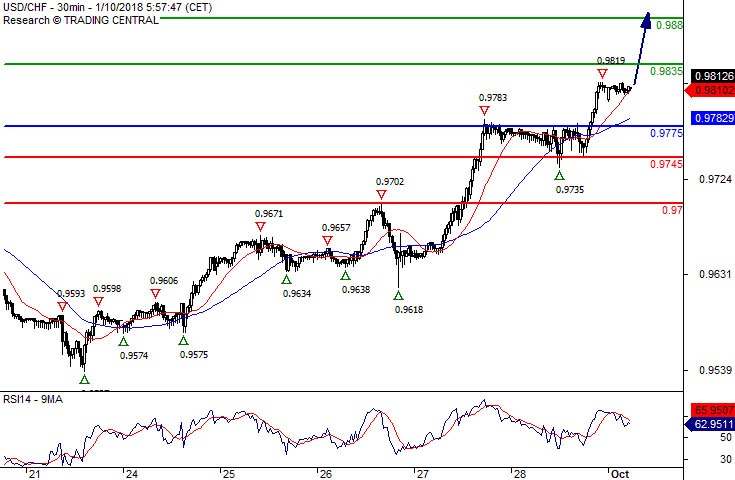
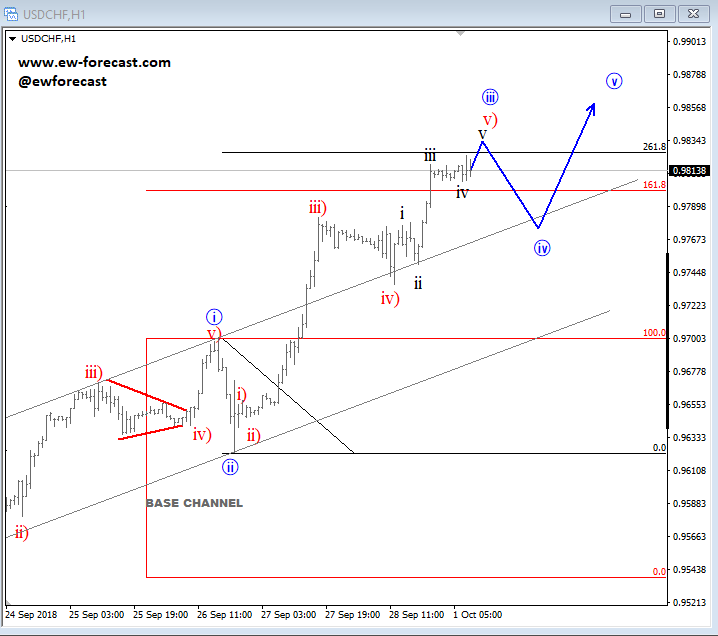
USD/CHF Aim @ 0.9880
Pivot (invalidation): 0.9775
Our preference Long positions above 0.9775 with targets at 0.9835 & 0.9880 in extension.
Alternative scenario Below 0.9775 look for further downside with 0.9745 & 0.9700 as targets.
Comment Technically the RSI is above its neutrality area at 50.
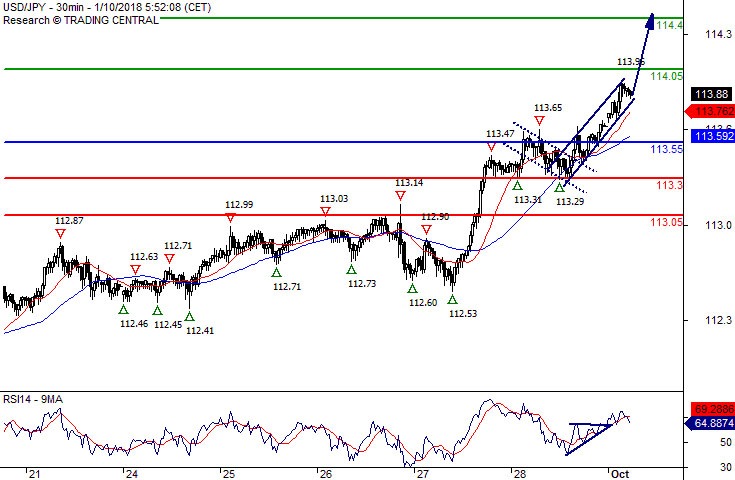
USD/JPY Further Advance
Pivot (invalidation): 113.55
Our preference Long positions above 113.55 with targets at 114.05 & 114.40 in extension.
Alternative scenario Below 113.55 look for further downside with 113.30 & 113.05 as targets.
Comment The RSI lacks downward momentum.
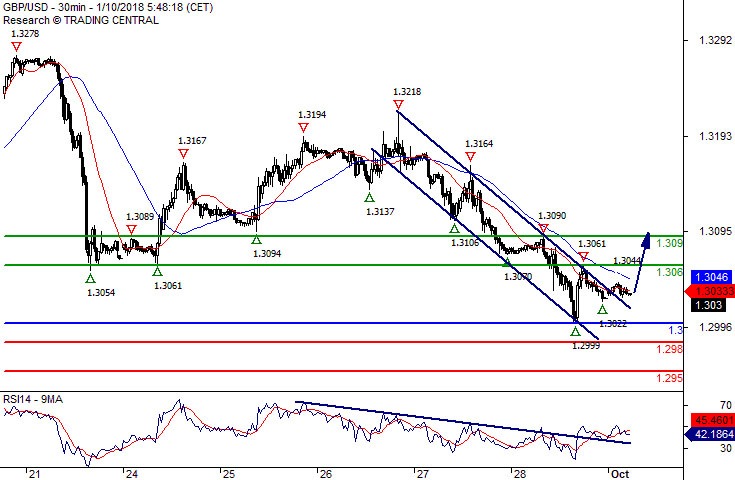
GBP/USD Bullish Bias Above 1.3000
Pivot (invalidation): 1.3000
Our preference Long positions above 1.3000 with targets at 1.3060 & 1.3090 in extension.
Alternative scenario Below 1.3000 look for further downside with 1.2980 & 1.2950 as targets.
Comment A support base at 1.3000 has formed and has allowed for a temporary stabilisation. Prepared
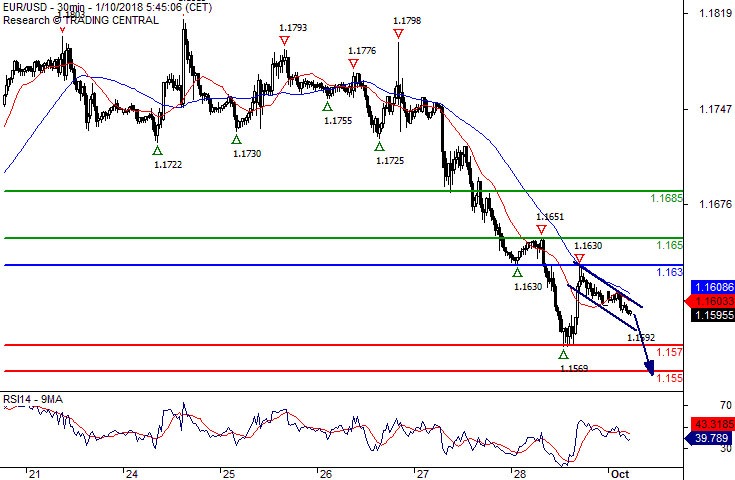
EUR/USD Turning Down
Pivot (invalidation): 1.1630
Our preference Short positions below 1.1630 with targets at 1.1570 & 1.1550 in extension.
Alternative scenario Above 1.1630 look for further upside with 1.1650 & 1.1685 as targets.
Comment The RSI calls for a new downleg.
USDCHF And EURUSD Correlation
USDCHF is testing short-term Fib. resistance levels highlighted on Friday, where prices can slow down, but only temporary for wave four, which can find a base at the upper trendline of base channel; similar like red wave iv) of a lesser degree.
USDCHF, 1h
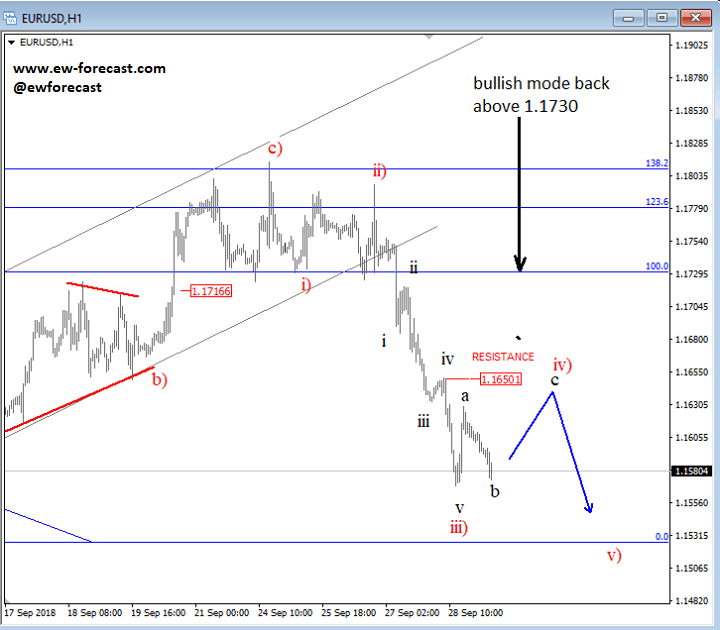
If USDCHF is going to see more upside after a set-back, then EURUSD will also remain in current decline of an impulsive wave c of B which can be headed to 1.1500/1.1530 area. However, be aware of 1.1650 resistance that can be tested within current wave four before fifth wave sell-off comes in.
EURUSD, 1h
UK Hammond: Chequers plan offer in-the-middle, down the center solution for Brexit
UK Chancellor of the Exchequer Philip Hammond talked about Brexit negotiation in a BBC TV interview. He said "the mood is undoubtedly that people want to do a deal with the UK. People want to minimize the disruption of the UK's departure from the European Union, they want to continue having a relationship with us and smooth trading partnership in the future."
But he also admitted "Clearly there has been a hit to the economy through the uncertainty the Brexit process has caused. Many businesses are sitting on their hands frankly waiting to see what the outcome of this negotiation is before confirming their investment plans."
He also defended Prime Minister Theresa May's Chequers plan and said "What Chequers does is offer an in-the-middle solution, down the center, taking the best from both models, and proposing a way forward which delivers on the mandate of the British people in the referendum but also protects British jobs and British businesses,"
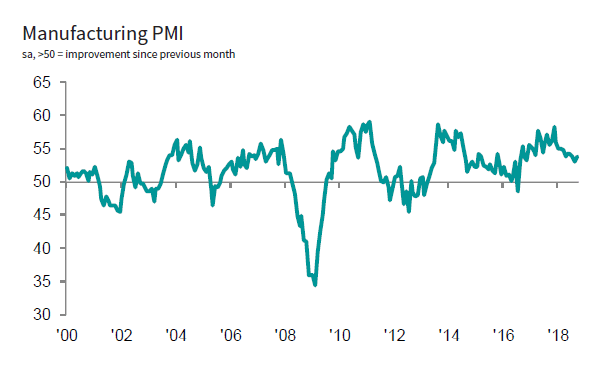
UK PMI manufacturing rose to 53.8, conditions still relatively lacklustre overall
UK PMI manufacturing rose to 53.8 in September, up from 53.0 and matched expectations. Keying findings showed "output and new order growth both accelerate", "input cost and output charge inflation strengthen".
Rob Dobson, Director at IHS Markit, which compiles the survey:
"September saw a mild improvement in the performance of the UK manufacturing sector. Domestic market demand strengthened, while increased orders from North America and Europe helped new export business stage a modest recovery from August's contraction. Business confidence also rose to a three month high.
"Despite these causes for short-term optimism, conditions in manufacturing are still relatively lacklustre overall. Based on its historical relationship with official ONS data, the latest survey is consistent with output expanding at only a moderate pace. Although total exports rose, exports of goods used as inputs by other manufacturers fell for the third straight month, ending the worst quarter for over three years for such exporters, suggesting that foreign companies may be sourcing less from UK-based component suppliers.
"Many UK manufacturers also noted that the backdrop of Brexit and a volatile exchange rate were making any forecasting activity increasingly difficult, with uncertainty adding to reluctance to hire. Headcounts fell at larger companies for a second successive month.
"On the price front, both output charges and input costs rose at faster rates in September, which may exert further upward pressure on consumer prices in future."
Also from UK, mortgage approvals rose to 66k in August. M4 money supply rose 0.2% mom in August.
Eurozone PMI manufacturing finalized at 53.2, export-led slowdowns clearly evident in Germany, France, Italy, Spain and Austria
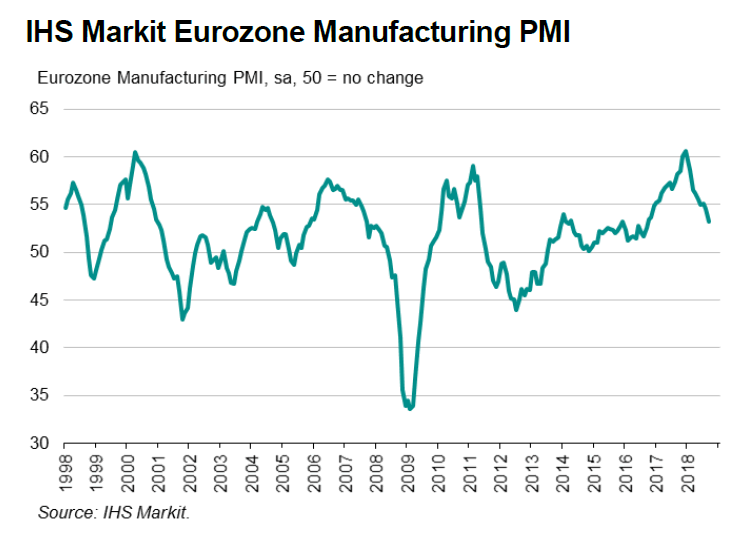
Eurozone PMI manufacturing was finalized at 53.2 in September, revised down from down from August's 54.6. Key findings are "exports rise only slightly, weighing on growth of total orders and production", and, "global trade concerns push confidence down to near three-year low".
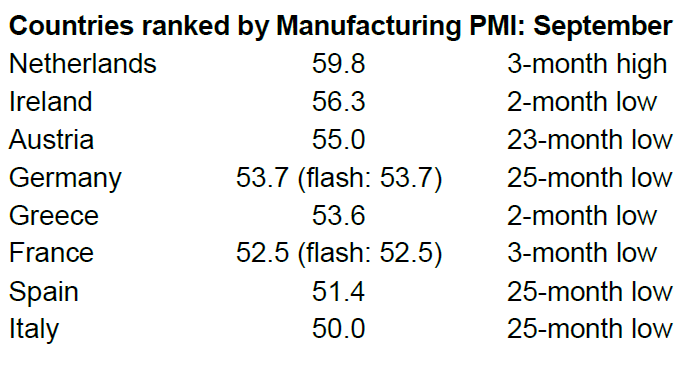
Among the countries, German PMI manufacturing was finalized at 25-month low at 53.7. Austria PMI manufacturing dropped to 23-month low at 55.0. Spain reading dropped to 51.4, 25-month low. Italy reading dropped to 50.0, 25-month low.
Commenting on the final Manufacturing PMI data, Chris Williamson, Chief Business Economist at IHS Markit said:
"Eurozone manufacturing shifted down yet another gear at the end of the third quarter. The sector has seen booming growth at the start of the year rapidly fade to the worst performance for two years in September as production and jobs growth have slowed in response to a stalling of export trade.
"The survey paints the worst trade picture for over five years, with export growth having slumped sharply from a series record high in late 2017 to near-stagnation in September.
"The slowdown can be linked to sluggish demand and increased risk aversion among customers, often linked to worries about trade wars and tariffs, but also ascribed to rising political uncertainty and higher prices.
"Forward-looking survey indicators suggest the worst is yet to come: optimism about the year ahead is close to a three-year low, inflows of new orders and input buying are the weakest for over two years and backlogs of work are dropping for the first time in over three years.
"Production also continues to run ahead of order book growth, which is a key sign that output and jobs growth will be reined-in further as we move into the fourth quarter unless demand revives.
"Export-led slowdowns are clearly evident in Germany, France, Italy, Spain and Austria, but the weakening picture is by no means universal, with the Netherlands and Ireland being notable in continuing to report strong growth of both output and exports."
Also from Eurozone, unemployment rate dropped to 8.1% in August, below expectation of 8.2%.
GBPUSD: Pound Can Crash If Hard-Brexit Fears Loom
It is no surprise the Brexit newsflow continues to dictate sudden fluctuations in the British Pound. Although what is surprising is that despite there being less than six months remaining before the United Kingdom is scheduled to leave the European Union with minimal confidence a Brexit deal is close, investors still refuse to price into expectations that there is a potential eventuality of a hard-Brexit.
The British Pound trading close to 1.32 at time of writing provides memories of recent history where investors have been caught off-guard by political risk events. The historic outcome of the EU referendum springs to mind as an example of this and with the clock ticking fast until the deadline for a Brexit deal, investors should be more aware of potential downside risks to the Pound.
At the moment, investors seem to be content with optimism that a Brexit agreement will eventually be struck. I think we just need to look at the events following the recent meeting in Salzburg and the defiant comments made by UK Prime Minister Theresa May after the summit to recognize that any optimism that a deal is close should be faint.
Even if a breakthrough in Brexit negotiations is eventually struck, the upside potential in the British Pound is limited to around 5%. This is low in comparison to how fast the Pound could crash if a hard-Brexit is the eventual outcome. The Pound is at risk to crashing back down to the lower 1.20’s if investors become frightened over a hard-Brexit.
There are no shortages of reasons for investors to hold negative views on the British Pound. The assertive comments from Theresa May following the failed Salzburg meeting that no a Brexit deal is better than a bad deal heavily highlights how strained UK and EU relations have become during the long-winded negotiations. The EU is obviously not wanting to provide UK officials with any favors to prevent other populist parties around Europe gaining encouragement from leniency shown towards the UK, suggesting that Theresa May will continue to struggle against EU officials.
What is also not supporting Theresa May in her quest to secure a Brexit deal that is fair for those who voted to leave the EU two years ago is the ongoing and relentless speculation over her position remaining at threat to a potential leadership challenge. Reports over another potential UK election refuse to go away and investors need to see stability with leadership positions at a time where it is common knowledge that the UK will go through a period of uncertainty. The potential for a hostile Tory Party Conference for Theresa May in early October might provide encouragement for investors to take profit on Pound positions.
All of the above doesn’t mean that there is no positive news out there for the Pound. The problem with current valuations is that investors are not positioned, or prepared at all for a potential hardBrexit shock. Positive news for the Pound includes the continuation of UK economic data defying worrying forecasts of what the outcome for the UK economy would be following the EU referendum shock, and the probability that the Bank of England will remain ahead of the European Central Bank and Bank of Japan (when it comes to providing guidance on the possibility of higher interest rates.
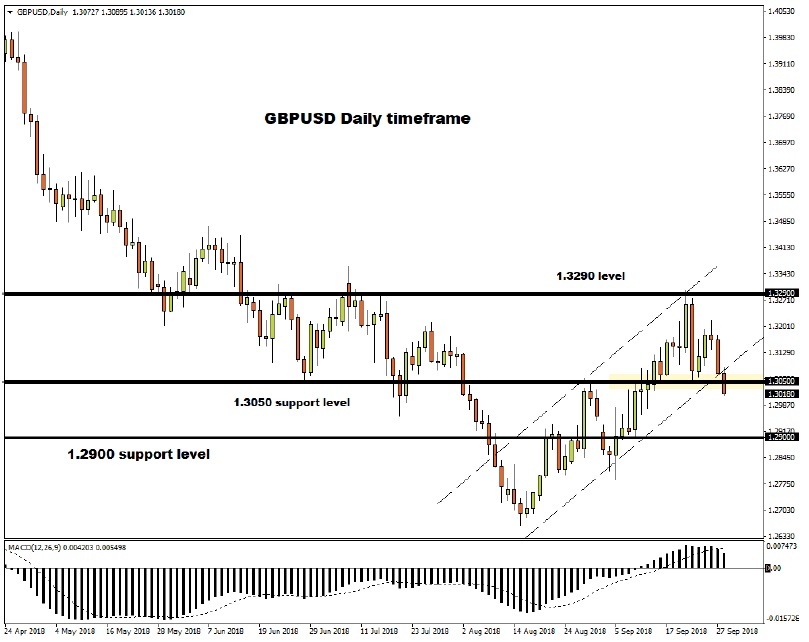
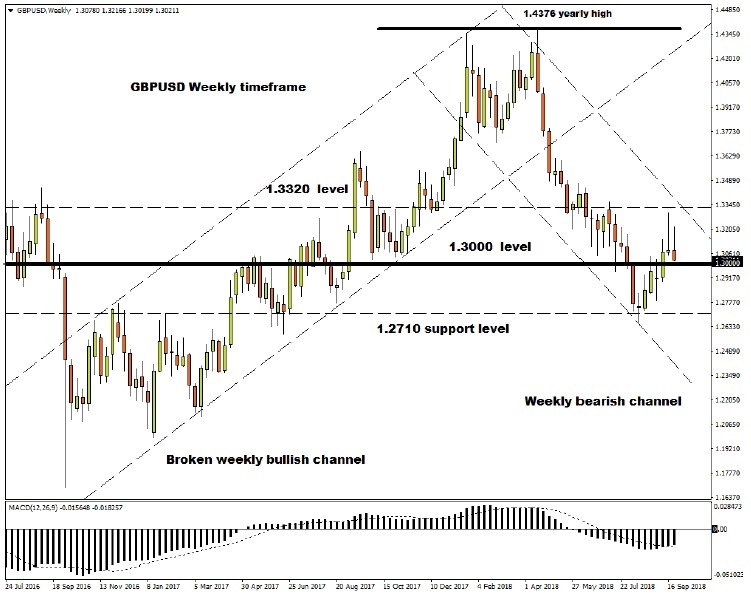
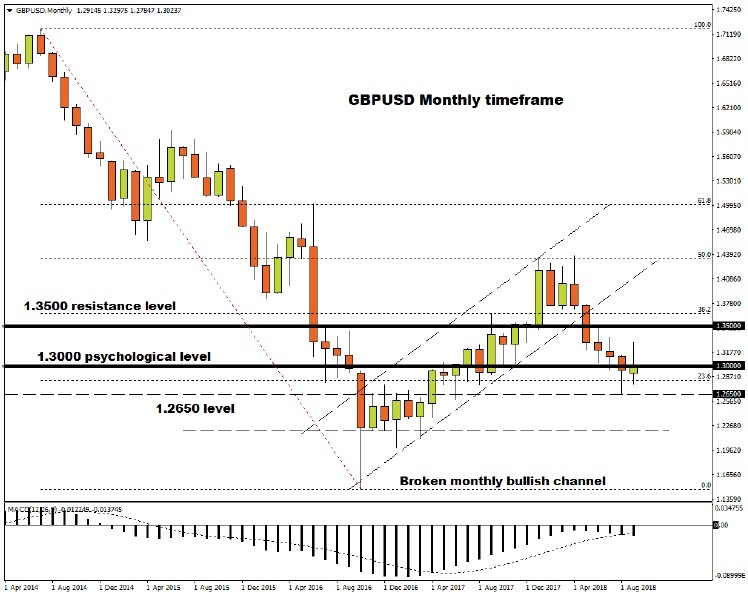
The technical outlook for the GBPUSD is somewhat conflicted by how suddenly the Pound can shift in direction due to sensitivity around Brexit newsflow.
1.30 in the GBPUSD will continue to act as a strong psychological level for investors. Ambitious investors might continue to use the 1.30 level in the Pound to drive the currency towards 1.32/1.33. The pair would need to conclude above 1.33 on a monthly basis to instill confidence that the GBPUSD can rally above 1.35 on a Brexit agreement outcome.
Otherwise, and while Brexit uncertainty remains, selling rallies in the British Pound will be tempting for investors. A technical close below 1.30 would signal the potential for further declines in the Cable.
USDJPY: Concerns Trump Administration Will Target Japan Next With Trade Rhetoric
The USDJPY unexpectedly challenged 2018 highs above 113 towards the end of September, in spite of the Dollar index declining towards its lowest level in three months during the same period and as emerging markets remain rattled by external uncertainties leading to fears that some are suffering from a currency crisis.
This shift in weakness for the Japanese Yen didn’t get the attention it deserves in the headlines due to the ongoing focus around global external uncertainties, but it is a significant surprise that the Yen dropped to milestone lows at a time when you would usually expect the Yen to remain as a safe-haven asset for investors.
I do not think the trend of Yen weakness is a deliberate measure from officials in Japan, because the Dollar has also clobbered the Swiss Franc and Gold during the same period of Yen weakness. It would not be a surprise if investors are proactively selling the Yen on concerns that Japan could be the next target of President Trump for trade tariffs. Reports have circulated since early September that the Trump Administration is considering directing the trade rhetoric towards Japan while Washington remains in deadlock with Beijing around the same narrative, and that President Trump might have used the recent visit of Japanese Prime Minister Shinzo Abe to the United States as an opportunity to push the trade agenda.
From the aspect of the Bank of Japan, policymakers are likely to be content to see an emerging trend of Yen weakness because it has been widely speculated that officials would prefer to see the return of a weaker Yen. Hesitance from the Japanese central bank to lift the monetary policy outlook for anticipation of higher Japanese interest rates over the long-term remains a pull towards maintaining a negative bias on the Yen over the longer-run.However, I would keep an eye on whether the safe-haven appeal for the Yen could return in the lead up to the U.S. mid-term elections in November.
We have seen time and time again in recent history, and specifically when there is market uncertainty around political risk, that investors are incredibly loyal to the Japanese Yen, and I am not buying into the near-term price action suggesting that the Yen has lost its safe-haven status.
Loyal investors of the Yen might also consider potential selling positions when the USDJPY rallies. I would expect the Yen to fluctuate if the Trump Administration redirects attention later down the road towards talking down Greenback strength.
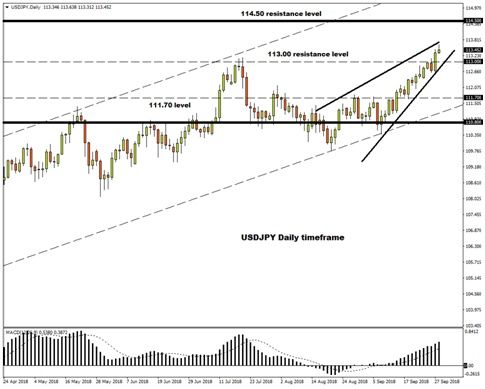
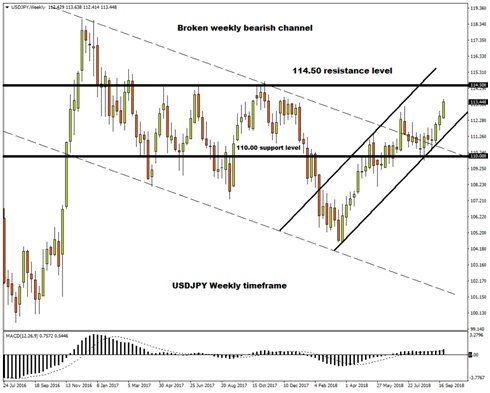
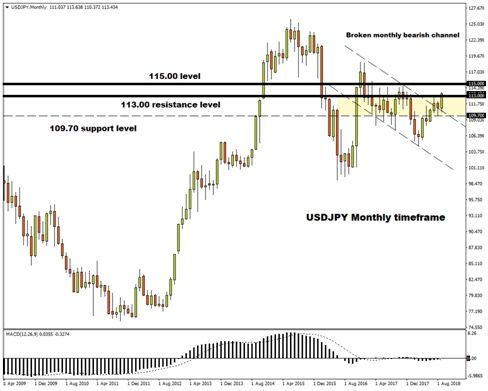
The technical outlook suggests that 113 in the USDJPY remains as a key point of interest for traders. I would personally like to see the pair close above this level on a monthly basis, to buy into the trend that more Yen weakness is upon us. The weekly timeframe also suggests that 113 in the USDJPY will continue to act as a barrier to prevent the pair from extending even higher in the short-run.
Ambitious USDJPY investors might overall be tempted to price in an eventual return to 115 in the pair if the USDJPY can conclude above 113 on a monthly basis.
November will likely provide the heaviest round of political risk in financial markets this year, considering that this is when the US mid-term elections will take place.
If the USD sells off on comments from the Trump Administration that the Dollar is too strongly valued, or that the outcome of the mid-term elections might provide a stumbling block to President Trump implementing his America First agenda, this is where investors will likely consider bearish positions in the USDJPY.