Sample Category Title
AUDUSD: Navigated By Global Trade Tensions
The drivers behind the Australian Dollar's rocky depreciation during Q3 mostly revolved around ongoing global trade disputes and widening interest rate differentials in the United States.
Market fears were elevated over a tit-for-tat tariff battle between the U.S. and China adversely impacting global growth, emerging markets and export-dependent nations. With China accounting for almost a third of Australia's exports, any possible slowdown in economic momentum represents a threat to demand for Australian commodities. While trade tensions were a significant drag on the Aussie, rising interest rates elsewhere compounded to downside pressures. With the Federal Reserve on a path towards gradually normalizing monetary policy and the Reserve Bank of Australia (RBA) maintaining a “wait and see” approach, the AUD remains a victim of widening interest rate differentials.
As we head into the final trading quarter of 2018, the Australian Dollar is likely to remain impacted by global trade developments, the Dollar's performance, monetary policy and commodity prices.
The AUD remains at threat of depreciating further if escalating U.S.-China trade tensions transform into a full-blown trade war. Such an unfavorable development may trigger global risk aversion, punish export reliant nations and pressure commodity prices – all of these are negative for the Australian Dollar. While the domestic conditions in Australia have improved with growth expanding at the fastest pace in 6 years during Q2 at an annualized 3.4%, the nation still remains in the firing line of trade disputes. With anemic wage growth and subdued inflation at home providing a solid argument for the RBA to leave interest rates unchanged at the record low of 1.50%, the Australian Dollar's outlook points to further downside.
With Australia being the world's second largest producer of Gold, investors should keep a close eye on the yellow metal which tends to be positively correlated with the Australian Dollar. The past few trading months have certainly not been kind to Gold prices and this may impact the Australian economy during the final trading quarter of 2018. With the zero-yielding metal currently entangled in a losing battle against the Dollar and Fed hike expectations, the Australian Dollar seems to be instore for more pain and punishment down the road.
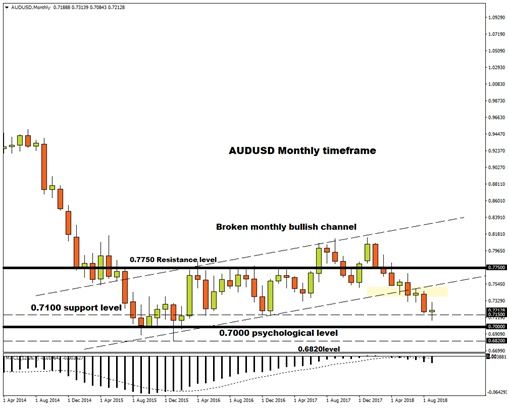
In regards to the technical picture, the AUDUSD respected a bearish trend during the final trading quarter of 2018 with prices sinking to levels not seen in over two years below 0.7100. With the Aussie's weakness the product of trade tensions, widening interest rate differentials and falling Gold prices, the AUDUSD remains bearish fundamentally. A monthly close under 0.7150 could inspire a decline towards the 0.7000 psychological level and possibly 0.6820.
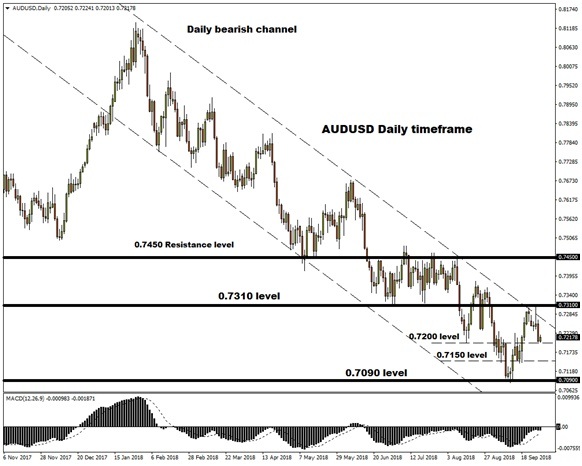
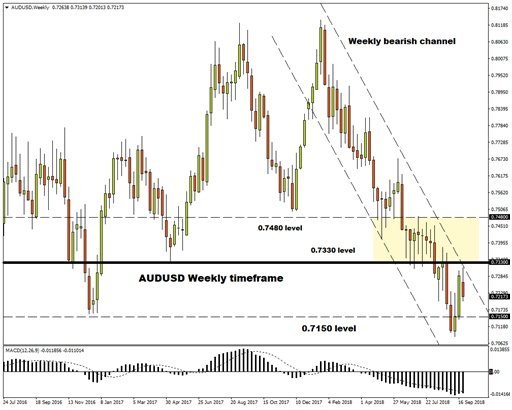
There have been consistently lower lows and lower highs on the weekly charts while the MACD remains firmly planted to the downside. For as long as the AUDUSD is unable to break back above the 0.7330 level, prices could challenge 0.7150 and 0.7000, respectively. Zooming into the daily timeframe, the AUDUSD experienced a technical rebound towards the 0.7310 region before bears dived back in to send prices lower. A solid daily close below 0.7200 could be the catalyst needed for a further selloff towards 0.7150. If the downside momentum shows no signs of cooling, prices are likely to test 0.7090. In an alternative scenario, a breakout back above 0.7450 needs to be achieved to invalidate the current bearish setup.
Gold: Fortunes Hang On Dollar’s Performance
Gold has repeatedly failed to live up to its title as a safe-haven asset for investors despite ongoing global trade tensions and chaos across emerging markets weakening risk sentiment.
The rising interest rate environment, robust U.S. economic growth and bullish equity markets in the United States are just a handful of many themes that have offered nothing but pain to Gold. With the high opportunity cost of holding the zero-yielding metal a leading factor behind weak appetite, prices tumbled roughly 4.9% during the third trading quarter. However, the major culprit behind Gold's painful downfall remains a broadly stronger Dollar and this continues to be reflected in price action.
As we head into the final quarter of 2018, investors may continue shunning Gold in favour of the Dollar, which has become the go-to-currency in times of global trade uncertainty. The Greenback has already stolen a fair chunk of Gold's safe-haven allure this year amid the bullish sentiment towards the U.S. economy. It seems investors remain with the belief that robust economic growth could shield the United States from negative impacts of global trade risks, supporting the Dollar into a destination of safety for investors.
Ongoing developments across emerging markets will play an important role in where the precious metal concludes this year. Emerging markets are the biggest consumers of physical Gold and with their currencies hammered in recent months by an appreciating Dollar, this could weaken purchasing power. A drop in purchasing power is very bad news for Gold and is likely to compound the metal's pain. Investors will also keep a close eye on the looming mid-term elections in November for any potential shifts in trade policy rhetoric which could impact Dollar sentiment.
Gold's short- to medium-term outlook will remain heavily influenced by the Dollar's performance, rate hike speculation and emerging market developments. The longer-term view will depend on how intense global trade tensions become. If trade disputes reach a dangerous tipping point and transform into a full-blown tit-for-tat trade war, Gold could find itself back in fashion.
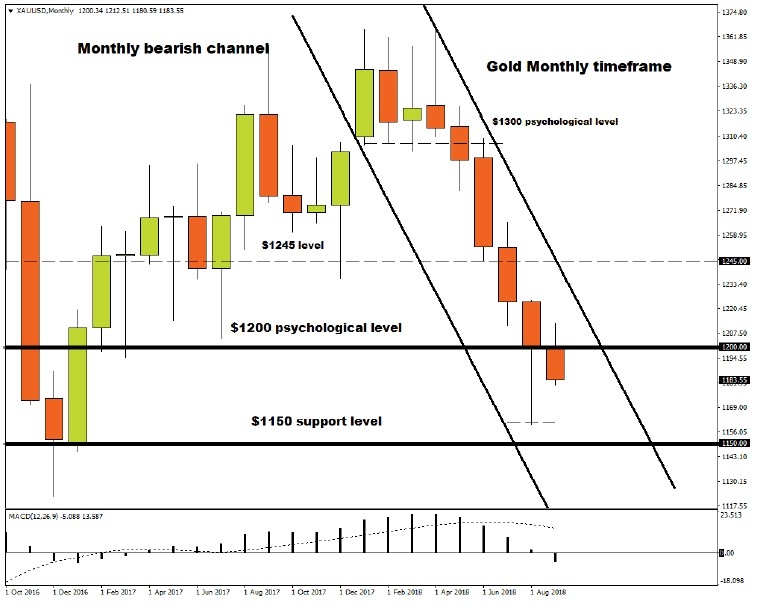
Focusing purely on the technical outlook, Gold remains depressed and unloved on the monthly timeframe with prices trading within a bearish channel. There have been consistently lower lows and lower highs created since prices tumbled below the $1,300 psychological level back in May 2018. With the metal poised to conclude the third trading quarter of 2018 under the $1,200 psychological level, bears remain in firm control. Previous monthly support is likely to transform into a dynamic resistance that encourages a decline towards $1,160 and $1,150, respectively.
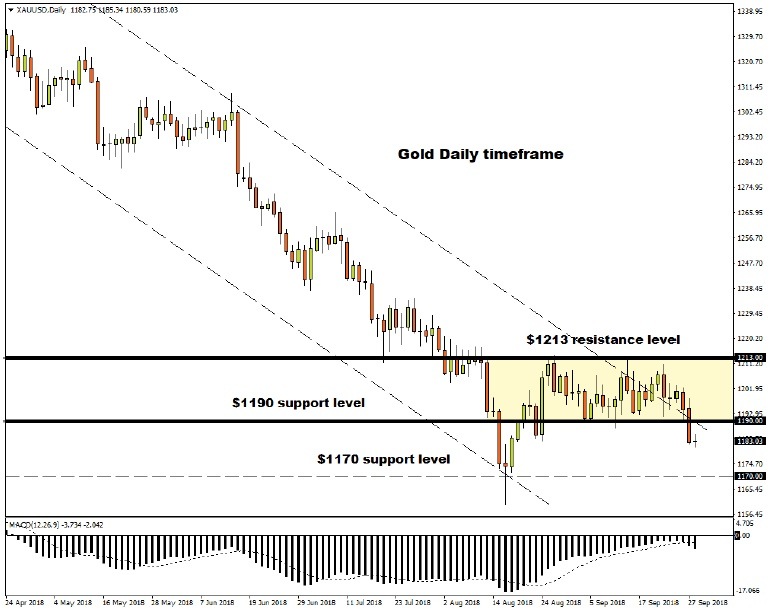
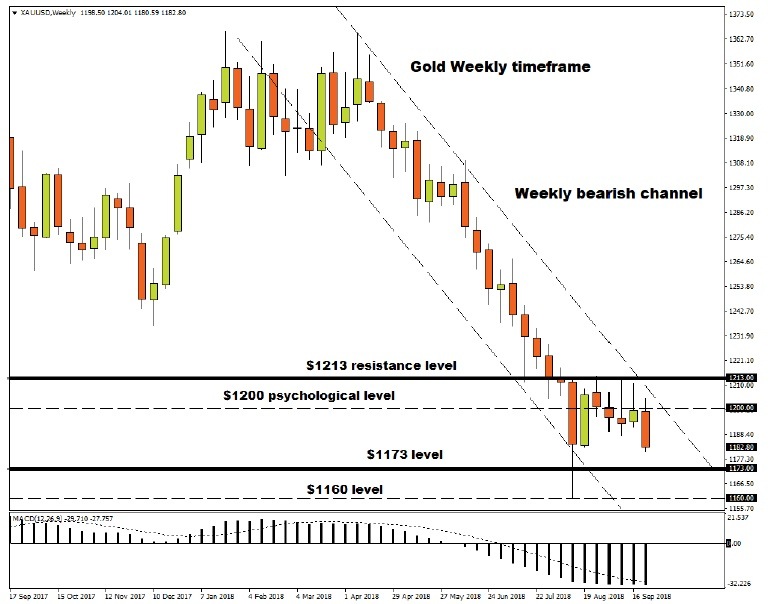
The weekly charts illustrate a similar bearish picture with $1,213 proving very stubborn resistance. Sustained weakness below the $1,200 psychological level could inspire bears to challenge $1,173 and $1,160. Daily traders may interpret the breakdown below $1,190 support as a signal for further downside with $1,170 acting as a magnetic point. For bulls to jump back into the game prices need to break back above $1,190 and $1,213.
Quarterly Market Outlook 2018 – Q4
Trumponomics, the Federal Reserve, emerging markets turmoil, Oil prices, and Brexit negotiations were the biggest drivers of financial markets throughout the third quarter of 2018. These factors will continue to dominate the markets for the remaining quarter of the year, along with the upcoming U.S. mid-term elections as a potential shift in the balance of power could impact Trump’s ability to govern.
U.S. equity markets outperformed the rest of the world so far this year, but many warning signals are starting to flash red. The U.S. economy is clearly in the late stage of the current economic cycle, but there are no signs of a recession yet. Valuations are overstretched compared to historic norms, and the Federal Reserve is expected to raise rates four times until the end of 2019. Given that U.S. equity markets seem to be priced for perfection, any negative surprises have the potential to end the longest bull market in history.
In the currency markets, the Dollar’s exchange rate has attracted much attention throughout the past several months, especially against EM currencies where many of them fell to record or multiyear lows.
The Argentine Peso holds the title of the worst performing currency in 2018, having lost more than half its value since the beginning of the year. The Turkish Lira comes second, with more than a third of its value erased. While the South African Rand, Indian Rupee and Russian Ruble fell less significantly, they have still lost more than 10% so far.
Many of these economies face one or a combination of substantial current account deficits, external imbalances, shortages in FX reserves and political risks that led the currency to the selling wave. However, the Dollar also appreciated against its major counterparts, especially commodity currencies. With the Federal Reserve continuing to tighten policy faster than the rest of the world, the short-term outlook remains in favor of a stronger Dollar. This upward trend will likely start fading when other major central banks follow the path of the Fed, especially when factoring in that most currencies are undervalued in terms of purchase power parity.
Sterling will likely be the most interesting currency to trade in the final quarter of 2018. While a no-deal Brexit could see the Pound falling 10%, the opposite case scenario has the potential to boost the currency by 5% or more. The Salzburg summit suggested that lots of work still needs to be done in order to achieve a withdrawal agreement. By late October or early November, the UK’s future relationship with the EU should become clear, and every headline related to the negotiations will be remain a trading opportunity. In the next quarter, keep a close eye on U.S. politics, trade developments, Brexit negotiations, and Oil prices. These factors will tell us all what we need for trading in Q4 2018. Here’s our outlook for the coming three months:
EURUSD: Investors Not Quite Ready To Pull Trigger On Rally
The longer-term outlook is that the Euro remains undervalued against the Dollar at its current level of around 1.15 at time of writing, and that these remain attractive valuations to consider purchasing the EU currency in the long run. However, investors want clear guidance from the European Central Bank (ECB) on when it will potentially raise EU interest rates to pull the trigger on a potential EURUSD rally.With the ECB more likely than not going to mirror memories of previous Federal Reserve Chair Janet Yellen and the Fed from 2015 by taking as much time as possible before finally raising interest rates, this is going to make investors hesitant to jump on potential EURUSD trade for a while yet.
I personally do not think the ECB and President Mario Draghi will be in a confident enough position to prepare investors for an eventual increase in EU interest rates until the end of the year, at the earliest. Expectations that the ECB will be lifting interest rates away from their record low levels by the second half of 2019 are premature as they stand. An increase in EU interest rates as we edge closer to the end of the current decade is by far the more likely scenario. This ultimately means that investors might not be prepared to consider adding material Euro purchasing positions into their portfolios until the end of the year, at least when it comes to optimism over ECB monetary policy.
Downside risk for the Euro over the rise of populist parties in Europe and headlines over the financial health of Italy will remain, but these are also not new headlines and are something that investors will need to closely monitor instead.
With it in mind that the ECB will be taking all the time it needs before providing confident signals that policymakers will be ready to raise interest rates before the end of 2019, investors will likely be looking for rounds of weakness in the USD for a jump in the Euro. This is exactly where matters get interesting for Euro bulls, because there are reasons to carry a negative view on the Greenback heading into Q4.
U.S. interest rate expectations for at least the remainder of 2018 have been priced into the U.S. Dollar a long time ago. This weakens the monetary policy divergence that contributed to the EURUSD decline earlier this year. When you also consider the likelihood of the Trump Administration stepping up the narrative on the Greenback being too strong along with comments on U.S. monetary policy from Trump – you do have reasons to develop a negative view on the Greenback.
There are alsothe massive US mid-term elections in early November that will easily be seen as the biggest political risk event for financial markets in 2018,which supports the Euro outperforming expectations if the Greenback declines on election uncertainty. Investors do not appear to have yet factored inU.S. mid-term elections into valuations, and there might be a frantic frenzy of profit-taking on the Greenback around the November event.
We have seen time and time again in the past how suddenly the Euro can rally to the upside when there is a round of investors unwinding USD positions.This is why we can’t rule out a potential EURUSD recovery before the end of the year.
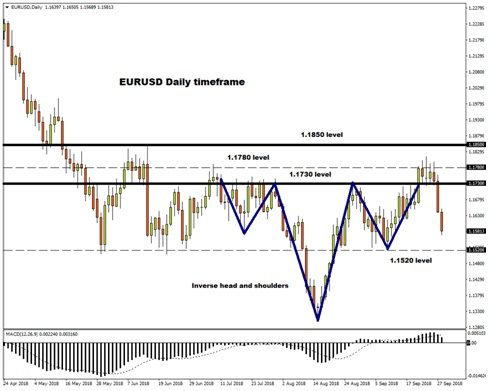
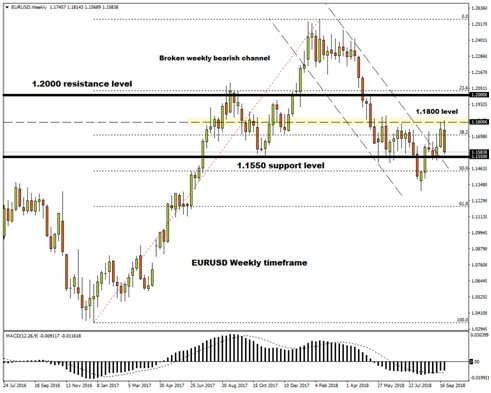
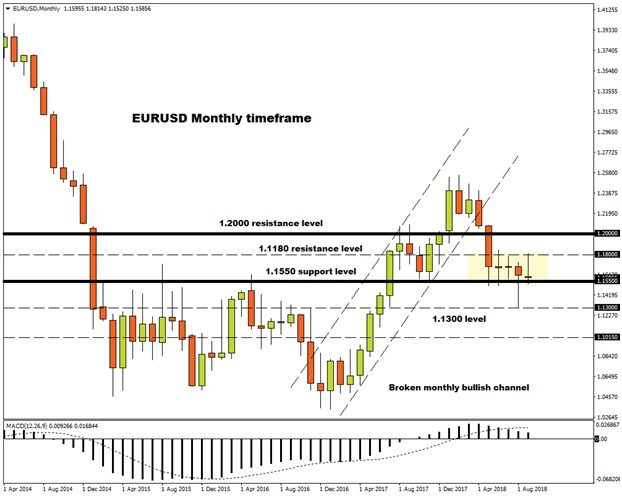
The current technical outlook in the Eurodollar suggests that the pair is facing a wall of technical resistance at 1.18, and the EURUSD will need to push above this level on at least a weekly basis for investors to price in a return to 1.20 in the Euro. 1.13/1.14 looks like a potential psychological bottom in the Eurodollar over the medium term and it would probably require intense concerns over the health of the financial system in Italy to push the Euro lower than this.
Ultimately what investors might be more encouraged to consider is temptation to buy the Euro on dips.This is overall probably the most difficult outlook to provide for the final quarter, but if I were to pick a side then I would favour the longer-term view that the Euro should beappropriately valued much higher than its current levels.
XAUUSD Intraday Analysis
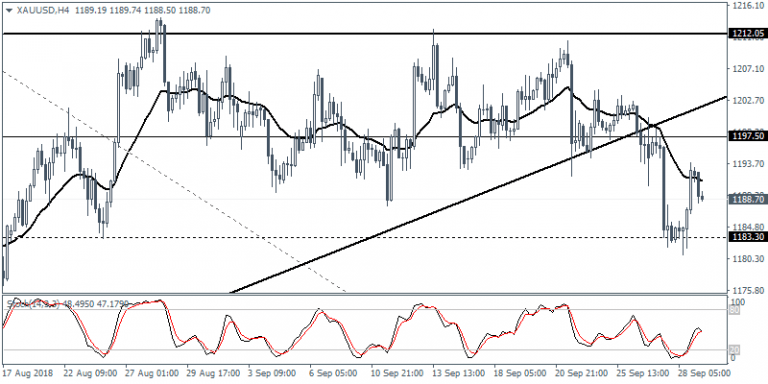
XAUUSD (1188.70): Gold prices managed to rebound after falling to the support level of 1183.30. However, the resistance level at 1197.50 remains a key level to breach. We expect gold prices to maintain a range within the said levels with a breakout from this level suggesting the near term direction in prices. The bias remains flat for the moment but the risk of a downside breakout is rising.
GBPUSD Intraday Analysis
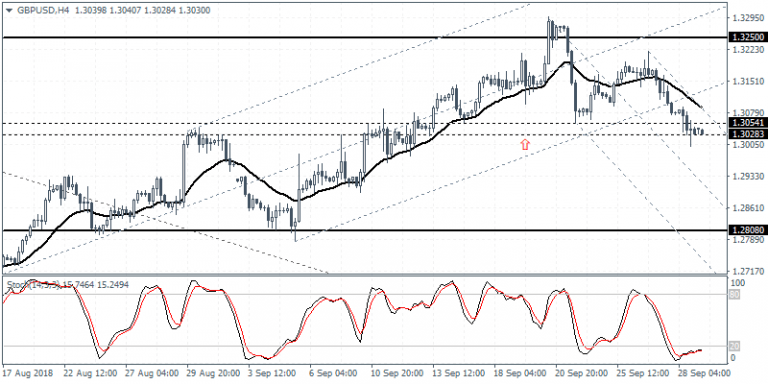
GBPUSD (1.3030): The GBPUSD currency pair tested the support at 1.3028 by Friday's close. As expected, the support level seems to be holding for now. We could expect some consolidation taking place at this level in the near term. A potential break down below this support could push GBPUSD lower toward the 1.2808 level of support. However, we expect to see a modest rebound in price action taking place.
EURUSD Intraday Analysis
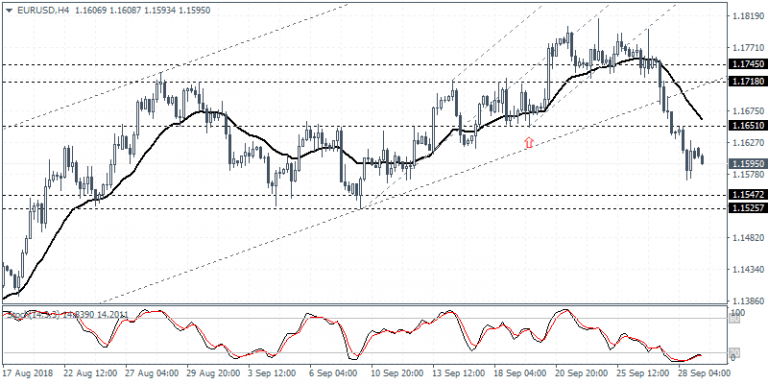
EURUSD (1.1595): The EURUSD currency pair extended strong declines on the last trading day of the month in September. Price action however pulled back just a few pip shy from the 1.5400 level of support. In the short term, the support level at 1.1547 - 1.1525 remains the next level of interest. A rebound off this level could push the EURUSD to the upside. Resistance is seen at 1.1651 level which could be tested in the near term. Further gains could extend the rally toward the previously breached support area of 1.1745 - 1.1715 where resistance could be formed.
The U.S. Economy Was On Track To Keeping The 4% GDP Growth
The U.S. dollar closed with modest gains ending the month of September on a high note. Solid economic data continued to suggest that the U.S. economy was on track to keeping the 4% GDP growth. The euro continued its decline led by concerns from Italy.
The Italian government passed a budget with deficit higher than the EU’s limit. This is expected to cause some friction between the governments in Rome and Brussels.
The markets open to a new trading month. Data from Japan showed that the Tankan manufacturing index fell to 19 while the non-manufacturing index fell to 22.
The European trading session will see the release of the monthly manufacturing and services PMI numbers. Activity in the sectors is expected to remain broadly unchanged from the previous month.
The monthly unemployment rate from the EU is expected to show a decline to 8.1% from 8.2% previously.
The UK will be releasing its monthly manufacturing PMI for September. The median forecasts put the index to ease to 52.5 from 52.8 previously.
In the NY trading session, data will start with Markit's final manufacturing PMI followed by the ISM's manufacturing PMI figures.
Economists forecast that the ISM activity in the manufacturing sector eased to 60.3, down from 61.3 just the month before.
Currencies: US-Canada Trade Deal To Support Further USD Gains Against Other Majors?
Rates: More outperformance of German Bunds vs US Treasuries?
The US, Mexico and Canada reached a last-minute agreement to revamp NAFTA. US equity futures gain ground, while the US Note future is a tad weaker. Today's eco calendar contains US eco data and Fed speakers, but we think sentiment will be the key trading theme. We expect more outperformance from Bunds, as the Italian situation remains precarious.
Currencies: US-Canada trade deal to support further USD gains against other majors?
In Friday, euro weakness prevailed as European assets suffered from the Italian budget deal. This morning, investors try to assess the meaning of the US-Canada trade deal for global (FX) trading. For now, it looks that the deal might be supportive for the dollar against other majors. Sterling traders keep a close eye at the Tory conference in Birmingham.
The Sunrise Headlines
- US equity markets closed Friday's trading session almost unchanged. Chinese markets are closed for the week. Other Asian stock markets open the week mixed. US equity futures profit from the new NAFTA deal.
- Only hours before the deadline for the US and Mexico to send their trade agreement to Congress, Canada has joined the deal. The ‘United States Mexico Canada Agreement' ends months of uncertainty over trade in North America.
- UK PM May has insisted that her ‘Chequers' blueprint for Brexit is not dead, but that she does not rule out making further concessions to the EU. Her comments came after Boris Johnson launched a fresh attack on the PM and her plan.
- US President Trump and the King of Saudi Arabia discussed the global oil supply after a slowdown in American drilling. Combined with the uncertainty from Iran, the oil price rose to its highest level since 2014, with $83.15 p/b.
- Japanese business confidence (manufacturing) unexpectedly dropped from 21 in Q2 to 19 in Q3 while an increase to 22 was expected. Future forecasts fall as well for manufacturing, but increase for non-manufacturing from 21 to 22.
- Italy's Finance Minister Tria has insisted his country will be able to reduce public debt despite the new budget agreement to raise the deficit to 2.4% next year. He said growth in GDP will help to keep public finances under control.
- Today's eco calendar contains the ISM manufacturing numbers in the US and the Markit PMI Manufacturing index in the UK. Federal Reserve governors Bostic, Kashkari and Rosengren speak as well as ECB Villeroy.
Currencies: US-Canada Trade Deal To Support Further USD Gains Against Other Majors?
US-Canada deal to support further USD gains?
On Friday, the Italian budget agreement allowing the 2019 deficit to rise to 2.4% revived investor worries on the county's debt sustainability. Italian and European equities nosedived, Italian spreads widened and the euro was sold. EUR/USD touched an intraday low around 1.1570. Sentiment on risk turned less negative as US investors got involved. US data were slightly softer than expected but with no meaningful impact the dollar. EUR/USD finished the day at 1.1604 (from 1.1641). USD/JPY didn't suffer from the Italian driven risk-off and extended its established uptrend closing the day at 113.70 (from 113.38). Overnight, Chinese markets are closed. The BOJ quarterly Tankan report was mostly on the soft side of expectations but still suggests a decent level of economic activity. However, global trading is dominated by headlines that the US and Canada reached a new trade deal, replacing Nafta. The news propels the Canadian dollar (USD/CAD 1.2840 area) and to a lesser extent the Mexican peso. US equity futures are jumping higher. USD/JPY is nearing the 114 mark. For now, this risk-on sentiment doesn't help the euro. EUR/USD (1.16 area) is losing a few ticks. Today, the US manufacturing ISM is expected to ease slightly from 61.3 to 60. A softening after last month's sharp rise won't change markets' (and the Fed's) positive assessment on the economy. The US-Canada trade agreement removes a regional factor of uncertainty. It might be slightly USD supportive. Especially, USD/JPY stays in remarkably good shape. For EUR/USD, question is whether/how fast uncertainty on Italy will recede. In a day-to-day perspective, the dollar apparently still has better cards compared to the euro. Next intermediate EUR/USD support comes in at 1.1526. (September low). The technical picture of USD/JPY is constructive, but we are reluctant on yen shorts as LT Japanese yields remain under upward pressure.
Yesterday, sterling again tentatively followed the intraday price moves of the euro and the dollar, but there was some underlying GPB-softness, too. EUR/GBP closed the session little changed at 0.8904. Today, the UK August lending data and the manufacturing PMI will be published. However, markets will keep a close eye at the Tory conference in Birmingham. For now, there is no indication that the internal rift in the UK government will end soon. In this context, we don't expect any protracted GBP gains anytime soon.
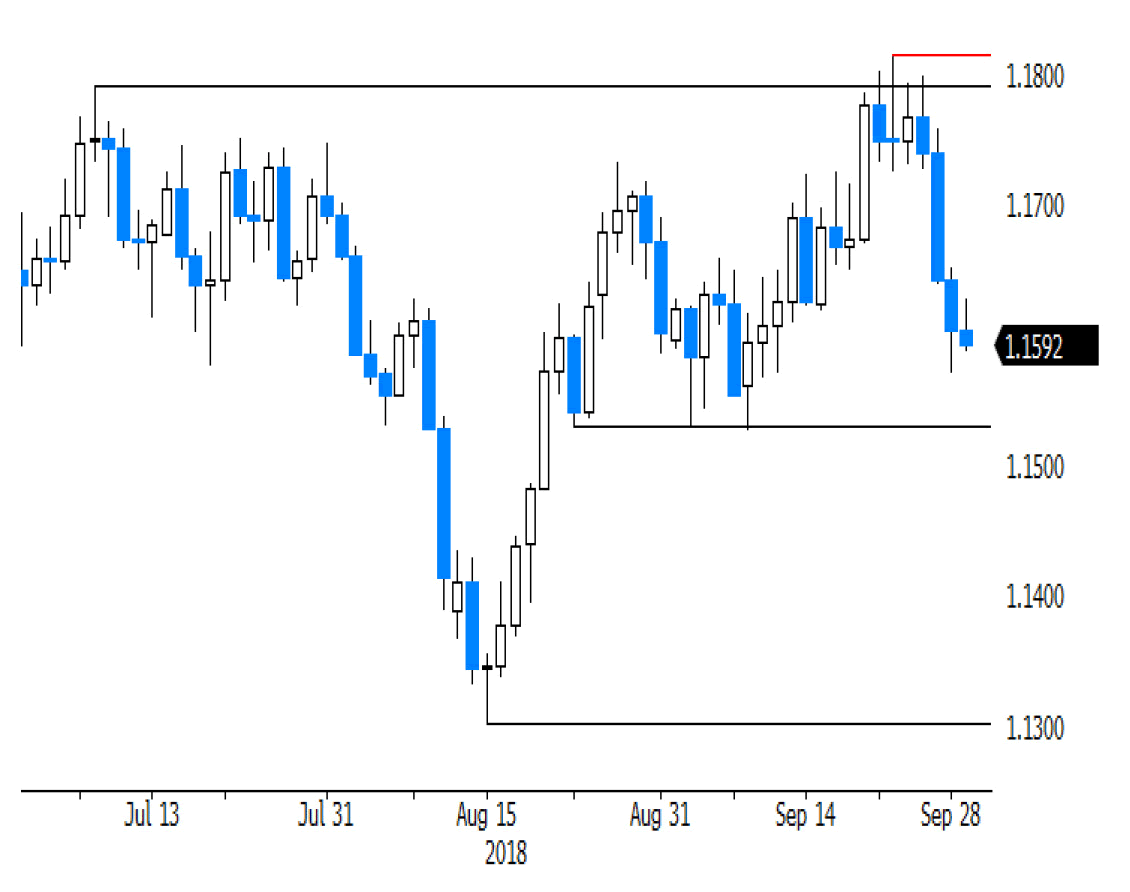
EUR/USD: topside test rejected. 1.1526 first intermediate support.
USDJPY Wathing Bearish Divergence
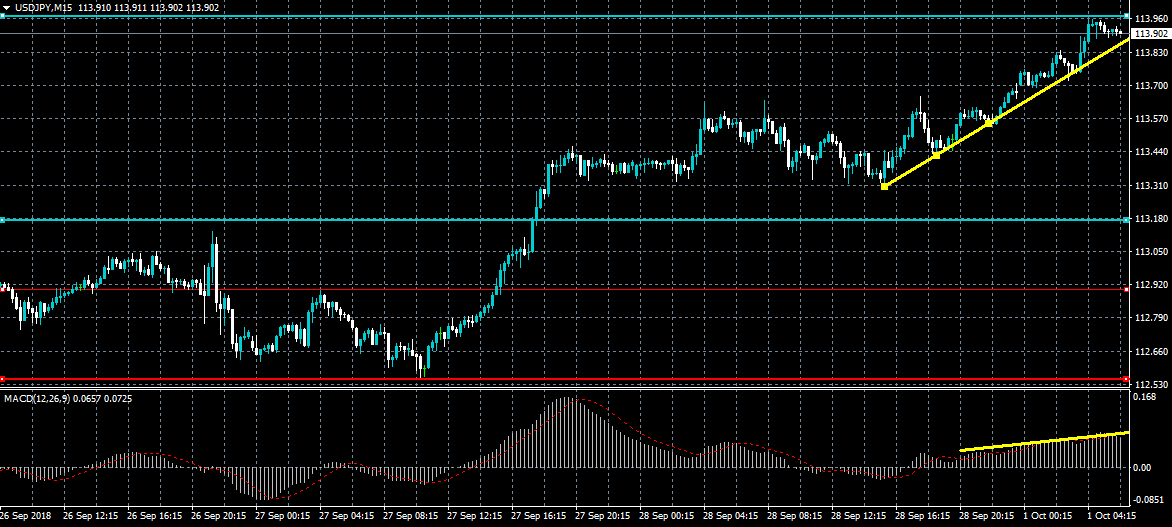
The US dollar continues to trade towards the 114.00 level against the Japanese yen as the US dollar index climbs towards it’s highest trading level in nearly three weeks. Bearish MACD divergence can be seen on the lower time frames as the USDJPY pair starts to move into overbought territory. Buyers will likely aim for the 114.43 level, while sellers will look for signs of price exhaustion at current levels.
The USDJPY pair is bullish while trading above the 113.17 level, key resistance is now found at the 114.00 and 114.43 levels.
If the USDJPY pair moves below the 113.17 level, key support is found at the 112.92 and 112.56 levels.