Sample Category Title
USD/CAD Daily Outlook
Daily Pivots: (S1) 1.2860; (P) 1.2954; (R1) 1.3003; More...
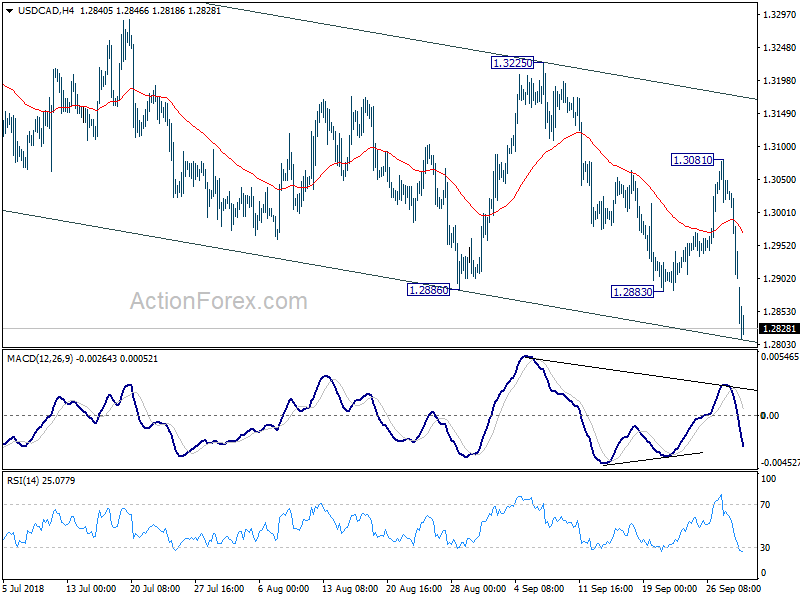
USD/CAD drops sharply to as low as 1.2812 so far today and fall from 1.3385 resumes. With 1.2879 key fibonacci level firmly taken out, such decline should now target next fibonacci level at 1.2567, which is close to 1.2526 support. On the upside, break of 1.3081 resistance is needed to indicate short term bottoming. Otherwise, outlook will remain bearish even in case of recovery.
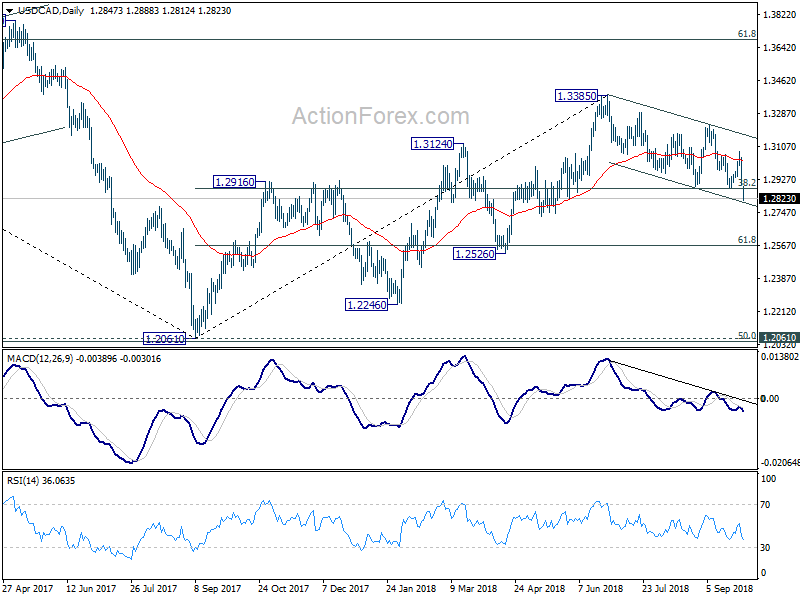
In the bigger picture, the firm break of 38.2% retracement of 1.2061 to 1.3385 at 1.2879 key fibonacci level argues that whole choppy rebound from 1.2061 has completed at 1.3385 already. Deeper fall would be seen back to 61.8% retracement at 1.2567, which is close to 1.2526 support and possibly below. For now, we're not seeing fall from 1.3385 as resuming larger down trend from 1.4689 (2015 high) yet. Thus, we'll look for bottoming signal again below 1.2567 .
Canadian Dollar Soars as USMCA Trilateral Trade Deal Agreed Finally
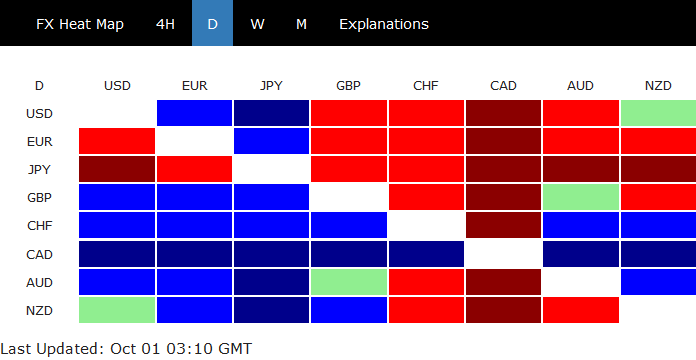
Canadian Dollar surges broadly today as the an agreement, the USMCA is finally reached with the US to replace NAFTA. Riding on the last week's post GDP rally, the Loonie is enjoying strong bullish momentum. The USMCA news further seal the case for an October BoC rate hike. At the time of writing, Swiss Franc is following as the second strongest, and then Dollar. Yen is the weakest one as Nikkei extends recent rise, followed by Australian Dollar and then Euro.
In other markets, Nikkei is currently up 0.56% at the time of writing,confirming medium term up trend resumption. Singapore Strait Times is up 0.12%. China and Hong Kong are on holiday. WTI crude oil is up 0.31 at 73.56 and it's on track for 75.27 key resistance level. Gold is back below 1190 as Friday's recovery faded.
Technically, USD/CAD has taken out 1.2883 key support level today. It's still a bit early to confirm medium term reversal and that will very much depends on downside momentum ahead. But Canadian Dollar's strength is rather overwhelming. And it's rightly so given expectation of October BoC hike, a trade deal with US and strong oil price. EUR/CAD should now be targeting 1.4798 support to confirm resumption of down trend from 1.6151. CAD/JPY's rally is also on track to test 91.62 key resistance.
USMCA agreed to replace NAFTA, but not everyone's happy
An agreement is finally reached between the US and Canada after US imposed deadline. The trilateral trade deal is now called the United States-Mexico-Canada Agreement (USMCA), replacing NAFTA. There should be enough time to go through legal work before Mexico's outgoing President Enrique Pena Nieto leaves office at the end of November.
In short, it's reported that the agreement would incentivize more auto production in the US. Canada also opens more access for US farmers on its dairy market, and agreed to eliminate the so called Class 7 milk system. There is no substantial change in the chapter 19 dispute resolution mechanism. If the US impose auto tariffs, both Mexcio and Canada will be accommodated in "side letters". But the deal doesn't affect the current steel and aluminum tariffs imposed.
While the deal is welcomed by the financial markets, not everyone is happy with it. President of Dairy Farmers of Canada Pierre Lampron warned that "Granting an additional market access of 3.59% to our domestic dairy market, eliminating competitive dairy classes and extraordinary measures to limit our ability to export dairy products will have a dramatic impact not only for dairy farmers but for the whole sector."
Lampron also criticized` "this has happened, despite assurances that our government would not sign a bad deal for Canadians. We fail to see how this deal can be good for the 220,000 Canadian families that depend on dairy for their livelihood."
American Federation of Labor and Congress of Industrial Organizations President Richard Trumka also warned that "Our history of witnessing unfair trade deals destroy the lives of working families demands the highest level of scrutiny before receiving our endorsement." And, "Added protections for working people and some reductions in special privileges for global companies is a good start, but we still don't know whether this new deal will reverse the outsourcing incentives present in the original NAFTA."
Japan Tankan large manufacturing dropped to 19 in Q3
Japan Tankan large manufacturing index dropped to 19 in Q3, down from 21 and missed expectation of 22. Large manufacturing outlook dropped to 19, down form 21 and matched expectations.
Large non-manufacturing index dropped to 22, down from 24 and missed expectation of 22. Non-manufacturing outlook rose to 22, up from 21 and beat expectation of 20.
Large all industry capex rose 13.4%, missed expectation of 14.2%.
Japan PMI manufacturing: Q3 average notably lower than Q1 & Q2
Japan PMI manufacturing was finalized at 52.5 in September. The key points are "output growth sustained amid solid demand pressures", meanwhile, "input delivery times continue to lengthen sharply", and "business confidence drops further".
Joe Hayes, Economist at IHS Markit, noted that "growth in the Japanese manufacturing sector was sustained in September, rounding off a fairly robust quarter of expansion". However, Q3 average at 52.4 was "notably weaker" that Q1 and Q2, "suggesting weaker momentum". "Slowing input delivery times reportedly weighed on output capabilities". "The degree of confidence dipped to a 22-month low, with some panellists raising concern towards the demand outlook."
Australia manufacturing PMI rose to 59.0, two years of uninterrupted expansions
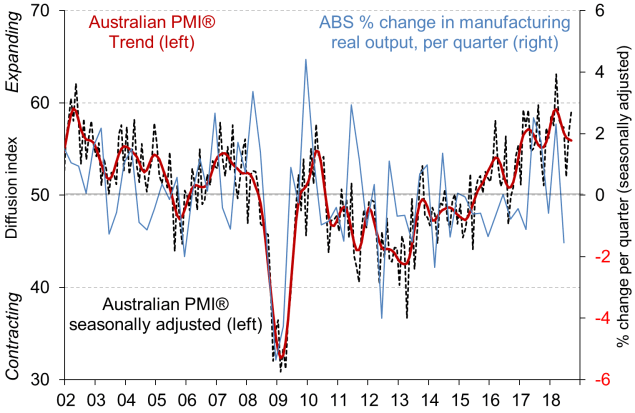
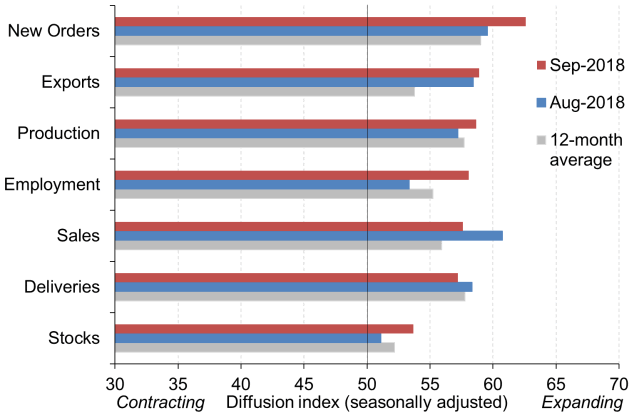
Australian Industry Group Performance of Manufacturing index rose 2.3 to 59.0 in September, indicating faster growth across the sector. It's now in two years of "uninterrupted expansions", the longest run since 2005. All seven activity sub-indexes expanded, that is above 50. Five activity sub-indexes accelerated with the new orders sub-index reaching a six-month high.
AiG also noted that "the manufacturing sector has confounded doubters in recent years by lifting employment and production despite the exit of passenger car assembly from Australia. Australia's manufacturing sector is diverse and comprised of multiple sub-sectors that are continuing to adapt to their operating environment. An improving economy, along with infrastructure, mining, renewable and defence projects continue to support demand for manufacturing products in 2018."
Also from Australia, TD Securities Inflation rose 0.3% mom in September.
China Caixin PMI manufacturing dropped to 50, downward pressure significant
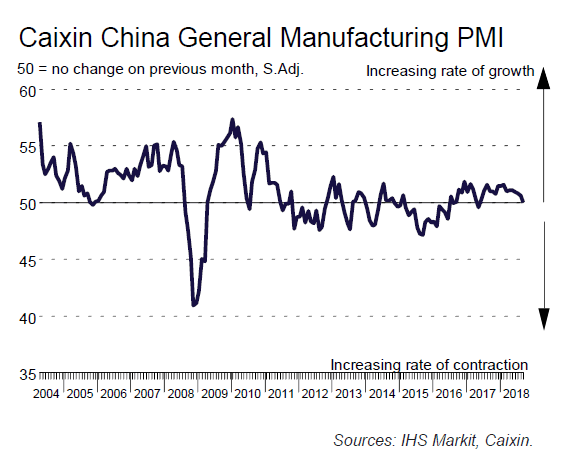
Released over the weekend, China Caixin PMI manufacturing dropped to 50.0, down from 50.6. That's the fourth straight monthly drop and an acceleration in the index's decline. The key points are, "production rises at weakest pace for nearly a year", "total new business broadly stagnant, as export sales decline at faster rate", "business confidence slips to nine-month low".
Dr. Zhengsheng Zhong, Director of Macroeconomic Analysis at CEBM Group said in the released that "expansion across the manufacturing sector weakened in September, as exports increasingly dragged down performance and continued softening demand began to have an impact on companies' production. In addition, the employment situation worsened further. Downward pressure on China's economy was significant."
Also released, the official China PMI manufacturing dropped to 50.8 in September, down from 51.3. Official PMI non-manufacturing rose to 54.9, up from 54.2.
RBA to stand pat, UK PMIs and US NFP featured ahead
RBA rate decision will be a major focus of the week. The central is widely expected to keep interest rate unchanged at 1.50% and maintain a neutral stance. It's also a big week in terms of Australian data with building approvals, trade balance and retail sales featured.
A lot batch of data will be featured this week too. UK PMIs will catch some attention. But the biggest events will be US non-farm payrolls and Canada employment. Fed is pretty much on auto-pilot but strong wage grow will raise the chance of extending the rate hike cycle beyond neutral rate. Also, BoC is widely expected to hike in October. BoC Governor Stephen Poloz has made himself clear that the cycle will continue gradually. Strong employment data from Canada will support the path the laid.
Here are some highlights for the week:
- Monday: Eurozone PMI manufacturing final, unemployment rate; Swiss retail sales, PMI; UK PMI manufacturing, M4 money supply, mortgage approvals; US ISM manufacturing
- Tuesday: Japan monetary base, consumer confidence; RBA rate decision; UK PMI construction; Eurozone PPI
- Wednesday: Australia building approvals; Eurozone PMI services final, retail sales; UK PMI services; US ADP employment, ISM services
- Thursday: Australia trade balance; US jobless claims, factory orders; Canada Ivey PMI
- Friday: Australia retail sales; Japan leading indicators; German factory orders, PPI; Swiss foreign currency reserves, CPI; Canada employment, trade balance; US non-farm payroll, trade balance.
USD/CAD Daily Outlook
Daily Pivots: (S1) 1.2860; (P) 1.2954; (R1) 1.3003; More...
USD/CAD drops sharply to as low as 1.2812 so far today and fall from 1.3385 resumes. With 1.2879 key fibonacci level firmly taken out, such decline should now target next fibonacci level at 1.2567, which is close to 1.2526 support. On the upside, break of 1.3081 resistance is needed to indicate short term bottoming. Otherwise, outlook will remain bearish even in case of recovery.
In the bigger picture, the firm break of 38.2% retracement of 1.2061 to 1.3385 at 1.2879 key fibonacci level argues that whole choppy rebound from 1.2061 has completed at 1.3385 already. Deeper fall would be seen back to 61.8% retracement at 1.2567, which is close to 1.2526 support and possibly below. For now, we're not seeing fall from 1.3385 as resuming larger down trend from 1.4689 (2015 high) yet. Thus, we'll look for bottoming signal again below 1.2567 .
Economic Indicators Update
| GMT | Ccy | Events | Actual | Forecast | Previous | Revised |
|---|---|---|---|---|---|---|
| 22:30 | AUD | AiG Performance of Manufacturing Index Sep | 59 | 56.7 | ||
| 23:50 | JPY | Tankan Large Manufacturing Index Q3 | 19 | 22 | 21 | |
| 23:50 | JPY | Tankan Large Manufacturers Outlook Q3 | 19 | 19 | 21 | |
| 23:50 | JPY | Tankan Large Non-Manufacturing Index Q3 | 22 | 22 | 24 | |
| 23:50 | JPY | Tankan Non-Manufacturing Outlook Q3 | 22 | 20 | 21 | |
| 23:50 | JPY | Tankan Large All Industry Capex Q3 | 13.40% | 14.20% | 13.60% | |
| 23:50 | JPY | Tankan Small Manufacturing Index Q3 | 14 | 13 | 14 | |
| 23:50 | JPY | Tankan Small Manufacturing Outlook Q3 | 11 | 12 | 12 | |
| 23:50 | JPY | Tankan Small Non-Manufacturing Index Q3 | 10 | 6 | 8 | |
| 23:50 | JPY | Tankan Small Non-Manufacturing Outlook Q3 | 5 | 4 | 5 | |
| 0:30 | JPY | PMI Manufacturing Sep F | 52.5 | 52.9 | 52.9 | |
| 1:00 | AUD | TD Securities Inflation M/M Sep | 0.30% | 0.10% | ||
| 7:15 | CHF | Retail Sales Real Y/Y Aug | 0.40% | -0.30% | ||
| 7:30 | CHF | PMI Manufacturing Sep | 60.8 | 64.8 | ||
| 7:45 | EUR | Italy Manufacturing PMI Sep | 51.1 | 50.1 | ||
| 7:50 | EUR | France Manufacturing PMI Sep F | 52.5 | 52.5 | ||
| 7:55 | EUR | Germany Manufacturing PMI Sep F | 53.7 | 53.7 | ||
| 8:00 | EUR | Eurozone Manufacturing PMI Sep F | 53.3 | 53.3 | ||
| 8:30 | GBP | Mortgage Approvals Aug | 65K | 65K | ||
| 8:30 | GBP | Money Supply M4 M/M Aug | 0.60% | 0.90% | ||
| 8:30 | GBP | PMI Manufacturing Sep | 53.8 | 52.8 | ||
| 9:00 | EUR | Eurozone Unemployment Rate Aug | 8.20% | 8.20% | ||
| 13:30 | CAD | Manufacturing PMI Sep | 56.6 | 56.8 | ||
| 13:45 | USD | Manufacturing PMI Sep F | 55.4 | 55.6 | ||
| 14:00 | USD | Construction Spending M/M Aug | 0.40% | 0.10% | ||
| 14:00 | USD | ISM Manufacturing Sep | 60 | 61.3 | ||
| 14:00 | USD | ISM Employment Sep | 58.5 | |||
| 14:00 | USD | ISM Prices Paid Sep | 70.8 | 72.1 |
NAFTA renamed USMCA, formally announced
Canadian Foreign Affairs Minister Chrystia Freeland published a joint statement with US Trade Representative Robert Lighthizer. On reaching a trilateral trade deal together with Mexico. The new agreement is no longer called NAFTA but the United States-Mexico-Canada Agreement (USMCA).
No formal details on the agreement are released yet. But it's reported that the deal include increased access on Canada's dairy marke and the so called Class 7 milk system would be eliminated. The deal would encourage more auto production in the US. There is no substantial change in the chapter 19 dispute resolution mechanism. If the US impose auto tariffs, both Mexcio and Canada will be accomodated in "side letters". But the deal doesn't affect the current steel and alumnium tariffs imposed.
Below is the full joint statement.
Joint Statement from United States Trade Representative Robert Lighthizer and Canadian Foreign Affairs Minister Chrystia Freeland
"Today, Canada and the United States reached an agreement, alongside Mexico, on a new, modernized trade agreement for the 21st Century: the United States-Mexico-Canada Agreement (USMCA). USMCA will give our workers, farmers, ranchers, and businesses a high-standard trade agreement that will result in freer markets, fairer trade and robust economic growth in our region. It will strengthen the middle class, and create good, well-paying jobs and new opportunities for the nearly half billion people who call North America home.
"We look forward to further deepening our close economic ties when this new agreement enters into force.
"We would like to thank Mexican Economy Secretary Ildefonso Guajardo for his close collaboration over the past 13 months."
Japan Tankan large manufacturing dropped to 19 in Q3
Japan Tankan large manufacturing index dropped to 19 in Q3, down from 21 and missed expectation of 22. Large manufacturing outlook dropped to 19, down form 21 and matched expectations.
Large non-manufacturing index dropped to 22, down from 24 and missed expectation of 22. Non-manufacturing outlook rose to 22, up from 21 and beat expectation of 20.
Large all industry capex rose 13.4%, missed expectation of 14.2%.
Market Morning Briefing: Dollar Yen Is Trading Just Near Important Resistance At 114
STOCKS
Although the Dow (26458.31, +0.07%) is trading a bit higher, while immediate support at 26250 holds, there is chance of the index rising back towards 26750-27000 l3eves eventually. A break below 26250, if seen would open up downside chances of testing 26000.
Dax (12246.73, -1.52%) came off sharply to test 12200 facing sharp rejection from resistance at 12500. It could possibly come off towards 12100-12000 before again bouncing back towards 12500. Near term looks bearish.
Nikkei (24287.84, +0.70%) continues to move up slowly. After breaking above 24200, if the index is unable to come off from 24400 levels, the upside momentum could take it towards 24800-25000 soon.
Shanghai (2821.35, +1.06%) has moved up but will have to rise beyond 2850 to trigger a fresh upmove in the longer run. For now, while the resistance near 2850 holds, the index may come off towards 2800-2750 again in the near term.
Nifty (10930.45, -0.43%) has important support in the 10800-10850 region which is likely to holds and eventually push the index to higher levels. Unless it breaks below 10800, bulls still have some chances of a come-back.
COMMODITIES
Baker Hughes data released Friday showed the US oil rig count fell by three to 863 in the week ended September 28. Also the ongoing supply concerns ahead of the reimposition of the US sanctions on Iran seem to provide some price support to the Crude.
Brent (83.21) and WTI (73.59) have risen sharply. Brent is moving as expected and could soon test 85-86 levels on the upside before coming off from there. Weekly candles indicate that 85-86 could be seen in the next 1-2 weeks.
Breaking above immediate resistance near 73, WTI (73.59) could now be headed towards 76-78 levels in the medium term. Near to medium term looks bullish towards 78.
Gold (1192.70) is stable. Support near 1175 is likely to hold keeping the prices either stable below 1200 or pushing it upwards towards 1220 again in the near term.
Copper (2.8005) rose back from 2.75 as expected. There is immediate resistance near 2.88 but on the longer term the price looks bullish.
FOREX
Dollar Index (95.188) is trading higher and is headed towards 95.50-96.00 levels again in the near term. Immediate view is bullish.
Important horizontal supports near 1.550 and 1.1500 are seen on the Euro (1.1595) daily chart and may provide some support in the near term to bounce back towards 1.1650-1.1700 again in the coming sessions. Below 1.15, the next important support is at 1.14 on the 3-day candles.
Dollar Yen (113.91) is trading just near important resistance at 114.Note that 114 and 115 are important resistances on the weekly candle charts and are likely to hold, indicating limited upside for Dollar-Yen in the near term. A short corrective dip either from 114 or anywhere between 114-115 region is possible in the near term. If Nikkei comes off from 24400 in the near term, upside for Dollar-Yen could be limited.
Euro-Yen (132.09) could come off towards 131 support this week. Overall trade region for the near term is likely to be 131-133, where the currency pair is likely to spend the next 1-2 weeks at least.
Pound (1.3031) is coming off to test support zone of 1.300-1.295 which is likely to be test in this week. A break below this support will call for a lower support at 1.28-1.27 on weekly candles. While below 1.32, near to medium term loks bearish.
Aussie (0.7219) faced rejection as the near term resistance on the 3-day candles has held well. While the chart shows possibility of a fall towards 0.715, the par has bounced slightly from the daily 21-Ma support which indicates a rise in the near term towards 0.7250. Overall there could be some near term ranged movement for now. As mentioned last week, Aussie has support in the 0.7175-0.708 zone on the weekly chart which could eventually take it higher in the longer term.
Dollar Rupee (72.49) is likely to remain ranged in the broad 72.20-72.80 region. With increase in Crude prices, it is likely that the USDINR could again move up towards 72.60/80, within the mentioned range. Unless a break on either side of the range is seen, there is little clarity on further direction. In such moments, we would wait and watch for any cues from the markets.
INTEREST RATES
The US 10 Year (3.07%) has risen again from 3.05% but is likely to remain below 3.10% eventually coming off in the medium term. 3.0-2.9% is the target on the downside while the 10Yr remains below 3.10%.
The 10 Year German-US spread (-2.60%) has fallen and is just above the near term horizontal support which if holds could push the yield spread back towards -2.55%.
The German 10 year yield (0.472%) has scope on the upside towards 0.55-0.6% before coming off from there in the longer run.
The Japan 30Yr (0.9%) seems as if it is trying to break above the long term resistance and while it moves higher, it could pull up the other shorter term yields also in the medium term.
Japan PMI manufacturing: Q3 average notably lower than Q1 & Q2
Japan PMI manufacturing was finalized at 52.5 in September. The key points are "output growth sustained amid solid demand pressures", meanwhile, "input delivery times continue to lengthen sharply", and "business confidence drops further".
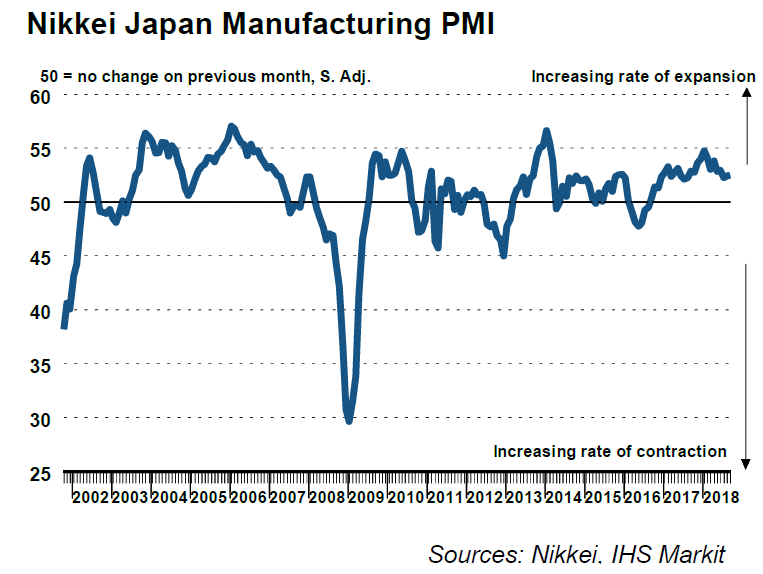
Joe Hayes, Economist at IHS Markit, noted that "growth in the Japanese manufacturing sector was sustained in September, rounding off a fairly robust quarter of expansion". However, Q3 average at 52.4 was "notably weaker" that Q1 and Q2, "suggesting weaker momentum". "Slowing input delivery times reportedly weighed on output capabilities". "The degree of confidence dipped to a 22-month low, with some panellists raising concern towards the demand outlook."
Australia manufacturing PMI rose to 59.0, two years of uninterrupted expansions
Australian Industry Group Performance of Manufacturing index rose 2.3 to 59.0 in September, indicating faster growth across the sector. It's now in two years of "uninterrupted expansions", the longest run since 2005. All seven activity sub-indexes expanded, that is above 50. Five activity sub-indexes accelerated with the new orders sub-index reaching a six-month high.
AiG also noted that "the manufacturing sector has confounded doubters in recent years by lifting employment and production despite the exit of passenger car assembly from Australia. Australia's manufacturing sector is diverse and comprised of multiple sub-sectors that are continuing to adapt to their operating environment. An improving economy, along with infrastructure, mining, renewable and defence projects continue to support demand for manufacturing products in 2018."
Also from Australia, TD Securities Inflation rose 0.3% mom in September.
China Caixin PMI manufacturing dropped to 50, downward pressure significant
Released over the weekend, China Caixin PMI manufacturing dropped to 50.0, down from 50.6. That's the fourth straight monthly drop and an acceleration in the index's decline. The key points are, "production rises at weakest pace for nearly a year", "total new business broadly stagnant, as export sales decline at faster rate", "business confidence slips to nine-month low".
Dr. Zhengsheng Zhong, Director of Macroeconomic Analysis at CEBM Group said in the released that "expansion across the manufacturing sector weakened in September, as exports increasingly dragged down performance and continued softening demand began to have an impact on companies' production. In addition, the employment situation worsened further. Downward pressure on China's economy was significant."
Also released, the official China PMI manufacturing dropped to 50.8 in September, down from 51.3. Official PMI non-manufacturing rose to 54.9, up from 54.2.
Canadian Dollar surges as NAFTA agreed
Canadian Dollar surges broadly on news that the US and Canada have finally agreed on a deal to update NAFTA, just ahead of US imposed deadline. The legal text would be published within hours just of meet the deadline for US Congress to to complete before Mexico's outgoing President Enrique Pena Nieto leaves office at the end of November.
According to unnamed sources, Canada will give the US access to 5% of its dairy markets, same as it granted to Europe with CETA and Pacific-Rim nations with TPP combined. In turn, the US agreed to keep the Chapter 19 dispute resolution mechanism. Also, both sides agreed to put a cap on auto exports to the US, at around 140% of current production level, free of any auto tariffs that the US might impose. Canada also agreed to a quota of steel and aluminum tariffs to the US in exchange for exemption from tariffs.
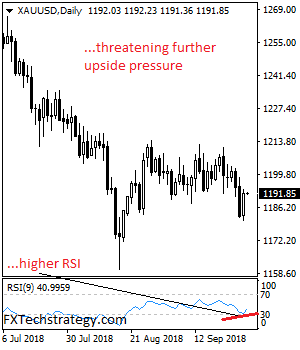
GOLD Faces Price Hesitation Risk
GOLD faces price hesitation risk as it looks to follow through higher on the back of its Friday gains. Unless it returns below the 1,180.00 levels, risk of consolidation is likely. On the downside, support comes in at the 1,180.00 level where a break will turn attention to the 1,170.00 level. Further down, a cut through here will open the door for a move lower towards the 1,160.00 level. Below here if seen could trigger further downside pressure targeting the 1,150.00 level. On the upside, resistance resides at the 1,200.00 level where a break will aim at the 1,210.00 level. A turn above there will expose the 1,220.00 level. Further out, resistance stands at the 1,230.00 level. All in all, GOLD looks to weaken further towards but with caution of price hesitation.