

Sample Category Title
The Weekly Bottom Line: Don’t Let Textual Changes Get in the Way of Rate Hikes
The Weekly Bottom Line
U.S. Highlights
- The Fed hiked rates by 25 bps this week as widely expected. But, the communiqué dropped the reference to policy remaining "accommodative". Interpretations regarding this change led to volatility in bond yields and equities.
- The debate on textual changes in the Fed statement detracts from the main point: the Fed remains committed to additional tightening – a message echoed by a broadly-unchanged rising interest rate path in the Fed dot plot.
- Despite not being all positive, economic data reaffirmed the notion that the U.S. economy remains on solid footing. Of note, real personal spending rose 0.2% in August, keeping our tracking for Q3 consumption above 3% (ann.).
Canadian Highlights
- GDP posted a trend-like 0.2% monthly gain in July on higher goods and services output. The decent monthly gain supports our above-consensus 2.4% call for third quarter growth.
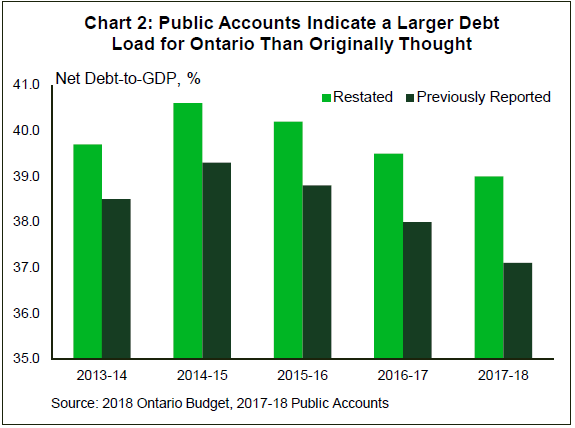
- Last Friday's release of the 2017-18 public accounts painted a worse picture of Ontario's fiscal situation than previously thought and sets the stage for further spending cuts.
- New Brunswick elected a (very slim) conservative minority government on Monday, perhaps making it tougher to push legislation through government. Quebec's provincial election is slated for next Monday. The incumbent Liberals and the poll-leading CAQ Party encouragingly share a commitment to reducing the province's outsized debt.
U.S. - Don't Let Textual Changes Get in the Way of Rate Hikes
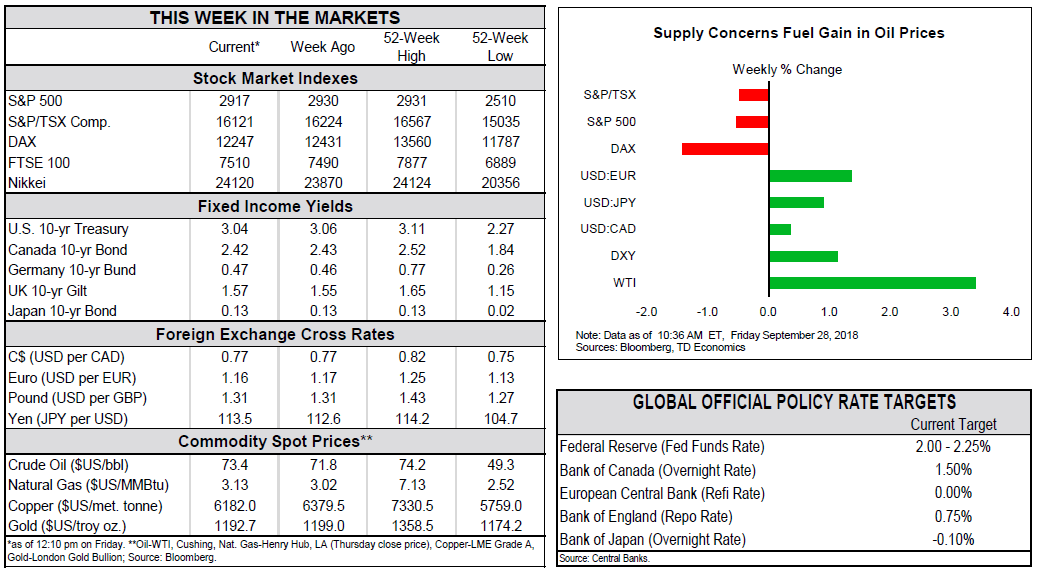
The September FOMC meeting was the highlight of this week's economic calendar. The Fed did not disappoint, hiking the Fed Funds rate by 25 bps as widely expected. This lifted the upper bound target to 2¼ % – the highest level since 2008 (Chart 1). The policy path ahead remained broadly unchanged as per the Fed dot plot. What's more, the funds rate is now projected to remain above the longer-run neutral level through 2021.
Market focus however, gravitated more toward what was not in the Fed statement, rather than what was in it. The communiqué dropped the reference to policy remaining "accommodative". This received a dovish interpretation initially under the premise that the Fed may be getting close to the end of the hiking cycle, leading to volatility in bond yields and equities.
The debate around textual changes in the Fed communiqué appears to detract from the main point – the Fed remains committed to further gradual tightening given its conviction for well-anchored inflation expectations and a positive view of the economy. Economic data in the week remained broadly in line with this narrative. The Fed's preferred measure of inflation held right on target for the fourth straight month in August. Meanwhile, real personal spending was up 0.2% in the same month. While this marks a slight moderation in the monthly pace of spending, it's sufficient to keep our tracking for third quarter consumption growth north of 3% annualized. A solid rise in wholesale and retail inventories added to the positive tally.
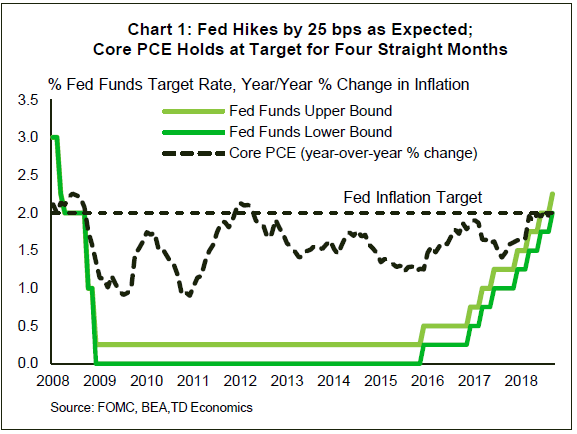
Not all of the data was positive though, with soft pockets including trade and housing. The goods trade deficit widened more than expected in August. The first two months of the quarter reaffirm the notion that, unlike the second-quarter experience, net trade will be a drag on growth this time around. Pending home sales, a leading indicator of sales activity, also fell 1.8% in August (Chart 2). This marks the fourth decline in five months, suggesting that sales will continue to languish in the near-term.
Putting all the pieces together, the economy is still on solid footing, with over 3% growth expected in the third quarter. With price pressures holding near target, this should indeed be sufficient for one more hike before the end of the year. Beyond this point, however, there is significantly more uncertainty, as trade disputes pose significant downside risk to the economic outlook.
The U.S.-China trade conflict saga continued to play out in the background, given other more salacious domestic political developments. China scrapped talks with the U.S. as tariffs on $200 bn of Chinese goods came into effect. Meanwhile, President Trump accused China of attempting to interfere in the upcoming midterm elections, given his stance on trade. With the two economic heavy-weights on a hard-to-avoid collision course, we see this dispute as a key risk to growth. Tariffs in effect and those threatened could knock off up to 1 p.p. from U.S. and 0.3 p.p. from global economic growth (see here).
Canada - Provincial Developments Take Centre Stage
Global oil prices drifted higher again this week on signals that OPEC and Russia had no immediate plans to raise production, despite looming U.S. sanctions on Iranian oil exports. However, the story for Canadian producers remains one of weakness, given the persistently large wedge between WTI and Western Canada Select (WCS) prices. Meanwhile, precious little progress was made this week on NAFTA negotiations, with President Trump claiming to have spurned a trade meeting with Prime Minister Trudeau, casting a pall on the mood.
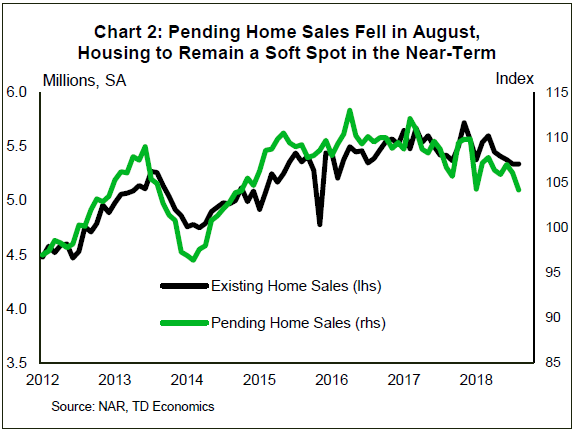
On the economic data front, last week's flood of releases turned into a slow drip. The most notable report – July's monthly GDP data – showed a decent 0.2% monthly gain. Goods output advanced 0.3%, lifted by manufacturing, mining and utilities production. However, oil and gas sector output was down significantly, weighed on by a power outage at the Syncrude facility in late June (Chart 1). Meanwhile, services-sector output advanced 0.2% in July, proving once again its status as stalwart of the Canadian economy. All told, July's data reinforced our above-consensus 2.4% call for third quarter growth.
With a quieter week on the economic calendar, provincial political and fiscal developments came increasingly into focus. Last Friday, the 2017-18 public accounts for Ontario were released. What is typically seen as a ho-hum affair was anything but, with the accounts offering a new look at the province's restated fiscal position following audits ordered by the PC government. As expected, the accounts painted a worse picture of Ontario's fiscal standing than originally reported (Chart 2). Indeed, in a speech on the same day of the release, Finance Minister Fedeli reported a $15 billion shortfall for this fiscal year, versus the $6.7 billion deficit projected by the prior government. While a $15 billion deficit is nothing to sneeze at, prior analysis by the Auditor General and the Financial Accountability Office had already prompted markets to expect something big, reducing the sticker shock from the announcement. Ultimately, larger deficits set the stage for the government to deliver additional spending cuts, which could offset benefits to growth from promised tax relief.
Not to be outdone, New Brunswick held its own provincial election on Monday, producing a (very slim) victory for the new minority Conservative government. While we await an updated budget to inform our forecasts, election of a slim minority will likely make it tough to push policies through government, at least not without some compromises.
Looking ahead to the coming week, a provincial election in Quebec is on tap for Monday. Current polling points to the Coalition Avenir Quebec (CAQ) holding an advantage over the incumbent Liberal Party. In terms of policy, the parties seem somewhat aligned on a few points, with arguably the most important being their shared commitment towards reducing Quebec's mountainous debt load. This should appease credit rating agencies and help shore up business confidence.
U.S.: Upcoming Key Economic Releases
U.S. Employment - September
- Release Date: October 5, 2018
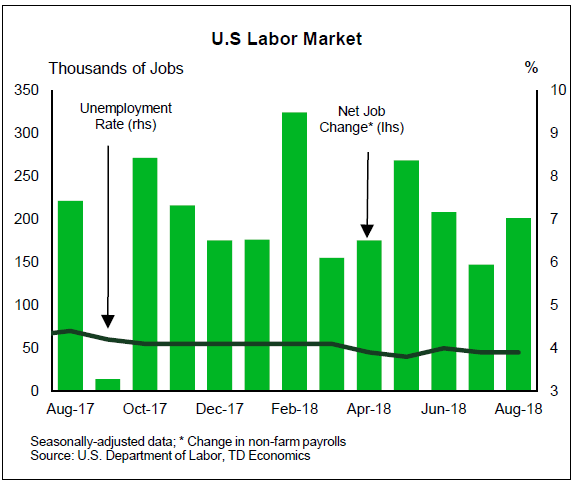
- Previous: 201k, unemployment rate: 3.9%
- TD Forecast: 180k, unemployment rate: 3.8%
- Consensus: 188k, unemployment rate: 3.8%
We expect payrolls to rise by a solid 180k in September albeit a touch softer than in August (201k). Manufacturing should make a comeback, offset by some deceleration in private services. ISM and regional surveys suggest an overall solid figure near 200k, though September prints tend to disappoint expectations and see upward revisions. Hurricane Florence should not impact the payroll figures, as persons in the survey are counted as employed if they worked or received pay for at least one day of the pay period (that includes the 12th of the month). Evacuations did not begin until the 10th to 11th, so it is plausible that workers would still be considered employed.
Wages however could see an impact. The hurricane should negatively impact hours worked, implying a boost to average hourly earnings. Reference week itself (with the 12th landing on a Wednesday) also suggests a strong read, with m/m increases averaging 0.3% and up to 0.5%. We therefore expect a 0.3% m/m print, with upside risk for 0.4% and leading the y/y pace lower to 2.8%. Note that revisions could bias the y/y pace lower, as strong readings (such as the 2.9% rate in August) tend to be revised away.
Finally, we expect the unemployment rate to dip further back to its previous low of 3.8% on the back of strong jobs gains, though a pickup in participation is an upside risk.
Canada: Upcoming Key Economic Releases
Canadian Employment - September
Release Date: October 5, 2018
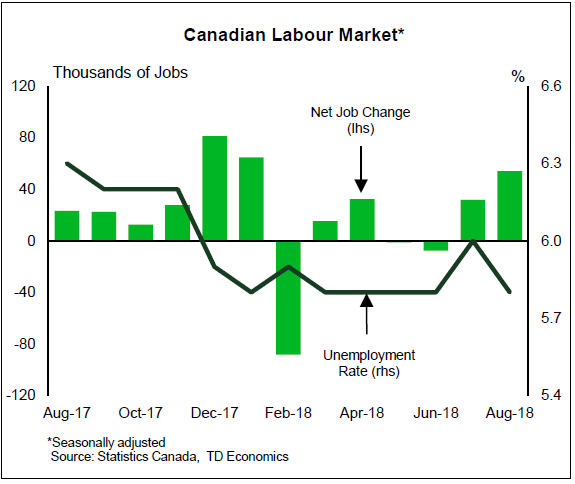
Previous: -52k, unemployment rate: 6.0%
TD Forecast: 25k, unemployment rate: 5.9%
Consensus: N/A
TD looks for the September employment report to show job growth of 25k for the month, although the details should prove less upbeat than the headline print. Part time employment should rebound after registering the second largest decline on record, which will leave full-time employment down slightly on the month. We also look for employment gains in retail trade, construction and professional services after suffering outsized declines in August. Job growth of 25k alongside a more modest inflow to the labour force should allow the unemployment rate to edge lower to 5.9%, leaving it contained within the recent range, while wage growth for permanent employees is expected to slip to 2.4% y/y. If realized this would mark the fourth consecutive deceleration since the 3.9% highs in May, which accompanies a similar pullback in SEPH wage growth.
Canadian International Trade - August
Release Date: October 5, 2018
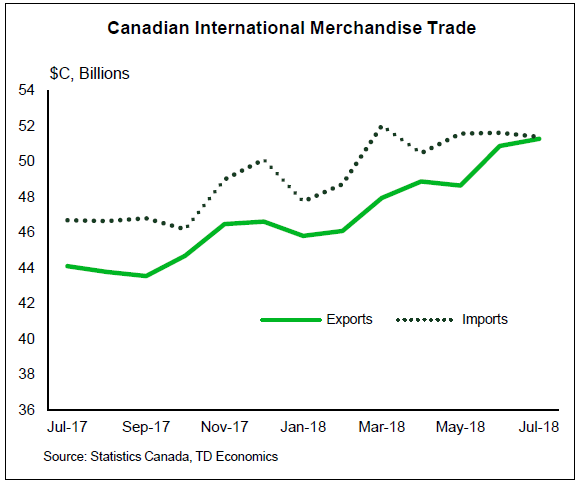
Previous: -$0.1bn
TD Forecast: -$0.5bn
Consensus: N/A
The international trade deficit is forecast to widen to $500m in August on a decline in both export and import activity. Weakness in the former will be concentrated in energy products, where we look for a significant pullback on the heels of disruptions to production and lower crude oil prices. Motor vehicles will provide a key offset as presaged by US import data which should leave non-energy exports unchanged on the month after accounting for a broad decline in factory prices. Imports should see a modest decline, although after two months of little growth we expect any further pullback to be modest. Meanwhile, real exports should outperform the nominal print on the 0.5% decline in factory prices and an even more significant decline in raw material prices, which suggests the drag on growth will be more modest than the headline print would imply.
Strong Dollar Awaits Jobs Report to Validate Further Fed Hikes
The US dollar is mixed against major pairs on Friday. The dollar gained against the JPY, EUR, GBP and CHF but depreciated against the commodity pairs (CAD, AUD and NZD).
Fundamental data in the US supported the dollar: the Fed delivered its anticipated third rate hike of 2018, the final GDP for the second quarter was 4.2 percent. Fed Chair Powell’s speech and press conference after the FOMC was a big factor in the rise of the dollar after the market had already priced in the 25 basis points lift to interest rates. Mr Powell will speak next week on Tuesday, October 2nd on the topic of employment and inflation. This will officially kick off jobs week in the US.
The main event will be the release of the biggest economic indicator on Friday, October 5 at 8:30 am when the U.S. non farm payrolls (NFP) is published.
- US manufacturing and service PMIs could signal growth slowdown
- UK leading indicators expected to remain flat
- US NFP report to show economy added 190,000 jobs
Euro Hit by Political Turmoil and Inflation Softness
The EUR/USD lost 0.26 percent on Friday. The single currency is trading at 1.1610 and accumulated 1.16 percent in losses during the week. A higher than predicted Italian budget for 2019 at 2.4 percent and softer core inflation in the eurozone put downward pressure on the currency.
European stock markets were hit by the news as political turmoil once again threatens the European Union.
The other shoe dropped when inflation slowed down in the Eurozone in the same week that the U.S. Federal Reserve hiked rates and was optimistic about economic growth in the US.
The monetary policy divergence between the Fed and other major central banks was clear this week as fundamentals back the US policy makers, while questions remain on how effective other policy makers around the world have been.
Loonie Rises as GDP Data Validates October Rate Hike
The Canadian dollar rose on Friday after the monthly gross domestic product (GDP) beat the forecast with a 0.2 percent gain. The loonie is up almost 1 percent on the final day of the trading week. The currency is still showing a weekly loss against the greenback as NAFTA uncertainty and the U.S. Federal Reserve rate announcement put downward pressure.
The rise today comes with higher expectations of a Canadian interest rate lift in October. The Bank of Canada (BoC) held rates in September ahead of a highly anticipated Fed rate hike in September that came to pass. The US central bank has forecasted another rate hike in 2018 and 2 or 3 more next year as part of its economic projections published Wednesday.
BoC Governor Stephen Poloz spoke on Thursday addressing the rising inflation and Friday’s GDP data point puts a rate hike firmly on the table in the short term.
NAFTA negotiations have not made big inroads as the US met with Canada with the goal of turning two bilateral agreements into a trilateral one.
With a considerable amount of work still to be done in bridging the gap between US and Canada, the US-Mexico agreement will be published tonight with a possibility of leaving the door open for Canada to join.
It is that possibility that has kept the loonie gaining despite the NAFTA train moving without Canada.
Crude Surges as Supply Concerns Push Prices to 4 Year Highs
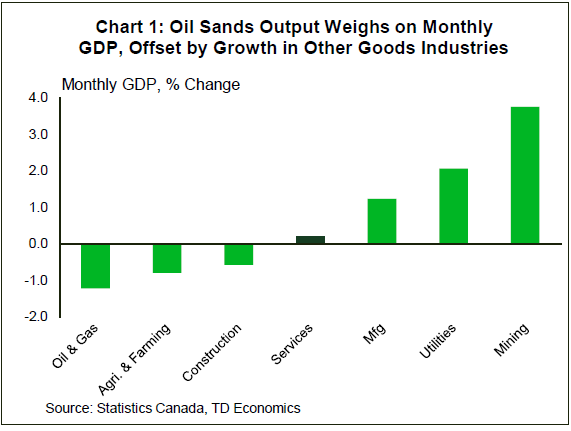
Oil prices surged on Friday as supply concerns took crude to four year highs. The news that China is cutting back on Iranian oil purchases triggered a rally where Brent and WTI had a 1.40 percent one-day gain. Brent is on track to a 5.34 percent gain during the week with WTI clocking in at 3.66 percent.
The US sanctions against Iran don’t kick into effect until November, but the harsh penalties threatened against those who do have made Iranian crude purchases drop.
China’s Sinopec Corp is slashing its loadings in half to avoid the wrath of Washington. In August Sinopec planned to offer Tehran a lifeline by circumventing the sanctions as it reduced US oil purchases due to the rising trade turmoil between the US and China.
The decision by the Chinese state owned energy company will deal a huge blow to Iran as China is its biggest customer.
The shortfall from Iranian crude sales does not have a short term solution after US Energy Secretary Rick Perry said earlier this week that the US would not tap into its emergency crude reserves to bring prices down.
US President Donald Trump had implied during his UN General Assembly speech that unless the OPEC increase production levels America’s would utilize its position as the largest energy producer in the world.
Gold Gains But US Dollar to Limit Recovery
Gold rose 0.67 percent on Friday but the strength of the US dollar after the U.S. Federal Reserve lifted interest rates this week proved to be too much for the yellow metal that will end up losing 0.49 percent on a weekly basis.
The Fed raised the benchmark rate by 25 basis points and the futures market is pricing in a 78.5 percent probability of a lift in December. Gold traders will look ahead at next week’s manufacturing and service PMIs for more guidance as the US economy continues to grow. Friday’s U.S. non farm payrolls (NFP) will be the final test of the yellow metal.
The US is expected to add 190,000 jobs with average hourly earning rising 0.3 percent. Higher inflation expectations validate the Fed’s forecasts and the market is pricing in a rate hike in December and follow ups in 2019.
Market events to watch this week:
Monday, October 1
- 4:30am GBP Manufacturing PMI
- 10:00am USD ISM Manufacturing PMI
Tuesday, October 2
- 12:30am AUD Cash Rate
- 12:30am AUD RBA Rate Statement
- 4:30am GBP Construction PMI
- 12:45pm USD Fed Chair Powell Speaks
Wednesday, October 3
- 4:30am GBP Services PMI
- 8:15am USD ADP Non-Farm Employment Change
- 10:00am USD ISM Non-Manufacturing PMI
- 10:30am USD Crude Oil Inventories
Thursday, October 4
- 9:30pm AUD Retail Sales m/m
Friday, October 5
- 8:30am CAD Employment Change
- 8:30am CAD Trade Balance
- 8:30am USD Average Hourly Earnings m/m
- 8:30am USD Non-Farm Employment Change
*All times EDT
An Incredible End to Q3 Could be an Even Bumpier Ride in Q4
Well, that was an astonishing end to Q3 as we herald in what is certainly shaping up to be a bumpy ride in the markets for Q4. While the eerily familiar themes will continue to dominate, US-China trade, NAFTA, Brexit and Italian budget which will confront traders at every twist and turn. But as US lawmakers rush to make final preparations ahead of what is shaping up to be a fierce midterm election run, headline risks will abound.
China markets will shutter for the Golden Week Holidays during the first week of the month. But focus is in PMI data none the less.
Not an overly busy docket next week, but on the data front, the granddaddy of them all, Non-Farm Payroll, will be released next Friday and as usual the primary focus is on US wages, and how quickly they expanded in September could have a significant impact on the projected course of US interest rates. Recall in August wage growth accelerated the fastest since June 2009, an if the average hourly wages prints north of .4 % expectation, and given the USD has gained the upper hand again, it could drive a stake through dollar bears hearts. Indeed a make or break report for USD’s near-term momentum.
On the Central Bank front, the RBA will announce there interest rate decision but absent inflation suggests the RBA’s half glass full approach to monetary policy continues but as usual there will be more focus on the policy statement.
Local EM traders will focus on the RBI rate decision. Given the RBI recent defend the Rupee at all cost stance, its widely expected the RBI will match the latest Fed hike.
Local eyes are on Singapore PMI data as the market is positioned for a rebound after last month manufacturing forecast fell to the lowest level since June 2017 as exports plummeted.
Oil Markets
Everyone is telling me my views are far too unabashedly bullish, but from my seat until sizable supply is offered up by OPEC and with pandemic market chatter raging about the $100 per barrel market, its hard not to be blatantly bullish.
Brent crude oil finished the quarter in a spectacular note on Friday as concern over the potential impact of US sanctions on Iranian exports continued to mount on a report that at least one Chinese refiner was cutting back on purchases. WTI prices followed Brent higher.
Gold Markets
After falling to a fresh one-month low water mark as the USD was bullying around the Euro. Gold bounced off the intraday lows.But frankly, the Gold market is so oversold that we should expect consolidation to set in before the next leg lower. We’re in the domain of the Gold Bears who have August $1160 lows in their crosshairs.
Same view as Friday morning Singapore open note:
A reality check as spot gold is selling off today as the USD continues to strengthen. For the past three months, gold has traded more like a currency rather than a go-to safe have an asset. With the Euro tumbling overnight, the $1190 trap door gave way as Gold has fallen to $1183 just ahead of the COMEX end of NY break. Besides with the final reading of second-quarter GDP holding at 4.2%Thursday, its reinforced the Fed rate hike outlook for 2019. Gold has been a seller’s market for some time, but with $1190 yielding, bearish activity could intensify with short-term speculators likely to target the August low when the yellow metal hit $1160 before rebounding.
Currencies to keep an eye on next week
The Euro
EUR continues to leak lower as Italy’s government has shattered the budget and challenged the EU’s mandate. BTPs have driven a good chunk of the move lower. The Euro was holding on the 1.1600 handles by a thread, but the less -than -vigorous Eurozone September Core CPI came in lower than expected at 0.9%YoY (1.1% estimated, 1.0% prior) which sprung the 1.1600 trap door triggering a wave of stop losses as that fundamental and psychological level ceded.
Indeed, music to EURO bears ears as the ECB will be in no mood to signal a quicker pace of interest normalisation anytime soon. And with the Fed laying their cards on the table and guiding the markets to a December rate hike. While markets pulled off the intraday lows, the keep it simple pragmatic approach to this trade suggests the dollar remains in favour as US growth and positive USD differentials will stay supportive.
The Japanese Yen
For all the right macro reason spot USDJPY is looking to break higher, and if the NKY and US 10 y yields continue to track higher, there is no reason the markets shouldn’t take out 114 next week given the dollar is completely under-owned vs the JPY.
There are some chunky structural long EURJPY and a lot of underlying derivatives that add up to the same view but have different path dependency.
These positions are clearly at risk during this Italy induced panic as we leak near yet another psychological support level EURJPY 131. But the market pressure points are probably more towards EURJPY 130 level, so we could assume these positions will remain safe with USDJPY marching higher.
The British Pound
Its a mess and the markets are fraying beyond the fringe as signs of stress related to a potential No-Deal Brexit remains a significant possibility. Unfortunately, vols in GBP have rallied significantly of late, so buying the downside insurance to protect against a Hard Brexit fallout is rather expensive.
Cable is stuck in a broader range still getting knocked around by various Brexit headlines. It’s impossible to filter out the political nose so best to remain cautious on GBP as it’s tough to predict next rate move. There were a few hawkish tidbits from Haldane and Ramsden this week albeit with caveats that the Brexit outcome is a smooth one.
The Australian Dollar
Much more focus on the US rates outlook in the wake of the FOMC, and this plays into the USD ‘s hand short term. I think the markets are tricky as USD moves are entirely data dependent over the next few weeks. While the RBA rate decision is on tap, there will be an outsized focus on next weeks NFP but more toward wage growth component as by all account the US job growth is rocking, but the Feds are looking for that elusive inflation spark. But this is where I temper my bearish Aussie expectations. With commodity prices going higher, this will undoubtedly be a boon for commodity-linked currencies so against a lot of forecasts I see the Aussie moving higher on that narrative alone.
The Canadian Dollar
Canadian GDP was a beat at 2.4%YoY vs 2.2% forecast, showing a healthy bounce back in July after June weakness. It suggests upside risk to Q3 growth. And with BoC Poloz sounding very neutral and data dependent, CAD was able to hold onto gains. But ultimately CAD upside will be capped until trade talks between the US and Canada progress meaningfully. But 1.2700 on a NAFTA 2 signing looks possible given surging oil prices and a higher chance for a BoC rate hike on the GDP beat.
Lessons Learned
The big lesson learned last week was analysing the knee jerk reaction to Wednesday FOMC meeting which caused a rally across the US yield curve and temporarily weakened the US only for the move to be reversed out when the Fed chair Powell explained that both policy and financial conditions are still accommodative. Mind you, given the time zone difference in Singapore, all this happened while I slept and without knowing all the facts my initial knee jerk reaction, which I incorrectly elaborated in my morning note by castigating the FOMC for verbal gymnastics, could not have been further from the truth. In reflection, Jay Powell is a breath of fresh air, and by removing accommodative, he’s signalling that forward guidance should be removed as rates move toward normal, and that dot plot projections should be taken with a grain of salt as FOMC policy will be dependant on incoming data.
U.S.-China Trade Tensions Now A Key Risk To Growth
Timing is everything
U.S. tariffs have been an ongoing theme since the March announcement on steel and aluminum, but the scale and risks associated with recent action can no longer be minimized within the economic outlook for 2019. Initial tariffs were broadly applied and affected most countries, including traditional U.S. allies and NAFTA partners.
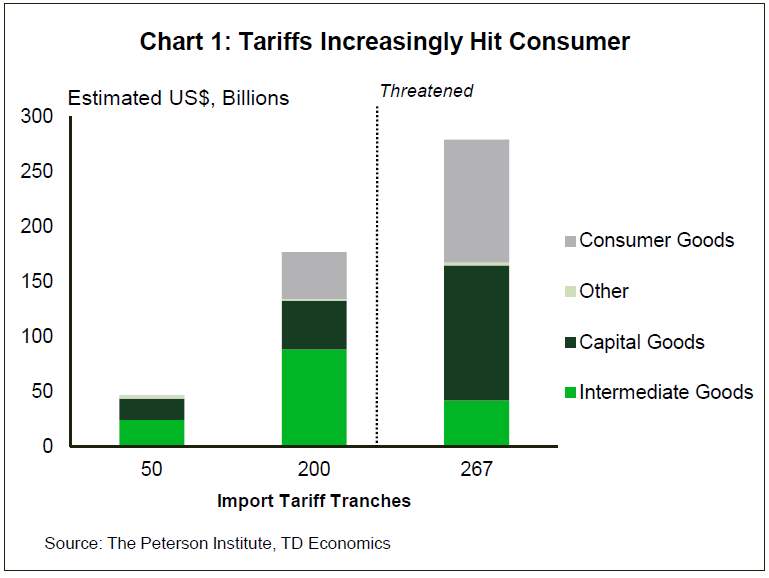
However, these amounted to a mere $10 billion tax on American business inputs, which could mostly be absorbed. The next layers of tariffs have largely been leveled against China, and in grand fashion. We had little concern regarding the first tranche, which reflected roughly U.S. $50bn in "technology" imports, or products included as intermediate or capital goods. These ultimately raise costs for U.S. businesses, but again were relatively small in economic scope (see Chart 1). That view is now changing. On September 24th, Phase 2 ramped up the pressure on businesses, with $200bn in Chinese imports incurring 10% tariffs until year-end, rising to 25% thereafter. It is the latter 25% tax-hike that offers the greatest concern; particularly should it be coupled with a potential Phase 3 for an additional 10-25% tariff on $267bn in Chinese imports. This increasingly targets consumer goods, which would directly raise prices for American consumers alongside already-rising pressures among a broader range of American businesses.1
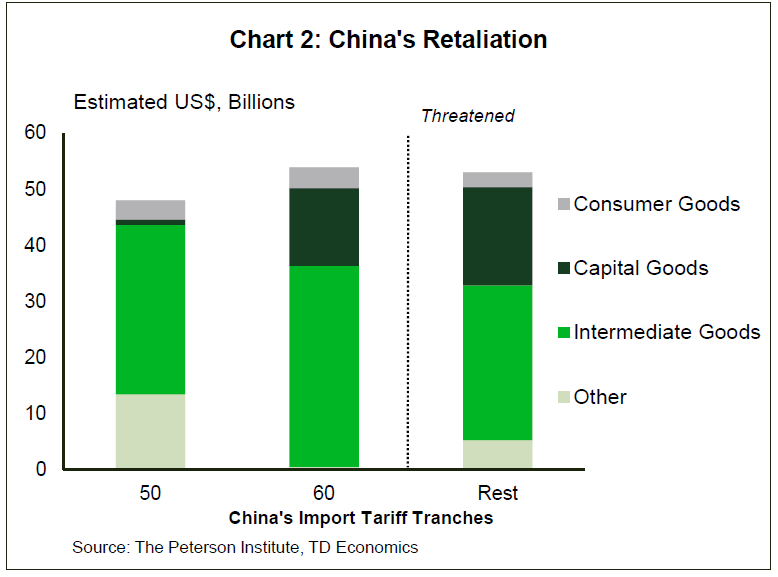
China has not sat idle, choosing to retaliate in a strategic fashion. China's Phase 1 response focused import tariffs on cars (classified as other in Chart 2), as well as agricultural products like soybeans and pork. These are goods often produced within states where constituents tend to vote conservative. Phase 2 retaliation amounting to 5-10% tariffs on $60bn in U.S. products has shifted to include intermediate inputs and capital equipment. The lower 5% tariff is likely a nod by Beijing in recognition of the additional cost to be borne by Chinese importers on key components, particularly since the domestic currency has depreciated by 8% since the trade war heated up in March.
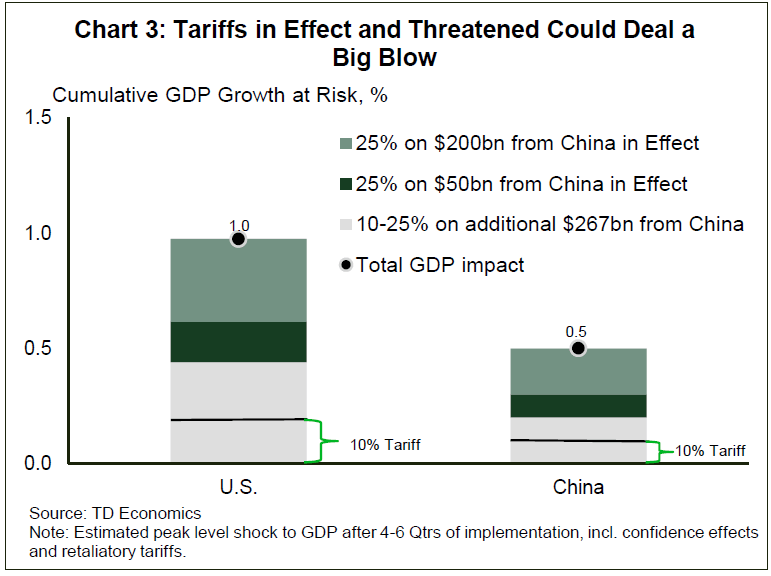
The latest tit-for-tat trade spat is expected to have negative economic repercussions for both the U.S. and Chinese economies. Model simulations suggest that a 10-25% tariff on $200bn in Chinese goods import could hit U.S. GDP growth by between 0.1 and 0.4 ppts in a little over a year's time, depending on whether the U.S. administration follows through on applying the 25% tariff in the New Year. Implicit in this estimate is an assumption that sentiment among consumers and businesses is impacted, accounting for more than a third of the drag on U.S. economic growth. If these impacts fail to materialize, the drag to economic growth falls to the lower end of the range. However, we think it's a leap of faith to assume equity markets would not recalibrate to lower earnings growth potential. Although there is always uncertainty embedded in forecasts calibrated on historical relationships, it's a hard case to make that the negative effects on domestic income and consumer purchasing power will be completely skirted. It's not realistic to presume that firms can fully substitute away from more expensive imports to domestically produced goods, particularly given the large scope of products captured in the latest tariff round. The end result will lead to less efficient supply chains, and by extension, higher production costs and less competitive domestic firms than the status quo.
Since China has retaliated by imposing 5-10% tariffs on $60bn of U.S. goods, there is an ever-present risk that the U.S. follows through on its threat to up-the-ante with an additional 10-25% tariff on the remaining $267bn in Chinese goods imports. This move could endanger an additional 0.4 ppts of U.S. GDP growth (Chart 3). Adding it all up, further escalation could reduce U.S. economic growth by up to 0.8 ppts over the next eighteen months or so, and is consistent with a loss in 250k jobs relative to the counterfactual of our baseline forecast (+0.15 ppt increase in the civilian unemployment rate, with the impact possibly larger depending on the total amount of goods targeted by tariffs).
Since more consumer goods were included in the current round of tariffs, higher consumer prices are all but guaranteed. Model simulations suggest a peak impact on inflation a year from now of about +0.1 to +0.3 ppts in the case of U.S. tariffs of 10-25% on $200bn, and the inflation impact could rise to +0.6 ppts if the U.S. were to impose a 25% tariff on an additional $267bn in Chinese goods imports.
The potential impacts of the tariffs already in place may not sound notable in an economy trending close to 3% growth. But, due to waning fiscal impulse and tighter financial conditions, our recent forecast has growth slowing towards 2% by early 2020 – when the peak impact from the tariffs would occur. Regardless of whether the U.S. follows through with Phase 3, the tariff-induced impacts may already produce a more anemic growth outlook.
No Surprises In China's Response
The U.S. market for imported goods is $2.4tn, and home to some of the world's wealthiest consumers. This gives the U.S. much of the leverage in trade negotiations with other nations. Chinese imports of $505bn comprised about one-fifth of total U.S. imports in 2017, representing a mix of intermediate and finished goods. Therefore, tariffs do not just make imported goods more costly for consumers, but also raise costs for U.S. industries that rely on global supply chains, threatening to make them less competitive overall.
Chinese authorities recognize that the U.S. has the upper-hand in negotiations, and have been careful in their response in order to mitigate any potential damage to their economy. In response to U.S. tariffs on Chinese goods this year, China has levied tariffs on about $113bn (or 73% of the total).
Although the U.S. maintains the upper-hand on having less trade dependence on China than vice-versa, it's important to keep in mind that China has strategic levers at hand. For instance, shortly following the Phase 2 U.S. tariff imposition, Chinese authorities announced intentions to reduce import duties broadly for all nations, pushing China's effective tariff rate down to 7.5% from 9.8% last year.2 Technically this was already in the works as part of China's intent to pursue market reforms via trade deals with partner countries, but the timing may now have been accelerated. This has a couple implications for American companies. First, it can reinforce a first-mover advantage for companies from other countries into a $12.2 trillion economy, which has a clear advantage of rising incomes coupled with a large population base. Second, if China were to lower tariffs, in general, for countries, the U.S. would qualify under WTO's most-favored-nation (MFN) rules. But, that benefit would now be obstructed as long as retaliatory tariffs remained in place. It also requires the U.S. to remain in the WTO to receive this benefit, which the current administration has placed into question. We doubt China would be quick to implement these changes, but they have clearly signaled market direction, and will ensure their path remains in alignment with their Made in China 2025 strategy, irrespective of U.S. policies,
China was open to ongoing dialogue with the U.S. administration, but has openly stated they would not negotiate under threat. So it was not altogether surprising that China pulled out of scheduled talks once the U.S. announced they would proceed with the tariffs targeting $200bn Chinese products. But, authorities have stated that they remain amenable to talks in late October or a November trade summit.3
So there we have it. Both countries have moved closer to intractable positions. This was reinforced by China earlier this week when they published a whitepaper stating its position on trade with the U.S.4 This document highlights mutually beneficial aspects of China-U.S. trade cooperation, but also addresses that the 'America First' attitude of the new U.S. administration has "abandoned the fundamental norms of mutual respect and equal constitution that guide international relations". Moreover, the document highlights the importance of China and U.S. in the global economy, and that current trade tensions threaten to slow global growth.
Chain Reaction: Global implications
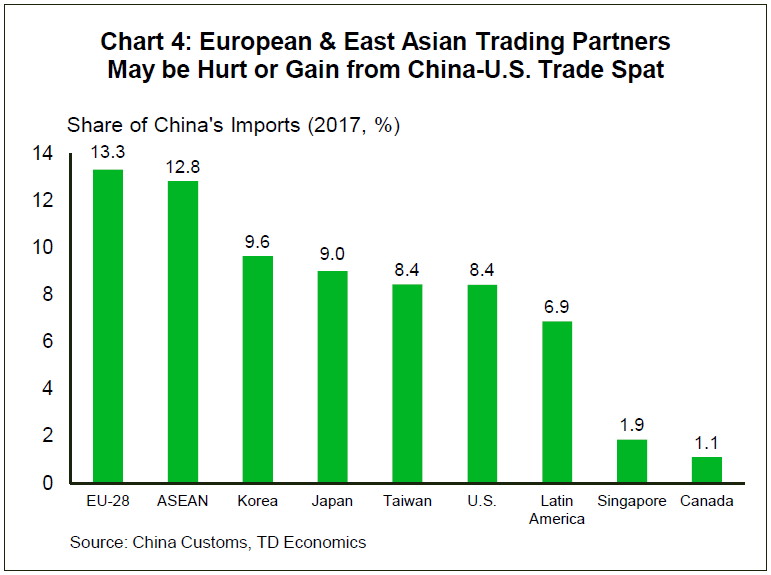
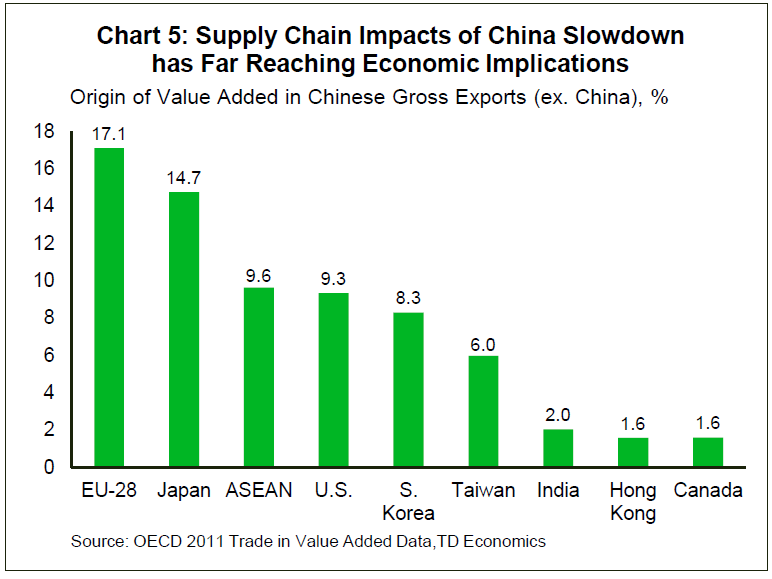
Certainly further escalation may start to impair global supply chains, risking a material slowdown in global trade, investment, and ultimately economic growth. A slowdown in Chinese economic growth from the current 6.6% pace may put in peril the growth outlook in its East Asian trading partners (Chart 4) that together comprise about 10% of global economic activity. However, the China trade spat may provide opportunities for these same trade partners to gain more Chinese business at the expense of U.S. firms. Nevertheless, since much of the value added in Chinese exports is generated abroad, these tariffs may exacerbate the economic slowdown already underway in China that has been orchestrated by authorities to wean the economy off its overreliance on debt. As such, supply chain partners outside of Asia, such as Europe, are also likely to be negatively impacted. For example, we estimate that a 1 percentage point level shock to Chinese output relative to our baseline would result in a loss of up to 0.2% in European output. In turn, softer European income and demand could compound the drag on U.S. output from tariffs, where Europe makes up more than 18% of U.S. shipments (Chart 5).5 This narrative gets replicated dynamically throughout the globe.
Although there remains hope that dialogue will provide a resolution to the current tit-for-tat trade dispute, there is reason to be worried that this is only a battle amidst a long cold trade war with China. It's difficult to see how a new trade deal or global trade paradigm will satisfy both the U.S. demand for fairer trade, and China's longer-run ambition of becoming a global economic and military power in the next few decades. This means that trade frictions between the two economic powers are likely to escalate in coming months, and that thicker borders between the two nations may provide a significant headwind to global growth beyond our estimated 0.3ppt drag.
End Notes
- Based on analysis by Chad P. Bown et al. "Trump and China Formalize Tariffs on $260bn of Imports and Look Ahead to Next Phase" September 20th, 2018. https://piie.com/blogs/trade-investment-policy-watch/trump-and-china-formalize-tariffs-260-billion-imports-and-look
- For further details see: https://www.scmp.com/news/china/politics/article/2165880/china-cut-tariffs-some-big-ticket-imports-it-braces-trade-war
- For more details see: https://www.wsj.com/articles/china-cancels-trade-talks-with-u-s-amid-escalation-of-tariff-threats-1537581226?mod=searchresults&page=1&pos=8
- A good summary of the whitepaper is available here: http://www.globaltimes.cn/content/1120652.shtml
- Based on simulations in Oxford Economics Global Model, September 2018 baseline.
Is the Dollar Rally on its Last Legs?
After touching its highest levels in 2018, the US dollar lost some of its shine in recent weeks, leading one to question whether this is simply a correction in a broader uptrend, or the early days of sustained weakness for the world’s reserve currency. While trade tensions and relative rates could continue to support the greenback for now, a paradigm shift may be in the works heading into 2019, as the Fed approaches “terminal” rates at a period when the ECB prepares to raise its own.
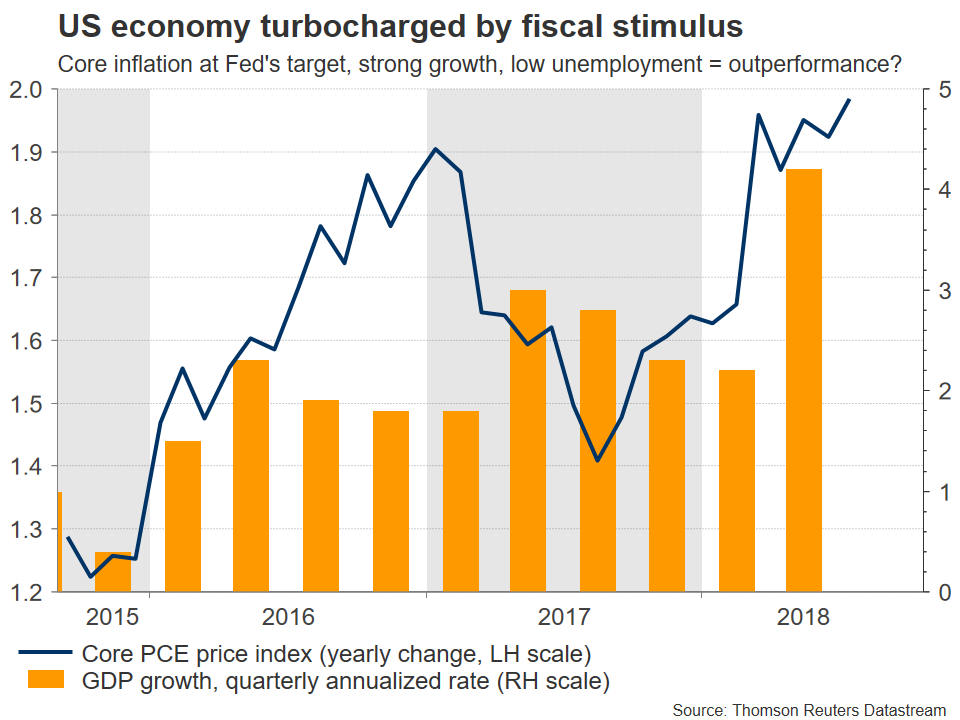
The US currency enjoyed a sweet spot in recent months, gaining ground against all its major counterparts since early April. A fiscally-turbocharged US economy, consistent rate increases by the Fed, and haven inflows by investors seeking shelter for their funds amid escalating trade tensions, all played a large role. Separately, other major currencies like the euro and sterling have been in a “soft patch” of their own. The ECB managed to push the euro lower even while announcing QE tapering, with worries around the Italian budget contributing to the losses, while Brexit risks have been holding the pound down – further pushing investors towards the dollar for a lack of attractive alternatives.
Yet, the dollar’s recent dip has brought this whole narrative into doubt, leading one to question whether this is merely a correction lower in a bigger uptrend, or the beginning of a broader sea-change. So, what factors are currently arguing for weakness in the world’s reserve currency, and what points to a rebound?
US is strong, but most “good news” may be priced in by now
There’s no denying the US economy is robust. Economic growth is above trend and above potential after the recent tax cuts, wage growth seems to be picking up amid a very tight labor market, and core PCE inflation is exactly in line with the Fed’s 2% goal. “Soft data” concur, with NFIB business optimism reaching its highest since records began, consumer morale at 18-year highs according to the CB survey, and both ISM PMIs resting at elevated levels. In the context of financial markets though, it’s fruitful to consider how much of a narrative is already priced into an instrument. In this sense, one could argue most of the “good news” are likely reflected into the dollar’s price already, as the “US outperformance” theme has been dominating for months now.
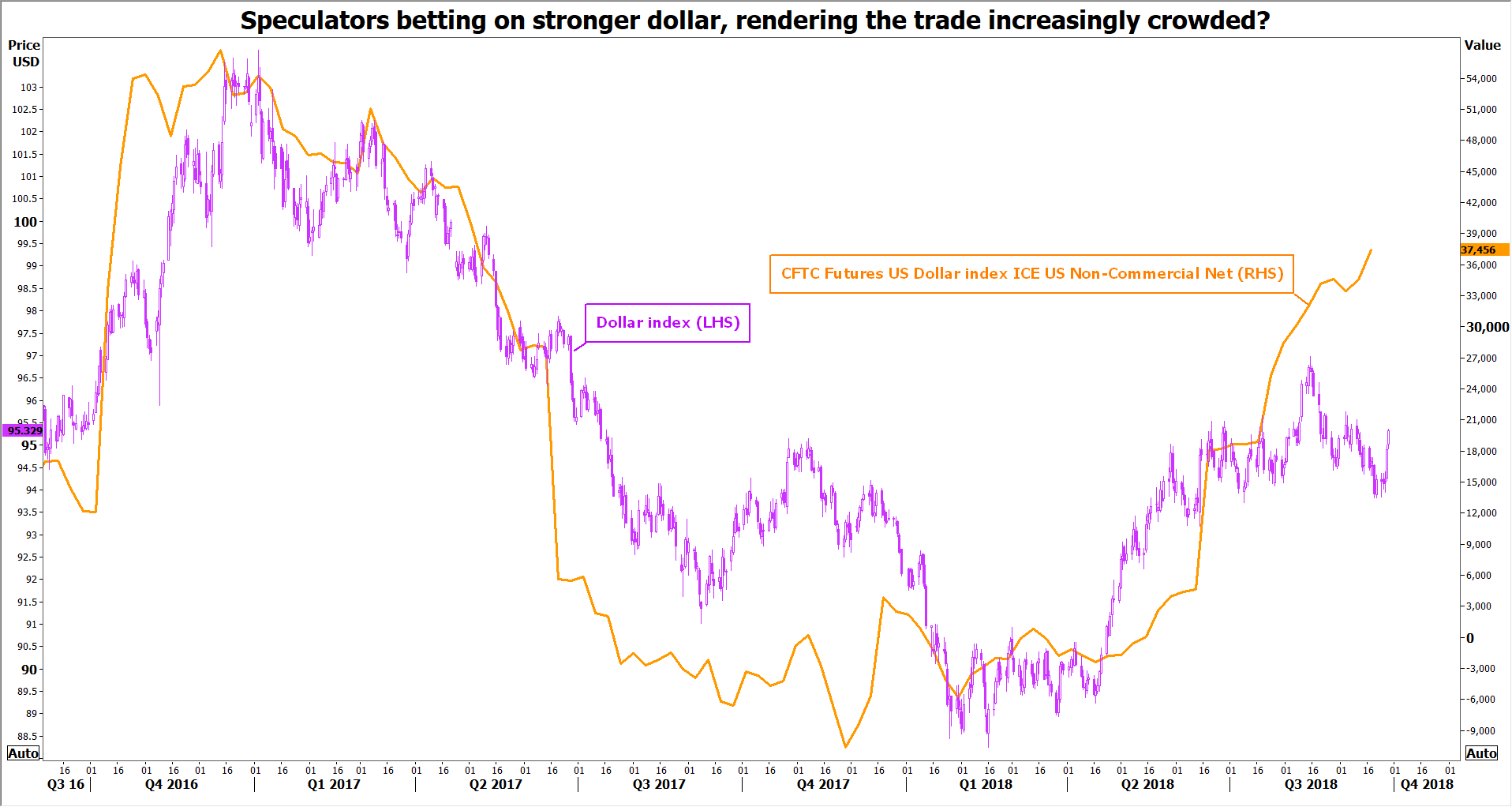
Adding credence to this view, is market pricing around the Fed. Investors currently assign an 80% probability for the central bank to raise rates by a quarter-percentage point in December according to Fed funds futures, while 2 more hikes are largely baked in for 2019 (versus the 3 signaled by the latest Fed “dot plot”). In isolation, this implies the dollar is unlikely to draw too much strength from monetary policy moving forward, even if the Fed proceeds as it expects. Enhancing this concept, is the extent of speculative bullish bets on the currency, which recently touched a one-and-a-half year high, suggesting that long-dollar is becoming an increasingly crowded trade.
Monetary policy divergence nearly run its course
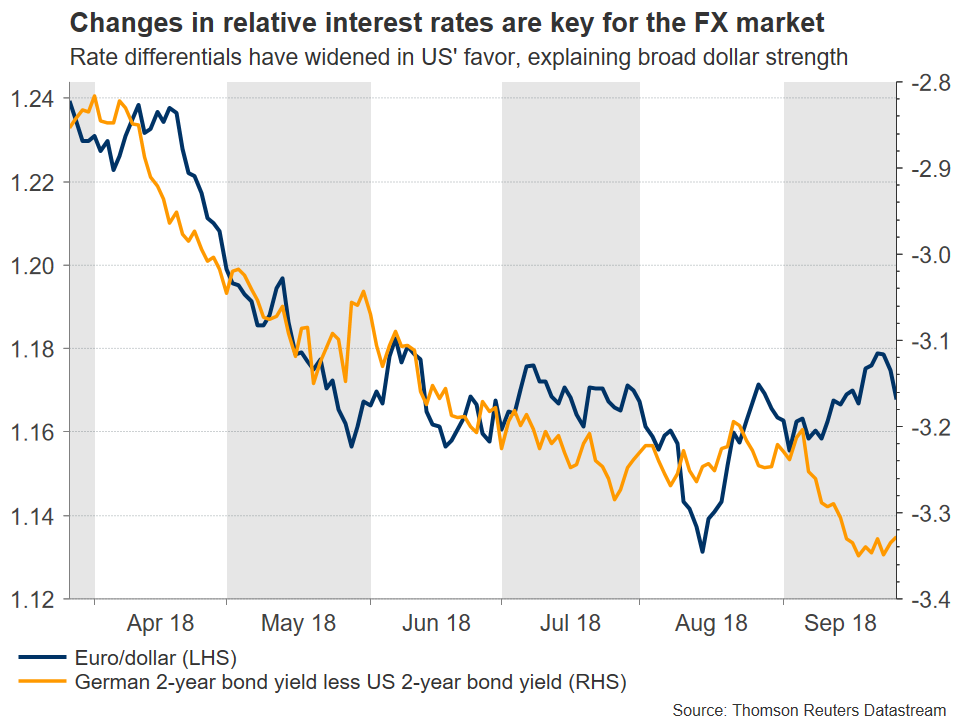
Staying on central banks, it’s worthwhile to consider what other policymakers around the globe are doing. Relative rate differentials between two economies are one of the most important drivers of a currency pair, and much of the dollar’s gains recently were owed to these spreads widening in the US’ favor, as the Fed was among the few central banks raising rates.
Alas, this theme of “monetary policy divergence” may have nearly run its course, giving way to a regime of “policy convergence”, with the likes of the European Central Bank (ECB) announcing rate hikes for next year. In contrast to the Fed, markets haven’t priced too much tightening by the ECB, which suggests the euro may have room to run higher as the first hike draws nearer and markets reprice the rate path. Euro strength typically brings dollar weakness, not least due to the euro holding almost 60% of the weight in the dollar index. While this may be more of a 2019 story, it’s still worth keeping a close eye on.
In the more immediate term, the Italian budget outcome will be key for the euro. Risks surrounding a large budget deficit leading to a “standoff” with the EU have added a significant risk-premium on the euro, dragging the currency lower. While this premium may linger for the time being, should the two sides eventually manage to reach a compromise that avoids a clash, then the single currency could rally in relief.
Other major currencies waiting for a comeback
Beyond the euro, consider the British pound and the yen for a moment, which have been battered by uncertain politics and ultra-loose monetary policy respectively, rendering them quite “cheap” from a long-term valuation perspective. Should UK political risks recede (a Brexit deal) or should the Bank of Japan hint at scaling back stimulus, then these currencies may well stage a comeback – taking demand away from the dollar. Added to these, is the prospect of a rebound in the Chinese yuan, in the (unlikely) event that trade tensions subside sometime soon.
What about upside risks?
The main one relates to the recent surge in US bond yields, and the potential for that to continue. A rise in Treasury yields is traditionally associated with dollar gains, as higher interest rates make the currency more attractive for foreign investors. Yet, while both short- and long-dated US yields have moved higher over the past month, the dollar has pulled back, similar to what transpired in late-2017.
History suggests the two will eventually recouple. The question is whether it will be US yields that turn lower to meet the dollar, or whether the currency will eventually recover amid a continued upturn in yields. When the correlation broke down in late-2017, it was the dollar that eventually raced higher in April of 2018 to meet elevated yields, though that doesn’t mean the same will play out this time around. Make no mistake, this will probably be the most important driver for the dollar moving forward; the currency is unlikely to remain indifferent to a sustained rise in yields for too long, as much as it is unlikely to escape unscathed in case yields come crashing down.
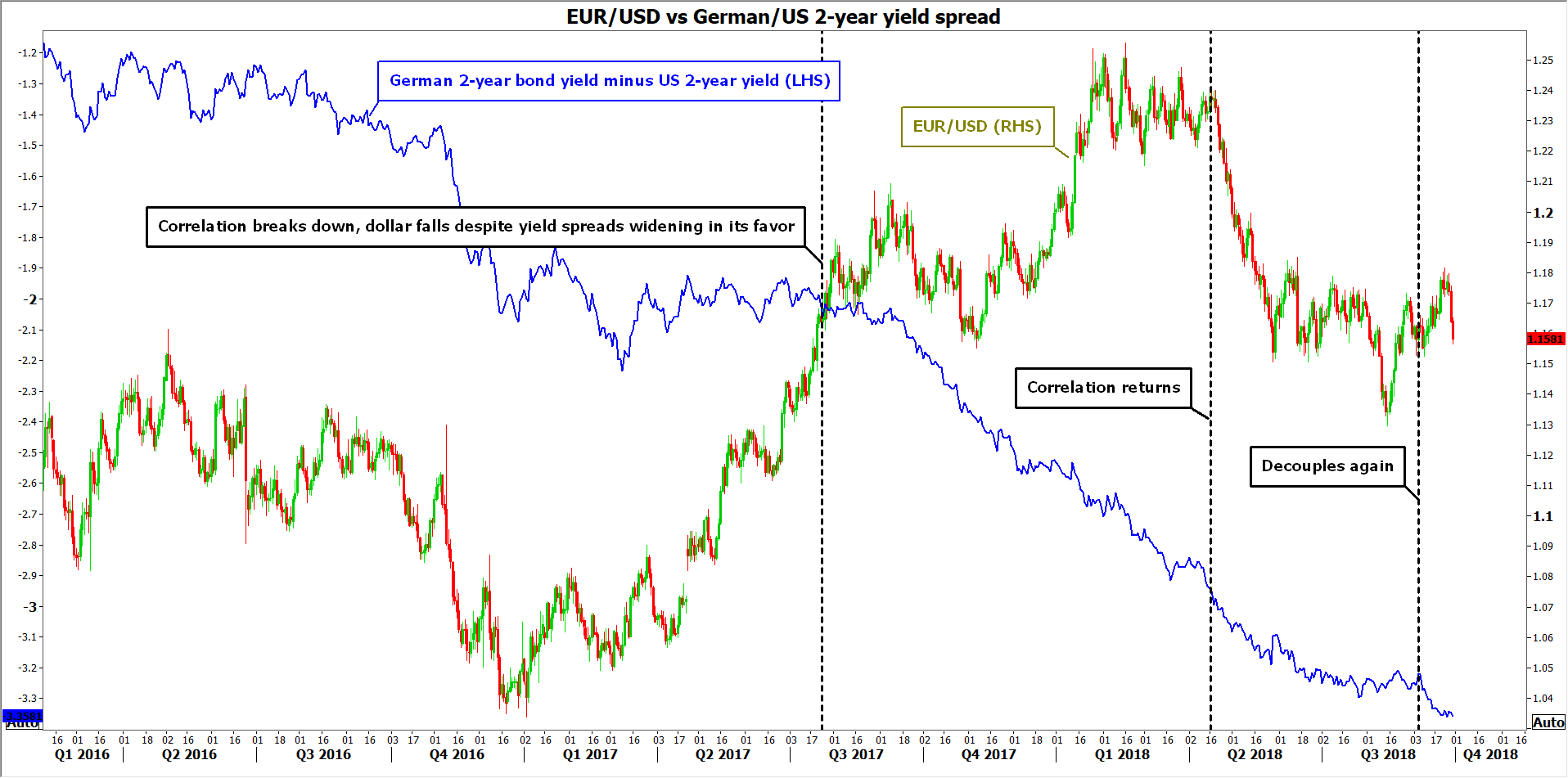
Another upside risk relates to trade, and the prospect of a further escalation in tensions that diverts safe-haven flows into the dollar. To explain – the greenback has been acting as a haven asset amidst trade worries, benefiting when frictions intensified under the view the US economy is better prepared than others to weather any “trade storms”. Hence, increased concerns around trade could prop-up the greenback, though in similar logic, a potential de-escalation in tensions may equally trigger a rotation away from the currency.
Patches of dollar strength left, but broader tide may be turning
With the Fed being nearly – but not fully – priced in over the next quarters, relative rates could continue to act as a source of support for the dollar in the near-term. A possible heating up in trade tensions could also contribute to periodic “patches” of dollar strength. In a broader context though, especially looking towards 2019, the outlook becomes increasingly clouded as the Fed approaches “terminal” rates and prepares to pause hikes at a period when the ECB will be gearing up to raise its own rates, lessening the dollar’s carry appeal.
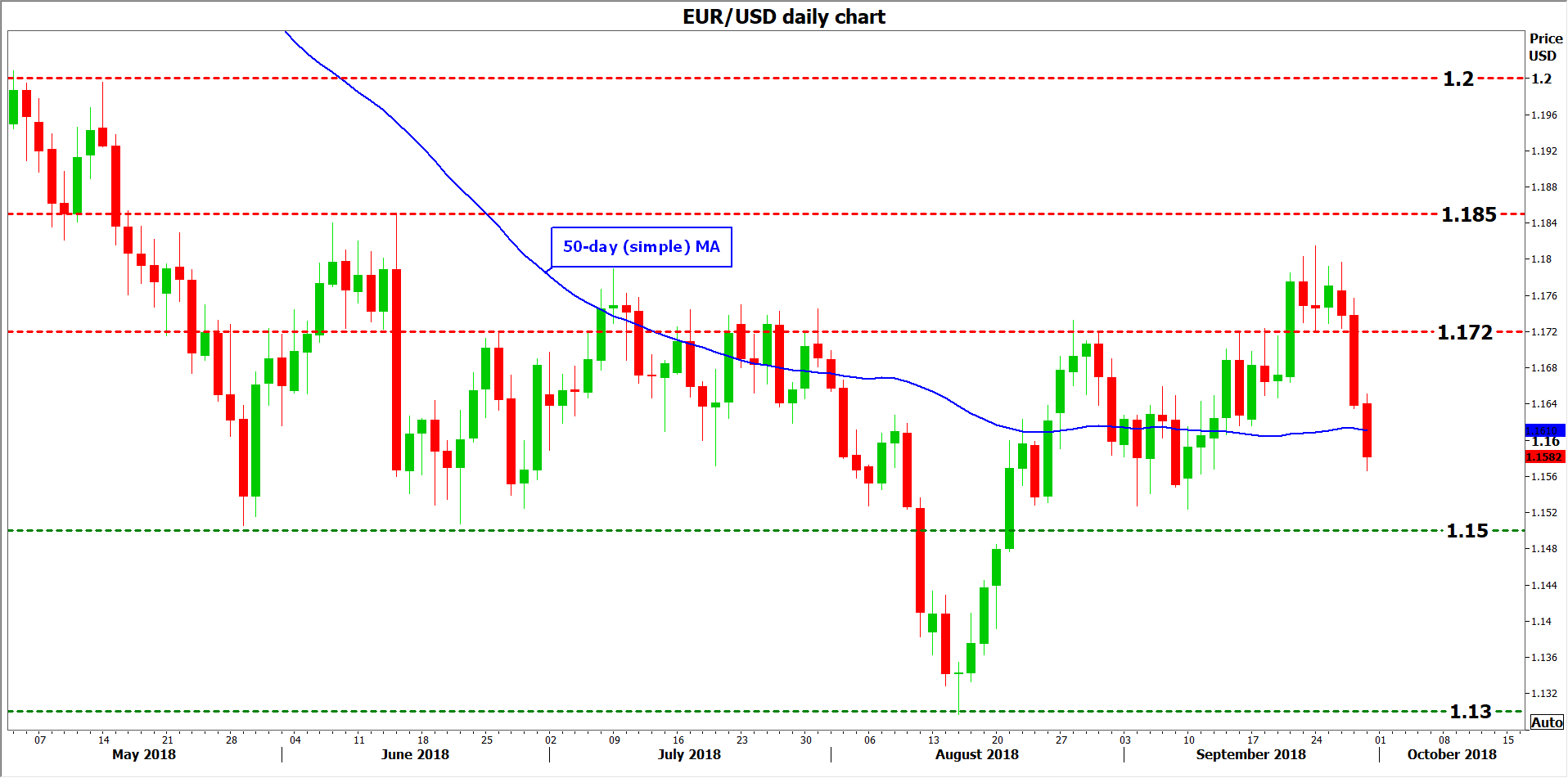
Against this backdrop, while euro/dollar could well challenge the 1.1500 area soon on the back of Italian-budget woes, the risks surrounding the next “large” move seem to be tilted towards the pair eventually visiting the 1.2200 neighborhood again, and not 1.1000. A key level to watch in this respect is the 1.1850 hurdle, which has acted as a significant resistance barrier this year. A break above it is needed to shift the technical outlook to “cautiously positive”, with a move above 1.2000 as well turning it decisively positive. On the downside, a clear break below 1.1500 could be a signal for further declines, initially towards the 1.1300 zone.
RBA to Stand Pat with Bank’s Communication to Drive the Aussie; Trade Remarks Eyed
The Reserve Bank of Australia will be deciding on rates next week, with a policy decision scheduled to be made public on Tuesday at 0430 GMT. No change in rates is anticipated, with the focus falling on the Bank’s level of optimism on the economy as expressed in the statement accompanying the decision; the Aussie will react accordingly.
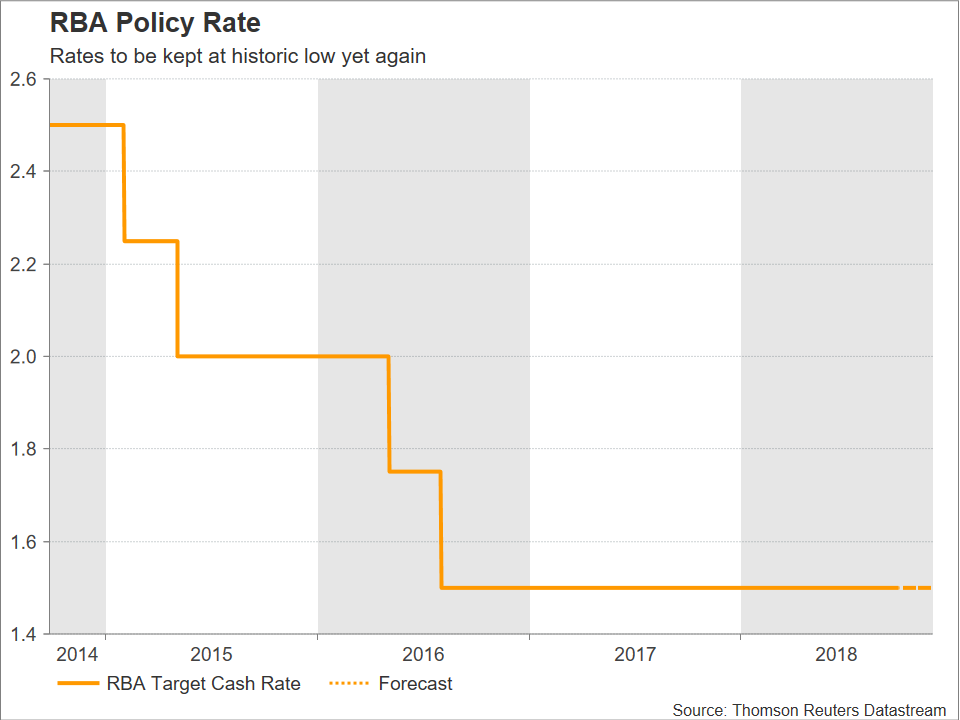
It appears virtually certain that Australia’s central bank will maintain its policy rate at the record low of 1.50% for the 24th straight meeting, this being the longest stretch without an interest-rate move in the nation’s modern history. Moreover, the latest Reuters poll shows economists expecting this to continue for the foreseeable future, with a quarter percentage point hike not predicted to come before end-2019.
The country’s inflation stood at 2.1% y/y in Q2, re-entering the RBA’s target band of 2-3% for the first time since Q1 2017. This is definitely a positive development, though it should be kept in mind that the rise was largely owed to elevated energy prices. Moreover, inflation merely rests within the lower bound of the RBA’s target range, overall not justifying action – a rate increase – by the central bank.
Another factor limiting the Bank’s ability to normalize rates is that a number of the country’s commercial banks decided to raise their mortgage rates fairly recently. In effect, this has similar effects to an RBA rate hike. Namely, it is seen as squeezing already indebted households’ ability to spend and is thus a potential threat to economic growth; a central bank rate increase would only make things worse for Australian consumers.
Given that a move in rates is seen as off the table, the Bank’s communication will dictate positioning on the Aussie. In this respect, recent data releases including a Q2 GDP beat and better-than-forecasted employment figures in August may suggest that a relatively rosy outlook is to be projected by the RBA. Taking away from this though is the ongoing trade dispute between the US and China – the latter is Australia’s largest export destination – and still near record low wage growth despite employment blowing past the most optimistic estimates in August and the unemployment rate remaining at a six-year nadir. Commentary by policymakers on all these will be closely watched.
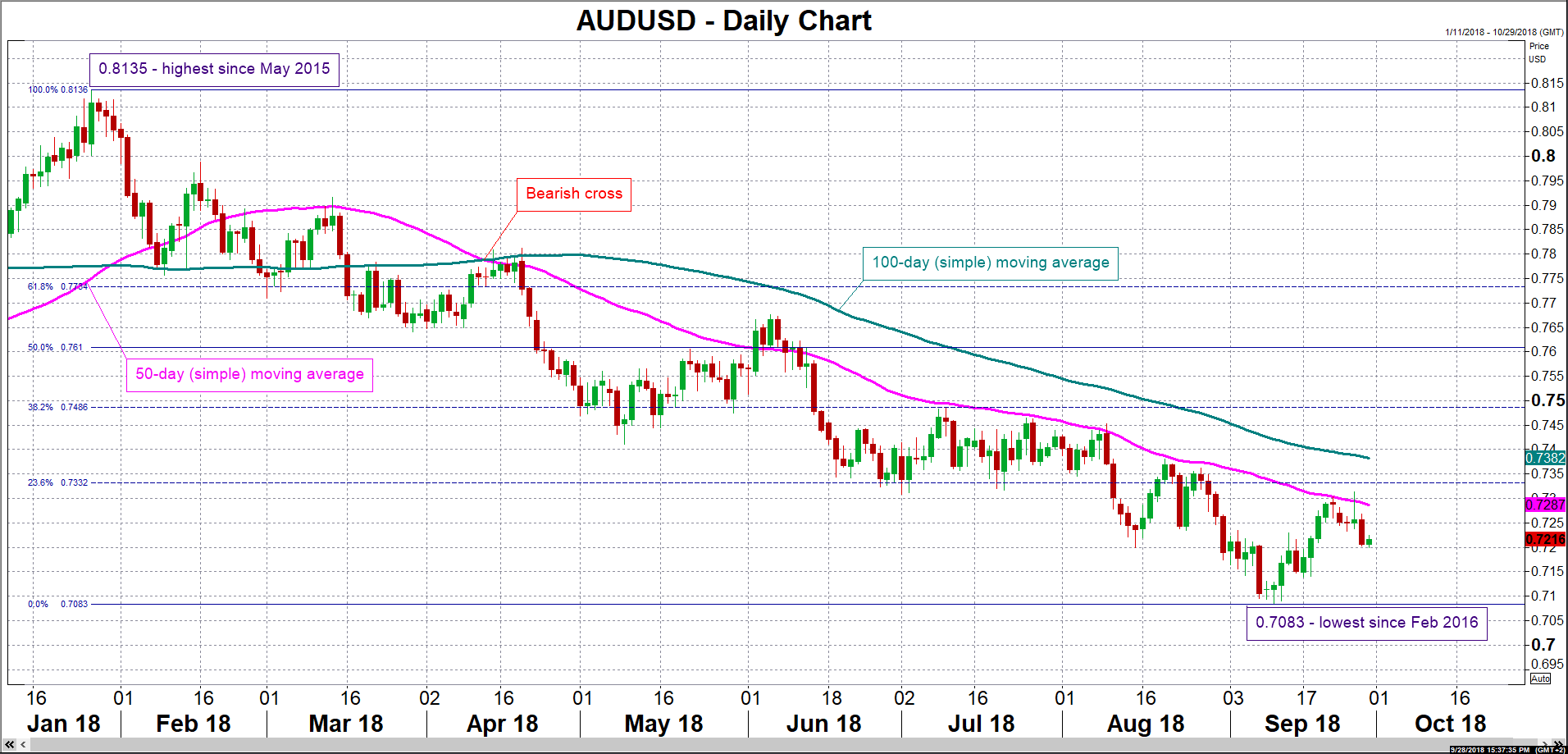
An upbeat tone by the RBA is likely to boost AUDUSD. Resistance to an advancing pair may take place around the current level of the 50-day moving average at 0.7287. Not far above lies the 23.6% Fibonacci retracement level of the downleg from 0.8135 to 0.7083 at 0.7332, while stronger gains may meet a barrier around the 100-day MA at 0.7382; notice that the region around this point was relatively congested between late June to early August.
Conversely and in case of a relatively cautious RBA, declines would bring into scope 0.7083, the pair’s lowest since February 2016 hit on September 11. Steeper losses would turn the attention to the 0.70 mark that may be of psychological importance. It should be kept in mind that a double top from September last year and January-February of the current year on the weekly chart projects towards the 0.69 handle.
Lastly, beyond RBA remarks on global trade and the risks posed on Australia’s economy by a deteriorating trade outlook, actual developments on this front will also be eyed; intensifying tensions are expected to weigh on the Aussie and vice versa. The latest tariff exchange between the US and China taking effect on Monday, the latter opting to abstain from planned trade talks between the two sides, and the former signaling that the 10% levies on $200 billion of Chinese imports would rise to 25% starting 2019 as well as threatening duties on an additional $267 billion of Chinese goods, all suggest that the trade situation is more likely to exert downside pressure on the Australian currency rather than the other way around, at least for the time being.
Week Ahead – After Fed, US Jobs Report to Take Centre Stage; RBA Next to Set Rates
Markets will be looking to the September US jobs report for direction after a mostly unchanged dot plot chart by the FOMC this week failed to clear the fog for the 2019 rate outlook. Apart from the nonfarm payrolls report, monthly PMI readings out of China, the United Kingdom and the United States will also be important. In the central bank spectrum, the Reserve Bank of Australia will be the only major bank holding a policy meeting next week. Meanwhile, trade and political developments will remain at the forefront as another NAFTA deadline passes without a deal and the UK prime minister faces her Brexit plan critics at the Conservative party conference.
Aussie eyes RBA meeting and China PMIs
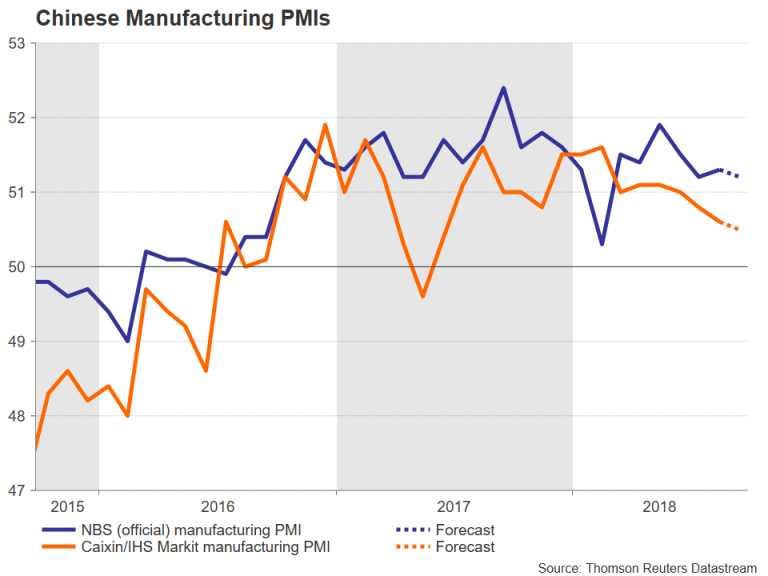
The Australian dollar regained some positive footing in September on the back of increasing evidence from data that supports the RBA’s upbeat forecasts on economic growth. However, lingering global trade tensions have restrained more significant advances and the aussie could face some more negative pressure on Monday if Chinese PMI readings due on Sunday indicate a further easing in manufacturing activity in September. Markets in China will be closed for the whole of next week so both the official and Caixin/Markit PMIs will be released on Sunday. The government’s print on the manufacturing sector is expected to show the PMI index dropping slightly to 51.2 in September. The private Caixin/Markit PMI is also projected to deteriorate, falling from 50.6 to 50.5, which would make it a 15-month low.
Moving to domestic events, the RBA is widely expected to keep its cash rate unchanged at 1.5% on Tuesday and will likely reiterate that inflation and wage growth are anticipated to pick up only gradually, despite stronger economic fundamentals. In terms of data, aussie traders should keep an eye on building approvals on Wednesday, trade figures on Thursday and retail sales on Friday, all for August.
Canadian jobs data to be watched for BoC rate clues
A stalemate in the NAFTA talks has dragged the Canadian dollar away from 3½-month highs reached in mid-September. With Canada refusing to compromise on key issues and subsequently missing a key October 1 deadline, the US looks set to increase the pressure by moving ahead with its bilateral trade deal with Mexico without the participation of the Canadians. However, the slow progress risks an even more drastic action by the Trump administration such as imposing tariffs on Canadian auto imports.
But any escalation in the trade spat between the US and Canada is unlikely to deter the Bank of Canada from raising interest rates in late October and employment figures due on Friday would increase the market odds for a rate hike if jobs growth bounces back in September following a big fall in August. In other data, the September Ivey PMI are out on Thursday, while also on Friday, the trade numbers for August are scheduled for release.
BoJ Tankan survey to point to continuation of moderate growth
US President Trump had better to words to say for his Japanese counterpart this week than for the Canadian prime minister as the US and Japan agreed on a framework to start bilateral trade talks (something Japan had been resisting until now). The agreement means Japan avoids US duties on its car exports for the time being, in a major relief for the country’s dominant manufacturing sector. However, the Bank of Japan’s closely-watched quarterly Tankan sentiment survey due on Monday will likely show Japanese businesses remain cautious about the prospects for the fourth quarter. A slight dip is forecast for the indices measuring the outlook for big manufacturers and non-manufacturers. As for the current quarter, large manufacturers are expected to become slightly more optimistic, but analysts are anticipating large non-manufacturers to turn slightly less positive.
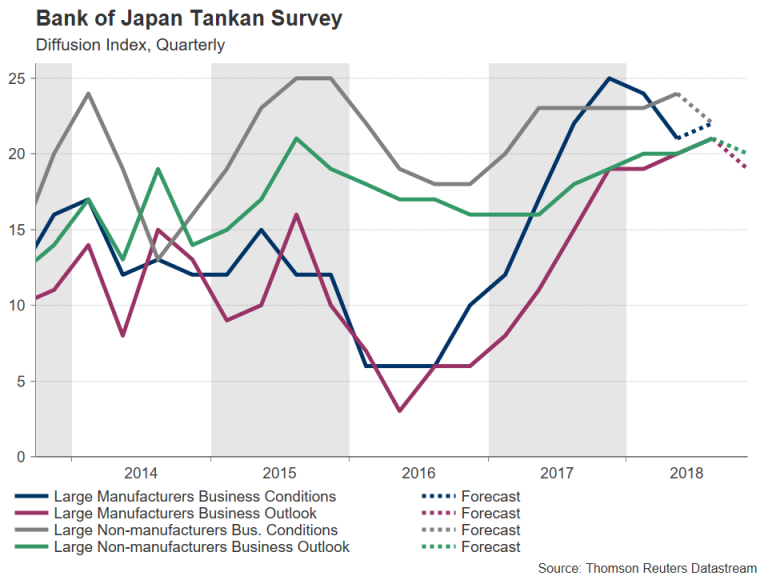
The yen will probably be unmoved by the Tankan survey but could see some reaction to the latest wage growth numbers coming up on Friday. Overall earnings growth in Japan fell back to 1.6% in July after jumping to a 21-year high of 3.3% in June. A rebound in August would signal that wage growth remains on an upward path and that would bode well for domestic demand. Also out on Friday are household spending figures for August.
Absence of major data to keep euro focus on Italy
The Eurozone economic calendar will consist mostly of mid-tier data, meaning traders’ attention will probably remain on political happenings in Rome as Italy’s coalition government scrambles to put together a budget that satisfies EU fiscal rules as well as meet the parties’ election pledges. First up on the release schedule are the final manufacturing PMI print for September and the August unemployment rate on Monday. They will be followed by August producer prices for August on Tuesday. On Wednesday, the final services and composite PMIs are due, along with retail sales figures for August. Finally, German industrial orders for August will be monitored on Friday for a turnaround in factory orders following two straight months of sharp declines.
UK’s May under the spotlight
British Prime Minister, Theresa May’s Brexit plans will come under the scrutiny of her Conservative party members as the party’s annual conference gets under way on September 30. May will address her divided party on the closing day on Wednesday as she attempts to win the backing from both Conservative remainers and Brexiteers for her controversial Chequers plan.
EU leaders rejected the core elements of the Chequers plan at an informal summit on September 20, driving the pound lower. But hopes that a deal could still be reached led sterling to recover to around the $1.32 level before falling back again. The rebound could be shortlived, however, if May suffers another humiliation at her party conference and senior Conservatives become even more vocal in urging her to ditch her plan in favour of a Canada-style free trade agreement with the EU.
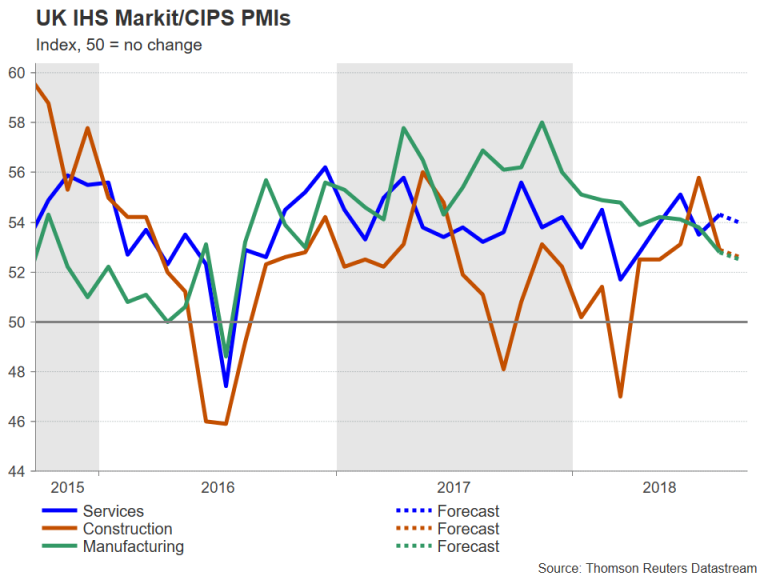
The ongoing Brexit drama could overshadow PMI figures out of the UK in the coming week. The manufacturing PMI, which has been on a downward path since late 2017, is released first on Monday and will be followed by the construction and services PMIs on Tuesday and Wednesday, respectively. All three PMIs are forecast to decline in September.
US wage growth to hit 3%
The US dollar got a lift from the Fed’s September policy meeting in the past week as Chairman Jerome Powell signalled that rates would continue to go up even if they are nearing their perceived neutral level. The greenback could get an additional boost from the latest jobs report due on Friday, but before then, there will be plenty of other data for traders to watch.
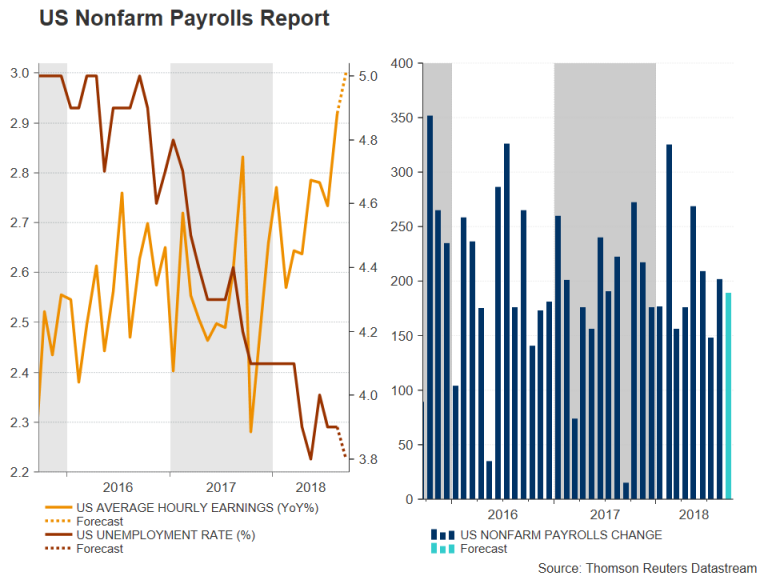
After a surprise surge in August, the ISM manufacturing PMI is expected to ease marginally in September when released on Monday. The ISM’s non-manufacturing PMI will follow on Wednesday and is also forecast for a slight drop in September. Also out the same day is the ADP employment report, which is often seen as a preview to the official jobs numbers. On Thursday, the only major data will come from the August factory orders before attention turns to the nonfarm payrolls report on Friday. The US economy is forecast to have added 188k jobs in September, somewhat less than the 201k gains seen in the prior month. The jobless rate is expected to inch lower by 0.1 percentage points to 3.8%, signalling a further tightening in the labour market and this will likely be evident in the monthly wage numbers. Average hourly earnings are projected to have risen by 3.0% year-on-year in September, which would mark the fastest rate in nine years.
If the jobs report fails to excite the markets, the dollar could enjoy more action from Fed officials as several FOMC members will take to the podium, including Chairman Powell. Any remarks on the pace of rate increases in 2019, as well as on trade risks, could prove market-moving. In the meantime, trade-related headlines will keep investors on edge, especially if there are any developments in the negotiations with China and Canada.
Weekly Focus: Crucial Week for European Politics
Market Movers ahead
- In the US, non-farm payrolls are likely to show healthy gains along with another uptick in wage growth.
- In Europe, the Italian budget projections will continue to be a theme for financial markets as well as the reaction from the EU commission and rating agencies.
- In the UK, the Conservative Party Conference beginning on Sunday and lasting until Wednesday will be critical for the outlook of Brexit negotiations with the EU.
- In China, there are downside risks to the PMI number for September in light of the trade war with the US, while Japan may see a small rebound in business confidence.
- In Sweden, government formation talks will be watched along with the PMI survey, which should post a modest rebound.
Global macro and market themes
- Market participants are not waiting for the first ECB hike to actually arrive before reacting.
- The next big move in EUR/USD is up when the first ECB hike draws closer. We forecast 1.25 in 12M.
- The US economy is in great shape despite trade war concerns supporting the case for further Fed rate hikes and higher US Treasury yields.
BoE Ramsden: Range of outcomes for Brexit clearly still possible
BoE Deputy Governor Dave Ramsden said the central bank is so far still adopting the assumption of smooth Brexit in its forecasts. But he also noted that a "range of outcomes for Brexit are clearly still possible".
Pointing to the market, he said "option pricing implies that market participants are insuring to a greater degree against tail outcomes." Also, Sterling's depreciations suggested a "greater increase in relative weight on downside outcomes".
Nonetheless, he played down the moves and noted that were still small relative to those we saw ahead of the referendum."
ECB Lane: Fairly sure core inflation on upward path
ECB Governing Council Member Philip Lane said policymakers are "fairly sure that core (inflation) is on an upward path", "not spectacular but steady enough". Also, he added "the support of more jobs, more labor income driving consumption is very strong."
He also reiterated ECB's forward guidance that interest rates will stay at present levels at least through summer of 2019. But he also noted that "it is not committing to any particular date for lift-off, so there is a clear commitment there, which is that it's open to revisions depending on where the data come in."