Sample Category Title
US personal income and spending missed expectations, core PCE unchanged at 2%
US personal income rose 0.3% in August, below expectation of 0.4%. Spending rose 0.3%, below expectation of 0.4%. Headline PCE slowed to 2.2% yoy, down from 2.3% yoy and missed expectation of 2.3% yoy. Core PCE was unchanged at 2.0% yoy, matched expectations.
Dollar is generally firm and steady after the release, except versus Canadian.
Canadian Dollar jumps as GDP grew 0.2%, led by manufacturing
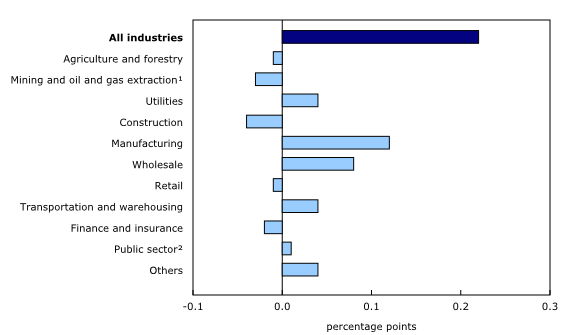
Canadian Dollar surges after stronger than expected GDP data. GDP grew 0.2% mom in July versus expectation of 0.1% mom. The growth was "concentrated" as 12 of 20 sectors were up, led by manufacturing, wholesale trade, utilities and transportation and warehousing. Good-producing industries grew 0.3% mom while services-producing industries grew 0.2% mom. Full released here.
Also from Canada, IPPI dropped -0.5% mom in August. RMPI dropped -4.6% mom.
Euro on Slippery Road; US Core PCE Inflation Next in Focus
Here are the latest developments in global markets:
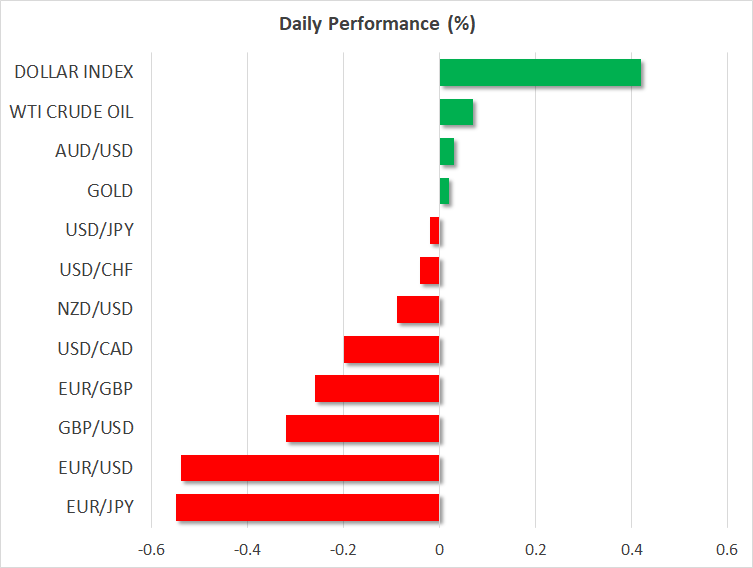
FOREX: The dollar maintained yesterday’s impressive rally against the Japanese yen, consolidating gains around 113.34 as the US confirmed a strong 4.2% q/q GDP growth in the second quarter, the highest since Q2 2016, signaling further rate hikes in the future. Monthly US durable goods orders printed a sharper increase in August than analysts thought, adding further spark to the greenback on Thursday. The dollar index head up to 95.28 (+0.41%) as the pound and the euro remained on the downside. Pound/dollar slipped to a two-week low of 1.3032 (-0.33%) after the final yearly Q2 GDP growth figure out of the UK was revised lower to 1.2%, from 1.3% in the second estimate, while the print for Q1 was also marked lower to 1.1% y/y. Final UK business investment readings were discouraging too, ending the second quarter in negative territory. Economic issues in Italy were the main drag on the euro today after the Italian government announced a budget deficit of 2.4% in 2019 which is below the 3.0% EU debt limit but above what markets expected. The flash core CPI figure for September out of the bloc disappointed as well, inching down to 0.9% in yearly terms from 1.1% expected and 1.0% seen in August. Euro/dollar dived to a more than a 2 ½ -week low of 1.1575 (-0.54%), euro/pound fell to 0.8877 (-0.25%), while euro/yen tumbled to 131.22 (-0.55%). In antipodean currencies, aussie/dollar and kiwi/dollar were moving in different directions, with the former improving to 0.7209 (+0.04%) and the latter decreasing to 0.6611 (-0.11%). Dollar/loonie was changing hands lower at 1.3016 (-0.18%), a day after the BoC Governor said that the economy is operating near capacity and that the central bank will continue to raise rates gradually. Moreover, he expressed optimism on NAFTA a few days before the October 1 deadline.
STOCKS: European equities were in the red at 1130 GMT with financial stocks led by Italian banks losing more than 1% following the announcement of a bigger-than-expected budget deficit. The pan-European STOXX 600 and the blue-chip Euro STOXX 50 dropped by 0.83%. The Italian FTSE MIB was the worst performer diving by 4.11%, the German DAX 30 lost 1.44% and the French CAC 40 retreated by 0.93%. In the UK, the FTSE 100 inched down by 0.71%, while in the US futures tracking the S&P 500, Dow Jones and Nasdaq 100 were flat. In Asia stocks closed in positive territory, with Chinese and Japanese indices gaining around 1%.
COMMODITIES: Crude oil prices were in positive terittory amid evidence that Iranian crude exports were suffering from US sanctions, while investors feared additional losses in the coming months as the US is ready to kick off a second round of sanctions against Tehran on November 4. Data showed that purchases of Iranian crude oil by major Asian buyers fell to two-month lows in August. Yet, reports that Saudi Arabia is planning to increase production by up to 600k bpd in the coming months to offset supply shortages in Iran, limited gains in the market. WTI crude and the London-based Brent were last seen at $72.17/barrel (+0.07%) and $82.25 (+0.65%) respectively. In precious metals, gold steadied at $1,182.6/ounce after hitting six-week lows at $1,181.6 on Thursday.
Day Ahead: PCE inflation closely watched in US; Canadian GDP coming up
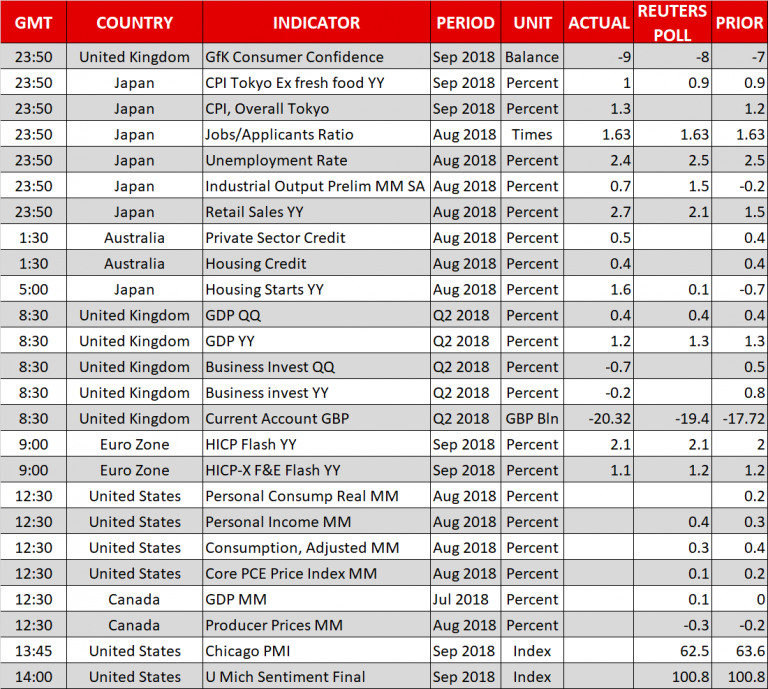
The most significant data release later today will be the US core Personal Consumption Expenditure (PCE) index for August, the Fed’s favorite inflation measure. It will be released alongside personal income and spending figures for the same month, at 1230 GMT, while at 1345 GMT the Chicago PMI will also come under review. Flash estimates for the core PCE rate support that inflation remained unchanged at 2.0% in yearly terms, however, on a monthly basis the measure is predicted to inch down to 0.1% from 0.2% previously. Meanwhile, both income and spending are projected to have risen by 0.4% m/m and 0.3% m/m, from 0.3% and 0.4% previously correspondingly.
Remaining in the US, at 1400 GMT, the University of Michigan will deliver final readings on consumer sentiment and inflation expectations for the month of September. Forecasts suggest the consumer sentiment index is to hold flat at 100.8. The survey related to inflation expectations will attract interest as well.
Following the US and the UK, Canada will publish GDP growth figures too. The Canadian economy is said to have expanded by 0.1% month-on-month in July from 0.0% in the preceding month. Any deviation from expectations could trigger some volatility in the loonie.
In energy markets, investors will keep a close eye on the US oil rig count issued by the Baker Hughes company at 1700 GMT. Potential increases in active drilling rigs are likely to add pressure to oil prices.
As of today’s public appearances, at 1130 GMT the Irish Central Bank Governor Philip Lane and the Deputy Governor at the Bank of England Dave Ramsden will have a talk about the economic outlook and monetary policy. The latter will be making comments at 1320 GMT as well. Later, Federal Reserve Bank of Richmond President Thomas Barkin and Federal Reserve Bank of New York President John Williams will be delivering speeches at 1530 GMT and 2045 GMT respectively. The ECB chief economist Peter Praet will be participating in a panel in Frankfurt at 1535 GMT.
On Sunday, the UK ruling Conservative Party will start its three-day annual conference in Birmingham to discuss political strategies. The event could be a challenging one for the UK Prime Minister as it comes a week after the EU rejected her Chequers Brexit plan, with May probably making efforts to persuade her counterparts that she is the appropriate leader to help the UK leave the EU. Brexit protesters, though, are not expected to take the back seat. May is scheduled to address the event early on Wednesday, though sterling could show some volatility on Monday in the wake of fresh Brexit headlines.
Canadian Dollar Edges Higher, Canadian GDP ahead
The Canadian dollar has slight gains on Friday, erasing the losses seen on Thursday. Currently, USD/CAD is trading at 1.3018, down 0.18% on the day. On the release front, Canada will publish GDP, which is released each month. The July release is expected to show a weak gain of 0.1%. In the U.S, the focus is on consumer reports. Personal Spending is expected to edge lower to 0.3%, while UoM Consumer Sentiment is expected to climb to 100.5 points. The indicator last broke through the symbolic 100 level in March. As well, the U.S releases Core PCE Price Index, the preferred inflation indicator of the Federal Reserve, with an estimate of 0.3%.
The next rate meeting for the Bank of Canada is not until late October, but the bank is already under strong pressure to raise rates. The Federal Reserve raised rates on Wednesday and another rate hike is expected in December, which would be the fourth hike in 2018. On Thursday, BoC head Stephen Poloz said that the bank will continue to raise rates gradually and that a key priority for the BoC would be preventing inflation from gaining momentum. The BoC has raised rates some four times since July 2017, but has shown some hesitancy to raise rates due to trade war tensions, as Canadian and U.S negotiators have yet to agree on a new NAFTA accord.
As widely expected, the Federal Reserve pressed that rate trigger for the third time this year, raising the benchmark rate by a quarter-point, to a range of 2 percent to 2.25 percent. The Fed intends to continue gradually raising rates, with another rate hike expected in December and three hikes in 2019. What was of more interest to investors was the rate statement, in which the Fed removed the word ‘accommodative’ in the statement, which means that the Fed now considers monetary policy to be neutral. Fed Chair Jerome Powell, in a bid to keep markets calm, stated in a follow-up press conference that removing accommodative language in the statement did not reflect a change in policy. Still, the markets were upbeat after the Fed meeting and the U.S dollar has responded with gains against the Canadian dollar on Thursday.
GBPUSD – Faces Bear Pressure, Targets 1.3000 Zone
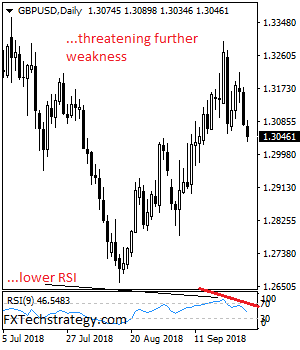
GBPUSD - faces bear pressure as it weakens further on the back of its Thursday sell off. Resistance stands at the 1.3100 with a turn above here allowing for more strength to build up towards the 1.3150 level. Further out, resistance resides at the 1.3200 level followed by the 1.3250 level. Support lies at the 1.3000 level where a break will turn attention to the 1.2950 level. Further down, support lies at the 1.2900 level. Below here will set the stage for more weakness towards the 1.2850 level. Its daily RSI is bear and pointing lower suggesting further bear pressure. On the whole, GBPUSD remains biased to the downside.
Into US session: Euro weakest on Italy, Dollar mixed awaiting PCE inflation
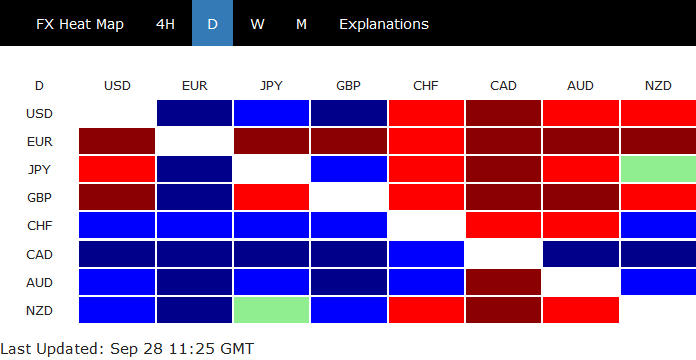
Entering into US session, Euro is trading as overwhelmingly the weakest one as markets respond rather negatively to Italy's budget deficit plan. Additionally, Eurozone core CPI unexpectedly slowed in September, pointing to risk of reducing underlying price pressure. Euro is the second weakest after Swiss Franc for the week, but it will very likely over take the place should the selloff continue. On the other hand, Canadian Dollar and Australian Dollar are the strongest ones today. But that's mainly because Dollar's rally slowed ahead of PCE inflation data.
Major European indices are trading all in red at the time of writing. DAX leads the way lower, down -1.35%, CAC is down -0.79% and FTSE is down -0.63%. Italian 10 year yield is trading up 03.329 at 3.221. German 10 year bund year is down -0.062 % 0.470. Suddenly, 300 yield spread is not too far away again.
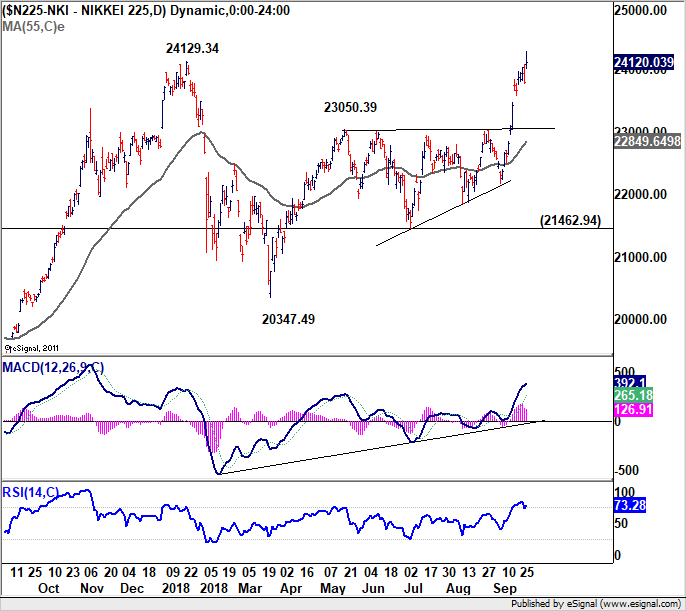
Risk appetite was strong in Asia thought. Nikkei reached as high as 24286 and breached 24129.34 resistance. But it closed at 24120.04, up 1.36%. Hong Kong HSI was up 0.26%, China Shanghai SSE up 1.06% and Singapore Strait Times was up 0.64%.
Euro Slides On Weaker Core Inflation
- Euro under pressure on weaker Core CPI
- Italian Indices tank on higher budget deficit agreement
- Weak Yen helps push Nikkei to 27 year high
Asia:
- Nikkei reaches highs not seen since early 1990s
- Bank of Japan cuts super-long bond purchases in Oct (as expected)
- Japan Aug Prelim Industrial Production misses consensus, Retail Sales beats, Jobless rate falls to 2.4% lowest level since early 1990s.
- China Commerce Min spokesperson: extreme pressure from US will not cripple the Chinese economy
Europe:
- Italy is said to have agreed on a 2019 budget plan coming at the high end of expectations at 2.4%; Tax cuts and pension reforms have been agreed upon, and the agreement will not raise the sales tax.
- Italy requests Fin Min Tria stay on as Finance minister
- Core Eurozone CPI falls below forecasts and adds pressure on the Euro
- UK final Q2 GDP reading revised slightly lower
Macro
- (IT) Italy: Markets unimpressed by the populists' push for a higher deficit/GDP ratio. The appointment of Tria as Finance Minister during the formation of the Eurosceptic coalition government had helped to bring yields down from highs, but as yesterday's struggle suggests, he may not be strong enough to keep the populists under control.
- (FR) France: August Consumer Spending jumped 0.8% m/m in August, significantly boosted by a 4.1% m/m increase in spending on durable goods. Car purchases jumped 10.1% y/y in August ahead of new EU emissions tests on September 1. This suggests that the strong August number may be a one-off and not be sustainable.
- (DE) Germany: German jobless numbers dropped 23K to a record low of 5.1%. The jobless rate is rapidly approaching the neutral rate, highlighting that structural unemployment remains elevated, with the ongoing shortage in skills underpinning unemployment.
- (UK) UK: According to the Research Centre for Social Research's poll-of-polls, 52% of the UK's population would now favor remain versus 48% favoring leave. The tracker used the average share of the vote in six of the most recent polls.
- (EU) Eurozone: September HICP inflation ticked up to 2.1% y/y. As with the German number yesterday, the core rate actually ticked lower to 0.9%. The heatwave across Europe impacted harvests but is not directly translating into higher food price inflation. The ECB thus can point to the dip in the core rate to continue to justify its current accommodative policy stance, especially as food consumption is effectively price inelastic.
SPEAKERS/FIXED INCOME/FX/COMMODITIES/ERRATUM
Equities
- Indices [Stoxx50 -0.7% at 3,426, FTSE -0.1% at 7,540, DAX -0.7% at 12,346, CAC-40 -0.3% at 5,522, IBEX-35 -1.0% at9,432 , FTSE MIB -2.7% at 20,922, SMI flat at 9,109, S&P 500 Futures flat]
- Market Focal Points/Key Themes: European indices open down across the board with Italy leading the way, maintaining negative as the session progressed; high deficit agreement from Italy puts markets on edge; financials impacted following Italy budget agreement; auto sector also underperforming; consumer discretionary among better performers; attention on month- and semester-end macroeconomic data; Czechia closed for holiday; upcoming earnings expected in the US session include BlackBerry and Vail Resorts; next week China will be closed for Golden Week holiday
Equities
- Consumer discretionary: Beter Bed BBED.NL +0.8% (asset sale), easyjet EZJ.UK -0.4% (guidance), Publicis PUB.FR -0.3% (Accenture reportedly not to bid), WPP WPP.UK -1.7% (Reportedly US prosecutorial probe in ad market)
- Energy: Spie SPIE.FR +2.9% (analyst action)
- Financials: Moscow Exchange MOEX.RU -4.9% (will not pay interim dividend), Royal & Sun Alliance Insurance Group RSA.UK -9.0% (trading update), Serco Group SRP.UK +15.1% (trading update)
- Healthcare: Essity ESSITY-A.SE -3.5% (restructuring)
- Industrials: Astaldi AST.IT -14.7% (applies for creditor protection), BASF BAS.DE -2.2% (outlook), Dialight Plc DIA.UK -6.0% (outlook), SAAB SAABB.SE +8.0% (contract)
- Materials: K+S AG SDF.DE +1.8% (impact from stoppage)
Speakers
- (EU) ECB's Lane (Ireland): Italy budget plan will be analyzed; Budget plan will feed into Dec
- (IN) India FIn Min: Had detailed discussion on States Revenue position at today GST council meeting
- (IT) Italy Dep PM Di Maio: We must have dialogue with Europe and not argue
- (IT) Italy's Salvini: FInMin Tria not in danger, he's a member of the government
Currencies
- EUR/USD trades lower following the Italian Budget agreement and lower Core Eurozone CPI. Currently pair trades 1.1605, a 2 week low.
- GBP/USD ticked lower on a revised Y/Y GDP print, coming of a high of 1.3090
Fixed Income
- Bund Futures trades at 158.67 up 20 ticks after Rome agrees on a higher deficit target. Resistance moves to 161.82 then 163. A downside break of 158.25 sees 157.69 initially.
- Gilt futures trades at 121.10 up 23 ticks following the move in Treasuries. Continued support at 120.50, with a continued move higher targeting 123.93 then 124.00.
- Friday's liquidity report showed Thursday's excess liquidity fell from €1.855T to €1.841T. Use of the marginal lending facility stayed fell from €48M to €29M.
- Corporate issuance saw 2 issuers raises $3.3B in the primary market; Lipper fund flows saw inflows of $1.8B, while High Yield had $1.6B of outlflow
Economic Data:
- (UK) Q2 FINAL GDP Q/Q: 0.4% V 0.4%E; Y/Y: 1.2% V 1.3%E (UK) Q2 Current Account: -£20.3B v -£19.4Be
- (ES) SPAIN SEPT PRELIMINARY CPI M/M: 0.2% V 0.2%E; Y/Y: 2.2% V 2.2%E
- *(FR) FRANCE SEPT PRELIMINARY CPI M/M: -0.2% V -0.2%E; Y/Y: 2.2% V 2.3%E
- (FR) FRANCE AUG CONSUMER SPENDING M/M: 0.8% V 0.3%E; Y/Y: 1.3% V 0.7%E
- (DE) GERMANY SEPT UNEMPLOYMENT CHANGE: -23K V -9KE; UNEMPLOYMENT CLAIMS RATE: 5.1% V 5.2%E
- (FR) France Aug PPI M/M: 0.2% v 0.6% prior; Y/Y: 3.7% v 4.0% prior (ES) Spain Q2 Final GDP Q/Q: 0.6% v 0.6%e; Y/Y: 2.5% v 2.7%e
- (CH) Swiss Sept KOF Leading Indicator: 102.2 v 100.0e
- (SE) Sweden Aug Retail Sales M/M: 0.8% v 1.0%e; Y/Y: 2.0% v 0.6%e
- (NO) Norway Sept Unemployment Rate: 2.3% v 2.2%e
Looking Ahead
- 06:00 (IE) Ireland Aug Retail Sales Volume M/M: No est v +6.5% prior; Y/Y: No est v 5.5% prior
- 06:00 (PT) Portugal Aug Industrial Production M/M: No est v 0.7% prior; Y/Y: No est v -1.7% prior
- 06:00 (PT) Portugal Aug Retail Sales M/M: No est v -1.0% prior; Y/Y: No est v 2.2% prior
- 07:30 (IN) India Weekly Forex Reserves
- 08:00 (BR) Brazil Aug National Unemployment Rate: 12.2%e v 12.3% prior
- 08:00 (ZA) South Africa Aug Budget Balance (ZAR): -9.2Be v -96.0B prior
- 08:00 (ZA) South Africa Aug Trade Balance (ZAR): -1.8Be v -4.7B prior
- 08:00 (CL) Chile Aug Industrial Production Y/Y: 0.0%e v -1.6% prior
- 08:00 (CL) Chile Aug Unemployment Rate: 7.2%e v 7.3% prior
- 08:15 (UK) Baltic Dry Bulk Index - 08:30 (US) Aug PCE Core M/M: 0.1%e v 0.2% prior; Y/Y: 2.0%e v 2.0% prior
- 08:30 (US) Aug PCE Deflator M/M: 0.1%e v 0.1% prior; Y/Y: 2.2%e v 2.3% prior
- 08:30 (US) Aug Personal Income: 0.4%e v 0.3% prior; Personal Spending: 0.3%e v 0.4% prior
- 08:30 (CA) Canada Aug Industrial Product Price M/M: -0.4%e v -0.2% prior; Raw Materials Price Index M/M: No est v % prior; Y/Y: No est v 0.7% prior
- 08:30 (CA) Canada July GDP M/M: 0.1%e v 0.0% prior; Y/Y: 2.2%e v 2.4% prior
- 09:00 (RU) Russia Q2 Final Current Account: No est v $22.3B prior
- 09:30 (BR) Brazil Aug Nominal Budget Balance (BRL): -58.2Be v -29.2B prior; Primary Budget Balance: -16.0Be v -3.4B prior
- 09:45 (US) Sept Chicago Purchasing Manager: 62.0e v 63.6 prior
- 10:00 (MX) Mexico Aug Net Outstanding Loans (MXN): No est v 4.27T prior
- 10:00 (US) Sept Final University of Michigan Confidence: 100.5e v 100.8 prior
- 11:00 (CO) Colombia Aug National Unemployment Rate: No est v 9.7% prior
- 13:00 (US) Weekly Baker Hughes Rig Count data
EURUSD Outlook: Bears Extend Despite Positive German/EU Data
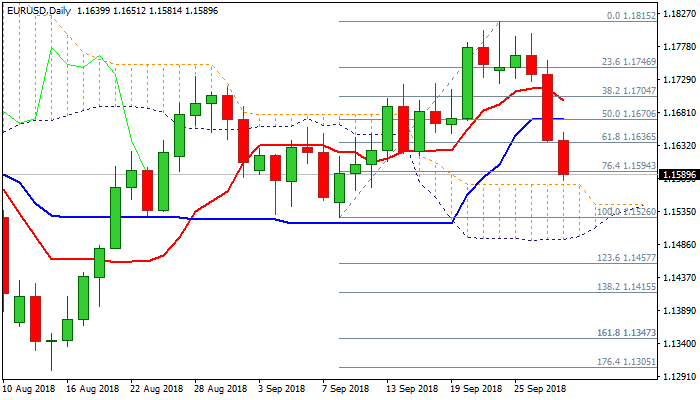
The pair dips below 1.16 handle in extension of previous day's strong fall, after brief consolidation in early Friday's trading was capped by broken falling 10SMA (1.1651). Fresh bears broke below 1.1594 (Fibo 76.4%) and pressure daily cloud top (1.1574) violation of which would lead towards full retracement of 1.1526/1.1815 upleg. Daily momentum is about to break into negative territory and maintains bearish pressure, as daily cloud is thinning and will twist late next week, which could further attract bears. Better than expected German labor data in Sep and higher inflation in the Eurozone provided no help to the single currency as Italian government decision to set higher than expected budget deficit for the next three years, brings Italy in collision with Brussels, offset positive impact from data. Bears so far show no signs of fatigue, however, oversold slow stochastic warns of consolidative action in the near term. Upticks are expected to provide better selling opportunities and should be capped at 1.1616/1.1636 zone (broken 55SMA / broken Fibo 61.8% of 1.1526/1.1815 bull-leg).
Res: 1.1616, 1.1636, 1.1651, 1.1670
Sup: 1.1574, 1.1565, 1.1526, 1.1497
UK Conservative Conference The Next Source Of Volatility For Sterling
All roads will lead to Birmingham on Sunday, where the UK’s ruling Conservative Party will hold its annual three-day conference to map out its political strategies. With the coming weeks being the make-or-break period for reaching a Brexit deal, sterling will likely be ultra-sensitive to any remarks around the negotiations, as well as any hints that Theresa May’s leadership could be challenged moving forward.
While this conference will cover a wide range of topics, the financial community will have its gaze locked on anything Brexit-related, as the negotiations are now entering their final stretch. Another (crucial) point to watch is whether the hardline Brexiteers within the party will seek to challenge Theresa May’s leadership. While this group may not go as far as launch a leadership contest at the conference itself, the tone of their remarks will still be important, as they could attempt to set the stage for a “coup” later on in case they are dissatisfied with any “soft” deal she brings back to Parliament. Specifically, the comments of key ministers on May’s Chequers plan, which she has insisted remains the main basis for negotiations despite discontent among Brexiteers, will be closely eyed.
As for the potential ramifications on sterling, the worst-case scenario would probably be an immediate leadership challenge, especially by a popular Tory figure like Boris Johnson. Political uncertainty would reach new heights in such a case, not least due to the possibility the process drags on, rendering the government leaderless at a time when all efforts should be concentrated on the exit talks. Equally, replacing May with someone that may have vastly different ideas could reduce the chances of any deal, considering the scarcity of time.
Of particular interest will be any mention to the recently-leaked EU documents suggesting the EU and UK could establish “free trade areas” between them, and that Northern Ireland could be among these areas. While this suggestion may fall short of solving the Irish border issue entirely, it would certainly mark progress on what is probably the biggest sticking point left. Hence, the best-base scenario for sterling may be any potential hint from core Tories that this would be an acceptable compromise, or at least a starting ground for negotiations.
On the possibility of a second referendum, which the opposition Labour Party recently “did not rule out” at its own conference, one shouldn’t hold their breath – as the Tory Party is nearly unanimous in opposing such action.
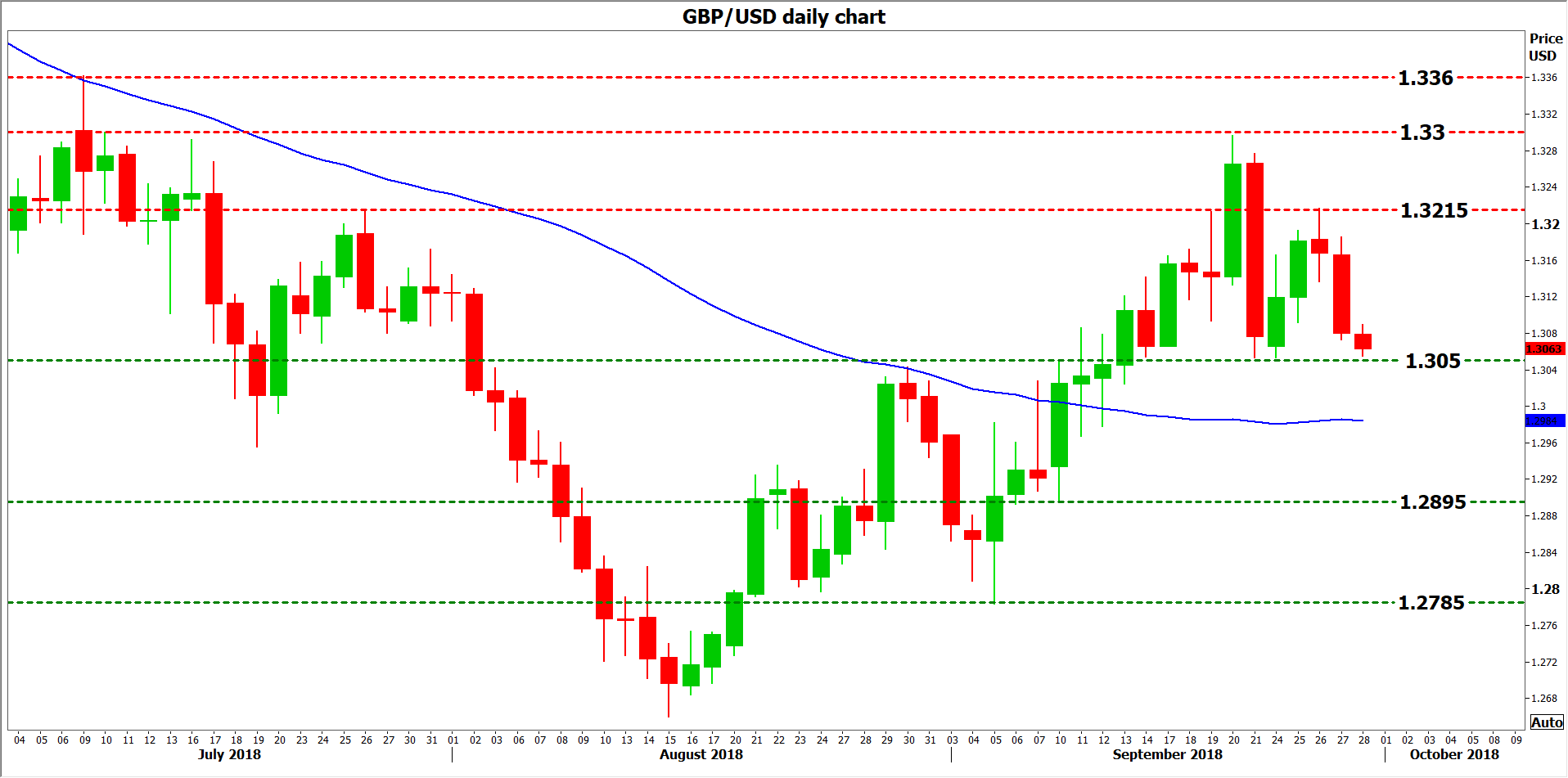
Technically, declines in sterling/dollar may encounter a first line of support near 1.3050, which halted the decline on September 21. A downside break could open the way for the September 10 low of 1.2895, before the September 5 trough of 1.2785 comes into view.
On the upside, resistance to advances could come around 1.3215, a zone marked by the highs of September 26. If the bulls manage to pierce it, advances could stall near the 1.3300 handle, the peak of September 20, ahead of the 1.3360 mark – this being the July 9 top.
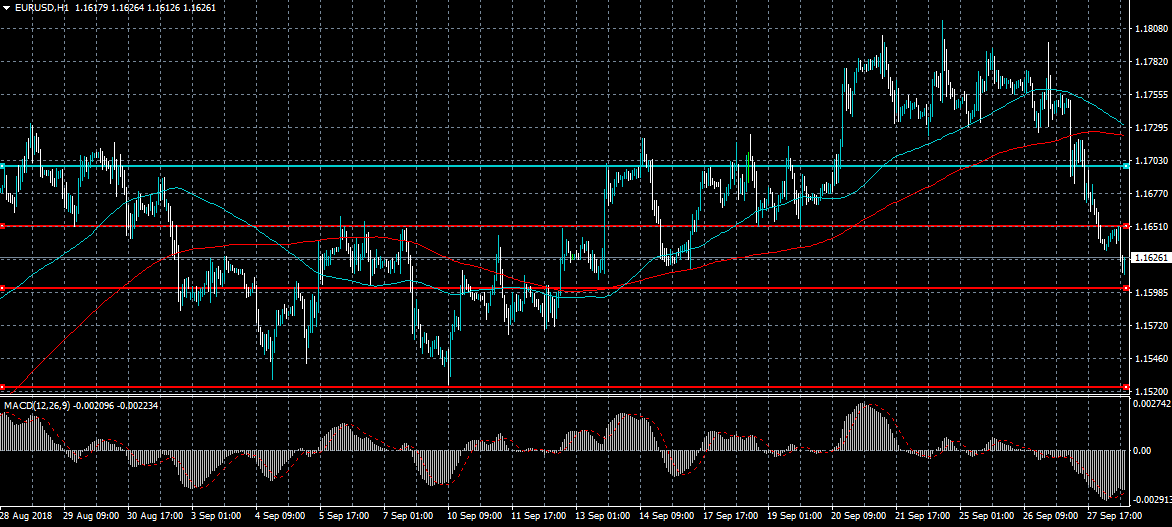
EURUSD Bears Targeting 1.1600 Level
The euro has continued to weaken against the US dollar during the European trading session, with price moving closer to the 1.1600 support level. A break below the 1.1600 support level exposes further losses towards the current monthly trading low, around the 1.1520 level. Overall, bearish pressure is likely to remain on the EURUSD pair while price trades below the 1.1650 level.
The EURUSD pair is strongly bearish while trading below the 1.1600 level, key support is found at the 1.1554 and 1.1520 levels.
If the EURUSD pair moves above the 1.1650 level, we may see a correction back towards the 1.1680 and 1.1714 resistance levels.