

Sample Category Title
USDCAD Remains In Short-Term Sideways Channel, Needs Stronger Bullish Signals
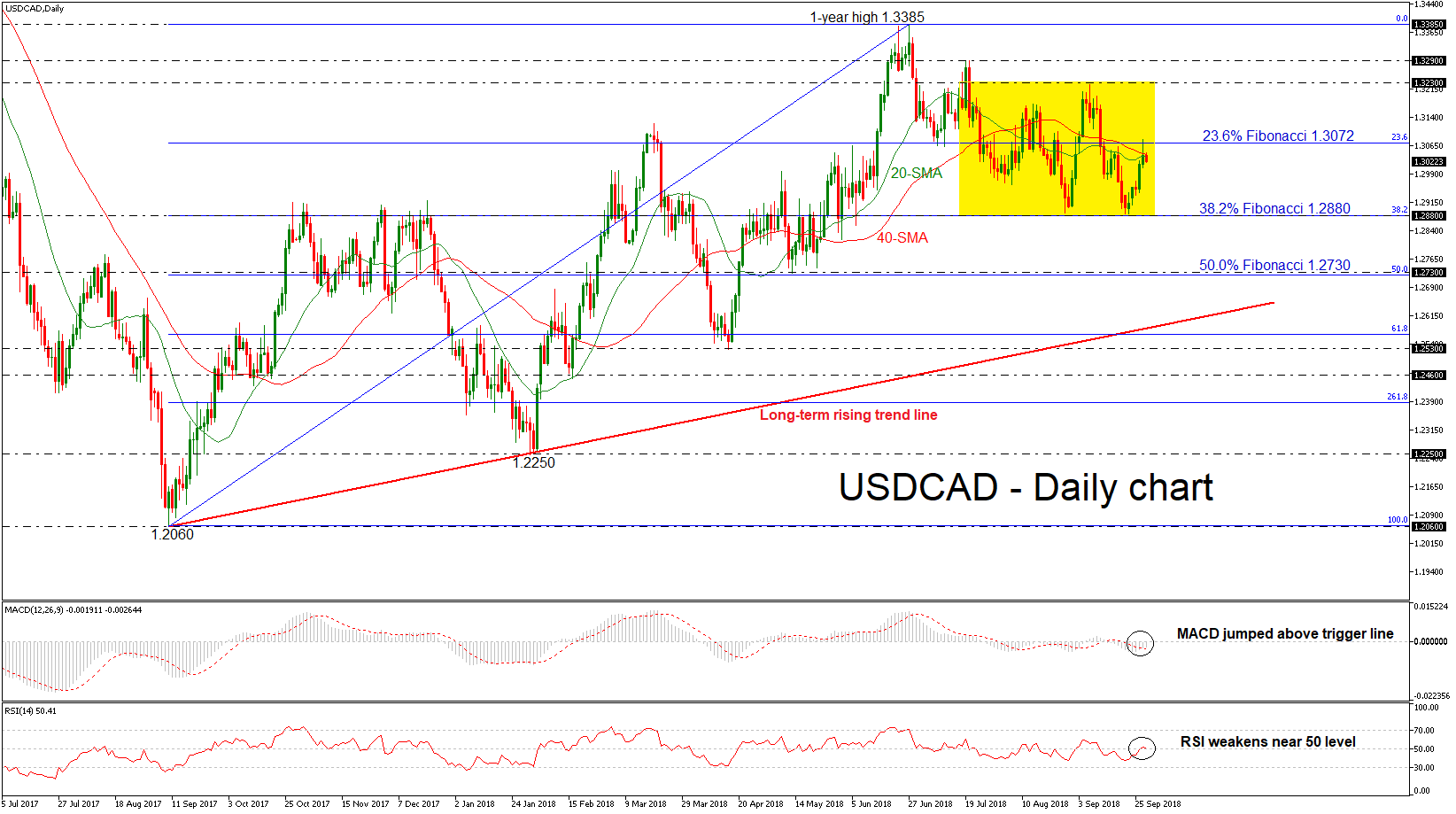
USDCAD has been consolidating since July 20 and has been stuck in a channel with upper boundary the 1.3230 resistance level and lower boundary the 1.2880 support, which overlaps with the 38.2% Fibonacci retracement level of the upleg from 1.2060 to 1.3385. Moreover, the price is trading around the mid-level of the trading range, the 23.6% Fibonacci of 1.3072.
From the technical point of view, the price remains below the 20- and 40-simple moving averages (SMAs) in the daily timeframe, which are ready to post a bullish crossover. The MACD oscillator rose above its trigger line in the negative zone, though the RSI indicator is pointing down near its neutral threshold of 50.
In case of an upward attempt above the 23.6% Fibonacci, dollar/loonie would likely meet resistance at the 1.3230 barrier. A break above the sideways channel would send prices until the 1.3290 resistance level, achieved on July 19. Further gains would push the market until the one-year high of 1.3385.
Immediate support is being provided by the 38.2% Fibonacci mark of 1.2880, which is acting as major obstacle for the bears. If prices dip below of this area, the next support would likely come from the 50.0% Fibonacci around the 1.2730 barrier, taken from the low on May 11. A drop below the 50% Fibonacci level would signal the start of a deeper bearish phase, challenging the longer-term rising trend line again.
In the long-term the bullish outlook remains intact as the pair stands above the ascending trend line, which has been holding since September 2017. The short-term consolidation movement would be erased if the price surpasses the 1-year high of 1.3385.
GBPJPY Re-Challenges Uptrend Line In Near Term
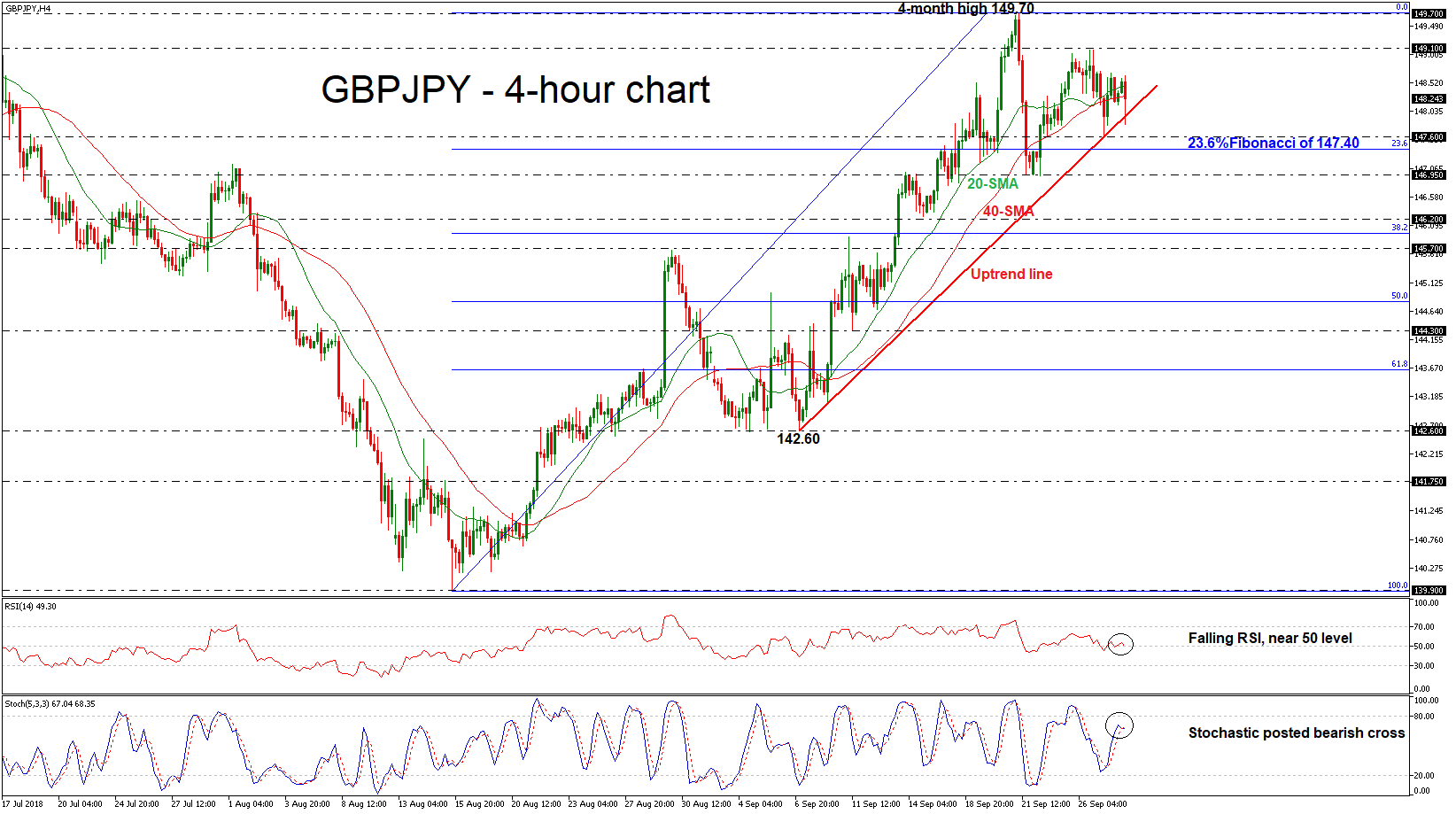
GBPJPY has been moving lower, reaching the short-term rising trend line. The price dropped below the 20- and 40-simple moving averages in the 4-hour chart, while the technical indicators are confirming the recent risk to the downside. The RSI indicator is pointing down near the 50 level and the %K line of the stochastic oscillator is ready for a bearish cross with %D line.
If the price penetrates the uptrend line, this could shift the upside price action to the downside, hitting the 147.60 support and then the 23.6% Fibonacci retracement level of the upleg from 139.90 to 149.70, near 147.40. In case of more losses the market could touch the 146.95 barrier, taken from the lows at the beginning of the week.
Should price manage to change the negative momentum to positive, the next resistance could come around the 149.10 barrier. Above this level, the next target could be the four-month high of 149.70 before moving towards the strong psychological level of 150.00.
Looking at the short- to medium-term picture, the bias remains positive since prices hold above the ascending trend line, which has been standing since September 7 when the upside tendency started after the rebound on 139.90
An update on GBP/USD short, lower the stop
An update to our GBP/USD position as entered here, sold at 1.3150, stop at 1.3300. Finally, GBP/USD catches up with other dollar pairs and reaches the fall from 1.3297. The recovery from 1.3054 was in a way longer than we expected. But given that it drew support from 55 day EMA, that's not too much of a surprise.
Overall outlook is unchanged that rise from 1.2661 is a corrective move that has completed with three waves up to 1.3297. Just ahead of 38.2% retracement of 1.4376 to 1.2661 at 1.3316. Focus is now on 1.3042 resistance turned support, which GBP/USD has breached already. Sustained trading below this 1.3042 will further affirm our bearish view and should at least target 1.2661/2784 support zone.
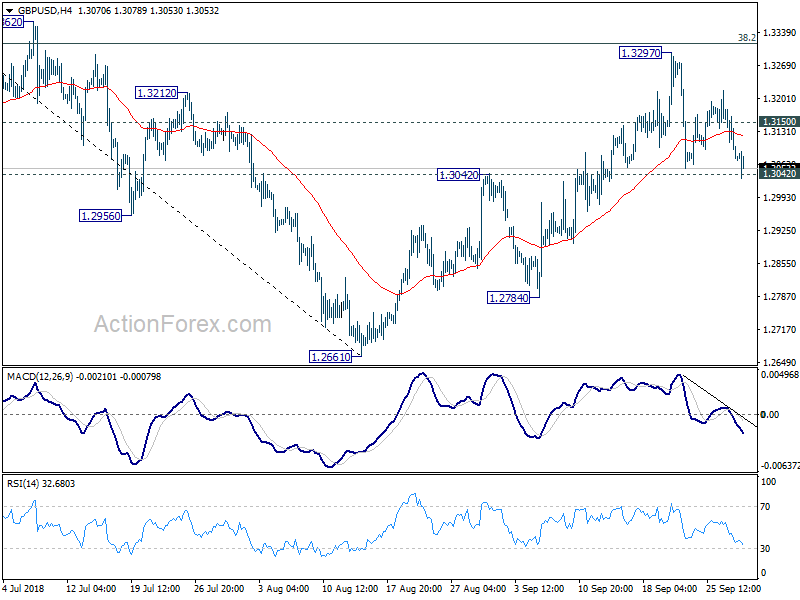
Meanwhile, it's a bit early, but we're looking at the chance of resuming whole down trend from 1.4376. Hence we haven't decided whether we will exit the trade inside the 1.2661/2784 support zone. We'll look at downside momentum of the current decline to make an assessment later. Ideally, the current fall is a wave 3, it should be rather powerful after taking out 1.3042. Though for now, we'd like to lower the stop to break even to guard against a strong reversal from 1.3042.
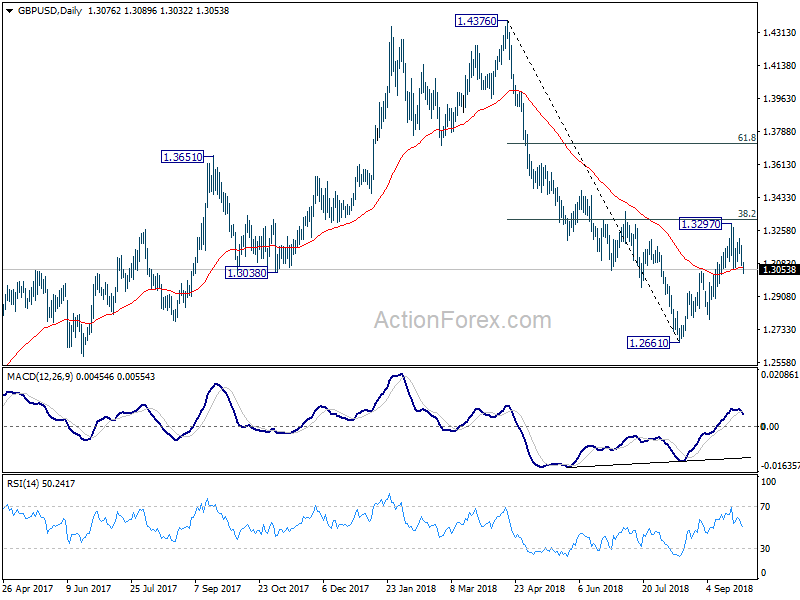
Hence to conclude, we'll hold short (entered at 1.3150), lower the stop to breakeven at 1.3150, and wait-and-see how it plays out.
Crude Locks In Gains, Italian Budget In Focus
Italian budget overhyped
Concern over Italy's budget are overwrought. The government in Rome has passed a budget with a 2.4% deficit relative to GDP – slightly higher than expected, considerably higher than 1.6%-1.8% recommended. Euro Stoxx 50 are lower while EUR/USD has fallen 1.40% to 1.1620. Italian bond yields continue to rise. We suspect that lasting effects will be limited and expect the Euro to recover.
First, the European Central Bank is still active in the bond markets that provide support. Markets should not underestimate the ECB's conviction to maintain European stability. Let's not forget ECB President Mario Draghi's famous speech on 26 July 2012 over the 'irreversibility' of the euro and ECB's readiness to do 'whatever it takes' to preserve the euro. Second is the global relevance of budget deficits. It been a long time since markets really cared about maintaining a balanced budget, so why should this matter in Italy? Aggregate Eurozone has an 86% debt to GDP, just slightly above the UK's. And then there is the USA's swelling deficit. As investors turn their attention to the Ryder Cup (Europe will not hold their early lead), the Euro will recover.
Crude talk
Crude oil is about to end another week in green, as a barrel of West Texas Intermediate rose as high as $72.78. Despite anticipations of tighter supply, thanks to Iran sanctions and shrinking output in Venezuela, crude prices have tread water since Tuesday. The $71.45 – $72.75 range is holding: traders don't know where to stand. There is growing sentiment that crude is heading towards $100. The US government said it won't release emergency crude reserves to keep prices low.
From a technical standpoint, the WTI is still trading in its long-term and short-term uptrend channel. On the downside, a short-term support lies around $72.15, while a medium-term one can be found at $69 (50-day moving average). In absence of a vocal intervention from The Donald, investors will stay side-lined ahead of the weekend – range trading will dominate.
EUR/USD – Euro Slides As Italy Approves Controversial Budget
EUR/USD is down slightly in the Friday session, after sharp losses on Thursday. Currently, the pair is trading at 1.1622, down 0.16% on the day. In economic news, German unemployment change plunged by 23 thousand, easily beating the estimate of -9 thousand. In the eurozone, inflation indicators missed their estimates. CPI Flash Estimate edged higher to 2.1%, matching the forecast. CPI Core Flash Estimate ticked lower to 0.9%, shy of the estimate of 1.1%. In the U.S, the focus is on consumer reports. Personal Spending is expected to edge lower to 0.3%, while UoM Consumer Sentiment is expected to climb to 100.5 points. The indicator last broke through the symbolic 100 level in March.
The euro took a tumble on Thursday, slipping 0.8 percent. Investors reacted negatively after the Italian government approved a controversial budget, which aims for a budget deficit in 2019 of 2.4% of GDP. This number could move higher as the budget is debated in parliament. Although EU guidelines allow a deficit of 3%, Brussels will be nervously following the budget. The markets were hoping that Italy’s budget deficit would be around 2%, and Brussels will be nervously following the budget. As well, investors could lose confidence in Italian government bonds. This negative sentiment is already weighing on the euro and on European equity markets.
As widely expected, the Federal Reserve pressed that rate trigger for the third time this year, raising the benchmark rate by a quarter-point, to a range of 2 percent to 2.25 percent. The Fed intends to continue gradually raising rates, with another rate hike expected in December and three hikes in 2019. What was of more interest to investors was the rate statement, in which the Fed removed the word ‘accommodative’ in the statement, which means that the Fed now considers monetary policy to be neutral. Fed Chair Jerome Powell, in a bid to keep markets calm, stated in a follow-up press conference that removing accommodative language in the statement did not reflect a change in policy. Still, the markets were upbeat after the Fed meeting and the U.S dollar has responded with slight gains against the euro on Thursday.
Asia Market Update JPY And EUR In Focus
Japanese Yen
USDJPY has been the focus of the Asia session as the US dollar is doing what it does best and that strengthens after facing a short period of adversity. Buoyant risk markets and higher US yields make for a convincing argument to push higher, but the recent strong gains in Japanese equities are the most definitive signal to sell JPY
USD/JPY at nine-month high as risk returns
Euro
Euro bears are back in force after EURUSD printed a low of 1.1622 so far. But participation was predictably weak as Asia G-10 dealers were a bit apprehensive to add downside exposure at the bottom of the dip especially ahead of the weekend not to mention critical Eurozone CPI data due at later this afternoon. Likewise, Singapore traders found it equally as difficult to hold any bullish views ahead of the 1.1600 psychological danger zone. Everyone is back in Italy watch mode
Bank of Italy Balance Sheet and latest Monthly Economic note Oct 5
Deadline for Italy to submit the draft budget to EU (Oct 15);
S&P rating review expected for Italy (Oct 26);
Moody’s rating review scheduled for Italy (unknown)
USD in general vs G-10
I think trading the greenback gets incredibly tricky from today through to next Friday NFP as dollar moves will be very much data dependent making it challenging to build a longer terms consensus, in other words, it’s going to be choppy.
Gold Markets
A reality check as spot gold is selling off today as the USD continues to strengthen. For the past three months, gold has traded more like a currency rather than a go-to safe have an asset. With the Euro tumbling overnight, the $1190 trap door gave way as Gold has fallen to $1183 just ahead of the COMEX end of NY break. Besides with the final reading of second-quarter GDP holding at 4.2%Thursday, its reinforced the Fed rate hike outlook for 2019. Gold has been a seller’s market for some time, but with $1190 yielding, bearish activity could intensify with short-term speculators likely to target the August low when the yellow metal hit $1160 before rebounding.
Oil Markets
While still in bullish territory elevated chatter suggesting that Saudi Arabia may quietly add some supply over the next few months has tempered Asian oil bulls today While the likely loss of Iranian supply may be the dominant market theme, OPEC production may be rising.
In this context, speculative flows have categorically focused on Saudi spare capacity or the lack there off and less focus on Saudis contention they will raise output, but I guess the big question is at what price will they deliver? But let’s face it there still a lot of guesswork in play, as there typically is in the boisterous oil markets.
So, in the meantime, dips remain well supported as Iran sanction continues to underpin sentiment but now investors are setting sights on a glitzy $100 per barrel price tag
Italian bond yield jumps on budget deficit target, 5-star Maio not worried
European markets respond rather negatively to Italy's budget, which it targets deficit at 2.4% of GDP for the next three years. Italian 10 year yield is up 0.268 to 3.161 for now, back above 3.000 handle. It's also back at the level in the beginning of the month. German 10 year bund yield losses -0.06 to 0.472, back below 0.5 handle. DAX is currently down -0.68%, CAC own -0.32%.
European Commission said today that it would assess the draft budget plan of Italy before end of November. But it's spokesman emphasized it's just "part of the normal European Semester process, the EU's economic policy coordination cycle, and happens each year." European Economics Commissioner Pierre Moscovici noted that nothing would be gained from a clash with Italy but added "we don't have any interest either that Italy does not respect the rules and does not reduce its debt, which remains explosive."
5-Star Movement leader Luigi Di Maio, also Deputy Prime Minister of Italy, said he was not worried by market reaction and will meet investors soon.
Dollar Gains, Euro Tumbles, Eurozone Flash Inflation And US Core PCE Due
Here are the latest developments in global markets:
FOREX: The dollar is higher by 0.17% against a basket of six major currencies on Friday, extending the significant gains it recorded in the previous session. The euro, which holds the largest weight by far among those six currencies, edged lower as concerns around the Italian budget intensified.
STOCKS: Wall Street roared back on Thursday, with all the major indices closing in the green, aided by gains in tech giants like Apple (+2.06%), Google-parent Alphabet (+1.11%), and Facebook (+1.13%). Accordingly, the tech-heavy Nasdaq Composite outperformed (+0.65%) the benchmark S&P 500 (+0.28%) and the Dow Jones (+0.21%). In company-specific news, US regulators (SEC) announced after markets closed they are suing Tesla CEO Musk for fraud due to his “misleading” tweet a few weeks ago, sending the electric car-maker's share price sharply lower in after-hours trading. In Asia, most indices were flashing green on Friday, with Japan's Nikkei 225 (+1.36%) and Topix (+0.95%) recovering, the former touching a 27-year high. In Hong Kong, the Hang Seng was down by a marginal 0.07%. Europe was a different story, with all benchmarks expected to open much lower today according to futures, amidst worries around Italy (see below).
COMMODITIES: Oil traded higher, albeit only modestly, with some media reports that Saudi Arabia may increase its production by up to 600k barrels per day in the final quarter of the year having little effect on prices. WTI is higher by 0.21% at $72.27 per barrel, while Brent gained 0.12% on Friday, trading at $81.82 a barrel. In precious metals, gold is little changed on Friday, licking its wounds following a notable tumble in the previous session that caused it to exit to the downside the narrow range it had been trading in for a month. The losses came as the greenback surged, rendering the dollar-denominated yellow metal more “expensive” for investors using foreign currencies.
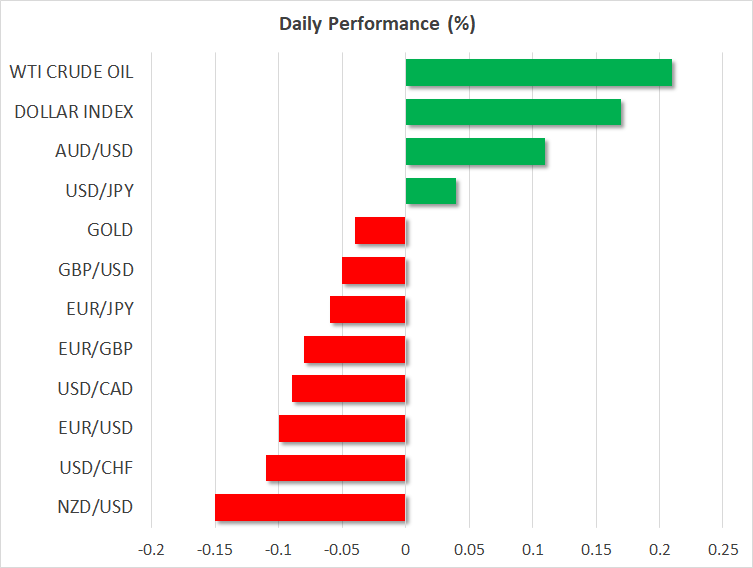
Major movers: Dollar firms on upbeat data; Italian worries drag euro lower
“King dollar” made a return on Thursday. The world's reserve currency soared across the board, propelled higher by another round of robust US economic data, with broad-based weakness in the euro amidst Italian budget angst also lending a hand. Euro/dollar plunged to find a bottom around 1.1640, from an earlier intraday high of 1.1755. Meanwhile, dollar/yen raced as high as 113.63 – recording a fresh 9-month high – before pulling back a little, also buoyed by strong risk appetite.
As for catalysts, the greenback got a push higher after US durable goods orders for August surprised to the upside, painting a brighter picture for GDP growth in Q3. Adding further credence to this, were the details of the final GDP release for Q2, which showed that inventory-rebalancing by firms shaved more than 1 percentage point away from Q2 GDP. Hence, assuming firms restocked their inventories in Q3, the next GDP print may well show inventories adding to growth.
Even more important for the dollar's ascend, was the softness in the euro, which was hammered lower by renewed concerns around the Italian budget. The Italian government stated yesterday the budget deficit will be 2.4% for the upcoming year, higher than the 1.9% – 2.0% that had been rumored. While this is still safely below the 3.0% deficit limit set by the EU's Maastricht Treaty, and admittedly not a gigantic difference relative to expectations, markets still interpreted this as a sign of “fiscal indiscipline” – sending Italian bond yields across all maturities higher and dragging the euro lower. Market chatter even suggests the wider deficit may lead to major ratings agencies downgrading Italian debt. Uncertainty on this front will likely keep a risk-premium on the euro for the time being, perhaps until the official budget is submitted on October 15.
Elsewhere, there was little of note in the FX market, with most pairs simply following the dollar-strength trend. Sterling/dollar fell back below 1.3100, with the next source of volatility for sterling likely to be the Conservative Party conference that commences on Sunday. Two key areas of focus may be any Brexit remarks, especially following the recently-leaked EU papers hinting at “free trade areas”, and any hints that hardline Brexiteers could seek to challenge Theresa May's leadership in case they are dissatisfied with any “soft” deal she negotiates.
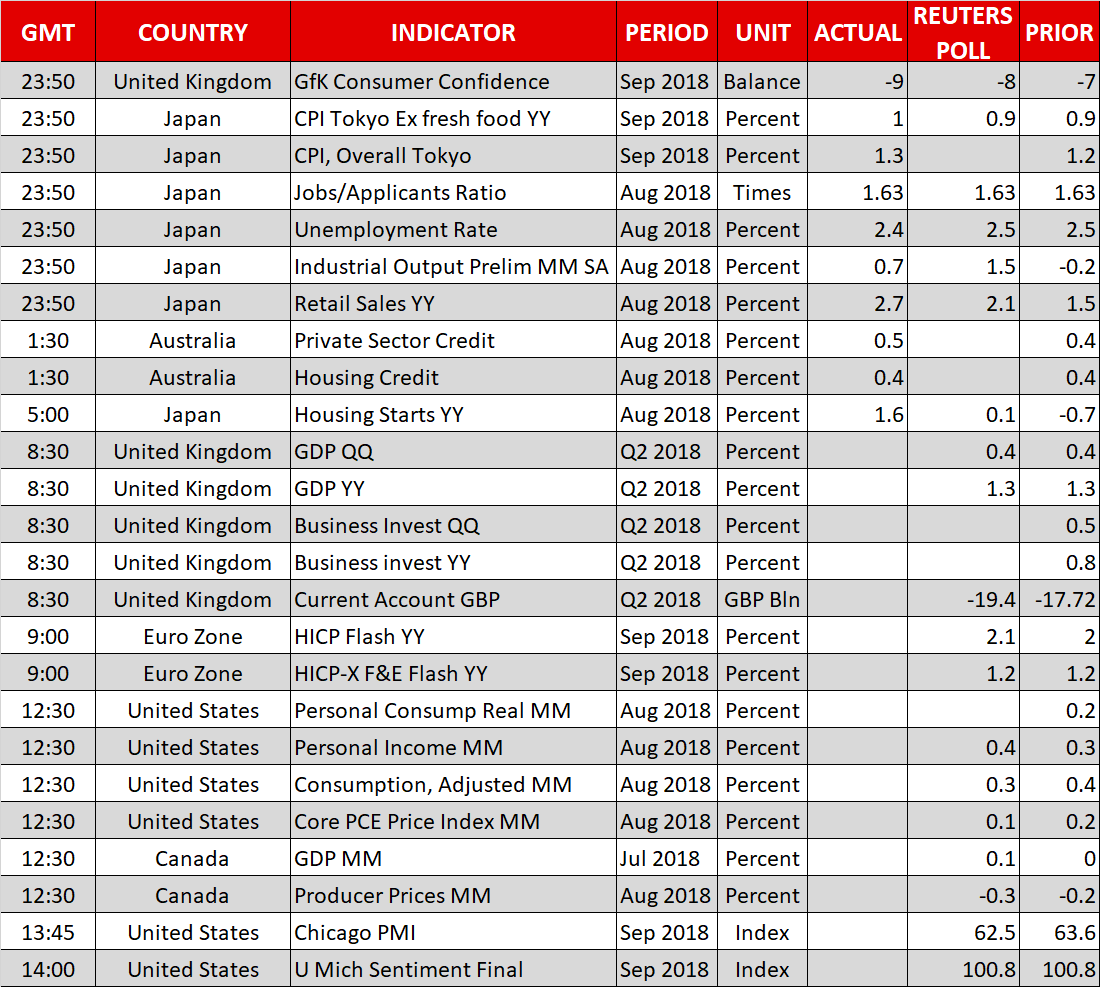
Day ahead: Eurozone flash inflation, US core PCE, UK & Canadian GDP on the agenda
Eurozone preliminary inflation figures for September and US core PCE data are among the releases generating attention in Friday's calendar.
At 0830 GMT, revised Q2 GDP estimates out of the UK are anticipated to confirm the quarterly and annual pace of growth at 0.4% and 1.3% respectively, above Q1's equivalent figures of 0.2% and 1.2%. Data on Q2's business investment and the current account will be made public at the same time. A risk event for sterling will be the Conservative Party conference commencing on Sunday.
The eurozone will be on the receiving end of flash inflation numbers for September. Annually, headline inflation is expected to rise by 2.1%, which compares to August's 2.0% and the ECB's target of “close to but below 2%”. The core rate of inflation that excludes volatile food and energy items is projected to stand at 1.2% y/y, the same as in August. Earlier in the week, ECB chief Draghi said he sees a vigorous pickup in inflation, something which led to a jump in the euro. It remains to be seen whether today's prints will start confirming his views.
Also euro-related, Germany will see the release of unemployment data for September earlier in the day (0755 GMT). The unemployment rate in Europe's largest economy is forecast to remain at 5.2%, the lowest since the country's reunification back in 1990.
The attention will next turn to the US, where the Fed's preferred inflation gauge, the core PCE price index, is due at 1230 GMT. The measure is predicted to rise by 0.1% m/m in August (vs 0.2% in July), something which would allow the annual rate to remain at the 2.0% mark that coincides with the US central bank's target for inflation. The readings on August's personal income and consumption are also due at 1230 GMT. The two are anticipated to expand by 0.4% and 0.3% m/m, after rising by 0.3% and 0.4% correspondingly in July.
Other US releases on Friday are September's Chicago PMI (1345 GMT) and the University of Michigan's final survey on consumer sentiment (1400 GMT), both for the month of September.
Numbers on Canadian economic activity for July will be hitting the markets at 1230 GMT, with the growth rate expected at 0.1% m/m, after June's stagnation. Canadian OIS project a 77% chance for a late October hike by the Bank of Canada and upbeat data today and in the coming weeks can push that closer to a done-deal; the opposite holds true as well. August producer prices out of the nation are due at the same time.
Elsewhere, Turkish President Erdogan and German Chancellor Merkel will be speaking to reporters at 1030 GMT following their meetings aiming to restore ties and improve relations between the two nations. Irish Central Bank Governor and ECB policymaker Lane and Bank of England member Ramsden will be talking at 1130 GMT; the latter will be returning to the rostrum at 1320 GMT. Other policymakers on the agenda are ECB's Praet (1235 GMT), and regional Fed Presidents Barkin (1230 GMT) and Williams (2045 GMT) – they both hold voting rights within the FOMC in 2018, with Williams having permanent voting rights given that he chairs the NY Fed.
In energy markets, the weekly Baker Hughes report on active oil rigs in the US is scheduled for release at 1700 GMT.
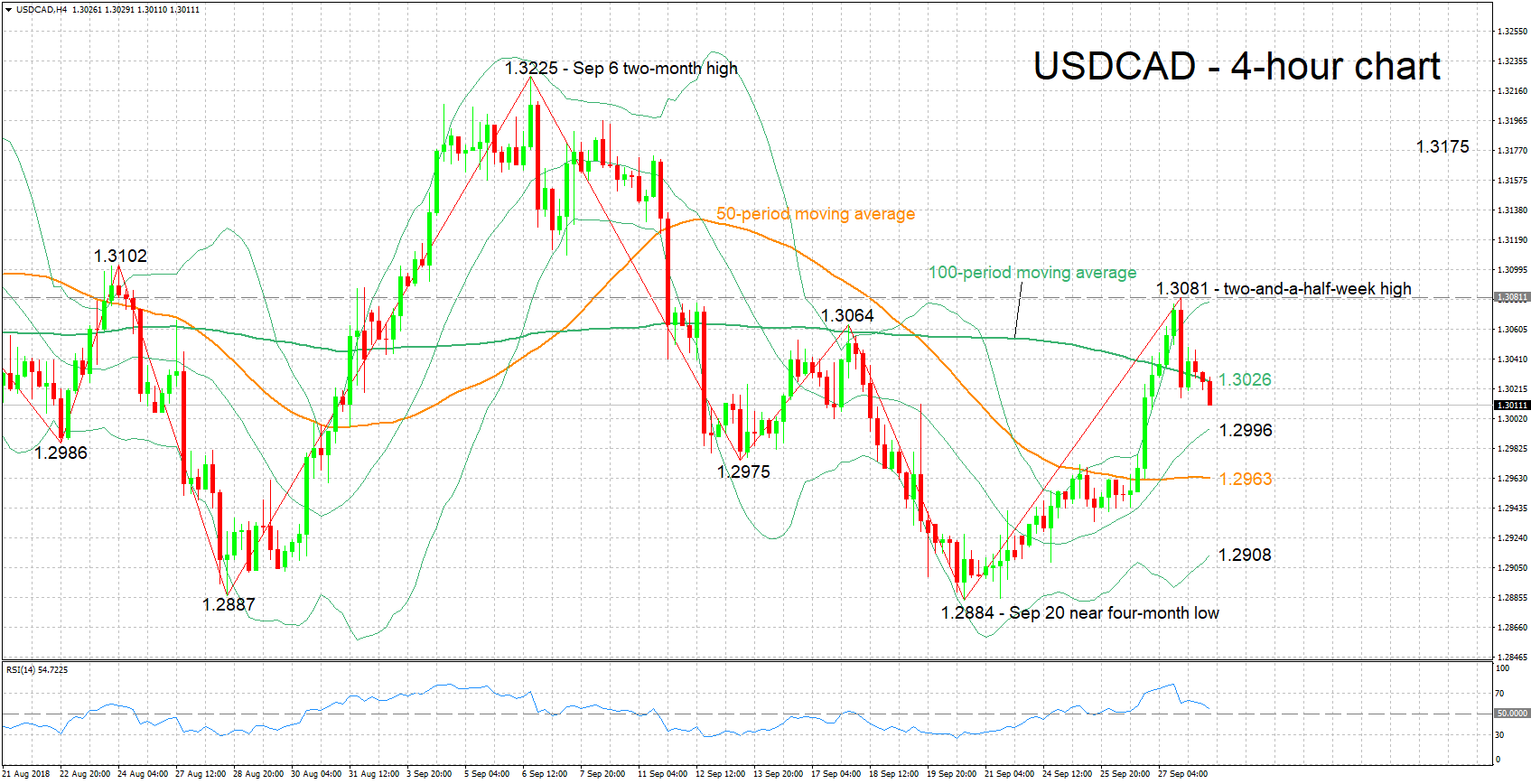
Technical Analysis: USDCAD near-term momentum could be shifting to the downside
USDCAD lost ground after touching a two-and-a-half-week high of 1.3081 during Thursday's trading. The RSI entered a path of declines after previously rising into overbought territory. Its fall is signaling a change in short-term momentum to the downside.
Upbeat Canadian GDP numbers can push the pair further down. Immediate support to losses may come around the middle Bollinger line – a 20 period moving average line – at 1.2996 and the 50-period MA at 1.2963. Further below, the attention would turn to the zone around the lower Bollinger band at 1.2908 and the near four-month low of 1.2884 from September 20.
Conversely, disappointing Canadian figures are expected to lift USDCAD. Given a move above the 100-period MA at 1.3026, resistance could occur around yesterday's high of 1.3081, while further above, the region around 1.3175 was congested earlier in September and may hold significance, acting as a barrier to gains.
US data out on Friday can also move the pair.
Eurozone CPI rose to 2.1% but core slowed to 0.9%
Eurozone headline CPI rose to 2.1% yoy in September, up from 2.0% yoy and matched expectation. However, Core CPI slowed to 0.9% yoy, down from 1.0% yoy and missed expectation of 1.1% yoy. Energy inflation remained strong, at 9.5% yoy, followed by food, alcohol & tobacco at 2.7%. The reading is likely unwelcome by ECB.
Also released, Germany unemployment rose 23k in September, unemployment rate dropped 0.1% to 5.2%.
The US Dollar Is In The Positive Zone
The US dollar strengthened significantly against the basket of major currencies. The US dollar index (#DX) updated the weekly high and closed in the positive zone (+0.80%). The US currency is supported by an increase in the Fed interest rate, as well as data on GDP. The index counted to 4.2% in the second quarter, as investors expected. Also, the GDP report indicates that the US economy has been growing at the fastest rate in the past 4 years.
Meanwhile, weak economic data were also published in the US, which still did not prevent the growth of the US currency. So, the core durable goods orders increased by 0.1% in August instead of the expected value of 0.4%. Pending home sales index counted to -1.8% in August, while experts forecasted -0.2%.
The "black gold" prices are consolidating. At the moment, futures for the WTI crude oil are testing a mark of $72.25 per barrel.
Market Indicators
Yesterday, the bullish sentiment was observed in the US stock market: #SPY (+0.28%), #DIA (+0.18%), #QQQ (+0.85%).
At the moment, the 10-year US government bonds yield is at the level of 3.04-3.05%.
The news feed on 2018.09.28:
German unemployment change at 10:55 (GMT+3:00);
UK GDP data at 11:30 (GMT+3:00);
Consumer price index in the Eurozone at 12:00 (GMT+3:00);
Canada GDP data at 15:30 (GMT+3:00).