

Sample Category Title
EURUSD Bulls Losing Momentum
The euro is starting to lose bullish momentum against the US dollar after the pair once again failed to break the 1.1800 level after the FOMC interest rate decision and policy statement. The EURUSD pair came under pressure after Federal Reserve Chair Jerome Powell struck a hawkish tone towards future rate increases during his scheduled press conference. Sellers need to break the 1.1730 level, while buyers need to maintain price above the 1.1780 level.
The EURUSD pair is bearish while trading below the 1.1730 level, key support is found at the 1.1700 and 1.1668 levels.
If the EURUSD pair moves above the 1.1780 level, price may test towards the 1.1812 and 1.1850 resistance levels.
EUR/CHF Daily Outlook
Daily Pivots: (S1) 1.1319; (P) 1.1352; (R1) 1.1372; More...
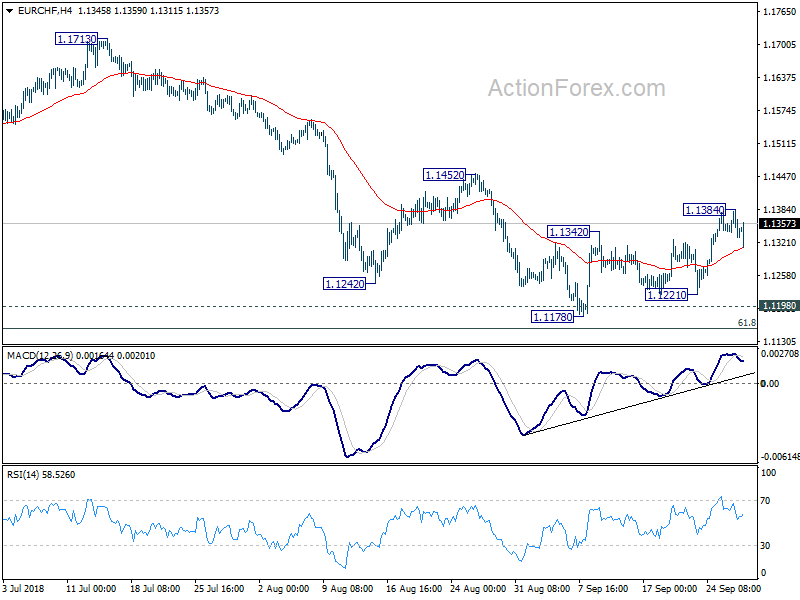
EUR/CHF's rebound lost momentum after hitting 1.1384 and retreated sharply from there. Intraday bias is turned neutral first. For now, another rise remains mildly in favor as long as 1.1221 support holds, break of 1.1384 will resume the rebound from 1.1178 and target 1.1452 resistance. Decisive break there should confirm near term reversal. That is, whole correction from 1.2004 has completed at 1.1178 after hitting 1.1154/98 key support zone. However, break of 1.1221 will turn focus back to 1.1154/98 key support zone.
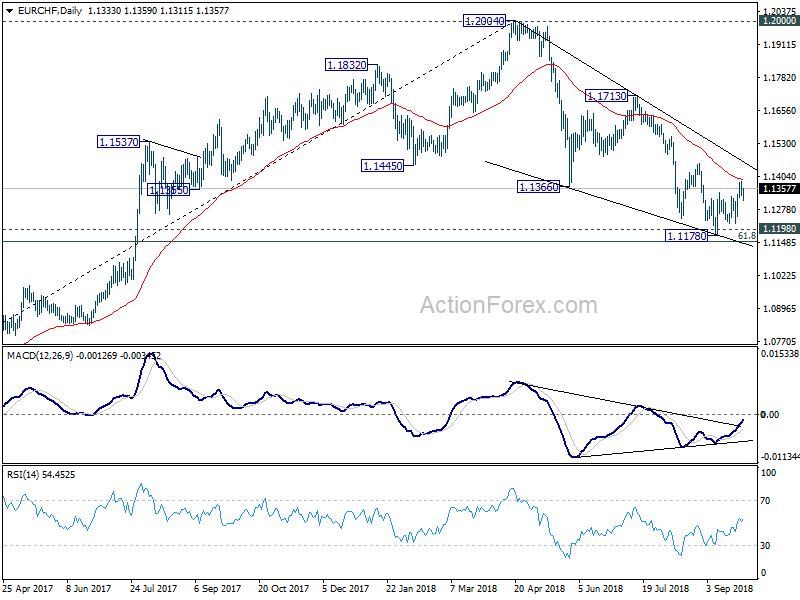
In the bigger picture, for now, the price actions from 1.2004 medium term top is seen as a correction only. Downside should be contained by support zone of 1.1198 (2016 high) and 61.8% retracement of 1.0629 to 1.2004 at 1.1154 to complete it and bring rebound. This cluster level is in proximity to long term channel support (now at 1.1207) too. A break of 1.2 key resistance is still expected in the medium term long term. However, sustained break of the mentioned support zone will mark reversal of the long term trend. In that case, 1.0629 key support will be back into focus.
Bitcoin Trades In Range As FSA Starts Probe On Zaif Hack
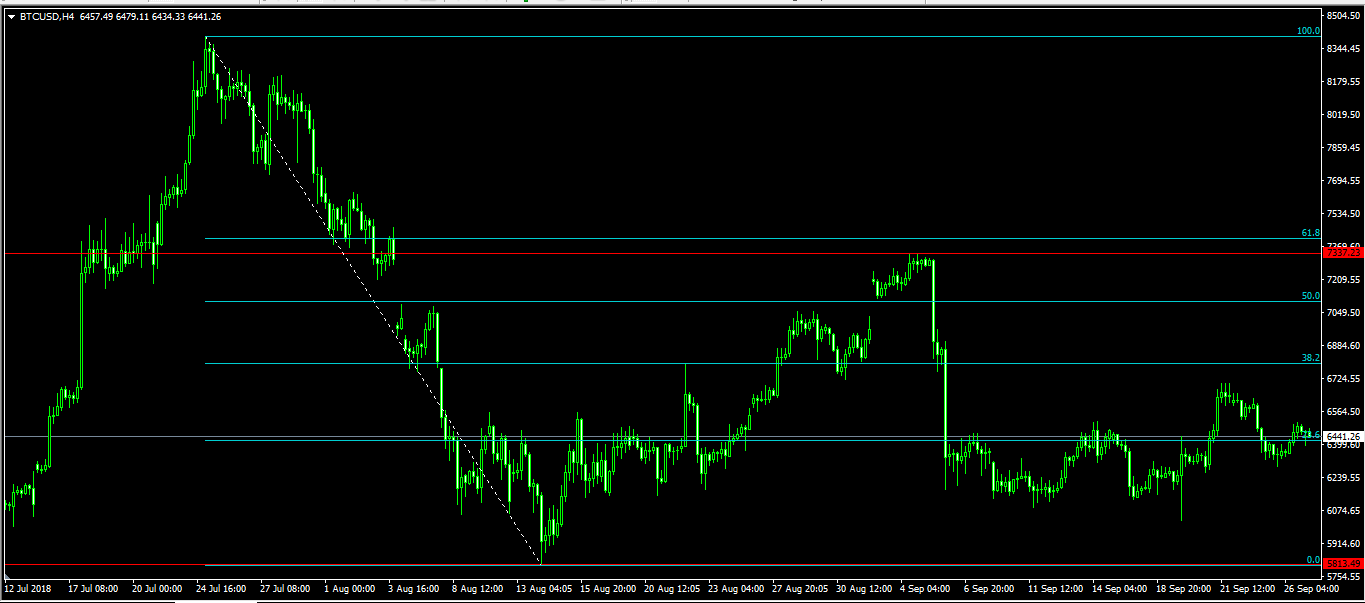
This month, Bitcoin reached a high of $7337 before a sharp decline that saw it fall to a low of $6020. The lower level was higher than August’s low of $5813.
September has been a worrying month for cryptos to date. First, there was a major hacking of a Japanese exchange, Zaif, which saw more than $60 million stolen. Yesterday, the main Japanese watchdog gave Zaif a third official warning and demanded more information regarding the incident. The regulator asked the company how the hack took place and how they plan to compensate the people whose funds were stolen. The Financial Service Authority (FSA) also wants to know why there was a delay in reporting the hack. A sustained legal case between the FSA and the company will mean more trouble for Zaif because of the heavy fees and compensation requirements.
Yesterday, Michael Novogratz who runs a crypto asset management company said that Bitcoin was set to start moving higher as more institutional interest comes in. However, such statements should be taken with a pinch of salt because of a conflict of interest with Novogratz likely to benefit when the price goes up. The reality is that there is no such large interest from institutional investors. In fact, when Bitcoin futures started trading at CME and CBOE, many expected its demand to rise. It did not and in fact, more institutional traders opened sell trades.
The BTC/USD pair is trading at 6442, which is along the 23.6% Fibonacci Retracement level and headed lower. A lower trend below this level will see the pair test the 6000 level. Upside movements, on the other hand, will see it test the 38.2% Fibonacci level at 6800.
USD Gans As Fed Points To More Tightening
The Federal Open Markets Commission (FOMC) raised interest rates by a quarter percentage point to 2 – 2.25%. This was the third rate hike this year and the eighth in the tightening cycle that started in 2015. The committee said that it remained supportive of more rate hikes despite the challenges that lie ahead. The yield curve is edging closer to inversion, the trade war is going on, and the GDP is expected to start slowing down. The forward guidance by the Fed is for another rate hike in December, three in 2019, and one in 2020.
The Reserve Bank of New Zealand (RBNZ) left interest rates unchanged at 1.75% and indicated that this level could remain through 2019 and into 2020. The bank last raised interest rates in 2016. In an official statement, the bank said that while the economy remained strong, the low interest rate policies will continue to provide the necessary support particularly for the weaker Kiwi, which helps to prop up the exports industry.
It will be another significant day for the USD as traders wait for crucial economic data. Today, the government will release the final reading for GDP. The first reading showed that the economy grew by 4.1%, followed by 4.2% in the second reading. Today, traders expect the number to show that the economy rose by 4.2%. In addition, the jobless claims numbers, and durable goods order numbers will be released.
The Canadian dollar fell sharply against the USD after the US sent signals that it will move ahead with a new NAFTA deal without Canada. Donald Trump said that he turned down a meeting request from Trudeau. Canadian officials responded saying that no such meeting was planned in the first place.
USD/CAD
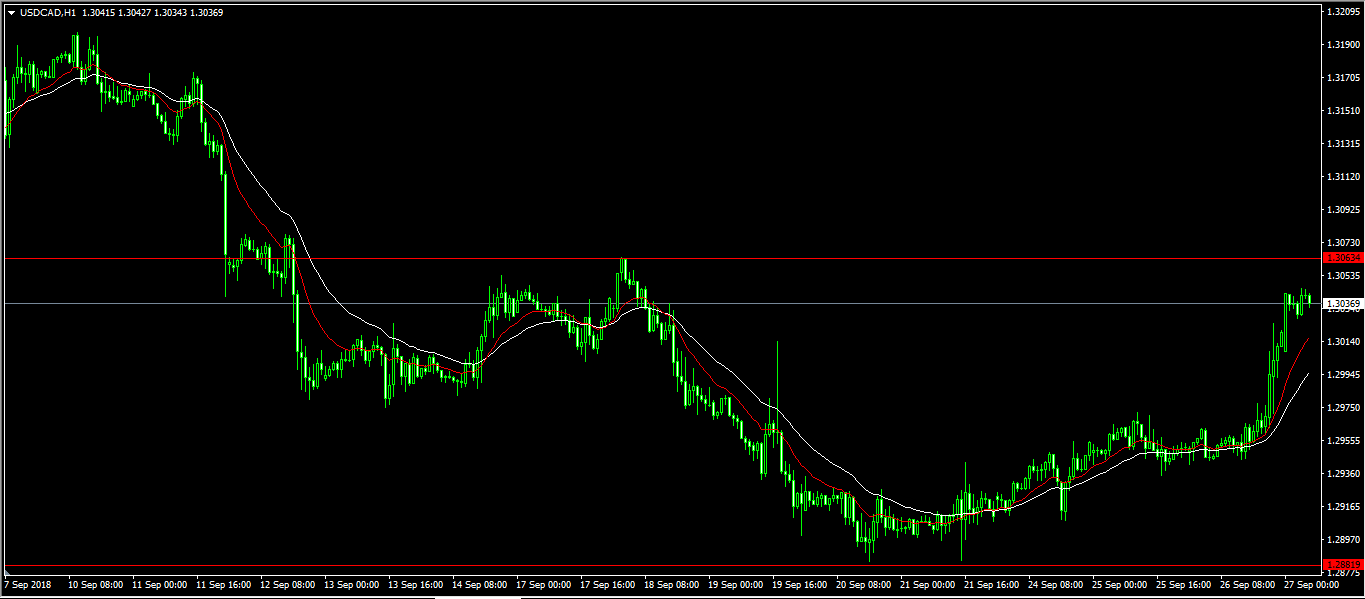
Last week, the USD/CAD pair reached a double bottom at around the 1.2880 level. Since then, it has been moving higher and in the Asian session today, it reached a high of 1.3045. The current price is between the 38.2% and 50% Fibonacci Retracement level, with the 14 and 28-day EMA showing signs that it will keep moving higher. In the short term, it will likely test the 1.3063 level where it will find some resistance. It will then likely continue moving higher.
EUR/USD
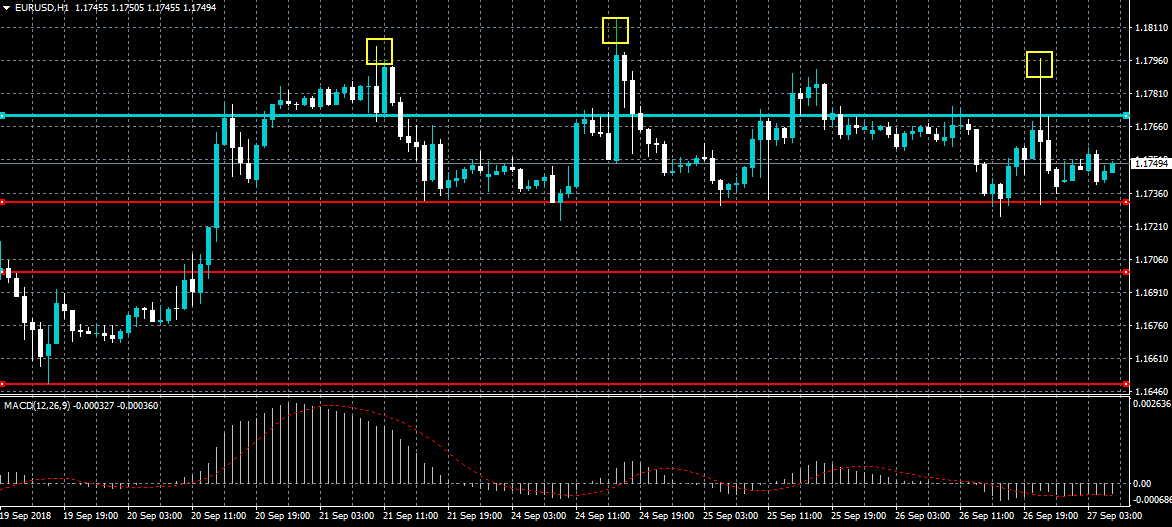
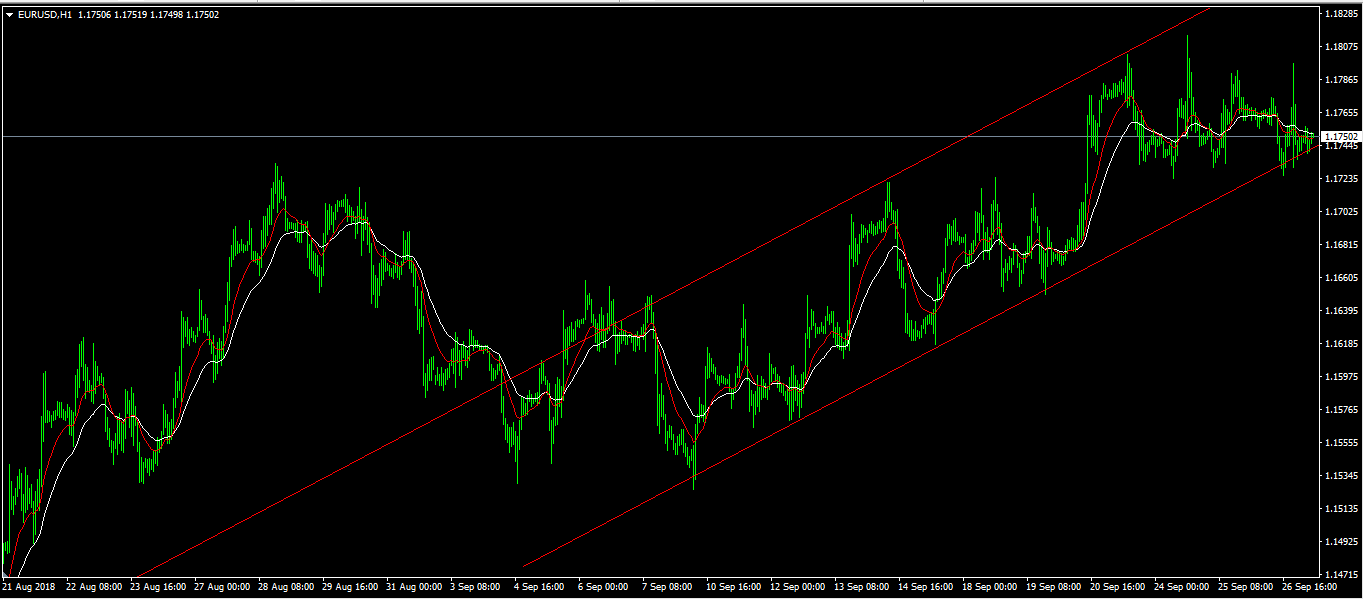
This month, the EUR/USD pair has moved up, establishing a channel of diagonal support and resistant points as shown in the hourly chart below. The pair was little moved after the Fed decision yesterday. It now remains at the lower part of the channel. A high volume below the support level will likely lead to more downward movements for the pair. The alternative is that the pair will likely move to the upper side of the channel and test the resistance at 1.1820.
USD/JPY
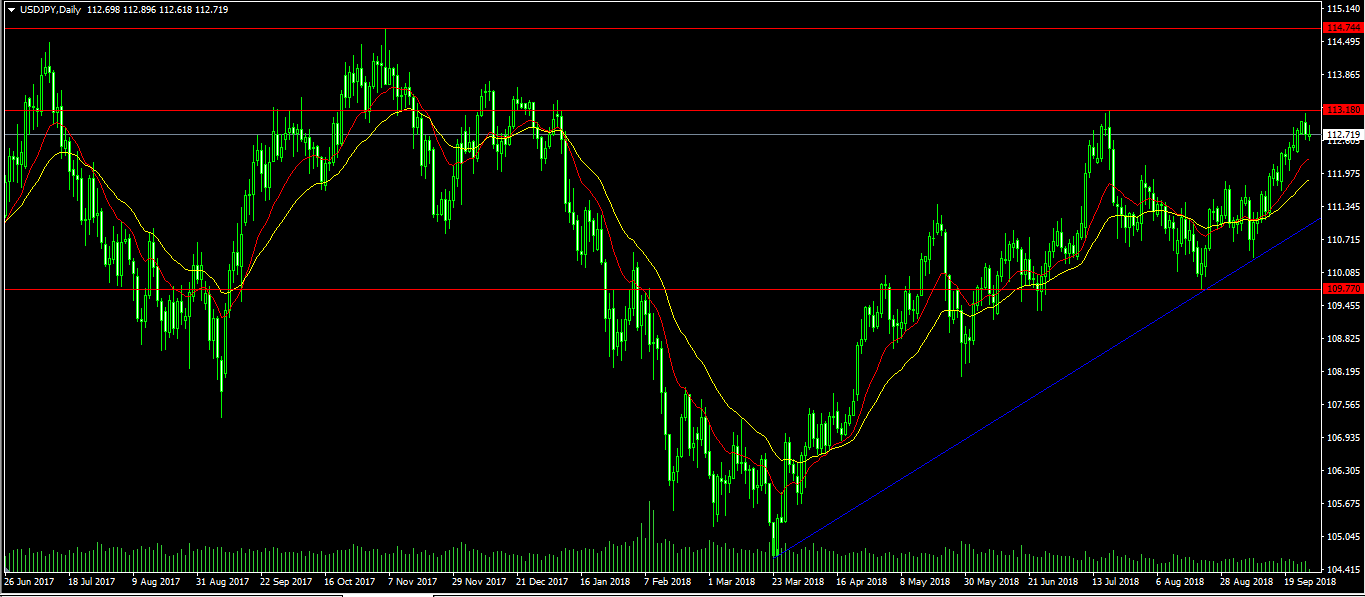
In the Asian session today, the USD/JPY pair reached the important level of 113.18. This was an important resistance level. As expected, the pair then started moving slightly lower and is now trading at 112.73. Today, the pair will likely remain around this level as bulls and bears compete on the next direction. A strong break above the 112.73 will see it test the 114 level
EUR/GBP Retest Of Recent Highs Is Possible
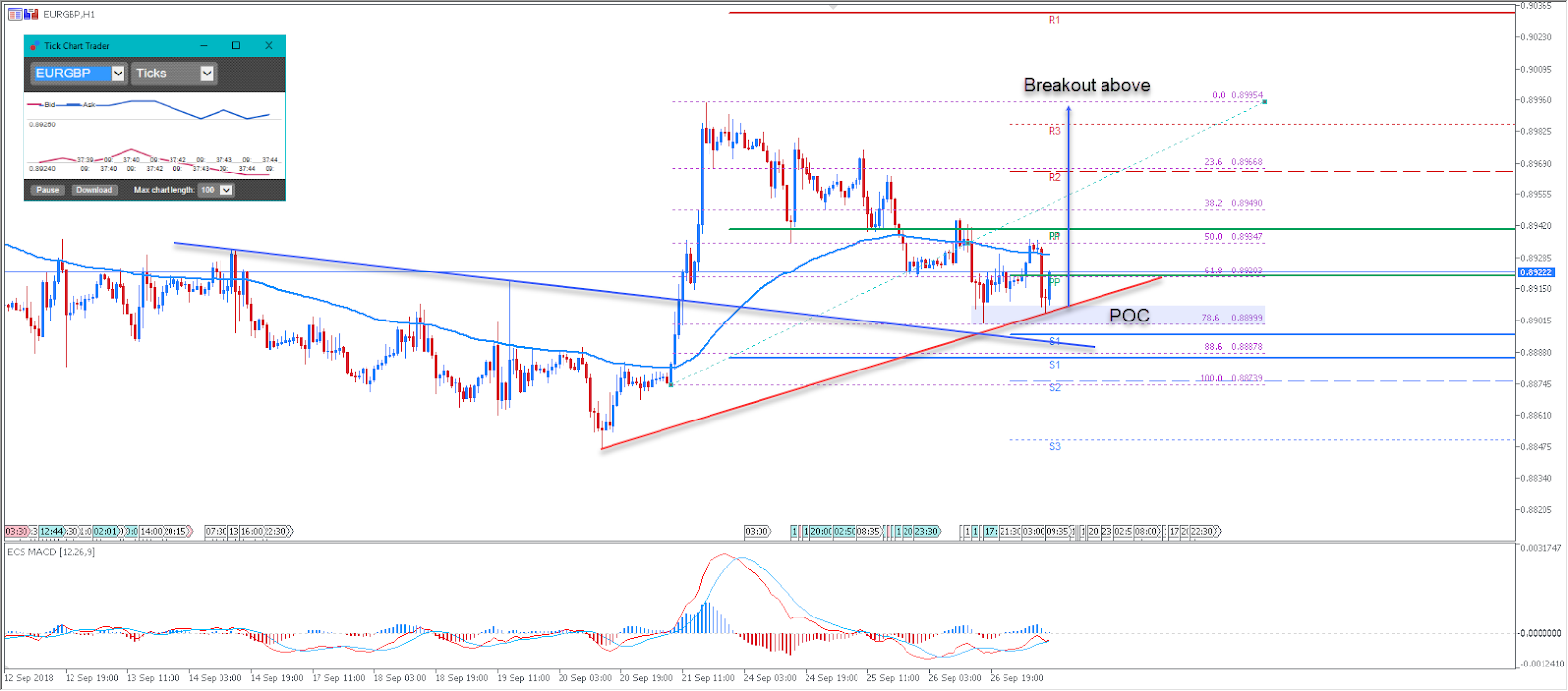
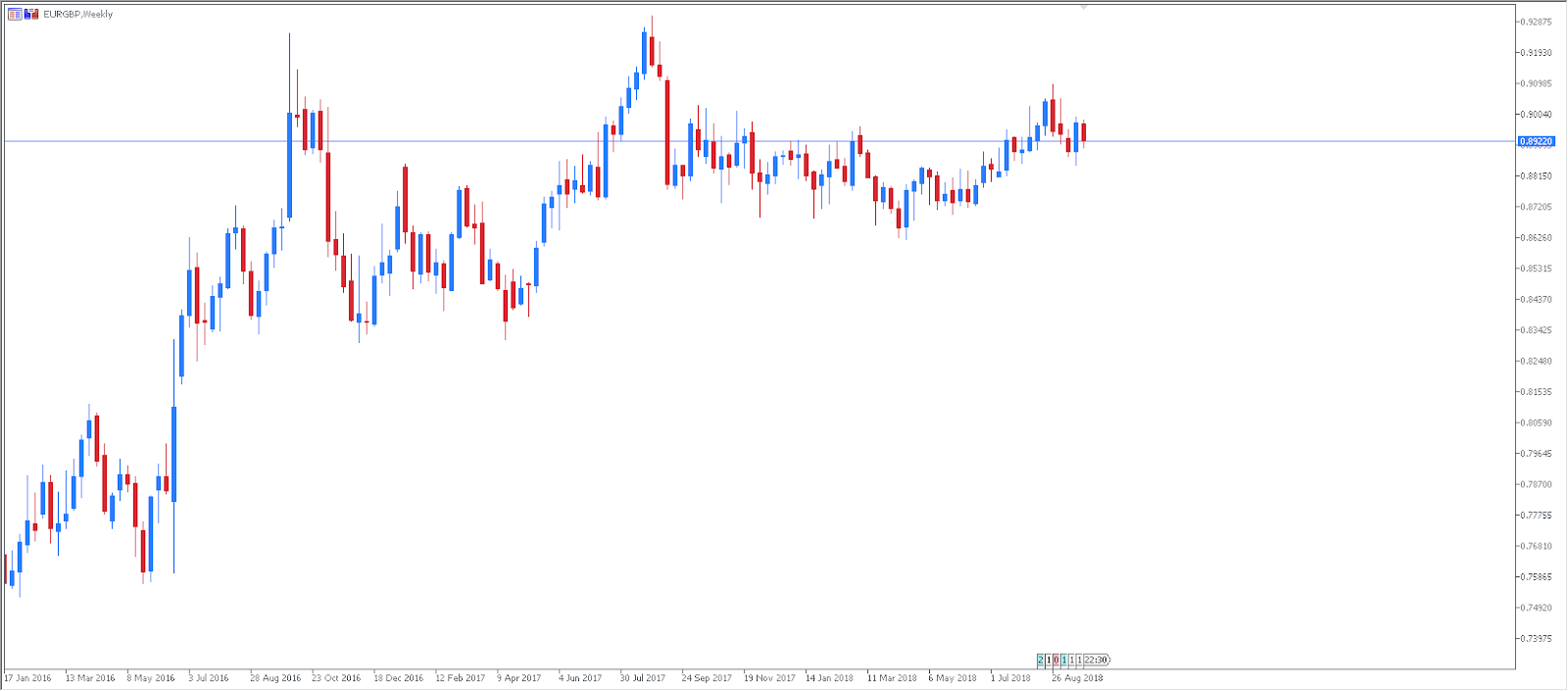
The EURGBP currency pair has formed a strong momentum almost reaching the psychological 0.9000 level. The ascending trend line (red) and the retracement trend line (blue) are still keeping the trend intact. The ECB president Mario Draghi is going to deliver opening remarks at the European Systemic Risk Board annual conference, in Frankfurt.
As head of the ECB, which controls short term interest rates, he has more influence over the Euro's value than any other person. Any mention of future economic policy guidance usually has a very strong impact on EUR crosses. On the contrary, the UK doesn't have any news scheduled for today, but traders always need to be aware of potential developments regarding Brexit. Don't forget to follow our Forex calendar for all regular updates on the news, economic announcements, forecasts and much more.
Technically, the EUR/GBP currency pair has formed an ascending trend line right at the 78.6 Admiral pivot points and the ascending trend line. Rejections from 0.8900 are possible as long as trend lines hold. Targets are 0.8950 and eventually 0.8995. Only a breakout above 0.8995 could spike the pair further towards the R1 Admiral Pivot. The price should get volatile in this pair, so be careful and follow the price action as usual.
Pivot Lines - Weekly Support and Resistance
POC - POC - Point Of Confluence (The zone where we expect the price to react - aka the entry zone)
The Analytical Overview Of The Main Currency Pairs
The EUR/USD currency pair
Technical indicators of the currency pair:
Prev Open: 1.17654
Open: 1.17362
% chg. over the last day: -0.21
Day's range: 1.16906 – 1.17570
52 wk range: 1.0571 – 1.2557
The Fed, as expected, raised the key interest rate range by 25 basis points to 2.00% -2.25%. The regulator improved the forecast of GDP growth for 2018-2019. The head of the Central Bank, Jerome Powell, also said that the rejection of identifying the monetary policy as "stimulating" in the communique is not a signal of a change in the Fed's current policy rate. At the moment the EUR/USD quotes show negative dynamics. The trading instrument is consolidating in the range of 1.16850-1.17100. The EUR/USD currency pair is tending to decrease.
The news feed on the US economy for 2018.09.27
A report on GDP at 15:30 (GMT+3:00);
The index of pending sales in the real estate market at 17:00 (GMT+3:00).
We also recommend paying attention to the speech by the heads of the ECB and the US Federal Reserve System.
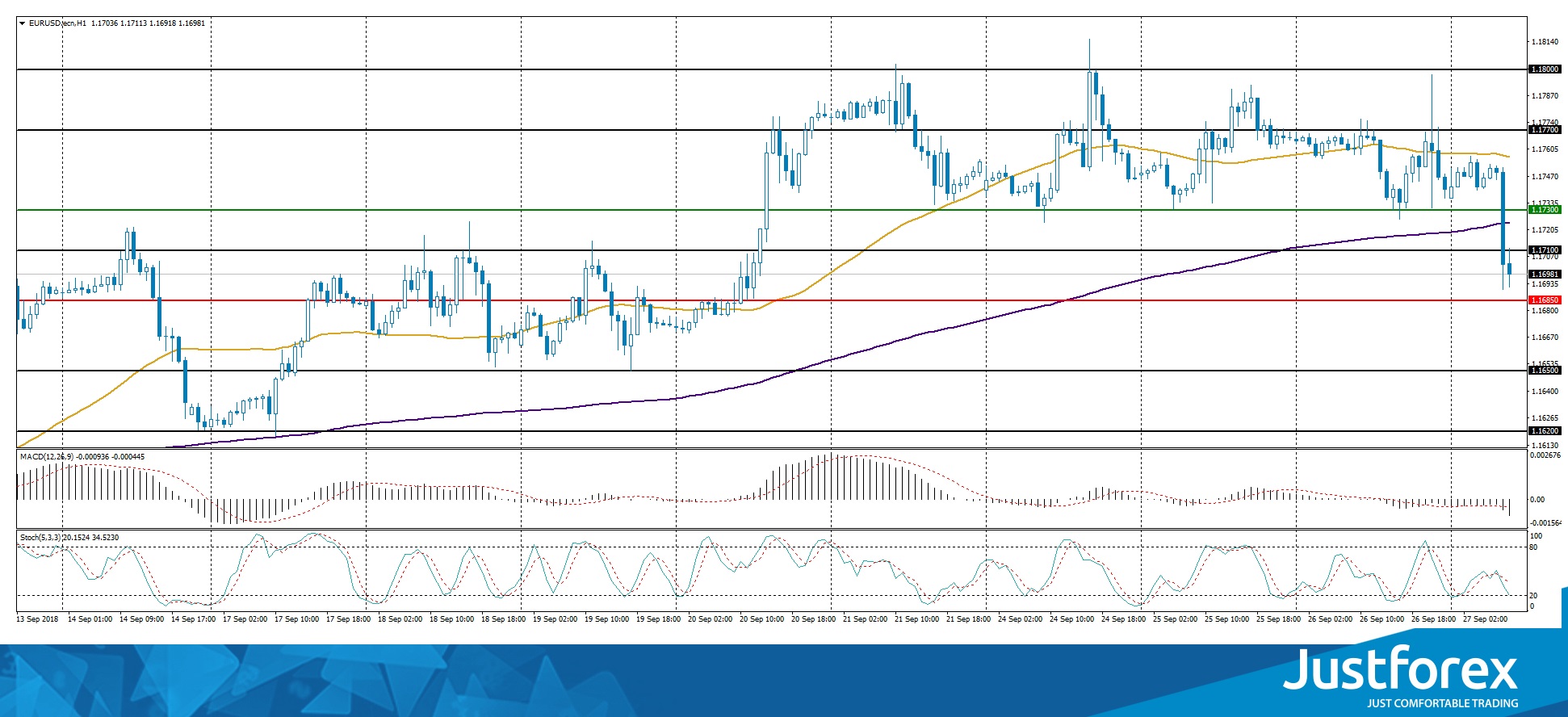
Indicators point to the power of sellers: the price has fixed below 50 MA and 200 MA.
The MACD histogram has moved to the negative zone and is below the signal line, which gives a strong signal to sell EUR/USD.
Stochastic Oscillator is located in the neutral zone, the %K line is below the %D line, which indicates the bearish sentiment.
Trading recommendations
Support levels: 1.16850, 1.16500, 1.16200
Resistance levels: 1.17100, 1.17300, 1.17700
If the price fixes below the support level of 1.16850, the EUR/USD quotes are expected to fall further. The movement is tending to 1.16500-1.16200.
An alternative may be the growth of the EUR/USD currency pair to the level of 1.17500-1.17700.
The GBP/USD currency pair
Technical indicators of the currency pair:
Prev Open: 1.31778
Open: 1.31653
% chg. over the last day: -0.09
Day's range: 1.31230 – 1.31779
52 wk range: 1.2361 – 1.4345
Yesterday the GBP/USD currency pair held the round level of 1.32000, which caused the bearish sentiment. The current technical pattern signals a further fall in quotations. The key levels of support and resistance are: 1.31250 and 1.31650 respectively. The positions must be opened from these marks. We recommend you to keep track of the current information regarding the Brexit process.
The news feed on the UK economy is calm. At 17:00 (GMT+3:00) investors will evaluate the speech by the head of the Bank of England.
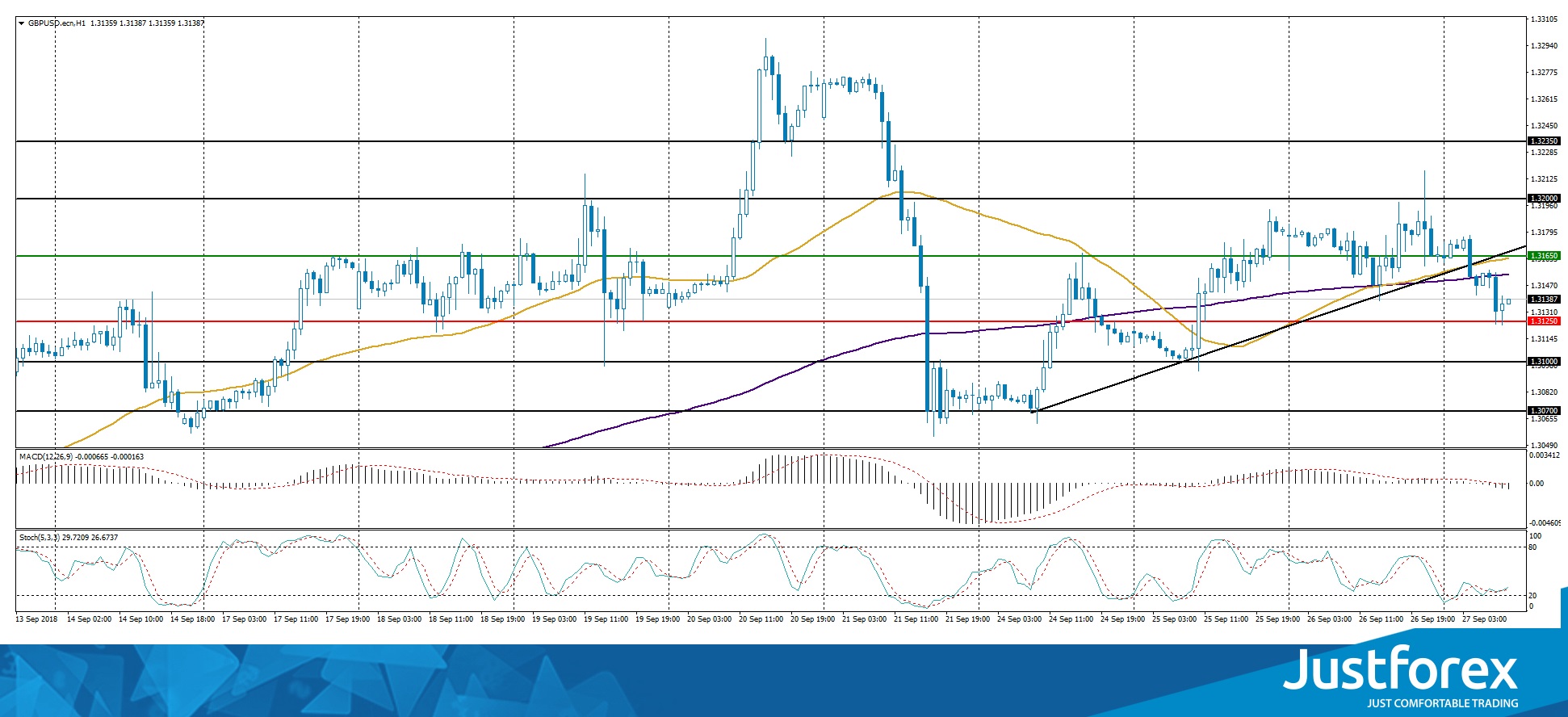
Indicators point to the power of sellers: the price has fixed below 50 MA and 200 MA.
The MACD histogram has moved to the negative zone and is below the signal line, which gives a strong signal to sell EUR/USD.
Stochastic Oscillator is located in the neutral zone, the %K line is below the %D line, which indicates the bearish sentiment.
Trading recommendations
Support levels: 1.16850, 1.16500, 1.16200
Resistance levels: 1.17100, 1.17300, 1.17700
If the price fixes below the support level of 1.16850, the EUR/USD quotes are expected to fall further. The movement is tending to 1.16500-1.16200.
An alternative may be the growth of the EUR/USD currency pair to the level of 1.17500-1.17700.
The GBP/USD currency pair
Technical indicators of the currency pair:
Prev Open: 1.31778
Open: 1.31653
% chg. over the last day: -0.09
Day's range: 1.31230 – 1.31779
52 wk range: 1.2361 – 1.4345
Yesterday the GBP/USD currency pair held the round level of 1.32000, which caused the bearish sentiment. The current technical pattern signals a further fall in quotations. The key levels of support and resistance are: 1.31250 and 1.31650 respectively. The positions must be opened from these marks. We recommend you to keep track of the current information regarding the Brexit process.
The news feed on the UK economy is calm. At 17:00 (GMT+3:00) investors will evaluate the speech by the head of the Bank of England.
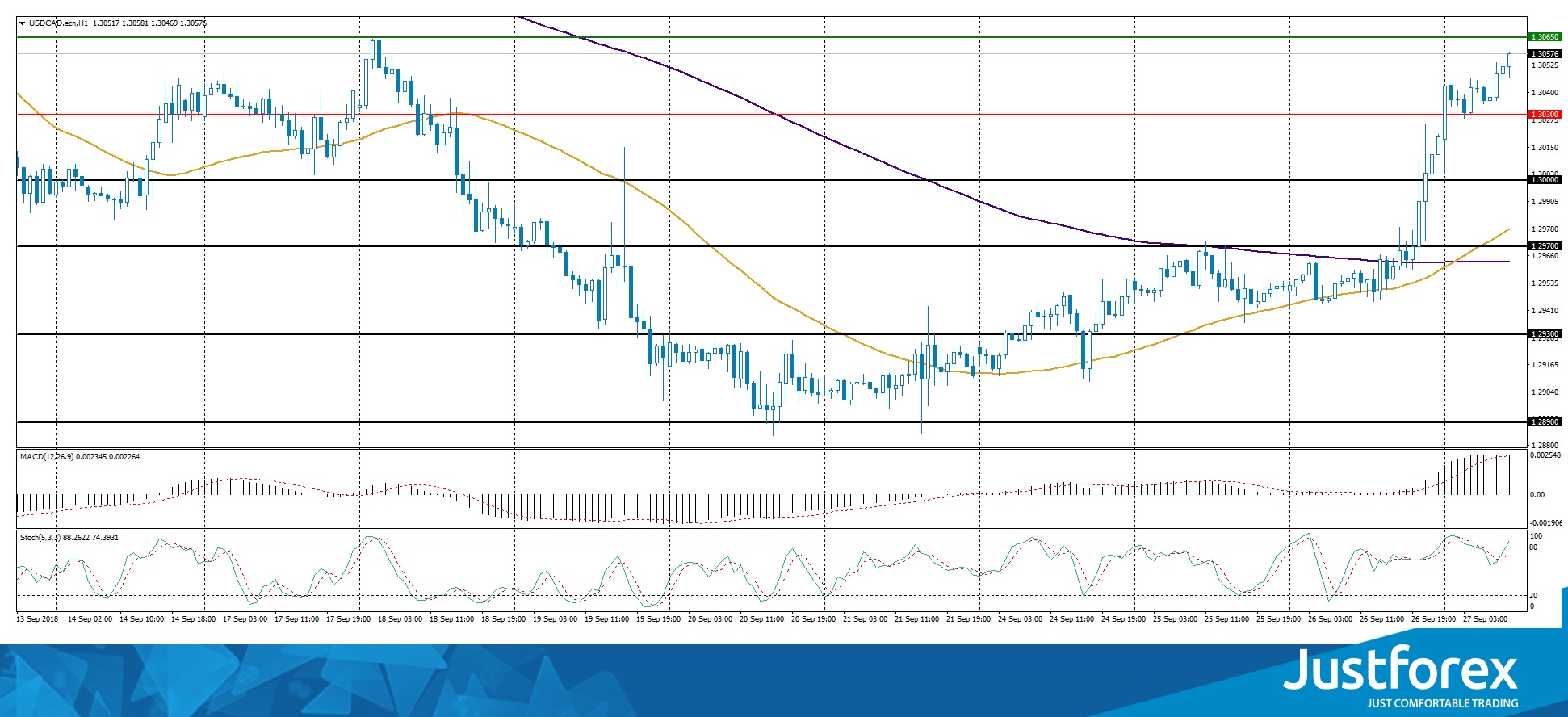
Indicators point to the power buyers: the price has fixed above 50 MA and 200 MA.
The MACD histogram is in the positive zone and above the signal line, which gives a strong signal to buy USD/CAD.
Stochastic Oscillator is located near the overbought zone, the %K line is above the %D line, which also signals the purchase of USD/CAD.
Trading recommendations
Support levels: 1.30300, 1.30000, 1.29700
Resistance levels: 1.30650, 1.31000
If the price fixes above the resistance level of 1.30650, further growth of the USD/CAD quotations is expected. The movement is tending to 1.31000-1.31250.
Alternative option. If the price fixes below 1.30300, we recommend you to look for entry points to the market to open short positions. The target level for profit-taking is 1.30000-1.29700.
The USD/JPY currency pair
Technical indicators of the currency pair:
Prev Open: 112.970
Open: 112.714
% chg. over the last day: -0.23
Day's range: 112.586 – 112.899
52 wk range: 104.56 – 114.74
At the moment, the USD/JPY currency pair is consolidating after a significant increase since the beginning of this month. In the near future, a technical correction is not ruled out. The trading instrument is testing local support and resistance levels: 112.600 and 112.850, respectively. The positions must be opened from these marks. We recommend you to pay attention to economic reports from the USA.
The news feed on Japan's economy is calm.
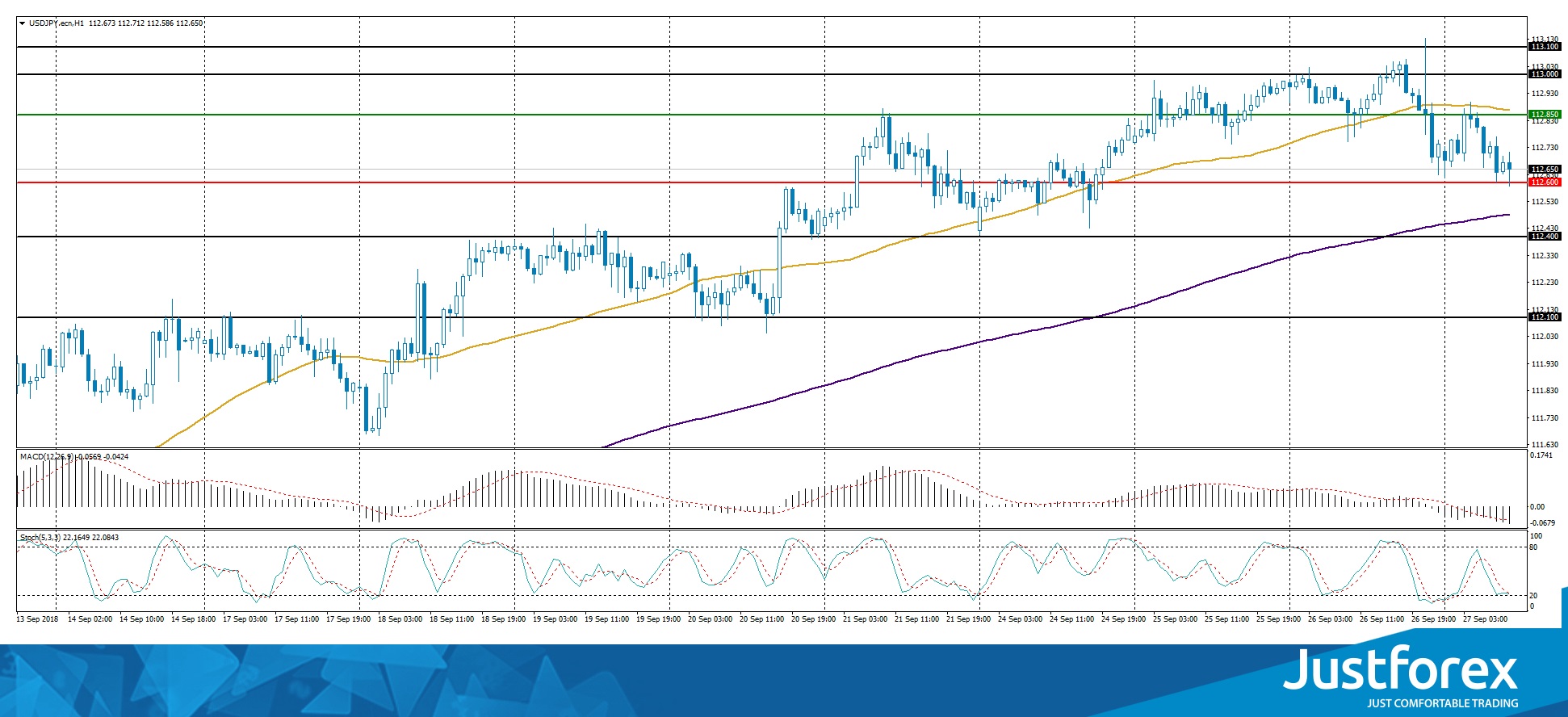
The price has fixed between 50 MA and 200 MA, which are strong dynamic levels of support and resistance.
The MACD histogram is located in the negative zone and below the signal line, which gives a strong signal to sell USD/JPY.
Stochastic Oscillator is close to the oversold zone, the %K line is crossing the %D line. There are no signals at the moment.
Trading recommendations
Support levels: 112.600, 112.400, 112.100
Resistance levels: 112.850, 113.100
If the price fixes below the local support of 112.600, the correction movement is expected. The movement is tending to 112.400-112.100.
An alternative may be the growth of the USD/JPY quotations to the local offer zone of 113.000-113.100.
Dollar Capitalizes On Euro Jitters, German Inflation Coming Up
Here are the latest developments in global markets:
FOREX: The dollar index – which tracks the greenback's performance against a basket of six major currencies– is higher by 0.35% on Thursday. This is owed mainly to weakness in the currency that has the biggest weight in this index by far, the euro, which is under pressure amid fresh worries around the Italian budget situation. The kiwi, meanwhile, responded little to the RBNZ rate decision overnight, though it is trading lower overall today.
STOCKS: An early rally in Wall Street came to a screeching halt on Wednesday, with all the major indices closing the day lower after a widely-telegraphed Fed rate hike sapped risk appetite. The Dow Jones led the way lower (-0.40%), while the S&P 500 (-0.33%) and Nasdaq Composite (-0.21%) followed not far behind. Asia took its cue from the US, with most benchmarks trading in the red on Thursday. In Japan, the Nikkei 225 (-0.99%) and the Topix (-1.18%) gave back some of their recent gains, while in Hong Kong, the Hang Seng fell by a modest 0.33%. In Europe, all benchmarks were set to open lower today according to futures, most likely due to renewed concerns around the Italian budget situation (see below).
COMMODITIES: Oil edged higher despite a larger-than-expected build in the crude inventories yesterday. The gains came after US Energy Secretary Rick Perry said his nation will not tap its Strategic Petroleum Reserves to combat higher oil prices – something that had been speculated following Trump's recent address at the UN. WTI is up by 1.21% at $72.43 per barrel, while Brent gained 1.02% to reach the $82.16/barrel mark. In precious metals, gold is fractionally higher on Thursday (+0.06%) at $1,196 per ounce, recovering some of the losses it posted in the previous session.
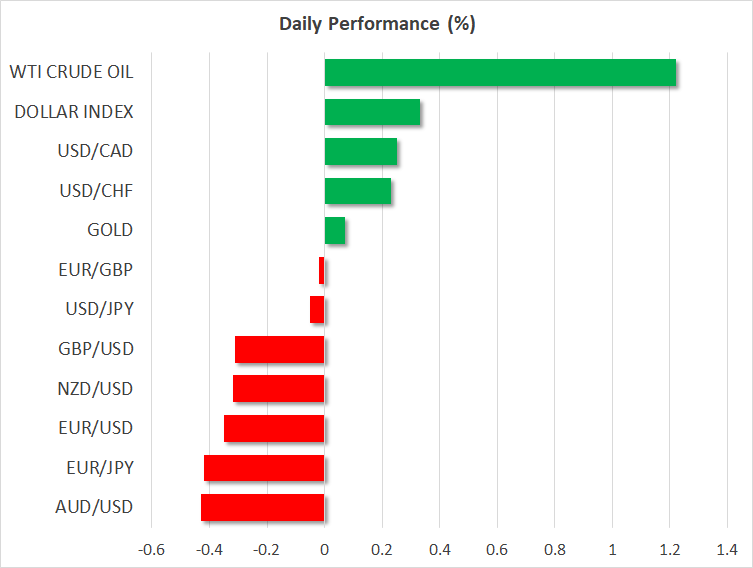
Major movers: Dollar little changed after Fed; euro drops on Italian budget woes
As was universally expected, the Fed raised interest rates by 25bps yesterday, delivering few fresh signals on policy. The dollar tumbled immediately on the decision, as policymakers removed from the statement a sentence that previously read “policy remains accommodative”, generating worries that the pace of hikes may slow moving forward. However, the US currency quickly recovered to trade almost unchanged after Chair Powell downplayed the change as merely cosmetic. He also didn't appear too worried about the escalation in trade tensions, indicating that it's a risk, but that the Fed doesn't see adverse effects in the numbers yet.
In terms of the rate projections, while the “median” dots remained unchanged to signal another hike in 2018 and three more in 2019, there was greater confidence on these forecasts among officials. As for economic forecasts, GDP growth for 2018 and 2019 were revised higher, while inflation for 2019 was marked slightly lower. Overall, there was nothing shocking out of this meeting, a fact reflected by the subdued reaction in the dollar and the nearly-unchanged market pricing for a December rate hike (still roughly 80%). The Fed remains committed to raising rates in a gradual manner amid a fiscally-turbocharged US economy, and trade risks are not dire enough yet to derail – or even delay – the central bank's normalization efforts.
Euro/dollar spiked up on the decision, almost touching the 1.1800 zone, but then fell back to 1.1740 once the press conference commenced. Several hours later, during the early European session on Thursday, the pair fell even further towards the 1.1700 handle – this time on euro weakness. Italian-budget worries came back to haunt the single currency, which took a hit on news that the much-anticipated budget may be delayed amid “complications” on reaching a consensus on the deficit. Concerns around a potential Italy-EU standoff over budget deficit limits will likely keep a risk-premium on the euro, and perhaps risk-sensitive assets in general, until there is some greater clarity on the situation.
Overnight, the RBNZ kept its policy unchanged, reiterating that the next move in interest rates could be both up or down, implicitly keeping a rate cut on the table. The Bank maintained a cautious-to-neutral tone overall, indicating that there are signs of “core inflation rising”, but “downside risks” to growth linger. Given the lack of fresh signals, there was little reaction in the kiwi.
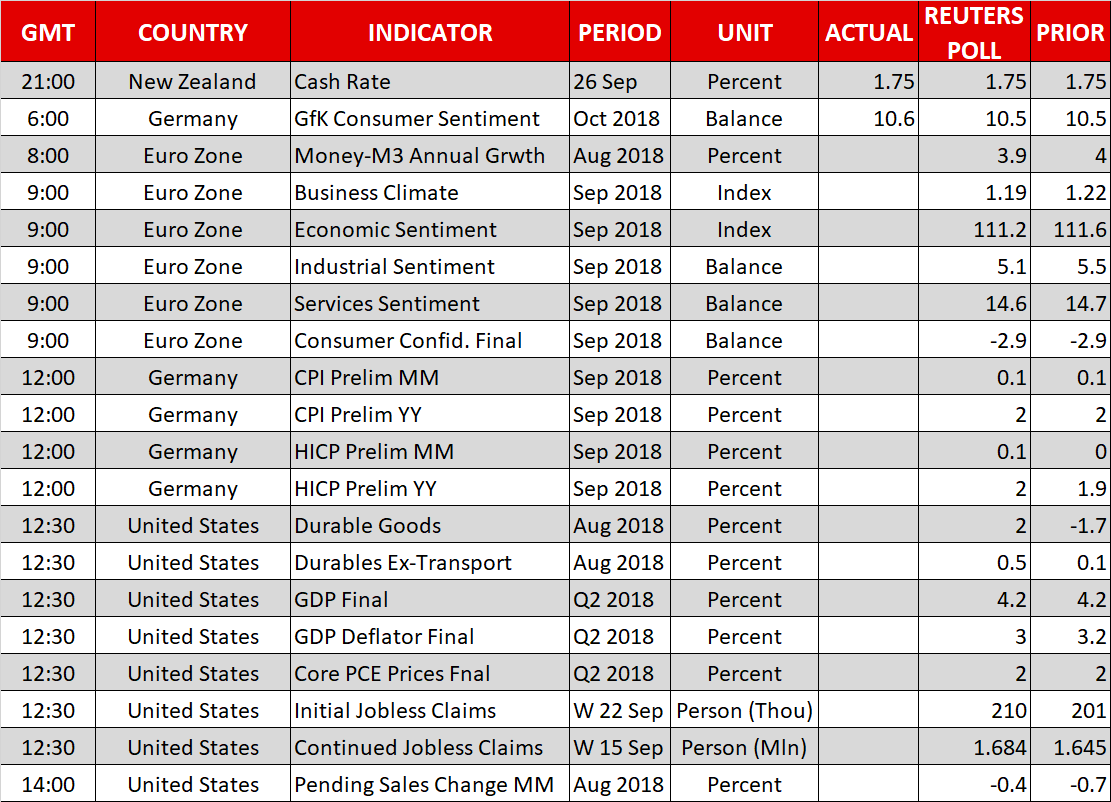
Day ahead: German inflation, US durable goods & final Q2 GDP figures due; Italian budget plans eyed
Eurozone business surveys, German inflation numbers, US durable goods & final Q2 GDP figures will be on tap on Thursday.
Numerous surveys gauging business sentiment in the eurozone during September are due out at 0900 GMT, all of which are expected to show a slight deterioration in morale relative to August; rising trade tensions have weighed on survey results in the past. Meanwhile, eurozone consumer confidence data due at the same time are projected to confirm the preliminary release which saw the relevant index coming in at -2.9 in September, its lowest since May 2017. For comparison, the US Conference Board's consumer confidence index for September released on Tuesday jumped to a fresh near two-decade high.
Having greater potential to drive euro pairs will be September flash inflation readings out of Germany at 1200 GMT. Month-on-month, CPI growth is expected to remain at 0.1%, which would leave the year-on-year pace of expansion unchanged at 2.0%. The harmonised figures (HICP), that use a common methodology across EU countries, will also be watched. It bears mention that the numbers come one day ahead of the eurozone's preliminary prints on September inflation and traders may thus use today's figures to speculate on tomorrow's euro-wide release, positioning themselves accordingly.
Also euro-important will be deliberations for Italy's budget, with reports suggesting that a meeting on the country's 2019 budget plan will be postponed.
Out of the US, data are anticipated to show durable goods orders rebounding to grow by 2.0% m/m in August, after contracting by 1.7% in July. Growth in the core measure of durable goods that excludes transportation items is forecast to stand at 0.5% m/m, faster than July's 0.1%. The prints are due at 1230 GMT, the same time as final Q2 GDP figures which are expected to confirm the annualized pace of growth at 4.2%. Also out at 1230 GMT will be Q2's final GDP deflator and core PCE prices. Weekly jobless claims data will be hitting the markets at the same time as well, while August's pending home sales will be released at 1400 GMT.
Numerous policymakers, including Fed chief Powell (2030 GMT), ECB President Draghi (1330 GMT), Bank of England Governor Carney (1400 GMT), and Bank of Canada head Poloz (2200 GMT) will be making public appearances. Also on the agenda are BoE policymaker Haldane (1145 GMT), ECB chief economist Praet (1700 GMT), and Dallas Fed President Kaplan (non-voting FOMC member – 1800 GMT).
Elsewhere, Turkish President Erdogan will be visiting Germany, where he will also meet Chancellor Merkel in an effort to restore ties and improve relations between the two nations; the two will be speaking to reporters tomorrow.
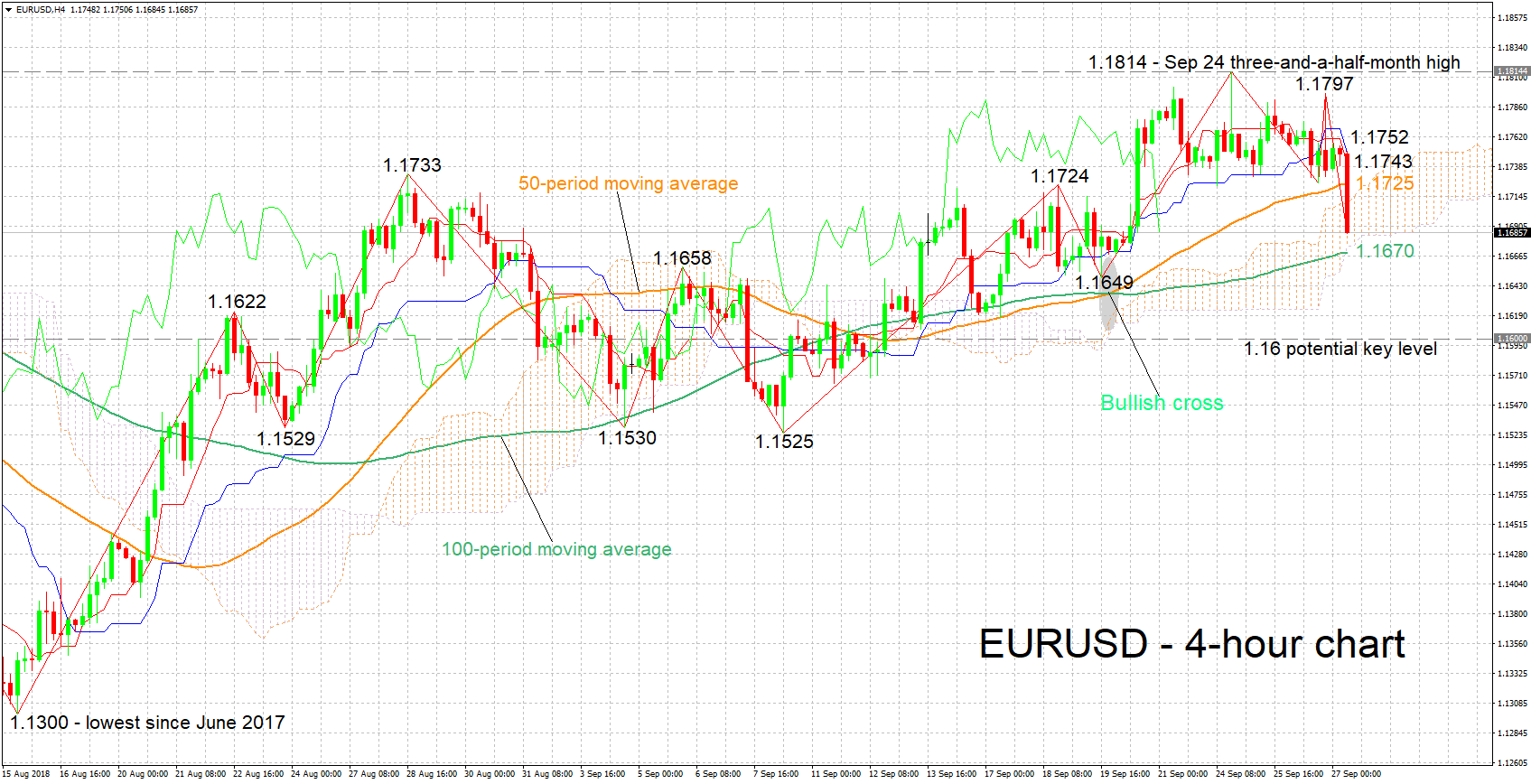
Technical Analysis: EURUSD bearish momentum as pair hits one-week low
EURUSD touched a one-week low of 1.1684 earlier on Thursday, while trading activity continues to take place near this trough. The Tenkan-sen moved below the Kijun-sen, signaling bearish momentum.
Stronger-than-expected German inflation numbers may boost the pair. The region from 1.1714 to 1.1752 includes the Ichimoku cloud top, the current level of the 50-period moving average line, and the Tenkan- and Kijun-sen lines, and may thus prove of significance, acting as resistance to gains. Further above, the area around the three-and-a-half-month high of 1.1814 would increasingly come into view.
On the downside and in case of a data miss, immediate support could occur around the 100-period MA at 1.1670; this is where the Ichimoku cloud bottom lies too. Steeper losses would bring into focus the zone around the 1.16 round figure which was congested between late August to mid-September.
Italian budget developments can well move the pair as well, while it should be kept in mind that US data are due later in the day.
Investors Assess The Results Of The Fed Meeting
The US currency strengthened against the basket of major currencies after the Fed meeting. As it became known, the regulator increased the range of the key interest rate by 25 basis points to 2.00%-2.25%, as investors expected. Yesterday, the US dollar index (#DX) closed in the positive zone (+0.06%) and continues to rise. The Central Bank published an optimistic forecast of the country's economic growth for 2018-2019. The Fed Chairman, Jerome Powell, also said that the rejection of identifying the monetary policy as "stimulating" in the communique is not a signal of a change in the Fed’s current policy rate.
Today, during the Asian trading session, the Reserve Bank of New Zealand has also announced a decision on the interest rate. The indicator remained unchanged at 1.75%, as investors expected. The regulator plans to adhere to the current rate of monetary policy. Today, we recommend paying attention to the US news feed.
The "black gold" prices are rising. At the moment, futures for the WTI crude oil are testing a mark of $72.45 per barrel.
Market Indicators
Yesterday, there was a variety of trends in the US stock market: #SPY (-0.30%), #DIA (-0.36%), #QQQ (+0.07%).
At the moment, the 10-year US government bonds yield is at the level of 3.04-3.05%.
The news feed on the US economy on 2018.09.27:
Core durable goods orders at 15:30 (GMT+3:00);
GDP data at 15:30 (GMT+3:00);
Pending home sales at 17:00 (GMT+3:00).
We also recommend paying attention to the speeches by the heads of the ECB, the Bank of England and the Fed.
BoJ Kuroda: Allowing JGB yield to move strengthens effect of monetary easing
BoJ Governor Haruhiko Kuroda said today the measures taken in July, allowing 10 year JGB yield to move between -0.1% and 0.1%, "would strengthen the effect of monetary easing as a whole". It's because, it "would allow us to continue powerful monetary easing." And he's optimistic that "the steps will help accelerate inflation to 2 percent at the earliest date possible, while ensuring financial market stability."
Meanwhile, Kuroda also warned that "we need to be vigilant of the potential impact of recent protectionist moves, though the economy is likely to sustain a moderate expansion".
Currencies: Dollar Keeps The Benefit Of The Doubt Post-Fed
Rates: US Treasuries gain after FOMC, but focus will turn to Italy today
US treasuries sold off quite sharply this month in' the run-up to yesterday's FOMC meeting. The Fed hiked its policy rate and kept forecasts for 2018-2020 broadly unchanged. A sell-the-rumour, buy-the-fact reaction lifted US Treasuries afterwards. Attention will turn to Europe today, with the 2019 Italian draft budget. It might turn out to be a tough day for BTP's.
Currencies: Dollar keeps the benefit of the doubt post-Fed.
The Fed policy decision/guidance brought no big surprise yesterday. The Fed will continue on the path of gradual rate hikes. The dollar showed no clear directional reaction, gaining a few ticks in a daily perspective. This morning, EUR/USD dropped to the 1.17 area, but his is Italy-related rather than Fed-induced. EUR/USD 1.1815/51 still looks like a tough resistance.
The Sunrise Headlines
- US equity markets closed yesterday's trading session with losses, after a full day in green. This morning most Asian exchanges are losing ground , except a few. China and Japan are underperforming the bunch.
- The Federal Reserve has, as expected, raised its policy rate by 25bp to 2%-2.25%. Chairman Powell remained upbeat about the US economy despite looming trade wars. A fourth rate hike in December is expected.
- The IMF has increased its three-year emergency lending program for Argentina from $50 billion to $57 billion, on the condition that Argentina's central bank allows the peso to float freely and only intervenes in the FX market in extreme circumstances.
- Italian media report the cabinet meeting today to decide on the 2019 budget targets may be postponed. The League party is said to join the Five Star Movement in seeking a 2.4% deficit, compared to FM Tria's target of 1.6%.
- US President Trump accused China of meddling in the 2018 mid-term elections. His director of national intelligence, Dan Coats, told reporters that China's cyber activities in the US were unprecedented. China denies everything.
- New Zealand's central bank left its policy rate unchanged at a record low of 1.75%. Governor Orr added that the he expects to keep it at 1.75%, but signalled he would be prepared to cut interest rates if the economy fails to gather pace.
- Today's eco calendar contains jobless claims and durable goods orders in the US, economic confidence for the EMU. Germany releases September inflation numbers. ECB's Draghi and Praet, BoE's Carney and Fed's Powell are speaking today.
Currencies: Dollar Keeps The Benefit Of The Doubt Post-Fed
USD to maintain the benefit of the doubt post-Fed? The dollar traded soft of late, but gained a few ticks in the run-up to the Fed decision. The Fed as expected raised its policy rate by 25 bp. The Fed communication (dots, statement, and press conference) signals a continuation on the path of gradual rate hikes. The Fed message was little different from August. At the same time, markets continue to anticipate a rate path that is materially softer than the Fed's indication. The Fed sees growth slowing over the 2018/21 horizon, but the policy rate stays above the neutral rate (3.0%) end 2021. So, the Fed assessment includes factors that could both be used to support a hawkish and a dovish view. This was also visible in the market reaction. Both US yields and the dollar were looking for direction. The US yield curve bull flattened, with yields at longer maturities losing a few bp. The USD jumped up down but finally finished marginally stronger (EUR/USD close at 1.1740; DXY at 94.91). Overnight, Asian equities are mostly losing modest ground. EUR/USD slipped to the low 1.17 area. However this wasn't Fedinduced, but due to press headlines that a key meeting on the Italian budget might be delayed. Today, eco data include EC confidence data, German inflation, final US Q2 GDP and US durable orders. EC confidence is expected slightly softer while German headline inflation is expected unchanged (1.9% Y/Y). US durable orders /shipments are expected solid. Data might be slightly more supportive for the dollar than for the euro. Italy might be an additional source of euro uncertainty. Yesterday's Fed meeting didn't bring any spectacular news. Even so, we think that the Fed assessment on the economy and indications on monetary policy should be ‘strong' enough to provide downside protection for the dollar. We keep the working hypothesis that a break of EUR/USD beyond 1.1815/1.1851 won't be evident ST. The recent USD/JPY outperformance might become a bit less outspoken. Yesterday, sterling traded sideways against the dollar but regained further ground against the euro.We didn't see much progress in Brexit. Today, there are no UK data. BoE's Haldane and Carney will speak. Brexit noise will proably continued to guide the intra-day GBP-gyrations. Italy might be a slightly negative for EUR/GBP, too. For now, we assume that any further sterling rebound shouldn't go much further than recent EUR/GBP correction low near 0.8850
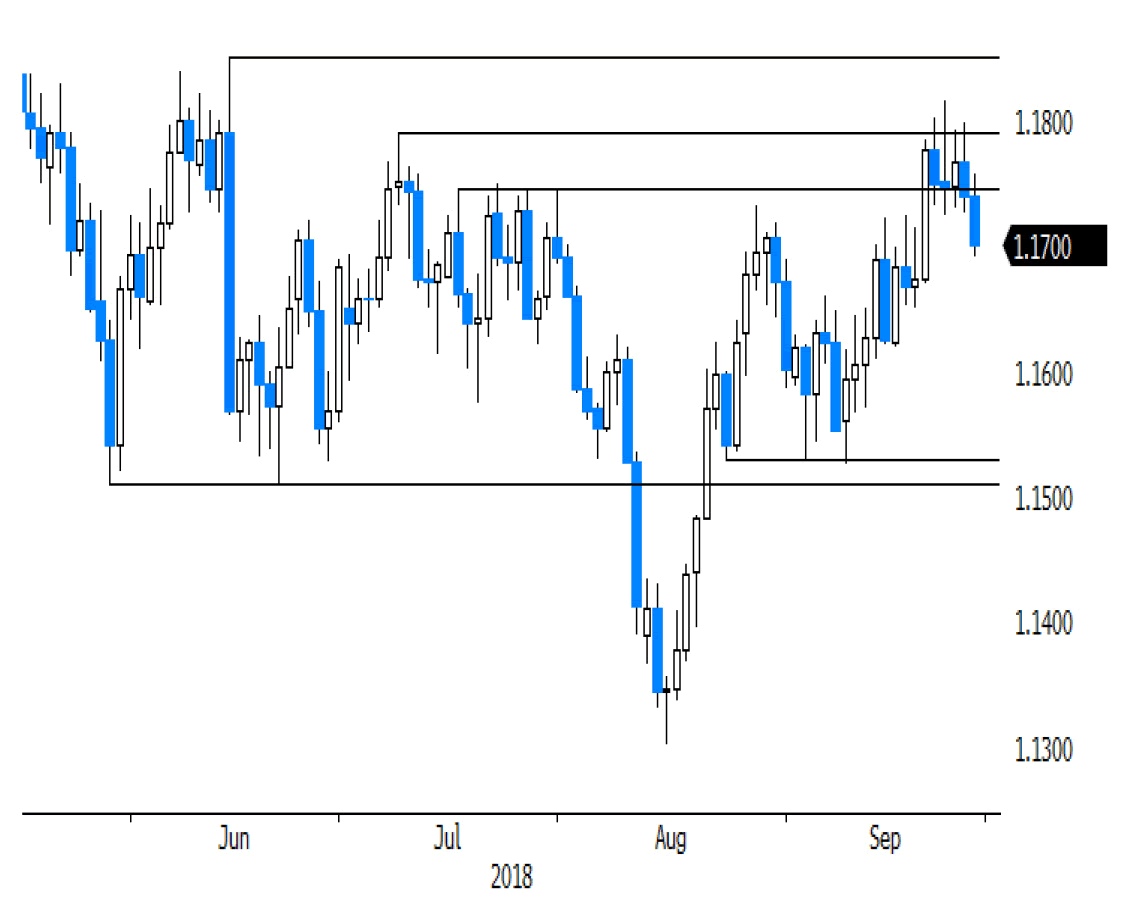
EUR/USD: Fed brought no high profile news, but USD downside might remain well protected