Sample Category Title
Into US session: Sterling pares losses, Aussie weakest
Entering into US session, Sterling is trading as the strongest one for today, reversing much last last week's losses. It's followed by Euro and then Dollar. On the other hand, commodity currencies are generally lower, as led by Australian Dollar. There were a lot of comments on Brexit from UK and EU, but there were just nothing more than words. UK Prime Minister Theresa May's cabinet will meet on Brexit today and the result out the there would be watched.
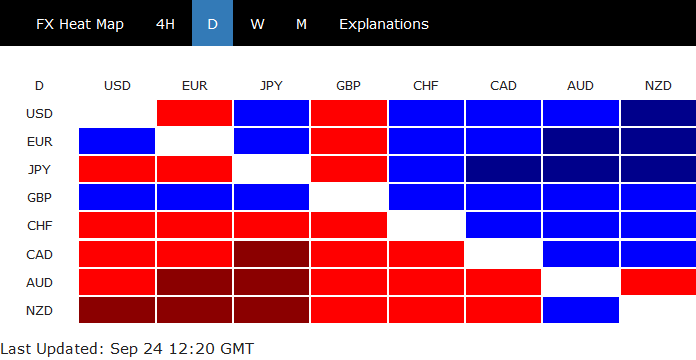
Meanwhile, new round of US-China tariffs are set to kick in today. Ahead of that, China's State Council released a 36k white paper on its position, criticizing US "bullying" and pledged to defend it's own interests. It doesn't matter much on how much truth the white paper tells, as what China says is always doubtful. Most important thing is that China is not going to back down from trade war. That's a factor weighing down Aussie and Kiwi.
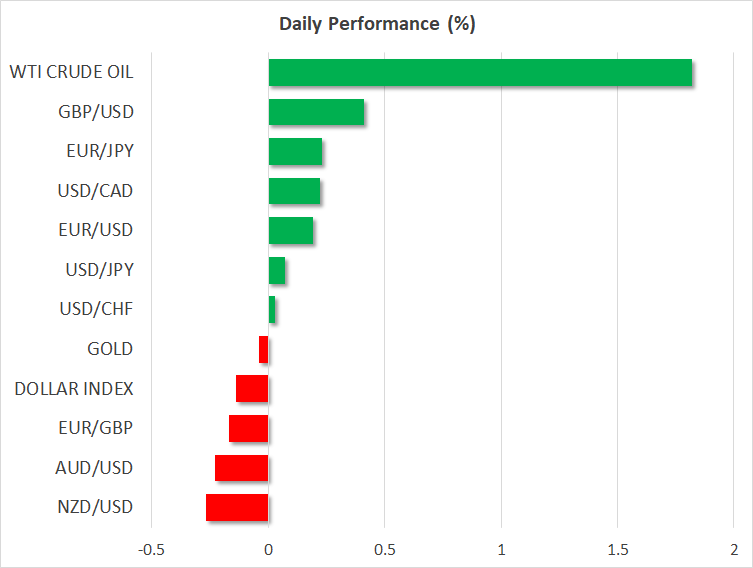
In other markets, European stocks are generally lower today. FTSE is down -0.24% at the time of writing, DAX down -0.38%, CAC down -0.21%. China and Japan are on holiday. Hong Kong HSI closed down -1.62%, Singapore Strait Times closed up 0.05%. WTI crude oil was lifted by OPEC decision to stick with its production plan and is up 1.65% at 71.95. Gold is hovering around 1200.
Sterling recovers as UK PM May’s cabinet meets on Brexit
Sterling appears to be lifted by reports that German European affairs minister Michael Roth said Brexit deal is still possible by November. And he also warned that a no-deal Brexit would be the worst case scenario for all parties. However, Roth also emphasized that "we will not undo the single market or create special rules which could result in competitive disadvantages for our companies." Also, he added that Germany fully support chief negotiator Michel Barnier. There is no softening on Germany's stance indeed.
Separately, French President Emmanuel Macron's office also said he expected the UK to put forward new proposals in October. And he preferred not to drag on. His office said that "It's a way of raising pressure, ... It's not necessarily 'take it or leave it', it's really to say there's a lot of work to be done by November, we must do it, and not let this thing drag on."
UK Prime Minister Theresa May's spokesman said the cabinet is due to discuss Brexit negotiations today. And he emphasized "the cabinet gave its full support to the white paper (Chequers plan), and that continues to be the case."
However, Jacob Rees-Mogg, chairman of the European Research Group of anti-EU lawmakers in May's ruling Conservative party, said "the prime minister is a lady of singular wisdom and therefore is likely to recognize the reality that Chequers does not have much support either in this country or abroad."
Pound Rallies as UK’s Raab Eases Brexit Fears; Oil Gains the Most
Here are the latest developments in global markets:
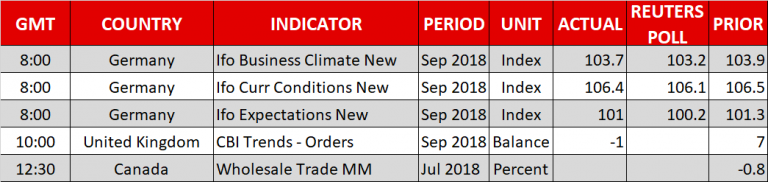
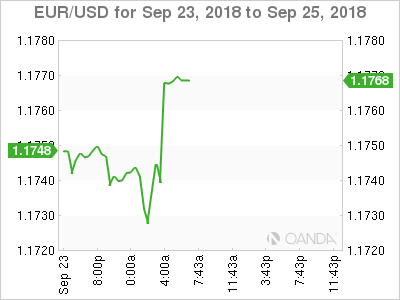
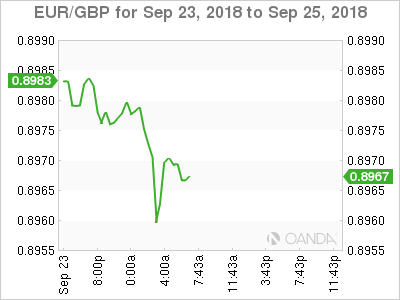
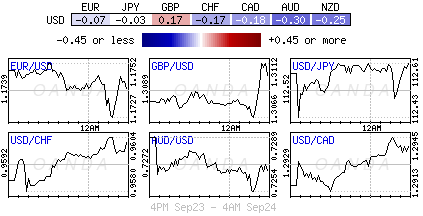
- FOREX: After China canceled planned trade talks with the US on Saturday and new import tariffs took effect, Chinese officials reiterated on Monday that Beijing is ready for a new round of negotiations only if the talks are based on mutual respect. Investors, though, remained positive on the dollar as they widely expected the Fed to shrug off trade risks and deliver another 25 bps rate hike on Wednesday, with dollar/yen trading higher but only modestly so, at 112.67 (+0.10%). US 10-year government yields peaked at 3.09%, the highest since May. The dollar index, however, started the week on the downside, easing to 94.11 (-0.12%) as the euro and the pound grabbed buying interest. Euro/dollar was set to recover Friday’s losses, rising to 1.1770 (+0.18%), finding some support from better-than-expected German Ifo readings; the German Ifo business climate index for the month of September increased to 103.7 compared to 103.2 forecasted, but stood slightly below the August mark of 103.9. Meanwhile in Britain, the UK Brexit Secretary gave some relief to the markets (see below) sending pound/dollar up to 1.3126 (+0.38%), helping it to recover some of Friday’s losses. Pound/yen increased to 147.91 (+0.50%) and euro/pound eased to 0.8965 (-0.17%). In the antipodean sphere, the trade-sensitive aussie/dollar and kiwi/dollar were on the backfoot at 0.7274 (-0.21%) and 0.6668 (-0.25%) respectively. Dollar/loonie edged up to 1.2938 (+0.24%) as last week’s NAFTA talks failed to deliver progress in US-Canadian trade relations ahead of an informal deadline on October 1. In emerging markets, the Turkish lira managed to rally by 1.38% versus the greenback despite the Turkish Ministry of Finance announcing lower growth forecasts for 2018 and 2019 last week. The ministry did not provide details on how it will assist the banking sector.
- STOCKS: New fears on the trade front bit European stocks on Monday, driving the pan-European STOXX 600 and the blue-chip Euro STOXX 50 down by 0.28% and 0.42% respectively at 1140 GMT. The German DAX 30 declined by 0.36%, the French CAC retreated by 0.25%, while UK’s FTSE 100 fell by 0.23%. The Italian FTSE MIB edged lower by 0.11%. In the US, futures tracking S&P 500, Dow Jones and Nasdaq 100 were heading down but marginally so, pointing to a modestly negative open.
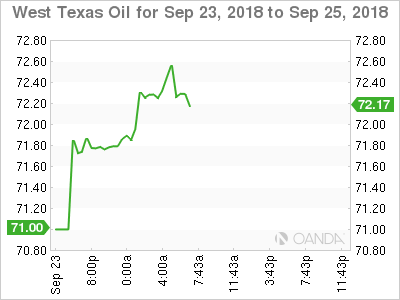
- COMMODITIES: Oil prices were rising considerably early on Monday as concerns about US sanctions weighing on Iranian oil exports continued to support the market. Note that the US prepares a second round of sanctions against Iran in November. On Saturday, the OPEC and non-OPEC oil producers who agreed to raise supply in June met in Algiers to discuss the allocation of the supply increase. However, as expected the members did not concluded to reach a formal decision, while they also showed no pledge to hike supply even further unlike the US President’s demands. WTI crude jumped by 2.06% to $72.24/barrel and the London-based Brent surged by 2.45% to $80.76/barrel. In precious metals, gold was steady at $1,199/ounce.
Day Ahead: Monday light in terms of data releases; eyes on trade and Brexit negotiations
Monday will be relatively quiet in terms of economic releases as investors are turning their attention to the Federal Reserve policy meeting on Wednesday that is will widely expected to deliver a 25 bps rate hike for the third time this year. Markets are increasingly pricing another rate rise in December as well, currently assinging an 80% probability to such an outcome.
Any updates, however on the trade front and particularly on the US-Sino relations could prove crucial for the market sentiment as relevant talks were cancelled by China on Saturday, while both Washington and Beijing activated fresh tariffs on each other’s goods today. The US administration imposed an additional 10% tariff on $200 billion of Chinese goods spanning thousands of products. China retaliated immediately with new tariffs ranging between 5% to 10% on $60 billion of US products.
In the UK, Britain’s Secretary of State for Exiting the European Union Dominique Raab said that he was confident that the UK will achieve progress with the EU regarding the withdrawal plan, while saying that a no-deal Brexit is not the end of the world and the UK is ready to face such an outcome. Meanwhile, the Labour Party leader Jeremy Corbyn threatened to support a second Brexit referendum if the UK Prime Minister, Theresa May, fails to push her Brexit proposal through Parliament. May is scheduled to defend her Chequers plan today at a meeting with her Cabinet at 1300 GMT. Recall that the EU rejected May’s divorce proposals last week in Austria.
Looking at the calendar, Canadian wholesale trade data for the month of July are due for release at 1230 GMT. Yet the main focus will be on NAFTA negotiations between US and Canadian officials with the next deadline being October 1.
As for public appearances, President Mario Draghi will be speaking to the European Parliament’s ECON committee at 1300 GMT.
Overnight, the Bank of Japan will release minutes of its July 30-31 meeting at 2350 GMT, this being the meeting before the latest one. Note that on September 19 the central bank left rates unchanged at -0.1% and maintained its July pledge to keep borrowing costs low for an extended period of time. Still, policymakers remained optimistic on the path of the economy despite warning that US trade protectionism may cloud the outlook.
Asia FX Falls On Renewed Trade Tensions, Pound At Risk To More Sell-Offs
Reports that Beijing has cancelled planned trade talks with Washington in response to the ongoing narrative from the Trump Administration to threaten further tariffs on Chinese goods has encouraged risk aversion to return at the beginning of the new trading week. Investor sentiment towards global stocks has once again switched into a cautious stance and with a number of emerging market currencies in Asia trending lower against the Greenback, it does appear that investors are preparing for another potential escalation in global trade tensions.
While most eyes have focused on how the offshore Chinese Yuan (0.13% weaker) has responded to the latest developments, it is interesting to note that it is the same currencies that were exposed to repeated weakness during the emerging market volatility a few weeks back that have once again been hit the hardest. The Indonesian Rupiah, Philippine Peso and Indian Rupee are all trading more than 0.3% weaker at time of writing.
Officials in both India and Indonesia remain under high pressure to introduce further measures to stabilize their currencies. Bank Indonesia is under the spotlight to potentially raise interest rates later this week for the fifth time since May, while authorities in India are expected to tighten measures that would prevent imports of non-essential items into India.
I continue to hold concerns that unless there is a key breakthrough in trade tensions that the overall sentiment towards emerging markets will remain hesitant, meaning that there is still a risk that measures to shore up currencies in emerging markets will continue to not have the desired impact.
Pound at risk to return below 1.30
Although the British Pound is attempting to bounce higher after suffering its heaviest sell-off in over a year following assertive comments from UK Prime Minister Theresa May regarding the prolonged stand-off with Brexit negotiations, I am concerned that this bounce could be another Pound rally at risk of falling like a house of cards.
The statement from Theresa May late last week represented a clear warning that investors should be better prepared for a potential hard-Brexit eventuality than what is currently priced into the market.
Unless there is material progress soon in these long-winded discussions between the United Kingdom and European Union, I am not ruling out the likelihood of further aggressive sell-offs in the British Pound. A hard-Brexit outcome would likely push the Pound back to the low 1.20 levels at the very least, which is a significant distance from the 1.31 valuation in the Pound today.
Overall the downside risk in the Pound is far more dramatic than any upside potential from a breakthrough in negotiations that increases optimism that the outcome will be a soft-Brexit.
Brent Oil Outlook: Brent Hits Highest Levels Since Nov 2014
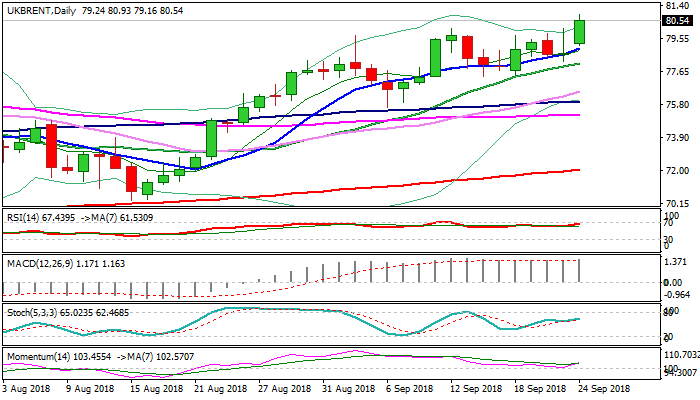
Brent oil hit new nearly four-year high at $80.93 on Monday, after fresh bullish acceleration through psychological $80 barrier broke above former high at $80.48 (17 May). Renewed bullish sentiment after Saudi Arabia said it is comfortable with Brent price above $80, as well as looming US sanctions on Iran which already started to bite, underpinned fresh rally. Technical studies in full bullish configuration add to growing bullish sentiment. Bulls need close above $80.48 to open way towards next key barrier at $81.84 (Fibo 61.8% of $115.68/$27.09, 2014/16 fall). Daily indicators head north and show enough space for stretch towards $81.84 pivot, break of which would generate next strong bullish signal. Meanwhile, bulls may consolidate before continuing, on profit-taking after today's rally. Broken $80 barrier should ideally hold to keep fresh bulls intact. Deeper dips would face strong support at $78.96 (rising 10SMA), with firm break here to sideline immediate bulls and signal false break higher.
Res: 80.93, 81.15, 81.84, 82.19
Sup: 80.48, 80.10, 79.16, 78.96
Special Report: OPEC’s Only Interest Is To Put Leash On Wildcatters
Higher oil prices are causing a rift between Trump and the oil cartel- OPEC. Both OPEC and Non-OPEC producers are concerned about one thing, put a leash on widlcatters
Crude and Brent oil prices are flirting with multi-year highs. Year to date, Crude oil is up whopping 23.47% and Brent has gained nearly 25.55%. At the time of writing this article, crude oil was trading at $72.10and Brent was trading at $80.40. What instigated this move is the question that many are asking because surely Trump doesn't like higher oil prices and he has tweeted several times about this.
The fact is that Trump's tweet about lower oil prices has little to no impact on the prices. Last week, Trump used his favourite platform-twitter in order to communicate his frustration about Brent price being near $80. However, his tweet fell on deaf ears because there is literally no impact on the price today.
Even the biggest oil cartel, OPEC didn't pay much attention to Donald Trump's rants about higher oil prices during their meeting which took place over the weekend. But before we sweep further into the OPEC meeting and its outcome, it is worth looking at Trump's tweets about lower oil prices and its impact on the oil prices over the last five months. Since, his first tweet (“Oil prices are artificially Very high! No good and will not be accepted”) back in April this year, oil prices have gained nearly 12.81%. Thanks to plunging oil output from Venezuela and sanctions on Iran, both have contributed to higher oil prices.
There is clear US political pressure on the countries which are importing oil from Iran. Since the sanctions have been announced, South Korea has dropped its oil import to nearly zero from Iran but on the other hand, countries like Turkey and Japan have reduced very little oil import from Iran. Nonetheless, there is a huge pressure on all US allies to cut their oil supplies from Iran and the fact is that countries are complying. The only difference is that in some places you are seeing much larger cuts than the other.
Going back to the OPEC meeting, the OPEC ministers met in Algeria on Sunday to think a way forward about the ongoing challenges for the cartel. Their response to Trump's tweet was simple; no additional supply boost. This means that they didn't pay any attention to what Trump has said and not willing to increase the supply. Generally speaking, higher oil supply should push the price lower. Saudi Energy Minister Khalid al-Falih response was the most intriguing who said: “I do not influence prices”. Clearly, the biggest oil producer of the OPEC has no interest to disturb the oil equilibrium now. Non-OPEC oil producer, Russia also echoed a similar message and made it clear that the country has no interest to play with the oil equation now.
The cartel's only interest is to put a leash on the wildcatters from Texas to North Dakota. They have added major threats for the cartel. Since 2010, the three major shale basins have added nearly 5.05 million barrels a day, something which OPEC needs to keep a close eye on. Of course, it isn't in cartel's favour to keep the prices higher because this will simply attract more oil producers. But the matter of the fact is that both OPEC and Non- OPEC producers, particularly Saudi Arabia and Russia need to have the oil prices are current level in order to keep the growth going and maintain their exuberant expenses.
Fed And Trade Threats To Drive Markets
Monday September 24: Five things the markets are talking about
Global equities are under pressure as China called off planned trade talks with U.S, potentially triggering an escalation in the tariff war between the world’s largest economies.
Note: U.S’ tariffs on +$200B in China goods took effect at midnight, while China’s counter tariffs on +$60B of U.S goods also came into effect this morning.
Presidents Trumps’ veiled threat to OPEC to increase global crude supply was met with a tepid response over the weekend. The Saudi oil minister said that the market was adequately supplied.
The ‘big’ dollar continues to find support on pullbacks, while Treasuries trade under pressure along with Euro sovereign bonds.
Topping investors’ agenda this week is the FOMC meeting along with the Fed’s updated forecasts and the chair’s quarterly press conference (Sep 25-26). The market is looking for a third +25 bps rate hike and is pricing in another one for December. Investors await Fed chair Powell’s views on trade and tariffs.
Elsewhere, the Reserve Bank of New Zealand (RBNZ) will also meet Wednesday (Sept 26) and no rate hike is expected. The U.K posts its final estimate of Q2 GDP, while the Eurozone releases the September flash harmonized index of consumer prices (Sept 28). Also on Friday, Canada will release its monthly GDP data for July.
1. Stocks see red
Asian volumes were light and liquidity a concern as markets in China, Japan, South Korea and Taiwan were closed for holidays. Both Hong Kong and South Korea will be closed on Tuesday.
Note: Despite Japanese markets closed, Japans Economy Minister Motegi and USTR Lighthizer are expected to hold trade talks today in New York. Japan is said to considering a bilateral trade agreement with the U.S.
Down-under, Aussie stocks edged lower overnight, as lower commodities prices hit materials stocks while financials slipped on new revelations of wrongdoing in the sector revealed in a quasi-judicial inquiry. The S&P/ASX 200 index fell -0.1% at the close of trade. The benchmark rose +0.4% on Friday.
In Hong Kong, stocks plummeted after the U.S imposed fresh tariffs on an additional +$200B of Chinese imports and as Beijing cancelled planned talks between the two sides. The Hang Seng Index fell -1.62%.
In Europe, regional bourses opened in the ‘red’ and continue to trade lower. Market risk sentiment continues to be impacted over trade concerns as U.S tariffs came into effect at midnight and China cancels trade talks – consumer discretionary sector among worst performers.
U.S stocks are set to open in the ‘red’ (-0.2%).
Indices: Stoxx50 -0.3% at 3,419, FTSE -0.1% at 7,480, DAX -0.3% at 12,389, CAC-40 -0.2% at 5,481, IBEX-35 -0.5% at 9,543, FTSE MIB -0.5% at 21,427, SMI % at , S&P 500 Futures -0.2%
2. OPEC, Russia reject Trump’s call for immediate boost to oil output
Yesterday in Algiers, both OPEC and Russia ruled out any immediate, additional increase in crude output, effectively rejecting Trump’s calls for action to “cool” the market.
The recent price rally has mainly stemmed from a decline in oil exports from OPEC member Iran due to fresh U.S sanctions.
Also, according to OPEC’s projections, a strong rise in non-OPEC production could exceed global demand growth, which could eventually put pressure on prices.
Oil prices remain better bid this Monday morning as U.S. markets tighten ahead of Washington’s plan to impose new sanctions against Iran.
Brent crude futures are at +$79.74 per barrel, up by +94c, or +1.2%. U.S West Texas Intermediate (WTI) crude futures have rallied +74c, or +1.1%, to +$71.52 a barrel.
The market remains concerned about U.S inventory levels. U.S commercial crude oil inventories (EIA) are at their lowest level in three-years, and while output remains around the record of +11M bpd, recent subdued U.S drilling activity points towards a slowdown.
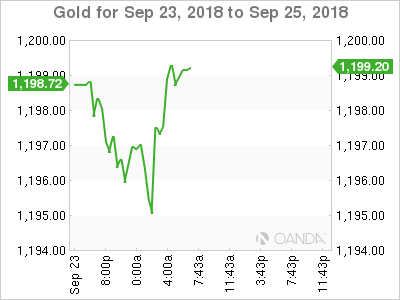
Gold prices have edged a tad lower this morning as the U.S dollar holds firm on news that China has cancelled trade talks with the U.S, while the market waits for this week’s FOMC meeting for guidance on future rate hikes. Spot gold is down -0.1% at +$1,198.36, after declining as much as -1.3% on Friday. U.S gold futures are little changed at +$1,201.60 an ounce.
3. HK interbank rates jump to 10-year highs after HKD surge
Some of the short-term rates banks in Hong Kong charge each other leapt to their highest levels in roughly a decade, in the first trading session after a sudden surge in the tightly controlled HKD.
Note: Speculators have been covering some significant ‘short’ HKD positions and the lack of liquidity has not helped the move.
The overnight HK interbank offered rate jumped +2% to +3.85%, it’s highest since 2007. One-month Hibor rose less sharply, but still reached nearly +2.17%. On Friday, HKD unexpectedly surged +0.42%, its biggest gain since 2003.
Note: The currency, which is pegged in a range of $7.75 to $7.85 to the U.S. dollar, was little changed at $7.8113.
Elsewhere, Italian government bond yields are backing up again this morning, again reflecting some unease among investors given this week’s deadline for the government to present its budget targets.
Note: ECB’s Mario Draghi speaks at the European Parliament later today, while on Wednesday; the Fed is expected to raise interest rates again.
Two-year Italian bond yields are up +4.5 bps on the day at +0.81%, while the ten-year yields are +3.5 bps higher at +2.87%. The gap over benchmark German Bunds yields have widened from Friday’s close at around +241 bps.
The yield on U.S 10-year Treasuries has increased +1 bps to +3.07%. In Germany, the 10-year Bund yield has rallied less than +1 bps to +0.47%, while in the U.K, the 10-year Gilt yield has climbed +1 bps to +1.563%.
4. Dollar hold firms, but G7 does find some support
GBP/USD (£1.3123) remains handcuffed to Brexit rhetoric and PM May woes. Sterling has begun Monday’s session on the front foot, reclaiming the psychological £1.31 handle after comments from U.K Brexit Minister Raab indicated that he is confident he will make progress on Brexit. There are also whispers that PM May has started contingency planning for possible snap election in November – however, Raab reiterated that “no election is planned.”
The EUR (€1.1770) is again wading towards the key €1.18 handle. Consensus does not expect this week’s data or monetary policy decisions to mount a serious challenge to the ‘single unit’s recent rally. The FOMC meeting is due on Wednesday, but a +25 bps increase to +2.25% is already priced into EUR/USD. The government in Italy is expected to roll out new fiscal projections, but the 2019 budget deficit will probably be set at close to +2% of GDP, which is similar to where the deficit stands now. While eurozone inflation data later this week should provide the euro with “minor support.”
The INR continues to weaken; with the USD/INR rallying to an intraday high of $72.73. There have been rumours that Reserve Bank of India (RBI) has intervened to cap dollar gains. Trade concerns continue to weigh as China cancels trade talks with the U.S.
5. German business sentiment slipped in September
Ifo data this morning showed that German business sentiment slipped this month following a sharp rise in August, as companies slightly lowered their business outlooks.
The Ifo business climate index decreased to 103.7 from an upwardly revised 103.9 in August, but still beat forecasts. The street had been looking for a decline to 103.2.
“Despite growing uncertainty, the German economy remains robust,” said Ifo president Clemens Fuest.
In manufacturing, managers were less content with the current situation in September compared with the month before. Business expectations, however, hit their highest level since February.
“Manufacturers plan to ramp up production in the months ahead,” according to the Ifo Institute.
EURUSD Analysis: Stays Below Monthly R1
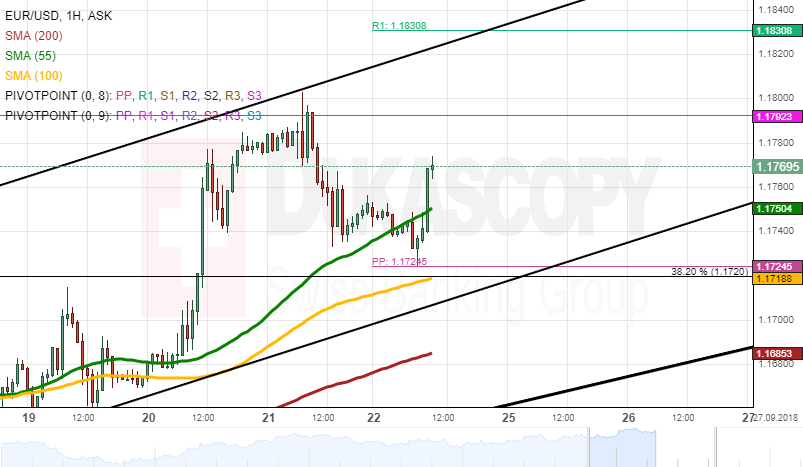
The European Single Currency depreciated 0.07% against the US Dollar since last Friday. The currency exchange rate was located at the 1.1759 mark on Monday morning.
In regards to the near-term future, the rate will surge upwards to the monthly R1 at the 1.1792 mark due to the support of the weekly PP at 1.1724 and the 38.20% Fibo. Moreover, the rate is also supported by the 55-hour and the 100-hour SMAs, which should help the rate to surge during the day.
Most likely, the rate will bounce off the monthly R1 during the session, but it also might move unexpectedly to other side due to the Mario Draghi's testimony before a EU Parliament Committee at 13:00 GMT.
GBPUSD Analysis: Drops To 1.3100
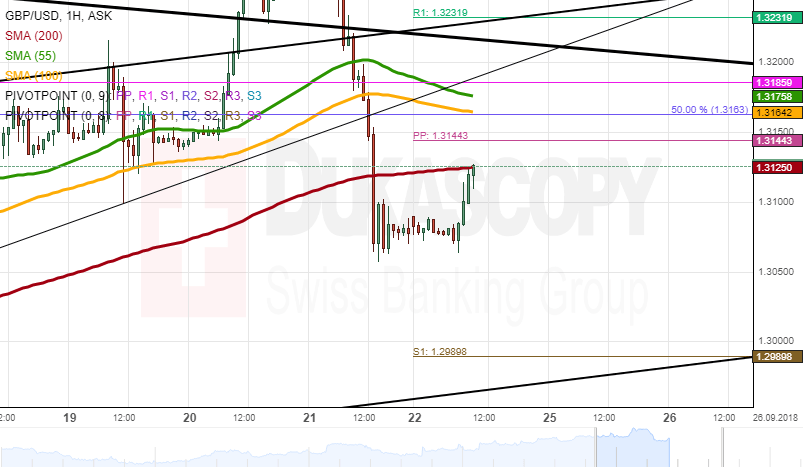
The British pound dropped 1.08% against the US Dollar since Friday's session due to fundamentals. The currency exchange rate went down passing through the most technical indicators, located at the 1.3100 level on Monday.
In the near-term future, the rate should move downwards to trade in the 1.3050 area due to the resistance of the 200-hour simple moving average and other influential technical indicators, which are located between the 1.3200 level and the 1.3140 level.
Besides, the 55– hour and the 100-hour simple moving averages will try to catch up the rate during the trading session.
USDJPY Analysis: Trades In Large Pattern
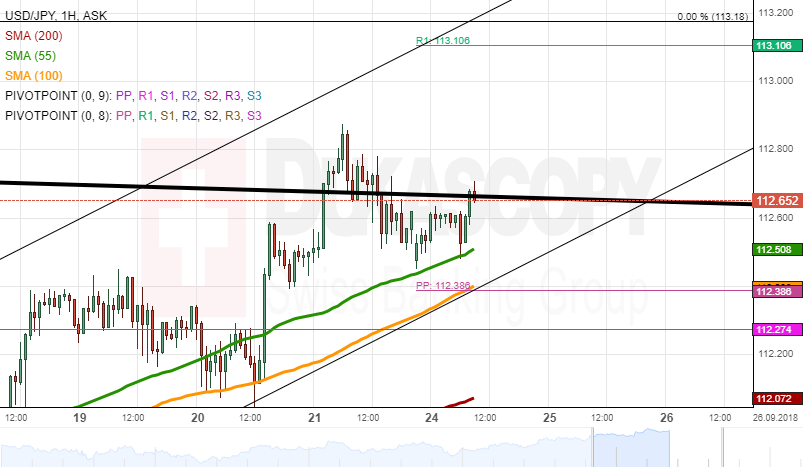
The US Dollar appreciated 0.19% against the Japanese Yen since Friday's session. During Monday morning hours, the currency pair bounced off the upper boundary of the large descending pattern at 112.66 mark.
In regards to the near future, most likely, the rate should go downwards towards the weekly PP at 112.38 mark. Later, the rate might trade sideways during the session on Monday.
On the other side, the 55-hour and 100-hour simple moving averages may support the US Dollar to break the large pattern once again to trade in the 112.80 on Monday.