Sample Category Title
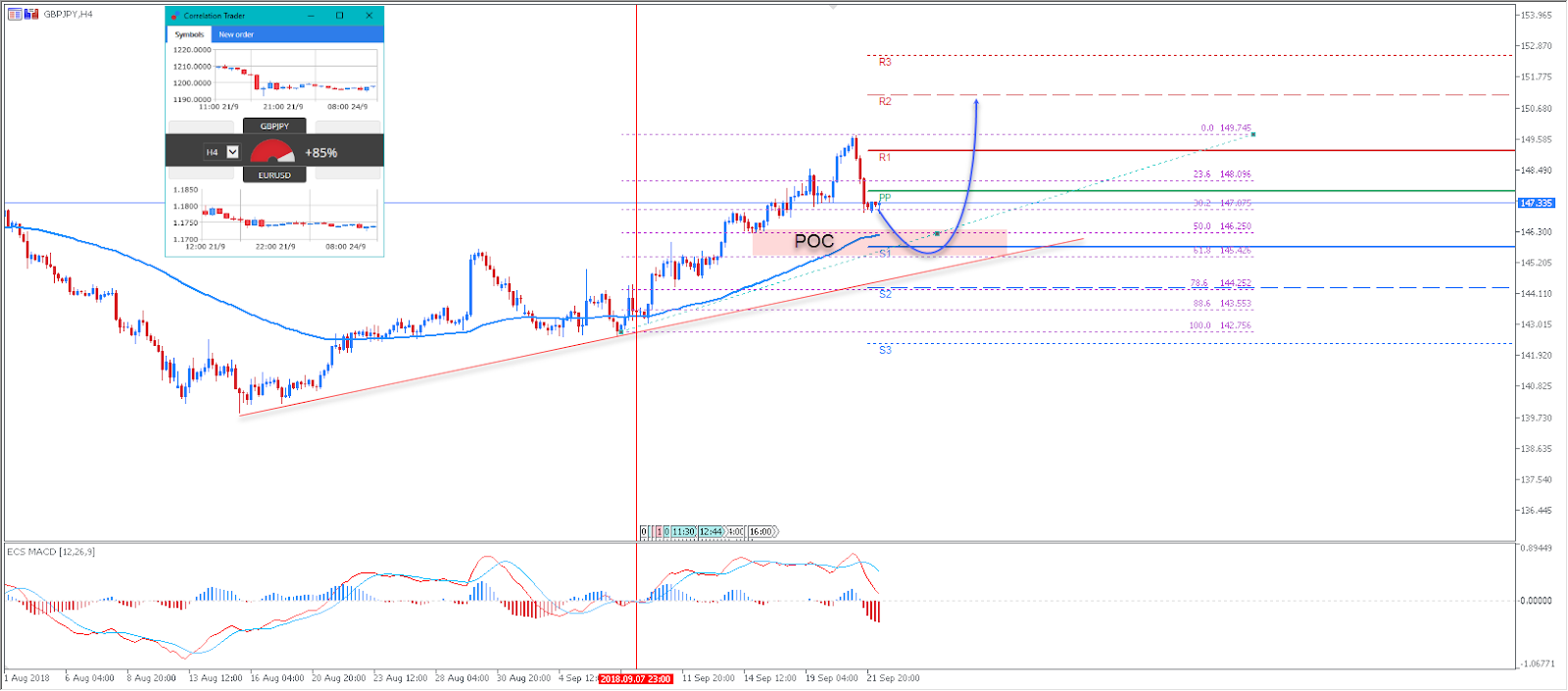
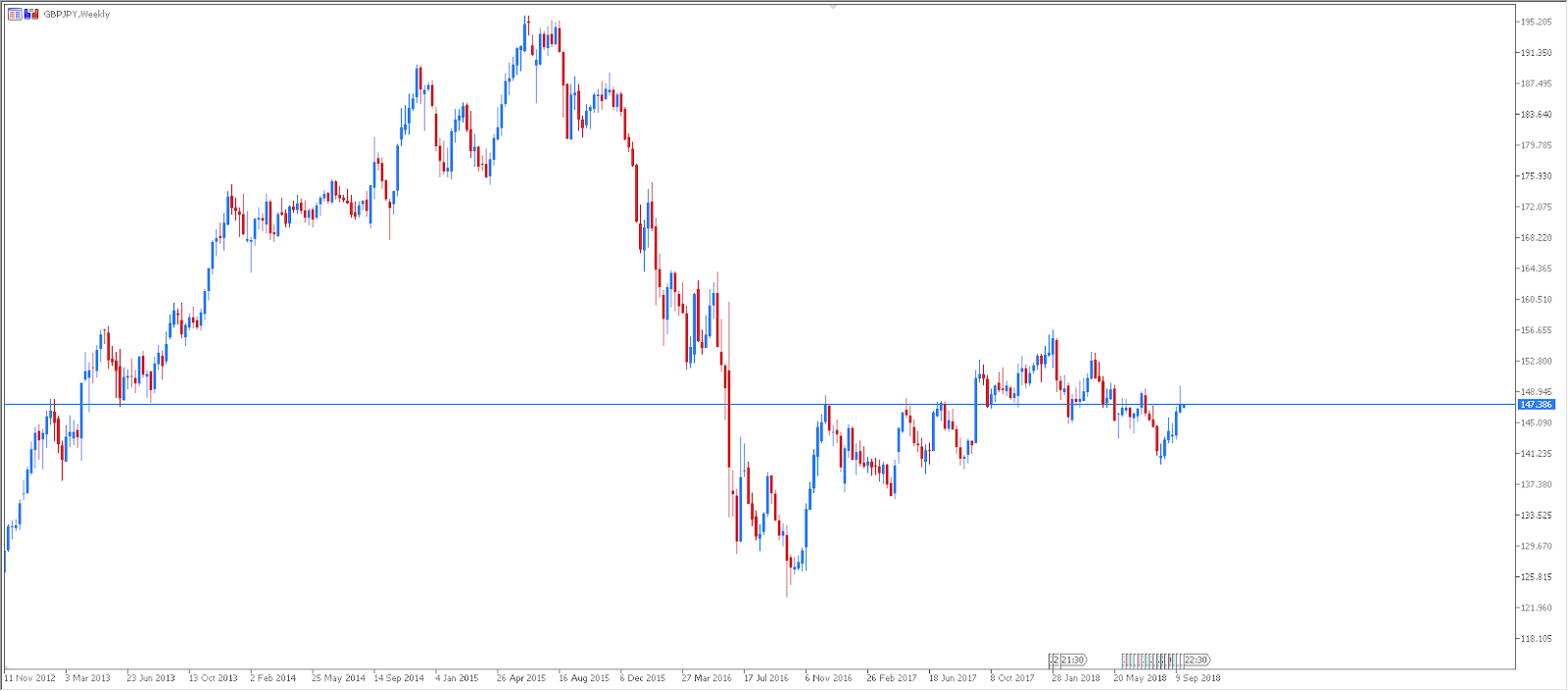
GBP/JPY Confluence At 61.8 Fib And S1 Pivot
The GBPJPY is following the ascending trend line with a zig zag pattern which indicates a bullish trend. Today we have light UK data which might provide bulls with another chance to spike the price to the upside. The FPC (Financial Policy Committee) statement includes detailed analysis on the stability of the financial system, an assessment of potential risks to financial stability, and recommendations to protect and enhance the resiliency of the UK financial system. This is one of the tools that the FPC uses to communicate with investors about financial policy. It contains policy changes taken, and commentary on the economic conditions that influenced their actions, which can impact future MPC (Monetary Policy Committee) interest rate decisions. Don't forget to check our Forex calendar for all regular updates, economic announcements, forecasts and much more!
Technically, the GBP/JPY has formed a zig zag with an ascending trend line that might spike the price to the upside potentially from the POC zone of 145.40-60 or slightly higher above, around 146.25. Traders might also want to focus on a potential price close above the Admiral pivot point (PP) -147.73. If it happens, targets are likely to be around R1- 149.15 followed by 149.74. Only a close above 149.74 might open the way to a weekly R2 - 151.13. This scenario will be negated if the price breaks below 145.00
Pivot Lines - Weekly Support and Resistance
POC - POC - Point Of Confluence (The zone where we expect the price to react - aka the entry zone)
UK Raab: Stubborn tone of EU just blips blown a little out of proportion
UK Brexit Minister Dominic Rob said today "we keep on negotiating in good faith, we try and get the best deal we can, but we are ready for all eventualities." He also urged not to overreact to the "stubborn" tone of the EU. He emphasized "these blips in the world, they're blown a little bit out of proportion, but we double down, we don't throw our toys out the pram, hold our nerve, keep our cool."
However, Rob also pointed out "at the same we need to be ready for the possibility ... that the ambitions that we are bringing to these negotiations to try and get a win-win deal isn't matched by the other side and it does take two to tango."
He added "what they need to see is some unity of purpose from the UK which is why all this Labour nonsense about a second referendum is not only undemocratic but it's the last thing we should be doing right now with our EU partners because it encourages them to offer us a lousy deal which makes a no deal more likely." Raab also said "the vast majority, the silent majority in this country just want us to get on with it and that's what we're doing."
The Dollar Index Has Recovered Some Of The Losses
On Friday, the US dollar strengthened against the basket of major currencies. The US dollar index (#DX) closed in the positive zone (+0.33%). Demand for the American currency is still high. This week investors expect the Fed meeting, which will be held on September 25-26. Financial market participants believe that the regulator will raise the key interest rate by 25 basis points to 2.00%-2.25% per annum.
The British pound weakened significantly against the US dollar on Friday after Theresa May stated that Brexit negotiations were at an impasse. According to the Prime Minister, the EU rejected any proposals of the UK without suggesting alternatives.
On Friday, economic data were also published. Thus, the index of economic activity in the German manufacturing sector fell to 53.7 in September, while experts expected 55.7. The core retail sales index in Canada rose to 0.9% in August instead of 0.6%.
The "black gold" prices show positive dynamics. At the moment, futures for the WTI crude oil are testing a mark of $72.00 per barrel.
Market Indicators
On Friday, there was a variety of trends in the US stock market: #SPY (-0.54%), #DIA (+0.03%), #QQQ (-0.55%).
At the moment, the 10-year US government bonds yield is at the level of 3.07-3.08%.
The news feed on 24.09.2018:
German Ifo business climate index at 11:00 (GMT+3:00).
We also recommend paying attention to the speech by the ECB president Draghi.
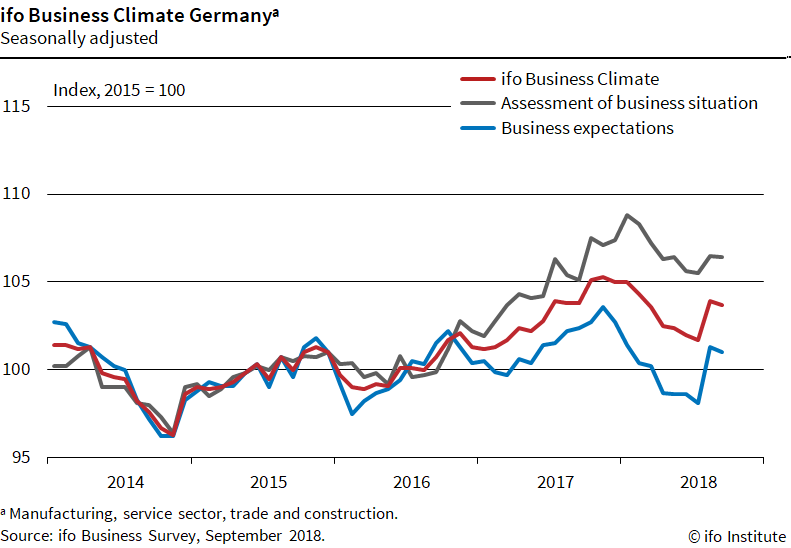
German Ifo dropped to 103.7, economy remains robust
German Ifo Business Climate Index dropped -0.1 to 103.7 in September but beat expectation of 103.2. Business Expectations index dropped -0.2 to 101.0, above consensus of 100.5. But Current Assessment Index was unchanged at 106.4, above expectation of 106.0.
Ifo President Clemens Fuest noted in the release "firms' assessments of their current business situation deteriorated marginally, but remain at a high level. Companies also scaled back their business expectations somewhat. Despite growing uncertainty, the German economy remains robust."
USDJPY Outlook: Risk Of Deeper Pullback Exists But Bulls Will Remain Intact While 112.40 Support Holds
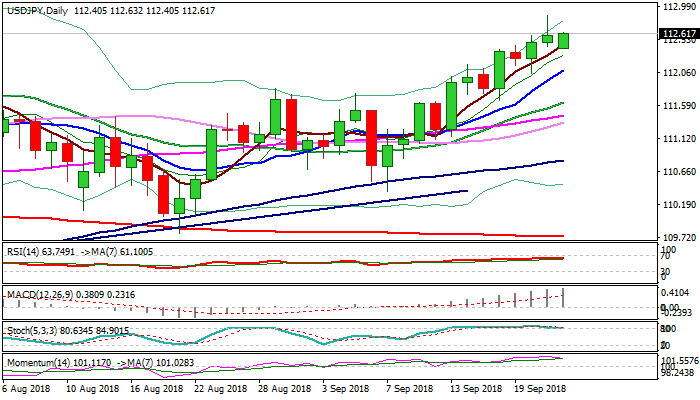
The pair consolidates above session low at 112.40, posted after Monday's gap-lower opening, as China cancelled trade talks with the US.
Strong upside rejection on Friday (112.87) could be initial signal of pullback, with scenario being supported by slow stochastic attempting to reverse from overbought zone and momentum turning south and attempting to form bear-cross.
Today's twist of daily cloud could also attract bears, but the action requires initial signal on break below 112.00 support zone (rising 10SMA/Fibo 38.2% of 110.38/112.87 upleg).
Conversely, overall bullish tone is expected to remain intact while the price holds above initial supports at 112.40/45 (session low/rising 5SMA) for renewed attempt at 112.87 (Fiday's high) and key barrier at 113.17 (19 July peak) in extension.
Res: 112.63, 112.87, 113.17, 113.30
Sup: 112.40, 112.09, 111.92, 111.63
Exchange Rate on Forex
Exchange rate is one of the key concepts on Forex. Traders sell one currency, buy another and earn on the difference in rates. When a trader buys a certain currency, he or she expects the growth of the exchange rate relative to another currency.
How the rate is formed
The "supply-demand" ratio is the basis for the behavior of the price on Forex. The demand and supply form the price. When demand is higher than supply, prices rise, if supply exceeds the demand, prices fall.
If you look at the chart, you can see that prices constantly fluctuate. That depends on the volatility and the fundamental factors. To understand the price behavior, technical and fundamental analysis are used.
Factors that affect the exchange rate
Fundamental analysis takes into account statistical data, political events and macroeconomic indicators, all that can strengthen or weaken the currency. There are certain economic indicators that have a strong impact on the movement of the foreign exchange market:
- Interest rates – influences the exchange rate of the national currency and the economy of the country as a whole. This is the main tool of regulating the country's monetary policy.
- Employment Change – measures the change in the number of people employed. The growth trend shows strength in the labor market and has a positive impact on consumer spending and, consequently, on the economic growth.
- GDP – shows the general state of the economy, an increase in the indicator strengthens the national currency, and vice versa. The GDP report includes data on exports of goods and services, consumption and investment.
- Other factors: the inflation rate, the volume of retail sales, the economic activity, etc. It should be noted that verbal interventions quite often have a significant impact on the dynamics of currency pairs.
Every day a lot of news is published, which have a significant impact on currency pairs, provoking both a sharp increase and a rapid decline in price. You can monitor the main important events on the economic calendar. News and the time of their release are displayed here. Moreover, the calendar shows the significance of the event, as well as the power of its influence on a particular currency pair.
Macroeconomic events are one of the most powerful drivers of the price movements on Forex. Nobody can forecast accurately market behavior after the release. Any important event is followed by an increase in volatility, that often foregoes the strong trends formation. It is not recommended trading 30 minutes before the release of the news and 30 minutes after. It is better to wait for a decrease in volatility and for a stable direction.
But there are traders who prefer trading on news. There are 2 approaches:
- To foresee the movement direction and the possible reaction of the market to the published news.
- To wait for the news publication and watch the reaction of the price. Thus, traders monitor price behavior, and then enter the foreign exchange market.
Technical analysis
Technical analysis allows predicting the price movement in the future based on information of the past. You can obtain more information by reading the chart. It displays the price path, which allows tracking the significant market trends, changes in demand and supply.
There are various methods of technical analysis: chart patterns, technical indicators, support and resistance levels.
The price always moves in a certain direction (trend). The trader's task is to reveal the direction of the trend. There are three types of trends:
- Uptrend – shows the growth of prices in a certain period of time.
- Downtrend – points to the drop in prices.
- Flat – the price does not have a clear direction. Lows and highs are on the same level.
To trade profitably, it is necessary to understand the factors that can affect the movement of the exchange rate, as well as to know how to read the price chart. These methods of analysis complement each other, that allows getting a complete market picture and foreseeing the future direction of the price movement.
GBPUSD Outlook: Recovery Attempts Under Way After Friday’s Fall Was Contained By Top Of Thick Daily Cloud
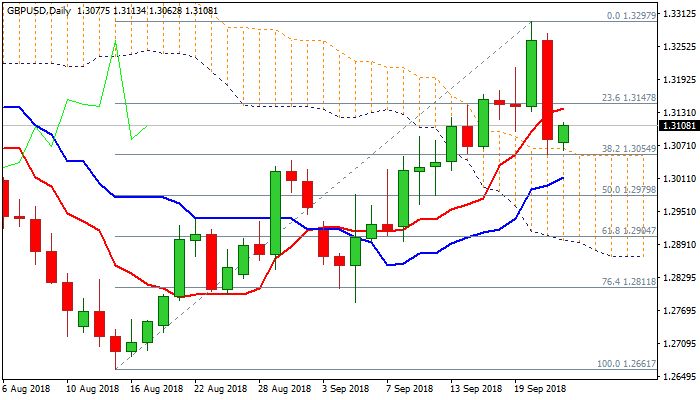
Cable moved higher in early Monday's trading, consolidating above thick daily cloud, after cloud top contained Friday's sharp fall and continues to support the action.
Sterling crashed on Friday after Brexit-negative news, but Monday's action was so far unaffected from more negative news that came over the weekend.
Near-term sentiment was soured by Friday's fall, while daily techs give mixed signals (slow stochastic in steep descend and Friday's close below 10SMA were negative signals, while momentum continues to strengthen and thick daily cloud underpins recovery attempts).
While strong supports at 1.3054 (daily cloud top/Fibo 38.2% of 1.2661/1.3297) hold, hopes for stronger recovery will exist, but sustained break above 10SMA (1.3115) is needed to confirm. Further bullish signal could be expected on break and close above broken 100SMA (1.3151), also Fibo 38.2% of 1.3297/1.3054 pullback, which would signal higher base (1.3054) and open way for stronger recovery.
On the other side, bearish signal could be expected on close below 1.3054 pivot, with extension below 1.3025/00 (20/55SMA) to signal reversal and open way for further retracement of larger 1.2661/1.3297 uptrend.
Res: 1.3115, 1.3151, 1.3176, 1.3204
Sup: 1.3054, 1.3025, 1.3000, 1.2980
EURUSD Outook: Weak Tone At The Beginning Of The Week, But Dips Remain Limited For Now, FOMC Meeting Eyed
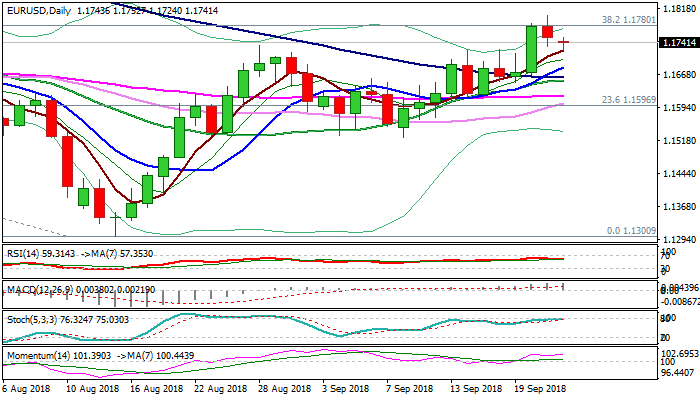
The Euro stands at the back foot in early Monday's trading, following Friday's close in red after strong rejection at psychological 1.1800 barrier and failure to close above cracked 1.1780 Fibo barrier (38.2% of 1.2555/1.1300 descend).
Daily techs show MA's in bullish setup and strong momentum, but RSI is flat and slow stochastic showing initial signs of reversal, together giving mixed signal.
Break of initial support at 1.1720 zone (former highs / rising 5SMA) would signal further easing and expose pivotal supports at 1.1683 (rising 10SMA) and 1.1660/55 (converging 100/20SMA), break of which would signal deeper pullback.
The single currency is expected to track British pound, however, consolidation with lower pace could be expected ahead of Wednesday's FOMC meeting which could generate stronger direction signal.
Res: 1.1752, 1.1780, 1.1802, 1.1848
Sup: 1.1720, 1.1683, 1.1655, 1.1617
Dollar Modestly Up, Sentiment Sours As China Cancels Trade Talks
Here are the latest developments in global markets:
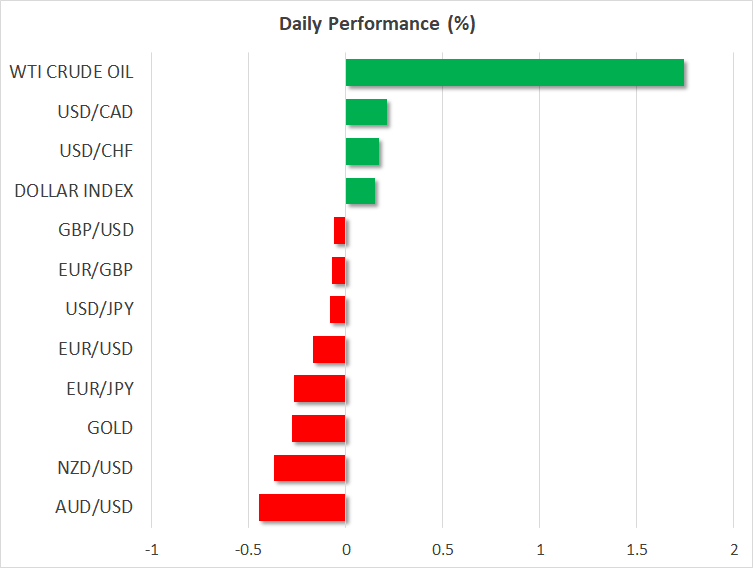
FOREX: The dollar index – which tracks the greenback's performance against a basket of six major currencies – is higher on Monday (+0.12%), looking set to extend the gains it recorded in the previous session. The safe-haven yen is also a little higher while risk-sensitive currencies such as the aussie and kiwi are lower, following news that China won't attend the trade talks it had planned with the US. In the UK, the British pound nosedived on Friday, after PM Theresa May struck a relatively unyielding tone in her latest Brexit remarks.
STOCKS: The Dow Jones (+0.32%) closed at a fresh record high on Friday, buoyed by gains in industrial stocks, though the rest of the major US benchmarks were not as fortunate. The S&P 500 (-0.04%) inched slightly lower, while the tech-heavy Nasdaq Composite (-0.51%) tumbled, dragged down by losses in names like Amazon (-1.51%) and Apple (-1.08%). Futures tracking the Dow, S&P, and Nasdaq 100 are all pointing to a lower open today, probably due to weekend news that China won't attend the trade talks it had planned with the US this week after all. Asia was rather quiet on Monday, as Japanese and Chinese markets remained closed for public holidays. The Hang Seng in Hong Kong, which was open, fell by 1.63%. In Europe, all major indices were set for a lower open today, futures suggest, with the only exception being the UK FTSE 100.
COMMODITIES: Oil soared on Monday, following a meeting between OPEC and related producers over the weekend. WTI is higher by 1.67% at $71.95 per barrel, recording a high last seen in July, while Brent gained 1.92% to touch $80.31, a peak previously recorded in May. OPEC and its allied producers announced no formal plans to boost their production, as had been speculated going into the meeting, and as had been called for by the US President recently. In precious metals, dollar-denominated gold is lower by roughly 0.3% at $1,195 per ounce on Monday, extending the losses it recorded in the previous session amid a strengthening US currency. That said, the metal continues to oscillate in a narrow range between $1,189 and $1,214, and a break in either side is needed to determine the short-term bias.
Major movers: Risk sentiment sours as China cancels talks; May sinks sterling
Investors were taken by surprise over the weekend, after news hit the wires that China would cancel the trade talks with the US that were planned for this week. With the tariffs the two sides announced recently due to take effect from today as well, this development likely cast some doubt on the narrative that the Sino-American trade skirmish will be resolved in a diplomatic manner anytime soon. Separately, media reports suggest the US government is preparing to launch a major “administration-wide broadside” against China over the coming weeks, meaning a fierce verbal attack on several issues.
Risk appetite soured as investors turned more defensive, with safe-havens like the Japanese yen as well as the dollar trading higher to start the week. Meanwhile, US equity futures are pointing to a notably lower open today, while risk-sensitive currencies such as the aussie and kiwi are on the back foot once again. In the grand scheme of things, China seems unwilling to negotiate “with a gun pointed to its head”, while the US administration looks set to ramp up the pressure on the Asian nation even further in the near-term, ahead of the US midterm elections in November. Hence, the situation currently looks more than likely to get worse before it gets any better.
In Brexit-land, there is never a boring moment. The British pound plummeted on Friday, after UK PM Theresa May delivered some remarks that failed to impress. She maintained a relatively rigid tone on Brexit, suggesting the UK has already made enough compromises and that it is now the EU's turn to soften its own stance, particularly on the Irish border. Rhetoric aside, and despite the somewhat unfounded optimism around the prospect of a deal recently, the fact is that there is still no viable solution for the Irish border on the table, and that neither side seems ready to back off on this issue. Thus, sterling is likely in for a turbulent ride over the coming weeks, with politics likely to continue overshadowing economics, until – and if – there is greater clarity around the exit terms.
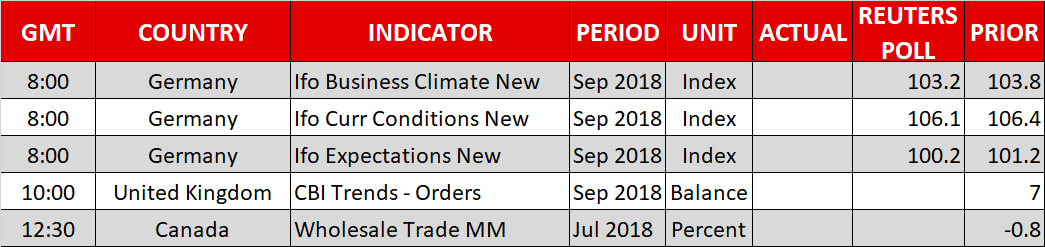
Day ahead: German Ifo surveys due; trade & Brexit headlines to be closely watched
Monday's calendar is very light in terms of releases, with the Ifo surveys gauging business sentiment in Germany due for release. Elsewhere, trade and Brexit will again be coming to the fore.
Trade developments will be closely watched as China cancelled relevant talks with the US just as the latest round of tariffs and counter-tariffs went into effect. Meanwhile, tensions are spilling over in other directions; China summoned the US ambassador in Beijing and postponed military discussions in the aftermath of sanctions imposed on a Chinese military agency by the US.
In terms of data, the Ifo Institute's reports on German business morale during September will be made public at 0800 GMT. The business climate, current conditions and expectations indices are all expected to slightly deteriorate relative to August. The survey results have so far been proving sensitive to trade issues; for example, threats on Germany's auto sector stemming from Trump's trade rhetoric would weigh on the figures.
Out of the UK, the Confederation of British Industry will be releasing its factory orders balance for July at 1000 GMT. However, any Brexit headlines are yet again likely to drive sterling pairs. On Sunday, Labour Party leader Jeremy Corbyn said he would push for a second Brexit referendum if his party votes in favor of such an outcome; the party will be voting this week to keep a referendum on the table if PM Theresa May proves unsuccessful in passing her plan to leave the EU through parliament.
Canadian wholesale trade data for July are due at 1230 GMT. On the NAFTA front, last week's talks did not bear fruit, with the next self-imposed deadline to strike a deal being October 1.
Lastly, ECB President Mario Draghi will be addressing the EU Parliament in Brussels at 1300 GMT.
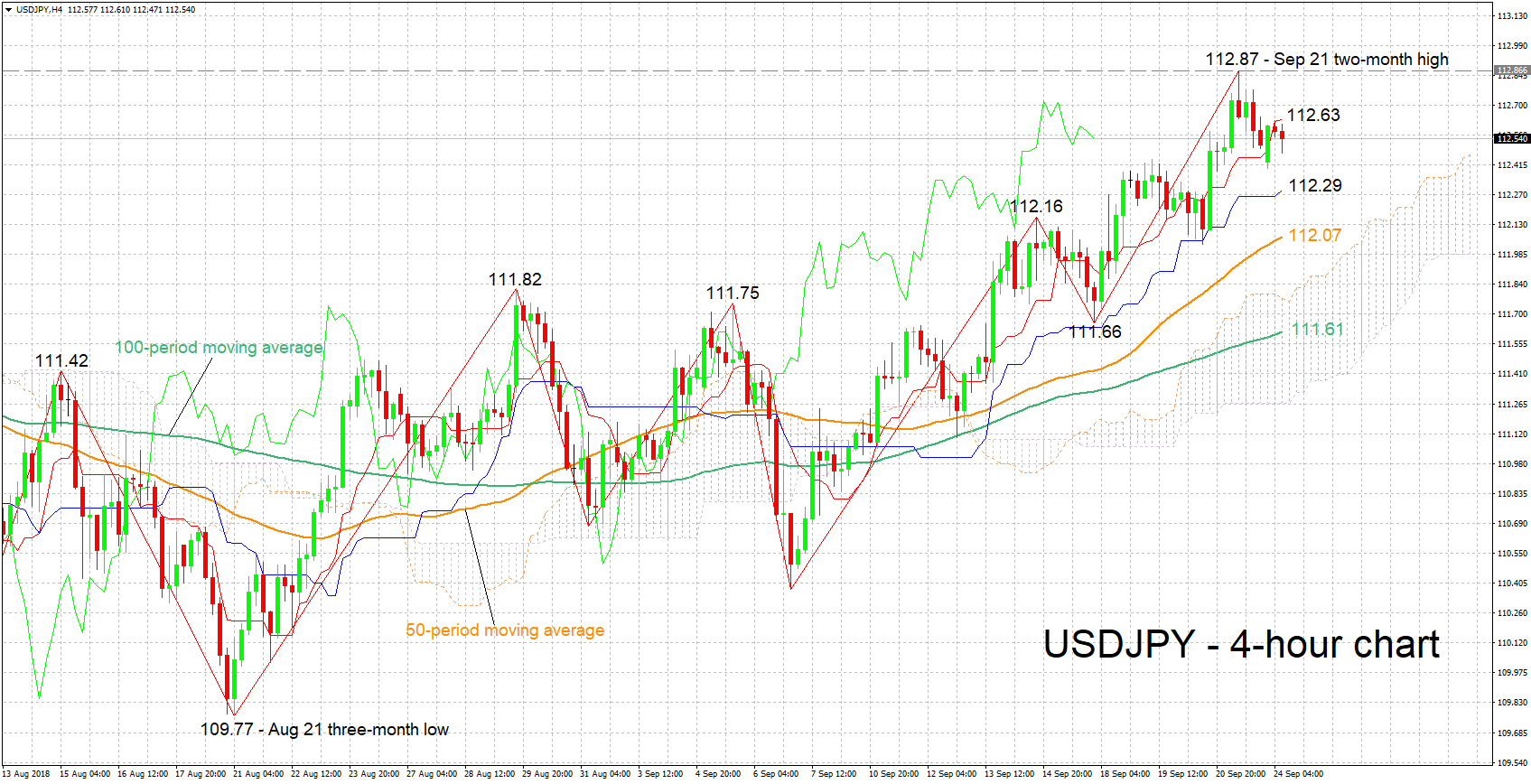
Technical Analysis: USDJPY bullish bias still in place
USDJPY has retreated a bit from last week's two-month high of 112.87, though it continues to trade relatively close to that peak. The Tenkan- and Kijun-sen lines, which remain positively aligned, support that the positive bias in the short-term is still in place.
A significant deterioration in Sino-US trade relations could shift funds to the safe-haven perceived yen. Support to a declining USDJPY may come around the current level of the Kijun-sen at 112.29, with the 50-period moving average line lying not far below at 112.07. Further below, the Ichimoku cloud top (111.76) and the 100-period MA (111.61) would come into focus.
A de-escalation of tensions, on the other hand, may boost the pair. Immediate resistance to gains could occur around the Tenkan-sen at 112.63. In proximity and in case of an upside break is last week's two-month high of 112.87; the 113 round figure is also part of the region around this point. Stronger bullish movement would increasingly bring into view the 114 handle.
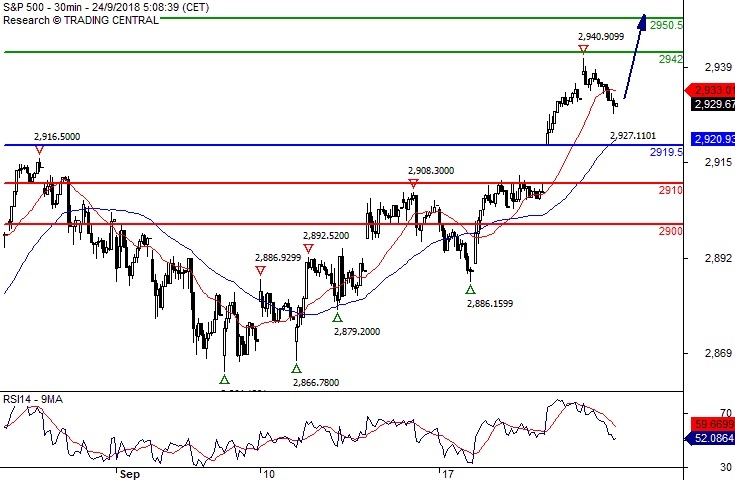
S&P 500 Intraday Support Around 2919.50
Pivot (invalidation): 2919.50
Our preference Long positions above 2919.50 with targets at 2942.00 & 2950.50 in extension.
Alternative scenario Below 2919.50 look for further downside with 2910.00 & 2900.00 as targets.
Comment The RSI is mixed to bullish.