

Sample Category Title
European Indices Shrug Off Early Weakness Following Widely Anticipated US Tariff Announcement
Notes/Observations
- China to impose retaliatory tariffs following the confirmation from the White House on tariffs worth $200B on China imports
- Indices reverse earlier losses to trade mostly higher across the board
Asia:
- White House confirms $200B worth of tariffs on China imports; US President Trump reiterates if China retaliates he will immediately pursue tariffs on $267B in Chinese imports
- (CN) China Commerce Ministry (MOFCOM) announces retaliatory tariffs noting that they had no choice but to retaliate. No details initially provided on details of tariffs
Europe:
- (IT) Italy Fin Min Tria: Brexit to open new scenario for European capital markets; Italy's economy still growing but at lower pace
- Sweden Jobless Rate At 10-month High
Economic Data:
- (ES) Spain Q2 Labour Costs Y/Y: 0.7% v 0.7% prior (IT) Italy July Industrial Sales M/M: -1.0% v +1.7% prior; Y/Y: 2.9% v 5.0% prior
- (PL) Poland Aug Employment M/M: 0.0% v 0.0%e; Y/Y: 3.4% v 3.5%e
Fixed Income Issuance:
- (ES) Spain Debt Agency (Tesoro) sells €2.0B v €1.5-2..5B indicated range in 3-month and 9-month Bills
SPEAKERS/FIXED INCOME/FX/COMMODITIES/ERRATUM
Equities
- Indices [Stoxx50 +0.5% at 3,363, FTSE +0.1% at 7,318, DAX +0.6% at 12,164, CAC-40 +0.6% at 5,383; IBEX-35 +0.4% at 9,446, FTSE MIB +0.2% at 21,148, SMI -0.3% at 8,908, S&P 500 Futures +0.2%]
- Market Focal Points/Key Themes: European indices open mixed with a downward bias, but later moved higher as the session progressed; markets little impacted after US imposes further tariffs on China as expected; automotive sector leads gains, with materials sector; consumer discretionary on the backfoot in early trading; Zalando issues profit warning dragging on luxury stocks including Hugo Boss; Oracle reported yesterday impacting tech stocks including SAP; Ferrari has capital markets day; upcoming earnings expected in the US session include AutoZone, General Mills and Cracker Barrel
Equities
- Consumer discretionary: Air France-KLM AF.FR +1.0% (analyst action), Ocado OCDO.UK +3.3% (results), Pandora PNDORA.DK 10.2% (rumor of potential interest from PE firm), Zalando ZAL.DE -13.4% (outlook)
- Financials: Jardine Lloyd Thompson JLT.UK +31.2% (to be acquired)
- Healthcare: Spire Healthcare SPI.UK -5.6% (results), Virbac VIRP.FR +11.8% (results)
- Industrials: Husqvarna HUSQB.SE -4.0% (outlook)
- Materials: RM2 International RM2.UK +54.6% (contract)
- Technology: Osram Licht OSR.DE +8.1% (outlook), SAP SAP.DE +0.2% (Oracle results)
Speakers
- (EU) EU's Tusk: Need to reach common view on Brexit on Pol declaration
- (EU) ECB's Villeroy (France): Making SRM operation should be top priority, common backstop for resolution fund is key
- (JP) Japan Chief Cabinet Secretary Suga: Will communicate with US and China on tariffs
- (UK) UK Brexit Minister Raab says already made major compromises, now ball is in EU's court - German Press
- (SE) Sweden Central Bank (Riksbank) First Deputy Gov Af Jochnick: Reiterates Swedish economy is doing well
Currencies
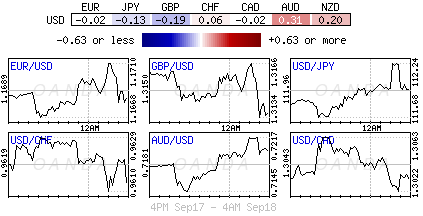
- EURUSD trades little changed dipping below the the 1.17 level after hitting a high of 1.1718
- GBPUSD pulls back from recent 6 week highs as traders await the upcoming EU summit, having hit an intraday high of 1.3171. The Turkish Lira continues to weaken down over 0.7% continuing to fade the bigger than expected rate hike last week.
Fixed Income
- Bund Futures trades at 159.20 up 11 ticks as China/US trade conflict escalates. Resistance moves to 161.82 then 163. A downside break of 159.85 sees 158.69 initially.
- Gilt futures trades at 121.49 up 12 ticks following the move in Treasuries. Continued support at 122.50, with a continued move higher targeting 123.93 then 124.00.
- Tuesday 's liquidity report showed Monday's excess liquidity fell from €1.986T to €1.881T. Use of the marginal lending facility rose from €74M to €93M.
- Corporate issuance saw 5 high grade issuers raise $11.9B in the primary market
Looking Ahead
- 05.30 (UK) Weekly John Lewis LFL sales data
- 07:00 (BR) Brazil Sept IGP-M Inflation (2nd Preview): No est v 0.7% prior
- 07:45 (US) Weekly Goldman Economist Chain Store Sales
- 08:00 (HU) Hungary Central Bank (MNB) Interest Rate Decision: Expected to leave the Base rate unchanged at 0.90%
- 08:05 (UK) Baltic Dry Bulk Index
- 08:30 (CA) Canada July Manufacturing Sales M/M: No est v 1.1% prior
- 08:55 (US) Weekly Redbook Sales
- 09:00 (EU) Weekly ECB Forex Reserves: € v € prior
- 10:00 (US) Sept NAHB Housing Market Index: No est v 67 prior
- 11:00 (CO) Colombia July Trade Balance: No est v -$0.7B prior
- 16:00 (US) July Total Net TIC Flows: No est v $114.5B prior; Net Long-term TIC Flows: No est v -$36.5B prior
- 16:30 (US) Weekly API Oil Inventories
Where To Hide? That’s The Next Million-Dollar Question
Tuesday September 18: Five things the markets are talking about
It was coming, the market new it was coming, just when, and how much, were the unknown variables.
President Trump has imposed an additional +10% tariffs on about +$200B worth of imports from China, rising to +25% by the turn of the New Year. Trump has threatened additional duties on about +$267B more if China contemplates hitting back on the latest U.S action, beginning next Monday.
Of course China is going to retaliate, but how, is part of the guessing game – “to protect its legitimate rights and interests and order in international free trade, China is left with no choice but to retaliate simultaneously.”
There are a few tech exceptions – which benefit Apple/Fitbit for now – and the tiered deployment is to help U.S companies find alternative supply chains. However, if the U.S needs to go to phase three, it would consume all remaining U.S imports from China and Apple products and its competitors would not be spared.
The problem for China is that they do not import enough U.S goods to go head-to-head with the U.S leverage strategy. They will want to cause U.S pain and will probably focus even more on the tech sector. Nevertheless, watch the Yuan's value, it may be one of China's strongest weapons. It has weakened by about -6.0% in the past three-months, offsetting any -10% tariff rate by a substantial margin.
From an asset price viewpoint, it's been a rather ‘subdued' reaction to Trump's announcement. Buying U.S dollars in response to trade conflicts does not seem to be as appealing anymore. The delay in imposing +25% tariffs may explain the lack of movement, in addition to the fact that the tariffs have been widely anticipated.
1. Stocks mixed results
In Japan, the Nikkei rallied overnight to its highest close in seven-months, led by insurers thanks to rising U.S Treasury yields. However, no surprises, capping gains were electronic suppliers, which underperformed as the market weighs the new U.S China, tariff impact. The index closed out +1.4% higher, while the broader Topix rallied +1.8%.
Down-under, materials and energy stocks pushed Aussie equities lower as the escalating Sino-U.S trade war pressured commodity and oil prices. The S&P/ASX 200 index fell -0.4% at the close. The index rallied +0.3% yesterday. In S. Korea, the Kospi stock index closed +0.26% higher along with some of its regional bourses as Chinese markets largely shrugged off trade tariff threats.
In China, stocks staged a late rebound as the blue-chip index CSI300 rallied +1.9% as some investors bet that authorities will increase their investment in infrastructure to offset the impact of the latest tariff penalties from Trump. In Hong Kong, the Hang Seng index closed out +0.6% higher.
In Europe, regional bourses have shrugged off early weakness following the ‘telegraphed' U.S tariff announcement after the yesterday's U.S close. Autos lead the gains, while the materials sector and consumer discretionary are under early pressure.
U.S stocks are set to open in the ‘black' (+0.2%).
Indices: Stoxx50 +0.5% at 3,363, FTSE +0.1% at 7,318, DAX +0.6% at 12,164, CAC-40 +0.6% at 5,383; IBEX-35 +0.4% at 9,446, FTSE MIB +0.2% at 21,148, SMI -0.3% at 8,908, S&P 500 Futures +0.2%
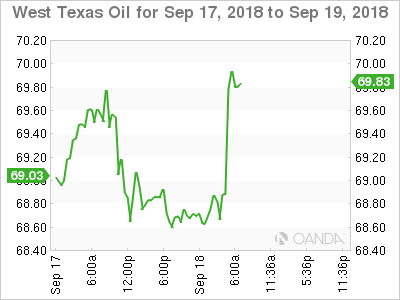
2. Oil prices fall as U.S-China trade war questions demand, gold lower
Oil markets have eased a tad as the Sino-U.S trade war questions the outlook for crude demand from the world's two largest economies.
Brent crude futures have dropped -29c, or -0.37% to +$77.76 per barrel, while U.S West Texas Intermediate (WTI) crude is down -15c, or -0.22%, at +$68.76 per barrel.
U.S crude ‘bears' believe that these tariffs are likely to limit economic activity in both China and the U.S – a hit to growth is a hit to consumption.
Note: Refineries stateside consumed about +17.7m bpd of crude oil last week, while China's refiners used about +11.8m last month.
Crude ‘bulls' are currently clinging to the potential supply cuts caused by U.S sanctions on Iran (third-largest producer in OPEC) as reason enough to support short-term oil prices.
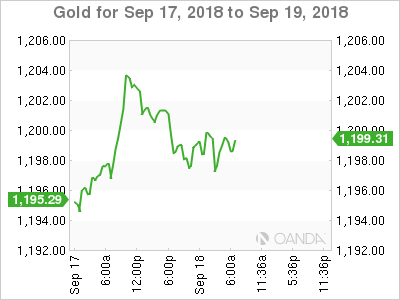
Ahead of the U.S open, gold prices are under pressure as the ‘big' dollar steadies amid concerns of an escalation in Sino-U.S trade tensions. Spot gold is -0.3% lower at +$1,197.51 an ounce, after rising +0.6% in Monday's session. U.S gold futures are down -0.3% at +$1,202.20 an ounce.
However, if the ‘big' dollar loses its ‘tariff haven' appeal, expect the ‘yellow' metal to find support on pullbacks.
3. Sovereign yields rally
U.S Treasury yields have backed up along the curve on growing expectations that the Fed could raise interest rates a few more times this year after recent data showed wages spiking last month, elevating concerns about inflation.
Note: U.S data last week showed that wages in August posted their largest annual increase in more than nine-years, rising +0.4% m/m and +2.9% y/y.
Yesterday, U.S 10's touched +3.022%, the highest level in four-months, along with U.S 30-year yields at +3.159%. As to be expected, the short end rallied to a 10-year high, backing up to +2.799%.
Elsewhere, German Bund yields continue drifting upward to the +0.50% level amid better sentiment around Italy. The 10-year Bund yield is trading at +0.46%, up +0.05%. In the U.K, the 10-year Gilt yield has rallied +1 bps to +1.536%.
4. Dollar muted reaction
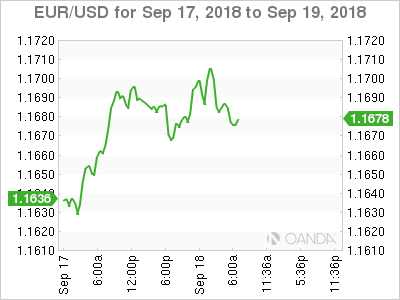
EUR/USD (€1.1680) shows a muted reaction to the U.S announcement that it will charge +10% on another +$200B of Chinese imports starting from next Monday. Typically trade tensions have been positive for the ‘big' dollar; maybe attitudes will change once China shows its hand.
GBP/USD (£1.3126) pulls back from recent six-week highs as the market awaits Thursday's E.U summit.
TRY ($6.3670) continues to weaken, down another -0.7% as investors remain confident in fading last weeks bigger than expected Central Bank of the Republic of Turkey (CBRT) rate hike.
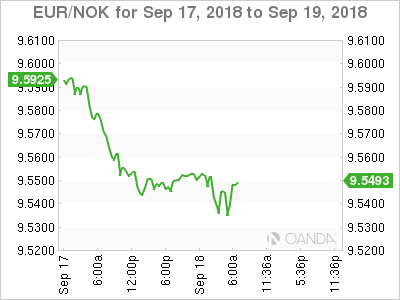
An interest rate increase by the Norges Bank on Thursday is widely expected and already broadly priced into EUR/NOK (€9.5406). However, NOK bulls believe the central bank will likely signal more rate increases, which should provide further support for this commodity currency.
5. Reserve Bank of Australia (RBA) stays true to its ‘hawkish' stance
In its minutes released overnight there were no surprises. The RBA maintained its interest-rate guidance in the minutes from its meeting a fortnight ago, reiterating that increases will eventually come amid anticipated economic strength.
RBA also noted that a number of G10 central banks, including the Fed, were expected to continuing rate hikes. This had been reflected in the markets, “most notably a broad-based appreciation of the US dollar” that “raised risks” for some, especially for “fragile emerging” markets. However, “the modest depreciation of the AUD was helpful for domestic economic growth.”
The copy and recent rhetoric suggests that Aussie policy makers remains highly confident its current stance – interest rates at record lows will ultimately bring lower unemployment, higher wage growth and an uptick in inflation over time.
DAX Higher Despite New Trump Tariffs
The DAX index has posted considerable gains in the Tuesday session. Currently, the index is at 12,149, up 0.44% on the day. On the release front, there are no German or eurozone indicators. On Wednesday, the eurozone releases current account and Germany holds an auction for 10-year bonds.
There was growing speculation that another round of tariffs in the U.S-China trade war was in the offing, and President Trump has delivered the goods. On Monday, Trump imposed tariffs of 10% on some $200 billion worth of Chinese goods and threatened further action if China retaliated. Why did the currency markets not react? Investors were braced for a move by Trump, and may be sighing in relief that the tariff was set at 10% rather than at 25%. One senior economist summed up Trump’s most recent salvo as “bad but manageable”. However, if the Chinese retaliate and the U.S takes further measures, this would likely hurt the equity markets.
ECB President Mario Draghi will be speaking at events on Tuesday and Wednesday, and the markets will be hoping for some insights after last week’s ECB policy meeting. As expected, the benchmark rate was held at 0.00%. However, in a slight the Bank announced that it would wind up asset purchases at the end of this year. As well, the ECB will trim its monthly bond purchases from EUR 30 billion to 15 billion, starting in October. These measures mark a vote of confidence in the eurozone economy, which has softened in the second quarter, but still remains solid. If there is no sudden downturn in economic conditions, investors can look forward to the ECB finally winding up its stimulus program.
EU companies in China releases report with 828 reform recommendations in 14 areas
The European Union Chamber of Commerce in China released an annual position paper today, urging China to accelerate reforms. The paper described the widening gap of the maturing economy and the shortcomings of reforms and opening agenda as "reform deficit". Such reform deficit is seen as the "root cause" of tensions in the global economic tensions which resulted in the US-China trade war. And, "the strong reaction from the United States with its escalation of tariffs is, albeit undesirable, a direct response to these deficiencies, many of them longstanding."
The paper examines 14 common concerns faced by European companies. These issues "continue to hold back China's development and prevent businesses from serving their core function". And the paper urged that "each of these issues should be viewed by Chinese officials as a challenge to overcome in the years ahead."
The areas of concerns include access to licenses, complex and lengthy administrative procedures, consultation and communication, cybersecurity, IPR and R&D, overlapping regulations and interdepartmental coordination, market access barriers, SOE-related issues, standards setting, transparency issues, unclear regulations and unpredictable enforcement, unequal and unfair treatment, unfair procurement systems and SMEs. The 33-page paper listed out a accumulative total of 828 recommendations.
The press statement and full report can be found here.
Well... isn't it "lead by example" that the US administration has to learn from?
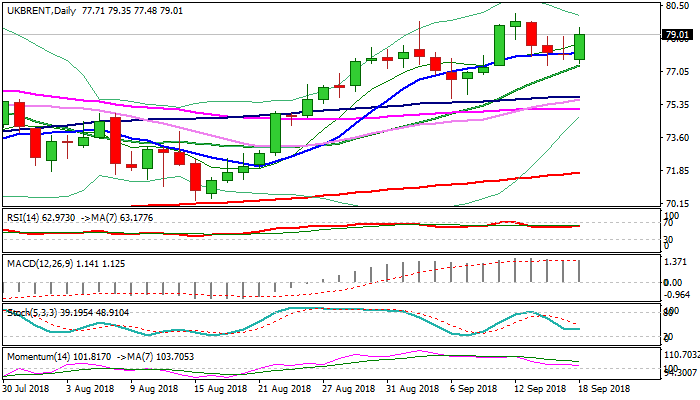
Brent Oil Outlook: Rallies After Saudi Said Ok For Rise Above $80
Brent oil accelerated strongly higher on Tuesday, bringing psychological $80 barrier in focus again (after last week's attempt stalled at $80.10) after Saudi Arabia agreed with short-term price rise and said they are comfortable with Brent price above $80. The global oil markets remains tight, with looming US sanctions on Iran (due to go into effect on 4 November, with Iran's crude exports already falling) maintaining concerns about supply. Bullishly aligned daily techs are still lacking momentum which could cause another failure at $80 zone, despite supportive fundamentals, as plethora of strong barriers above $80 (former highs at $80.10 and $80.48), could provide strong headwinds and delay bulls. Scenario of repeated rejection at $80 zone could keep the price within initial range between $80.10 and $77.36, while loss of $77.36 handle would risk deeper pullback and put immediate bulls on hold. Conversely, sustained break above $80.00/48 pivots would open way towards next key barrier at $81.84 (Fibo 61.8% of larger $115.68/$27.09 fall).
Res: 80.10, 80.48, 81.00, 81.84
Sup: 78.55, 77.48, 77.35, 75.87
The Analytical Overview Of The Main Currency Pairs
The EUR/USD currency pair
Technical indicators of the currency pair:
Prev Open: 1.16224
Open: 1.16827
% chg. over the last day: +0.40
Day's range: 1.16806 – 1.17003
52 wk range: 1.0571 – 1.2557
Yesterday, the bullish sentiment was observed on the EUR/USD currency pair. Quotes rose by more than 70 points. The US dollar weakened against the basket of major currencies due to the escalation of trade conflict between the US and China. At the moment, EUR/USD quotes are consolidating. The key support and resistance levels are 1.16700 and 1.17000, respectively. We recommend opening positions from these marks.
The news feed is calm. We recommend paying attention to the speech by the ECB president Mario Draghi.
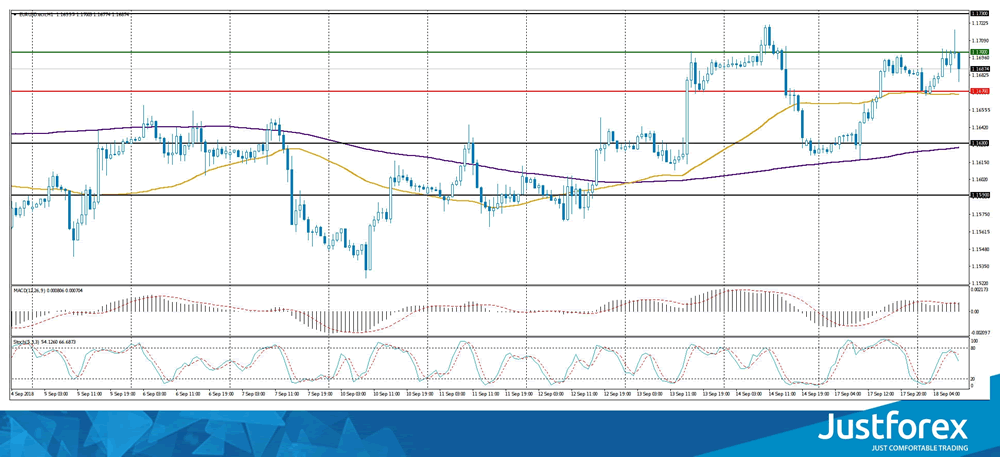
Indicators point to the power of buyers: the price has fixed above 50 MA and 200 MA.
The MACD histogram is in the positive zone and above the signal line, which gives a strong signal to buy EUR/USD.
Stochastic Oscillator is located in the neutral zone, the %K line is below the %D line, which indicates a decrease in quotes.
Trading recommendations
Support levels: 1.16700, 1.16300, 1.15900
Resistance levels: 1.17000, 1.17300
If the price fixes below 1.16700, the EUR/USD quotes are expected to decline. The movement is tending potentially to 1.16300-1.16000.
An alternative may be the further growth of the EUR/USD currency pair to the level of 1.17300-1.17600.
The GBP/USD currency pair
Technical indicators of the currency pair:
Prev Open: 1.30660
Open: 1.31328
% chg. over the last day: +0.57
Day's range: 1.31315 – 1.31528
52 wk range: 1.2361 – 1.4345
Yesterday, the bullish sentiment was observed on the GBP/USD currency pair. The British pound strengthened against the US currency amid positive news about Brexit. At the moment, the technical pattern is ambiguous. The key support and resistance levels are: 1.31200 and 1.31600 respectively. The positions should be opened from these marks. In the near future, a technical correction is not ruled out.
The news feed on the UK economy is calm.
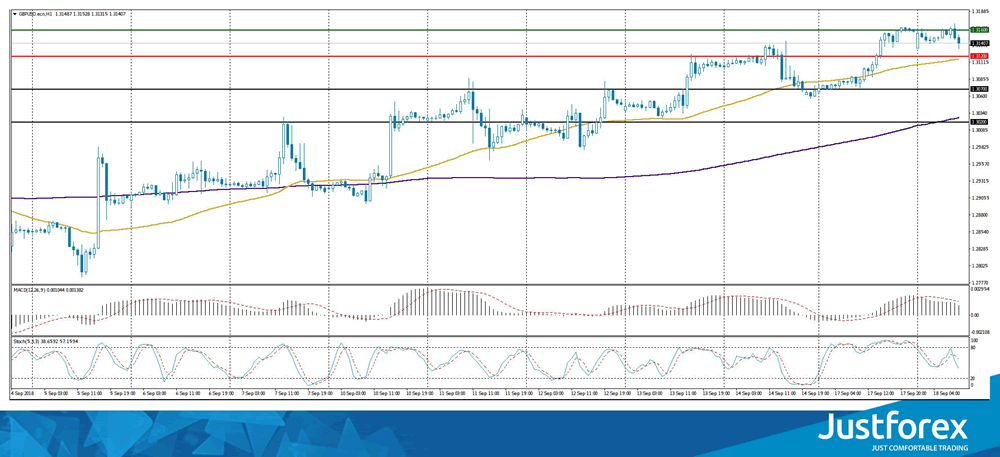
Indicators point to the power of buyers: the price has fixed above 50 MA and 200 MA.
The MACD histogram is located in the positive zone, but below the signal line, which gives a weak signal to buy GBP/USD.
Stochastic Oscillator is in the neutral zone, the %K line is below the %D line, which indicates a decrease in quotes.
Trading recommendations
Support levels: 1.31200, 1.30700, 1.30200
Resistance levels: 1.31600, 1.32000
If the price fixes above the resistance level of 1.31600, further growth of the GBP/USD quotes is expected. The movement is tending to 1.32000-1.32200.
An alternative may be the correction of the GBP/USD currency pair to 1.30700-1.30500.
The USD/CAD currency pair
Technical indicators of the currency pair:
Prev Open: 1.30292
Open: 1.30330
% chg. over the last day: +0.15
Day's range: 1.30312 – 1.30373
52 wk range: 1.2059 – 1.3795
The technical pattern on the USD/CAD currency pair is ambiguous. The trading instrument is consolidating. Financial market participants expect additional drivers. Local support and resistance levels are: 1.30100 and 1.30500, respectively. We recommend opening positions from these marks. A trading instrument is tending to recover.
The news feed on the economy of Canada is calm
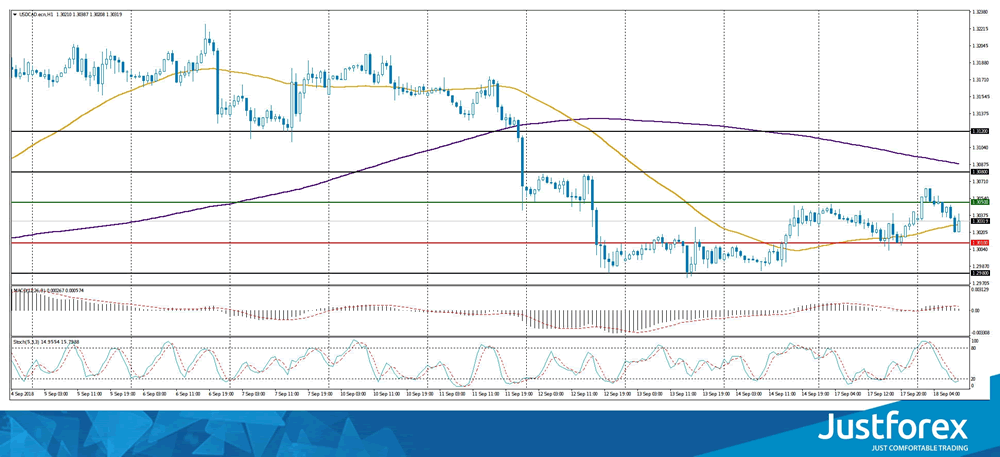
Indicators do not send accurate signals: the price has crossed 50 MA.
The MACD histogram is near 0 mark.
Stochastic Oscillator has reached the oversold zone, the %K line is crossing the %D line. There are no accurate signals.
Trading recommendations
Support levels: 1.30100, 1.29800
Resistance levels: 1.30500, 1.30800, 1.31200
If the price fixes below the support of 1.30100, the USD/CAD quotes are expected to decline. The movement is tending to 1.29800-1.29500.
Alternative option. If the price fixes above 1.30500, it is necessary to consider purchases of USD/CAD. The target movement level is 1.30800-1.31000.
The USD/JPY currency pair
Technical indicators of the currency pair:
Prev Open: 112.005
Open: 111.839
% chg. over the last day: -0.25
Day's range: 111.914 – 112.235
52 wk range: 104.56 – 114.74
There is a variety of trends on the USD/JPY currency pair. Local support and resistance levels are: 111.900 and 112.250, respectively. The positions should be opened from these marks. Investors expect additional drivers. We recommend paying attention to the US government bonds yield.
The news feed on the economy of Japan is calm.
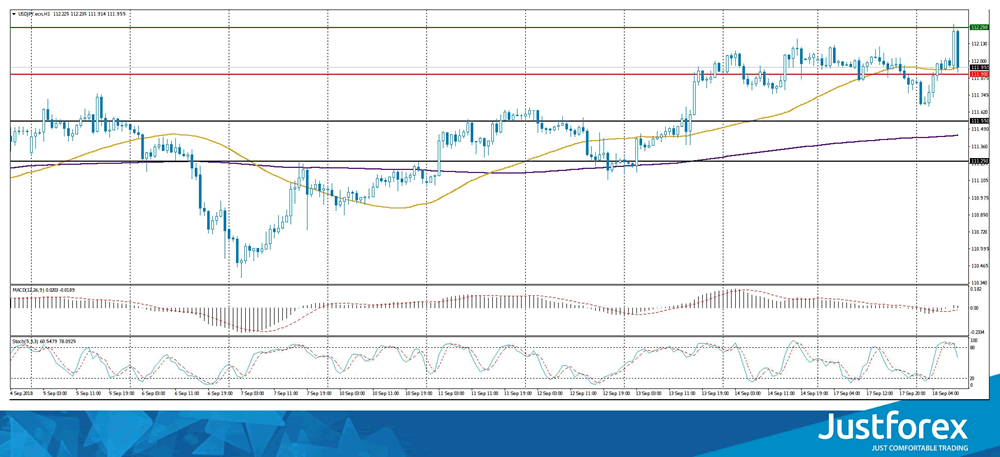
Indicators do not send accurate signals: the price is testing 50 MA.
The MACD histogram is located near the 0 mark. There are no signals at the moment.
Stochastic Oscillator has started moving out the overbought zone, the %K line is below the %D line, which gives the signal to sell USD/JPY.
Trading recommendations
Support levels: 111.900, 111.550, 111.250
Resistance levels: 112.250, 112.600
If the price fixes above the resistance level of 112.250, the USD/JPY quotes are expected to rise. The movement is tending to 112.600-112.800.
Alternative option. If the price fixes below the level of 111.900, we recommend looking for entry points to the market to open short positions. The target movement level is 111.550-111.250.
AUDUSD Outlook: Aussie Maintains Bullish Bias And Looks For Break Above Falling 20SMA
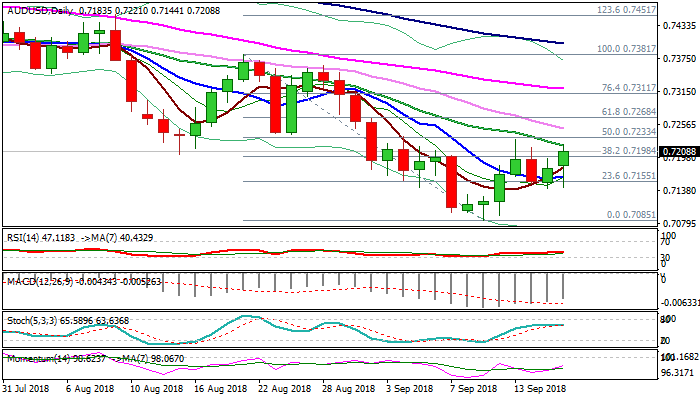
The AUDUSD pair maintains bullish bias and looks for retest of last week's recovery high at 0.7229, after bulls regained traction and rallied from Asian session low at 0.7144.
The Aussie reacted on the latest decision of the US to impose new tariffs on Chinese goods, with controlled downside action on China's subsequent comments about response to the US decision.
Better than expected Australian Q2 housing data were also supportive, while the RBA released the minutes of the latest policy meeting.
The central bank's decision to keep accommodative policy for some time was in line with expectations, as it expects further fall in unemployment and inflation to pick up, to give firmer signals for fresh tightening.
Daily techs are bullishly aligned and supportive, however, bulls need break above falling 20SMA (0.7219) and previous high (0.7229) to spark extension of bull-leg from 0.7085 towards 0.7250 (falling 30SMA) and 0.7268 (Fibo 61.8% of 0.7381/0.7085 descend).
Initial support lays at 0.7180 (rising 5SMA), with extended downticks expected to find footstep above north-turning 10SMA (0.7163) which guards pivotal supports at 0.7144/41 (lows of Monday / today).
Res: 0.7219, 0.7229, 0.7250, 0.7268
Sup: 0.7180, 0.7141, 0.7085, 0.7000
GBPUSD Outlook: Bull Are Taking A Breather After Initial Attack At 100SMA Failed
Cable ticked lower on Tuesday after attempts to extend previous day’s rally faced headwinds from strong resistances at 1.3162/67 (Fibo 61.8% of 1.3472/1.2661 / falling 100SMA).
Bulls may take a breather, with consolidative / corrective action signaled by overbought slow stochastic and 14-d momentum heading south after forming a bear-cross.
Dips are expected to hold above broken top of falling daily cloud (1.3088) to keep bulls intact for renewed attack at 1.3162/67 pivots.
Sustained break here would generate strong bullish signal for extension of short-term uptrend from 1.2661 (15 Aug low) towards targets at 1.3213 (26 July high) and 1.3280 (Fibo 76.4%).
Conversely, break and close below daily cloud top would risk deeper pullback and expose supports at 1.3043 (former high of 30 Aug) and 1.3010 pivot (55SMA).
Res: 1.3167, 1.3213, 1.3280, 1.3335
Sup: 1.3130, 1.3101, 1.3088, 1.3010

US Futures Higher Despite New Chinese Tariffs
- New tariffs already priced in;
- Will Trump follow through with more tariffs?
- Politics likely to remain primary driver of markets.
Investors have taken US President Donald Trump's announcement of new tariffs against China in their stride on Tuesday, with indices across much of Asia and Europe in the green and US futures a little higher.
The tariffs have been talked about for some time now and it was only a matter of time until the announcement came so there was no reason to expect too much of a response, unless either the final number was higher or the list included unexpected items that investors deemed damaging. Not only did neither of these happen, but some expected items were not included on the list and the tariff will only be 10%, rising to 25% at the end of the year if negotiations don't move forward, a minor positive.
The ball is now in China's court, how they respond will determine how big an escalation we can expect and what the economic and market price will be. So far, the economic impact has been minimal but we've only just entered into significant tariff territory. The greatest impact has come in the markets, with Chinese stocks having fallen into bear market territory and the yuan having fallen more than 10% against the dollar.
The interesting result of this is that the currency move has largely offset the impact of the tariffs on Chinese goods and the trade deficit has widened, I'm sure much to the frustration of the Trump administration. If we see a similar result from these tariffs and the impact on prices at home is more significant, I wonder whether Trump will revisit the strategy or just persist and attempt to inflict as much damage on China and its markets as possible.
China obviously doesn't have the tariff firepower that Trump has but appears to be adopting a different strategy for getting under the skin of the Trump administration. Aside from counter-tariffs, more of which will likely be announced very soon, China has shown a willingness to forge closer ties with others and reduce its reliance on the US, most notably Russia, something that will make lawmakers very uncomfortable and could hurt the US much more in the longer-term.
Ultimately, I'm sure investors would rather that common sense prevail and both sides return to the negotiating table and find a solution that removes tariffs and promotes free trade but it doesn't feel like we're any closer to that, especially if China follows through on reported threats to reject an invitation for talks if Trump follows imposes more tariffs.
While there are a number of notable economic events that investors should pay attention to over the course of this week, politics has been dominant and I don't see that changing, especially as Brexit negotiations continue with the deadline fast approaching. The pound has been extremely sensitive to Brexit reports recently, no matter how minor the comments appear to be and it's likely that will continue until we start to see some significant progress.
USDJPY Considers New Trade Tariffs
The US dollar has moved below the 112.00 level against the Japanese currency, as traders digest the news that the United States will impose another round of trade tariffs on Chinese imports. The recent short-term bullish momentum seen in the USDJPY pair is likely to remain intact while price trades above the 111.75 support level. Buyers need to break the 112.20 level, while sellers need a bearish daily price close below the 111.37 level.
The USDJPY pair remains bullish while trading above the 111.75 level, key resistance is now found at the 112.20 and 112.80 levels.
If the USDJPY pair moves below the 111.75 level, key support is found at the 111.37 and 110.90 levels.
