Sample Category Title
USDJPY Analysis: Trades Sideways At 112.00
The US Dollar appreciated 0.28% against the Japanese Yen since Monday's session. On Monday morning, the currency pair was located near the monthly R1 at the 112.27 mark, which stopped the rate from the surge.
In regards to the near future, most likely, the rate will keep trading sideways with the support of the 55-hour simple moving average and the resistance of the monthly R1, staying at the 112.00 level during the day.
On the other hand, the rate might break the resistance of the monthly R1 and the resistance of the upper boundary of the medium pattern to trade near the weekly R1 at the 112.55 mark.

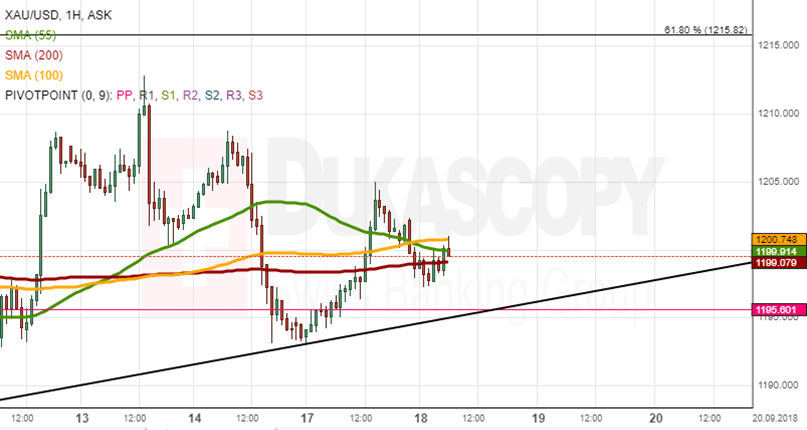
XAUUSD Analysis: Is Squeezed At 1,199.00
The gold price appreciated 0.62% since Monday's trading session. During Tuesday morning hours, the yellow was squeezed between the simple moving averages at the 1,199.00 level.
In regards to the near future, the rate will face a breakout, most likely, to move upwards due to support of the 200-hour and the 55-hour simple moving averages and the additional support of the monthly pivot point at the 1,195.60 mark.
However, the SMAs could become resistance for gold, which could try to push the rate downwards to the monthly PP at the 1,195.60 mark.
AUD/NZD 4H Chart: Weekly Buy Signals
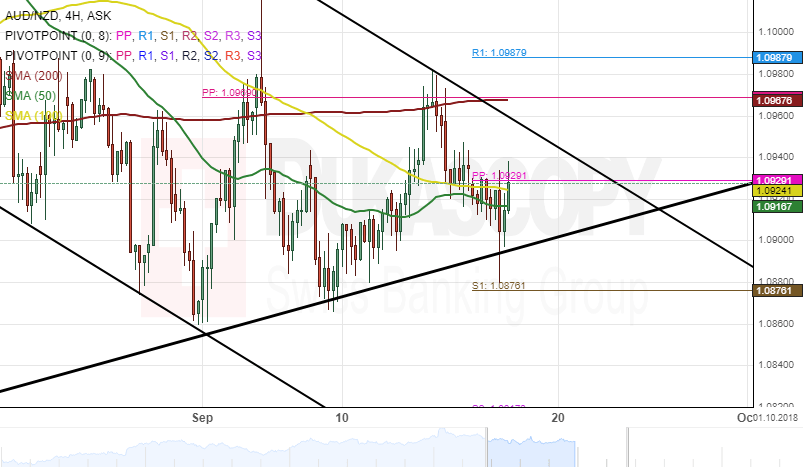
The AUD/NZD currency pair has been moving in a descending channel during the past one month. During this period, the exchange rate tested the lower boundary of a dominant ascending channel.
Presently, the rate is trading near the bottom border of the dominant channel pattern and could be set for a breakout.
Technical indicators favour bullish signals on the weekly time-frame, therefore, a reversal from the border as mentioned above at 1.0900 could be a possibility during the following trading sessions. Bullish traders could push the rate towards the 200-hour SMA at 1.0967 within this week.
AUD/CHF 4H Chart: Sets To Break Pattern
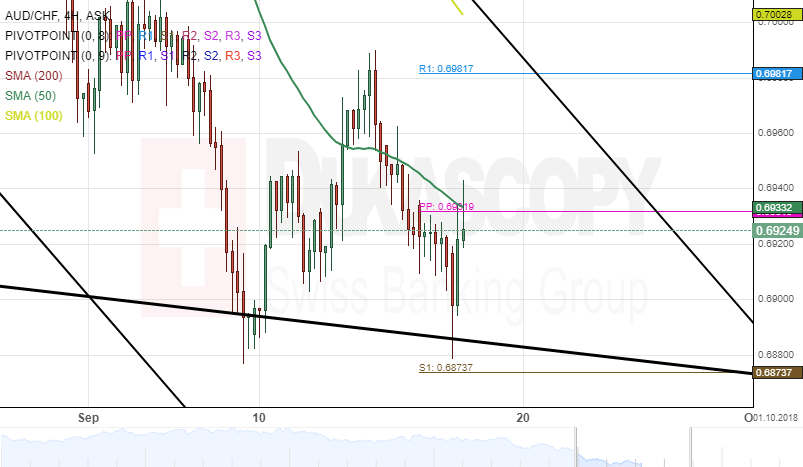
The Australian Dollar has declined significantly against the Swiss Franc after reaching a high mark at 0.7556. The currency pair made a U-turn from the upper boundary of a dominant descending channel on June 7.
Currently, the exchange rate is stranded between the lower boundary of the dominant descending channel at 0.6873 and a resistance cluster formed by the 50-hour simple moving average and the weekly PP at 0.6934.
Everything being equal, it is likely that the AUD/CHF currency exchange rate continues to maintain a junior descending channel during the following trading sessions. The most realistic target for the pair could be a support cluster formed by the weekly and monthly PPs at 0.6820.
The Escalation Of Trade Conflict Continues
The US dollar weakened against the basket of major currencies due to the escalation of trade conflict between the US and China. Yesterday, Donald Trump announced the introduction of a new 10% duties on import of Chinese goods $200 billion worth, which will come into effect on September 24. The US president also said that tariffs could grow to 25% if China did not make concessions. The dollar index (#DX) closed in the negative zone (-0.45%).
The British pound strengthened against the US currency amid positive news about Brexit. The first of three rounds of talks, at which the leaders of the European countries intend to conclude an agreement with the UK on favorable terms for the country's exit from the EU, will be held this week.
The "black gold" prices are declining due to the introduction of new duties against China. At the moment, futures for the WTI crude oil are testing a mark of $68.50 per barrel. Investors expect statistics on the API weekly crude oil stock in the US at 23:30 (GMT+3:00).
Market Indicators
Yesterday, the bearish sentiment was observed in the US stock market: #SPY (-0.53%), #DIA (-0.35%), #QQQ (-1.44%).
The 10-year US government bonds yield shows positive dynamics. At the moment, the indicator is at the level of 3.00-3.01%.
The news feed on 18.09.2018:
Today, the publication of important economic reports from the US and the Eurozone is not expected. We recommend paying attention to the speech by the ECB president Mario Draghi.
Trump Fires Fresh Tariff Salvo, How Will China ‘Strike Back’?
Here are the latest developments in global markets:
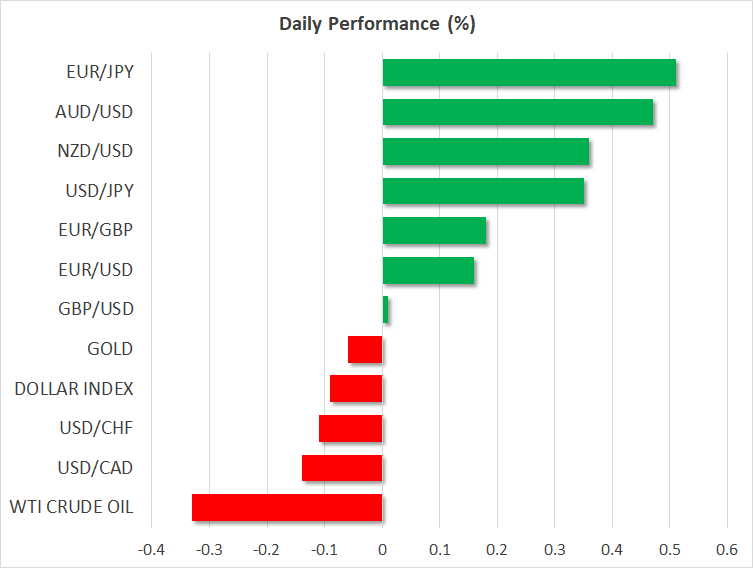
FOREX: The dollar index is down fractionally on Tuesday (-0.08%), extending the notable losses it posted in the previous session, unable to attract safe-haven inflows even despite a fresh escalation in the US-China trade standoff. The pound gained ground on Monday alongside the euro as investors positioned for an EU summit that commences tomorrow, with expectations for a Brexit breakthrough riding high.
STOCKS: US markets closed in the red on Monday, weighed down by a fresh escalation in the Sino-American trade skirmish, with the tech sector leading the way lower. The tech-heavy Nasdaq Composite (-1.43%) underperformed as major names like Apple (-2.66%), Amazon (-3.16%), Netflix (-3.90%) and Twitter (-4.18%) got slammed. Outside of tech though, losses were rather contained, with the benchmark S&P 500 (-0.56%) and the Dow Jones (-0.35%) not feeling as much heat. Turning to Asia, most indices surprisingly ended well in the green on Tuesday, perhaps due to the size of the announced US tariffs being smaller than previously touted. Japan’s Nikkei 225 (+1.41%) and Topix (+1.81%) climbed on their first day back from a holiday, while in Hong Kong the Hang Seng rose by 0.49%. Markets in China and South Korea were also higher. In Europe, most benchmarks were set to open lower today, futures suggest.
COMMODITIES: Oil is lower on Tuesday, as trade tensions between the world’s two largest economies returned to the forefront, casting a long shadow on the outlook for future crude consumption. WTI is down by 0.33% at $68.81 per barrel, while Brent shed 0.47% of its value, trading at $77.76/barrel. Crude prices could remain sensitive to any updates in the trade skirmish, particularly in case China 'strikes back' soon. In precious metals, gold is lower by a marginal 0.06% at $1197 per troy ounce today, continuing to exhibit no interest in any developments on the trade front, and remaining in a narrow range between $1189 and $1214.
Major movers: Trump fires fresh tariff salvo; euro & pound advance on Brexit hopes
As had been broadly expected, the Trump administration announced yesterday that it will impose a 10% tariff on $200bn worth of Chinese goods, effective from September 24. From 2019 onwards, these tariffs will be raised to 25%. The delay is apparently aimed at giving US businesses some precious time to reconfigure and adjust their supply chains, before the increased costs really 'start to bite'. Interestingly, the inclusion of this new timeframe suggests the US expects this to be a drawn out and prolonged trade skirmish, pouring cold water on expectations for a swift, diplomatic resolution.
Characteristically, Trump also warned that if China retaliates – which the Asian nation has stressed it will – then his administration will pursue new tariffs on another $267bn Chinese products. All in all, Trump seems set to ramp up the pressure to the maximum ahead of the US midterm elections, and with Beijing almost certain to strike back given it does not want to be 'bullied around' by the US, tensions may be set to escalate further in the coming weeks. Now, the ball is in China’s court. It will be crucial to see what method and size of retaliation Chinese officials deem appropriate to utilize, and whether the previously-planned talks with the US are now dead in the water.
In terms of market reaction, the magnitude of the moves was not as big as one would have expected following such an escalation – perhaps because the move was well telegraphed in advance, or due to the tariffs being smaller than the expected 25%. US stock markets closed lower, albeit not massively, while safe-haven currencies like the yen were broadly weak, failing to attract substantial inflows. The dollar was the biggest underperformer, ending the day lower across the board even despite growing trade risks, which until recently had been supporting the currency.
The biggest outperformers in Monday’s session were actually the pound and euro, in that order. Both currencies climbed as investors seem to be positioning for a favorable outcome at this week’s EU summit, which is likely to set the stage for what to expect from the Brexit negotiations through the fall. Some even suggest this event could be the 'turning point' for the talks, though to be fair, until a realistic solution to the Irish border issue is presented such optimism may be unfounded.
Elsewhere, aussie/dollar is higher by nearly 0.50% today, after the RBA struck a somewhat optimistic tone in the minutes of its latest meeting released overnight, reiterating that the next moves in interest rates is likely to be upward
Day ahead: Trade to keep markets busy; Brexit in focus
Following the tariff announcement by the US president late on Monday, who triggered an additional 10% tariff against Chinese imports worth approximately $200 billion, eyes will now turn to China. Investors are waiting eagerly to see whether Beijing will continue the already-inflamed trade dispute by taking countermeasures as well, and what would be the size of a potential retaliation. However, based on latest stats, Chinese orders for US products total around $130 billion, less than a third of what the US purchase from China, generating a question of whether Beijing will simply decide to increase its already-existing tariffs on US imports. Besides that, traders now have bigger concerns that the US could turn even more punitive if Beijing fights back, with the US president warning yesterday that in this case, he would activate further tariffs on $267 billion Chinese goods, including on Apple products. Note that the new 10% import tariff will take effect on September 24, while from January 1 2019, the weigh will increase to 25%. Yet, questions remain on whether China will agree to restart or cancel trade talks with the US.
Brexit will remain under the spotlight as well this week as the UK Prime Minister prepares to meet EU officials in an informal summit in Salzburg, Austria on September 20, where UK’s withdrawal plan will be a highlight in the agenda. While recent headlines support that the EU prefers to avoid a no-deal Brexit, other sources suggest that the EU has not softened its stance. At Thursday’s summit markets could get fresh clues on where the EU stands, six months before UK’s official exit from the trading bloc. Note that yesterday, a report by The Times newspaper raised hopes on the Brexit progress, stating that the EU Brexit negotiator Michel Barnier is working on plans to limit physical checks on the Irish border, a key issue in the Brexit talks.
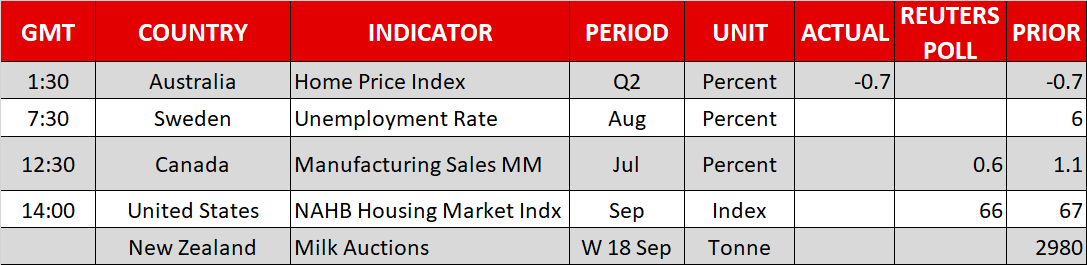
Turning to data releases, Tuesday’s calendar will feature Canadian Manufacturing sales for the month of July at 1230 GMT, while at 1400 GMT, the National Association of Home Builders in the US will publish its Housing Market index which tracks the relative level of current and future home sales. In New Zealand, the outcome of the bi-weekly dairy auction is due at a tentative time.
Technical Analysis – GBPUSD stretches rally to 2 ½ -month highs; looks positive in short-term
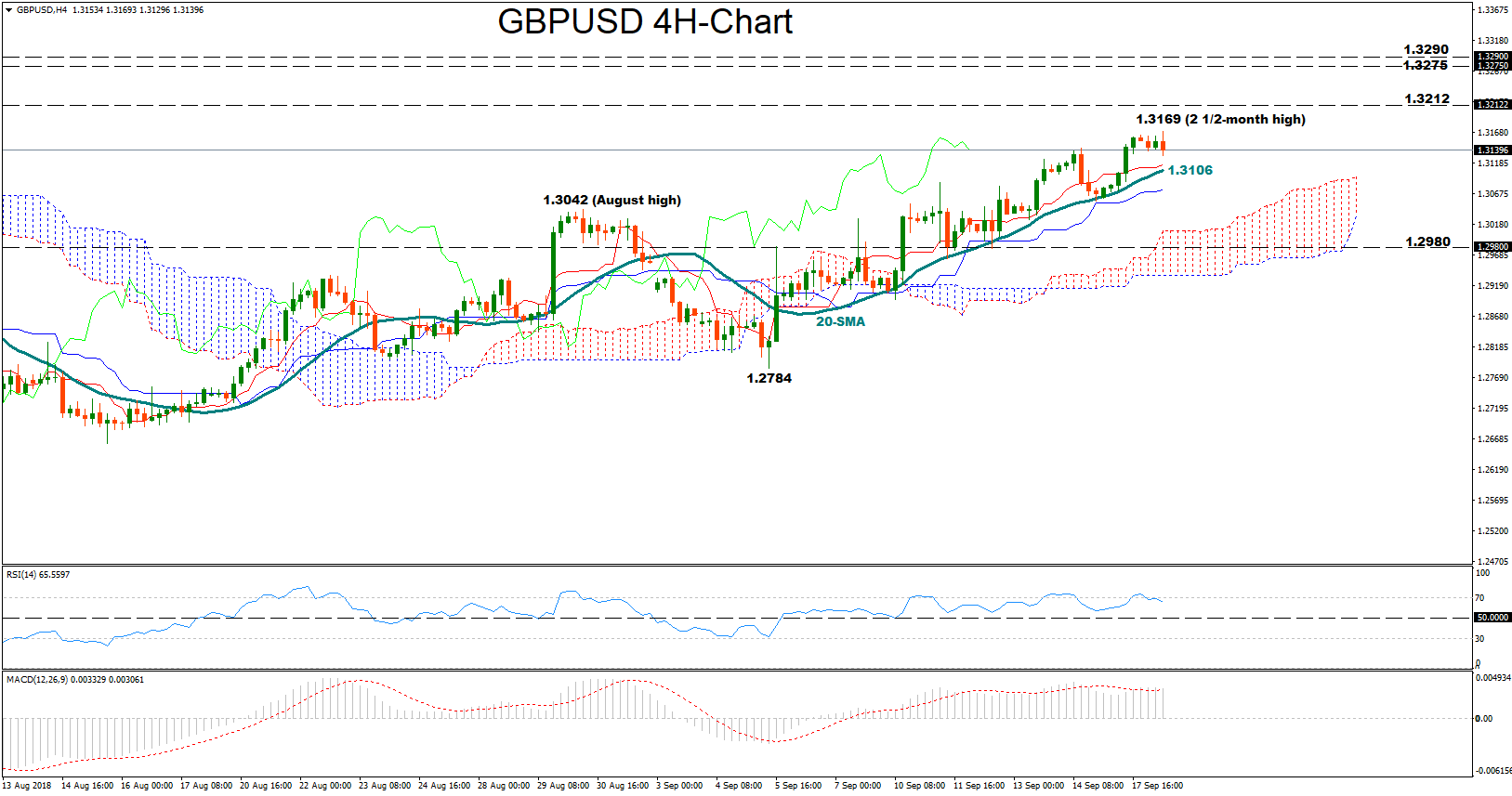
GBPUSD rallied significantly after its drop to 1.2784 on September 5, the lowest level reached since August 20, rising back above the Ichimoku cloud in the 4-hour chart to reach 2 ½ -month highs at 1.3169 today. In the short-term, upside risks are likely to hold as long as the red Tenkan-Sen line continues to fluctuate above the blue Kijun-Sen line and the RSI trends above its 50 neutral mark.
On the upside, the price could retest today’s peak of 1.3169 which acted as a resistance on July 30 as well. Even higher, the bulls may try to break above the 1.3212 where the market paused on July 26, while steeper increases could meet a wall between 1.3275 and 1.3290.
In the alternative scenario, if bearish forces dominate, the price could decline until it meets the 20-period simple moving average currently at 1.3106 which has been restricting downside movements over the past two weeks. A close below that line, however, and specifically a fall below the August peak of 1.3042, could trigger further bearish actions, probably towards the area around 1.2980.
Forex Technical Analysis: EUR/USD, USD/JPY, GBP/USD
EUR/USD
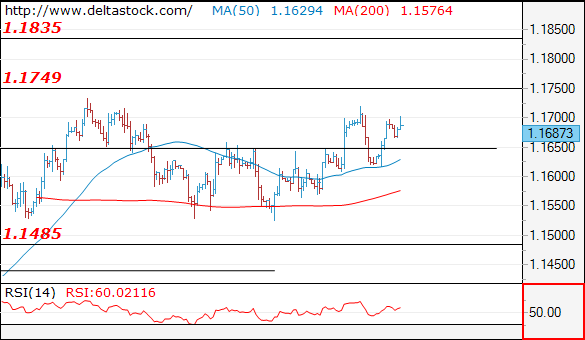
Current level - 1.1687
The rebound above 1.1650 signals a renewal of the positive outlook, for a rise through 1.1730, en route to 1.1830.
| Resistance | Support | ||
| intraday | intraweek | intraday | intraweek |
| 1.1730 | 1.1730 | 1.1650 | 1.1300 |
| 1.1840 | 1.1840 | 1.1530 | 1.1100 |
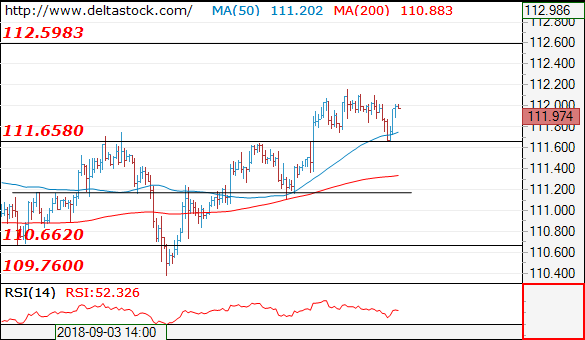
USD/JPY
Current level - 111.97
The recent dip to 111.65 support clearly signals, that the upmove has been renewed, heading towards 112.60 area.
| Resistance | Support | ||
| intraday | intraweek | intraday | intraweek |
| 112.20 | 114.50 | 111.65 | 109.30 |
| 112.50 | 114.50 | 109.70 | 109.30 |
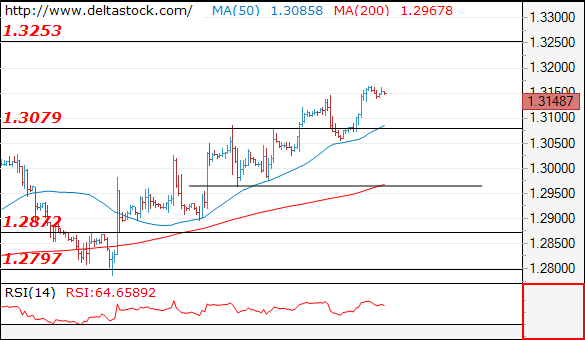
GBP/USD
Current level - 1.3148
The bias is positive after 1.3050 reversal, for a rise towards 1.3250 hurdle.
| Resistance | Support | ||
| intraday | intraweek | intraday | intraweek |
| 1.3150 | 1.3120 | 1.3050 | 1.2570 |
| 1.3250 | 1.3250 | 1.2960 | 1.2570 |
EURUSD Outlook: Bullish Bias Above 100SMA, Further News From US-China Trade Conflict To Provide Fresh Signals
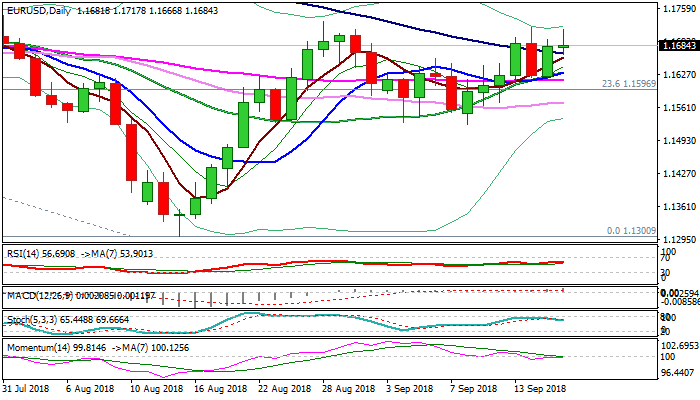
The Euro remains steady and extended previous day's strong rally but gains stalled ticks ahead of last Friday's peak at 1.1721, but subsequent pullback on new US tariffs was contained by broken 100SMA (1.1669) which now acts as initial support.
Conflicting daily techs (south-heading slow stochastic and weakening momentum against bullish setup of daily MA's) lack clearer signals, with focus turning towards US-China trade conflict and response from China on the newest measures from the US.
Initial comments from China were conciliatory, preventing deeper losses, however, further response from China could be anticipated and would the key market driver.
Converged 10/20SMA's (1.1631) mark next strong support below 100SMA, which is expected to hold extended dips and maintain bullish bias.
At the upside, plethora of resistances lays between 1.1733 (28 Aug high) and 1.1780 (Fibo 38.2% of 1.2555/1.1300 fall), with sustained break higher needed to generate stronger signal for continuation of recovery leg from 1.1300 (15 Aug low).
Res: 1.1721, 1.1733, 1.1750, 1.1780
Sup: 1.1669, 1.1631, 1.1615, 1.1571
Markets Reversed To Growth, Despite New Tariffs On China Import
Trump's administration announced the introduction of 10%-tariffs for Chinese imports to $200 billion. The news had a moderate negative impact on the markets. The dynamics is limited, as the information about these measures appeared on Monday, which took from MSCI about 1% on Monday. We see something like the traditional reaction of the market “buy rumors, sell facts.'
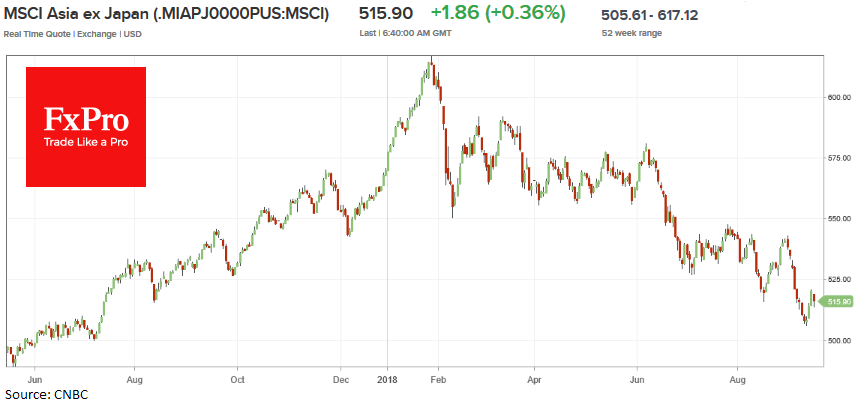
At the same time, we cannot forget about the long-term negative consequences of the world trade problems. It is cautious to expect a response from China that threatened to abandon the planned negotiations with the United States in case of the trade war escalation.
In addition, trade disputes have already led to decline in world trade, which last time happened in 2015 against the backdrop of the collapse of oil quotes, and before that was noticed only in 2008. The reduction is detrimental for the demand for raw materials and energy.
Metal quotes have been losing for the third session in a row. Brent oil lost 3.2%, once again stepping from the important resistance around $80 to the mark on $77.25. Under these circumstances, the current roll back of the markets should be seen as a temporary rollback after a sale earlier, but hardly as an excuse for a sustained growth.
The dollar has decreased this week by 0.6%, testing the minimum levels from the first half of July. It is obvious that the dollar is not able to develop the offensive, even though the Fed is moving in full swing to raise the rates in September and December. The weakening of the US currency is also a supporting factor for the markets of developing countries.
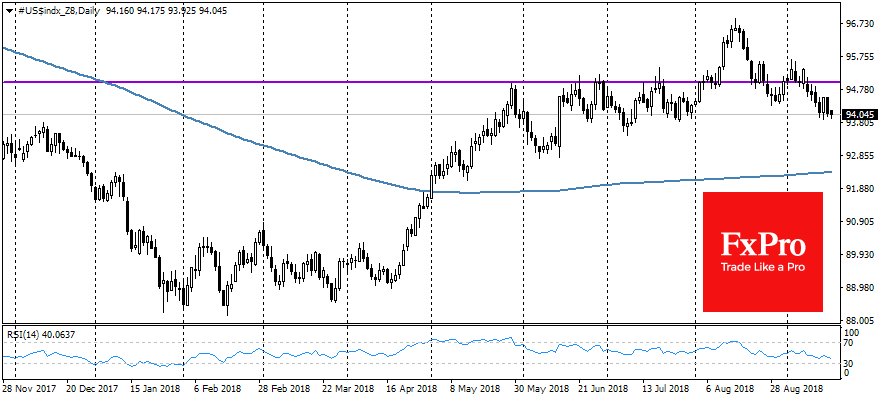
The current dollar deviation risks to increase if the dollar index overcomes the level of support at 93.80. No less important level for EURUSD is the mark of 1.17. If the euro succeeds steadily above these marks, the purchase of a single currency can noticeably increase on the investors' faith in a further rally.
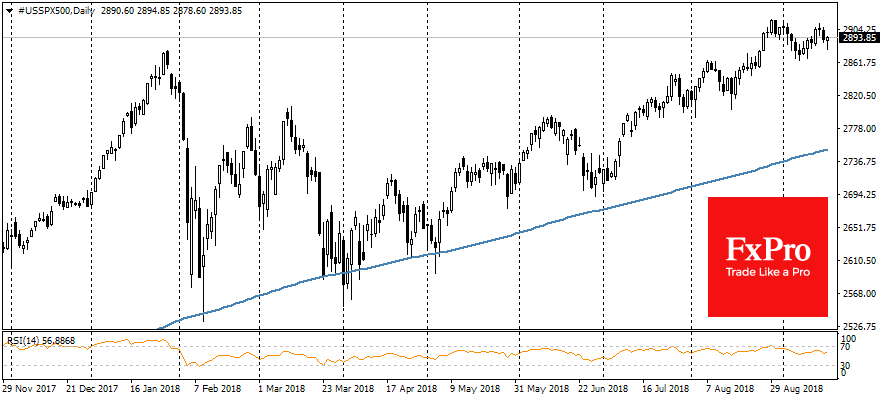
At the same time, the stock markets have not yet developed a certain dynamic: The index of S&P 500 remains below the important level of resistance (2900), although staying in the framework of the last-week growing mini-trend.
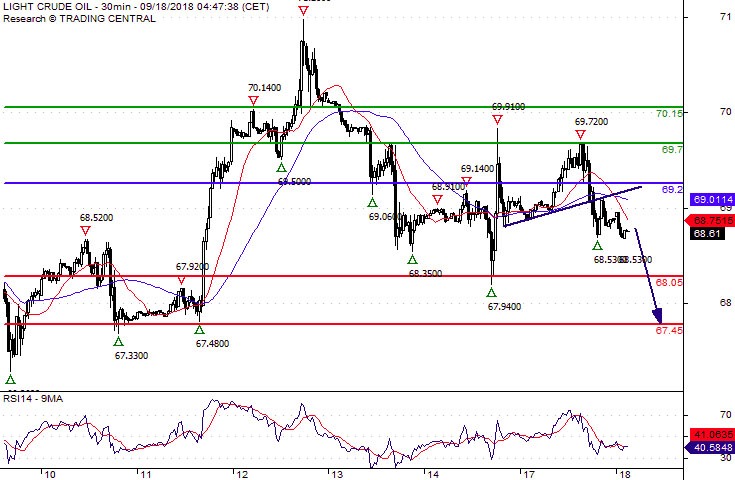
Crude Oil Under Pressure
Pivot (invalidation): 69.20
Our preference Short positions below 69.20 with targets at 68.05 & 67.45 in extension.
Alternative scenario Above 69.20 look for further upside with 69.70 & 70.15 as targets.
Comment The RSI advocates for further downside.