

Sample Category Title
USDJPY: Resumes Uptrend, Eyes The 112.61 Resistance Zone
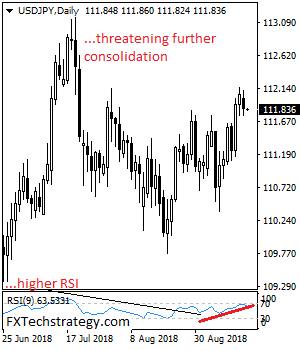
USDJPY: The pair now faces further bull pressure after resuming its short term uptrend during Tuesday trading today. On the downside, support lies at the 112.00 level where a break if seen will aim at the 111.50 level. A cut through here will turn focus to the 111.00 level and possibly lower towards the 110.50 level. On the upside, resistance resides at the 112.50 level. Further out, we envisage a possible move towards the 113.00 level. Further out, resistance resides at the 113.50 level with a turn above here aiming at the 114.00 level. Its daily RSI is bullish and pointing higher suggesting further strength. On the whole, USDJPY faces further upside pressure short term.
EUR/USD Mid-Day Outlook
Daily Pivots: (S1) 1.1635; (P) 1.1668; (R1) 1.1717; More.....
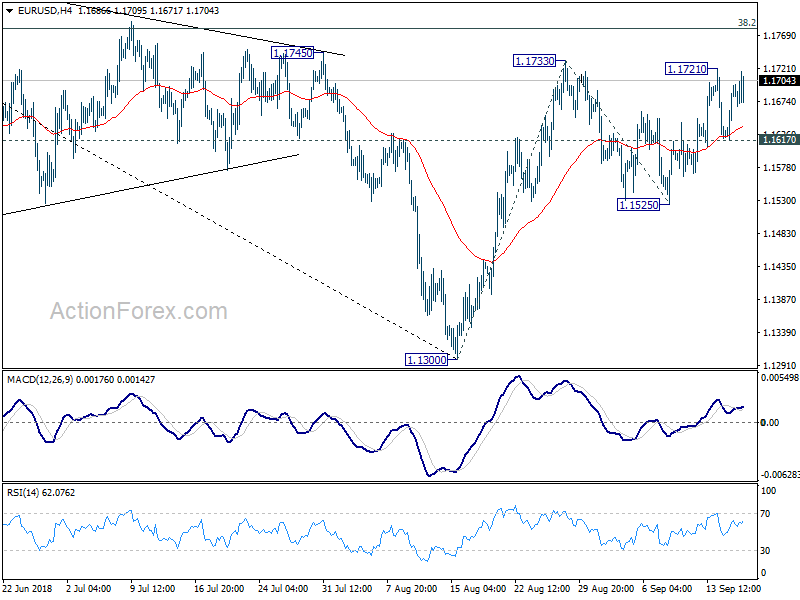
EUR/USD strengthens further today and focus is back on 1.1733 resistance Break will resume whole rebound from 1.1300. At this point, we'd still expect strong resistance from 38.2% retracement of 1.2555 to 1.1300 at 1.1779 to limit upside, at least on first attempt. Break of 1.1617 minor support will turn bias back to the downside. Further break of 1.1525 support will indicate completion of this corrective rebound from 1.1300. However, firm break of 1.1779 will extend the rise to 100% projection of 1.1300 to 1.1733 from 1.1525 at 1.1958.
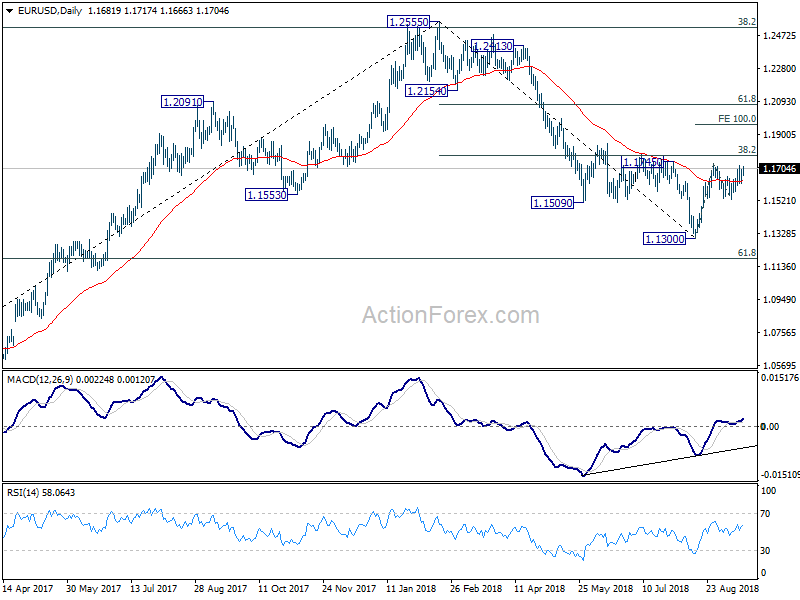
In the bigger picture, a medium term bottom should be in place at 1.1300, on bullish convergence condition in daily MACD and some consolidations would be seen. But still, note that EUR/USD was rejected by 38.2% retracement of 1.6039 (2008 high) to 1.0339 (2017 low) at 1.2516. That carries some long term bearish implications. Thus, we'd expect fall from 1.2555 high to resume after consolidation completes. Below 1.1300 should send EUR/USD through 61.8% retracement of 1.0339 to 1.2555 at 1.1186. And, in that case, EUR/USD would head to retest 1.0339 (2017 low).
Business Back to Usual after Trade War Escalation, Show Time for Euro or Aussie?
This time, the escalation of US-China trade war is largely ignored by the financial markets. There were just some very brief knee jerk reaction in stock and the currency markets. Yen and Dollar are both back under pressure after initial rebound. On the other hand, Australian Dollar looks immune from trade risks and trades broadly higher today, leading other commodity currencies. Though, one development to note is that Euro could be quietly picking up some momentum, helped by softness in Sterling. We might see Euro and Aussie compete for the strongest spot for the rest of the day.
At the time of writing, European indices are trading all up slightly. FTSE is up 0.04%, DAX up 0.15% and CAC up 0.23%. German 10 year bund yield reversed initial loss and is up 0.008 at 0.466. Earlier in Asia, Nikkei closed up 1.41%, Hong Kong HSI up 0.56% and Singapore Strait Times was just down -0.07%. Most notably, China Shanghai SSE reversed earlier loss and closed up 1.82% at 2699.95, just shy of 2700 handle. The strong close is indeed suggesting short term bottoming, just ahead of 2638.30 key support (2016 low). But question remains on how strong the rebound could be.
Technically, EUR/JPY has already caught up with USD/JPY and GBP/JPY and broke 131.00 minor resistance to resume recent rebound. It's time for EUR/USD to show whether it can break 1.1733 resistance. Dollar is staying in range against Australian Dollar and Canadian Dollar. But fresh selling is seen in early US session. USD/CAD could challenge 1.2975 temporary low while AUD/USD could take on 0.7228 temporary top during the session.
China MOFCOM, Foreign Ministry and CSRS responded to new tariffs
China Ministry of Commerce issued a brief statement in response to new round of US tariffs. It said "to protect its legitimate rights and interests and order in international free trade, China is left with no choice but to retaliate simultaneously". Also, "the United States insists on increasing tariffs, bringing new uncertainties to bilateral trade negotiations. China hopes the United States would recognize the negative consequences of its actions, and take convincing steps to correct its behavior in a timely manner."
Foreign Ministry spokesman Geng Shuang said in a regular press briefing that "China has always emphasized that the only correct way to resolve the China-U.S. trade issue is via talks and consultations held on an equal, sincere and mutually respectful basis. But he criticized that "at this time, everything the United States does does not give the impression of sincerity or goodwill."
No details are provided today. But based on information released last month, China already has a list of USD 60B of US goods to tariff any time.
Fang Xinghai, vice chairman of the China Securities Regulatory Commission (CSRC) criticized that the Trump's new round of tariffs on China has "poisoned" the atmosphere for negotiations. Fang also warned that "President Trump is a hard-hitting businessman, and he tries to put pressure on China so he can get concessions from our negotiations. I think that kind of tactic is not going to work with China." Also, according to Fang, "if he puts tariffs on all Chinese exports to the United States - which he says he will - even in that scenario, the negative impact on China's economy is about 0.7 percent."
USTR announced 10% tariffs on Chinese imports, to increase to 25% on Jan 1 2019
US Trade Representative finally announced the tariffs on USD 200B of Chinese imports, effective September 24, 2018. The initial tariff rate is 10%. Staring January 1, 2019, the tariff rate will be increased to 25%. The list of products covers 5745 lines of the original 6031 lines proposed back in July 10. 297 lines were fully or partially removed from the list. Products include consumer electronics, certain chemical inputs for manufactured goods, textiles and agriculture; certain health and safety products such as bicycle helmets, and child safety furniture such as car seats and playpens.
The tariffs were part of the follow-up actions on Section 301 investigations. China's unfair trade practices were repeated in the statement. These include, forced technology transfer, depriving UA companies to set market based terms in negotiations, unfairly facilitating systematic investment in acquisition of US technology companies, and cyber intrusions to US commercial computer networks for valuable business information.
Trump warned in a statement that new round of tariffs on around USD 267B of additional imports will be pursued if China retaliates. He added that "we have been very clear about the type of changes that need to be made, and we have given China every opportunity to treat us more fairly." "But, so far, China has been unwilling to change its practices."
Responses on tariffs: Trump did not heed American warnings
Here are some responses from the industry on Trump's tariffs on China:
The U.S. Chamber of Commerce president and CEO Thomas Donohue said in a statement, "today's decision makes clear that the administration did not heed the numerous warnings from American consumers and businesses about rising costs and lost jobs on Main Street, in factories, and on farms and ranches across the country. "
Dean Garfield, president of the Information Technology Industry Council said in a statement, "President Trump's decision to impose an additional $200 billion is reckless and will create lasting harm to communities across the country."
Hun Quach, the Retail Industry Leaders Association's s vice president for international trade said in a statement, "we are extremely discouraged by the Administration's announcement to levy tariffs on millions of products American consumers buy every day." "We are disappointed to see that warnings from importers and exporters representing every sector of the U.S. economy have not been heeded with no time for mitigation."
Jay Timmons, National Association of Manufacturers (NAM) President and CEO, said in a statement "more U.S. tariffs and Chinese retaliation risk undoing that progress and moving our economy in the wrong direction." "Now is the time for talks—not just tariffs".
EU companies in China releases report with 828 reform recommendations in 14 areas
The European Union Chamber of Commerce in China released an annual position paper today, urging China to accelerate reforms. The paper described the widening gap of the maturing economy and the shortcomings of reforms and opening agenda as "reform deficit". Such reform deficit is seen as the "root cause" of tensions in the global economic tensions which resulted in the US-China trade war. And, "the strong reaction from the United States with its escalation of tariffs is, albeit undesirable, a direct response to these deficiencies, many of them longstanding."
The paper examines 14 common concerns faced by European companies. These issues "continue to hold back China's development and prevent businesses from serving their core function". And the paper urged that "each of these issues should be viewed by Chinese officials as a challenge to overcome in the years ahead."
The areas of concerns include access to licenses, complex and lengthy administrative procedures, consultation and communication, cybersecurity, IPR and R&D, overlapping regulations and interdepartmental coordination, market access barriers, SOE-related issues, standards setting, transparency issues, unclear regulations and unpredictable enforcement, unequal and unfair treatment, unfair procurement systems and SMEs. The 33-page paper listed out a accumulative total of 828 recommendations.
The press statement and full rebound can be report here.
EU Tusk laid down three key Brexit issues to focus on at Salzburg meeting
Brexit will be an important topic in the upcoming European Council meeting in Salzburg on September 19 and 20. European Council President Donald Tusk laid out three key issues to focus on, in a statement:
- First, we should reach a common view on the nature and overall shape of the joint political declaration about our future partnership with the UK.
- Second, we will discuss how to organise the final phase of the Brexit talks, including the possibility of calling another European Council in November.
- Third, we should reconfirm the need for a legally operational backstop on Ireland, so as to be sure that there will be no hard border in the future.
Tusk said a no deal scenario is "still quite possible". But, "if we all act responsibly, we can avoid a catastrophe."
Separately, UK Brexit Minister Dominic Raab told Spiegel newspaper that Prime Minister Theresa May's Chequers plan are "so far the only proposals that guarantee smooth trade between Britain and the EU and take account of the specific problems in Ireland." And he saw "no other credible alternative, either from here or from the EU side."
Raab also added that "We have already made extensive compromises.. We have shown ourselves to be very pragmatic and ambitious. Now the ball is in the European Union's court."
RBA minutes reiterated no strong case for near term rate move
The minutes of September 4 RBA meeting provided practically no surprise at all. most importantly, RBA reiterated that "the next move in the cash rate would more likely be an increase than a decrease." However, "there was no strong case for a near-term adjustment in monetary policy."
RBA also noted that a few global central banks including the Fed were expected to continuing rate hikes. This had been reflected in the markets, "most notably a broad-based appreciation of the US dollar" that "raised risks" for some, especially for "fragile emerging" markets. However, "the modest depreciation of the Australian dollar was helpful for domestic economic growth."
The central bank also noted that there were "still significant tensions around global trade policy" that represented a "material risk" to the global outlook.
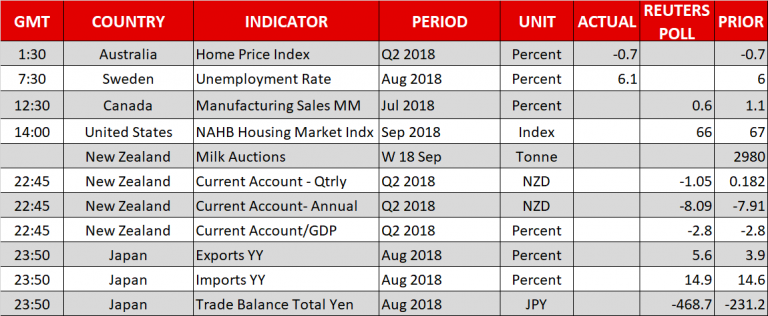
Also from Australia, house price index dropped -0.7% qoq in Q2, matched expectations.
EUR/USD Mid-Day Outlook
Daily Pivots: (S1) 1.1635; (P) 1.1668; (R1) 1.1717; More.....
EUR/USD strengthens further today and focus is back on 1.1733 resistance Break will resume whole rebound from 1.1300. At this point, we'd still expect strong resistance from 38.2% retracement of 1.2555 to 1.1300 at 1.1779 to limit upside, at least on first attempt. Break of 1.1617 minor support will turn bias back to the downside. Further break of 1.1525 support will indicate completion of this corrective rebound from 1.1300. However, firm break of 1.1779 will extend the rise to 100% projection of 1.1300 to 1.1733 from 1.1525 at 1.1958.
In the bigger picture, a medium term bottom should be in place at 1.1300, on bullish convergence condition in daily MACD and some consolidations would be seen. But still, note that EUR/USD was rejected by 38.2% retracement of 1.6039 (2008 high) to 1.0339 (2017 low) at 1.2516. That carries some long term bearish implications. Thus, we'd expect fall from 1.2555 high to resume after consolidation completes. Below 1.1300 should send EUR/USD through 61.8% retracement of 1.0339 to 1.2555 at 1.1186. And, in that case, EUR/USD would head to retest 1.0339 (2017 low).
Economic Indicators Update
| GMT | Ccy | Events | Actual | Forecast | Previous | Revised |
|---|---|---|---|---|---|---|
| 01:30 | AUD | House Price Index Q/Q Q2 | -0.70% | -0.70% | -0.70% | |
| 01:30 | AUD | House Price Index Y/Y Q2 | -0.60% | 2.00% | ||
| 01:30 | AUD | RBA Minutes Sep | ||||
| 12:30 | CAD | Manufacturing Sales M/M Jul | 0.90% | 1.00% | 1.10% | 1.30% |
| 14:00 | USD | NAHB Housing Market Index Sep | 66 | 67 | ||
| 20:00 | USD | Net Long-term TIC Flows (USD) Jul | 65.1B | -36.5B |
British Pound Edges Lower, Investors Eye UK Inflation
GBP/USD has edged lower in the Tuesday session. Currently, the pair is trading at 1.3136, down 0.18% on the day. On the release front, there are no British events. The U.S will release the NAHB Housing Market Index. On Tuesday, the UK releases a host of inflation indicators, led by CPI. The U.S. publishes building permits and housing starts.
A welcome respite in the U.S-China trade spat was shattered on Monday. President Trump imposed tariffs of 10% on some $200 billion worth of Chinese goods and threatened further action if China retaliated. Unlike earlier round of tariffs, the Canadian dollar has managed to hold its own, and investors have not flocked to the U.S dollar. The reason? Investors were braced for a move by Trump, and may be sighing in relief that the tariff was set at 10% rather than at 25%. One senior economist summed up Trump’s most recent salvo as “bad but manageable”. However, if the Chinese retaliate and the U.S takes further measures, this would likely shake up the currency markets and boost the U.S dollar.
British Prime Minister May faces pressure from both the Europeans and Conservative lawmakers at home. There has been talk that her job is in jeopardy, but May is doggedly moving forward, declaring that a Brexit deal will be reached on her terms or not at all. The Europeans may still be smarting from the UK’s decision to leave the club, but they prefer to deal with May rather than the Brexit hardliners. This means that the EU could show more flexibility in negotiations, such as over the thorny issue of the Irish border. At the same time, Brexit is only six months away, and the two sides will have to press hard on the gas to hammer out an agreement before the March deadline. There will likely be plenty of bumps along the Brexit road, which could spell headwinds for the British pound.
Trump Beats the Drums of Impending China Trade War Louder than Before
The drums of a global trade war are beating louder than ever after U.S. President Donald Trump imposed a 10% tariff on an additional $200 billion worth of Chinese goods.
This move has certainly elevated U.S.-China trade tensions to dangerous heights, especially when considering how the U.S. has also threatened to raise tariffs up to 25% in 2019 if no trade deal with China is reached. With Beijing threatening to bite back, concerns over a full-blown trade war becoming a reality are increasing. Beijing might react to the latest moves from President Trump by canceling trade talks with Washington as the latest U.S. tariff move “brings new uncertainties” to the negotiations.
Financial markets offered a fairly muted response to the announcement as the tariffs were already heavily priced into markets. Investors are instead likely to remain guarded and adopt a “wait and see” approach ahead of China’s possible retaliation to the latest round of U.S. tariffs.
In the currency markets, Dollar bulls are interestingly nowhere to be found today despite simmering trade tensions weighing on investor confidence. Buying sentiment towards the Greenback could receive a boost if Beijing’s potential reaction increases trade war fears and promotes risk aversion from investors.
Although the fundamental drivers behind the Dollar’s appreciation remain firmly intact, technically the Dollar is starting to look bearish on the daily charts. The Dollar Index is coming under increasing pressure with prices wobbling above the 94.50 support level. A breakdown below this point could encourage a decline towards 94.10 and 93.90. For bulls to jump back into the game, prices need to secure a solid weekly close back above 95.50.
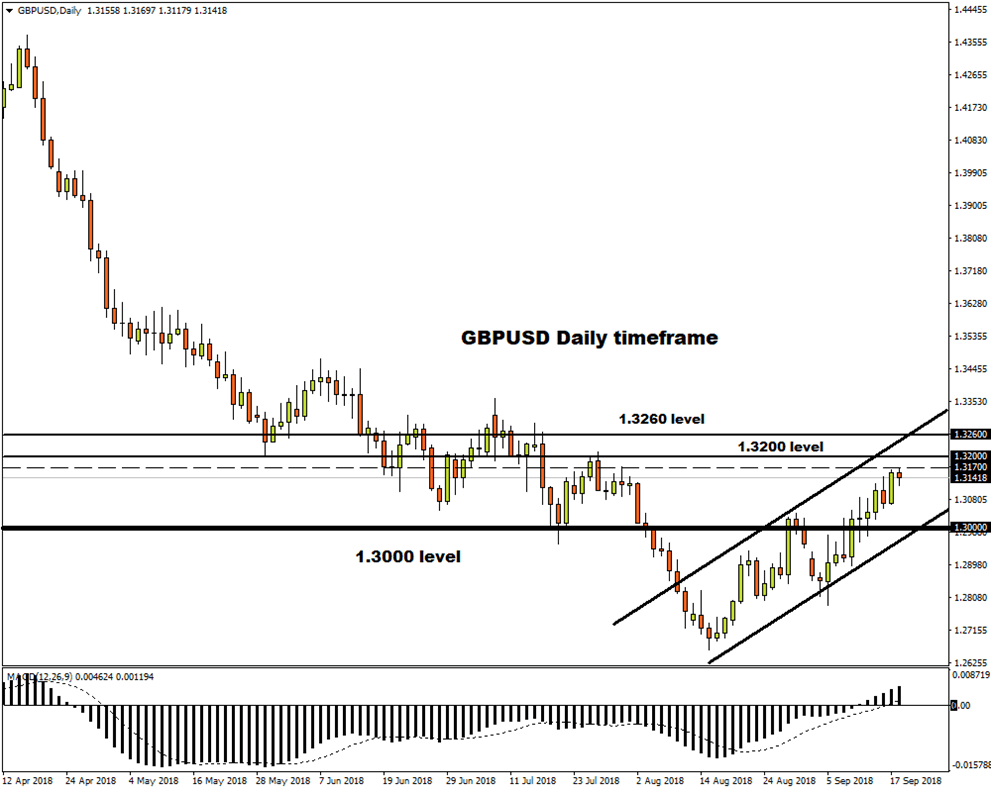
Sterling has the potential to appreciate sharply if the European Union adopts a flexible approach on Brexit at the European Union summit later this week. The GBPUSD remains firmly bullish on the daily charts with the weekly close above 1.3000 paving a path for further upside. An intraday breakout above 1.3170 could instill bulls with enough courage to challenge 1.3200 and 1.3260, respectively.
Into US session: Euro picking up steam as trade war impacts fade
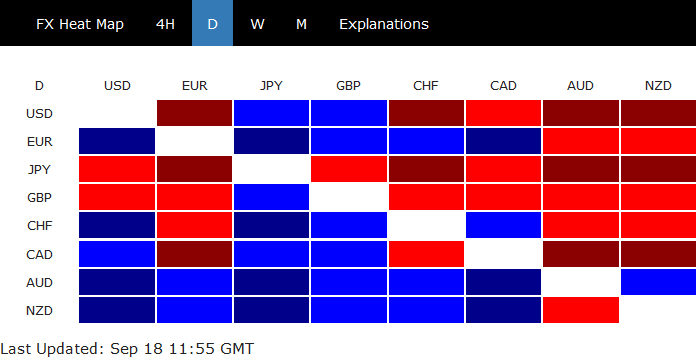
The markets seemed to have taken another escalation in trade war rather well. After some knee-jerk reactions, Dollar and Yen are back under selling pressure. Though, Sterling is the second weakest in between them as recent rally, in particular against Euro, lost steam. It's possibly the time for Euro to pick up from speed. Though for now, the common currency is out-performed by commodity currencies, with Australian Dollar leading the way up.
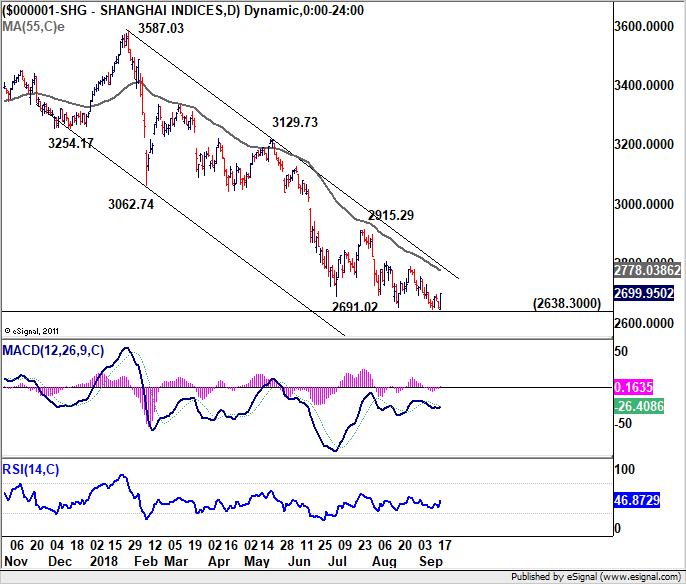
The stock markets are also cool. At the time of writing, DTSE is up 0.04%, DAX up 0.18% and CAC up 0.18%. Earlier in Asia, Nikkei closed up 1.41%, Hong Kong HSI up 0.56% and Singapore Strait Times was just down -0.07%. Most notably, China Shanghai SSE reversed earlier loss and closed up 1.82% at 2699.95, just shy of 2700 handle. The strong close is indeed suggesting short term bottoming,just ahead of 2638.30 key support (2016 low). But question remains on how strong the rebound could be.
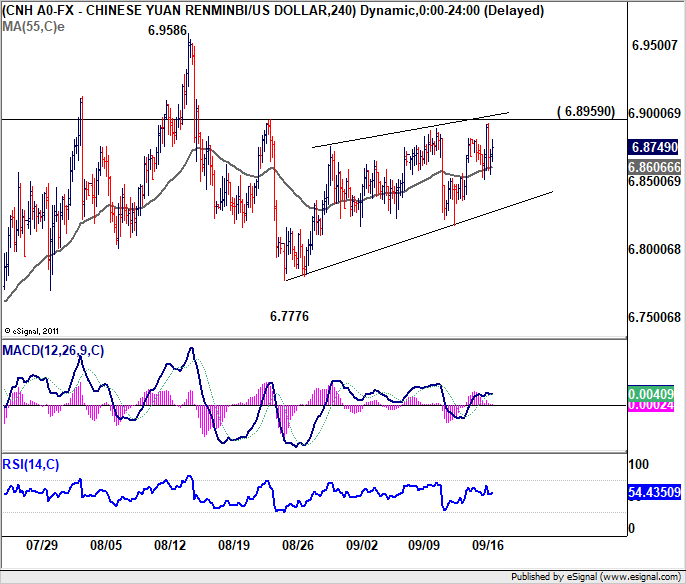
USD/CNH (offshore Yuan) is also steady. For now, we're not anticipating sustained break of 6.8959 minor resistance. Another fall to 6.7776 is mildly in favor as the corrective pattern from 6.9586 extends.
Dollar Holds onto Gains Despite China’s Warnings; BoJ Rate Decision in Focus
Here are the latest developments in global markets:
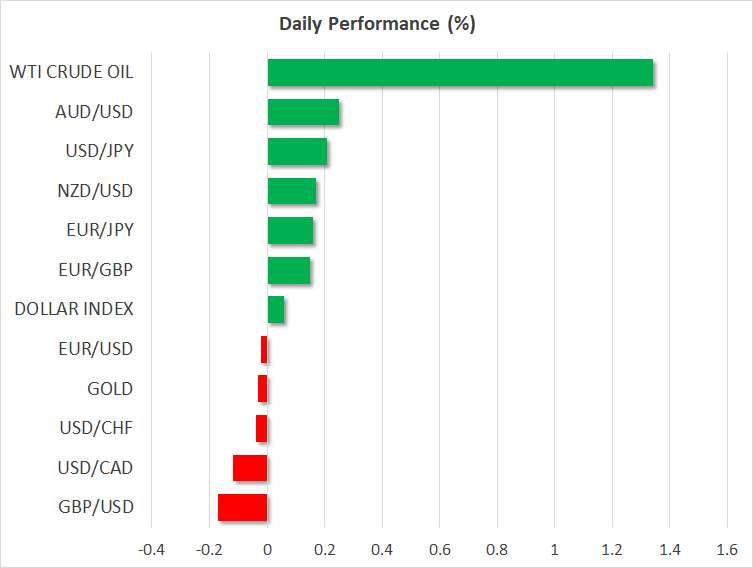
FOREX: The US dollar moved higher by 0.26% against the Japanese yen but held below its intraday high of 112.27, while the US dollar index edged marginally higher by 0.09%. US President Donald Trump announced yesterday that his country will impose a 10% tariff on $200bn of Chinese goods from September 24 as was widely anticipated. As of January 1, 2019, those tariffs will be raised to 25%. Euro/dollar erased earlier gains to return to 1.1682, near its opening price, while pound/dollar retreated from the 7-week high (-0.23%) despite German and Austrian ministers expressing hopes for a Brexit solution by November’s deadline. In the antipodean sphere, aussie/dollar and kiwi/dollar advanced by 0.35% and 0.21% respectively. Meanwhile, dollar/loonie declined by 0.17% to 1.3021.
STOCKS: European equities were in positive territory on Tuesday at 1100 GMT except for the Italian FTSE MIB which was weaker by 0.14%. The pan-European STOXX 600 and the blue-chip Euro STOXX 50 inched up by 0.07% and 0.04% respectively. The German DAX 30 climbed by 0.15%, the French CAC 40 increased by 0.22% and the British FTSE 100 jumped by 0.19%. In Asia, the majority of stocks closed strongly positive, while futures tracking US indices such the S&P 500, Dow Jones and Nasdaq 100 were slightly up, pointing to a softer positive open.
COMMODITIES: WTI crude and the London-based Brent were strongly positive early in the European session, trading higher at $69.87/barrel (+1.41%) and $79.25/barrel (+1.54%) correspondingly as the new round of tariffs on China’s imports to the US was finally formalized. Moreover, OPEC Secretary General Mohammed Barkindo mentioned today that OPEC and non-OPEC counties aim to agree on a framework securing long-term cooperation by December while regarding OPEC’s summit in Algeria on September 23 he said that oil producers will discuss on mechanisms to achieve full compliance on crude supply targets. A headline stating that Saudi Arabia is comfortable with higher Brent prices was also supportive. In precious metals, gold prices slowly returned below $1200/ounce, last seen at $1199.3 (-0.17%).
Day ahead: Traders wait for a response from China; Bank of Japan decides on rates
Although markets reaction to fresh US import tariffs against China was moderate, any potential headlines announcing retaliatory measures by China during the day could inspire risk-off sentiment among traders. As widely expected, the US President imposed a 10% tariff on $200 billion Chinese imports late on Monday taking effect on September 24, adding that the new tariffs will increase to 25% on January 1, 2019. Moreover, the US leader warned that should Beijing fight back, fresh tariffs would be applied to a larger list of $267 billion Chinese products. Beijing, however, does not look like giving up despite the US’s enhanced protectionism, as authorities continued to unleash threats of retaliation on Tuesday, arguing that US actions cannot be accepted and that there is no choice but to respond accordingly. Yet, questions arise about how China will counterattack given that Chinese orders for US products total at around $130 billion based on the latest stats, less than a third of what the US purchases from China. Recall that Beijing had earlier threatened to impose duties ranging from 5% to 25% on $60 billion US goods involving intermediate goods and capital equipment. The US avoided restrictions on items that could have a direct impact on consumers such as Apple products, which hold the largest share of Chinese shipments to the US in terms of value.
Brexit will be under the spotlight too as the UK Prime Minister prepares to meet EU leaders in an informal summit in Salzburg, Austria on September 20. That would be the first meeting after the UK presented the Chequer’s withdrawal plan to the EU, with investors looking forward to any clues on what could be the EU’s stance on the topic ahead of the EU summit next month. This is the target day for the EU Brexit negotiator to agree on the exit plan. Note that yesterday a report by The Times newspaper raised hopes on the Brexit progress, stating that Barnier is working on plans to limit physical checks in the Irish border, a key issue in the Brexit talks. Today the UK Brexit Secretary, Dominic Raab, reiterated that a border in the Irish sea is not the UK’s preferred arrangement.
Turning to data releases, Tuesday’s calendar will feature Canadian Manufacturing sales for the month of July at 1230 GMT, while at 1400 GMT, the National Association of Home Builders in the US will publish its Housing Market index which tracks the relative level of current and future home sales. In New Zealand, the outcome of the bi-weekly dairy auction is due at a tentative time before the release of the Westpac Consumer Sentiment Index and current account readings at 2200 GMT and 2245 GMT respectively.
Elsewhere, Japanese trade stats will come under review at 2350 GMT ahead of the Bank of Japan’s rate decision at 0300 GMT on Wednesday. Policymakers are forecasted to leave interest rates unchanged at -0.10% for the 22nd consecutive time as inflation remains far below the BoJ’s 2.0% price goal. Recent developments in the trade front could keep the central bank cautious as well. A press conference will follow the rate announcement at a tentative time.
USDJPY Outlook: Risk Of Upside Stall On Trade War Escalation And Fresh Risk Aversion
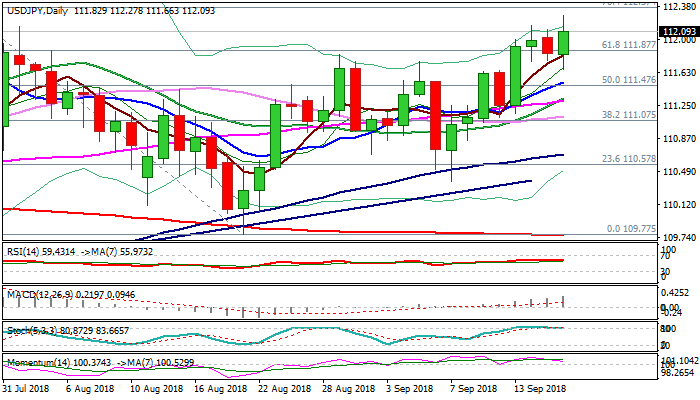
The maintains bullish bias on Tuesday but gains were so far limited as the price fell quickly from new high at 112.27, posted in early Europe.
Expectations that China will retaliate to the newest US package of tariffs increases concerns of escalation of trade war which could produce fresh risk aversion and boost safe-haven yen. Weakening momentum on daily and weekly charts supports scenario, which needs confirmation on return and close below 10SMA (111.51), to open way for further weakness. Daily cloud is narrowing and will twist early next week (111.21), which could also attract weakness.
Conversely, break and close above Fibo barrier at 112.37 (76.4% of 113.17/109.77) would neutralize bearish threats and signal further advance.
Res: 112.27, 112.37, 112.62, 112.92
Sup: 111.87, 111.66, 111.51, 111.30
Forex Analysis: GBPCHF
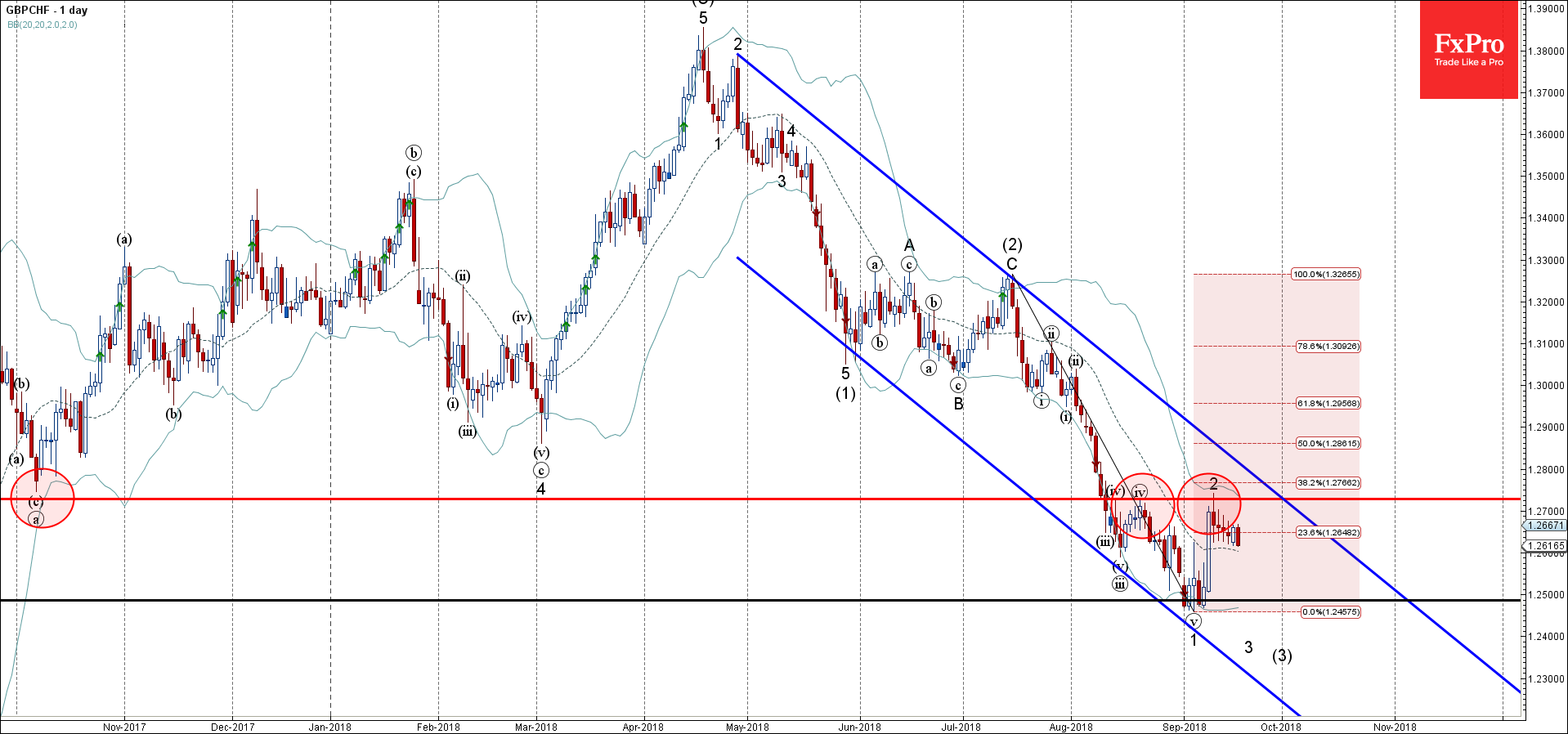
GBPCHF reversed from resistance zone
Further losses are likely
GBPCHF recently reversed down from the resistance zone located between the pivotal resistance level 1.2730 (which also reversed the price in August, as can be seen below), upper daily Bollinger Band and the 38.2% Fibonacci correction of the previous downward impulse 1 from July.
The downward reversal from this resistance zone started the active short-term impulse wave 3 – which belongs to the medium-term impulse wave (3) from July.
GBPCHF is expected to fall further and retest the next strong support level 1.2500 (low of the previous impulse wave 1).
USD/CAD – Canadian Dollar Steady Despite New US Tariffs On China
The Canadian dollar has posted small gains in the Tuesday session. Currently, USD/CAD is trading at 1.3003, down 0.12% on the day. On the release front, Canada releases Manufacturing Sales. There are no major releases in the U.S. On Wednesday, the U.S publishes building permits and housing starts.
A welcome respite in the U.S-China trade spat was shattered on Monday. President Trump imposed tariffs of 10% on some $200 billion worth of Chinese goods and threatened further action if China retaliated. Unlike earlier round of tariffs, the Canadian dollar has managed to hold its own, and investors have not flocked to the U.S dollar. The reason? Investors were braced for a move by Trump, and may be sighing in relief that the tariff was set at 10% rather than at 25%. One senior economist summed up Trump’s most recent salvo as “bad but manageable”. However, if the Chinese retaliate and the U.S takes further measures, this would likely shake up the currency markets and boost the U.S dollar.
Canadian and U.S negotiators continue to insist that the sides will hammer out a new NAFTA agreement, but investors have their doubts. There are have been no three-way talks since August, and last week, a senior Mexican negotiator said that Mexico would like to conclude a three-way agreement but was prepared to advance bilaterally with the United States. Ottawa cannot afford to be left out of NAFTA, and has made concessions to open up its dairy sector to US producers. However, President Trump could squeeze further concessions out of Canada before agreeing to a deal. If the deadlock continues, the uncertainty could weigh on the Canadian dollar.