

Sample Category Title
USD/CHF Daily Outlook
Daily Pivots: (S1) 0.9611; (P) 0.9634; (R1) 0.9669; More.....
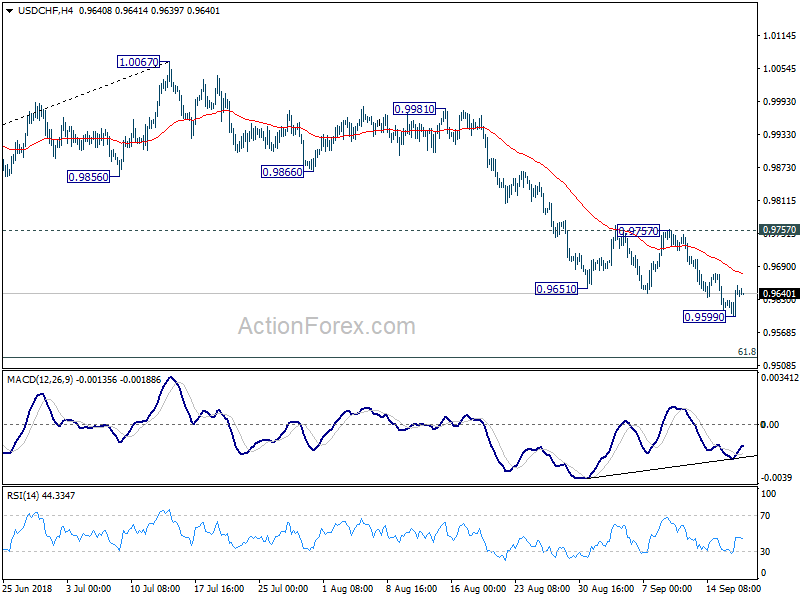
USD/CHF recovered after hitting 0.9599 and intraday bias is turned neutral again. As long as 0.9757 resistance holds, deeper decline is expected. Break of 0.9599 will target 0.9523 fibonacci level next. Considering bullish convergence condition in 4 hour MACD, downside will likely be contained by 0.9523 to bring rebound. On the upside, break of 0.9757 will suggests that fall from 1.0067 has formed a short term bottom. In such case, further rise would be seen back to 55 day EMA (now at 0.9809).
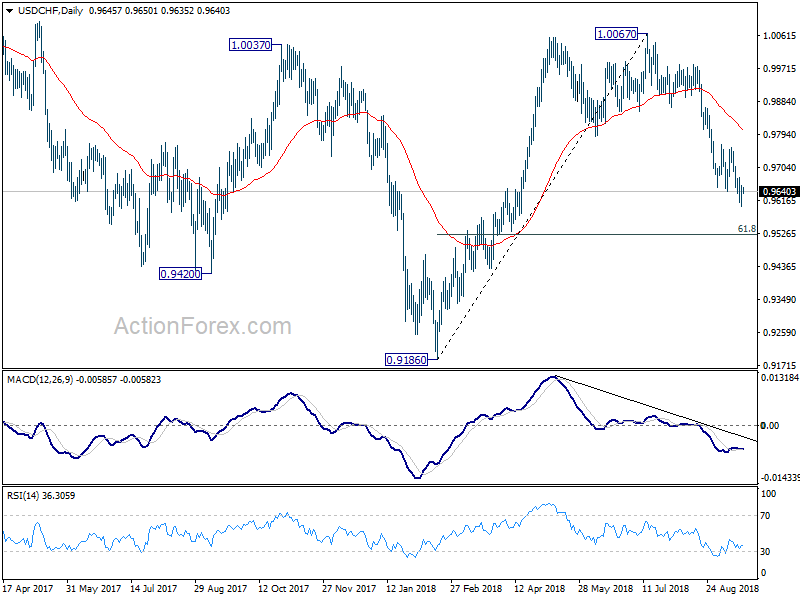
In the bigger picture, rise from 0.9186 low has completed at 1.0067, after failing to sustain above 1.0037 resistance. Fall from 1.0067 could extend to 61.8% retracement of 0.9816 to 1.0067 at 0.9523 and below. But for now, we don't expect a break of 0.9186 low. On the upside, firm break of 0.9866 support turned resistance will suggests that fall from 1.0067 has completed and rise from 0.9186 is resuming.
USD/JPY Daily Outlook
Daily Pivots: (S1) 111.88; (P) 112.15; (R1) 112.63; More...
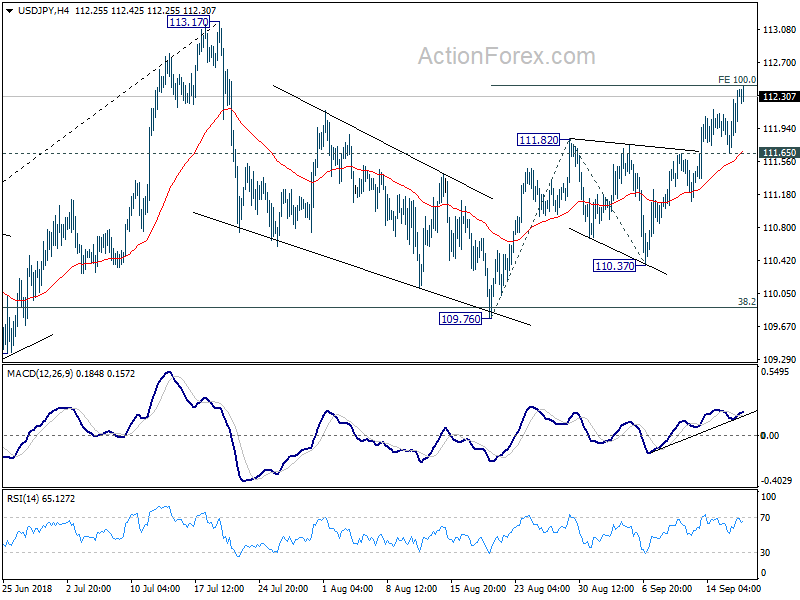
USD/JPY rises to as high as 112.42 so far, just below 100% projection of 109.76 to 111.82 from 110.37 at 112.43. Intraday bias remains on the upside. Sustained break of 112.43 will pave the way to retest 113.17 high. On the downside, break of 111.65 support is needed to indicate short term topping. Otherwise, further rise is expected even in case of retreat.
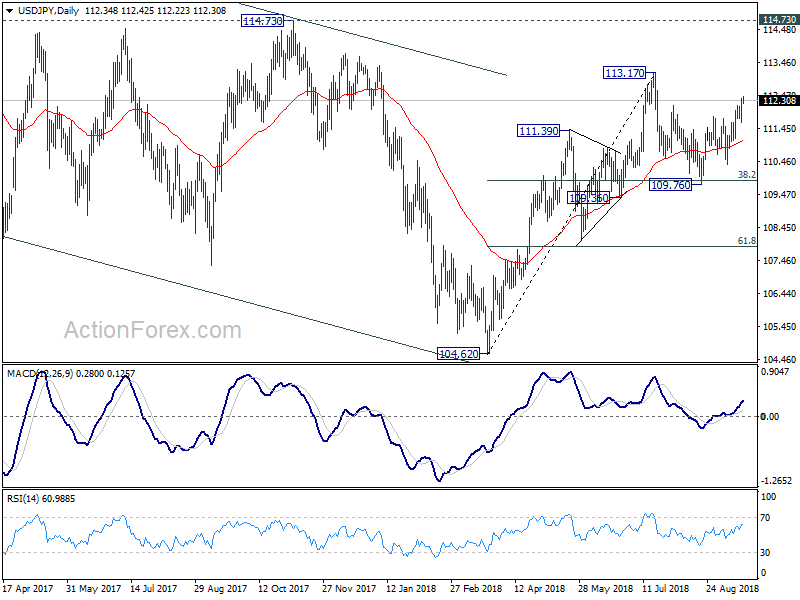
In the bigger picture, corrective fall from 118.65 (2016 high) should have completed with three waves down to 104.62. Decisive break of 114.73 resistance will likely resume whole rally from 98.97 (2016 low) to 100% projection of 98.97 to 118.65 from 104.62 at 124.30, which is reasonably close to 125.85 (2015 high). This will stay as the preferred case as long as 109.36 support holds. However, decisive break of 109.36 will mix up the outlook again. And deeper fall should be seen back to 61.8% retracement of 104.62 to 113.17 at 107.88 and below.
Yen Dives on Strong Rally in US Treasury Yields, Trade War Ignored
Trade war escalations continue to be ignored by the markets in general. Dollar and Yen are staying as the weakest ones today. In particular, Yen is pressured additionally by sharp rally in US treasury yields over night. BoJ's announcement to stand pat on monetary policy triggered little reactions to the Japanese currency too. On the other hand, Australian Dollar is leading New Zealand and Canadian Dollar higher. Euro firmed up slightly against Dollar and Yen but lacks conviction.
Overnight, DOW closed up 0.71% at 26246.96. S&P 500 gained 0.54% to 2904.31. NASDAQ rose 0.76% to 7956.11. Risk appetite continues in Asian session with Nikkei trading up 1.28% at the time of writing. Hong Kong HSI is up 0.97%. Singapore Strait Times is also up 0.60%. Even China Shanghai SSE is up 0.97% at 2726, back above 2700 handle. Gold is up slightly at 1201 but lacks momentum to take on 1214.30 resistance.
Technically, EUR/USD still fails to break through 1.1733 resistance so far. Recovery is seen in USD/CHF while GBP/USD lost momentum after hitting 1.3165 projection level. There is prospect a pull back in European majors today. On the other hand, AUD/USD broke 0.7228 minor resistance while USD/CAD broke 1.2975 minor support. This suggests that commodity currencies are picking up more strength.
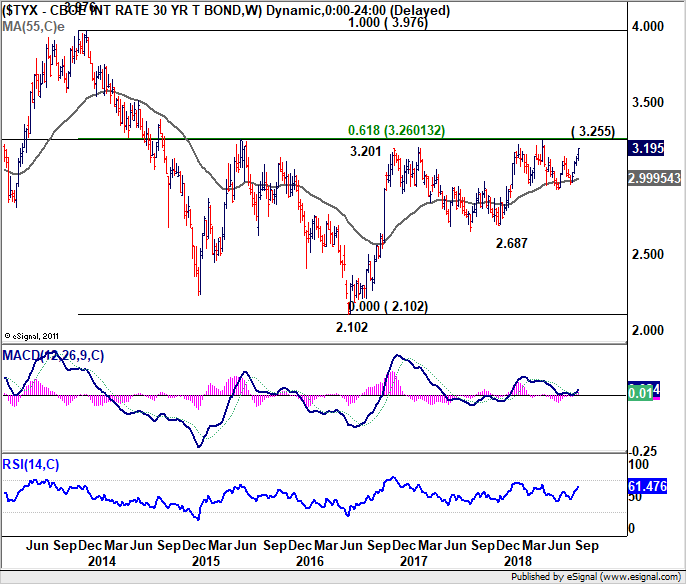
30-year yield to take on 3.255/260 key resistance
US treasury yield staged strong rally overnight, in particular at the long end. 5-year yield closed up 0.034 at 2.936. 10-year yield rose 0.047 at 3.048. 30-year yield rose 0.057 to 3.195. The development is certainly welcomed by Fed policy makers who are worried about flattening yield curve. The development also put extra selling pressure on the Japanese Yen.
30-year yield (TYX) could take on key resistance level at around 3.255 soon. That's in proximity to 61.8% retracement of 3.976 to 2.102 at 3.260. The rebound from 55 week EMA carries bullish implications. But decisive break 3.255/260 is needed to confirm underlying momentum. In that case, we could seen TYX head towards 3.976 or even 4.000 handle in medium term.
BoJ kept short term rate at -0.10%, asset purchase as JPY 80T pa
BoJ left monetary policies unchanged as widely expected. Short term policy interest was held at -0.10%. BoJ will also continue with JGB purchase to keep 10 year yield at around 0%, but allow it to "move upward and downward to some extent". Annual pace of monetary base expansion is kept at JPY 80T. The decision was made by 7-2 vote. Harada opposed again on allowing yield to move in a range as that's "too ambiguous" as guideline. Kataoka continued his push to "strengthen monetary easing".
The central bank expected the economy to "continue its moderate expansion". Domestic demand is likely to "follow an uptrend". Exports are expected to continue the "moderate increasing trend". CPI is "likely to increase gradually toward 2 percent, mainly on the back of the output gap remaining positive and medium- to long-term inflation expectations rising"
Risks to outlook include US macroeconomic policies, consequences of protectionist moves, developments in emerging and commodity-exporting economies, Brexit and geopolitical risks.
China announced retaliation, 5-10% tariffs on $60B US imports effective Sep 24
China formally announced its retaliation tariffs yesterday, in quick response to the tariffs on USD 200B in Chinese imports announced by USTR earlier in the week. In short, the tariffs will be effective at 12:01 local time on September 24. Total amount of American good involved values at USD 60B, Tariff rates are at 5% and 10%, much lower than prior proposed 5-25%.
China's announce was made through the Ministry of Finance. 2493 lines of products in Annex 1 and 1078 lines of products in Annex 2 will be subject to 10% tariffs. 974 lines in Annex 3 and 662 lines in Annex 4 will be charged 5% tariffs.
China state media said trade war is an opportunity
A front page article in China's official People's Daily newspaper said that the country is not afraid of "extreme measures" of the US regarding trade war. The article urged that "to deal with the trade war, what China really should do is to focus on doing its own thing well." It also said China should use the situation "as an opportunity to replace imports, promote localization or develop export-oriented advanced manufacturing."
Another official news paper China Daily also said "the trade conflict will not force China to succumb to US pressure. Instead, given its economic resilience, it will squarely face those challenges, find the right solutions, and emerge stronger."
UK PM May urged EU to evolve its position on Brexit agreement
UK Prime Minister Theresa May wrote in Die Welt newspaper that the agreement on an orderly Brexit is close be concluded. She said, "we are near to achieving the orderly withdrawal that is the essential basis for building a close future partnership."
However, May also urged that "To come to a successful conclusion, just as the UK has evolved its position, the EU will need to do the same. Neither side can demand the unacceptable of the other, such as an external customs border between different parts of the United Kingdom."
EU chief Brexit negotiator Michel Barnier also said yesterday that they "ready to improve" the Irish border backstop proposal. He added that "we are clarifying which goods arriving in Northern Ireland from the rest of the U.K. would need to be checked, where, when and by whom these checks would be performed."
BoE Vlieghe: Wage growth still happening quite slowly
BoE Gertjan Vlieghe said in an interview with the Newcastle Journal that wage growth is "still happening quite slowly". And he pointed to 2% wage growth for "a couple of years" and its now "at about 2.5% or 3%" only.
He noted "the general idea is an old one that is still valued". That is, "at some point the unemployment rate is low enough that it gets increasingly difficult for employers to find workers or keep the ones they have." He pointed to unemployment rate at 43-year low, "reports of skills shortages" and "job turnover" at a cyclical high. And that " creates pay pressures as their companies try to attract employees and stop their own from leaving".
But such development "has happened later in the process" and "it is only in 2017 we have been starting to see that." He added one of the reasons was that employers did not reduce compensations during the financial crisis. Additionally, many people are classed as under-employment, showing that they're only working part-time. Employment had turn to other method to compete for talent rather than just high pay.
EU releases proposals on WTO reforms, defend multilateral trade system
European Commission released their comprehensive approach for the modernisation of the World Trade Organisation yesterday .
In presenting the ideas, Commissioner for Trade Cecilia Malmström said: "The multilateral trading system has for the past decades provided a stable, predictable and effective framework for companies across the world, helping many economies to grow rapidly. Also today, the WTO is indispensable in ensuring open, fair and rules-based trade. But despite its success, the World Trade Organisation has not been able to adapt sufficiently to the rapidly changing global economy. The world has changed, the WTO has not. It's high time to act to make the system able to address challenges of the today's global economy and work for everyone again. And the EU must take a lead role in that."
The ideas in the proposal are related to three key ares:
- updating the rule book on international trade to capture today's global economy
- strengthening the monitoring role of the WTO
- overcoming the imminent deadlock on the WTO dispute settlement system.
EU also noted that the US and Japan are engaged in the framework of trilateral discussions. A dedicated workgroup was set up during the latest EU-China summit. And EU pledged to discuss the ideas with other WTO partners in the coming weeks.
Here is the press release. And a 17-page document detailing the proposals.
On the data front
New Zealand current account turned into NZD -1.62B deficit in Q2. Australia Westpac leading index rose 0.1% mom in August. Japan trade deficit widened to JPY -0.19T in August.
Looking ahead, UK inflation data will be the main focus today. Headline CPI is expected to slow from 2.5% yoy to 2.4% yoy. Core CPI is also expected to slow from 1.9% yoy to 1.8% yoy. RPI, PPI and house price index will also be released. Eurozone will release current account.
Later in the day, US current account, housing starts and building permits will also be featured.
USD/JPY Daily Outlook
Daily Pivots: (S1) 111.88; (P) 112.15; (R1) 112.63; More...
USD/JPY rises to as high as 112.42 so far, just below 100% projection of 109.76 to 111.82 from 110.37 at 112.43. Intraday bias remains on the upside. Sustained break of 112.43 will pave the way to retest 113.17 high. On the downside, break of 111.65 support is needed to indicate short term topping. Otherwise, further rise is expected even in case of retreat.
In the bigger picture, corrective fall from 118.65 (2016 high) should have completed with three waves down to 104.62. Decisive break of 114.73 resistance will likely resume whole rally from 98.97 (2016 low) to 100% projection of 98.97 to 118.65 from 104.62 at 124.30, which is reasonably close to 125.85 (2015 high). This will stay as the preferred case as long as 109.36 support holds. However, decisive break of 109.36 will mix up the outlook again. And deeper fall should be seen back to 61.8% retracement of 104.62 to 113.17 at 107.88 and below.
Economic Indicators Update
| GMT | Ccy | Events | Actual | Forecast | Previous | Revised |
|---|---|---|---|---|---|---|
| JPY | BoJ Rate Decision | -0.10% | -0.10% | |||
| 22:45 | NZD | Current Account (NZD) Q2 | -1.62B | -1.32B | 0.18B | 0.09B |
| 23:50 | JPY | Trade Balance (JPY) Aug | -0.19T | -0.14T | -0.05T | -0.10T |
| 00:30 | AUD | Westpac Leading Index M/M Aug | 0.10% | 0.00% | ||
| 08:00 | EUR | Eurozone Current Account (EUR) Jul | 22.4B | 23.5B | ||
| 08:30 | GBP | CPI M/M Aug | 0.50% | 0.00% | ||
| 08:30 | GBP | CPI Y/Y Aug | 2.40% | 2.50% | ||
| 08:30 | GBP | Core CPI Y/Y Aug | 1.80% | 1.90% | ||
| 08:30 | GBP | RPI M/M Aug | 0.60% | 0.10% | ||
| 08:30 | GBP | RPI Y/Y Aug | 3.40% | 3.20% | ||
| 08:30 | GBP | PPI Input M/M Aug | 0.40% | 0.50% | ||
| 08:30 | GBP | PPI Input Y/Y Aug | 9.10% | 10.90% | ||
| 08:30 | GBP | PPI Output M/M Aug | 0.20% | 0.00% | ||
| 08:30 | GBP | PPI Output Y/Y Aug | 2.90% | 3.10% | ||
| 08:30 | GBP | PPI Output Core M/M Aug | 0.20% | 0.00% | ||
| 08:30 | GBP | PPI Output Core Y/Y Aug | 2.10% | 2.20% | ||
| 08:30 | GBP | House Price Index Y/Y Jul | 2.90% | 3.00% | ||
| 12:30 | USD | Current Account (USD) Q2 | -103B | -124B | ||
| 12:30 | USD | Housing Starts Aug | 1.24M | 1.17M | ||
| 12:30 | USD | Building Permits Aug | 1.31M | 1.31M | ||
| 14:30 | USD | Crude Oil Inventories | -2.7M | -5.3M |
BoJ kept short term rate at -0.10%, asset purchase as JPY 80T pa
BoJ left monetary policies unchanged as widely expected. Short term policy interest was held at -0.10%. BoJ will also continue with JGB purchase to keep 10 year yield at around 0%, but allow it to "move upward and downward to some extent". Annual pace of monetary base expansion is kept at JPY 80T. The decision was made by 7-2 vote. Harada opposed again on allowing yield to move in a range as that's "too ambiguous" as guideline. Kataoka continued his push to "strengthen monetary easing".
The central bank expected the economy to "continue its moderate expansion". Domestic demand is likely to "follow an uptrend". Exports are expected to continue the "moderate increasing trend". CPI is "likely to increase gradually toward 2 percent, mainly on the back of the output gap remaining positive and medium- to long-term inflation expectations rising"
Risks to outlook include US macroeconomic policies, consequences of protectionist moves, developments in emerging and commodity-exporting economies, Brexit and geopolitical risks.
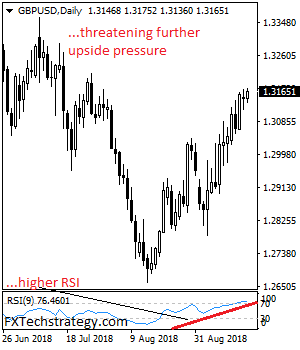
GBPUSD – Bullish, Sets Up To Push Higher Towards 1.3213 Region
GBPUSD - The pair continues to face further upside pressure as it looks to recover higher. Resistance stands at the 1.3200 with a turn above here allowing for more strength to build up towards the 1.3250 level. Further out, resistance resides at the 1.3300 level followed by the 1.3350 level. Support lies at the 1.3100 level where a break will turn attention to the 1.3050 level. Further down, support lies at the 1.3000 level. Below here will set the stage for more weakness towards the 1.2950 level. On the whole, GBPUSD remains biased to the upside.
China state media said trade war an opportunity to replace imports, promote localization or develop advanced manufacturing
A front page article in China's official People's Daily newspaper said that the country is not afraid of "extreme measures" of the US regarding trade war. The article urged that "to deal with the trade war, what China really should do is to focus on doing its own thing well." It also said China should use the situation "as an opportunity to replace imports, promote localization or develop export-oriented advanced manufacturing."
Another official news paper China Daily also said "the trade conflict will not force China to succumb to US pressure. Instead, given its economic resilience, it will squarely face those challenges, find the right solutions, and emerge stronger."
Market Morning Briefing: Aussie Has Broken Above 0.72
STOCKS
While Dow (26246.96, +0.71%) trades below 26250, there is scope of a fall towards 26000-25750 levels in the near term. A rise above 26250 and further above 26500 is necessary to trigger a sharp upmove in the longer run.
Dax (12157.67, +0.51%) moved up yesterday rising above 12150. If the rise sustains, near term could see a rally towards 12300 again ; else a fall back towards 11900-11800 looks possible.
Nikkei (23743.28, +1.37%) having broken the important resistance at 23000 is now technically bullish as the charts suggest the rally to continue towards 24000-24200 in the near term. Other than the technical charts, hope of PM Shinzo Abe winning the LDP election on Thursday is also pushing the stock markets up. This could pull up Dollar-Yen also in the near term despite the US-China trade war tensions.
Shanghai (2725.22, +0.94%) moved up as expected and is trading above 2700 now. While above 2700, the index could now start moving up towards 2800-2850 in the medium term. Near to medium term looks bullish.
Nifty (11278.90, -0.87%) closed below 11300 along with a sharp depreciation in Rupee to almost 73 at the session’s close. While below 11300, there is some scope of targeting 11200 on the downside. The 21-day MA on the daily line charts could provide some support this week.
COMMODITIES
80-81 is a crucial resistance zone for Brent (79.04) and it would be important to see if that holds. Although the crude prices saw a sharp rise yesterday, Brent is trading below 80 and is expected to remain so for the next few sessions. A break on the upside if seen could set up a rise towards 85; else there could be some room to fall back to levels below 78.
WTI (69.64) also rose yesterday but came off from just below resistance near 70.50. While the resistance holds, WTI could trade in the narrow 70.50-66.00 region in the near term. We expect a fall towards 66 while resistance near 70.50 holds.
Gold (1204.10) saw a slight rise. There is good support visible on the 3-day line chart which is likely to hold and push back Gold prices towards 1230 soon. The current sideways narrow ranged movement could be good levels to buy looking at the longer term possible rally.
Copper (2.74) broke clearly on the upside while support at 2.60 held well. Sharp rise in the Chinese stocks have been a major boost. Now while the China stocks look bullish, the long term support on Copper as seen on the weekly candles is also holding well and could push up Copper towards 2.80-2.85 in the near term.
FOREX
Aussie has broken above 0.72. Similarly, EURUSD and GBPUSD might also break above 1.17 and 1.316. Dollar Index might target 93.5 next week. Could this limit Rupee weakness too?
Dollar Index (94.65): The break of support trendline on weekly candles near 95 makes the Dollar Index look bearish in the near term. On a decisive break below the 21 weeks MA at 94.48, we could start looking at downside of 93.5-93.25 in the next 1-2 weeks.
Euro (1.1670): Trendline support now at 1.165. A decisive break above the crucial 1.17 resistance might happen in the next couple of sessions, which could then target 1.180-1.185 in the near term (next 1-2 weeks). Conversely, a break below 1.1650-1.1625 would negate the near term bullish view.
Dollar Yen (112.37) has gone above its previous high near 112.17 and could now target resistance on weekly candles near 112.5 in this week. A rise above 112.5 could be quite bullish in the medium term. Check out our Sep '18 monthly forecast report on Japanese Yen which discusses the next long term move in the narrowing contraction since 2016 : https://kshitij.com/usdjpy-forecast-payment-details-sep18
Euro Yen (131.14): Euro Yen saw a high near 131.5 yesterday and is now again trading slight above resistance near 131. It could rise towards 132 in the next couple of sessions - a breach above 132 could prove to be very bullish for Euro Yen in the near term.
Pound (1.3146) is continuing to respect the the 21 and 89 weeks MAs near 1.316 - while above 1.305, a breach above these MAs is possible in this week. A week close above this level could make Pound bullish towards 1.34 by Oct.
Aussie (0.7246) is breaching the 21 days MA near 0.7216 and it looks like previous week's 0.7085 might have been a bottom. While above 0.715, it could now rise towards 0.73 by next week.
Dollar Rupee (72.515) If the RBI doesn’t defend 73, rise to 73.2-73.4 could happen quickly. Downside today could be limited to levels near 72.50. Offshore NDF trading near 72.70 suggests that a gap up opening might be avoided.
INTEREST RATES
As we had expected yesterday, the US 10 Year yield (3.05%) has indeed started rising towards 3.10% and could now target it's previous May '18 high of 3.125% over the coming few sessions. Near term charts suggest that the 10 Year German-US spread (-2.57%) could fall further towards support near -2.6% while the German 10 Year climbs to 0.5%. This will imply the US 10 Year @ 3.1%. A break below -2.6% for the spread or above 0.5% for the German 10 Year would be bullish for the US 10 Year yield and might make it breach the previous high of 3.125%.
Looking at the German 10 Year yield (0.48%) long term chart, a rise towards 0.75% in 2018 is possible - near term rise could be towards 0.6% (if 0.5% is breached). Moreover, long term chart of the German-US 10 year spread suggests that it could break below -2.6% to target long term channel support near -2.7%. Considering these possibilities, a medium term rise to 3.30%-3.45% can also not be ruled out for the US 10 Year yield.
The rise beyond 3% might have happened due to the following reasons:
The tariff imposition of 10% by US on China is much lesser than the earlier 25% and has not dented market confidence, thereby possibly lowering risk aversion
some new supply of investment grade corporate bonds might have reduced demand for US govt bonds, thereby raising the yields
there are some fears that China might choose to retaliate by decreasing their holding of US treasuries (would be bullish for yields) - in July their holding of US treasuries fell to a 6 month low of $1.171 tn from the June level of $1.178 tn
Also, keep a watch on the Japan 10 year bond yield (0.12%) and Japan 30 Year bond yield (0.85%) - a breach above 0.13%-0.14% for the 10 year yield or a breach above 0.85% for the 30 Year yield would be very bullish and could be trigger for a rise in global yields.
Canada Freeland repeats no deal is better than a bad deal ahead of NAFTA talk restart
High level NAFTA talks between Foreign Minister Chrystia Freeland and US Trade Representative Robert Lighthizer will resume on Wednesday, working towards a US imposed deadline of October 1. head of the meeting, Freeland reiterated the government's position that "no deal is better than a bad deal." And she explained that "any negotiator who goes into a negotiation believing that he or she must get a deal at any price ... (will) be forced to pay the maximum price for that deal."
On the other hand, Trump continued to attack Canada. He told reporters "we love Canada, we love the people of Canada, but they are in a position that's not a good trade position for Canada." And, "they cannot continue to charge us 300 per cent tariff on dairy products, and that's what they're doing."
Trump close ally House Republican Steve Scalise also warned that "there is a growing frustration with many in Congress regarding Canada's negotiating tactics." And, "members are concerned that Canada does not seem to be ready or willing to make the concessions that are necessary for a fair and high-standard agreement." But it's unsure how much this such a view is shared among congressmen.
The Morning After
The morning after
US equity market has wholly shrugged off yesterday's back and forth on US-China trade, as the robust US economy continues to sway investors. However, when we look back at the 2018 stock market run, a lot of ink will be spilt about the benefits of US repatriation flows which are keeping balance sheet flush which could lead to higher levels of capital spending, and in a low rates environment, should continue to support a more robust corporate earnings narrative.
While there's a whole lot that can go upside down in US trade negotiations with China, Europe or Canada and despite the market taking the bluster in stride, history tells us that tariffs are detrimental for global trade and commerce. As such, the current levels of market buoyancy belie the possible groundswell that could overrun risk
The bottom line why the market didn't react negatively yesterday was the lack of shock and awe given the tariffs were so well telegraphed.
Oil Markets
Oil prices remain supported despite a larger than expected build in the API US crude inventories report, but stocks at the Cushing, Oklahoma delivery point declined 1.6 million barrels according to the API.
Traders are ignoring today's API data while focusing on news from the middle east
Prices firmed when Russia pointed the finger at Israel when one of their reconnaissance planes was shot down, although it was later determined to be a Syrian defence missle. None the less any type of escalation in the middle east provides a fillip for oil prices.
But it was comments from Saudi oil officials that continues to resonate. It was only two weeks ago traders were assuming that OPEC was prepared to keep Brent trading between $70 and $80 per barrel. However, overnight chatter suggests that the Saudis are more than happy with a Brent price above $80 or that OPEC, more generally, is not considering raising output.
The September 23 OPEC+ meeting in Algiers turning into a significant affair with 20+ nation set to attend. It appears Saudis are putting their cards on the table ahead of the meeting and it is currently being viewed through a bullish lens.
Gold Markets
Continues to be driven by the USD, given the lack of clear direction overnight, the market continues to teeter-totter around the critical $1200 levels.
Currency Markets
JPY was the worst performing currency over the past 24 hours due to higher US yields and a more buoyant risk market, and of course, the Nikkei benefits through the weaker yen better for exports feedback loop.
Some focus on the BoJ meeting today. Expected to tow the line but forward guidance is the key after BoJ was discussing throughout the summer about tapering.
CAD was among the best-performing currencies globally on broader sentiment. Investors are waiting for NAFTA discussion to restart. While traders took the following in a very positive light House Majority Whip Steve Scalise stated. “While we would all like to see Canada remain part of this three-country coalition, there is not an unlimited amount of time for it to be part of this new agreement.”
AUD the return of global risk appetite has the Aussie bulls coming out of the woodwork. But with the A$ the main G-10 proxy to express China risk, I think the top side will be limited given the sheer volumes of headline risk.
MYR: Higher oil prices and a favourable risk environment should see the Ringgit trade more favourably, but the surge in US yields will temper trader's expectations
BoE Vlieghe: Wage growth still happening quite slowly
BoE Gertjan Vlieghe said in an interview with the Newcastle Journal that wage growth is "still happening quite slowly". And he pointed to 2% wage growth for "a couple of years" and its now "at about 2.5% or 3%" only.
He noted "the general idea is an old one that is still valued". That is, "at some point the unemployment rate is low enough that it gets increasingly difficult for employers to find workers or keep the ones they have." He pointed to unemployment rate at 43-year low, "reports of skills shortages" and "job turnover" at a cyclical high. And that "creates pay pressures as their companies try to attract employees and stop their own from leaving".
But such development "has happened later in the process" and "it is only in 2017 we have been starting to see that." He added one of the reasons was that employers did not reduce compensations during the financial crisis. Additionally, many people are classed as under-employment, showing that they're only working part-time. Employment had turn to other method to compete for talent rather than just high pay.