Sample Category Title
Canadian Dollar at 1-Week High on NAFTA Hopes
The Canadian dollar is trading sideways in the Wednesday session. Currently, USD/CAD is trading at 1.3075, up 0.07% on the day. On the release front, Canada releases Capacity Utilization Rate. In the U.S, In the U.S, PPI and Core PPI are both expected to rise to 0.2%. On Thursday, Canada releases a housing inflation report and the U.S publishes CPI as well as unemployment claims.
Trade talks between the U.S and Canada are continuing, with the parties hoping to wrap up an agreement shortly. The Bank of Canada is also keeping a close eye on the NAFTA negotiations Last week’s rate announcement that policymakers would be “monitoring closely the course of the NAFTA negotiations and other trade policy developments, and their impact on the inflation outlook”. With the Canadian economy performing well and the Fed likely raising rates later this month, there is pressure on the BoC to again raise rates in 2018. However, concerns over NAFTA and global trade tensions have won the day for now, as the BoC took a pass on a rate hike.
Dollar Trades With Caution Ahead Of PPI, EM Currencies At Fresh Lows As Trade Fears Weigh
Here are the latest developments in global markets:
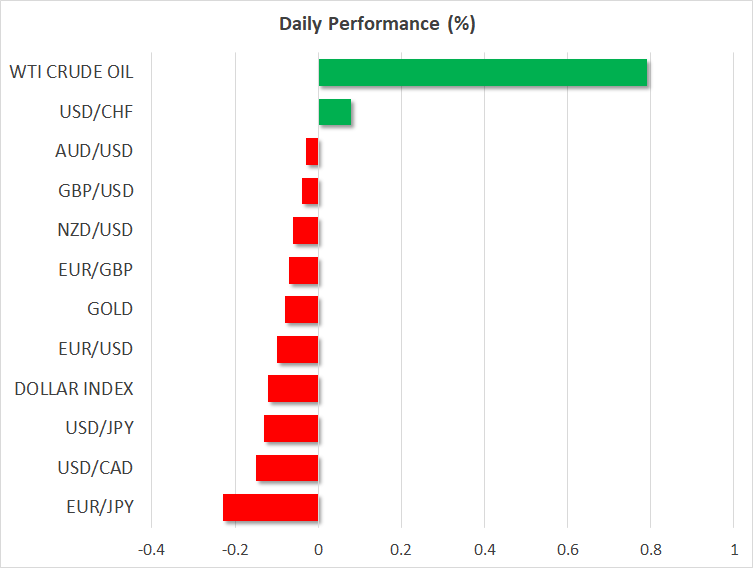
FOREX: During the early European session, the dollar was slightly weaker against the yen at 111.47 (-0.13%), while the dollar index also stood marginally lower at 95.16 (-0.09%) as investors were cautious about whether Washington will proceed with further import tariffs against China, potentially forcing Beijing to take countermeasures as well. In emerging markets, trade fears spurred a further sell-off, with the offshore Chinese yuan dropping to 2 ½ -week lows and the Indian rupee hitting fresh record troughs versus the greenback. The MSCI emerging currency index – which tracks the performance of 25 EM currencies relative to the dollar – fell to 16-month lows too. Dollar/loonie was close to 1-week lows after the Canadian Foreign Affairs Minister Chrystia Freeland said yesterday that talks with the US trade representative Robert Lighthizer, were productive and that both sides continued to have a goodwill for NAFTA progress. In the Eurozone, industrial production data for the month of July missed expectations, with the yearly gauge turning negative for the first time in two years. Specifically, industrial output declined by 0.1% compared to a plus 1.0% expected and a positive 2.5% growth seen in June. Yet, euro/dollar didn't react much on the data, remaining around 1.1596 (-0.09%). In other news, sources familiar with ECB thinking, which starts its two-day monetary policy meeting today, said that the central bank is set to lower its growth projections. Meanwhile, pound/dollar was consolidating yesterday's slight gains around 1.3028 (-0.04%) as the latest wave of Brexit headlines brought some confusion to investors. On the one hand, optimism for a Brexit deal before November – as was hinted by the European Brexit negotiator – became a tailwind to the pound with the President of the European Commision Jean-Claude Junker saying today that the UK Prime Minister's proposals for a close partnership are welcome. Still, a BBC report stating that a group of Brexiteer lawmakers in the British Parliament gathered to discuss how to challenge the PM's leadership, likely reminded markets that Theresa May has still to convince opposing members of her party about her Chequers Brexit plan. Pound/dollar changed hands lower at 1.3018 (-0.12%), while pound/yen eased to 145.14 (-0.23%). In antipodean currencies,aussie/dollar and kiwi/dollar were flat near 2 ½-year lows at 0.7122 and 0.6524 respectively, feeling the pressure from ongoing trade tensions.
STOCKS: Following a negative session in Asia, stocks opened higher in Europe on Wednesday led by gains mainly in the energy sector. The pan-European STOXX 600 and the blue-chip Euro STOXX 50 rose by 0.46% and 0.41% respectively at 0830 GMT. The German DAX climbed 0.48% despite considerable losses in utilities (-2.75%), while financials held in positive territory, supported by news that the two German largest banks, Commerzbank and Deutsche Bank are considering a merger. Yet stocks of the aforementioned banks were under pressure at the time of writing. The French CAC 40 was up by 0.85%, the Italian FTSE MIB climbed by 0.40%, while the British FTSE 100 inched up by 0.14%. Futures tracking US indices suggest the S&P 500, Dow Jones, and Nasdaq 100 are poised for a modestly positive open today.
COMMODITIES: A larger drawdown in US oil stockpiles in the week ending September 7 according to the American Petroleum Institute and concerns that renewed US sanctions on Iran in November may pressure the availability of oil aided crude prices to extend gains today. Comments by the Russian Energy Minister on Wednesday expressing that the global oil market remains “fragile” on the back of geopolitics and production shortages in several regions such as Venezuela and Mexico, also gave a helping hand to crude prices. WTI crude and Brent were last seen at $69.75 (+0.75%) and at $79.26 (+0.25%) correspondingly. Gas prices were also rising as hurricane Florence – a category 4 storm – is expected to hit South Carolina, North Carolina, and Virginia later this week. In precious metals, gold weakened to $1,194.6/ounce (-0.26%).
Day Ahead: US delivers PPI; Australian employment report pending
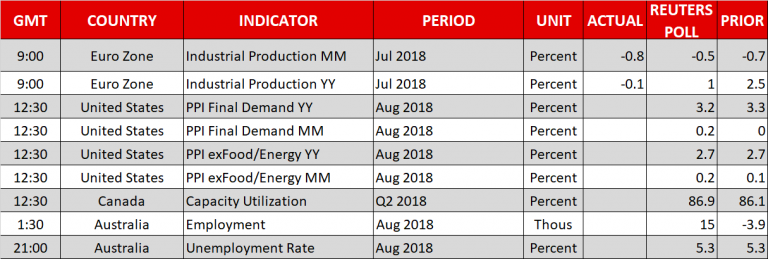
Next on the day's agenda, at 1230 GMT the US Bureau of Labor Statistics will release figures on producer prices, with analysts projecting the PPI to have edged down by 0.1 percentage points to 3.2% y/y in August. Month-on-month, though, the index is said to tick higher to 0.2% compared to 0.0% in July. The core measure of PPI that excludes volatile food and energy items is predicted to jump by 2.7% y/y, the same pace as before. Tomorrow, consumer prices are coming out of the US as well, so today's releases may give an early indication of the inflation trend.
In energy markets, investors will look to the EIA report on US crude oil inventories at 1430 GMT. According to forecasts, crude inventories have dropped by 0.805 million barrels in the week ending September 7 after falling by 4.302mn barrels in the preceding week. On the other hand, gasoline inventories and distillate stocks are anticipated to increase, though not by much.
Investors could remain cautious during the day as the US may announce tariffs on $200 billion Chinese goods at any moment. Also, during next week, China will request the World Trade Organization (WTO) permission to impose sanctions on the US, due to the nation's non-compliance with a ruling over US dumping duties.
Any news regarding NAFTA talks could add further volatility to the loonie, while the pound is expected to stay vulnerable to any potential Brexit headlines later this week.
In equities, European authorities are on track to impose fines to Google's parent Alphabet, Facebook and Twitter in the accusation of a breach of antitrust or consumer-protection lows. Apple is expected to unveil a new version of the iPhone X as well as other products today.
In terms of public appearances, External Member of the Prudential Regulation Committee of the Bank of England, Jill May, and London School of Economics Professor Julia Black will have a pre-appointment hearing at 1315 GMT. Later, at 1340 GMT and at 1645 GMT, Federal Reserve Bank of St. Louis President Bullard and Federal Reserve Board Governor Lael Brainard respectively will speak on the US economy and monetary policy. Also, the Fed's Beige Book of economic condition is due at 1800 GMT.
Overnight, the Australian unemployment rate is said to remain unchanged at 5.3%, the lowest jobless rate since November 2012, while the economy is expected to have added 18,400 jobs in August compared to a decrease of 3,900 in the preceding month.
US Inflation & Retail Sales Data On The Docket For Dollar
The latter part of this week will bring key US data releases, with CPI inflation figures hitting the markets on Thursday and retail sales prints due out on Friday, both at 1230 GMT. Forecasts point to a mild cooling in inflationary pressures and a slight slowdown in retail sales, which combined, may weigh on the dollar a little. Beyond economic data, the US currency will also be sensitive to any developments in the global trade arena.
The US economy has been firing on all cylinders in recent months, something that has turned investors increasingly more optimistic the Fed will raise rates another two times this year, thereby acting as a source of support for the dollar. According to market-implied pricing derived from the Fed funds futures, a quarter-point rate increase at the upcoming Fed meeting in September is now practically fully priced in (96.5% probability), while investors also assign 75% odds for a second one by year-end. The quality of incoming US data will hence play a large role in determining whether the latter percentage approaches 100% in the coming weeks, or whether it drifts back towards 50%; the dollar is likely to move accordingly.
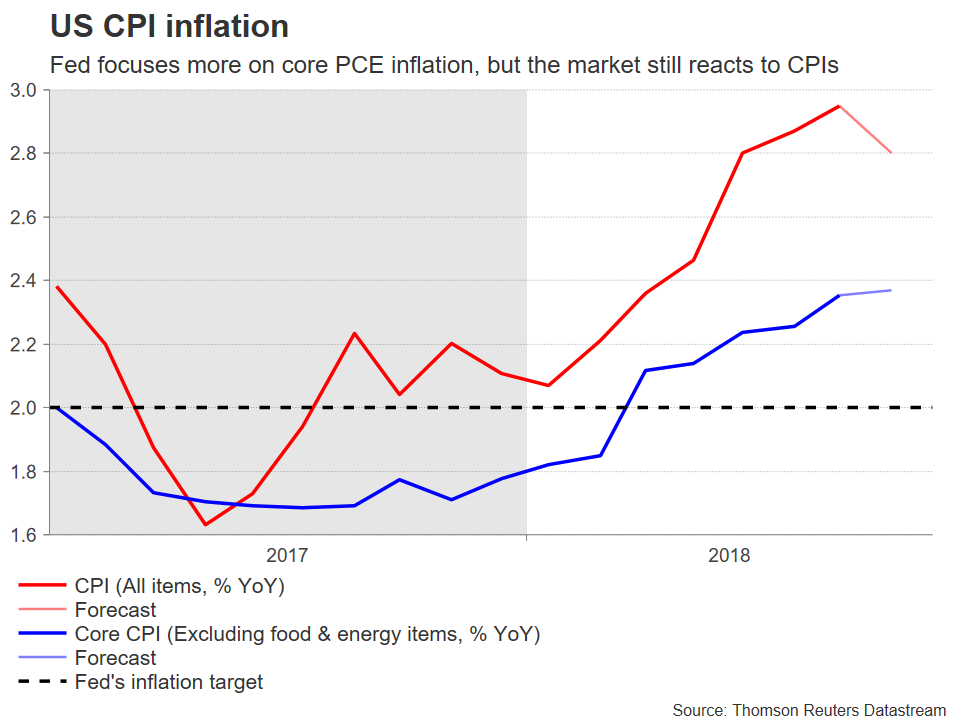
Turning to this week’s data releases, CPI figures for August – due out on Thursday – are projected to show a downtick in the headline inflation rate to 2.8% in yearly terms, from 2.9% in July. The core rate, which excludes the effects of volatile food and energy items, is anticipated to have held steady at 2.4%. Indeed, gauges of prices charged by firms such as the Markit manufacturing and services PMIs revealed that inflationary pressures eased in August, though both surveys stressed that the rate of inflation still remained well-above the trend average.
As for retail sales, they are forecast to have risen again in August, albeit at a slightly slower pace. Specifically, the headline rate is expected to rise by 0.4% in monthly terms, from 0.5% previously, while the core figure that excludes automobiles is projected to clock in at 0.5% after rising by 0.6% in July. While consumer sentiment measures like the Conference Board index were particularly optimistic, touching an 18-year high in August, one has to stress that official retail sales numbers tend to be highly volatile from month to month.
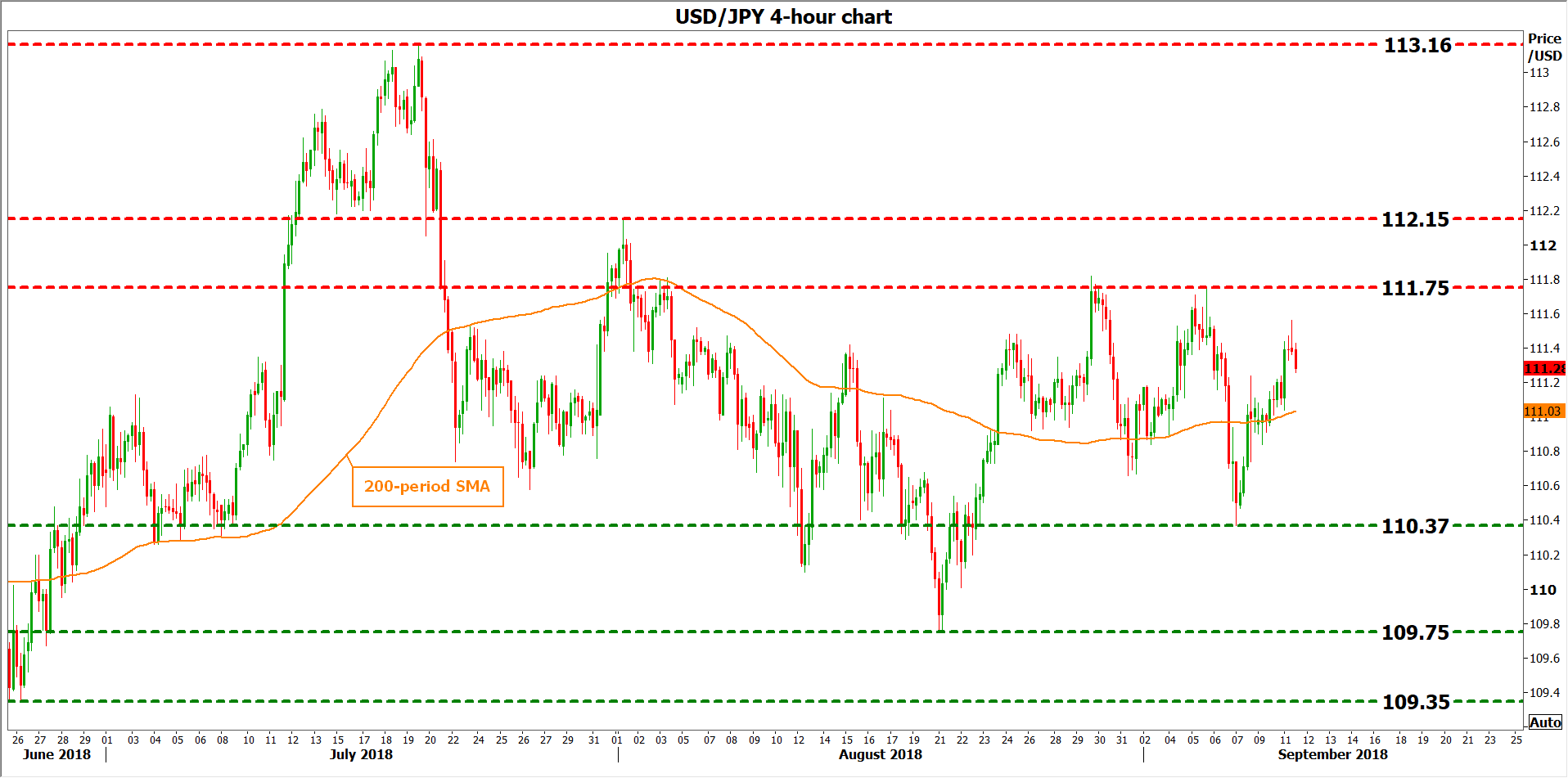
Technically, potential declines in dollar/yen could encounter support around 110.37, the hurdle that halted the pullback on September 7. A downside break may open the way for the August 21 lows of 109.75, with even steeper bearish extensions bringing into scope the 109.35 zone, this being the June 26 trough.
On the upside, a first wave of resistance to advances may be found near 111.75, a territory that capped the pair’s gains both on August 29 and September 5. The next barrier lies 40 pips higher, at 112.15, a level marked by the highs of August 1. Higher still, the 9-month high of 113.16 would increasingly attract attention.
Besides economic data, the other key variable for the dollar will be how trade tensions play out – particularly between the US and China. The greenback tends to gain when frictions escalate, attracting safe-haven flows on the view that the US economy is better prepared than most of its peers to weather any trade standoff. In similar logic, the greenback has underperformed whenever tensions appear to be fading, for instance after the recent US-Mexico deal. Investors are currently on edge, anticipating a fresh round of tariffs between the US and China to be announced at any moment. Meanwhile, the US President has also hinted that Japan may be the next target on his trade-radar, potentially opening another front in his global trade skirmish before long. Besides the dollar, any intensification in trade concerns could also benefit the Japanese yen – the classic haven currency – and probably to a greater extent than the greenback
Gold Falls As Dollar Climbs | Oil Prices Increase As Supply Declines
Gold falls as dollar climbs
Gold prices continue to take the fall as dollar climbs. U.S. and China trade wars are affecting the demand for gold as investors turn to the U.S. dollar in faith that the trade dispute will take least effect on the United States. The result of this harms the Yuan as it weakens the currency. However, this is not the only abuse encountered from the dollar increasing, this also in turn makes golds more expensive for the world’s biggest consumer of gold which is China. The precious metal becoming more expensive could damage demand levels as if the world biggest consumer for the yellow gold is feeling the heat on the price then various investors with foreign currencies other than the dollar are likely to feel this pressure too. This in turn could drive demand lower.
Rate hikes are due to commence this September which is additionally, pushing investors towards the greenback. This in turn continues to make the gold prices weaker. Moreover, investors are also aware that another rate hike is believed to be scheduled for December. The strength of this rate hikes being carried out depends upon the economic data.
Oil prices increase as supply declines
Oil prices remain to be on the rise while U.S. crude inventories drop. The report being released confirms the shortage in supply and the fact that the oil market continues to tighten. Additionally, a large decline in U.S. crude inventories had been shown in data which had given incentive for the prices to rise. The data release resulted to a 0.4 percent increase pushing the price up to $79.34.
Russia being the world’s main producer of oil has warned that the global crude market is fragile. This comes from one of the main countries in the oil producing industry. It emphasises the damage the markets may take if an increase in supply is not sourced.
On top of the oil supply declining, Washington continues to place pressure on surrounding governments across the globe to cut out imports from Iran. However, a solution to supply will have to be discovered in order to keep up with demand and keep prices stabilized. Many countries which are known to purchase approximately 2 million barrels per day of Iranian oil are having to relocate to different suppliers
However, with Iran being out of the picture Saudi Arabia and Russia may have to cover for these losses. Keeping in mind, Russia has warned the impact of sanctions on Iran. This brings about uncertainty in the markets for oil.
EUR/USD – Euro Slightly Lower As Eurozone Industrial Production Misses Mark
EUR/USD has edged lower in the Wednesday session. Currently, the pair is trading at 1.1576, down 0.24% on the day. On the release front, Eurozone industrial production declined 0.8%, missing the estimate of -0.5%. In the U.S, PPI and Core PPI are both expected to rise to 0.2%. On Thursday, Germany releases CPI and the ECB sets its monthly interest rate, which is expected to remain pegged at 0.00%. The U.S will publish CPI as well as unemployment claims.
The ECB is expected to hold rates at 0.00% on Thursday, so the markets will be focusing on the rate announcement and Mario Draghi’s press conference. The Bank is expected to lower its growth forecast due to weaker global growth and could spell out downside risks to growth. Inflation is expected to remain steady at 1.8% in 2018 in 2019, which means that the ECB is on track to wind up its asset-purchase program in December.
The U.S-China trade spat has been in the headlines for months, with the U.S slapping tariffs on China and the latter responding in kind. Will President Trump ratchet up the trade war between the world’s two largest economies? Trump has threatened to impose tariffs on $200 billion worth of Chinese tariffs, and the time period for public consultations ended last week, which means that Trump is free to announce another round of tariffs at any time. Despite fears that the trade war could trigger a recession trade between the U.S and China actually increased in August. The dollar has benefited from the global trade war, and further tariffs against China could boost the greenback against its major rivals, including the euro.
WTI Oil Oulook: Bulls Consolidate After 3.5% Rally, Further Upside Likely
WTI oil holds within narrow consolidation on Wednesday after strong 3.5% rally previous day, which marked the biggest one-day gains since 22 June.
Rising fears about the impact of Hurricane Florence which is moving towards the US east coast, boosted oil prices, along with persisting concerns about supply shortage on US sanctions on Iran.
Release of API crude stocks report on Tuesday which showed 8.63 million barrels draw in oil stockpiles, much stronger than expected, added to strong bullish sentiment.
Release of EIA crude oil inventories report later today is in focus, with forecast for 1.3 million barrels fall in oil inventories vs previous week’s draw of 4.3 million barrels.
Another surprise on stronger fall in crude stocks could further inflate oil prices.
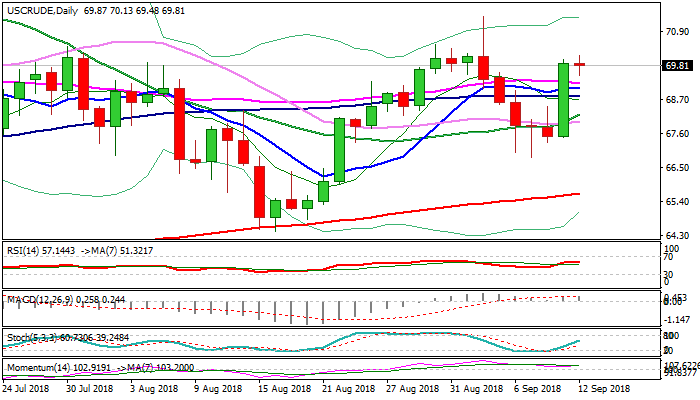
Tuesday’s strong rally retraced over 61.8% of $71.38/$66.85 bear-leg, probed above top of thin daily cloud ($69.85) and cracked psychological $70 barrier, showing scope for further advance.
Bullishly aligned daily techs are supportive, but flat momentum warns of extended consolidation.
Sustained break above $70 barrier would open way towards key barrier at $71.38 (04 Sep spike high), while cluster of converged daily MA’s (10/55/100) formed strong supports within $69.24/$68.84 zone, which is expected to protect the downside.
Res: 70.13, 70.48, 71.00, 71.38
Sup: 69.24, 68.84, 68.22, 68.00
Sterling Rises As EUs Juncker Welcomes Brexit Proposal
Notes/Observations
- Euro weakens on reports the ECB Technical committee slightly downgrades growth forecasts
- Oil prices rise on lower US crude inventories, slowing production and looming Iran sanctions
- UK Conservatives Party members openly discussing ousting May at an ERG meeting last night
Asia:
- Japan PM Abe in Russia for bilateral talks with Putin, Xi; Japan and Russia to sign peace treaty by end of this year -India PM Modi may hold economic review meeting over the weekend to discuss measures on the Rupee and OIL, does not rule out rate hike by the RBI
Europe:
- (EU) ECB Technical Committee: said to keep inflation outlook unchanged; Sees downside risks to growth (prior view broadly balance)
- Reportedly UK Conservative members openly discussing ousting May at an ERG meeting last night; MP Steve Baker later denies plotting to remove May -
- EUs Juncker in state union address says will work 'day and night' to reach Brexit deal; welcomes PM May's Brexit proposal
- Downing street said to drop Chequers plan if it is rejected by the EU
- BOE Carney has agreed to extend his term (by an additional 7-months) until end-Jan 2020
Americas:
- According to sources Canada ready to include access to Canadian diary market to the US as a concession in NAFTA negotiations
- Canadian Foreign Min says NAFTA talks are intense and constructive, deal is still possible
Energy:
- Russian Energy Min Novak: OPEC + will discuss whether more supply needed in Algiers
Economic Data:
- (EU) EURO ZONE JULY INDUSTRIAL PRODUCTION M/M: -0.8% V -0.5%E; Y/Y: -0.1% V 1.0%E
- (SG) Singapore July Retail Sales M/M: -2.9% v 1.3% prior; Y/Y: -2.6% v 0.7%e
- (ES) Spain Aug Final CPI M/M: 0.1% v 0.2%e; Y/Y: 2.2% v 2.2%e
- (IT) Italy July Industrial Production M/M: -1.8% v -0.3%e; Y/Y: 1.8% v 1.4% prior
- (IT) Italy Q2 Unemployment Rate: 10.7% v 10.8%e
- (CN) China Aug M2 Money Supply Y/Y: 8.2% V 8.6%E
- (CN) China Aug New Yuan Loans (CNY): 1.280T V 1.350TE
- (CN) China Aggregate (total social) Financing (CNY): 1.52T V 1.297TE
Fixed Income Issuance:
- (DK) Denmark sells total DKK3.9Bin 3-month and 6-month Bills
- (IT) Italy Debt Agency (Tesoro) sells €6.0B vs. €6.0B indicated in 12-month Bills; Avg Yield: 0.436% v 0.679% prior; Bid-to-cover: 1.91x v 1.79x prior
SPEAKERS/FIXED INCOME/FX/COMMODITIES/ERRATUM
Equities
- Indices [Stoxx50 +0.2% at 3,317, FTSE flat at 7,270, DAX +0.2% at 11,999, CAC-40 +0.6% at 5,313; IBEX-35 -0.1% at 9,280, FTSE MIB flat at 20,859, SMI +0.4% at 8,954, S&P 500 Futures +0.1%]
- Market Focal Points/Key Themes: European indices open mixed but moves higher as the session wore on; UK equities flat despite reports potential secret plans to dump Chequers Brexit agreement; Materials and Energy among top performer sectors; utilities underperforming; UK utilities dragged down following profit warning by SSE; Iberia A350 plane suffers technical engine problem, impacting Rolls Royce; upcoming events expected in the US session include traffic figures from major airlines
Equities
- Consumer discretionary: Casino Guichard-Perrachon CO.FR -1.4% (analyst action), Hermes RMS.FR +2.3% (results), Salvatore Ferragamo SFER.IT +4.6% (denies remors of potential M&A deal)
- Energy: Centrica CNA.UK -2.2% (SSE profit warning), Nordex NDX1.DE +5.3% (resumed contracts in South Africa)
- Technology: Nexans NEX.FR -7.8% (analyst action), Solutions 30 ALS30.FR +6.8% (analyst action)
- Telecom: Telecom Italia TIT.IT -1.6%(analyst action)
- Utilities: SSE SSE.UK -8.0% (results)
Speakers
- (EU) EU's Juncker: UK can't stay a member in parts of single markets only; welcomes PM May's proposal on EU partnership
- (IT) Italy Deputy PM Di Maio (Five Star party leader): Italy could face a crisis without citizens income. Reiterates no need for Italy to breach its 3% EU budget deficit limit
- (CN) China President Xi: China and Japan should uphold multilateralism; both countries should defend the free trade system - Comments from Russia
- (EU) EU's Juncker: Europe united has become an unavoidable force in world trade; United EU allows bloc to impose its will on others
- (CZ) Czech Central Bank Gov Rusnok: next Czech rate move is close; 2 more rate hikes is possible this year
- (IN) India official: PM Modi may hold economic review meeting this weekend; Not ruling out a rate hike by the RBI
- (RU) Russia Energy Min Novak: OPEC + will discuss whether more supply needed in Algiers
- (SE) Swedish Moderate Party leader Kristersson: calls for government to resign
Currencies
- Euro weakens following source reports of the ECB downgrading European growth forecasts before fading some of the move low. EURUSD currently trades below 1.16.
- The Indian Rupee strengthened over a report of PM Modi holding an economic review. With the USD/INR hitting a record low yesterday, the pair has rebounded approaching the 71 handle.
Fixed Income
- Bund Futures trades at 159.51 up 18 ticks with the focus on Thursday's ECB meeting, the 10-year bund yield trades steady above 0.40%. Resistance moves to 161.82 then 163. A downside break of 159.85 sees 158.69 initially.
- Gilt futures trades at 121.73 down 22 ticks following the move in Treasuries. Continued support at 122.50, with a continued move higher targeting 123.93 then 124.00.
- Wednesday 's liquidity report showed Monday's excess liquidity fell from €1.921T to €1.901T. Use of the marginal lending facility rose from €35M to €41M.
- Corporate issuance saw 3M and Enel lead issuance as momentum continues
Looking Ahead
- 06:00 (PT) Portugal Aug Final CPI M/M: No est v -0.3% prelim; Y/Y: No est v 1.2% prelim
- 06:00 (PT) Portugal Aug Final CPI EU Harmonized M/M: No est v -0.7% prelim; Y/Y: No est v 1.3% prelim
- 07:00 (US) MBA Mortgage Applications w/e Sept 7th: No est v -0.1% prior
- 07:00 (ZA) South Africa July Retail Sales M/M: +0.3%e v -1.2% prior; Y/Y: 1.6%e v 0.7% prior
- 08:00 (IN) India Aug CPI Y/Y: 3.8%e v 4.2% prior
- 08:00 (IN) India July Industrial Production Y/Y: 6.5%e v 7.0% prior
- 08:05 (UK) Baltic Dry Bulk Index
- 08:30 (US) Aug PPI Final Demand M/M: 0.2%e v 0.0% prior; Y/Y: 3.2%e v 3.3% prior
- 08:30 (US) Aug PPI (Ex Food and Energy) M/M: 0.2%e v 0.1% prior; Y/Y: 2.7%e v 2.7% prior
- 08:30 (US) Aug PPI (Ex Food, Energy, Trade) M/M0.2%e v 0.3% prior; Y/Y: No est v 2.8% prior
- 08:30 (CA) Canada Aug Teranet/National Bank HPI M/M: No est v 0.8% prior; Y/Y: No est v 1.8% prior, HPI Index: No est v 225.57 prior
- 08:30 (CA) Canada Q2 Capacity Utilization Rate: 86.8%e v 86.1% prior
- 10:30 (US) Weekly DOE Crude Oil Inventories
- 14:00 (US) Federal Reserve Beige Book
Sterling Pauses On Reports Of Leadership Challenge
- China using Russia to get at the US as trade tensions rise;
- Threat of leadership challenge weighing on sterling;
- BoE tomorrow likely to be uneventful.
US futures are trading relatively unchanged ahead of the open on Wednesday, taking the lead from Europe where markets have been quite calm early in the day.
It's been an uneventful day in financial markets so far, with only low level data being released and no major political stories causing a stir. This is likely to just be a temporary lull as tempers continue to flare between the US and China, with the latter using its relationship with Russia to send a message that there's more than one way to win a trade war.
With China involving the WTO in the dispute and the US preparing more tariffs – and threatening an eventual tariff on all imports – it doesn't appear this threat is going away any time soon and is something we should just get used to. This could work to the advantage of the EU with Trump engaging in negotiations in an attempt to forge closer trade ties, remove barriers and eliminate the apparent need for new tariffs.
The constant flow of Brexit speculation and reports are continuing to find their way into the media, something that is unlikely to change as we get ever closer to the deadline with a deal. Over the last couple of weeks that's resulted in a lot of volatility for the pound with traders getting very excited at the release of anything that indicates a move away from the no deal scenario.
While I'm sure the pound would have plenty further to fall in the event of a no deal Brexit, a large amount of pessimism has been priced in now which may explain why we see such significant surges in response to relatively insignificant reports. Still, that is the current reality and it's likely to see the pound remain in its volatile state for some time.
Working against these more optimistic stories has been reports of a leadership challenge with some of the more vocal Brexiteers in Theresa May's own apparently plodding against her, dissatisfied with the direction negotiations are headed in. The threat of this has prevented the pound making further gains in recent days as its seen as increasing the chances of no deal Brexit or at least a harder one.
With the Bank of England decision to come tomorrow, the pound is not likely to be steady for long. The central bank isn't expected to announce any changes tomorrow and will probably prefer to drift into the background as much as possible for the remainder of the year until a deal is reached but that won't stop traders picking apart the minutes and looking for clues on the timing of the next rate hike.
GBPUSD Testing Necklibe Resistance
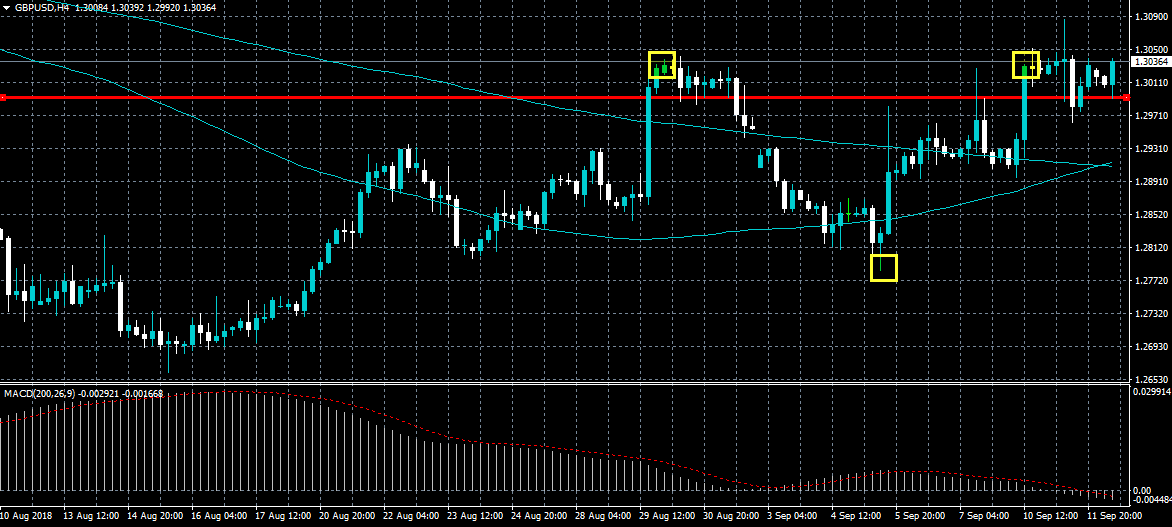
The British pound has moved towards neckline resistance against the US dollar, as sellers earlier failed to hold price below psychological 1.3000 level. The GBPUSD pair fell sharply from the 1.3086 level on Tuesday due to a strong recovery in the US dollar Index. Sellers now need to break the 1.2985 support level, while buyers need to quickly break the 1.3040 or face losing bullish momentum.
The GBPUSD pair is only bearish while trading below the 1.2985 level, key support is found at the 1.2955 and 1.2900 levels.
If the GBPUSD pair moves above the 1.3040 level, buyers may attempt to test the 1.3086 and 1.3101 levels.
EURUSD Lower On ECB Speculation
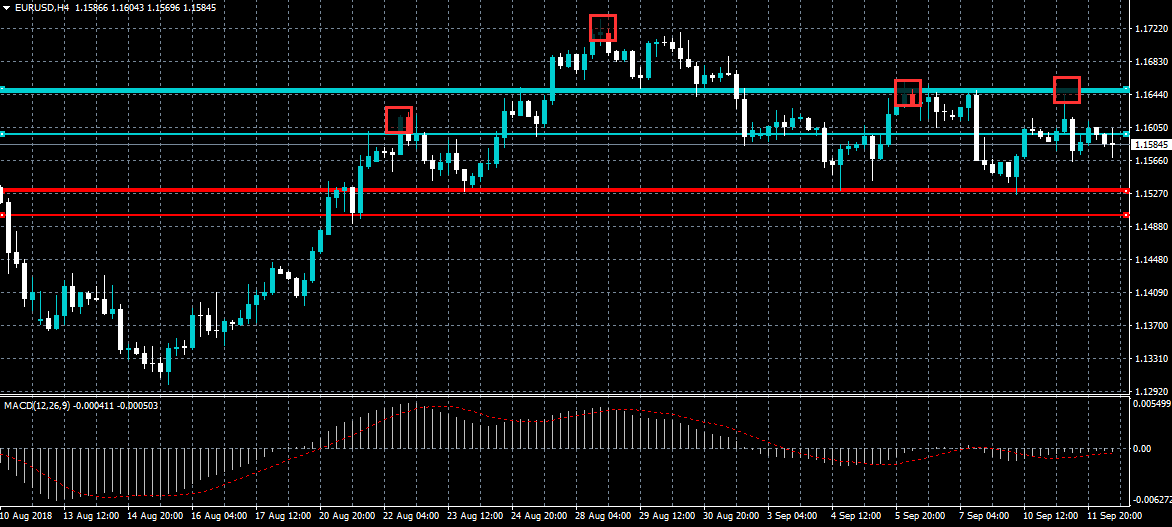
The euro has moved towards the worst levels of the day against the US dollar as reports surface that the ECB are going to lower European growth forecasts on Thursday. The EURUSD pair retains a neutral bias while trading around the 1.1600 level, with directional traders needing a clear break of the 1.1528 to 1.1650 range. The bearish head and shoulders pattern still remains valid across the lower time frames.
The EURUSD pair is intraday bearish while trading below the 1.1580 level, key support remains at the 1.1528 and 1.1500 levels.
If the EURUSD pair moves above the 1.1600 level, buyers may test towards the 1.1650 and 1.1681 levels.