Sample Category Title
ECB to Keep the Same Forward Guidance; Eyes on Fresh Economic Projections
On Thursday the European Central Bank (ECB) is expected to have another non-event policy meeting at 1145 GMT as policymakers have already laid down the path of monetary policy for the next year. The meeting, however, could bring a wave of volatility to the euro if the ECB elevates worries about the US trade strategy and calls for caution regarding political matters in Italy. Positioning on the common currency could also alter based on the central bank’s new economic projections.
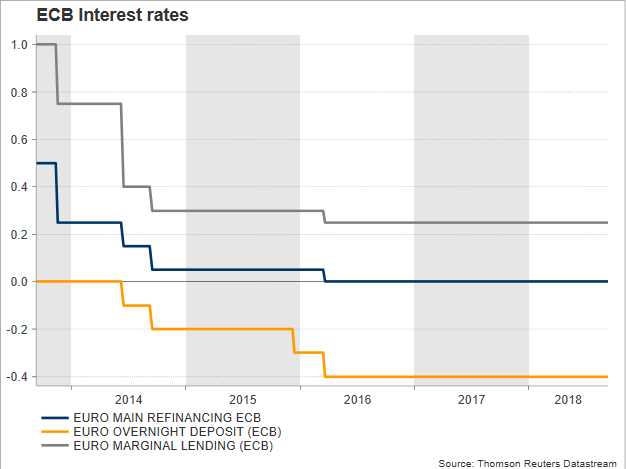
At July’s meeting, the ECB reiterated that key interest rates will remain unchanged at least through the summer of 2019 – as was agreed in June – while the central bank will continue to make net asset purchases at the monthly pace of 30 billion euros until the end of September 2018. It also guided that beyond September 2018 and if upcoming data are broadly in line with the central bank’s inflation forecasts, the amount of monthly net asset purchases will decline to 15 billion euros before the quantitative easing program comes to end in December. Indeed, initial estimates on consumer prices for the month of August showed that the headline inflation managed to stand at 2.0%, just above the central bank’s price target, a factor that could allow policymakers to proceed with their remaining QE plans. Recall that the ECB estimates inflation to come in at 1.7% across 2018 to 2020.
Yet the idea that the trade war between the US and China, the world’s two largest economies, may turn into something stronger in the future, could weigh on policymakers’ sentiment and thus on the Bank’s new economic projections delivered together with the rate announcement. According to the latest forecasts unveiled in June, the ECB believes that real GDP growth in the single market will stand at 2.1% at the end of 2018, while for the next two years expansion is anticipated to slow down to 1.9% and 1.7% respectively. While there is not yet clear evidence that US trade frictions have started to pressure the bloc’s business activities, given that the Eurozone Markit Manufacturing PMI weakened in August, but the composite PMI improved, policymakers could still think that a potential escalation in the already inflamed trade tensions may weigh on activity in the future. Therefore, taking into account that Washington may take stricter measures against Beijing, potentially unleashing additional tariffs on $200 billion Chinese products, policymakers may consider previous growth prospects overestimated. Especially if they judge that emerging markets, where debt is denominated in dollars and major European banks serve a considerable amount of loans, have more to lose in the wake of a stronger trade war. Note that the dollar managed to remain resilient to rising trade risks recently on the back of optimism on the US economy and high expectations of further monetary tightening by the Fed this year.
Besides trade, Italy could be another highlight of the central bank’s agenda. Italian politics have been on the wires quite often recently, turning the euro and Italian stocks upside down on fears that fiscal reforms proposed by the new coalition government are violating European spending rules. Earlier this week the Italian Minister of Economy and the Deputy Prime Minister calmed markets that Italy’s budget awaited in draft form at the end of September will respect European debt settings. Today, however, reports that the leader of the coalition Five-Star Movement would seek the resignation of the Minister of Economy if the basic income proposal worth 10 billion euros is not included in the budget, revived worries that divisions in the government remain. That also signaled that a budget leading to a public deficit above the EU’s 3.0% limit is possible.
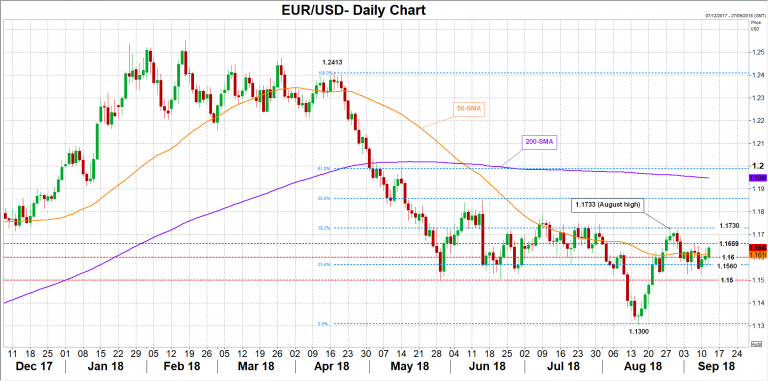
In the FX markets, euro/dollar is struggling to hold above 1.1600 as a combination of trade risks, noisy political conditions in Italy and weakness in emerging markets refrain investors from increasing exposure to the euro. A positive message by the ECB on Thursday however – probably indicating that the central bank holds optimistic on the bloc’s inflation and growth path – could raise interest for the common currency sending the pair towards September 9’s high of 1.1659. Above from there, bullish actions could target the August peak of 1.1733 where the 38.2% Fibonacci of the downleg from 1.2413 to 1.1300 is also placed.
Alternatively, if the ECB puts more weight on political and trade uncertainties than analysts currently price in, potentially downgrading its economic projections, the price could drop back below 1.1600 to test the 23.6% Fibonacci of 1.1560, before it visits the 1.1500 mark.
The ECB chief, Mario Draghi, will hold a press conference at 1230 GMT.
Bank of England to Hold Rates as Brexit Talks Intensify
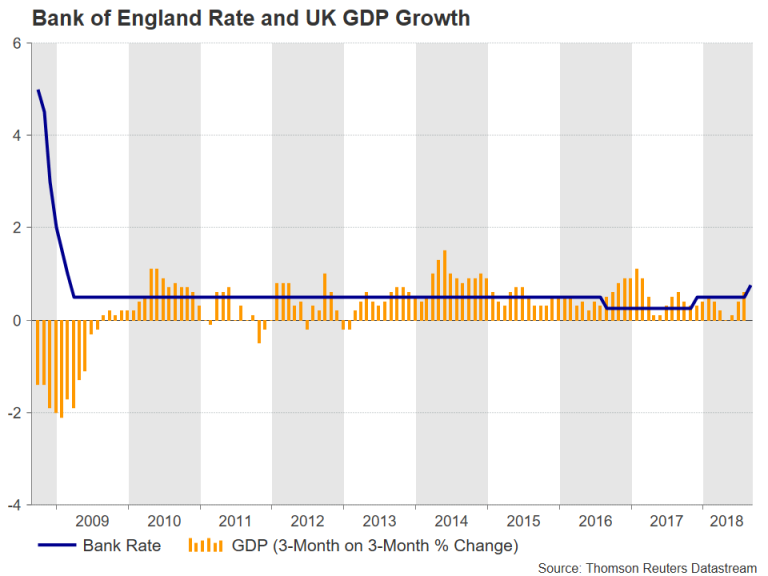
The Bank of England will announce its latest policy decision at 11:00 GMT on Thursday after concluding its two-day meeting. After last month’s rate rise of 25 basis points, no change in policy is anticipated at the September meeting. However, analysts will be looking to see if the Bank maintains its guidance of further “gradual and limited” rate increases as UK growth picks up a gear. But with Brexit negotiations approaching a critical stage, the next hike could be months away.
In August, the Bank lifted its benchmark interest rate to a post-crisis high of 0.75%, defying criticism by many analysts who argued that with Brexit uncertainty prevailing over the economy, it was not the right environment to be raising rates. However, the Bank has been stressing that even with moderate growth of around 0.4% on a quarterly basis, inflation would struggle to fall towards the BoE’s 2% target without rate increases.
GDP figures out this week support the Bank’s view that the British economy has sufficient momentum to withstand moderate tightening in monetary policy. UK GDP expanded by 0.3% month-on-month in July, topping expectations of 0.2% and taking the 3-month rate to 0.6% – the fastest since the thee months to August 2017. The latest job market report was also out this week. It showed annual UK wage growth quickened slightly to 2.6% in the three months to July, underscoring the Bank’s concerns about faster pay increases.
But the encouraging data failed to lift the pound as the British currency seems to react mostly to Brexit headlines these days. Likewise, the Bank of England’s decision on Thursday is unlikely to significantly move the pound, especially as there will be no press conference and quarterly forecasts this month.
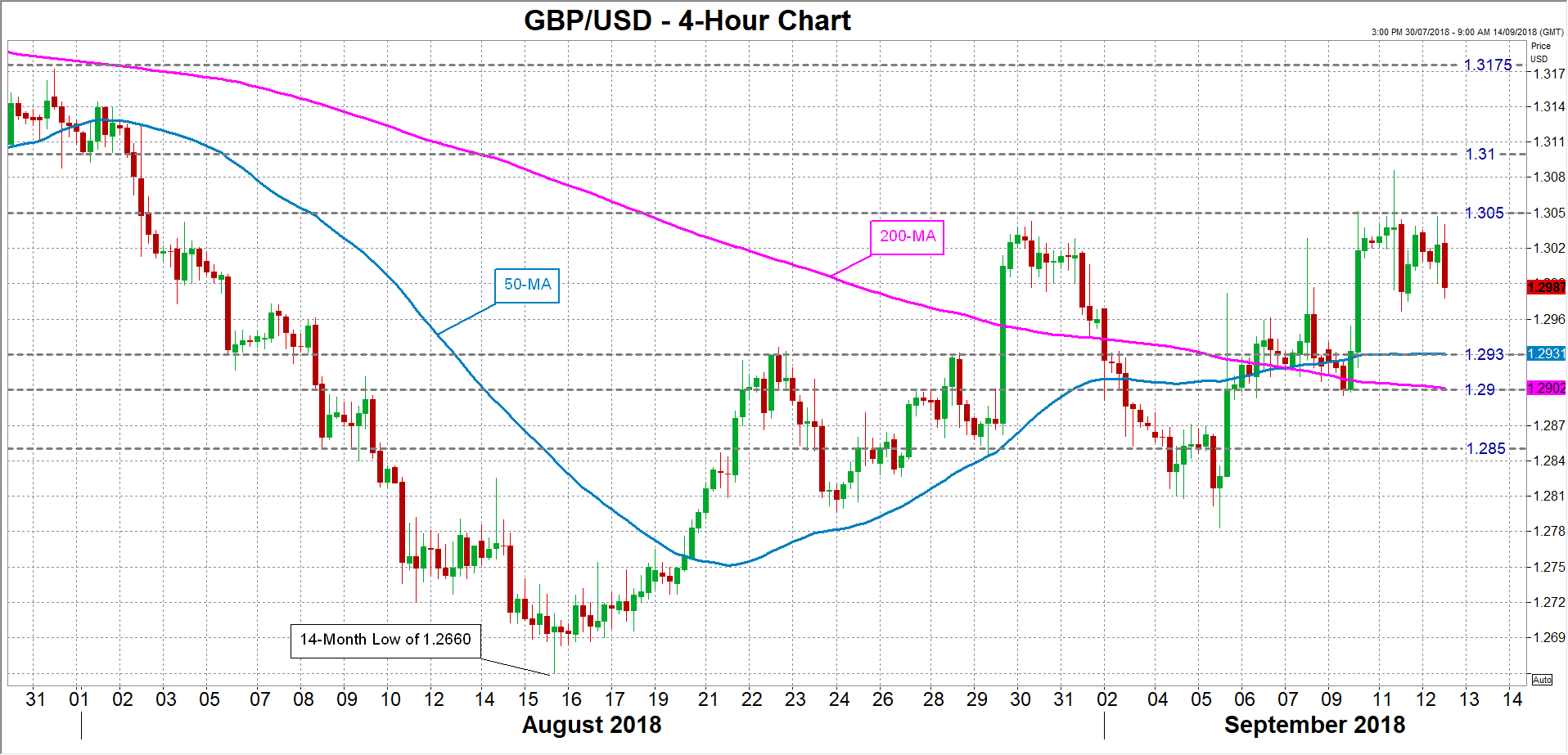
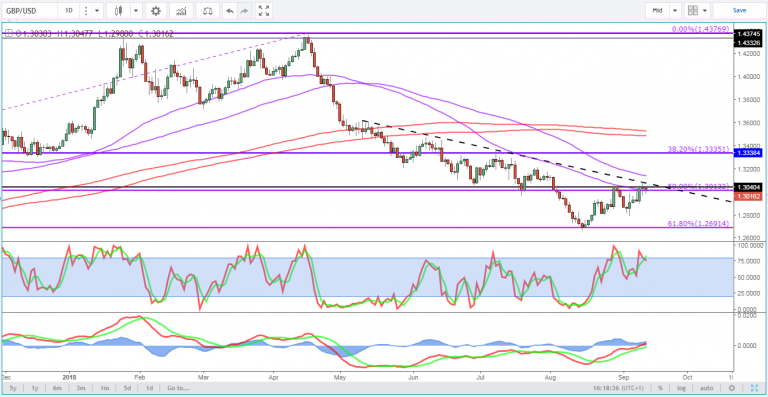
Sterling could break above immediate resistance at the $1.3050 level should the BoE adopt a slightly more optimistic language on the economic outlook following the past week’s solid set of data. Above that level, focus would shift to the $1.31 handle, which has been a heavily congested region in the past and is not too far Tuesday’s 5½-week peak of $1.3086. Stronger gains could see the $1.3175 area acting as a major barrier.
However, should the Bank offer no surprises and maintain its existing language, and perhaps add a bit more emphasis on the progress of Brexit talks, the pound could slip to around $1.2930 (a previous support and resistance level). A drop below this mark would risk breaching the key support at $1.29. Below that, the next support would likely come from the $1.2850 level.
With Brexit talks intensifying this month, as Britain and the European Union strive to avoid a no-deal scenario, the market’s attention is firmly on the negotiations and investors are likely to remain cautious until there is a clear outcome. The EU’s chief negotiator, Michel Barnier, said on Monday that it would be “realistic” to reach a deal with the UK in six to eight weeks, raising hopes that an agreement could be struck at the EU’s October 18 summit. The first big test, though, will be the informal summit of EU leaders in Salzburg, Austria, on September 20.
Successful negotiations could pave the way for the next BoE rate hike to arrive in May 2019, soon after the UK has left the EU. However, in the event of Britain exiting the EU without a deal, the next move could be a reduction.
GOLD: Bounces Off Lower Prices With Eyes 1,206/14.00 Zone
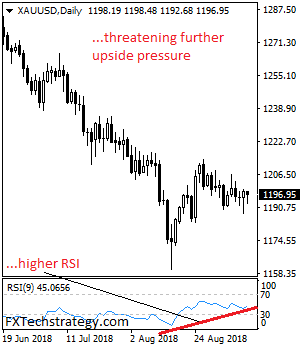
GOLD: The commodity looks to follow through higher on the back of its Tuesday price rejection. This has opened the door for more recovery higher. On the downside, support comes in at the 1,190.00 level where a break will turn attention to the 1,180.00 level. Further down, a cut through here will open the door for a move lower towards the 1,170.00 level. Below here if seen could trigger further downside pressure targeting the 1,160.00 level. Conversely, resistance resides at the 1,200.00 level where a break will aim at the 1,210.00 level. A turn above there will expose the 1,220.00 level. Further out, resistance stands at the 1,230.00 level. All in all, GOLD looks to strengthen further higher.
Will We Get Fireworks from BoE and ECB?
What to expect from a not-so-super Thursday
Thursday has the potential to be another interesting day in the markets, with interest rate decisions due from both the Bank of England and the European Central Bank.
It’s not often that we hear from two major central banks on the same day, let alone around the same time, but when we do there’s always the potential for some turbulence.
Both central banks are in the early days of their respective tightening cycles, with the BoE having recently raised interest rates above 0.5% for the first time since the financial crisis and the ECB drawing its quantitative easing program to a close at the end of this year.
While there’ll still be plenty of cash sloshing around the financial system until they start the process of reducing their balance sheets – as the Federal Reserve is currently experimenting with – the moves being undertaken represent a very cautious and gradual tightening that traders are monitoring very closely for any signs that they may lose their nerve.
This is particularly true in the current environment with the UK and EU locked in Brexit negotiations as the 31 March deadline draws ever near. Protectionism is another key risk factor with US President Donald Trump threatening tariffs on the block. Add to that the struggles being experienced in emerging markets at the moment – a major trade partner of Europe – and the jobs of the central banks become that much harder.
We already appear to be seeing a slowdown in numerous economies across Europe due to a combination of these factors, something the central banks don’t appear to concerned about just yet but may do should they persist.
What should I be looking at?
The obvious chart is EURGBP given that these are the two currencies most sensitive to what the BoE and ECB do. The closely linked nature of the two economies can mean we see less powerful swings in this pair though than we do certain others which can make it more or less appealing, depending on preferences.
EURGBP Daily Chart
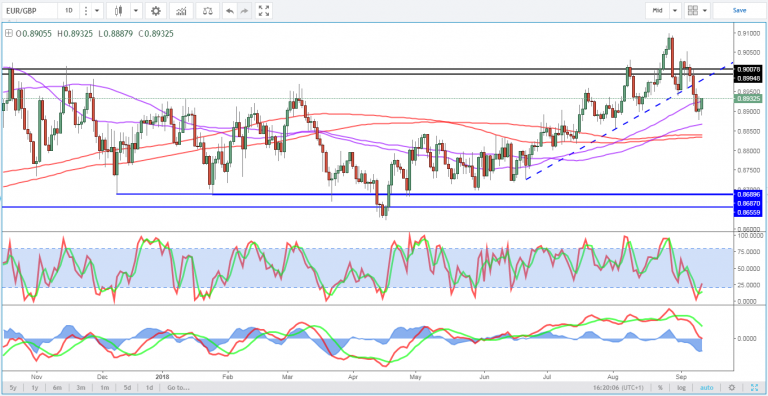
The euro has definitely had the better of things throughout the summer, with no deal Brexit being viewed as a far greater risk for the UK than the eurozone, which is understandable. What this means though is that if the two sides do start to find common ground, we may see this trend reverse course, as we have over the last couple of weeks when we’ve had some more positive news flow.
That trend may already have changed, with last week’s sell-off taking us below the rising trend line and potentially signalling a shift in sentiment in the market. Obviously that won’t change the outcome of the meetings, or press conference in the case of the ECB, but it does give a sense of bias heading into it.
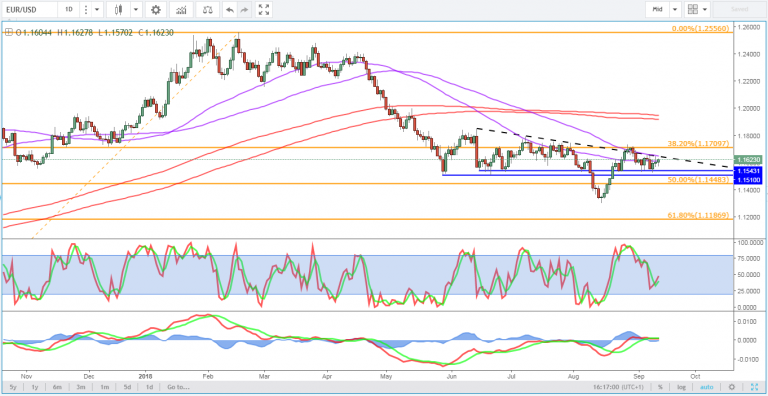
Both currencies have found some form against the US dollar over the last month following a rough summer but are yet to see the spark that gives some confidence that they’ve broken into a more sustainable uptrend. They’ll definitely be ones to watch heading into the meetings.
EURUSD Daily Chart
GBPUSD Daily Chart
What can we expect from the meetings?
My expectations are actually quite low for the meetings. The reason why is that it seems to suit both central banks to stay under the radar for now. Both have made important first steps towards normalization and are in no rush and with Brexit on the horizon, now is not a good time to be changing course, especially as they don’t have to.
Both have laid out quite clear plans for the next year and even if they don’t stick to them – which there’s a good chance they don’t given the amount of unknowns and risks – the important thing is that investors are largely on board and the economies are doing ok. I don’t think they’ll want to mess with that.
So I don’t expect any changes in interest rates or QE this month and we can probably expect ECB President Mario Draghi’s press conference to be a rather dull affair.
Famous last words eh….
EUR/AUD Mid-Day Outlook
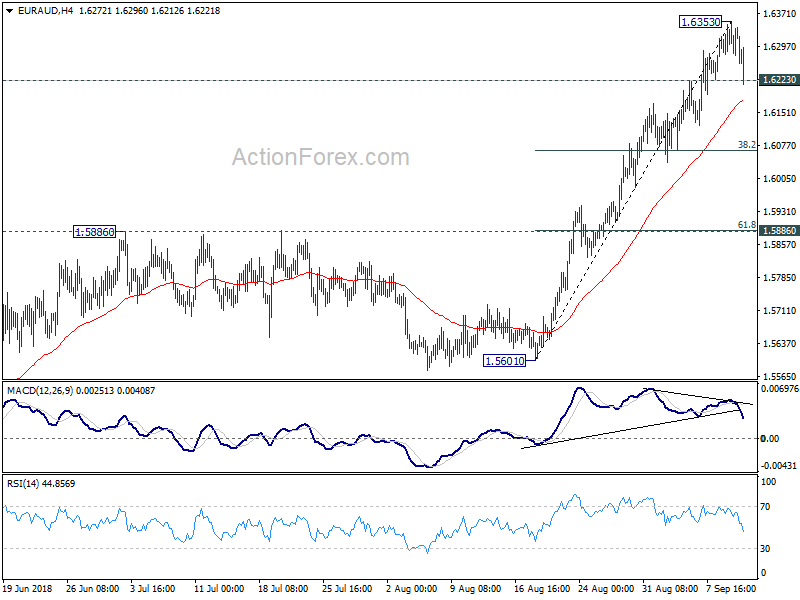
Daily Pivots: (S1) 1.6266; (P) 1.6311; (R1) 1.6341; More....
EUR/AUD's break of 1.6223 minor support suggests that a short term top is formed a 1.6353, on bearish divergence condition in 4 hour MACD. Intraday bias is mildly on the downside for deeper retreat to 38.2% retracement of 1.5601 to 1.6353 at 1.6066. But downside should be contained well above 1.5886 cluster support (61.8% retracement at 1.5888) to bring rise resumption. On the upside, break of 1.6353 will resume larger up trend to 1.6587 key resistance level.
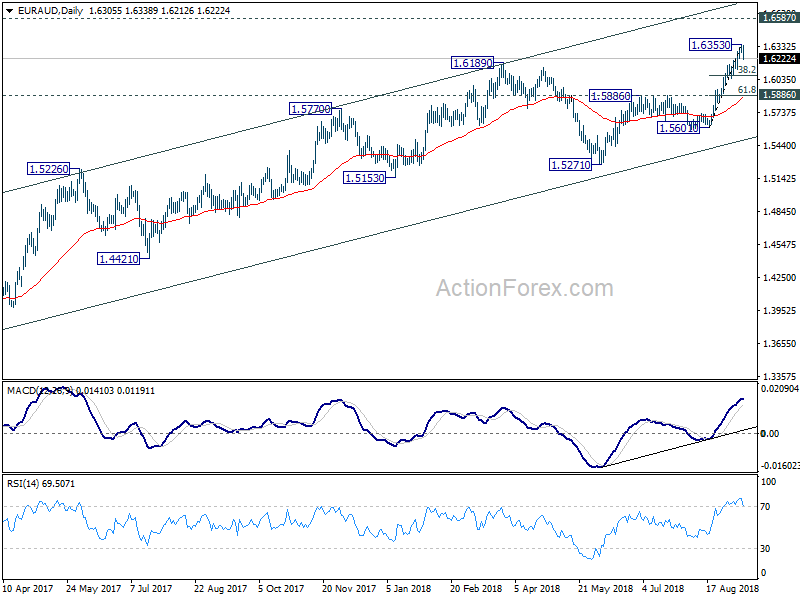
In the bigger picture, up trend from 1.3624 (2017 low) has just resumed. Further rise should be seen to retest 1.6587 (2015 high). Decisive break there will resume the long term rally and target 1.7488 fibonacci level. On the downside, break of 1.5601 support is need to be the first sign of medium term reversal. Otherwise, outlook will remain bullish in case of deep pull back.
AUD/USD Mid-Day Outlook
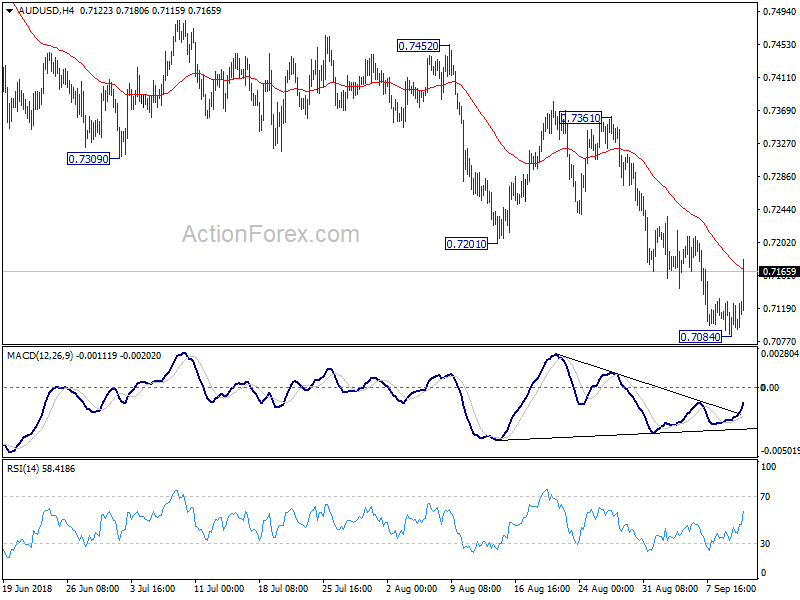
Daily Pivots: (S1) 0.7094; (P) 0.7112; (R1) 0.7138; More...
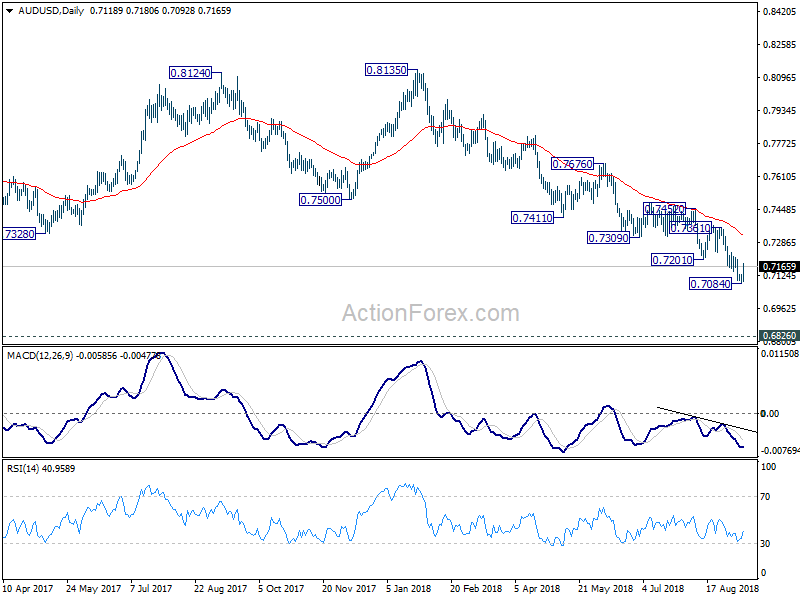
AUD/USD's strong rebound indicates short term bottoming at 0.7084, on bullish convergence condition in 4 hour MACD. Intraday bias is back on the upside for further rebound. But for now, we'd still expect upside to be limited well below 0.7361 resistance to bring down trend resumption. On the downside, break of 0.7084 will resume the fall from 0.8135 for key support level at 0.6826. However, sustained break of 0.7361 will carry larger bullish implication.
In the bigger picture, rebound from 0.6826 (2016 low) is seen as a corrective move that should be completed at 0.8135. Fall from there would extend to have a test on 0.6826. There is prospect of resuming long term down trend from 1.1079 (2011 high). Current downside momentum as seen in daily and weekly MACD support this bearish case. Firm break of 0.6826 will target 0.6008 key support next (2008 low). On the upside, break of 0.7361 resistance is needed to be the first sign of medium term bottoming. Otherwise, outlook will remain bearish even in case of strong rebound.
US to re-initiate trade talk with China before new tariffs, Aussie and DOW surge
The WSJ reported that the US is proposing new round of trade talk with China. That could happen in the near future before Trump imposes the new round of 25% tariffs on USD 200B in Chinese goods. It's reported that Treasury Secretary Steven Mnuchin sent an invitation to Chinese officials, proposing a meeting in the next few weeks to discuss trade issues, citing unnamed sources.
The proposal could be resulted from public hearing ended last week. Or, it could also be in response to outcries from American businesses.
As we noted here, over 60 US industry groups formed a coalition "Americans for Free Trade" to launch a campaign against Trump's tariffs and trade policies.
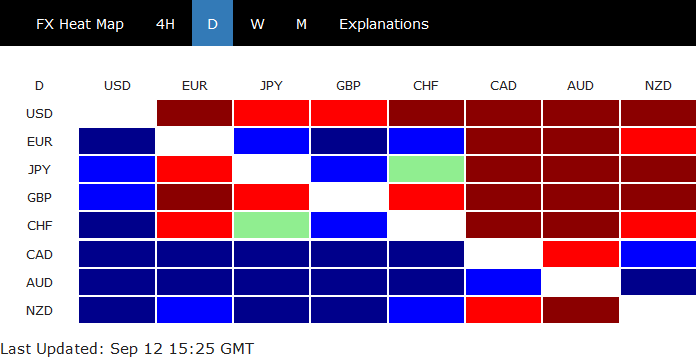
The news boosts Australian and New Zealand Dollar sharply higher. Meanwhile, Dollar clearly suffers.
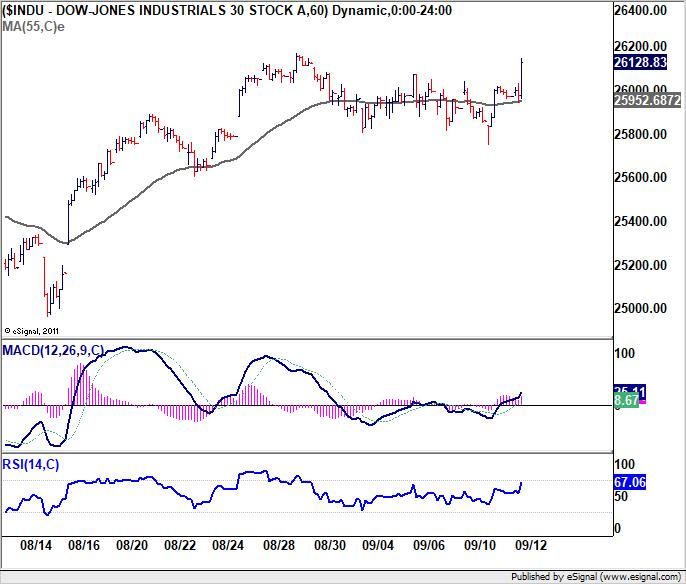
Meanwhile, DOW is also surging around 170 pts , taking recent high at 26167.74.
Japanese Yen Gains Ground
The Japanese yen has posted gains in the Wednesday session, erasing most of the losses seen on Tuesday. In North American trade, the pair is trading at 111.29, down 0.29% on the day. In economic news, Japanese BSI Manufacturing Index rebounded with a gain of 6.5, but this fell short of the estimate of 8.0 points. In the U.S., PPI and Core PPI both came in at -0.1%, missing their estimates. Later in the day, Japan releases Core Machinery Orders and PPI. On Thursday, the U.S publishes CPI as well as unemployment claims.
The Japanese economy showed strong expansion in the second quarter. GDP gained 0.7%, matching the estimate. This was an impressive rebound after a decline of 0.2% in Q1. On an annualized basis, GDP in Q2 was revised upwards to 3.0%, up from 1.9%. This gain marked the strongest gain in over two years. The Bank of Japan meets next week and is expected to hold its short-term interest rate target at -0.1 percent and a pledge to guide long-term rates near zero percent.
The U.S-China trade war has been on pause, but could heat up again at any time. The ball is currently in the corner of President Trump, who has threatened to impose tariffs on $200 billion worth of Chinese tariffs. The time period for public consultations ended last week, which means that Trump is free to announce another round of tariffs at any time. Despite fears that the trade war could trigger a recession, trade between the U.S and China actually increased in August. The dollar has benefited from the global trade war, and further tariffs against China could unnerve investors and propel the greenback upwards.
Loonie Extends Strong Rally against Hreenback
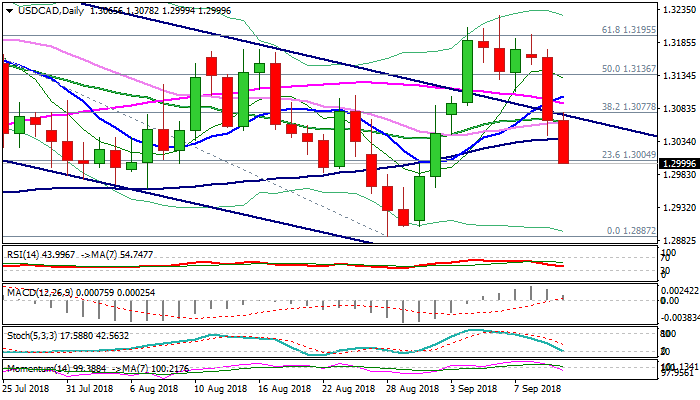
The pair resumed descend in early hours of US session after holding within narrow consolidation during European trading. Fresh weakness comes as extension of previous day’s strong fall, sparked by optimistic tone about NAFTA agreement talks. The loonie’s bullish sentiment was additionally boosted by weaker than expected US PPI data which hit the greenback, while Canada’s capacity utilization came at 85.5% in Q2, missing forecast at 86.9% but was well above Q1 downward-revised 83.7% figure. Fresh bearish acceleration cracked pivotal 1.3016 support (Fibo 61.8% of 1.2887/1.3226 ascend) and pressures psychological 1.30 support. Daily close below these points would be strong bearish signal for extension of steep fall 1.3174 (Tuesday’s high), towards next strong support at 1.2927 (top of thick weekly Ichimoku cloud. Rising bearish momentum supports scenario. Broken 100SMA offers initial resistance at 1.3038, while converged 20/30 SMA’s mark upper pivot at 1.3061.
Res: 1.3038; 1.3061; 1.3078; 1.3092
Sup: 1.3000; 1.2962; 1.2927; 1.2903
Oil Advances Further after US Crude Stocks Fell Below Expectations
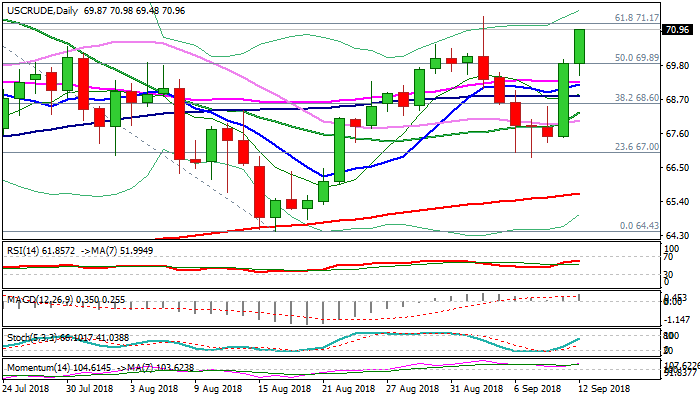
WTI oil accelerated higher after US weekly crude stocks data showed much stronger than expected fall in oil inventories. Weekly stocks fell by 5.29 million barrels, vs 1.3 million barrels draw forecasted and also overshot previous week’s 4.3 million barrels fall. This comes as additional supportive factor for oil prices, already boosted by fears on potential impact of hurricane, as well as rising concerns about looming US sanctions on Iran. Oil price is on track for close above broken psychological $70 barrier which would open way towards key barriers at $71.17/38 (Fibo 61.8% of $75.34/$64.43 fall / 04 Sep high).
Res: 71.17; 71.38; 72.00; 72.77
Sup: 70.48; 70.00; 69.89; 69.46