Sample Category Title
GBP/USD Daily Outlook
Daily Pivots: (S1) 1.2994; (P) 1.3033; (R1) 1.3085; More...
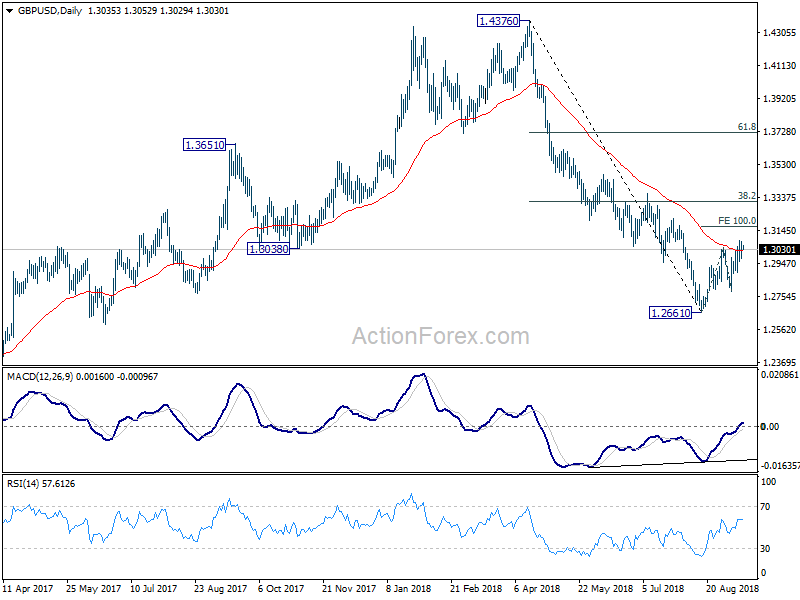
No change in GBP/USD's outlook. With 1.2896 minor support intact, further rise is expected for 100% projection of 1.2661 to 1.3042 from 1.2784 at 1.3165, and possibly above. However, we'd expect upside to be limited by 1.3316 key fibonacci level to complete the corrective rise and bring near term reversal. On the downside, break of 1.2896 minor support will now argue that rebound from 1.2661 has completed. In such case, intraday bias will be turned back to the downside for 1.2784 and then 1.2661.
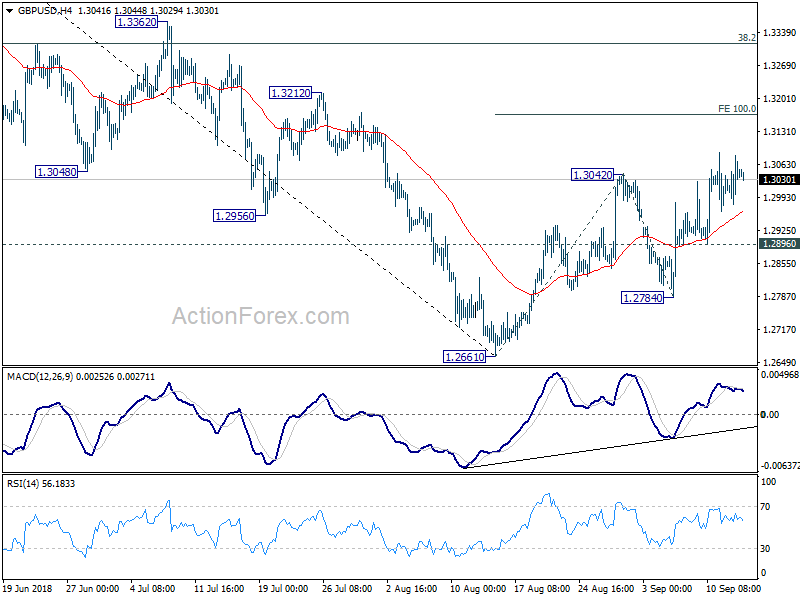
In the bigger picture, whole medium term rebound from 1.1946 (2016 low) should have completed at 1.4376 already, after rejection from 55 month EMA (now at 1.4099). The structure and momentum of the fall from 1.4376 argues that it's resuming long term down trend. And this will be the preferred case as long as 38.2% retracement of 1.4376 to 1.2661 at 1.3316 holds. However, firm break of 1.3316 would bring stronger rebound to 61.8% retracement at 1.3721. And, the eventual depth of the fall from 1.4376, and the chance of hitting 1.1946 low, will depend on the strength of the interim corrective rebound from 1.2661.
USD/CHF Daily Outlook
Daily Pivots: (S1) 0.9683; (P) 0.9717; (R1) 0.9738; More.....
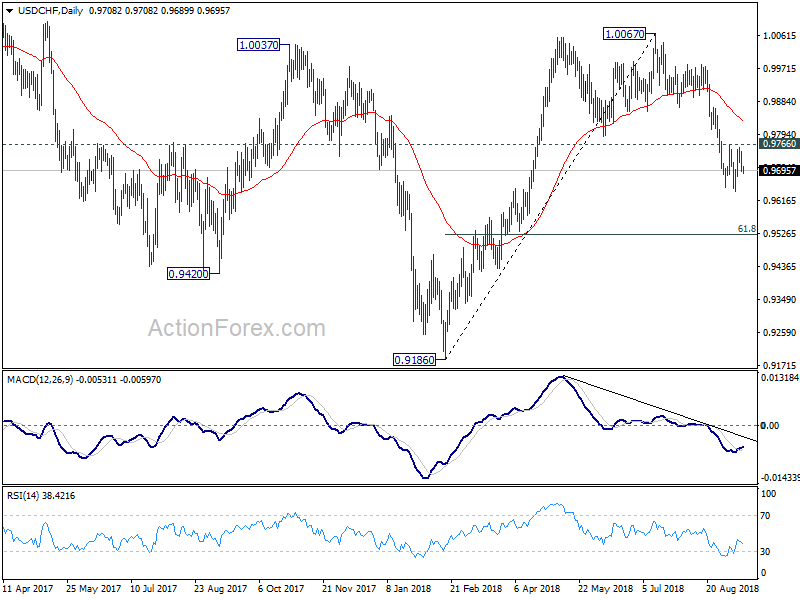
Intraday bias in USD/CHF remains neutral for the moment. With 0.9766 minor resistance intact, deeper decline could still be seen. Break of 0.9640 will resume the fall fro 1.0067 and target 0.9523 fibonacci level next. On the upside, firm break of 0.9766 will argue that the fall from 1.0067 is finished, with bullish convergence condition in 4 hour MACD. In such case, intraday bias will be turned back to the upside for 0.9866 support turned resistance for confirmation.
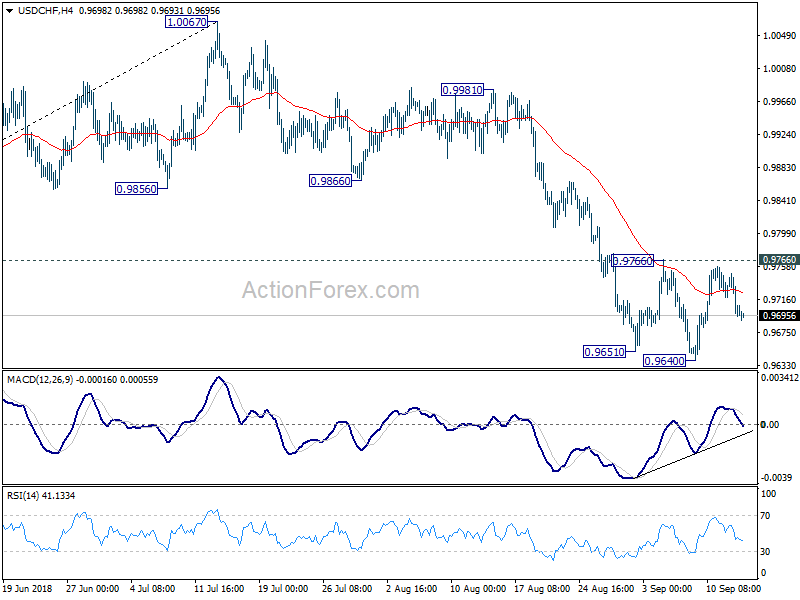
In the bigger picture, current development suggests that rise from 0.9186 low has completed at 1.0067, after failing to sustain above 1.0037 resistance. Fall from 1.0067 could extend to 61.8% retracement of 0.9816 to 1.0067 at 0.9523 and below. But for now, we don't expect a break of 0.9186 low. On the upside, firm break of 0.9866 support turned resistance will suggests that fall from 1.0067 has completed and rise from 0.9186 is resuming.
USD/JPY Daily Outlook
Daily Pivots: (S1) 111.02; (P) 111.34; (R1) 111.56; More...
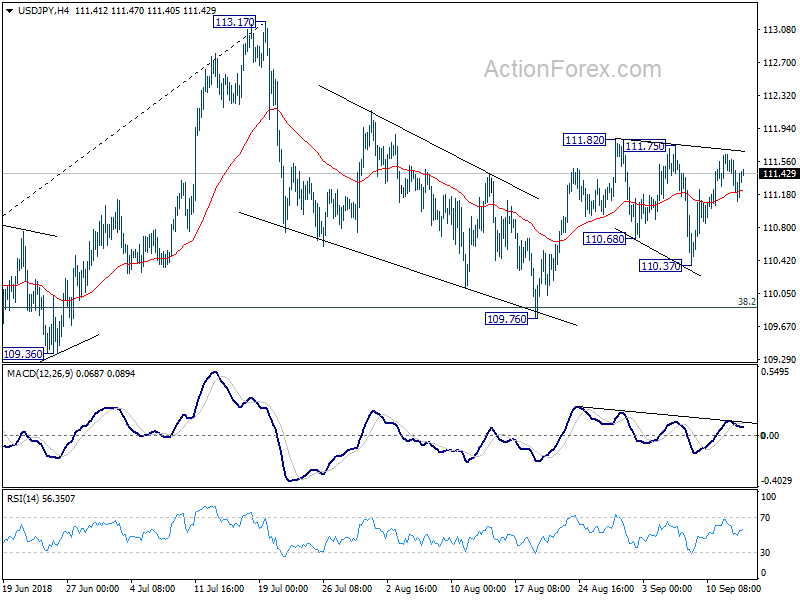
Intraday bias remains neutral at this point. While the consolidative pattern from 111.82 might extend with another fall, downside should be contained by 38.2% retracement of 104.62 to 113.17 at 109.90 to bring rebound. On the upside, break 111.82 will indicate that rise from 109.76 is resuming. And intraday bias will be turned back to the upside for retesting 113.17 high. Decisive break there will resume larger rally from 104.62.
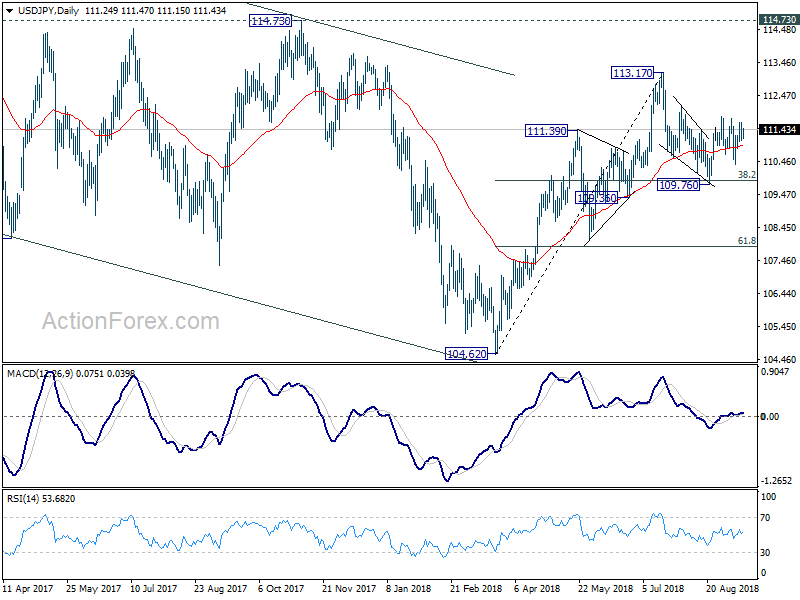
In the bigger picture, corrective fall from 118.65 (2016 high) should have completed with three waves down to 104.62. Decisive break of 114.73 resistance will likely resume whole rally from 98.97 (2016 low) to 100% projection of 98.97 to 118.65 from 104.62 at 124.30, which is reasonably close to 125.85 (2015 high). This will stay as the preferred case as long as 109.36 support holds. However, decisive break of 109.36 will mix up the outlook again. And deeper fall should be seen back to 61.8% retracement of 104.62 to 113.17 at 107.88 and below.
USD/CAD Daily Outlook
Daily Pivots: (S1) 1.2959; (P) 1.3019; (R1) 1.3059; More...
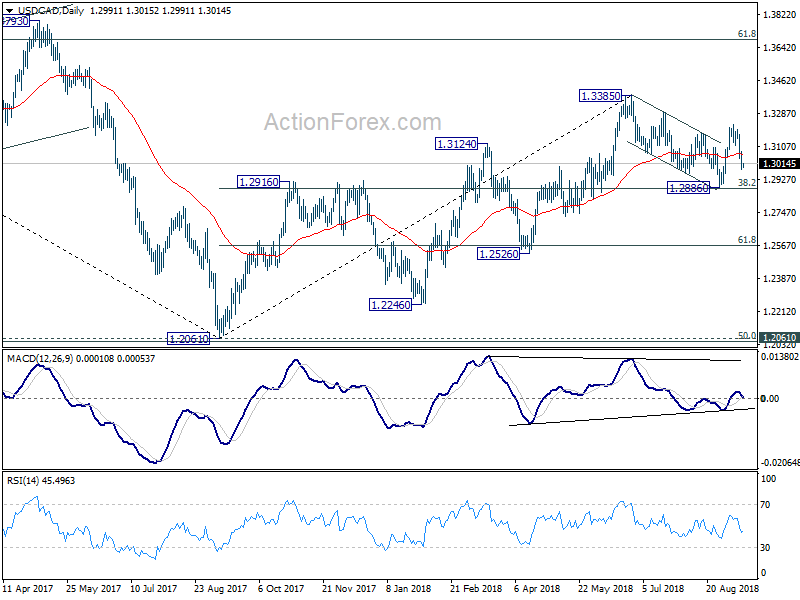
USD/CAD's decline from 1.3225 is still in progress and deep fall might be seen. But we'd expect downside to be contained well above 1.2886 to bring rally resumption. We're holding on to the view that corrective fall from 1.3385 has completed at 1.2886 already. On the upside, above 1.3077 minor resistance will turn bias back to the upside for 1.3225 first. Break will resume the rebound from 1.2886 to retest 1.3385 high.
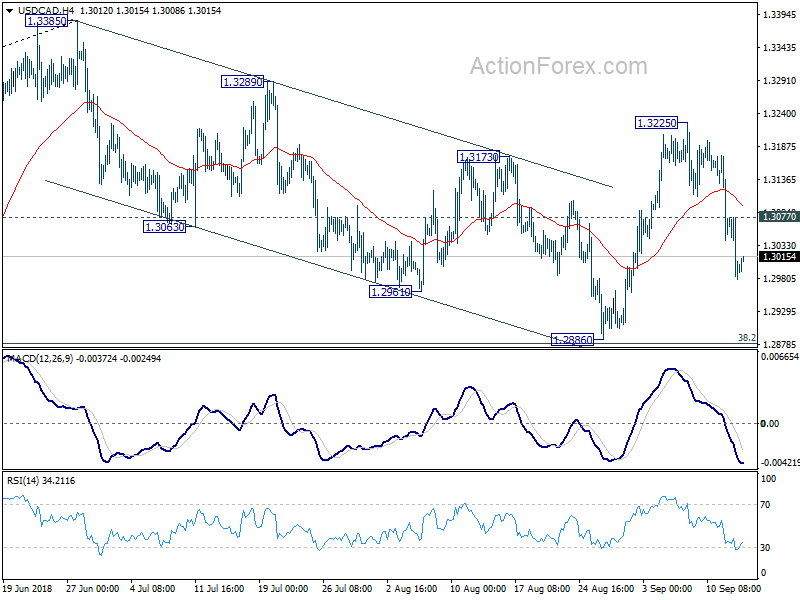
In the bigger picture, strong rebound ahead of 38.2% retracement of 1.2061 to 1.3385 at 1.2879 key fibonacci level retains medium term bullishness. That is, rise from 2017 low at 1.2061 is still in progress. Break of 1.3384 should target 61.8% retracement of 1.4689 (2015 high) to 1.2061 (2017 low) at 1.3685. On the downside, as long as 1.2886 support holds, outlook will now remain bullish.
NZD/USD Recovery Faces Resistance Near 0.6570
Key Highlights
- The New Zealand Dollar declined recently and traded towards 0.6500 against the US Dollar.
- There is a major bearish trend line formed with resistance at 0.6560 on the 4-hour chart of NZD/USD.
- The US Producer Price Index in August 2018 declined 0.1%, compared with the +0.2% forecast.
- Today, the US Consumer Price Index for August 2018 will be released, which is forecasted to rise 2.8% (YoY).
NZDUSD Technical Analysis
The New Zealand Dollar remained in a crucial downtrend from the 0.6620 swing high against the US Dollar. The NZD/USD pair recently traded towards 0.6500 and it is currently correcting higher.
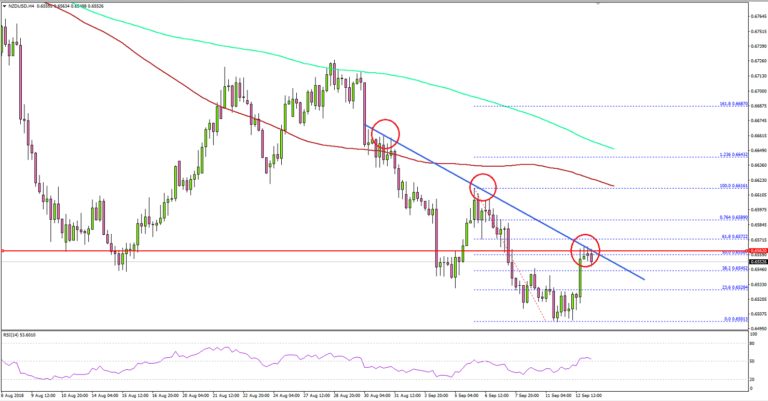
Looking at the 4-hours chart, the pair is clearly under a lot of pressure below the $0.6570 resistance and the 100 simple moving average (red, 4-hours). Recently, it formed a low at 0.6501 and later corrected a few higher.
On the upside, there is a strong resistance area near 0.6560-70, which was a support earlier. It also coincides with the 50% Fib retracement level of the last drop from the 0.6616 high to 0.6501 low.
Moreover, there is a major bearish trend line formed with resistance at 0.6560 on the same chart. Therefore, if the pair recovers further, it is likely to face a strong resistance near the 0.6570 zone. On the downside, a break below the 0.6500 support could open the gates for a push towards 0.6460.
Fundamentally, the US Producer Price Index for August 2018 was released by the Bureau of Labor statistics, Department of Labor. The market was looking for a rise of 0.2% in the PPI compared with the previous month.
However, the result was disappointing as there was a decline of 0.1% in the PPI. The yearly change came in at 2.8%, less than the forecast of 3.2% and much less than the last 3.3%.
The US Dollar corrected lower, but it could regain traction and pairs like NZD/USD and AUD/USD are likely to face an increased selling pressure in the near term.
Economic Releases to Watch Today
- German Consumer Price Index for August 2018 (YoY) – Forecast +2%, versus +2% previous.
- German Consumer Price Index for August 2018 (MoM) – Forecast +0.1%, versus +0.1% previous.
- ECB Interest Rate Decision – Forecast 0%, versus 0% previous.
- BoE Interest Rate Decision – Forecast 0.75%, versus 0.75% previous.
- BOE Meeting Minutes.
- US Consumer Price Index August 2018 (MoM) – Forecast +0.3%, versus +0.2% previous.
- US Consumer Price Index August 2018 (YoY) – Forecast +2.8%, versus +2.9% previous.
- US Consumer Price Index Ex Food & Energy August 2018 (YoY) – Forecast +2.4%, versus +2.4% previous.
AUD/USD Daily Outlook
Daily Pivots: (S1) 0.7115; (P) 0.7149; (R1) 0.7205; More...
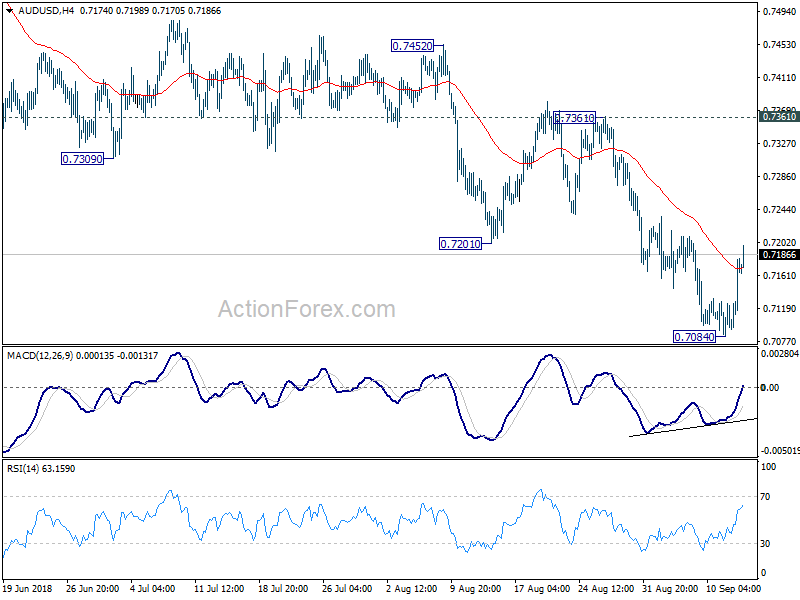
Intraday bias in AUD/USD stays mildly on the upside at this point. A short term bottom is in place at 0.7084 on bullish convergence condition in 4 hour MACD. Further rebound could be seen towards 55 day EMA (now at 0.7322). But upside should be limited well below 0.7361 resistance to bring down trend resumption. On the downside, break of 0.7084 will resume the fall from 0.8135 for key support level at 0.6826. However, sustained break of 0.7361 will carry larger bullish implication.
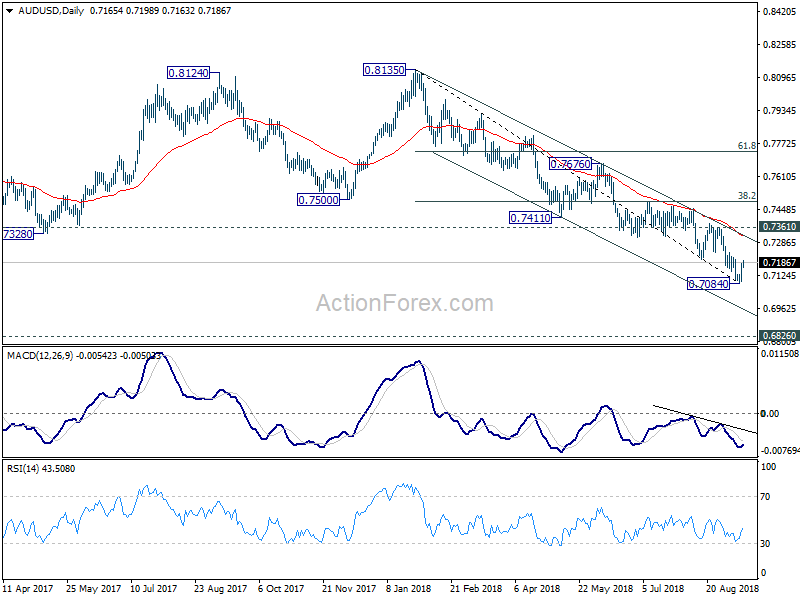
In the bigger picture, rebound from 0.6826 (2016 low) is seen as a corrective move that should be completed at 0.8135. Fall from there would extend to have a test on 0.6826. There is prospect of resuming long term down trend from 1.1079 (2011 high). Current downside momentum as seen in daily and weekly MACD support this bearish case. Firm break of 0.6826 will target 0.6008 key support next (2008 low). On the upside, break of 0.7361 resistance, however, argues that a medium term bottom is possibly in place, and stronger rebound could follow. We'll assess the medium term outlook later if this happens.
US & China to Restart Trade Talks, Aussie & Stocks Boosted But Investors Showed No Commitment Yet
Risk appetite was given a strong boost overnight on news that US and China were going to re-start trade talks before now round of tariffs take effect. The news was further confirmed by White House economic advisor Larry Kudlow after the bell. Australian Dollar surged sharply on the news and was given another lift by solid job data today. Dollar, on the other hand, weakened together with Yen on easing trade threats. For now, Canadian Dollar is the strongest for the week, followed by Australian Dollar and then Sterling. Yen is the weakest one, followed by Swiss Franc and then Dollar. Focus will turn to ECB and BoE meeting today.
While stocks were shot up by US-China trade news, it should be noted that the momentum didn't last. DOW hit as high as 26145.72 but closed up just 0.11% at 25998.92. That's just slightly above open at 25989.07.S&P 500 actually showed little reaction, and hit 2894.65 day high before closing at 2888.92, up only 0.04%. NASDAQ dropped -0.23% to 7954.23.
In Asian markets, China Shanghai SSE opened higher and hit 2689.06. But there was no follow through buying to help it reclaim 2700 handle. SSE then subsequently gyrated down and is up only 0.14% at 2659 at the time of writing. Nikkei is up 0.99%, Hong Kong HSI is up 1.46% while Singapore Strait Times is up 0.15%. All in all, investors haven't showed much commitment to the easing trade tension yet.
Technically, the forex markets are indeed staying in family range, with the exception of Aussie pairs. Further rise is in favor in EUR/USD and GBP/USD with 1.1525 and 1.2896 minor supports intact. USD/CHF and USD/JPY are range bound. Australia Dollar could have bottomed against both Dollar and Euro in near term, and more upside is in favor as corrective recovery.
WH Kudlow: Communications with China picked up a notch
White House top economic advisor Larry Kudlow said yesterday that communications with Beijing had "picked up a notch". He also confirmed that Treasury Secretary Steven Mnuchin had sent an invitation letter to senior Chinese officials to restart trade talks. Also, "there's some discussions and information that we've received that the top of the Chinese government wishes to pursue talks."
Kudlow also added that "most of us think it's better to talk than not to talk, and I think the Chinese government is willing to talk." And, if they come to the table in a serious way to generate some positive results, yes, of course. That's what we've been asking for months and months." But he also cautioned that "I guarantee nothing."
Overnight, the WSJ reported that the US was proposing new round of trade talk with China. That could happen in the near future before Trump imposes the new round of 25% tariffs on USD 200B in Chinese goods. It's reported that Treasury Secretary Steven Mnuchin sent an invitation to Chinese officials, proposing a meeting in the next few weeks to discuss trade issues.
The proposal could be resulted from public hearing ended last week. Or, it could also be in response to outcries from American businesses. Over 60 US industry groups formed a coalition "Americans for Free Trade" to launch a campaign against Trump's tariffs and trade policies.
Contrasting comments from Fed Brainard and Bullard
There were some contrasting comments from Fed officials yesterday.
Fed Governor Lael Brainard said that "with fiscal stimulus in the pipeline and financial conditions supportive of growth, the shorter-run neutral interest rate is likely to move up somewhat further, and it may well surpass the longer-run equilibrium rate for some period." And to her, gradual interest rate hikes are likely to be appropriate.
On the other hand, St. Louis Fed President James Bullard emphasized that "you can't just say, 'unemployment is 3.9 percent, obviously we have to raise rates'; or, 'growth is fast, obviously we have to raise rates.'" He noted that "I don't think that feedback to inflation is very strong to be able to make that argument."
Strong 44k job growth in Australia, unemployment rate unchanged at 5.3%
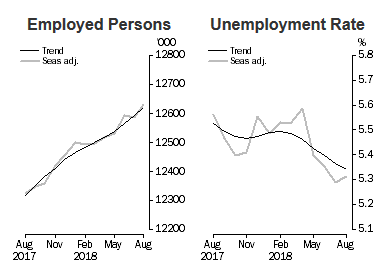
Australia job market grew 44k in August, well pass expectation of 18.4k. Full time employment grew strongly by 33.7k. Part time jobs added 10.2k. Unemployment was unchanged at 5.3%, matched expectation. Labor force participation rate rose to 65.7%, up from 65.6%.
Overall, the set of data affirmed RBA's view that spare capacity is gradually being taken out, which is a prelude to meaningful wage growth. However, wages have actually need to show the increase before RBA is convinced that eventually there is enough upward pressure on inflation. Talk of rate hike is premature based on just today's data.
Japan core machine orders jumped 11.0% yoy in July
In Japan, private machinery orders, excluding volatile ones, rose 11.0% yoy in July, well above expectation of 5.8% yoy. Total machinery orders rose 18.8% yoy. The strong growth suggests that companies were keen to invest despite the threat of trade protectionism. And rising capex will likely add to economic growth. So far, trade war worries haven't materialized in economic data yet.
Also released, domestic CGPI rose 3.0% yoy in August, below expectation of 3.1% yoy.
ECB and BoE in focus but may turn out to be non-events
ECB and BoE rate decisions are the main focuses today, but both would likely be non-events. ECB is widely expected to keep main refinancing rate unchanged at 0.00%, and there is no chance of surprise in the regard. The central bank will also reiterate the plan to halve monthly asset purchase size to EUR 15B in October and then stop it after December. There might be more information on the subsequent reinvestment plan thereafter.
The more interesting part of ECB announce would be on the new economic projections. Back in June, ECB projected real GDP growth to stand at 2.1% in 2018 and slowed to 1.9% in 2019 and then 1.7% in 2020. HICP inflation was projected to be at 1.7% in 2018, 2019 and 2020.
BoE is also widely expected to keep monetary policies unchanged today. Back in August, the central bank raised Bank Rate by 25bps to 0.75% in August, on unanimous vote. The August Inflation Report was a rather dovish one indicating that BoE may only have one rate hike in 2019, depending on incoming data and Brexit outcome. Headline CPI's rise to 2.5% in July was expected in the Inflation Report. Other data like wage growth were strong. But they're not enough to alter BoE's path yet.
More on ECB and BoE:
- ECB to Affirm QE Reduction from October and Downgrade Inflation Forecasts
- ECB to Keep the Same Forward Guidance; Eyes on Fresh Economic Projections
- Will We Get Fireworks from BoE and ECB?
- BOE Preview- Upbeat about Recent Economic Developments, but Cautious over Brexit
- Bank of England to Hold Rates as Brexit Talks Intensify
Also featured...
Germany will release CPI final. Swiss will release PPI. Later in the day, main focus will be on US CPI and jobless claims. Canada will also release new housing price index.
AUD/USD Daily Outlook
Daily Pivots: (S1) 0.7115; (P) 0.7149; (R1) 0.7205; More...
Intraday bias in AUD/USD stays mildly on the upside at this point. A short term bottom is in place at 0.7084 on bullish convergence condition in 4 hour MACD. Further rebound could be seen towards 55 day EMA (now at 0.7322). But upside should be limited well below 0.7361 resistance to bring down trend resumption. On the downside, break of 0.7084 will resume the fall from 0.8135 for key support level at 0.6826. However, sustained break of 0.7361 will carry larger bullish implication.
In the bigger picture, rebound from 0.6826 (2016 low) is seen as a corrective move that should be completed at 0.8135. Fall from there would extend to have a test on 0.6826. There is prospect of resuming long term down trend from 1.1079 (2011 high). Current downside momentum as seen in daily and weekly MACD support this bearish case. Firm break of 0.6826 will target 0.6008 key support next (2008 low). On the upside, break of 0.7361 resistance, however, argues that a medium term bottom is possibly in place, and stronger rebound could follow. We'll assess the medium term outlook later if this happens.
Economic Indicators Update
| GMT | Ccy | Events | Actual | Forecast | Previous | Revised |
|---|---|---|---|---|---|---|
| 23:01 | GBP | RICS House Price Balance Aug | 2% | 2% | 4% | |
| 23:50 | JPY | Domestic CGPI Y/Y Aug | 3.00% | 3.10% | 3.10% | 3.00% |
| 23:50 | JPY | Machine Orders M/M Jul | 11.00% | 5.80% | -8.80% | |
| 01:00 | AUD | Consumer Inflation Expectation Sep | 4.00% | 4.00% | ||
| 01:30 | AUD | Employment Change Aug | 44.0K | 18.4K | -3.9K | -4.3K |
| 01:30 | AUD | Unemployment Rate Aug | 5.30% | 5.30% | 5.30% | |
| 06:00 | EUR | German CPI M/M Aug F | 0.10% | 0.10% | ||
| 06:00 | EUR | German CPI Y/Y Aug F | 2.00% | 2.00% | ||
| 07:15 | CHF | Producer & Import Prices M/M Aug | 0.10% | 0.10% | ||
| 07:15 | CHF | Producer & Import Prices Y/Y Aug | 3.40% | 3.60% | ||
| 11:00 | GBP | BoE Bank Rate | 0.75% | 0.75% | ||
| 11:00 | GBP | BoE Asset Purchase Target Sep | 435B | 435B | ||
| 11:00 | GBP | MPC Official Bank Rate Votes | 0--0--9 | 0--0--9 | ||
| 11:00 | GBP | MPC Asset Purchase Facility Votes | 0--0--9 | 0--0--9 | ||
| 11:45 | EUR | ECB Rate Decision | 0.00% | 0.00% | ||
| 12:30 | EUR | ECB Press Conference | ||||
| 12:30 | CAD | New Housing Price Index M/M Jul | 0.10% | 0.10% | ||
| 12:30 | USD | CPI M/M Aug | 0.10% | 0.20% | ||
| 12:30 | USD | CPI Y/Y Aug | 2.70% | 2.90% | ||
| 12:30 | USD | CPI Core M/M Aug | 0.20% | 0.20% | ||
| 12:30 | USD | CPI Core Y/Y Aug | 2.40% | 2.40% | ||
| 12:30 | USD | Initial Jobless Claims (SEP 8) | 210K | 203K | ||
| 14:30 | USD | Natural Gas Storage | 63B | |||
| 18:00 | USD | Monthly Budget Statement Aug | -183.0B | -76.9B |
Aussie Rallies After Strong Jobs Data
Aussie jumped after the economy added more jobs, while the US dollar extended its slide on hopes of more talks at the US-China trade war negotiating table.
Australia labor market remains strong
Australia added a whopping 44,000 jobs in August, the second-highest monthly add in the last nine months. The fact the nearly all of the jobs, 33,700, were in the full-time category is testimony to the positive outlook for the local labor market. Despite a higher participation rate, 65.7% from 65.5%, the unemployment rate remained steady at 5.3%.
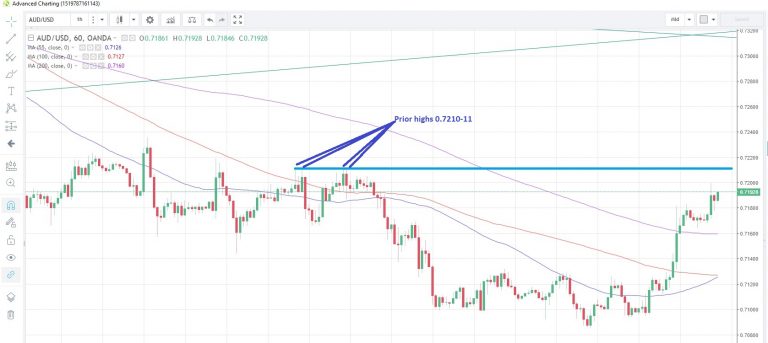
Whichever way you slice and dice it, it was a strong report and the knee-jerk reaction in the currency markets was to push the Aussie higher. AUD/USD touched 0.72 (just yesterday it was testing 0.71) before settling back to 0.7190, while AUD/JPY rose to a one-week high of 80.217. AUD/USD faces some immediate resistance from prior highs in the 0.7210-11 window on the hourly charts (four in total) followed by the August low of 0.7238.
No change from the BOE, ECB
Neither of the two central bank meetings today is expected to set the newswires on fire. Since its last meeting, economic data has seen some patchy improvement and the headlines on Brexit have become more favorable. As a result we could hear a more hawkish bias to the accompanying statement from the Bank of England, but markets are still only pricing in chances of a rate hike in the second half of 2019.
The guidance the ECB issued in June, gradual tapering asset purchases by year-end and keeping interest rates on hold through the summer of 2019, is likely to be kept unchanged. There is market talk that the central bank may tweak its 2018 economic forecasts lower as global trade tensions impact demand and change the language of its statement to reflect risks to growth may be tilted to the downside rather than being “broadly balanced”.
US consumer prices on tap
Following on from the weaker August US PPI numbers yesterday (negative for the first time since January), it is now the turn of consumer prices to step forward. Estimates suggest consumer prices rose 2.8% y/y last month, a slower pace than the 2.9% recorded in July, while on a month-on-month basis prices are seen rising 0.3% after 0.2% in July. We hear speeches from Fed’s Quarles (neutral, voter) and Bostic (dove, voter) and these could garner some interest given we are heading to the Fed’s media blackout period from Saturday ahead of the FOMC meeting on the 26th.
Edge Of The Seat Type Stuff !
US Markets
After wobbling most of the day in extremely choppy markets, the US equity market finished mostly higher supported by higher oil prices and news that the US has formally sent an invitation to China to resume trade talks. But festivities were tempered as the market gave a nod to comments earlier in the week from crucial Whitehouse advisor Kudlow stated that ” important information. ” needs to be answered before celebrating. But none the less with both parties scheduled to resume trade talks it should be viewed in a positive light. AS such the USDCNH dip triggered an across the board sell-off on the US dollar as some short CNH trade war hedges unwound, gold headed back towards the top of its one month range, and Brent briefly hit $80 for the first time since May.
Oil markets
Are the Bulls are back in control?
Administration crude inventories data for last week indicated 5.3 million barrels draw from commercial crude stocks, and while lower than the 8.6 million barrels registered by the American Petroleum Institute report but a much deeper drop than analyst’s expectations. Propelling Brent briefly above the fundamental and psychological $80 a barrel for the first time since May and was equally as supportive for the WTI contract. However, both benchmarks are trading off intraday highs heading into the Asia session as the distillate inventories which increased by 6.2 million barrels last week, more than the 5.8 million barrels gain in the API numbers and excessively more than expected, slightly dampened market overexuberance as indeed much weaker demand over the Labor Day holiday was a significant factor.
There remains a lot of noise in this week’s markets, but the confluence of bullish near-term signals, Iran sanction and sinking US crude inventories should keep oil prices supported for the remainder of the week. But traders are now pivoting to the Organization of the Petroleum Exporting Countries and non-members meeting next week in Algeria.
In that light, Brent does feel a wee bit testy above $ 80, notwithstanding the immediate contract sitting comfortably in the green with a bullish tailwind. Yesterday’s comments from Russia’s Energy Minister, Alexander Novak, who stated in a leading newswire interview that the country could increase output by as much as 300k bpd in the medium-term, back to post-Soviet records seen last in October of 2016. However, he went on to say that they will not make any decisions as to whether the market requires additional barrels until it’s meeting with fellow OPEC countries. And keep in mind there is still that lingering notion that OPEC may want to keep Brent in the $ 70-80, which has been supported by the charts the past five months.
Eyes along with prayers remain directed on the US east coast as Hurricane Florence quickly approached landfall. The storm’s trajectory remains relatively unchanged from yesterday as it is expected to miss all significant refineries. And while not a substantial threat to US production it has turned traders into Google meteorologist who is trying to forecast if a Hurricane will eventually sweep through the Gulf given the numbers of tropical storms brewing in the Atlantic Ocean this hurricane season.
Gold Markets
It almost feels counterintuitive to suggest a de-escalation in US-China trade war has provided a tailwind for Gold, but therein lies the fact that Gold is trading entirely and the mercy of the US dollar. And that to judge Gold by any other metric in this environment provides an indecisive, inconclusive and highly inconsequential signal. But there will be much to be said for the USD near-term direction during the next 24 hours as currency, and cross-asset traders remain coiled to spring in either direction as the US CPI will likely set the stage for the US dollar next move.
Currencies
Beyond the headlines, much of the overnight price action could be a function of paring risk ahead of the hugely busy day with BOE, ECB, plus AUD jobs German, French and US CPIs to navigate. But everyone across the currency world is also watching to see just how definitive a signal the Turkish Central Bank will deliver to quell emerging markets bloodletting.
USDCNH sold off from 6.8725 towards 6.8270 on news that the US has sent an invitation to China resume trade talks posted and indeed the greed of the move suggest most traders were caught overly wrong and long as the USDCNH was being viewed as a primary vehicle to hedge trade war risk.
While fundamentals still support the view USDCNH higher, the unwinding of trade war hedges is undoubtedly providing an unexpected shift in near-term sentiment and led to a substantial USD dollar sell-off globally.
Also, the US PPI was weaker than expected which had the US dollar leaning slightly lower.
From the more critical picture scenario, overnight price action was a cause and effect of a myriad of events that included position trimming and a reversal of fortune for the Yuan bears.
ON the other trade war front, Mexico made headlines for seeing a “high chance” of a US-Canada compromise with Nafta, and that sent USDCAD to the 1.3000 level. Canadian Dollar has reacted favourably, and as we get down to the nitty-gritty and on any trilateral NAFTA announcement, the USDCAD could drop to the low 1.29’s in a heartbeat, but in the meantime, we could be in for more stop and go on headline risk.
Malaysian Ringgit
Higher oil prices and a weaker dollar and optimism of US-China trade relations does suggest a stronger opening for the Ringgit, but I suspect with investors in pins and needles ahead of the next 24 hours of risk. Traders will remain cautious knowing that there is that small matter of the Federal Reserve Board and the prospects of higher US interest rates which are probably are a considerable obstacle for Malaysian capital markets as higher yield in US bonds lessens the Malaysian bond appeal from foreign investors and naturally weighs on Ringgit sentiment.
Strong 44k job growth in Australia, unemployment rate unchanged at 5.3%
Australia job market grew 44k in August, well pass expectation of 18.4k. Full time employment grew strongly by 33.7k. Part time jobs added 10.2k. Unemployment was unchanged at 5.3%, matched expectation. Labor force participation rate rose to 65.7%, up from 65.6%.
Overall, the set of data affirmed RBA's view that spare capacity is gradually being taken out, which is a prelude to meaningful wage growth. However, wages have actually need to show the increase before RBA is convinced that eventually there is enough upward pressure on inflation. Talk of rate hike is premature based on just today's data.