

Sample Category Title
Next phase of US-China trade war ready, as public comments end today
It's still a bit early, but the next phase of US-China trade war is approaching. The public comment period for the 25% tariffs on USD 200B in Chinese imports will end today. Trump could be ready to start imposition of such tariffs any time. And ahead of that Trump said yesterday that "right now we just can't make that deal" with China. And, "in the meantime, we're taking in billions of dollars of taxes coming in from China, with the potential of billions and billions of dollars more taxes coming in."
On the other hand, Chinese Commerce Ministry Spokesman Gao Feng said in a regular press conference that "if the United States, regardless of opposition, adopts any new tariff measures, China will be forced to roll out necessary retaliatory measures." Both sides have already slapped tit-for-tat tariffs on $US50 billion of each other's goods. That came after US steel and aluminium tariffs and China's own retaliation. For the upcoming ones, China already announced counter measures of tariffs on USD 60B of US goods ranging from liquefied natural gas to certain types of aircraft.
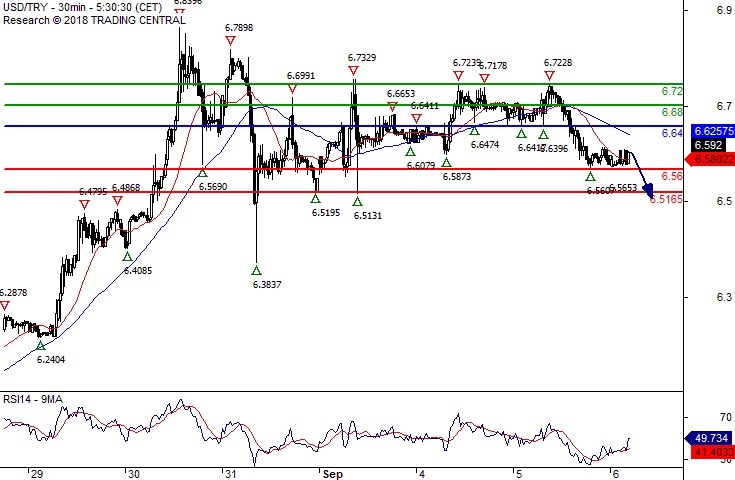
USD/TRY Turning Down
Pivot (invalidation): 6.6400
Our preference Short positions below 6.6400 with targets at 6.5600 & 6.5165 in extension.
Alternative scenario Above 6.6400 look for further upside with 6.6800 & 6.7200 as targets.
Comment A break below 6.5600 would trigger a drop towards 6.5165.
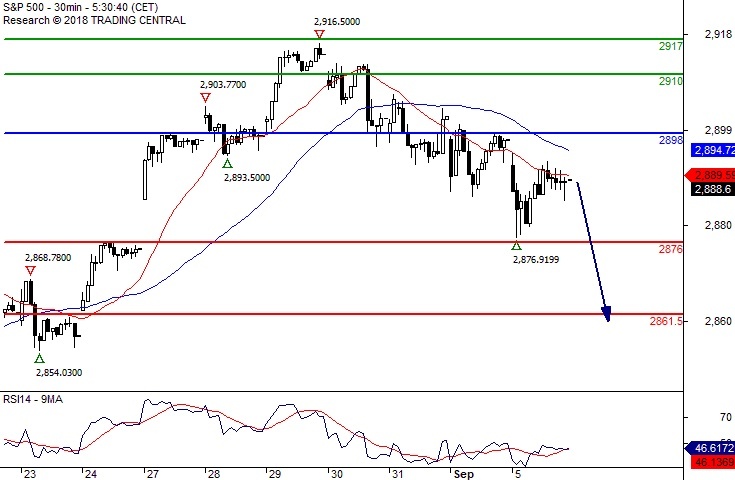
S&P 500 Under Pressure
Pivot (invalidation): 2898.00
Our preference Short positions below 2898.00 with targets at 2876.00 & 2861.50 in extension.
Alternative scenario Above 2898.00 look for further upside with 2910.00 & 2917.00 as targets.
Comment As Long as the resistance at 2898.00 is not surpassed, the risk of the break below 2876.00 remains high.
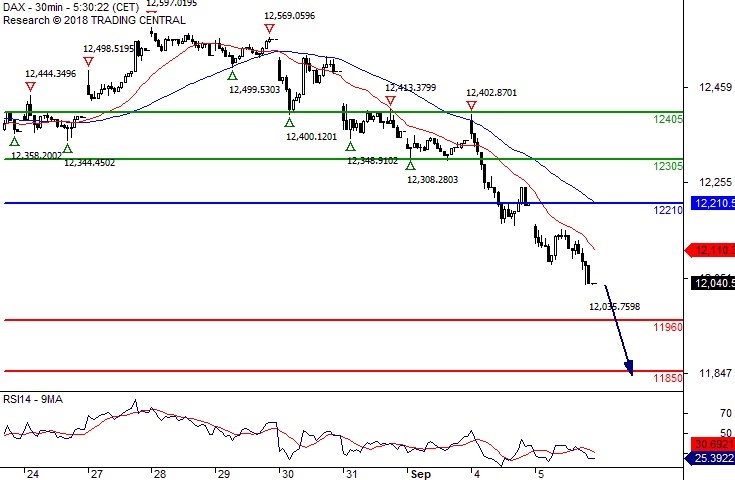
DAX The Downside Prevails
Pivot (invalidation): 12210.00
Our preference Short positions below 12210.00 with targets at 11960.00 & 11850.00 in extension.
Alternative scenario Above 12210.00 look for further upside with 12305.00 & 12405.00 as targets.
Comment The RSI has broken down its 30 level.
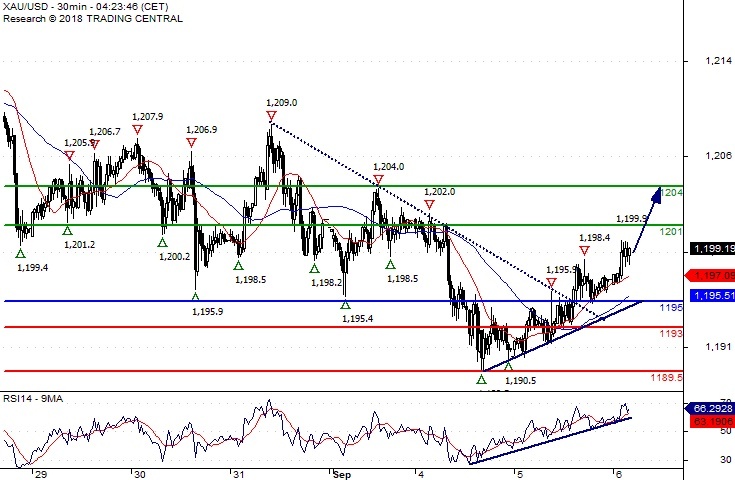
Gold Spot Rebound In Sight
Pivot (invalidation): 1195.00
Our preference Long positions above 1195.00 with targets at 1201.00 & 1204.00 in extension.
Alternative scenario Below 1195.00 look for further downside with 1193.00 & 1189.50 as targets.
Comment The RSI is supported by a bullish trend line
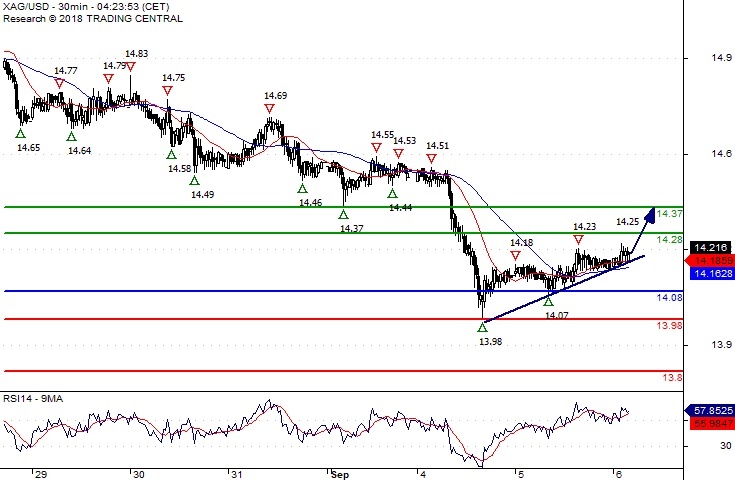
Silver Spot 14.3700 Expected
Pivot (invalidation): 14.0800
Our preference Long positions above 14.0800 with targets at 14.2800 & 14.3700 in extension.
Alternative scenario Below 14.0800 look for further downside with 13.9800 & 13.8000 as targets.
Comment The RSI is bullish and calls for further advance.
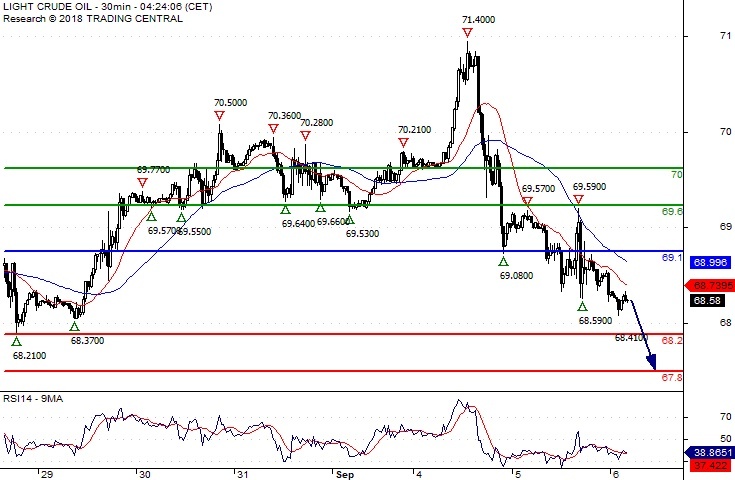
Crude Oil Under Pressure
Pivot (invalidation): 69.10
Our preference Short positions below 69.10 with targets at 68.20 & 67.80 in extension.
Alternative scenario Above 69.10 look for further upside with 69.60 & 70.00 as targets.
Comment The RSI advocates for further downside.
After Trade Deadline Dollar Looks At NFP Report For Direction
US nonfarm payrolls will hit the markets this week on Friday at 1230 GMT and investors might turn more sensitive to the data as the event follows a crucial trade deadline which could spur further escalation in the already boiling trade war between Washington and Beijing. While the dollar uses the Fed’s hawkish rate path narrative to mitigate trade risks, a potential retaliation from China could add some pressure to the greenback, with investors turning next to the NFP report for direction.
The government’s comprehensive job report is expected to say that employment growth in the nonfarm sector accelerated in August after July’s slowdown, rising by 190k compared to 157k in the previous month. That is also closer to the average 203k job gain recorded during the past 12 months. The unemployment rate is anticipated to lose 0.1 percentage points to reach 3.8%, the lowest since May 2000, while average hourly earnings are said to have increased by 0.2% month-on-month, slightly slower than the 0.3% growth recorded in July, but enough to keep the yearly gauge at 2.7% for the third consecutive month.
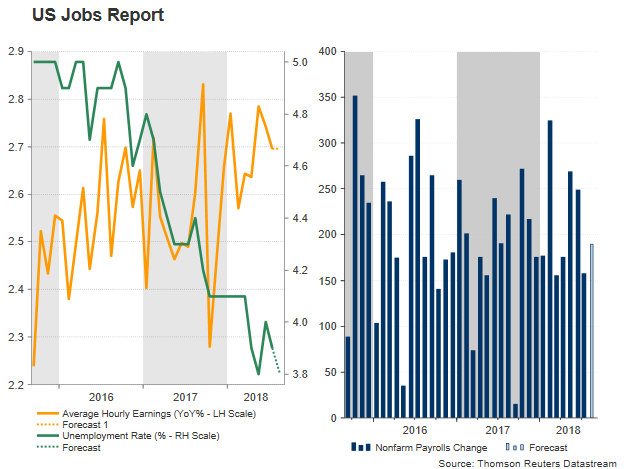
As in previous NFP releases, markets will likely keep their eyes on the wage component as this is the leading indicator of US inflation, with the latter rising at the Fed’s price goal of 2.0% according to the core Personal Consumption Expenditures index. Should wages expand surprisingly by more than analysts believe, traders could speculate that inflation is likely to hold at or above the target for longer, supported by lower taxes and improving economic growth as well. However, since the odds for a 25bps rate hike this month are above 90% according to the Fed fund futures, weaker than anticipated prints could do little to change the Fed’s rate thinking at a time when consumption is growing solidly, and manufacturing activity based on the Institute of Supply Management calculations stands at the highest in 14 years.
While an upbeat report could support the dollar, the upside move could turn out to be a recovery instead if China decides to impose tariffs on $60 billion of US imports as a punishment to US tariffs on $200 billion Chinese goods set to take effect soon after Thursday’s deadline. High expectations of further monetary normalization by the Fed later this year and a number of rosy economic data helped the greenback to overcome trade fears and gain ground against other major currencies. However, a potential retaliation by China and the fact that trade negotiations between the world’s two biggest economies are lacking a date of resumption could put investors into doubts on whether the US economy could keep positive momentum in a stricter trade environment, with its closest trade partners, China, and Canada also potentially activating further protectionist measures. Hence, in case the US moves ahead with another round of trade barriers on Thursday, forcing China to fight back, the greenback may face some downside ahead of the jobs stats. Yet the bearish move could prove short-lived if the employment gauges advance more than analysts believe and vice versa.
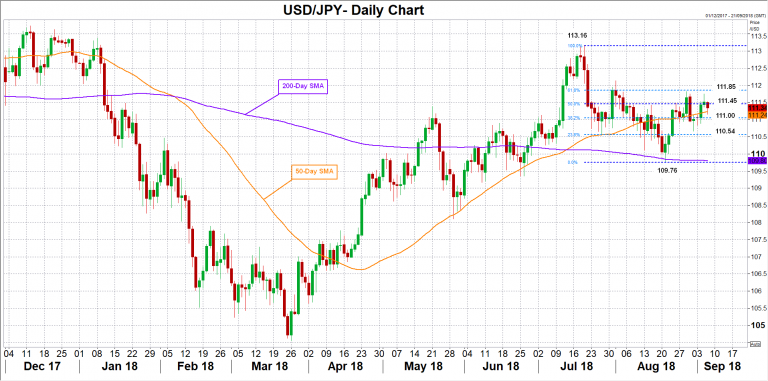
In forex markets, dollar/yen has been trading sideways over the past nine days, maintaining the bullish move above the 2-month low of 109.76. Encouraging news out of the US labor market on Friday could push the pair above the 50% Fibonacci retracement of the downleg from 113.16 to 109.76 towards 111.85, the 61.8% Fibonacci, if the dollar remains resilient to escalated trade tensions once again. Even higher, bulls could retest the 112 round level before running towards the six-month peak of 113.16.
Alternatively, if employment figures disappoint the focus would shift to the 111 psychological level where the 38.2% Fibonacci is also placed. Below that, the door could open for the 23.6% Fibonacci of 110.54 ahead of the 2-month bottom of 109.76.
Pound Goes For A Brexit Ride, Fresh Round Of Tariffs Coming Up?
Here are the latest developments in global markets:
FOREX: The US dollar is marginally lower (-0.07%) against a basket of six major currencies on Thursday, extending the losses it posted in the previous session. The British pound was in focus yesterday, having a volatile session that saw sizeable movements in both directions following some conflicting headlines on Brexit. Elsewhere, the Bank of Canada struck a slightly more cautious tone as it kept its policy unchanged.
STOCKS: Wall Street had a mixed session on Wednesday, with tech-weakness being the name of the game amid concerns that regulation in the sector is looming. This followed a Senate hearing attended by the CEO of Twitter (-6.06%) and the COO of Facebook (-2.33%), where lawmakers raised the prospect of increased regulation. The tech-heavy Nasdaq Composite (-1.19%) led the charge lower, while the S&P 500 fell only modestly (-0.28%). The Dow Jones, which is less exposed to tech, managed to climb by 0.09%. Futures tracking the Dow, S&P, and Nasdaq 100 are also pointing to a lower open today. Asia was mostly in the red on Thursday too, with Japan’s Nikkei 225 and the Topix edging down by 0.41% and 0.74% respectively. In Hong Kong, the Hang Seng fell 1.30%. In Europe, all the major benchmarks were set to open lower today, futures suggest.
COMMODITIES: Oil prices are modestly lower on Thursday, with WTI and Brent being down by 0.20% and 0.11% respectively, both extending the notable losses recorded yesterday. Sentiment surrounding the energy sector has turned sour, after a storm did not ultimately disrupt US oil production as was expected. On the demand side, a looming escalation in the Sino-American trade conflict, combined with the clouded prospects for EM economies, are also weighing on prices. In precious metals, gold is higher by a marginal 0.07% today, trading just a couple of dollars below the $1,200/ounce handle. Given the metal’s striking indifference to any political, geopolitical, or trade-related news in recent months, one would expect it to continue mirroring the US dollar’s movements. Namely, to move in the opposite direction of the greenback, as the two are inversely correlated.
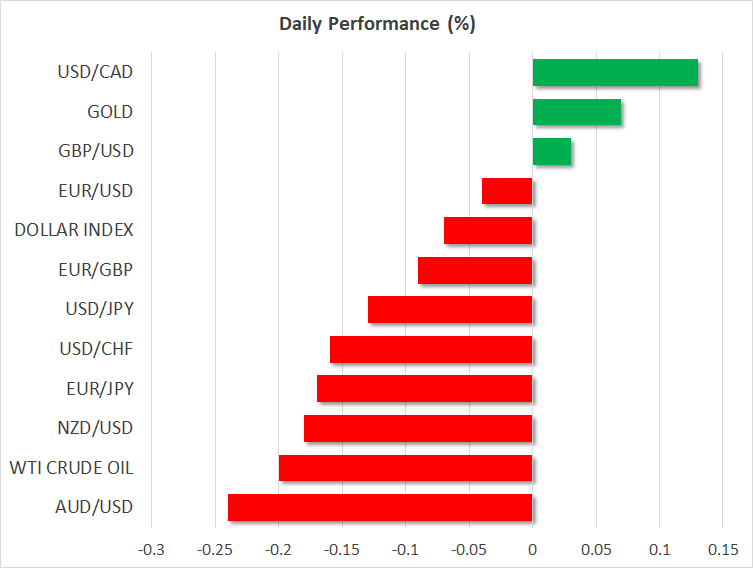
Major movers: Sterling goes for a ride amid conflicting Brexit headlines; BoC appears cautious
The spotlight fell on the British pound on Wednesday, following some Brexit headlines that left investors scratching their heads. Sterling/dollar surged initially, rallying more than 150 pips within minutes, after Bloomberg reported Germany is ready to accept a less detailed agreement on the future trading relationship for now – instead striking a deal on all other issues first to ensure a smooth exit. However, sentiment soon turned around after Reuters cited a German government spokesman saying his nation’s stance on Brexit hasn’t changed. The pound came back down, with euro/sterling finishing the day flat, while sterling/dollar still managed to close higher amid some dollar softness. Overall, despite some sterling-shorts being liquidated, nothing drastic appears to have changed in the broader Brexit narrative for now, with the pound likely to remain ultra-sensitive to any fresh developments.
The Bank of Canada (BoC) kept interest rates steady yesterday, sending mixed policy signals. On the bright side, officials appeared more upbeat on the economy, noting that recent data “reinforce” their view that higher rates will be warranted. However, policymakers also indicated they are “monitoring closely the course of NAFTA negotiations” – the first time such a reference was included in a statement. On the margin, investors interpreted these signals as being dovish, paring back their bets for a rate hike at the next meeting in October. The market-implied probability for such an action fell to 60% from 78% previously, according to Canada’s overnight index swaps. The loonie fell modestly on the decision, but ended the day higher against the dollar as the US currency retreated in general. Now, all eyes turn back to the NAFTA talks, which resumed yesterday.
In Sweden, the krona fell notably earlier in the European session, after the Riksbank signaled that it will delay a rate increase it had previously penciled in for Q4, pushing out the anticipated timing for such action to either December, or next year.
Elsewhere, aussie/dollar underperformed, down by nearly 0.25% on Thursday even despite a weak greenback, following news that more Australian commercial banks have raised the mortgage rates they offer to consumers. Effectively, this has similar effects to an RBA rate hike and hence, should be a worrisome development for policymakers. Namely, it squeezes the income of households, weighing on spending.
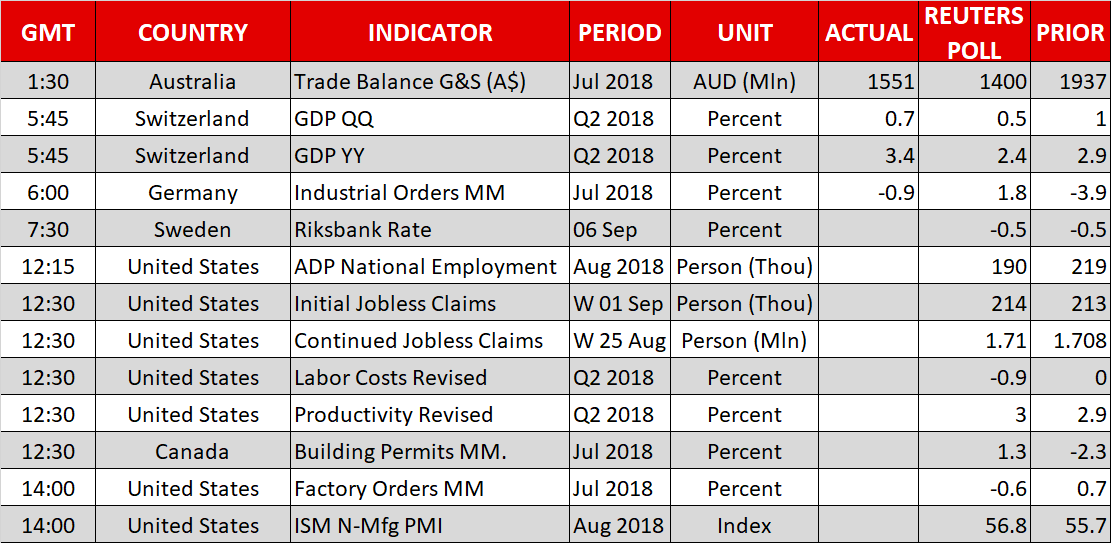
Day ahead: ADP employment data, US factory orders and ISM’s manufacturing PMI due; trade and Brexit eyed
Some notable data prints out of Thursday’s calendar are employment figures out of the US private sector, as well as the ISM services PMI. Meanwhile, trade and Brexit developments will again be closely monitored.
The ADP’s national employment report for positions added to the US economy by the private sector will be released at 1215 GMT. An addition of 190k positions is projected, below July’s 219k but nevertheless a healthy figure. The ADP data are seen by some as giving insights on the nonfarm payrolls report (due on Friday) which is broader in nature as it covers both the public and private sectors. It bears mention though that the two reports are not as closely correlated lately.
Also out of the US, weekly jobless claims data will be hitting the markets at 1230 GMT, alongside the figures on Q2 productivity and labor costs. Later (1400 GMT), July’s factory orders and the ISM’s services PMI for August are slated for release. Orders are forecast to contract by 0.6% m/m, after rising by 0.7% in June, while the services PMI is expected to rise to 56.8 from 55.7 in July. It remains to be seen whether the latter will maintain the positive momentum from earlier in the week when a surprisingly strong ISM manufacturing PMI for August came in at its highest in 14 years.
Canadian building permits for July are due at 1230 GMT. Of more importance for the loonie though are ongoing talks for a new North American trade deal.
Remaining on trade, the public comment period for proposed US levies on an additional $200 billion of Chinese imports expires today. President Trump signaled that once this period is over his administration is ready to push forward with new tariffs; a fresh escalation in the Sino-US trade dispute may thus be imminent.
Elsewhere, Brexit updates will be closely followed, after Germany and the UK appeared to be finding common ground for a deal.
ECB member Sabine Lautenschlager will be giving a speech at 1145 GMT, while New York Fed President John Williams, who holds permanent voting rights within the FOMC, will be participating in a chat at 1400 GMT. Moreover, Bank of Canada Senior Deputy Governor Carolyn Wilkins will be talking at 1845 GMT. Also of interest may be a meeting between French President Emmanuel Macron and the Prime Minister of Luxembourg Xavier Bettel on the future of the EU at 1500 GMT.
In energy markets, weekly EIA data on US crude stocks are due at 1500 GMT.
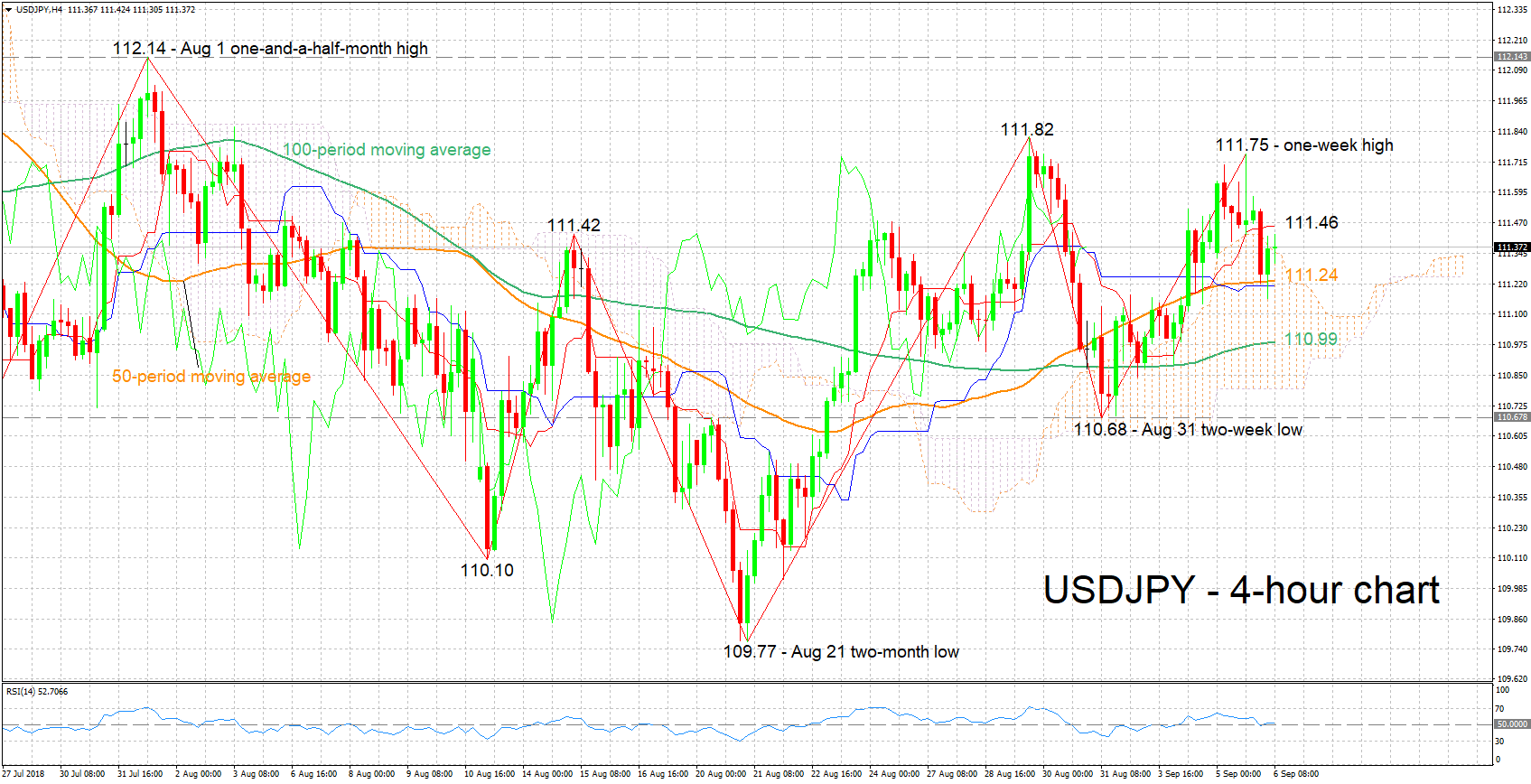
Technical Analysis: USDJPY looking neutral in the short-term
USDJPY lost some ground after climbing to a one-week high of 111.75 on Wednesday. The Tenkan- and Kijun-sen lines are positively aligned though they both have eased (the latter is flat), overall projecting a mostly neutral picture in the short-term. The RSI, which is largely moving sideways close to its 50 neutral level, is also supporting this view.
Overall positive data out of the US are likely to boost the pair. A move above the Tenkan-sen at 111.46 would turn the focus to yesterday’s one-week high of 111.75; the area around this includes another peak from the recent past. Not far above lies the August 1 one-and-a-half-month high of 112.14 which may also act as a barrier to price gains.
Downbeat US releases may push USDJPY lower. Support may come around the current level of the 50-period MA at 111.24; the zone around this includes the Ichimoku cloud top (111.35) and the Kijun-sen (111.21). Not far below lies the 100-period MA at 110.99, with the 111 round figure and the Ichimoku cloud bottom (110.79) being part of the area around it. Lower still, the two-week low of 110.68 from late August would be eyed.
Trade developments also have the capacity to move the pair.
Currency Majors Are Consolidating
Yesterday, a strong volatility was observed on the main currency pairs. The dollar index (#DX) closed in the negative zone (-0.33%). The GBP/USD currency pair showed the greatest activity. The pound's rate has started growing against the rumors about the progress of the Brexit negotiations. According to Bloomberg, Britain and Germany agreed on the abolition of key mutual requirements for the process of the country's exit from the EU. At the moment, the GBP/USD quotes are testing the round level of 1.2900.
The Bank of Canada, as expected, kept the key interest rate at the previous level of 1.50%. The regulator said that the country's economy is developing in accordance with the forecasts. At the same time, representatives of the Central Bank are concerned about continuous negotiations regarding new agreement on NAFTA. Investors expect a publication of important statistics on the US economy.
Oil quotes are moderately declining. At the moment, futures for the WTI crude oil are testing a mark of $68.60 per barrel. At 18:00 (GMT+3:00) data on the US crude oil inventories will be published.
Market Indicators
Yesterday, the major US stock indices showed mixed results: #SPY (-0.27%), #DIA (+0.07%), #QQQ (-1.29%).
At the moment, the 10-year US government bonds yield is at the level of 2.90-2.91%.
Important economic reports from the US on 06.09.2018:
Preliminary statistics on the US labor market at 15:15 (GMT+3:00);
The volume of industrial orders at 17:00 (GMT+3:00);
The index of economic activity in the non-manufacturing sector from ISM at 17:00 (GMT+3:00).