

Sample Category Title
China Tariffs, NAFTA talks and Bitcoin Plunge
Trump making headlines again on more embarrassing insider reports
US equity markets have been paring gains so far this week, on the back of the S&P 500 hitting new record highs, but they may be finding support with futures trading slightly in the green on Thursday.
This hasn’t been the most memorable week of the year so far, with it starting with a bank holiday in the US and major market news being few and far between. While Donald Trump has been making headlines again following the announcement of a new book from Bob Woodward and an article sourced from an anonymous official in the White House, both of which contain some embarrassing claims regarding the US President, none of this has had much impact on the markets even if they have drawn numerous angry Tweets.
The back end of the week promises to be far more interesting though, with the US jobs report being released on Friday – which always attracts the interest of investors – and attention once again falling on trade. Negotiations between the US and Canada are believed to have resumed on Wednesday in an attempt to overcome the differences that remain and end the often bitter and explosive talks.
Investors eyeing potential Chinese tariffs as consultation period expires
Heading in the opposite direction are negotiations with China, with the consultation period expiring today, many are expecting Trump to announce a further 25% tariff on $200 billion of Chinese imports. This would represent a significant ramping up of the trade war between the world’s two largest economies and show the US electorate ahead of the mid-terms that he will not shy away from his strategy, regardless of the warnings against doing so.
Trump’s approach to reducing trade deficits has not been widely supported – to say the least – and it has made investors very nervous which has acted as a drag on markets so far this year. The S&P 500 may be back at record highs and the Dow not far behind but this is largely due to the tax cuts that were passed late last year which have massively boosted earnings in the opening two quarters and perhaps disguised the impact that Trump’s trade approach has had.
Bitcoin plunges on reports that Goldman Sachs has postponed launching crypto desk
It’s been a rough 24 hours for the bitcoin and its peers, with reports that Goldman Sachs has postponed launching a cryptocurrency trading desk due to the uncertain regulatory landscape. This is a big blow for enthusiasts in the space as this would have been seen as evidence that big players in the financial world are finally taking it more seriously, with many – including JP Morgan CEO Jamie Dimon, among others – having ridiculed it in the past.
Bitcoin (CME) Daily Chart
Enthusiasts remain optimistic about the prospects for cryptocurrencies and see the launch of an ETF and the draw of institutional funds as being important for the next step, especially if the price is going to surpass its peak and reach some of the extraordinarily bullish highs that some are forecasting. The regulatory environment is going to be key to all of this and the fact that Goldman Sachs remains so concerned is clearly a blow. Whether it’s enough to send bitcoin below $6,000 where it’s found plenty of support this year, we’ll have to wait and see. At the moment, all we’re seeing is continued consolidation which has been the case for most of 2018.
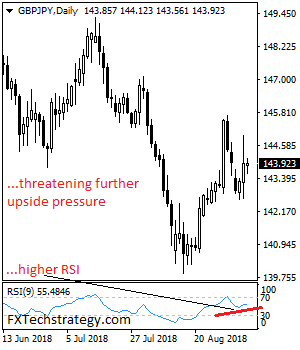
GBPJPY: Eyes Further Weakness. Targets 144.96 Zone
GBPJPY - The cross recovered higher on Wednesday opening the door for more strength. On the downside, support comes in at the 143.50 level where a violation will aim at the 143.00 level. A break below here will target the 142.50 level followed by the 142.00 level. Conversely, resistance is seen at the 143.50 level followed by the 144.00 level. A cut through that level will set the stage for a move further higher towards the 144.50 level. Further out, resistance resides at the 145.00 level. All in all, GBPJPY faces further upside pressure on correction.
Dollar Index Steady as Trade Deadline Clocks Down; ADP Employment Report in Focus
Here are the latest developments in global markets:
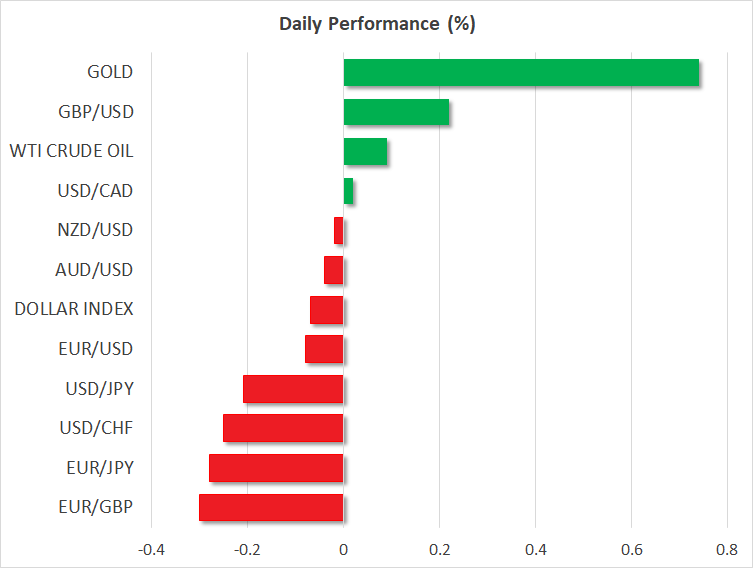
- FOREX: The pound continued the rally today that it posted yesterday on reports that Germany and the UK have dropped key Brexit demands after giving back some of them on Wednesday on new headlines that Germany has not changed position on Brexit. Pound/dollar rose by 0.26% above 1.2900, while euro/pound dropped by 0.29% below the 0.9000 round number. Furthermore, euro/dollar turned negative after it opened the day in the green, retreating by 0.06% to 1.1620 following disappointing German factory orders which fell by 0.9% in July instead of rising by 1.8% as analysts predicted. In June the gauge plunged by 4.0%. Dollar/yen was trading lower by 0.21% at 111.28 and the US dollar index was losing 0.07% ahead of a crucial trade deadline later today. In commodity-linked currencies, aussie/dollar, kiwi/dollar, and dollar/loonie held steady around their opening levels. It is worth to mention that on Wednesday, the BOC kept interest rates unchanged as was expected, while in the accompanying statement officials kept the door open for a rate increase at their upcoming gathering.
- STOCKS: European benchmarks were mixed at 1100 GMT. The pan-European STOXX 600 was steady and the blue-chip Euro STOXX 50 was down by 0.09%. Meanwhile, the German DAX, the French CAC 40 and the Italian FTSE MIB were trading higher by 0.07%, 0.16% and 0.31% correspondingly. However, the UK’s FTSE and the Spanish IBEX 35 declined by 0.14% and 0.65% respectively. In US stocks, the Dow Jones the S&P 500 and the tech-heavy Nasdaq 100 were poised to open higher according to E-mini futures.
- COMMODITIES: Oil prices were posting gains, though those were limited in magnitude. WTI crude edged up by 0.04% to $68.75 after the API weekly inventory report yesterday showed a 1.200-million-barrel drawdown. Brent rose by 0.26% to $77.47 per barrel. In addition, gold price is set to complete the second bullish day in a row, adding 0.74% to its performance as the dollar remained under pressure.
Day ahead: Trade deadline looms; ADP employment, factory orders, and ISM non-manufacturing PMI pending
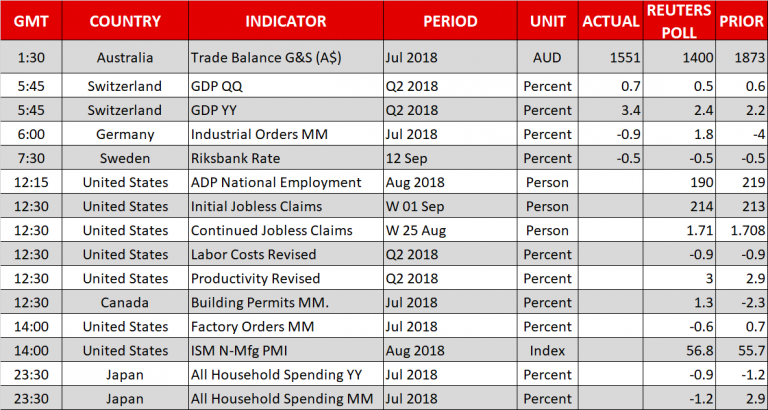
Thursday is expected to be another trade-dependent day for the markets as the US prepares to trigger another round of tariffs against China after the public comment period comes to an end today. Earlier, however, the ADP employment report, factory orders, and ISM non-manufacturing PMI out of the US could spread some volatility to the markets.
At 1215 GMT, the ADP research institute is expected to say that private non-farm job positions in the US increased by 190k in August after rising by 219k in the previous month, the highest growth recorded since April. While the report could be considered an early clue to the government’s jobs stats due on Friday, which are more comprehensive as they count for both public and private sectors, the correlation between the two has weakened over the past couple of years, with the ADP figure diverging more often from the NFP number.
A few minutes later at 1230 GMT, the US Department of Labor will publish its weekly jobless claims figures for the week ending September, while at the same time the Bureau of Labor Statistics will be issuing final quarterly estimates on labor unit costs and productivity for the second quarter. A bit later factory orders and ISM non-manufacturing PMI, which are of greater importance to investors, could bring some spikes to the markets. Forecasts are for the former to decline by 0.6% m/m in July after two straight positive months, while the latter is anticipated to climb from 55.7 to 56.8 in August. Recall that the ISM manufacturing PMI delivered on Tuesday surged to the highest in 14 years in the same month.
Still, traders could prefer to act cautiously during the day amid fears that trade risks could escalate to a new level following the end of the public comment on additional US import tariffs against China on Thursday. Should Trump press ahead with his threat of tariffs on $200 billion Chinese imports, marking the biggest attack against China in their month-long trade dispute so far, risk-off sentiment could fire up once again, with investors shifting funds out of riskier assets such as stocks. The action may raise voices in China as well, forcing Beijing to take countermeasures as China’s Commerce Ministry reiterated today; probably unleashing penalty duties on a $60 billion list of American products.
Out of the US, Brexit will be another persisting headache as the latest headlines on the topic brought some confusion to the markets. Yesterday, the German and the British governments softened their stance on Brexit demands according to people familiar with the matter, backing a less detailed agreement to get a deal done. While the statement increased optimism that the EU and the UK could come closer to solve their disagreements, shortly after a Reuters report said that German officials have not changed their views, pushing the pound back down.
In other areas of interest, Canada will see the release of building permits for the month of July at 1230 GMT. In Japan, July’s household spending will come out at 2330 GMT, while in Germany eyes will turn to industrial production and trade readings on Friday at 0600 GMT.
Emergency markets will be closely watched as trade uncertainties and political noises have weighed heavily on investors sentiment, with the Indian rupee collapsing to fresh record lows on Thursday. The Russian rubble was on the back foot as well, whereas the Turkish lira, the Argentine and the Mexican pesos, and the South African rand were somewhat recovering.
In oil markets, the Energy Information Administration will give its weekly updates on US oil inventories for the week ending September 1 at 1500 GMT.
In terms of public appearances, a number of speeches are scheduled for today. At 1145 GMT, Sabine Lautenschlager, member of the ECB’s Executive Board will be speaking at the Eurofi Financial Forum. At 1400 GMT, Federal Reserve Bank of New York President John Williams (permanent FOMC voting member) will be participating in a chat on the regional and national economy, while at 1845 GMT Bank of Canada Senior Deputy Governor Carolyn Wilkins will be commenting at Saskatchewan Trade and Export Partnership. A meeting between the French President Emanuel Macron and the Luxemburg Prime Minister, Xavier Bettel which will cover topics on the future of the European Union could be of interest as well.
Into US session: USD, CAD, EUR on the weak side as FX ranges. Singapore STI quite bearish
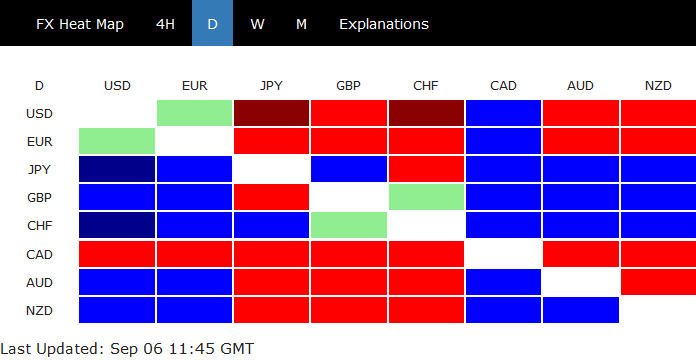
The forex markets are rather steady today, with most major pairs bounded in yesterday's range. US Dollar, Canadian Dollar and Euro are on the weaker side. On the other hand, Swiss Franc and Yen are the stronger ones, followed by Sterling. Economic data took a back seat again this week overall. Today's ISM services and ADP employment are unlikely to trigger persistent moves in the markets, given there will be non-farm payroll tomorrow. There are some central banker speaks scheduled ahead, including Fed Williams, SNB Zurbrugg and BoC Wilkins, and they may catch some attention.
Elsewhere, major European stocks somewhat stabilized from yesterday's steep selloff. FTSE is down -0.17% at the time of writing. DAX and CAC are up 0.12% and 0.26% respectively. Asian markets continued to be the bigger suffering in current concerns over emerging market crisis. Nikkei was down -0.41%, Hong Kong HSI was down -0.99%. China Shanghai SSE was down -0.47% at 2691.59, below 2700 handle. Singapore Strait Times dropped -0.27%. Gold rides on Dollar's weakness and is back at 1205. Focus is on 1209 minor resistance for indicating resumption of rise fro 1160.36.
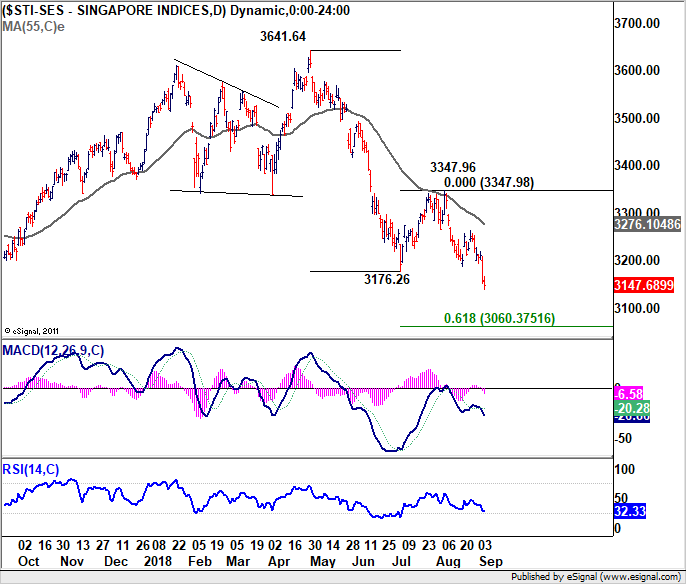
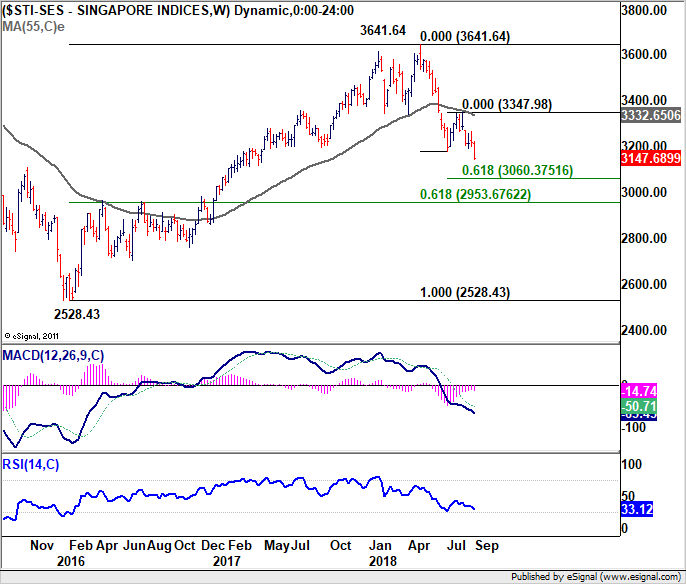
We hailed Singapore Strait Times as rather resilient a few weeks ago. But after our "blessing" the index turned south and never looked back. The technical development is rather bearish. STI was rejected both by 55 week and 55 day EMA. The index should now be correcting whole up trend from 2528.43 (2016 low) to 3641.64 (2018 high). Deeper fall should be seen to 61.8% projection of 3641.64 to 3176.26 from 3347.98 at 3060.37. There is project of hitting 61.8% retracement of 2528.43 to 3641.64 before completing the correction.
Gold and Oil Up For Now, But Will They Stay There?
Risk off sentiment pushing gold higher while crude investors focus on the supply side
Gold
Gold has begun to see the light while dollar faces weakness as it rose twice in the past two days. The greenbacks momentum being disturbed allows the precious metal to creep up and gain strength. This in turn has allowed investors with currencies other than the dollar to grasp the opportunity and buy cheaper gold. Spot gold had seen an increase of 0.3 percent which allowed the price to rise to $1,199.36. The yellow metal had touched the $1189 region on the 4th August. However, from this point onwards it has risen fairly. This alone emphasises how a weaker dollar can benefit gold.
The comeback is additionally supported by physical gold being purchased by investors. In addition, the current growth levels of gold and dollar weakening has enforced countries to invest more into the physical precious metal. In fact, India has gripped on to this opportunity of a weaker dollar to the point where gold imports have doubled this month in order to replenish gold to meet demand of the yellow metal. The gold imports in India has hit its highest in the last 15 months. Furthermore, a stronger decline in the dollar could drive the gold prices higher to the point of strong stability.
Oil
Oil prices on the decline is primarily because of the emerging market crisis which is present. The market price for U.S. West Texas Intermediate crude futures had dropped by 12 cents from the last session leaving the price at $68.60 per barrel. Additionally, Brent crude futures had dropped by 5 cents totalling the price to $77.22 per barrel. The decline in both prices is not solely due to the emerging market crises. The second reason is today marks the deadline for the U.S. trade tariffs of $200 billion on Chinese imports which brings about a lot of tension in the markets.
The possibilities of oil prices decreasing further in price are apparent. The Organisation of the Petroleum Exporting Countries sourcing more oil to cover the losses from Iran is up and coming which could affect the price. However, the markets are not yet exposed to the real rage of the U.S. sanctions on Iran will have. This is because at present the markets only receive a teaser of what is to come.
However, OPEC has stated that they believe oil demand to break into 100 million bpd for the first time this year. Therefore, this does provide some comfort to the markets as if demand is high at this rate and OPEC are successful in sourcing oil production to cover the losses in supply then the price may become balanced. However, for now due to recent and an on-going crises and trade tariffs, oil price has seen a decline. But this is to an extent as U.S. sanctions on Iran still support the price as supply drops.
Swiss government raised growth forecast after stronger than expected Q2 GDP
Swiss GDP grew faster than expected by 0.7% qoq in Q2, versus expectation of 0.5% qoq. The government also raised growth forecast for this year.
A government economist Ronald Indergand said that "for the year as a whole we could be looking at a growth rate much nearer to the 3 percent rate than 2 percent, which would be above the long-term average."
In the prior forecast, the government projected Swiss GDP to grow 2.4% in 2018, comparing to 1.6% in 2017.
Riksbank Pushes Back 1st Potential Rate Hike By A Few Months
Notes/Observations
Asia:
- Less appetite for safe havens in session
- Sweden’s Riksbank kept its policy steady (as expected) but pushed back its 1st potential rate hike until Dec/Feb period from its prior view of around year-end
- Swiss Q2 GDP handily beats expectations and has higher back quarter adjustments
- German July Factory Orders disappoint (MoM data has fallen in 4 of the last 5 months)
Asia:
- Australia July Trade Balance registered its 7th straight surplus (A$1.6B v A$1.9B prior)
- BOJ Board member Kataoka (dove; dissenter) noted that its forward guidance was no more effective than existing policies. Appropriate to do additional easing. BoJ should expand stimulus to quicken achievement of price target, instead of taking steps to continue easy policy for prolonged period. Seeking to guide super-long bond yields lower would help finance government spending
- South Korea Official: North and South Korea to hold summit on Sept 18-20 in North Korea
Americas:
- President Trump: We should know if Canada will be in trade deal in next two or three days, maybe today. If govt shutdown happens, it happens; reiterates willing to shut down the govt over border security funding
- Fed's Bostic (dove, voter): US economy was performing quite well; the economy was at full employment and inflation was at the 2% goal. Reiterated view that the economy was standing on its own, monetary policy should be neutral
- Fed's Kashkari (non-voter, dove): Still might be more labor market slack. Trade disputes pose a risk to the economy
Energy:
- Weekly API Oil Inventories: Crude: -1.2M v 0M (flat) prior
Economic Data:
- (NL) Netherlands Aug CPI M/M: 0.3% v 1.1% prior; Y/Y: 2.3% v 2.1% prior
- (NL) Netherlands Aug CPI EU Harmonized M/M: 0.4% v 0.5%e; Y/Y: 2.1% v 1.9%e
- (CH) Swiss Q2 GDP Q/Q: 0.7% v 0.5%e; Y/Y: 3.4% v 2.4%e
- (DE) Germany July Factory Orders M/M: -0.9% v +1.8%e; Y/Y: -0.9% v +1.9%e
- (CZ) Czech July National Trade Balance (CZK) -4.8B v -5.0Be
- (CZ) Czech July Industrial Output Y/Y: 10.3% v 8.3%e; Construction Output Y/Y: 15,8% v 5.5% prior
- (HU) Hungary July Industrial Production M/M: -2.0% v -1.2% prior; Y/Y: 3.9% v 8.0%e
- (MY) Malaysia Aug Foreign Reserves: $104.4B v $104.2B prior
- (DE) Germany Aug Construction PMI: 51.5 v 50.0 prior
- (SE) Sweden Central Bank (Riksbank) left Repo Rate unchanged at -0.50% (as expected); pushed back 1st potential rate hike until Dec or Feb
- (SE) Sweden Aug Average House Prices (SEK): 2.930M v 2.820M prior
- (ZA) South Africa Q2 Current Account Balance (ZAR): -164B v -151Be; Current Account to GDP Ratio: -3.3% v -3.3%e
- (GR) Greece Jun Unemployment Rate: 19.1% v 19.3% prior
- (IS) Iceland Aug Preliminary Trade Balance (ISK): -14.5B v -13.0B prior
Fixed Income Issuance:
- (IN) India sold total INR180B vs. INR180B indicated in 3-month, 6-month and 12-month bills
- (ES) Spain Debt Agency (Tesoro) sold total €4.375B vs. €4.0-5.0B indicated range in 2023, 2028 and 2048 Bonds
- Sold €1.908B in 0.35% July 2023 SPGB; Avg yield: 0.410% v 0.368% prior; Bid-to-cover: 1.70x v 3.38x prior
- Sold €1.587B in 1.40% Apr 2028 SPGB; Avg yield: 1.432% v 1.422% prior, Bid-to-cover: 1.41x v 1.50x prior
- Sold €880M in 2.7% Apr 2048 SPGB; Avg Yield: 2.583% v 2.225% prior; Bid-to-cover: 1.58x v 1.27x prior
- (ES) Spain Debt Agency (Tesoro) sold €545M vs. €250-750M indicated range in 0.30% Nov 2021 Inflation-Linked bonds (SPGBei); Real Yield: -1.285% v -1.578% prior; Bid-to-cover: 3.1x v 2.67x prior
- (FR) France Debt Agency (AFT) sold total €8.5BB vs. €7.5-8.5B indicated range in 2028, 2031, 2034 and 2066 bonds
- Sold €3.36B in 0.75% Nov 2028 Oat; Avg Yield: 0.71% v 0.67% prior; Bid-to-cover: 1.95x v 1.91x prior
- Sold €2.513B in 1.50% May 2031 Oat; Avg Yield 0.92% v 0.98% prior; Bid-to-cover: 1.38x v 1.70x prior
- Sold €1.375B in 1.25% May 2034 Oat; Avg Yield: 1.11% v 1.04% prior; Bid-to-cover: 1.60x v 2.23x prior
- Sold €1.252B in 1.75% May 2066 Oat; Avg Yield: 1.81% v 1.91% prior, Bid-to-cover: 1.69x v 1.24x prior
SPEAKERS/FIXED INCOME/FX/COMMODITIES/ERRATUM
Equities
- Indices [Stoxx600 +0.2% at 376.2, FTSE +0.1% 7393, DAX +0.4% at 12084, CAC-40 +0.4% at 5279, IBEX-35 -0.5% at 9253, FTSE MIB +0.7% at 20721, SMI +0.2% at 8886, S&P 500 Futures +0.1%]
- Market Focal Points/Key Themes: European Indices trade mostly higher across the board, reversing earlier losses tracking US futures. Upbeat earnings from Safran lifts the French CAC with strong earnings and guidance raise lifting the stock over 5%. Bovis Home, Dixons Carphone, Go-Ahead are among other notable names trading higher following results. Meanwhile Sodexo trades lower on its longer term outlook, with Uponor another notable decliner after cutting its Op profit outlook. Looking ahead notable earners include GIII apparel, Dell Technologies and Lands End.
Movers
- Consumer Discretionary Dixons Carphone [DC.UK] +1.7% (Trading update), Go Ahead [GOG.UK] +14% (Earnings), McCarthy & Stone [MCS.UK] +2.8% (Earnings), Sodexo [SW.FR] -4.5% (Outlook)
- Industrials Safran [SAF.FR] +5.9% (Earnings)
- Financials Commerzbank [CBK.DE] -1.1% (Removed from DAX 30 Index), Just Group [JUST.UK] +0.5% (Earnings)
- Real Estate Bovis [BVS.UK] +4.6% (Earnings)
- Energy Centrica [CNA.UK] +4% (Ofgem price cap announcement)
Speakers
- Sweden Central Bank (Riksbank) Policy Statement noted that if the economy developed as expected, there would soon be scope to slowly reduce the support from monetary policy.. It saw Repo Rate holding steady in October then raised by 25bps at either in December or February meeting. Policy to be expansionary for a long period of time and if conditions for inflation changed then Board was prepared to adjust monetary policy. Important for SEK currency (Krona) development to be compatible with inflation target . Dep Gov Ohlsson entered reservation on Repo Rate and the rate path while Dep Gov Floden entered reservation on rate path
- Sweden Central Bank (Riksbank) Gov Ingves post rate decision press conference: There would soon be room to reduce monetary stimulus; rates to be raised in either Dec or Feb
- France Fin Min Le Maire: Domestic growth seen around 1.7%
- Italy govt said to be heading towards €30B budget adjustment with budget deficit between 2.0-2.5% (**Note: would stay within EU rules)
- German IFO Institute raised its 2018 GDP growth from 1.8% to 1.9%. Forecasted 2019 GDP at 1.9%and 2020 GDP at 1.7%
- Germany said to prepare help for companies impacted by the Brexi. T o change reorganization act so that companies founded as English Limited firms could be changed into domestic companies
- South Africa Cabinet Statement reaffirmed its commitment to fiscal sustainability
- Russia Econ Min Oreshkin stated that sanctions would not cause a recession. Economy would be stable in case of any external volatility . Saw CPI between 4.5-5.0% area in Q1 2019 due to VAT hike. Weaker RUB currency (Ruble) to stimulate export activity
- Russia Central Bank Zabotkin (Monetary Policy Chief): To keep monetary policy stance tight at least to 2019. Neutral nominal rate seen between 6.00-7.00%. Current conditions seen as almost neutral
- Philippines Central Bank Dep Gov Guinigundo reiterated view that the domestic economy couldn withstand effects from rate hikes so far and was not ruling out more rate adjustments
- China Commerce Ministry (MOFCOM) spokesperson: China and US have maintained contact on working level. To take necessary retaliatory measures based on US actions
- **Reminder: The public comment period related to the US’ proposed tariffs on $200B in China goods due to end on Sept 6th (Thursday).
Currencies
- Less appetite for safe havens in session kept the USD steady against the major pairs with EUR/USD at 1.1630 area and USD/JPY at 111.35 just ahead of the NY morning.
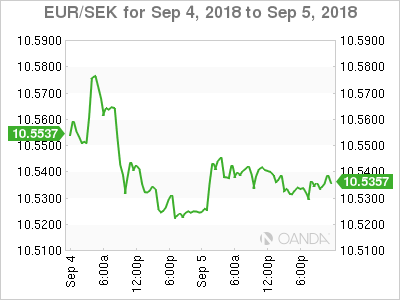
- The EUR/SEK was higher after the Riksbank pushed back its 1st potential rate hike until Dec/Feb period from its prior view of around year-end. Cross holding above 10.56, higher by 0.3% in the session
Fixed Income
- Bund Futures trades at 160.01 up 3 ticks as European markets trade lower amid emerging markets sell-off. Resistance moves to 161.82 then 163. A downside break of 159.85 sees 158.69 initially.
- Gilt futures trades at 122.47 up 10 ticks following the move in Treasuries. Continued support at 122.50, with a continued move higher targeting 123.93 then 124.00.
- Thursday 's liquidity report showed Wedneday's excess liquidity fell from €1.924T to €1.920T. Use of the marginal lending facility fell from €41M to €41M.
- Corporate issuance saw 13 issuers raise $22.5B in the primary market
Looking Ahead
- (IL) Israel Aug Foreign Currency Balance: No est v $115.8B prior
- (RU) Russia Aug Light Vehicle Car Sales Y/Y: 12%e v 11% prior
- 05:30 (HU) Hungary Debt Agency (AKK) to sell 12-Month bills
- 05:30 (PL) Poland to sell Bonds
- 05:30 (UK) DMO to sell £3.0B in 1.00% Apr 2024 Gilts
- 06:00 (IE) Ireland Aug Live Register Monthly Change: No est v -2.2K prior; Live Register Level: no est v 217.7K prior
- 06:45 (US) Daily Libor Fixing
- 07:00 (UR) Ukraine Central Bank Interest Rate Decision: Expected to raise Interest Rates by 25bps to 17.75%
- 07:00 (ZA) South Africa July Electricity Production Y/Y: No est v 0.3% prior; Electricity Consumption Y/Y: No est v 0.6% prior
- 07:00 (BR) Brazil Aug FGV Inflation IGP-DI M/M: 0.8%e v 0.4% prior; Y/Y: 9.2%e v 8.6% prior
- 07:30 (US) Aug Challenger Job Cuts: No est v 22.1K prior; Y/Y: No est v -4.2% prior
- 07:45 (DE) ECB’s Lautenschlaeger at Eurofi Financial forum in Vienna
- 08:00 (CL) Chile July Nominal Wage M/M: No est v 0.1% prior; Y/Y: No est v 2.7% prior
- 08:00 (BR) Brazil Aug IBGE Inflation IPCA M/M: 0.0%e v 0.3% prior; Y/Y: 4.3%e v 4.5% prior
- 08:05 (UK) Baltic Dry Bulk Index
- 08:15 (US) Aug ADP Employment Change: +200Ke v +219K prior
- 08:30 (US) Q2 Final Nonfarm Productivity: 3.0%e v 2.9% prelim; Unit Labor Costs: -0.9%e v -0.9% prior
- 08:30 (US) Initial Jobless Claims: 213Ke v 213K prior; Continuing Claims: 1.72Me v 1.708M prior
- 08:30 (CA) Canada July Building Permits M/M: +1.0%e v -2.3% prior - 09:00 (RU) Russia Gold and Forex Reserve w/e Aug 31st: No est v 457.1B prior
- 09:00 (MX) Mexico Jun Gross Fixed Investment: 2.2%e v 0.9% prior
- 09:45 (US) Aug Final Markit Services PMI: 55.2e v 55.2 prelim; Composite PMI: No est v 55.0 prelim
- 10:00 (US) Aug ISM Non-Manufacturing Index: 56.8e v 55.7 prior
- 10:00 (US) July Factory Orders: -0.6%e v +0.7% prior; Factory Orders (Ex-Transportation: No est v 0.4% prior
- 10:00 (US) July Final Durable Goods Orders: -1.7%e v -1.7% prelim; Durables Ex Transportation: No est v 0.2% prelim; Capital Goods Orders (Non-defense/ex-aircraft): No sst v 1.4% prelim; Capital Goods Shipments (Non-defense/ex-aircraft): No est v 0.9% prelim
- 10:00 (US) Fed’s Williams (moderate, voter)
- 10:20 (BR) Brazil Aug Vehicle Production: No est v 245.8K prior; Vehicle Sales: No est v 217.5K prior; Vehicle Exports: No est v 51.4K prior
- 11:00 (US) Treasury announcement for upcoming 3-year, 10-year and 30-year bonds
- 12:30 (CH) SNB’s Zurbruegg - 14:30 (CA) Bank of Canada (BOC) Wilkins
Trade And Tariff Agenda Dominate Thursday
Thursday September 6: Five things the markets are talking about
Global equities again are on the back foot, with a number of regional bourses trading atop of their lowest close of the year, as investors consider the risk of weaker growth thanks due to emerging market worries.
The U.S dollar continues to hang tough, while the yen has its supporters. EM currency pairs are weaker as the South African rand and Turkish lira remain under pressure.
In fixed income, U.S Ten-year note yields are holding steady, while Euro bonds trade mixed.
Sino-U.S tit for tat to persist
Immediate market focus now shifts to China on trade and tariffs. Today is D-day for U.S President Trump to implement fresh tariffs on another +$200B in Chinese imports. Investors can expect China to closely watch the impact from any fresh tariffs and adopt strong counter measures.
Note: The public consultation period on Trumps intent to impose additional tariffs on Chinese goods ends midnight Thursday.
In other trade news, the Canada-U.S trade talks seem to be making progress to revise Nafta, the CAD has found some early Thursday support.
1. Asian shares a sea of red on trade and EM worries
Asian bourses slipped for a sixth consecutive session overnight, with investor confidence shaken by the EM fallout and worries over an escalation in the U.S-China trade war.
In Japan, the Nikkei fell on the back of broad weakness in global equities, while the market waits damage assessments after a powerful earthquake in Hokkaido. The Nikkei share average dropped -0.4%, while the broader Topix fell -0.7%.
Down-under, the Aussie stock market saw ‘red’ amid investor concerns of a house price squeeze as three of the top four domestic lenders hiked their mortgage rates citing higher funding costs. The ASX/S&P closed down -1.1%, as investors digested the prospect that rising rates would hurt home prices further. In S. Korea, the Kospi index fell as EM turmoil and worries over a potentially escalation in the Sino-U.S trade war hurt sentiment.
In China and Hong Kong, shares naturally came under pressure ahead of expected U.S tariffs. China’s blue-chip index fell -1.2% while Hong Kong’s Hang Seng index stumbled -1.5%.
In Europe, regional bourses are trading mostly higher across the board, reversing earlier losses tracking U.S futures.
U.S stocks are set to open in the ‘black’ (+0.1%).
Indices: Stoxx600 +0.2% at 376.2, FTSE +0.1% 7393, DAX +0.4% at 12084, CAC-40 +0.4% at 5279, IBEX-35 -0.5% at 9253, FTSE MIB +0.7% at 20721, SMI +0.2% at 8886, S&P 500 Futures +0.1%
2. Oil dips on EM concerns, but looming Iran sanctions support, gold higher
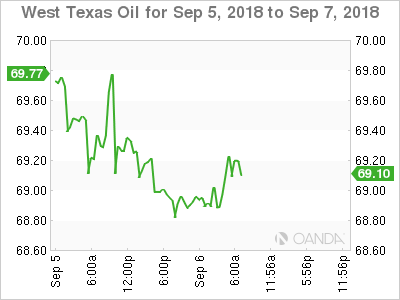
Oil prices have dipped this morning as EM worries weighed on investor sentiment, while Trump’s public consultation period deadline for China nears. However, U.S sanctions against Iran have prevented prices from falling further as they are expected to tighten market supply.
Brent crude futures fell -4c, to +$77.23 a barrel, while U.S West Texas Intermediate (WTI) crude futures are at +$68.59 per barrel, down -13c cents, or -0.2% from Wednesday’s close.
Data yesterday showed that U.S crude stockpiles fell last week as refineries boosted output amid strong consumption. API data showed that U.S crude inventories fell by -1.17M barrels to +404.5M barrels in the week to Aug. 31, while refinery crude runs rose by +198,000 bpd.
OPEC yesterday said it expected global oil demand to break through +100M bpd for the first time this year.
Note: U.S sanctions against Iran are expected to tighten global supply, while Venezuela remains another ‘hot spot’ where a government and political crisis has cut oil production by -50% in the last two-years to more than +1M bpd.
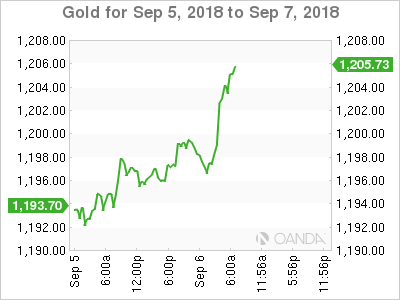
Ahead of the U.S open, gold prices have inched a tad higher, supported by physical buying and as the ‘big’ dollar remained range bound, but a weaker yuan amid worries of pending U.S tariffs on China is capping the ‘yellow’ metals gains for the time being. Spot gold is up +0.1% at +$1,197.38, after rising +0.5% yesterday. U.S gold futures have rallied +0.1% at +$1,202 an ounce.
3. Sweden’s Riksbank changes tightening timing
This morning, Sweden’s Riksbank left interest rates on hold at -0.5% and pushed back its forecasts for when it expects to raise interest rates. The Riksbank said it expects to leave rates on hold next month (dovish), raising them in either December or February, having previously flagged a likely rate rise in Q4, 2018. The Riksbank cut its average repo rate forecast for Q4 to -0.5%, from -0.43% previously.
Note: Although Sweden’s inflation is close to the +2% target, this is largely due to higher energy prices, and while measures of underlying inflation indicate inflationary pressures are “still moderate.” EUR/SEK has rallied +0.6% to around €10.6050.
The rally in Italian government bonds this week, which has been driving yields lower, has been pushing German Bund yields higher (+0.38%), indicating less appetite for safe-havens. The spread of Italy’s 10-year bonds over Germany’s has climbed +16 bps.
Note: German Bund yields are expected to come under more upward pressure today with heavy bond supply from Spain and France pending.
Elsewhere, the yield on U.S 10-year Treasuries fell less -1 bps to +2.90%. In the U.K, the 10-year Gilt yield has gained less than +1 bps to +1.404%.
4. Dollar trades steady
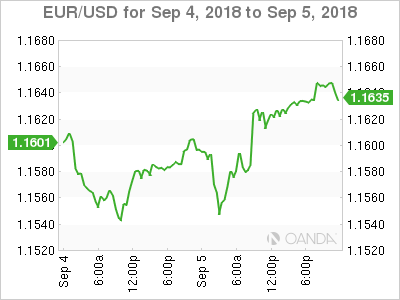
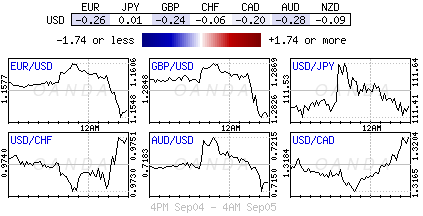
A lack of market appetite for safe havens currency pairs overnight has kept the USD confined against G7 FX pairs – EUR/USD at €1.1623 area, USD/JPY at ¥111.35 and GBP/USD at £1.2935 ahead of the open stateside.
The EUR/SEK is higher after the Riksbank pushed back its first potential rate hike until Dec/Feb period from its prior view of around year-end. The cross is holding above €10.58.
Down-under, a fall in Australia’s exports in July resulted in a narrowing of the country’s trade surplus. Data released this morning showed that Australia July Trade Balance registered its seventh consecutive surplus – A$1.6B vs. A$1.9B prior. AUD/USD slid marginally with the pair currently trading at A$0.7185.
Emerging market currencies continue to weaken with South Africa’s ZAR trading atop of its new two-year low around the $15.30, while TRY is off its intraday session highs at $6.6016.
5. German manufacturing orders drop
Euro data this morning showed that Germany’s manufacturers registered weak orders in July amid a sharp drop in demand from outside the eurozone. This would suggest that global trade tensions are already weighing on companies’ appetite for investments.
Total manufacturing orders fell -0.9% on the month, worsening June’s -3.9% orders drop. Market expectations were looking for a headline gain of +1.7%.
Germany’s economics ministry said that “global uncertainties from trade conflicts” as well as “temporary bottlenecks” in the approval of new passenger cars due to the new WLTP emissions-testing protocol were partly to blame.
“The backlog of orders in the manufacturing sector is still very high and the business climate has even improved recently,” the ministry said.
Digging deeper, while domestic orders rose +2.4% in July m/m, foreign orders dropped -3.4% led by a -4.0% fall in demand from outside the eurozone.
DAX Sinks To 5-Month Low, German Factory Orders Slips
The DAX index is trading sideways in the Thursday session. Currently, the index is at 12,038, down 0.01% on the day. On the release front, German Factory Orders declined 0.9%, missing the estimate of +1.8%. On Friday, Germany releases industrial production and trade balance, while the eurozone will release GDP. The U.S will release one of the most important economic indicators, nonfarm payrolls.
This week’s German manufacturing indicators have been soft. This has raised concerns about the strength of the German economy and weighed on the equity markets. The DAX is having a dismal week, dropping some 2.5 percent. On Thursday, the DAX dropped below the symbolic 12,000 level for the first time since early April. Factory orders dropped 0.9% in July, its fourth decline in five months. New orders were down in the eurozone as well as in other countries, as weaker growth in the eurozone and elsewhere has taken a bite out of the manufacturing sector. Earlier in the week, Germany, Final Manufacturing PMI fell from 56.9 to 55.9 points. Although this is a respectable reading, it is significantly lower than the readings we saw early in 2018, when the indicator was above the 60-level. We’ll get another look at German industrial data on Friday, with the release of Industrial Production. The markets are expecting a small gain of 0.2%.
The trade war continues to spook investors and weigh on the equity markets. Investors are keeping an eye on the White House, as President Trump could announce further trade sanctions against China as early as today. Trade tensions have been on the rise since April, when the U.S started imposed tariffs to protest its claim of unfair trade practices by its trading partners, in particular, China. The dollar has benefited from the global trade war, and further tariffs against China could boost the greenback and send gold prices lower.
EUR/USD – Euro Shrugs Off Weak German Industrial Data
EUR/USD has recorded small losses in the Thursday session. Currently, the pair is trading at 1.1624, down 0.07% on the day. On the release front, German Factory Orders declined 0.9%, missing the estimate of +1.8%. In the U.S, the focus will be on key employment indicators. ADP nonfarm payrolls is expected to slide to 195 thousand and unemployment claims are forecast to tick higher to 214 thousand. As well, ISM Non-Manufacturing PMI is expected to improve to 56.8 points. Friday will be busy, so traders should be prepared for some movement from EUR/USD. Germany releases industrial production and trade balance, while the eurozone will release GDP. In the U.S, there are three key employment indicators – nonfarm payrolls, wage growth and the unemployment rate.
This week's German manufacturing indicators have been soft. This has weighed on the euro and also raised concern about the strength of the German economy, the largest in the eurozone. Factory orders dropped 0.9% in July, its fourth decline in five months. New orders were down in the eurozone as well as in other countries, as weaker growth in the eurozone and elsewhere has taken a bite out of the manufacturing sector. Earlier in the week, Germany, Final Manufacturing PMI fell from 56.9 to 55.9. Although this is a respectable reading, it is significantly lower than the readings we saw early in 2018, when the indicator was above the 60-level. We'll get another look at German industrial data on Friday, with the release of Industrial Production. The markets are expecting a small gain of 0.2%.
The U.S dollar remains strong, as trade tensions boosted the U.S dollar against its major rivals. Nervous investors are keeping an eye on the White House, as President Trump could announce further trade sanctions against China as early as today. Trade tensions have been on the rise since April, when the U.S started imposed tariffs to protest its claim of unfair trade practices by its trading partners, in particular, China. The dollar has benefited from the global trade war, and further tariffs against China could boost the greenback and send gold prices lower.