

Sample Category Title
Boston Fed Rosengren: More policy buffers needed to mitigate future shocks
Boston Fed President Eric Rosengren warned in a paper, to be presented at a conference this week end, that the current policy buffers , "may not be sufficient to offset future shocks, reducing the capacity available to policymakers to insulate the economy from future adverse shocks". And he urged "more attention should be given to establishing appropriate policy buffers to mitigate future shocks."
And, Fed should either build a "larger monetary policy buffer" or be ready to use unconventional tools more aggressively. He added that "these tools have proven to be politically controversial, making their aggressive deployment, or even their deployment at all, less certain in response to a future economic downturn."
Chicago Fed Evans reiterated interest rate could go beyond neutral
Chicago Fed published yesterday a speech of its President Charles Evans titled "Back to the Future of Monetary Policy", originally intended to be delivered to a conference earlier this week in Argentina.
There Evans reiterated his stance that Fed the current economic outlook "entail moving policy first toward a neutral setting and then likely a bit beyond neutral". That was for helping the transition of the economy onto a "long-run sustainable growth path with inflation at our symmetric 2 percent target."
He added that "we may need to tighten somewhat further if currently unexpected tailwinds emerge that push the economy well beyond sustainable growth and employment levels, potentially leading to unacceptably high inflation beyond our symmetric objective." For example, "forward momentum imparted by earlier monetary accommodation" might be underestimated. And, there could be "greater-than-expected fiscal impetus from the recent tax cuts and spending increase".
On the other hand, "the emergence of currently unexpected headwinds could dictate a shallower policy path." For example, trade uncertainties could generate "adverse effects on business sentiment and spending". And, " firming in inflation expectations could stall out before expectations are clearly centered about 2 percent".
Market Morning Briefing: Dollar Yen Is Testing Support On 3 Day Candles Near 110.50
STOCKS
Dow (25995.87, +0.080%) is stable and is ranged just now. A test of 25750-25250 looks possible on the lower side but there is enough room towards 26250 and higher levels too. Trading right in the middle of the up-channel on the daily chart, there is now equal chances of moving on either side.
Dax (11955.25, -0.71%) is headed towards weekly support near 11600 and looks bearish in the near term. The price is strongly under the control of the bears and may continue to decline over the coming week. A slight pause could be expected near 11800 before it resumes towards lower levels of 11600.
Nikkei (22264.11, -1.00%) has fallen 1% and could come down to test daily candle support near 22000 from where a short term bounce is possible. Immediate view is bearish.
Shanghai (2709.71, +0.67%) has resistance at 2750 and has to break above this to move up further. While copper looks slightly bullish, shanghai could see limited fall and could either remain ranged or try to move up from here. While below 2750, downside cannot be negated.
Nifty (11536.90, +0.52%) has immediate support at 11400. Yesterday the index rose, moving back above 11500 and if this sustains, it could move back to re-test 11600+ levels soon. Else a test of 11400 at least could be possible in the near term.
COMMODITIES
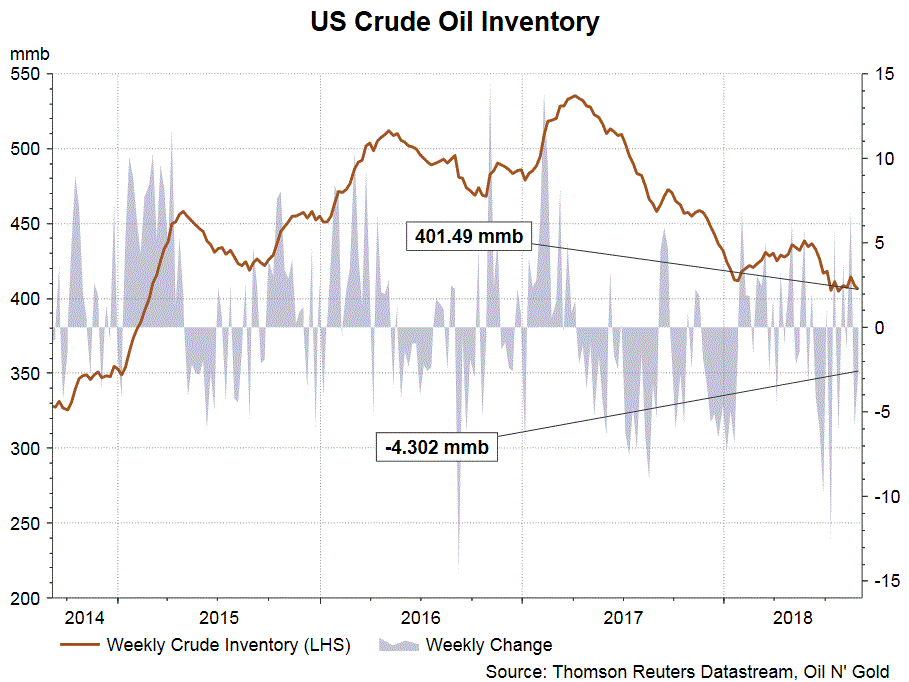
Crude prices rise slightly after release of the US inventory data that states a fall to Feb'15 low of 401.49 mln barrels.
Although the crude prices are trading slightly higher just now, the resistance on the Brent (76.65) daily chart may hold and eventually push the prices to lower levels in the near term.
WTI (67.87) could be dragged down towards 66, if Brent comes off just from the mentioned resistance.
Gold (1207.70) has possibly seen it's low in August and could now start moving upwards slowly. While above 1190, the price could move up towards 1215-1220 in the near term. Very short term support near 1200 may hold just now. Trade in the 1220-1200 region looks likely in the coming 1-2 weeks with a possible downside extension to 1190 and some sessions of ranged sideways movement.
Copper (2.6365) has risen a bit in line with our expectations of a possible test of 2.65. Medium term support near 2.58-2.60 may hold while copper slowly inches up in the near term. A sustained break above 2-65 and further above 2.70 is needed to establish a medium term low and continue rising higher in the longer run. Till then a fall back towards 2.60 cannot be ruled out.
FOREX
Both Euro-Dollar and Dollar Rupee have a crucial next 2-3 sessions ahead. Inability to break above 1.165-1.170 by EURUSD would increase chances of bearishness below 1.155. On USDINR, failure to correct to 71.70-60 in today's session might lead to another rally - this time towards 72.35.
Euro (1.1624): Resistance near 1.165-1.170 and support near 1.16 on daily candles are currently holding for Euro. Lower down, there is support near 1.155 as well. Currently, a break above 1.17 or below 1.155 would be significant - either case would establish the trend for the next move. Our preference is tilted towards the bearish side ie towards a break below 1.155. Maybe the markets are awaiting the ECB meeting next week.
Dollar Index (95.00) : Symmetrical with the situation on Euro charts, Dollar Index has support in the 95.0-94.5 zone and resistance slightly above near 95.5. A breach above 95.5 could correspond with a break below 1.155 on Euro while a break below 94.5 could happen if Euro breaches 1.17. Preference is for a breach above 95.5.
Dollar Yen (110.61) is testing support on 3 day candles near 110.50. A break below 110.50 could lead to a test of previous low near 109.75. While above 110.5, a rise back towards 111-112 remains possible.
Euro Yen (128.57) is staying below the 21 weeks MA near 129.50. A week close below 129.50 would increase chances of bearishness in the next week. On weekly line chart, support trendline near 128 would have to be broken in the next 1-2 weeks to open up lower levels.
Pound (1.2928): Immediate resistance near 1.295 on daily candles is holding on Pound for now. Higher up, there is crucial resistance near 1.305-1.310. We expect a correction in the near term - either from current levels or after a small rise to 1.305.
Turkish Lira (6.579) looks like it could move down towards support near 6.46 in the next week.
Dollar Rupee (71.99):
If a correction towards 71.70-60 is not seen in today's session, the chances of a test of 72.35 rises. We are looking for a correction in the near term- either from the 72.10 resistance, or from 72.35.
Euro-Rupee (83.657) : Crucial resistance near 84. Could produce a dip in the near term.
INTEREST RATES
In the absence of any step by the government, he Indian 10 year GOI (8.056%) could again rise towards 8.10%-8.15% in the near term. Levels near 7.9%-7.8% become crucial support levels in the weeks ahead - while above these levels, bullishness in the Indian 10 year yield could persist.
Following news points are currently important in context of US Yields:
Slight disappointment in employment data - which led to a dip in US yields.
Improvement in US manufacturing data released on Tuesday (bullish for yields).)
USA and Canada's inability to reach a trade deal (bearish for yields)
Impending possibility of $200 bn worth of tariifs by USA on China (very bearish for yields)
Note that the May high of 3.125% for the US 10 year yield might have been the year's top.
US 10 Year Yield (2.88%) is starting to dip again from the 2.9% resistance level. Another downmove towards 2.85%-2.82% could be on the cards. Crucial support at 2.82% would need to break decisively for lower levels to be tested.
Japan 10 year bond yield (0.10%) has again dipped after testing resistance near 0.12%. Levels near 0.12%-0.13% are slowly getting established as the new resistances for the Japanese 10 year bond yield (earlier the resistance was near 0.10%).
USDJPY dipped as Japan could be Trump’s next trade target
USD/JPY weakened notably over night and took out 110.68 minor support. Risk aversion could be a factor with NASDAQ losing -0.91% to close at 7922.73, and broke 7933.31 near term resistance turned support. US treasury yield also softened with 10 year yield closed down -0.79 at 2.879. Another factor behind the move could be reports that Trump is target Japan next on his trade policy.
The news started with WSJ's James Freeman, which Trump called after the former praised his tax and regulatory reforms on Fox News. Freeman wrote that "the President sees a problem and even if he wraps up negotiations with our friends in North America and Europe, the trade uncertainty won't necessarily end." And, "seems that he is still bothered by the terms of U.S. trade with Japan." Freeman also noted that Trump "described his good relations with the Japanese leadership but then added: 'Of course that will end as soon as I tell them how much they have to pay.'"
We'd like to emphasize that we're skeptical about the news. What is the purpose of a President calling a writer of the fake news media to leak some information? It doesn't make much sense to us.
BoC Wilkins: Trade developments have both downside and upside risks, gradual rate hike still appropriate
BoC Senior Deputy Governor Carolyn Wilkins delivered "An Update on Canada's Economic Resilience" yesterday. The most important part of the speech is that Wilkins said "Our practice is to not incorporate scenarios that have yet to occur, even though they may be the subject of ongoing discussions" And, risks of trade tensions "are not just on the downside", but "there is some significant upside as well." She emphasized that trade developments can result in "complex trade-offs for monetary policy." And, after considering all factors, "the bottom line is that Governing Council agreed that the gradual approach we have been following is still appropriate."
In short, Wilkins suggested that BoC is still on course for further rate hikes despite uncertainty of NAFTA negotiations. And that gave a nod to market expectation of an October hike. Canadian Dollar was lifted by her speech.
In the speech, she noted that most recent data indicates growth to "average near potential" over the new few years. Q2's strong rebound in GDP, 2.9% annualized, supported the central bank's July rate hike. She added that quarterly profile of GDP growth will be "volatile" for the rest of 2018, but to "still average around 2%". Even though temporary factors that pushed up exports in Q2 will unwind in Q3, the factors "do not point to weaker underlying momentum".
On inflation, she noted that wages were rising "less quickly" than expected in an economy that's "near capacity". And this is "still the case". July's headline inflation data "surprised" on the upside at 3% because of "temporary factors" but not "pressure from excess demand". Instead, core measures remained at around 2% "supporting our assessment that the inflation increase will be temporary."
On trade tensions, Wilkins said they're "among several factors keeping them from investing in new capacity". BoC estimated that "combination of reduced confidence and trade measures already taken will shave about two-thirds of 1 per cent from GDP in Canada by 2020". Canada's countermeasures on trade will "temporarily boost inflation by about 0.1 percentage point until the third quarter of 2019." She also emphasized that trade developments can result in "complex trade-offs for monetary policy". On the one hand, protectionist measures can be costly in terms of growth and incomes. On the other hand, protectionist measures create risks to the upside for inflation, especially when the economy is operating near full capacity.
USD/JPY Breaks Down Below 110.80 Ahead of US NFP
Key Highlights
- The US Dollar struggled on two occasions to break the 111.80 resistance against the Japanese Yen.
- There was a double top pattern formed with resistance at 111.80-82 on the 4-hour chart of USD/JPY.
- The US ADP Employment Change in August 2018 was 163K, less than the 190K forecast.
- Today, the US NFP figure for August 2018 will be released, which is forecasted to post an increase of 191K.
USDJPY Technical Analysis
The US Dollar remained supported this week above the 110.50 pivot level against the Japanese Yen. However, the USD/JPY pair also struggled to break the 111.80 resistance zone and declined recently
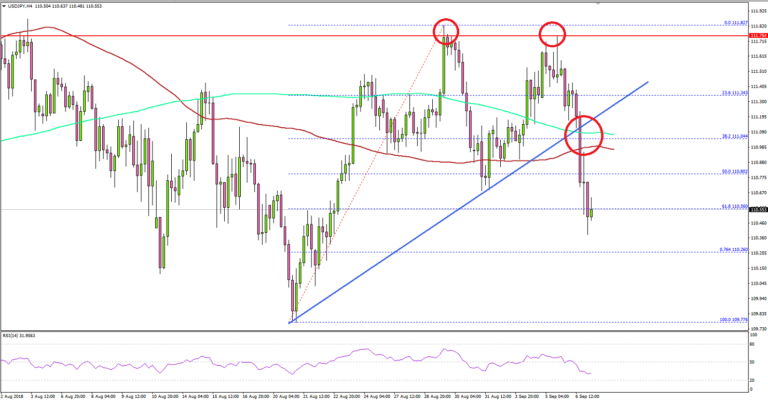
Looking at the 4-hours chart, the pair failed for the first time at 111.82 and declined sharply. It broke the 111.00 support and traded below the 38.2% Fib retracement level of the last wave from the 109.77 low to 111.82 high.
However, losses were protected by the 110.80 support, the 100 simple moving average (red, 4-hours), and the 50% Fib retracement level of the last wave from the 109.77 low to 111.82 high.
The pair bounced back above the 111.00 and 111.50 levels, but sellers once again protected the 111.80 resistance. USD/JPY was rejected, which means there was a double top pattern formed with resistance at 111.80-82.
The pair traded lower and broke a bullish trend line with support at 111.00, the 200 simple moving average (green, 4-hours), and the 100 SMA (red). It opened the doors for more losses towards the 110.50 and 110.20 levels.
In the short term, if the pair corrects higher, it could find resistance near the 110.80 level and the 100 SMA. On the downside, the next major support is at 110.20 followed by the 110.00 level.
Recently, the US ADP Employment Change for August 2018 was released by the Automatic Data Processing, Inc. The market was looking for a change of 190K compared with the last 219K.
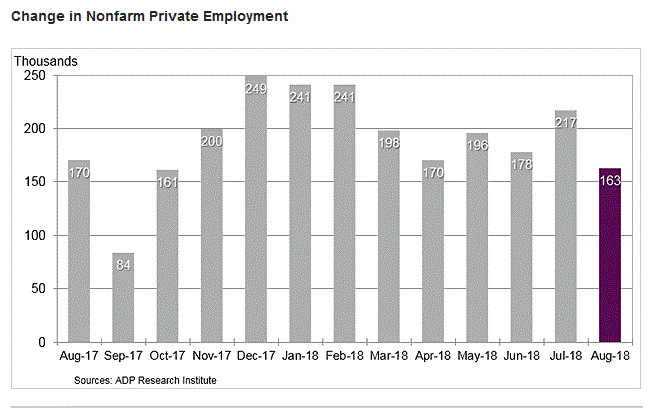
The actual result was on the lower side as there was an increase of 163K in the Private Sector Employment. Moreover, the last reading was revised down from 219K to 217K.
The US Dollar traded lower slightly and pairs like EUR/USD and GBP/USD recovered. Today’s NFP release in the US for August 2018 could play a key role for the next move in USD/JPY and other major pairs.
Economic Releases to Watch Today
- Euro Zone Gross Domestic Product Q2 2018 (QoQ) – Forecast 0.4%, versus 0.4% previous.
- Euro Zone Gross Domestic Product Q2 2018 (YoY) – Forecast 2.2%, versus 2.2% previous.
- US nonfarm payrolls August 2018 – Forecast 191K, versus 157K previous.
- US Unemployment Rate August 2018 – Forecast 3.8%, versus 3.9% previous.
- Canada’s employment Change payrolls August 2018 – Forecast 5.0K, versus 54.1K previous.
- Canada’s Unemployment Rate April August – Forecast 5.9%, versus 5.8% previous.
US Crude Oil Inventory Fell More Than Expected, While Fuel Stockpiles Unexpectedly Soared
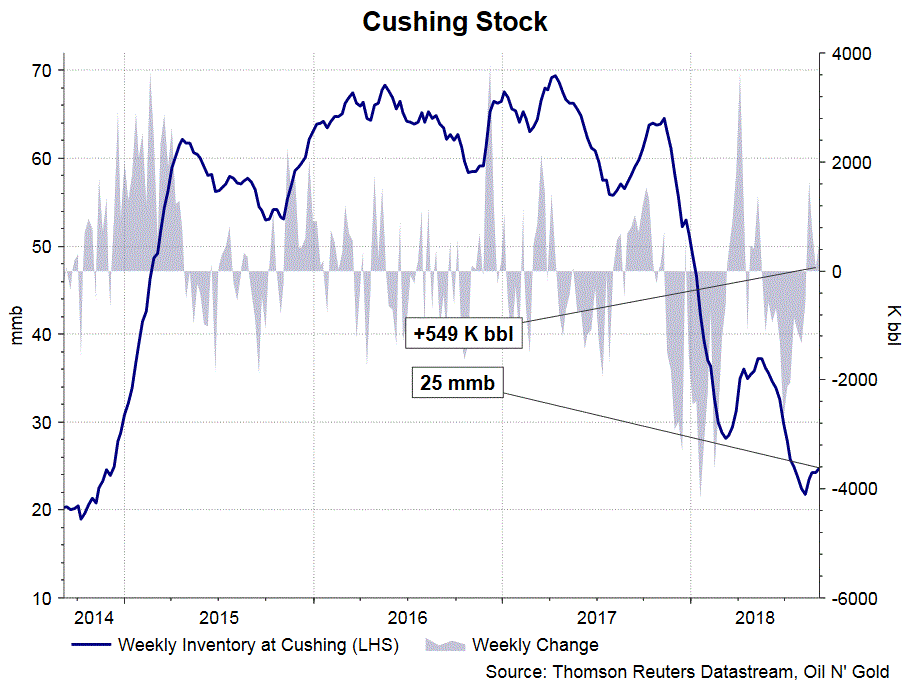
The report from the US Energy Information Administration (EIA) shows that total crude oil and petroleum products stocks rose +3.55 mmb to 1226.61 mmb in the week ended September 1. Crude oil inventory declined -4.3 mmb (consensus: -1.29 mmb) to 401.49 mmb. Inventories decreased in 4 out of 5 PADDs. Cushing stock added +0.55 mmb to 24.83 mmb. Utilization rate added +0.3% to 96.6%. Meanwhile, crude production steadied at 11M bpd for the week.
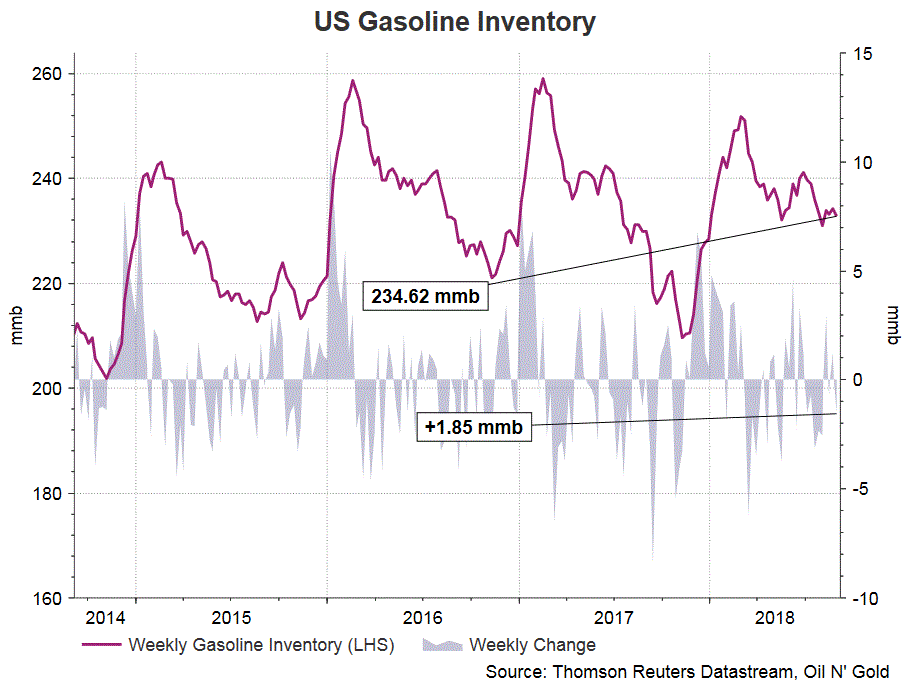
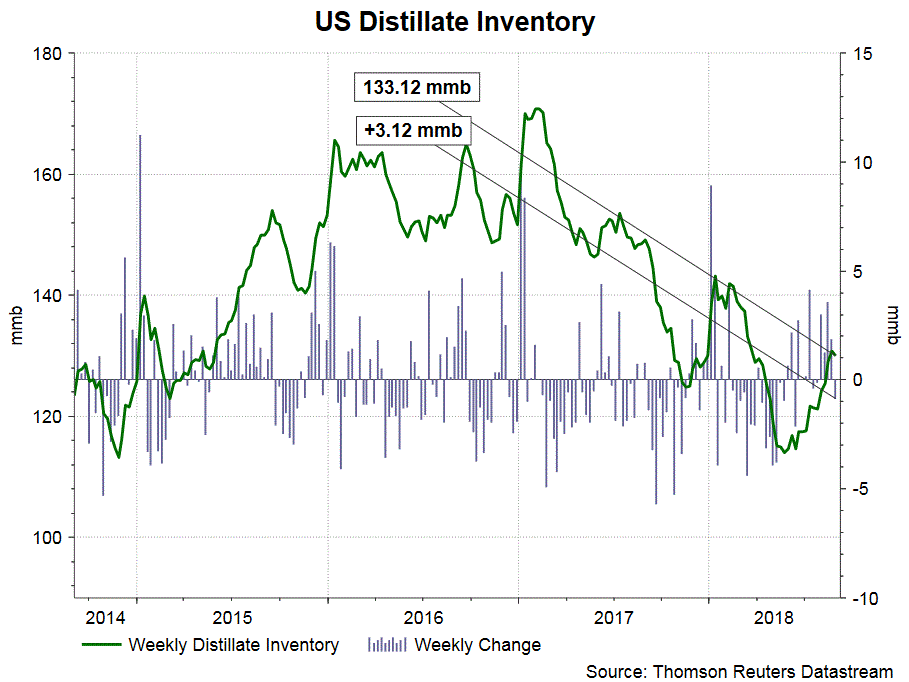
Concerning refined oil product inventories, gasoline inventory gained +1.85 mmb to 234.62 mmb as demand dropped -1.67% to 9.73M bpd. The market had anticipated a -0.81 mmb decrease in stockpile. Production slid -0.22% to 10.22M bpd while imports soared +13.83% to 0.99M bpd during the week. Distillate inventory added +3.12 mmb to 133.12 mmb as demand declined -3.31% to 4.29M bpd. The market had anticipated a +0.74 mmb gain in inventory. Production rose 5.02% to 5.44M bpd while imports rose +4.38% to 0.29M bpd during the week.
Released after market close on Wednesday, the industry- sponsored API estimated that crude oil inventory slipped -1.17 mmb during the week. For refined oil products, gasoline stockpile added +1 mmb while distillate was up +1.8 mmb.
US-Canada NAFTA negotiations continue to drag on
NAFTA negotiation between US and Canada continued to drag on with no concrete results after yesterday's meeting. Canadian Foreign Minister Chrystia Freeland just repeated her words that "we are making good progress," discussions were "constructive and productive" with "goodwill on both sides." But the key issues were unresolved and expectation is low for a deal to be made this week.
The Chapter 19 dispute resolution mechanism remained a sticky point. Canadian Prime Minister Justin Trudeau insisted on having the mechanism as Trump is a president "who doesn't always follow the rules as they're laid out." Another deadlock is diary quota which Canada might concede some ground, but based on condition that others issues are satisfactorily resolved. The third issue is the cultural exemptions to protect Canadian media company, which Trudeau said they're important to Canada's national sovereignty and identity.
USDCAD – Triggers Correction With Eyes 1.3100 Psycho Level
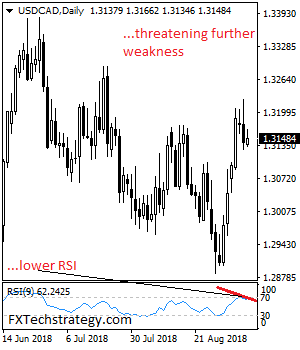
USDCAD - The pair looks to weaken further after triggering a correction on Thursday. Support stands at the 1.3100 level where a break will aim at the 1.3050 level. Further down, support comes in at the 1.3000 level where a turn lower may occur. But if further weakness is triggered support comes in at the 1.2950 level. Conversely, resistance lies at the 1.3200 level where a violation will target the 1.3250 level. Further up, resistance resides at the 1.3300 level and then the 1.3350 level. All in all, USDCAD looks to weaken further on pullback.
Why Don’t You, Show Me The Way?
Why don't you, show me the way?
EM's weakest links continued to firm yesterday on a combination of profit taking and position squaring ahead of today major risk events with the beleaguered ARS leading the pack ringing in close to 3 % gain,
while MXN and ZAR rallied more humbly.
But outside of this good news, the markets are looking incredibly fragile with USDJPY falling below 110.60 on a combination of lower US yields and a touch of risk aversion as both equity and oil markets wobbled.
But USDJPY was then summarily smacked at the NY closing bell as the markets turned attention to escalating trade tension between Japan and the US after a wire report suggested Trump feels he can win that one! Now, who doesn't like a little noise in USDJPY to start the day!! However, the market does have a proclivity to fade these so chasing downside risk could be little more than a fool's errand. Regardless, price action must be respected, and the next ” tell ” will be from the USD 10-year yields which are trading with a softer bias in the wake of Fed Williams comment which was interpreted by the market as a tad dovish. As well, the Tokyo open, as the local equity market support will be crucial for any recovery in risk and USDJPY.
Fed member Williams brought out the doves as the market latched on to his comments. “The fact that wages haven't grown a lot faster is a sign that this economy still has room to run… we don't feel the need to raise interest rates more quickly than otherwise.” But frankly, isn't this what the market is pricing in??
None the less from my shaky seat, these comments will put added focus on tonight US employment report with an outweighed focal point, the average hourly earnings.
Overall, however, it feels like interbank traders have taken to the sidelines with the comment period on the proposed USD200bn in Chinese tariffs ending today.
Oil Markets
Oil markets continue to trade with a softer bias, although prompt WTI did catch a fleeting knee-jerk bid on the Energy Information Administration inventory report headline after reporting a decent draw. However, gasoline inventories completely missed the market's expectation with a build of 1.84mn versus a draw of 1.37mn expected and WTI was summarily hammered close the key $ 67.But we're still a mile away from August lows suggesting bid on dips strategy remain in vogue as the long-term buy and hold traders stay focused on Iran sanctions, Chinese refineries unquenchable demand and a slightly improving sentiment in EM markets.
But the long strategy does come down the ” 64 million-dollar question” how much oil will be removed from the global supply chain due to Iran sanction. If the impact falls between the markets uppermost estimate, 1-1.5 million barrels, oil prices will ignite much higher given the frangible state of the supply and demand equation.
Gold Market
The retracement in the USD gives both precious and base metals some momentum Gold short positions covered back above key resistance of $1200 and with the markets slightly dovish lean from Fed Williams, dare I say gold might hold that bid leading up to today's critical Non-Farm Payroll report.
ETF holdings in both gold and silver were up marginally but in the absence of demand from large funds does on zero haven appeal, which does suggest Golds near term fare remain entirely based on the movements of the USD.
Asia Equities
Global equities are a potpourri of sorts morning with Asia markets feeling the pain the Hang Seng buckle under the weight from escalating trade tension. But traders will be looking to trade the Tokyo open after newswires suggested Japan is in Trumps Tariffs crosshairs. Sentiment on the Osaka exchange could very well set the tone in Asia this morning.
G-10 Currency
After completely overestimating volatility this week, I'm honestly left with more question than answers when it comes G-10 currencies.
Frankly, nothing seems to be working out as planned. Aussie remains supported and the markets to fade USDCAD moved lower, catching more than a few long and wrong at this juncture, doing little more than chasing the markets, in this endless cycle of rinse and repeat. But on the bright side, there's always next week.
Australian Dollar
Entering tonight's NFP report, positioning feels very much neutral outside of the Aussie which has attracted a plethora of short sellers, suggesting that unless there's a surprising move below .7175 AUDUSD today, traders will likely pare back shorts ahead of tonight's jobs report which could lend support. But of course, eyes will be on risk market and Japan-US trade, headlines, also, the Section 301 noise.
Canadian Dollar
The markets interpreted Wilkens speech as a bit hawkish with the loonie rally to 1.3140 level. But there nothing in the statement to suggest a faster acceleration of interest rate normalisation is in the offing.
The Malaysian Ringgit
The Ringgit is finding a modicum of support from July trade figures that beat all expectations as higher oil prices remain the Ringgits lifeline in these turbulent times significantly improving Malaysia's terms of trade. And support the notion that the Ringgit will be relatively insulated from external factor being the primary oil exporter
Besides, the local unit is getting a fillip from the bounce in other EM currencies with the weakest links in the EM currency chain have a positive overnight session.
However, what remains entirely interesting about the Ringgit it the full range of year-end estimates which does suggest trading the Ringgit will become incredibly active once the US-China trade news leaves the headlines.