Sample Category Title
Sunset Market Commentary
Markets
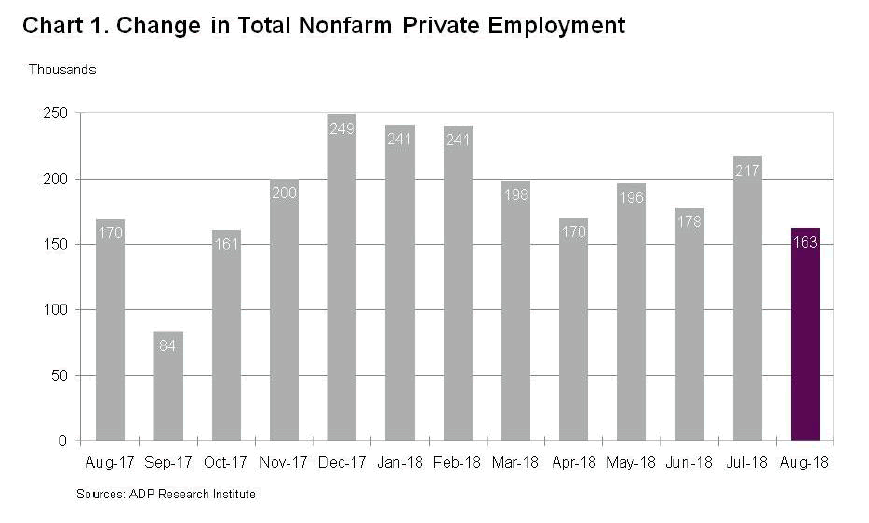
Core bonds more or less treaded water today. The US Note future lost minor ground going in to the ADP-employment report but quickly erased those losses as the “officious” job report (163k) printed softer than expected (200k). Markets are probably awaiting tomorrows official payrolls, hence a more muted market reaction. The US yield curve remains virtually unchanged compared to yesterday. Today’s track record of the German Bund isn’t that impressive either. Despite a mixed-to-better risk environment, the Bund contract gained slightly resulting in some bull flattening as 10-y yield drops 1bp while the 2-y yield is unchanged. Across the EGB-spectrum, the mild risk climate bodes well for southern bonds with Italian BTP’s extending gains. Greece outperforms (-13bp).
Trading in the major FX cross rates in general and in EUR/USD in particular is in some kind of limbo. There are plenty of stories that in theory have potential to move the dollar or the euro. Regional data, the sage on the US trade policy, emerging markets, Brexit, Italian politics all are able to move EUR/USD. However, currently none of these themes is strong enough to give EUR/USD a clear directional push. Of late, the eco data looked USD supportive. However, today’s ADP was softer than expected and historic low jobless claims also didn’t help the dollar. The US currency even lost a few ticks after the publication of the early morning US data. Have interest rates/interest rate differentials discounted enough USD positive news for now? All kind of issues on geopolitics & trade policy also fail to activate the USD’s safe haven role. Markets apparently want at least part of these event risks to be out of the way before engaging in new directional FX positions. Maybe there is more room of manoeuver once the US/Canada trade talks or ‘issue’ on China tariffs is clarified. Or will tomorrows payrolls do the job? EUR/USD is trading in near 1.1650. Sentiment on Europe apparently isn’t that negative. USD/JPY drifting back south in the 111 big figure.
Today, sterling trading entered calmer waters after some more pronounced swings yesterday and at the end of last week. There were no important eco data or high profile news/headlines on Brexit. Despite yesterday’s headlines that the EU and the UK were making progress to reach a brexit deal, today it became clear that there is still plenty of work to do. In technical trade EUR/GBP hovers in the 0.90 area. Cable is holding in the 1.29 big figure, awaiting ‘new news’.
News Headlines
Sweden’s central bank (Riksbank) left its policy rate unchanged at -0.5% today but tweaked its forward guidance, postponing the timing of a first rate hike yet again from December to “either December of February”. The country faces potentially disruptive elections this weekend, which at least partially explains the Bank’s cautious stance. The Swedish koruna again ceded ground after the Riksbank decision.
Rating agency Moody’s has cut South African growth prospects for 2018 by half from 1.5% to 0.7-1.0% as the country plunged into a recession in the 2nd quarter this year. The poor economic performance adds to the country’s currency issues, with the South African rand suffering severe losses from the recent rout in emerging markets.
Swiss Q2 GDP growth again topped forecasts as was the case in previous quarters. The Swiss economy grew 0.7% Q/Q and 3.4% Y/Y. The Swiss economy proved quite resilient to global trade tensions and to the strength of the Swiss franc as manufacturing and export were big contributors to growth. Q1 growth was upwardly revised to 1.0% Q/Q.
EUR/USD Mid-Day Outlook
Daily Pivots: (S1) 1.1569; (P) 1.1603; (R1) 1.1664; More.....
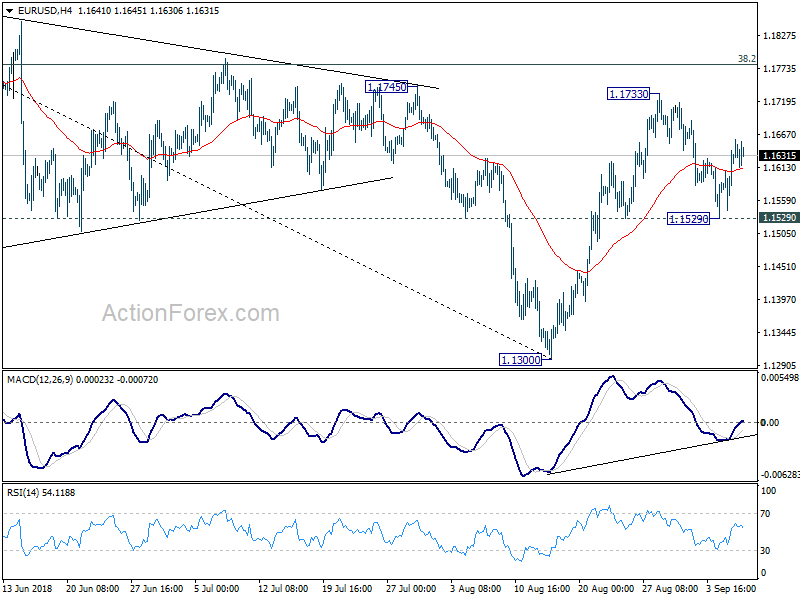
Intraday bias in EUR/USD remains mildly on the upside for 1.1733 and possibly above. And again, we'd expect strong resistance from 38.2% retracement of 1.2555 to 1.1300 at 1.1779 to limit upside, at least on first attempt, to bring near term reversal. On the downside, firm break of 1.1529 will indicate completion of the corrective rebound from 1.1300. In such case, intraday bias will be turned back to the downside for retesting 1.1300 low.
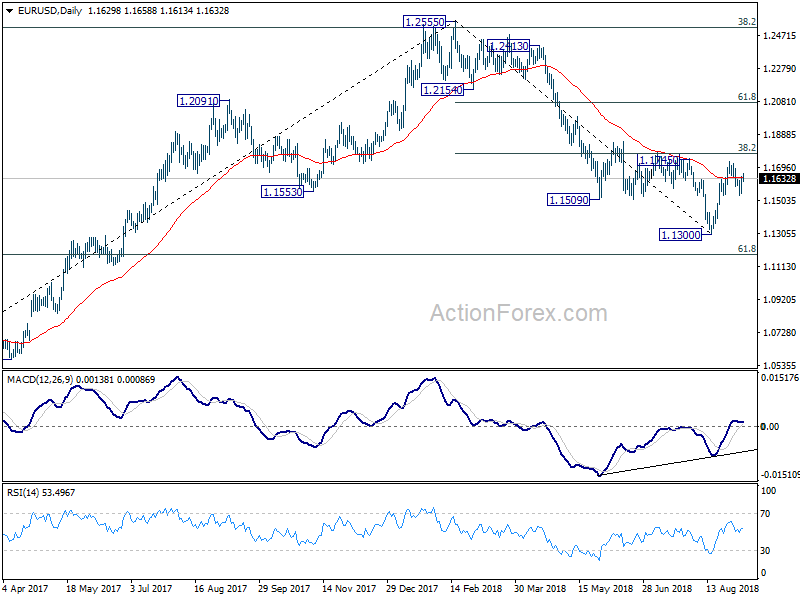
In the bigger picture, a medium term bottom should be in place at 1.1300, on bullish convergence condition in daily MACD and some consolidations would be seen. But still, note that EUR/USD was rejected by 38.2% retracement of 1.6039 (2008 high) to 1.0339 (2017 low) at 1.2516. That carries some long term bearish implications. Thus, we'd expect fall from 1.2555 high to resume after consolidation completes. Below 1.1300 should send EUR/USD through 61.8% retracement of 1.0339 to 1.2555 at 1.1186. And, in that case, EUR/USD would head to retest 1.0339 (2017 low).
GBP/USD Mid-Day Outlook
Daily Pivots: (S1) 1.2799; (P) 1.2891; (R1) 1.2997; More...
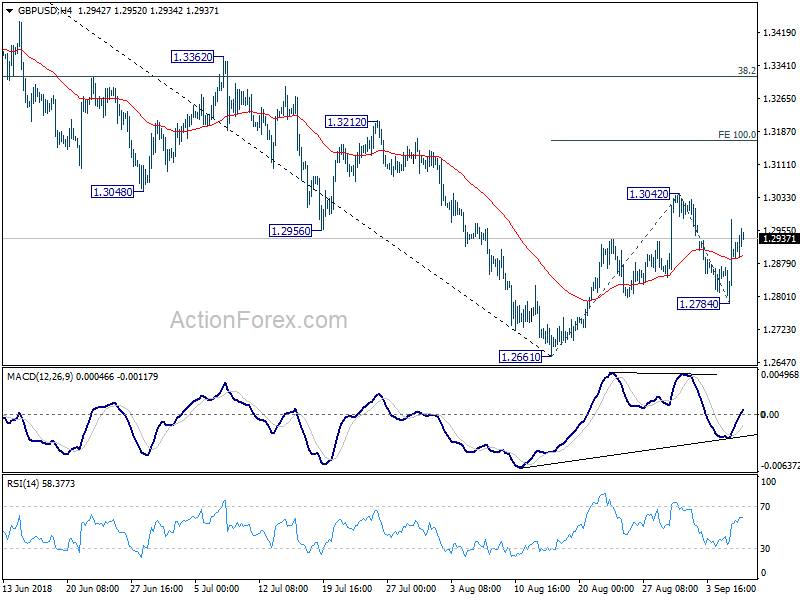
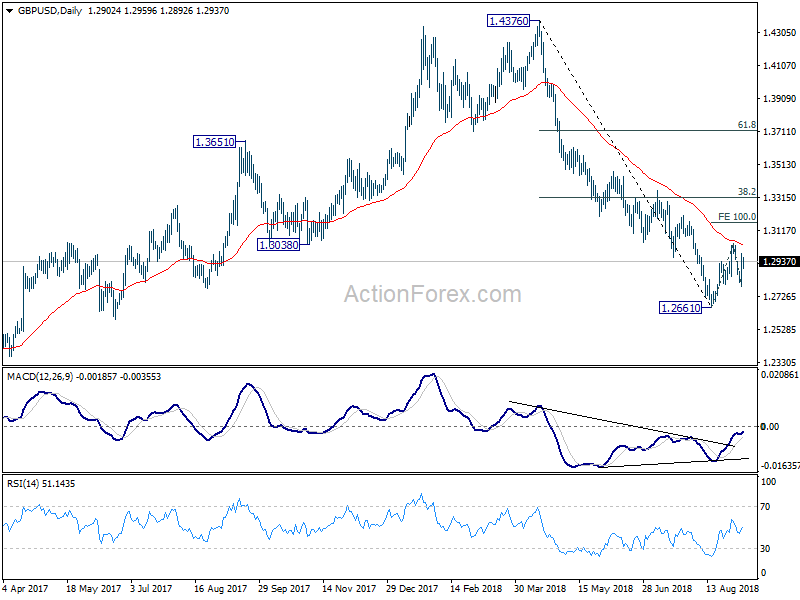
Intraday bias in GBP/USD remains mildly on the upside for 1.3042 resistance. Break there will resume the corrective rebound from 1.2661. Next target is 100% projection of 1.2661 to 1.3042 from 1.2784 at 1.3165. But upside should be limited by 1.3316 key fibonacci level to complete the corrective rise and bring near term reversal. On the downside, below 1.2784 support will bring retest of 1.2661 low.
In the bigger picture, whole medium term rebound from 1.1946 (2016 low) should have completed at 1.4376 already, after rejection from 55 month EMA (now at 1.4099). The structure and momentum of the fall from 1.4376 argues that it's resuming long term down trend. And this will be the preferred case as long as 38.2% retracement of 1.4376 to 1.2661 at 1.3316 holds. However, firm break of 1.3316 would bring stronger rebound to 61.8% retracement at 1.3721. And, the eventual depth of the fall from 1.4376, and the chance of hitting 1.1946 low, will depend on the strength of the interim corrective rebound from 1.2661.
USD/JPY Mid-Day Outlook
Daily Pivots: (S1) 111.35; (P) 111.56; (R1) 111.74; More...
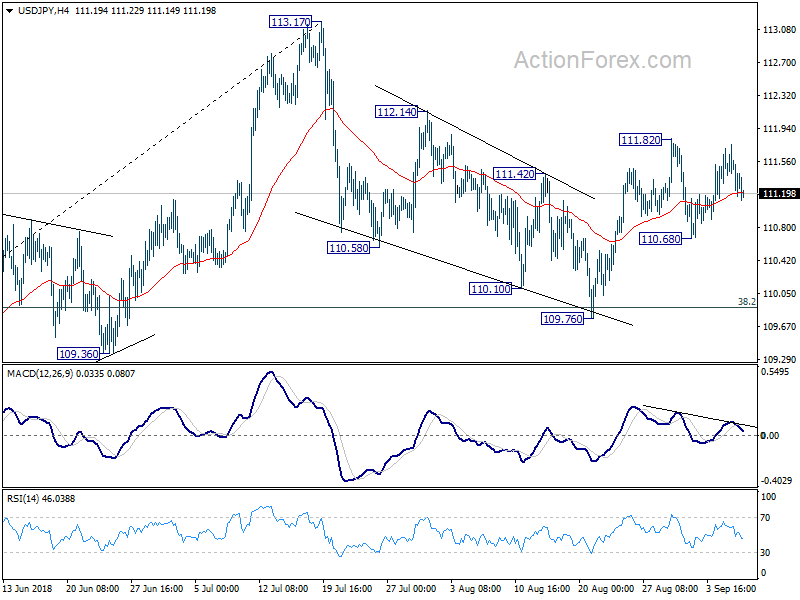
Intraday bias in USD/JPY remains neutral, as range trading continues, inside 110.68/111.82. On the upside, break of 111.82 will reaffirm the case that correction from 113.17 has completed at 109.76. And in that case, further rise should be seen back to retest 113.17 high. On the downside, below 110.68 will bring another fall. But still, downside should be contained by 38.2% retracement of 104.62 to 113.17 at 109.90 to bring rebound.
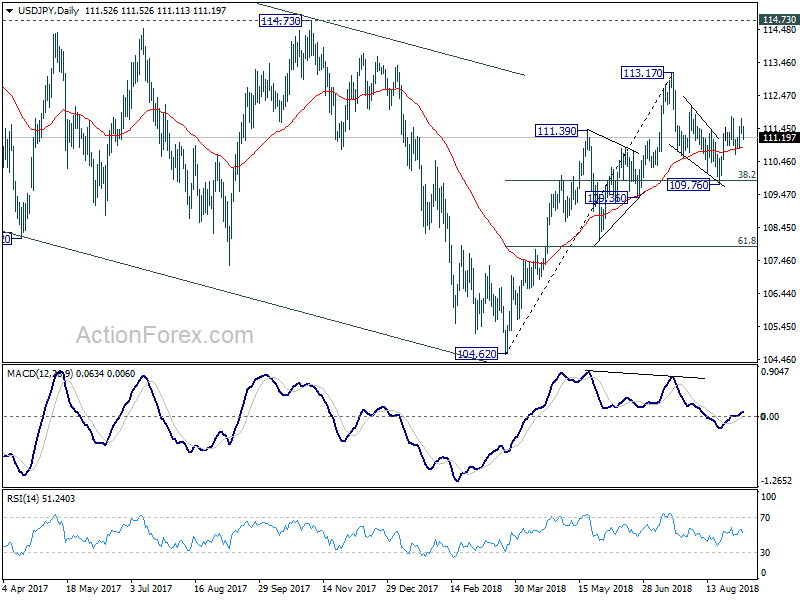
In the bigger picture, corrective fall from 118.65 (2016 high) should have completed with three waves down to 104.62. Decisive break of 114.73 resistance will likely resume whole rally from 98.97 (2016 low) to 100% projection of 98.97 to 118.65 from 104.62 at 124.30, which is reasonably close to 125.85 (2015 high). This will stay as the preferred case as long as 109.36 support holds. However, decisive break of 109.36 will mix up the outlook again. And deeper fall should be seen back to 61.8% retracement of 104.62 to 113.17 at 107.88 and below.
XAUUSD Outlook: Gold Maintains Firm Tone; Stronger Rally on Trade Concerns/Emerging Mkts Crisis Not Ruled Out
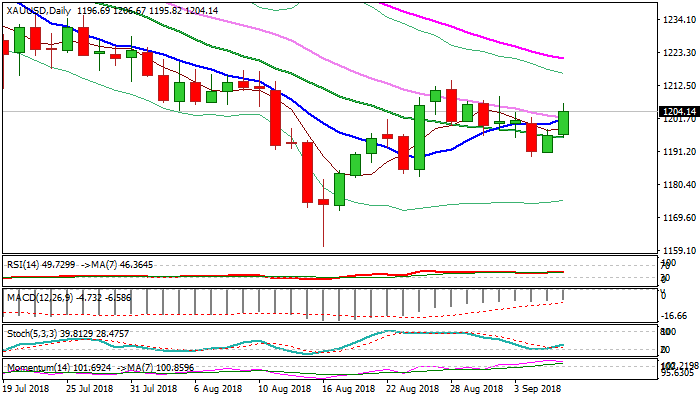
Spot Gold benefited from weaker dollar on Thursday and extends recovery from $1189 (04 Sep low) into second day. Fresh bullish acceleration broke above psychological $1200 barrier, reinforced by 10SMA and probed above $1204 pivot (Fibo 61.8% of $1214/$1189 bear-leg). Daily close above $1204 is needed to confirm higher low at $1189 and unmask key near-term barrier at $1214 (28 Aug high). Bullishly aligned daily techs are supportive, with the yellow metal being boosted by persisting concerns about US/China trade conflict, which could escalate and spark stronger safe-haven buying. Worsening situation in emerging markets, with Turkey, Argentina and South Africa, being currently in focus, could also strongly underpin gold price for further recovery of larger $1365/$1160 Apr/Aug fall. Sustained break above $1214 pivot (reinforced by falling weekly 10SMA) would open way towards $1225/27 (Fibo 61.8% of $1265/$1160 bear-leg / base of falling daily cloud). Broken 10SMA marks initial support ($1201), with deeper dips expected to find support above 20SMA ($1195).
Res: 1206; 1209; 1214; 1217
Sup: 1201; 1195; 1189; 1183
Financial Markets Quiver on EM Contagion Concerns
A sense of doom and gloom lingered across financial markets today as contagion fears from the brutal emerging market sell-off rattled investor confidence.
The unceasing turmoil across emerging markets has clearly bruised market sentiment with traders attacking EM currencies and equities at any given opportunity. More pain seems to be ahead for emerging markets as the combination of global trade tensions, prospects of higher U.S. interests and overall market uncertainty haunt investor attraction.
Speaking of trade, the US-China trade war could reach a dangerous tipping point if the Trump administration moves ahead with imposing tariffs on another $200 billion worth of Chinese goods. Such a development is likely to fuel fears of a full-blown trade war between the world’s two largest economies becoming reality. With a trade war representing a significant risk to global growth and stability, appetite for risk is poised to diminish further ultimately punishing emerging markets and global stocks further.
In the currency markets, Sterling bulls were thrown a lifeline yesterday after Bloomberg reported that both the UK and Germany have dropped key Brexit demands. However, some gains were later relinquished after German officials denied these reports. Taking a look at the technical picture, the GBPUSD jumped over 150 pips with price peaking around 1.2980 before eventually sinking back towards 1.2900. Bulls need to secure control above 1.2900 for the GBPUSD to extend upside gains towards 1.2980 and 1.3030, respectively
Today has been a positive trading session for Gold thus far thanks to a combination of short-term Dollar weakness and risk aversion. With prices currently trading back above the $1,200 psychological level and coincidentally above the daily 20 Simple Moving Average, intra-day bulls could target $1,214. However, the medium-to longer-term outlook for the yellow metal remains tilted to the downside with Friday’s U.S. employment figures playing a key role in where the metal concludes this week.
USD/CHF Mid-Day Outlook
Daily Pivots: (S1) 0.9699; (P) 0.9727; (R1) 0.9745; More.....
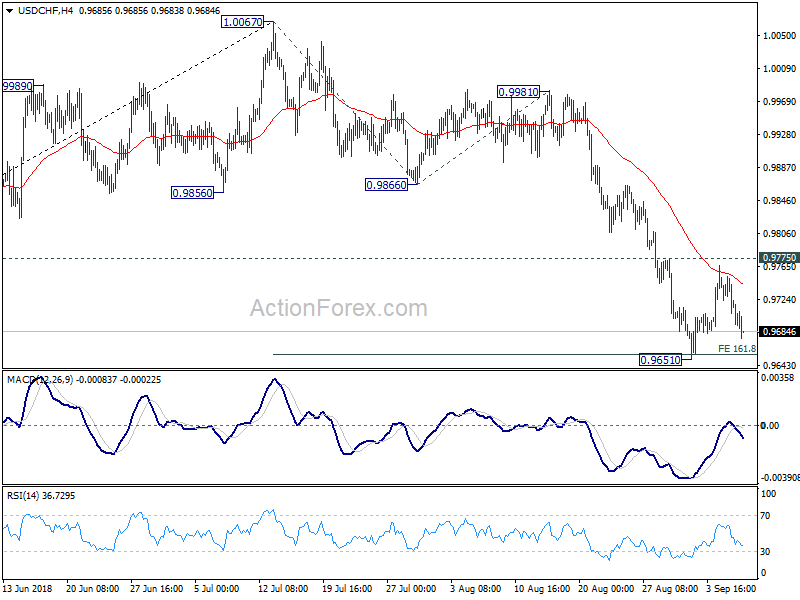
USD/CHF weakens further today after being rejected by 4 hour 55 EMA, but it's staying in range of 0.9651/9975. Intraday bias stays neutral first. With 0.9775 intact, another decline is mildly in favor. On the downside, break of 0.9651 will target 200% projection of 1.0067 to 0.9866 from 0.9981 at 0.8579 next. However, firm break of 0.9775 will be an early sign of near term reversal. That is, fall from 1.0067 could have completed. In this case, further rally would be seen back to 0.9866 support turned resistance for confirmation.
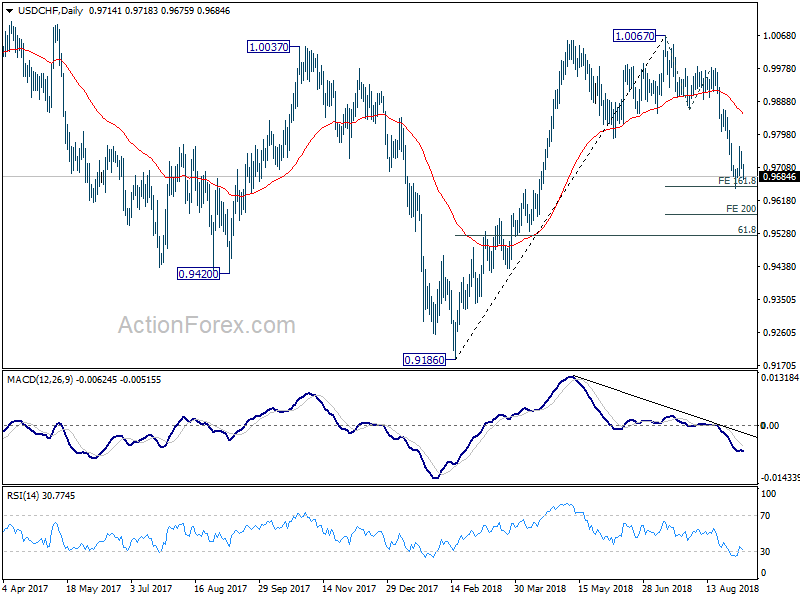
In the bigger picture, current development suggests that rise from 0.9186 low has completed at 1.0067, after failing to sustain above 1.0037 resistance. Fall from 1.0067 could extend to 61.8% retracement of 0.9816 to 1.0067 at 0.9523 and below. But for now, we don't expect a break of 0.9186 low. On the upside, firm break of 0.9866 support turned resistance will suggests that fall from 1.0067 has completed and rise from 0.9186 is resuming.
Dollar Weakens after Mixed Job Data, Awaiting Trade War Developments
Dollar weakens again in early US session after mixed job data, but selling pressure is so far limited. Markets are cautiously awaiting tomorrow's non-farm payroll report for sure. But more importantly, the development in trade relationship with Canada and China is the focal point. Canadian Foreign Affairs Minister Chrystia Freeland will have another day of meeting with US Trade Representative Robert Lighthizer. Meanwhile, Trump is ready to fire another shot at China once the hearing on the tariffs on USD 200B in Chinese goods ends today.
Euro and commodity currencies are generally weak follow Dollar. Meanwhile, Swiss Franc, Sterling, and Yen are the strongest ones. But the picture could easily be changed should there be any break through in US-Canada trade talks, or any new developments in US-China trade war. And, it should be noted again that Dollar surges almost every time there is an escalation in trade tensions.
In other markets, European stocks stabilized from yesterday's steep selloff and turned mixed. FTSE is down -0.21% at the time of writing, DAX up 0.12%, CAC up 0.27%. 10 year German bund yield drops -0.008 to 0.337. 10 year Italian yield also dropped -0.087 to 2.862.
Earlier today, Asian markets continued to be the bigger victims in current concerns over emerging market crisis. Nikkei was down -0.41%, Hong Kong HSI was down -0.99%. China Shanghai SSE was down -0.47% at 2691.59, below 2700 handle. Singapore Strait Times dropped -0.27%. Gold rides on Dollar's weakness and is back at 1205. Focus is on 1209 minor resistance for indicating resumption of rise fro 1160.36.
US initial jobless claims dropped to 203k, another lowest since 1969
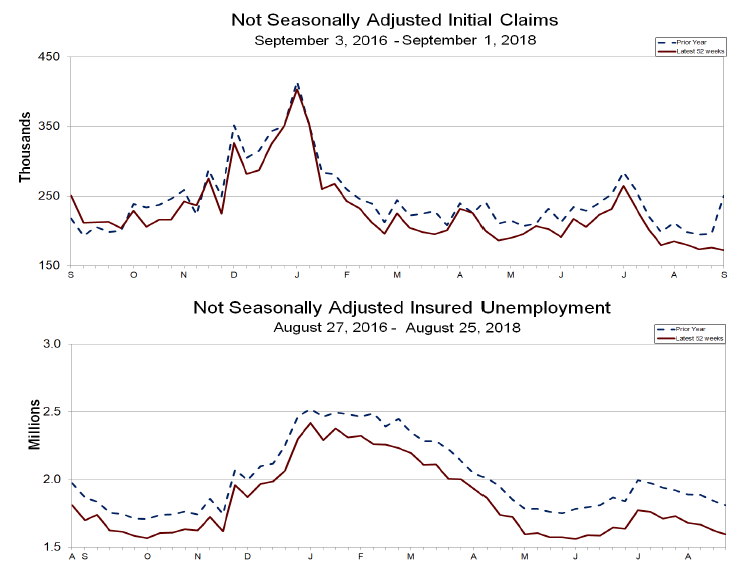
US initial jobless claims dropped -10k to 203k in the week ended September 1, well below expectation of 214k. Also, that's another lowest level since 1969 scored. And it's indeed just 1k above that 202k in the week of December 6 that year. Four-week moving average of initial claims dropped -2.75k to 209.5k, lowest since December 6 1969 too (204.5k).
Continuing claims dropped -3k to 1.707m in the week ended August 25. Four-week moving average of continuing claims dropped 013.25k to 1.7185m, lowest since December 8 1973.
US ADP employment missed expectation, but job markets remains incredibly dynamic
ADP report showed 163k growth in private sector jobs in August, below expectation of 188k. Ahu Yildirmaz, vice president and co-head of the ADP Research Institute said in the release that "although we saw a small slowdown in job growth the market remains incredibly dynamic". And, "midsized businesses continue to be the engine of growth, adding nearly 70 percent of all jobs this month, and remain resiliant in the current economic climate."
Also, Mark Zandi, chief economist of Moody's Analytics, said, "The job market is hot. Employers are aggressively competing to hold onto their existing workers and to find new ones. Small businesses are struggling the most in this competition, as they increasingly can't fill open positions."
Also released, US nonfarm productivity was finalized at 2.9% in Q2, unit labor cost at -1.0%. Canada building permits dropped -0.1% mom in July.
Next phase of US-China trade war ready, as public comments end today
It's still a bit early, but the next phase of US-China trade war is approaching. The public comment period for the 25% tariffs on USD 200B in Chinese imports will end today. Trump could be ready to start imposition of such tariffs any time. And ahead of that Trump said yesterday that "right now we just can't make that deal" with China. And, "in the meantime, we're taking in billions of dollars of taxes coming in from China, with the potential of billions and billions of dollars more taxes coming in."
On the other hand, Chinese Commerce Ministry Spokesman Gao Feng said in a regular press conference that "if the United States, regardless of opposition, adopts any new tariff measures, China will be forced to roll out necessary retaliatory measures." Both sides have already slapped tit-for-tat tariffs on $US50 billion of each other's goods. That came after US steel and aluminium tariffs and China's own retaliation. For the upcoming ones, China already announced counter measures of tariffs on USD 60B of US goods ranging from liquefied natural gas to certain types of aircraft.
Swiss government raised growth forecast after stronger than expected Q2 GDP
Swiss GDP grew faster than expected by 0.7% qoq in Q2, versus expectation of 0.5% qoq. The government also raised growth forecast for this year. A government economist Ronald Indergand said that "for the year as a whole we could be looking at a growth rate much nearer to the 3 percent rate than 2 percent, which would be above the long-term average." In the prior forecast, the government projected Swiss GDP to grow 2.4% in 2018, comparing to 1.6% in 2017.
Also released European session, German factory orders dropped sharply by -0.9% mom in July versus expectation of 13.7% mom.
BoJ Kataoka criticizes move to allow wider JGB yield band
BoJ board member Goushi Kataoka criticized the central bank's recent move to allow 10 year JGB yield to fluctuate in a larger range of -0.1% to 0.1%. He said in a speech that "there's no need to allow long-term interest rates to move in a wider range at a time when the BOJ is cutting its inflation forecasts." He added that "allowing long-term rates to rise at a time inflation and inflation expectations aren't heightening much could delay achievement of the BoJ's price target." Also, Kataoka warned "global trade frictions are intensifying and there's no room for complacency".
Kataoka is a known dove who dissented the decision to keep policy unchanged in every meeting since joining the board in 2017. Instead, he persistently pushed for more aggressive easing, targeting to keep JGB yields at 0% beyond 10 year maturity.
USD/CHF Mid-Day Outlook
Daily Pivots: (S1) 0.9699; (P) 0.9727; (R1) 0.9745; More.....
USD/CHF weakens further today after being rejected by 4 hour 55 EMA, but it's staying in range of 0.9651/9975. Intraday bias stays neutral first. With 0.9775 intact, another decline is mildly in favor. On the downside, break of 0.9651 will target 200% projection of 1.0067 to 0.9866 from 0.9981 at 0.8579 next. However, firm break of 0.9775 will be an early sign of near term reversal. That is, fall from 1.0067 could have completed. In this case, further rally would be seen back to 0.9866 support turned resistance for confirmation.
In the bigger picture, current development suggests that rise from 0.9186 low has completed at 1.0067, after failing to sustain above 1.0037 resistance. Fall from 1.0067 could extend to 61.8% retracement of 0.9816 to 1.0067 at 0.9523 and below. But for now, we don't expect a break of 0.9186 low. On the upside, firm break of 0.9866 support turned resistance will suggests that fall from 1.0067 has completed and rise from 0.9186 is resuming.
Economic Indicators Update
| GMT | Ccy | Events | Actual | Forecast | Previous | Revised |
|---|---|---|---|---|---|---|
| 01:30 | AUD | Trade Balance (AUD) Jul | 1.55B | 1.46B | 1.87B | 1.94B |
| 05:45 | CHF | GDP Q/Q Q2 | 0.70% | 0.50% | 0.60% | 1.00% |
| 06:00 | EUR | German Factory Orders M/M Jul | -0.90% | 1.60% | -4.00% | -3.90% |
| 11:30 | USD | Challenger Job Cuts Y/Y Aug | 13.70% | -4.20% | ||
| 12:15 | USD | ADP Employment Change Aug | 163K | 188K | 219K | 217K |
| 12:30 | CAD | Building Permits M/M Jul | -0.10% | 0.70% | -2.30% | -1.30% |
| 12:30 | USD | Initial Jobless Claims (SEP 1) | 203K | 214K | 213K | |
| 12:30 | USD | Nonfarm Productivity Q2 F | 2.90% | 2.90% | 2.90% | |
| 12:30 | USD | Unit Labor Costs Q2 F | -1.00% | -0.90% | -0.90% | |
| 13:45 | USD | Services PMI Aug F | 55.2 | 55.2 | ||
| 14:00 | USD | ISM Non-Manufacturing/Services Composite Aug | 56.9 | 55.7 | ||
| 14:00 | USD | Factory Orders Jul | -0.10% | 0.70% | ||
| 14:30 | USD | Natural Gas Storage | 70B | |||
| 14:30 | USD | Crude Oil Inventories | -2.6M |
US initial jobless claims dropped to 203k, another lowest since 1969
US initial jobless claims dropped -10k to 203k in the week ended September 1, well below expectation of 214k. Also, that's another lowest level since 1969 scored. And it's indeed just 1k above that 202k in the week of December 6 that year. Four-week moving average of initial claims dropped -2.75k to 209.5k, lowest since December 6 1969 too (204.5k).
Continuing claims dropped -3k to 1.707m in the week ended August 25. Four-week moving average of continuing claims dropped 013.25k to 1.7185m, lowest since December 8 1973.
Also released, US nonfarm producitivty was finalized at 2.9% in Q2, unit labor cost at -1.0%. Canada building permits dropped -0.1% mom in July.
US ADP employment missed expectation, but job markets remains incredibly dynamic
ADP report showed 163k growth in private sector jobs in August, below expectation of 188k. Ahu Yildirmaz, vice president and co-head of the ADP Research Institute said in the relesaed that "although we saw a small slowdown in job growth the market remains incredibly dynamic". And, "midsized businesses continue to be the engine of growth, adding nearly 70 percent of all jobs this month, and remain resiliant in the current economic climate."
Also, Mark Zandi, chief economist of Moody's Analytics, said, "The job market is hot. Employers are aggressively competing to hold onto their existing workers and to find new ones. Small businesses are struggling the most in this competition, as they increasingly can't fill open positions."