Sample Category Title
Stronger Chinese Data Countered By Trade War Risks
Market movers today
We have a packed calendar today, not least of all in the Scandi space. In Norway, we get the credit indicator and unemployment data this morning. The data are unlikely to change anything for Norges Bank, which we still expect to hike in September. In Denmark, we get the second estimate of Q2 GDP growth, the unemployment rate and wage growth. See page 2 for details.
The most important global release is the euro area inflation print. We expect core inflation was unchanged at 1.1% y/y, the level it has been fluctuating at since early 2017. Underlying inflation is gradually moving higher, as wage growth has increased. We still do not expect the ECB to hike rates before 2019 at the earliest.
Also look out for Fitch releasing its rating for Italy.
Selected market news
The collapse of the Argentinian Peso accelerated yesterday after President Macri called for the IMF to accelerate disbursement under its standby programme amid rapidly deteriorating market sentiment. The Argentinian central bank hiked its benchmark rate from 45% to 60% in a forceful attempt to shore up confidence. However, despite the hike, the Peso continued to weaken. See more in Flash Comment Argentina: Peso collapse, emergency central bank hike - what now IMF?, 30 August 2018.
China's manufacturing PM I rose to 51.3 in August from 51.0 and non-manufacturing PMI increased to 54.2 from 53.7. The stronger data is unlikely to help sentiment with regards to the Chinese economy as the US is apparently planning to impose USD200bn of new tariffs on Chinese imports faster than previously expected.
That was not the only trade war-related news out overnight. US President Trump also threatened to pull the US out of the World Trade Organisation and he also rejected an offer from the EU to remove levies on cars. The US-Canada trade talks are said to have made progress ahead of a deadline today.
USD/INR hit an all-time high yesterday, climbing 0.8% in the past three days as oil price continue to climb. India is a net oil exporter and the country 's external balance dep ends heavily on oil price developments. The US is mulling over sanctions against India for purchasing Russian arms (>USD5bn deal). India is following Turkey in its plans to buy Russian S-400 missile air defence systems.
Euro-Zone’s Economic Confidence Weakened For The Eighth-Consecutive Month In August In August
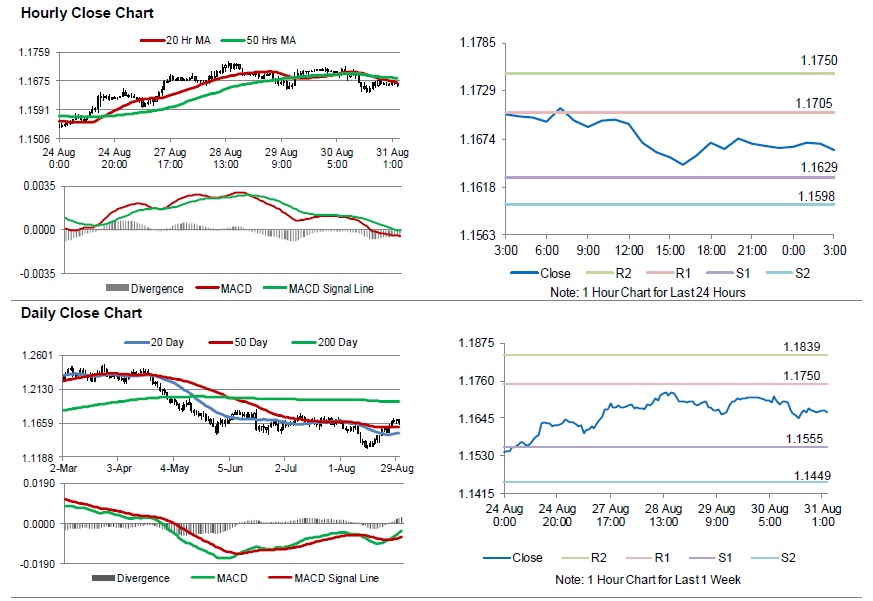
For the 24 hours to 23:00 GMT, the EUR declined 0.38% against the USD and closed at 1.1663.
On the macro front, the Euro-zone's final consumer confidence index slid to a level of -1.9 in August, confirming the preliminary print and following a revised level of -0.5 in the prior month. Market participants had anticipated the index to decline to a level of -1.9. Also, the region's business climate indicator declined to a level of 1.2 in August, compared to market expectations for a drop to a level of 1.3. In the previous month, the business climate indicator had recorded a revised reading of 1.3. Moreover, the nation's economic sentiment indicator fell to a level of 111.6 in August, for the eighth-consecutive month. In the prior month, the economic sentiment indicator had registered a reading of 112.1, while market participants had expected the indicator to ease to 111.9.
In the economic news, Germany's seasonally adjusted unemployment rate remained unchanged at a rate of 5.2% in August, marking its lowest rate since German reunification in 1990 and at par with market expectations. Meanwhile, the preliminary consumer price index (CPI) rose 2.0% on a yearly basis in August, in line with market expectations. The CPI had registered a similar rise in the prior month.
In the US, data showed that US personal income advanced 0.3% on a monthly basis in July, undershooting market expectations for an advance of 0.4%. In the prior month, personal income had recorded a rise of 0.4%.
Separately, the US dollar rose against the euro, following robust US consumer spending and inflation data.
Data showed that personal spending rose 0.4% on a monthly basis in July, in line with market expectations. In the previous month, personal spending had registered a similar rise. Moreover, core personal consumption expenditure climbed 0.2% on a monthly basis in July, at par with market forecast. In the prior month, core personal consumption expenditure had recorded a rise of 0.1%. Personal income advanced 0.3% on a monthly basis in July, compared to a rise of 0.4% in the prior month. Market anticipation was for personal income to rise 0.4%.
On the other hand, the US seasonally adjusted initial jobless claims increased to a level of 213.0K in the week ended 25 August 2018, compared to a level of 210.0K in the prior week. Market participants had envisaged initial jobless claims to climb to a level of 212.0K.
In the Asian session, at GMT0300, the pair is trading at 1.1661, with the EUR trading slightly lower against the USD from yesterday's close.
The pair is expected to find support at 1.1629, and a fall through could take it to the next support level of 1.1598. The pair is expected to find its first resistance at 1.1705, and a rise through could take it to the next resistance level of 1.1750.
Going forward, investors will keep an eye on the Euro-zone's unemployment rate for July and the consumer price index for August, set to release in a few hours. Later in the day, the US Chicago PMI and the Michigan consumer sentiment index, both for August, will keep traders on their toes.
The currency pair is showing convergence with its 20 Hr moving average and trading below its 50 Hr moving average.
UK’s Net Consumer Credit Grew At Its Slowest Pace Since November 2015 In August
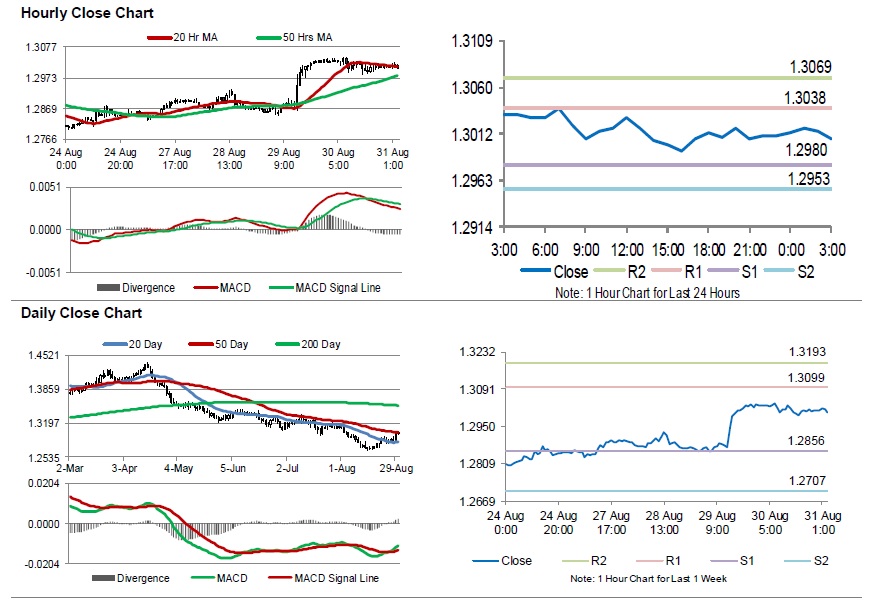
For the 24 hours to 23:00 GMT, the GBP declined 0.11% against the USD and closed at 1.3010.
Macroeconomic data showed that UK's net consumer credit climbed £0.8 billion, rising at its slowest pace since November 2015 and compared to a revised advance of £1.5 billion in the prior month. Market participants had expected the net consumer credit to advance £1.5 billion. Meanwhile, the nation's mortgage approvals eased to a level of 64.8K in July, overshooting market consensus for a fall to a level of 65.0K. Number of mortgage approvals had recorded a revised reading of 65.4K in the previous month.
In the Asian session, at GMT0300, the pair is trading at 1.3006, with the GBP trading a tad lower against the USD from yesterday's close.
Overnight data indicated that UK's Gfk consumer confidence unexpectedly jumped to a level of -7.0, defying market expectations for a steady reading. In the previous month, the consumer confidence had recorded a level of -10.0.
Separately, Lloyds business barometer eased 23.0% in August, amid escalating worries over smooth Brexit. In the prior month, the business barometer had recorded a reading of 29.0%.
The pair is expected to find support at 1.2980, and a fall through could take it to the next support level of 1.2953. The pair is expected to find its first resistance at 1.3038, and a rise through could take it to the next resistance level of 1.3069.
Looking ahead, traders will await UK's Markit manufacturing and services PMI, construction PMI and the Halifax house price index, due to release next week.
The currency pair is showing convergence with its 20 Hr moving average and trading above its 50 Hr moving average.
Japan’s Jobless Rate Unexpectedly Declined In July
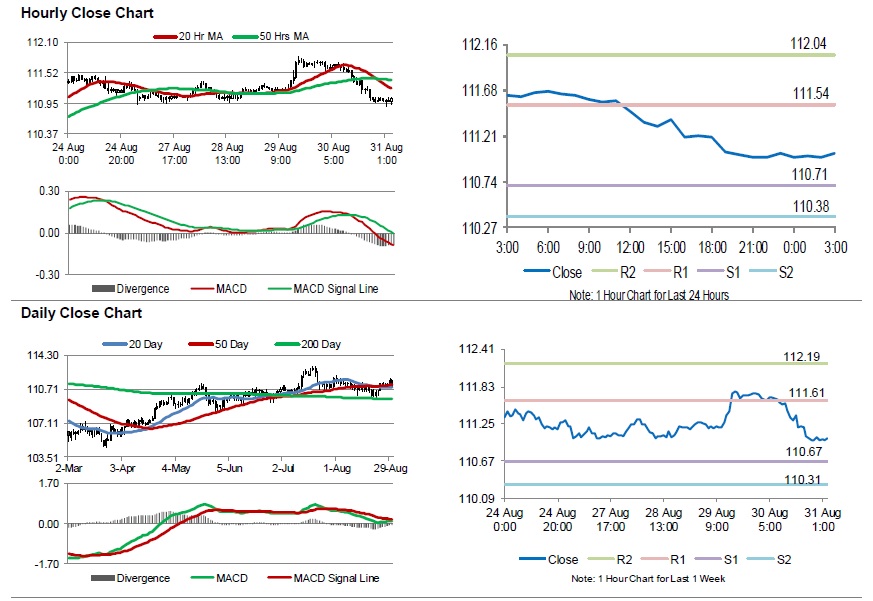
For the 24 hours to 23:00 GMT, the USD declined 0.62% against the JPY and closed at 111.04.
In the Asian session, at GMT0300, the pair is trading at 111.03, with the USD trading a tad lower against the JPY from yesterday's close.
Overnight data revealed that Japan's unemployment rate surprisingly rose to a rate of 2.5% in July, defying market consensus for a steady reading. In the prior month, unemployment rate recorded a rate of 2.4%. Moreover, the nation's preliminary industrial production unexpectedly declined 0.1% on a monthly basis in July, defying market expectations for a rise of 0.2%. In the previous month, industrial production had fallen 1.8%.
The pair is expected to find support at 110.71, and a fall through could take it to the next support level of 110.38. The pair is expected to find its first resistance at 111.54, and a rise through could take it to the next resistance level of 112.04.
Trading trend in the Japanese Yen today is expected to be determined by Japan's construction orders and housing starts, both for July, scheduled to release in a while
The currency pair is trading below its 20 Hr and 50 Hr moving averages.
Switzerland’s KOF Economic Barometer Eased In August
For the 24 hours to 23:00 GMT, the USD declined 0.19% against the CHF and closed at 0.9688.
On the data front, Switzerland's KOF economic barometer dipped to a level of 100.3 in August, following market expectations for a drop to a level of 101.3. The KOF economic barometer had registered a revised reading of 101.7 in the preceding month.
In the Asian session, at GMT0300, the pair is trading at 0.9684, with the USD trading slightly lower against the CHF from yesterday's close.
The pair is expected to find support at 0.9669, and a fall through could take it to the next support level of 0.9653. The pair is expected to find its first resistance at 0.9708, and a rise through could take it to the next resistance level of 0.9731.
The currency pair is trading below its 20 Hr and 50 Hr moving averages.

Canada’s Economic Growth Advanced Higher-Than-Anticipated In June
For the 24 hours to 23:00 GMT, the USD rose 0.55% against the CAD and closed at 1.2983.
On the macro front, Canada's gross domestic product (GDP) advanced 2.4% on an annual basis in June, higher than market expectations for a rise of 2.3%. The GDP had registered a rise of 2.6% in the prior month.
In the Asian session, at GMT0300, the pair is trading at 1.3021, with the USD trading 0.29% higher against the CAD from yesterday's close.
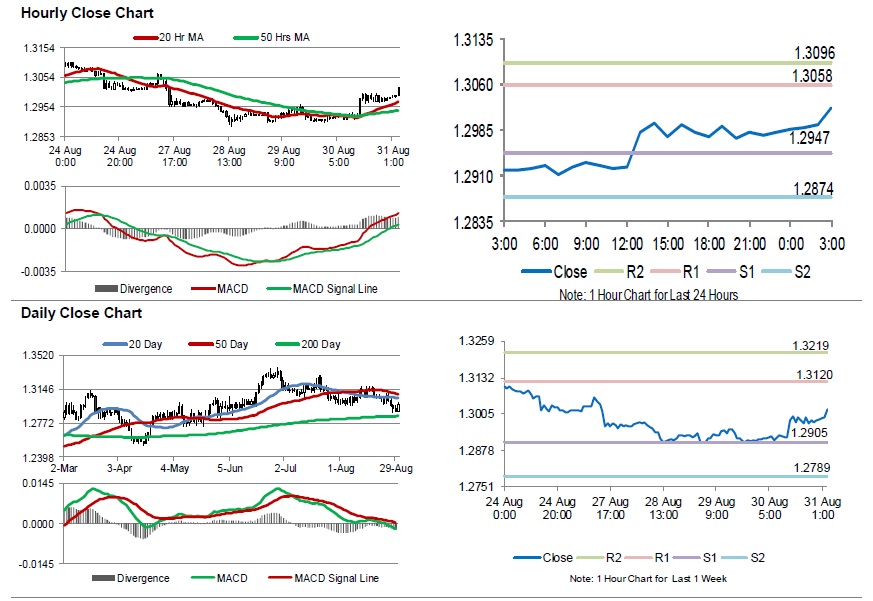
The pair is expected to find support at 1.2947, and a fall through could take it to the next support level of 1.2874. The pair is expected to find its first resistance at 1.3058, and a rise through could take it to the next resistance level of 1.3096.
Looking ahead, investors will closely monitor Canada's leading indicator, manufacturing PMI, trade balance, building permits, unemployment rate and the Bank of Canada's interest rate decision, all slated to release next week.
The currency pair is trading above its 20 Hr and 50 Hr moving averages.
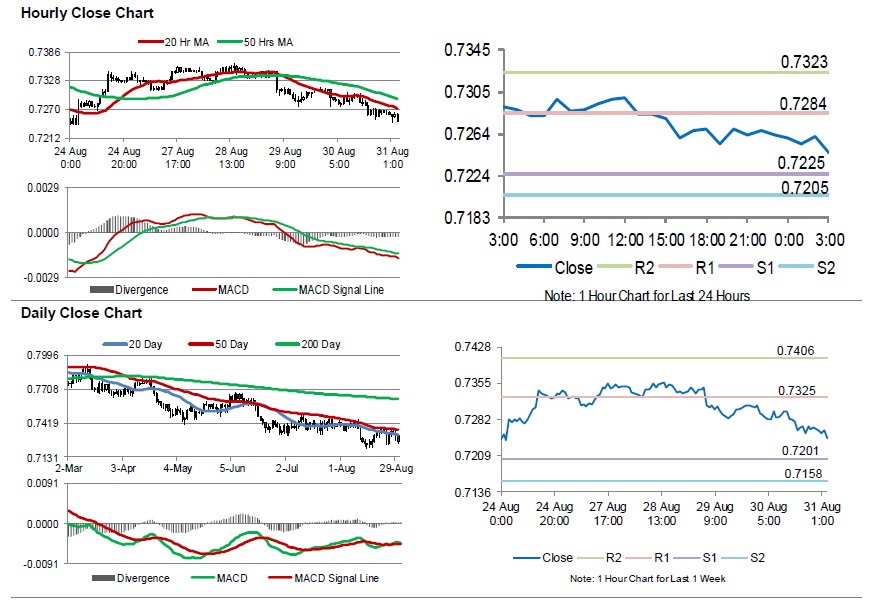
Aussie Extends Its Losses In The Asian Session
For the 24 hours to 23:00 GMT, the AUD declined 0.62% against the USD and closed at 0.7263.
LME Copper prices rose 0.02% or $1.5/MT to $6066.5/MT. Aluminium prices rose 0.5% or $11.0/MT to $2127.0/MT.
In the Asian session, at GMT0300, the pair is trading at 0.7245, with the AUD trading 0.25% lower against the USD from yesterday’s close.
Earlier in the session, Australia’s private sector credit climbed 0.4% on a monthly basis in July, beating market expectations for a rise of 0.3%. The private sector credit had recorded a rise of 0.3% in the prior month.
Elsewhere in China, Australia’s largest trading partner, China’s NBS manufacturing PMI unexpectedly climbed to a level of 51.3 in August, defying market expectations for a fall to a level of 51.0. In the prior month, the NBS manufacturing PMI had registered a reading of 51.2.
The pair is expected to find support at 0.7225, and a fall through could take it to the next support level of 0.7205. The pair is expected to find its first resistance at 0.7284, and a rise through could take it to the next resistance level of 0.7323.
The currency pair is trading below its 20 Hr and 50 Hr moving averages.
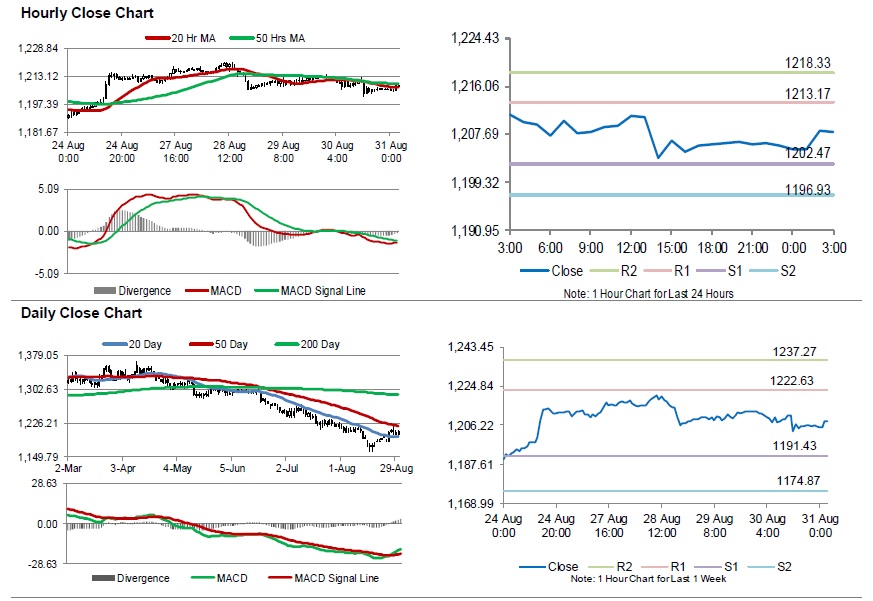
Gold: Yellow Metal Trading On A Stronger Footing In The Morning Session
For the 24 hours to 23:00 GMT, Gold declined 0.54% against the USD and closed at USD1206.10 per ounce, amid broad strength in greenback.
In the Asian session, at GMT0300, the pair is trading at 1208.00, with gold trading 0.16% higher against the USD from yesterday’s close.
The pair is expected to find support at 1202.47, and a fall through could take it to the next support level of 1196.93. The pair is expected to find its first resistance at 1213.17, and a rise through could take it to the next resistance level of 1218.33.
The yellow metal is showing convergence with its 20 Hr and 50 Hr moving averages.
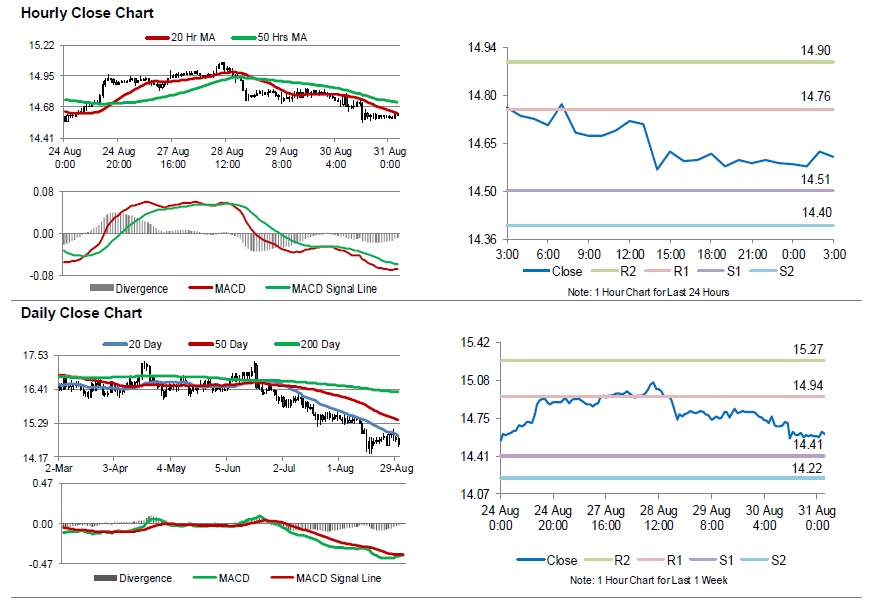
Silver: White Metal Reverses Its Losses In The Asian Session
For the 24 hours to 23:00 GMT, Silver declined 1.42% against the USD and closed at USD14.59 per ounce, tracking losses in gold prices.
In the Asian session, at GMT0300, the pair is trading at 14.61, with silver trading 0.14% higher against the USD from yesterday’s close.
The pair is expected to find support at 14.51, and a fall through could take it to the next support level of 14.40. The pair is expected to find its first resistance at 14.75, and a rise through could take it to the next resistance level of 14.90.
The white metal is showing convergence with its 20 Hr moving average and trading below its 50 Hr moving average.
Crude Oil: Oil Trading Higher, Ahead Of Baker Hughes Weekly Rig Count
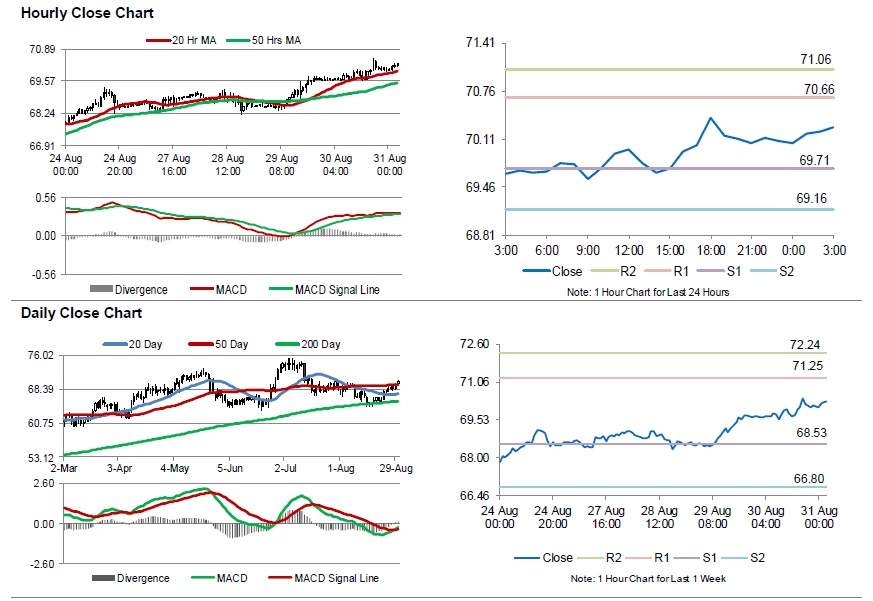
For the 24 hours to 23:00 GMT, Crude Oil rose 0.62% against the USD and closed at USD70.08 per barrel, amid weekly declines in the US crude supplies and led by ongoing concerns over tighter global inventories tied to the US sanctions on Iran.
In the Asian session, at GMT0300, the pair is trading at 70.27, with oil trading 0.27% higher against the USD from yesterday’s close.
The pair is expected to find support at 69.71, and a fall through could take it to the next support level of 69.16. The pair is expected to find its first resistance at 70.66, and a rise through could take it to the next resistance level of 71.06.
Crude oil is trading above its 20 Hr and 50 Hr moving averages.