Sample Category Title
GBP/USD Mid-Day Outlook
Daily Pivots: (S1) 1.2904; (P) 1.2969; (R1) 1.3092; More...
Intraday bias in GBP/USD remains on the upside and rebound from 1.2661 is in progress. Further rise should be seen to 55 day EMA (now at 1.3058) and then 1.3212 resistance. For now, we'd expect strong resistance from 1.3316 fibonacci level to limit upside, at least on first attempt. On the downside, break of 1.2844 support will argue that the rebound is completed and bring retest of 1.2661 low.
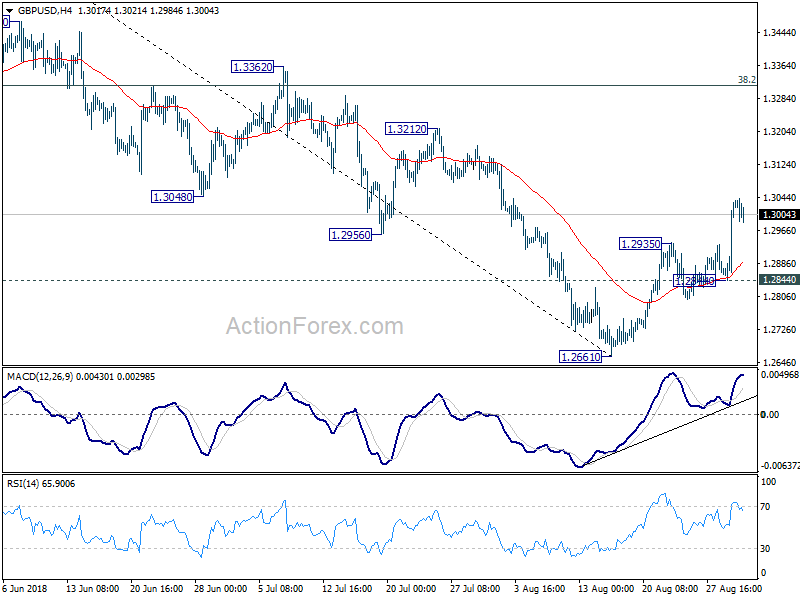
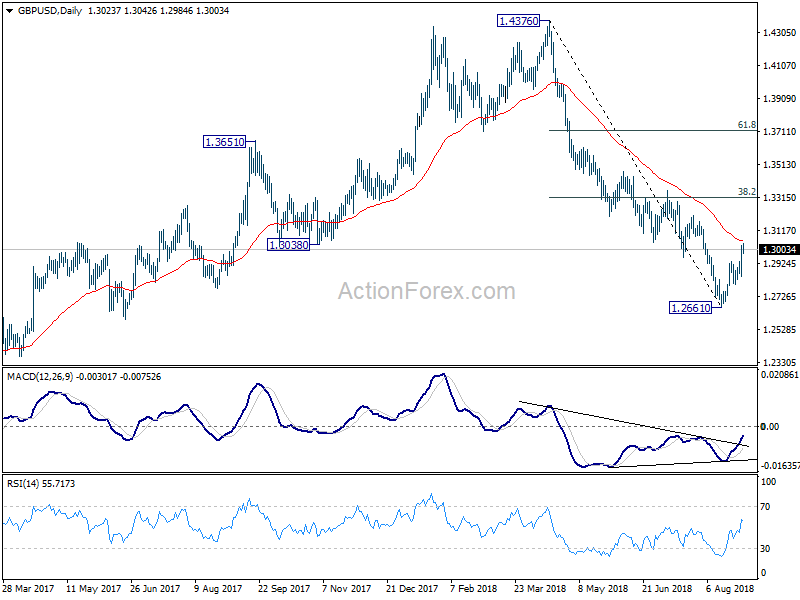
In the bigger picture, whole medium term rebound from 1.1946 (2016 low) should have completed at 1.4376 already, after rejection from 55 month EMA (now at 1.4091). The structure and momentum of the fall from 1.4376 argues that it's resuming long term down trend. And this will be the preferred case as long as 38.2% retracement of 1.4376 to 1.2661 at 1.3316 holds. However, firm break of 1.3316 would bring stronger rebound to 61.8% retracement at 1.3721. And, the eventual depth of the fall from 1.4376, and the chance of hitting 1.1946 low, will depend on the strength of the interim corrective rebound from 1.2661.
USD/CHF Mid-Day Outlook
Daily Pivots: (S1) 0.9736; (P) 0.9773; (R1) 0.9801; More.....
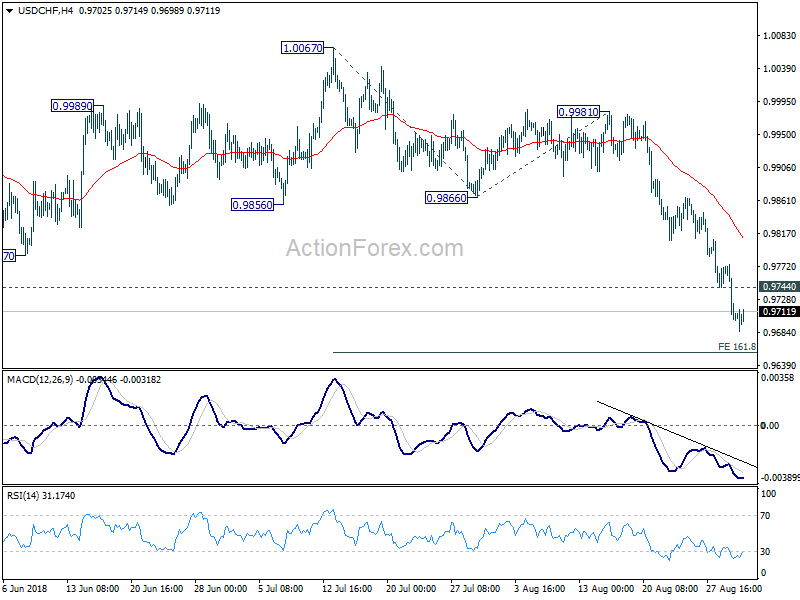
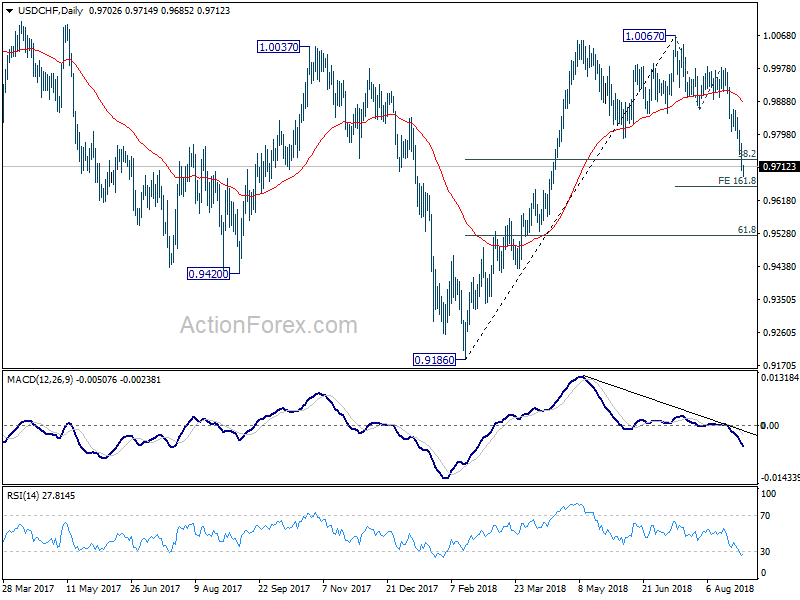
Intraday bias in USD/CHF remains on the downside at this point. Current fall from 1.0067 should target 161.8% projection of 1.0067 to 0.9866 from 0.9981 at 0.9656 next. On the upside, above 0.9744 minor resistance will turn intraday bias neutral first. But outlook will now stay bearish as long as 0.9866 support turned resistance holds. And deeper fall will remain in favor even in case of recovery.
In the bigger picture, current development suggests that rise from 0.9186 low has completed at 1.0067, after failing to sustain above 1.0037 resistance. Fall from 1.0067 could extend to 61.8% retracement of 0.9816 to 1.0067 at 0.9523 and below. But for now, we don't expect a break of 0.9186 low. On the upside, firm break of 1.0067 will resume the rise to 1.0342 key resistance (2016 high).
Canada: So-so Details in a Solid Q2 GDP Report
The Canadian economy expanded by 2.9% (q/q annualized) in the second quarter. This was well ahead of the (upwardly revised) 1.4% pace marked at the start of the year, although it fell a bit short of market (and our) expectations. Taking modest price gains into account, nominal GDP rose 5.1% in Q2.
Exports were in the driver's seat, up 12.3%. Energy exports and consumer goods led the way, up 24.2% and 27.6% respectively. Offsetting this somewhat was an acceleration of import growth to 6.5%.
Consumer spending also played an important role, as household consumption rose 2.6%. Service spending rose by 3.2%, while expenditures on durable goods were up a modest 2.1%.
If there is a dark spot in the report, it has to be business investment. Investment in non-residential structures rose a modest 2.2%, the slowest pace of expansion in the past six quarters. Machinery and equipment spending was also modest, up just 1.4% as firms pulled back their motor vehicle spending after a robust start to the year. Interestingly, residential structures investment rose by a modest 1.1% as solid renovation activity offset declines in new construction and ownership transfer costs (resales).
Real growth may have accelerated, but income growth decelerated modestly. Compensation of employees was up 2.9%, the slowest pace since mid-2016. The household saving rate fell to 3.4% from a (downwardly) revised rate of 3.9% in Q1.
On a monthly basis, we got a soft end to the quarter. Monthly GDP was flat in June, with 12 of 20 major industries expanding output. This was largely due to a disruption in the oil and gas sector, which led goods output lower (-0.2%). Conversely, services output rose 0.1%, marking 27 straight months of expansion, a new record.
Key Implications
We'll take it. Investment aside, there really isn't too much to complain about in today's figures. The surge of exports was driven by the resolution of supply disruptions earlier in the year, and so should be faded, but shipments of consumer goods were solid, and the domestic details were generally encouraging. Consumers felt comfortable spending a little more, and it was a pleasant surprise to see residential investment in positive territory thanks to renovation activity. The softer pace of investment is sure to get a lot of attention. We note that at least some of the deceleration is due to a normalization of spending on vehicles after a robust start to the year, but this component is definitely one to watch carefully going forward.
Looking ahead, a more 'normal' pace of growth should prevail. Housing activity seems to have bottomed, and so we expect residential investment to continue making a positive contribution, counterbalanced by disruptions in the energy sector. With labour markets and incomes still decent, solid U.S. demand, and still accommodative monetary policy, the pieces remain in place for modestly above-trend growth going forward.
The Q2 economic performance was pretty much bang on Bank of Canada expectations, and so there is little reason for them to alter the path of their policy interest rate. Another hike is coming, but communication opportunities and the timing of the Business Outlook Survey both make the Bank of Canada's October policy meeting the most likely timing for the next move.
US: Core Inflation Holds at Target in July, Real Spending Extends Winning Streak
Personal income rose 0.3% in July – a hair below both market expectations and last month's gain. Adjusted for inflation and removing taxes, real disposable income was up 0.2% in the month.
Personal spending rose 0.4% in nominal terms, in line with the market expectations. Spending in real terms rose 0.2%, with both services (+0.2%) and goods (+0.2%) contributing to the gain. Within real goods, the gain was driven by nondurables which rose 0.6% on the month, while durables pulled back 0.5%
Core PCE rose 0.2% on the month. Weakness in energy (-0.5%) held back the headline PCE deflator to just 0.1% m/m. In year-over-year terms, the headline PCE index accelerated to 2.3% from 2.2% in the month prior, while the core PCE rose to 2%. The latter has been in the 1.9% to 2% range since March.
The personal saving rate came in at 6.7%, down only 0.1 of a percentage point from the month prior.
Key Implications
A strong retail sales report had already hinted at a solid gain in consumer spending at the start of the third quarter. Today's report confirms this to be the case. It's encouraging to see that the American consumer continues to spend confidently and on a steady basis, with the streak in real spending gains extending to five months as of July.
The second quarter's 3.8% rebound in consumer spending will be difficult to repeat. Nevertheless, consumer confidence sitting at an 18 year high, along with rising incomes and employment gains all point to a healthy consumer spending growth in the 2½ to 3% range for the second half of the year.
It's also encouraging to see the Fed's preferred measure of inflation – core PCE – remaining at or near target on a consistent basis since March. Inflation has indeed firmed over the past few months, but is not getting out of hand. This implies that the Fed should continue on its gradual tightening cycle. A symmetric 2% target as communicated by the Fed, means that even in the event that core inflation breaks somewhat above target, the Fed will still maintain its current policy path. All told, a September hike appears to be in the bag, and is likely to be followed by another hike by year's end.
USD/JPY Mid-Day Outlook
Daily Pivots: (S1) 111.23; (P) 111.53; (R1) 111.98; More...
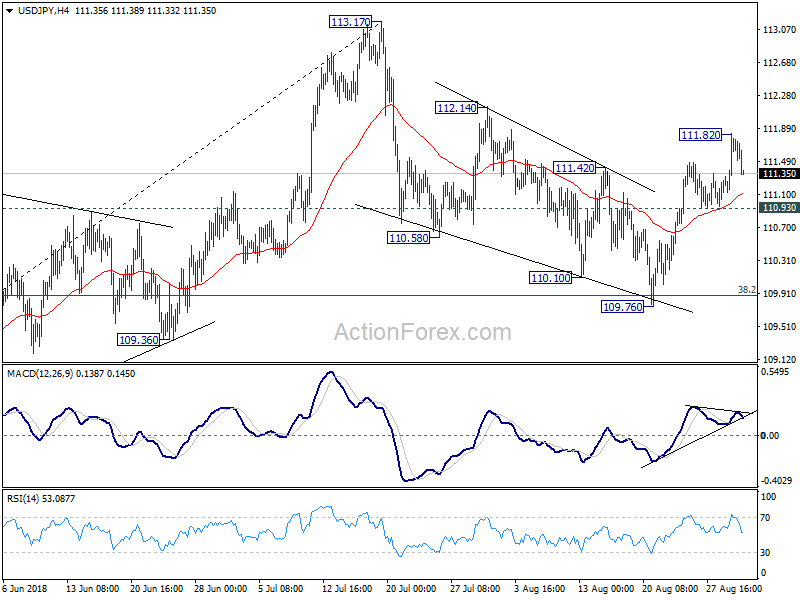
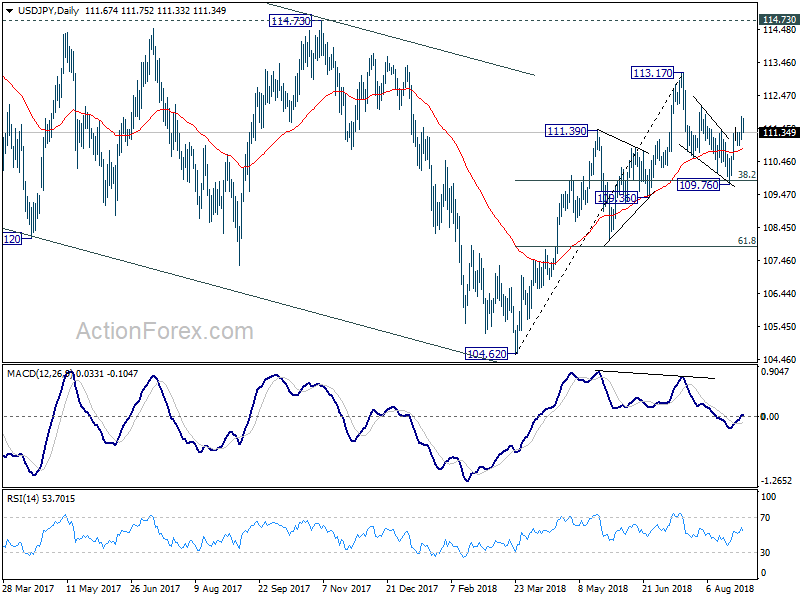
USD/JPY retreats notably after hitting 111.82 and with 4 hour MACD crossed below signa line, intraday bias is turned neutral first. We're holding on to the bullish case as long as 110.93 minor support holds. That is, correction from 113.17 should have completed at 109.76 already. On the upside, above 111.82 will target 112.14 resistance first. Break there should bring retest of 113.17 high. On the downside, however, break of 110.93 minor support will dampen the bullish case and turn focus back to 109.76 instead.
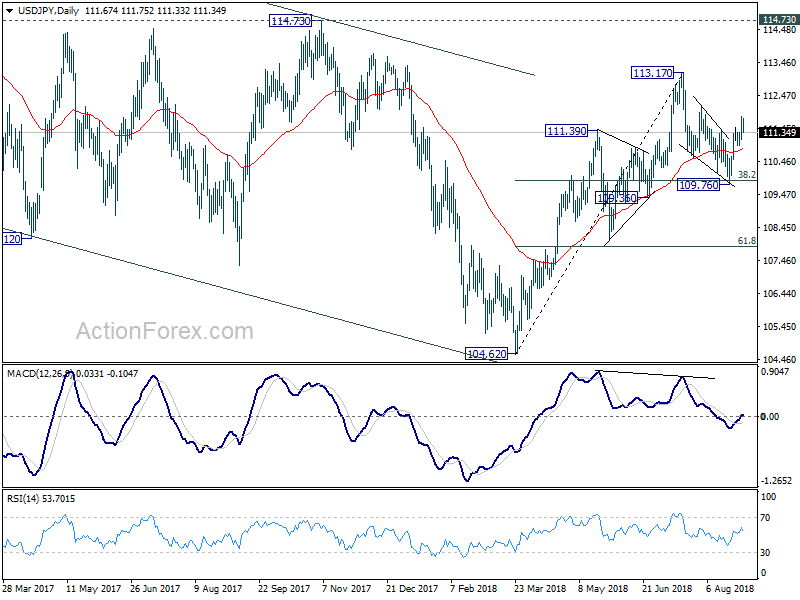
In the bigger picture, corrective fall from 118.65 (2016 high) should have completed with three waves down to 104.62. Decisive break of 114.73 resistance will likely resume whole rally from 98.97 (2016 low) to 100% projection of 98.97 to 118.65 from 104.62 at 124.30, which is reasonably close to 125.85 (2015 high). This will stay as the preferred case as long as 109.36 support holds. However, decisive break of 109.36 will mix up the outlook again. And deeper fall should be seen back to 61.8% retracement of 104.62 to 113.17 at 107.88 and below.
Yen Regains Ground as Investor Sentiments Weighed Down by Turkey and China Again
Yen regains some ground today as global markets, except US, are back in risk averse mode. Another day of selloff in the Turkish Lira is a reason for the selloff in European stocks. USD/TRY hits as high as 6.839 today and is currently up 4.76 %, 7.00 handle is within touching distance. Weakness in Chinese stocks and Asia is another factors weighing down sentiments. The US is making progress in trade negotiations with Mexico, Canada and the EU. But China as an outsider to the allies is left behind. Swiss Franc is following as the second strongest for today, Dollar as the third strongest.
Commodity currencies are generally under pressured. New Zealand Dollar was sold off earlier today on terribly bad business confidence data. Canadian Dollar also suffers some selling after Q2 GDP miss. USD/CAD surges on the back on contrasts in US and Canadian Dollar. However, it should be emphasized that 2.9% annualized growth is never a bad number for Canada. BoC is going to hike again, just a matter of September or October. And both Trump and Canadian Prime Minister Justin Trudeau expressed optimism that a trade deal can be concluded this week. So, we'd suggest not to be too bearish on Canadian Dollar.
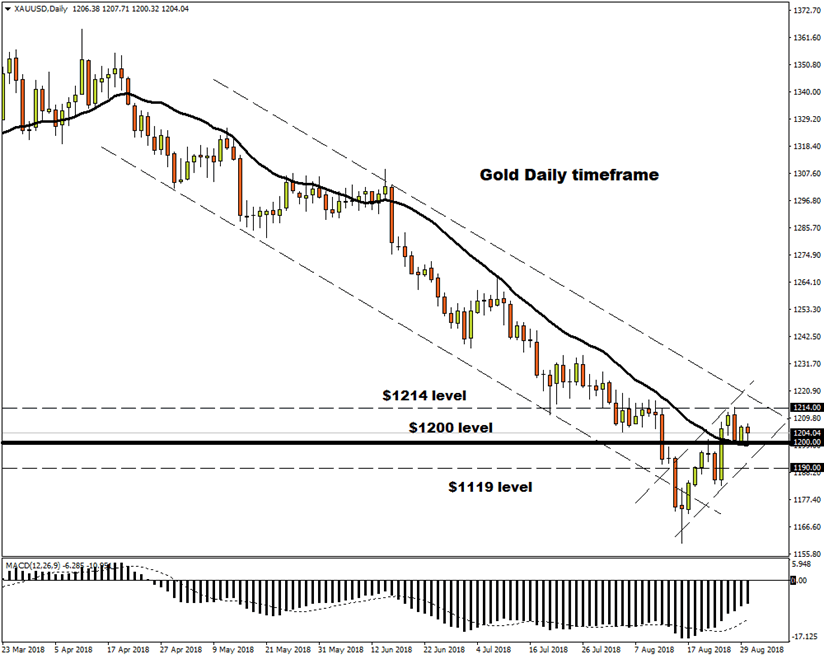
In other markets, major European indices are all in red, with FTSE down -0.76%, DAX down -0.74% and CAC down -0.57%. EU showed friendly hands to UK on Brexit negotiation. It also indicated that auto tariffs can be scrapped if US does the same. But these positive factors are seemingly not enough to offset worries over Turkey. Earlier today Nikkei closed up 0.09%, Hong Kong HSI down -0.89%, China Shanghai SSE down -1.14% and Singapore Strait Times down -0.56%. Gold continues to trade in tight range above 1200 handle as consolidation extends.
US PCE inflation accelerated, jobless claims stay low, Canada GDP missed
US personal income rose 0.3% in July, spending rose 0.4%, both matched expectations. Headline PCE accelerated to 2.3% yoy, up from 2.2% yoy and beat expectation of 2.2%. PCE core also accelerated to 2.0% yoy, up from 1.9% yoy and matched expectation of 2.0% yoy. Core inflation now formally meet Fed's target.
Initial jobless claims rose 3k to 213k in the week ended August 25, below expectation of 214k. Four-week moving average dropped -1.5k to 212.25k. That's the lowest level since December 13, 1969. Continuing claims dropped -20k to 1.708m in the week ended August 18. Four-week moving average of continuing claims dropped -4.5k to 1.73125m.
Canada data was slightly less impressive. GDP rose 0.0% mom in June versus expectation of 0.2% mom. For Q2, GDP grew 2.9% annualized, slightly below expectation of 3.0%. Exports was the main driver to Q2's growth, up 2.9%. Consumer spending growth also rose 0.6%. However, there was deceleration in business investments, contraction in inventories and imports. The set of data doesn't add any additional reason for BoC to hike in September instead of October.
EU Malmström willing to scrap auto tariffs if US does the same
EU Trade Commissioner for Trade Cecilia Malmström told the European Parliament's trade committee that they are willing to scrap auto tariffs in the negotiation with the US. She noted "we said that we are ready from the EU side to go to zero tariffs on all industrial goods, of course if the U.S. does the same, so it would be on a reciprocal basis."
And, "we are willing to bring down even our car tariffs down to zero … if the U.S. does the same," she said, adding that "it would be good for us economically, and for them."
But she also emphasized that it's not about "restarting TTIP" but aiming for "a more limited trade agreement." And more importantly, "agriculture would not be in the agreement, nor public procurement as it looks to today."
Eurozone economic sentiment dropped for the eighth straight month
Eurozone economic sentiment dropped -0.5 to 111.6 in August, down from 112.1 and below expectation of 112.2. That's also the eighth straight month of deterioration. Industrial confidence dropped to 5.5, down from 5.8 and below expectation of 5.5. Services confidence dropped to 14.7, down from 15.3 and below expectation of 15.2. Consumer confidence was finalized at -1.9.
Eurostats noted that "the decrease in the euro-area sentiment indicator resulted from a marked deterioration of confidence among consumers and a milder decrease in the services sector, which were only partly offset by increases in the retail trade and construction sectors." Meanwhile, "confidence in the industry sector remained broadly stable".
Also, the sentiment indicator was virtually unchanged in Germany, which was down by -0.1. But notable decreases are seen in France (-1.3), Italy (-0.8), Spain (-0.7) and the Netherlands (-0.5).
Business climate indicator dropped to 1.22, down from 1.29 and missed expectation of 1.25.
Also released in European session, German CPI was unchanged at 2.0% yoy in August. Unemployment dropped -8k in August, matched expectation. Unemployment rate was unchanged at 5.2%. UK Mortgage approvals was unchanged at 65k in July. M4 money supply rose 0.9% mom in July.
EU Barnier: Irish border the most sensitive point but a solution is possible
EU chief Brexit negotiator Michel Barnier talked to German broadcaster Deutschlandfunk with a more neutral tone on Brexit today. He said that EU should be prepared for every outcome, and "that includes the no-deal scenario". He also mentioned that the issue of Irish border was the "most sensitive point" of the negotiations. But he also noted that it is "possible" to have a solution.
Barnier said yesterday that the EU is "prepared to offer Britain a partnership such as there never has been with any other third country." That's taken as a sign of commitment to a deal.
Separately, it's reported that EU officials are considering an unscheduled summit in November to conclude Brexit negotiations. It's actually not news as the October summit is too tight while December one is too late to finalize all the parliamentary approvals.
Suggested reading on Brexit: The Real Meaning of "No Deal" Brexit
Swiss KOF dropped to 100.3, growth to hover around 10 year average
Swiss KOF Economic Barometer dropped 1.4 pts to 100.3 in August, below expectation of 101.2. KOF noted that it "pints to a level that is only marginally above its long-term average." And, "in the near future Swiss growth should hover around its average over the last ten years."
Also, it's noted that "the strongest contributions to this negative result come from manufacturing, followed by the indicators from the exporting sector." On the other hand, "the indicators related to private consumption give a positive signal. ". Financial and construction sectors were practically unchanged.
New Zealand business confidence plummets, AUD/NZD rebounds on Kiwi selloff
New Zealand ANZ business confidence tumbled by a further -5 pts in August to -50. Meanwhile, Activity Outlook was unchanged at 3.8. ANZ noted that "manufacturing is now the least confident sector – likely a lagged impact from construction sector woes". On the other hand, The services sector is the most optimistic. Also "activity sub-indicators remain weak" and "threat to near-term activity is real."
It's a "particularly sharp turnaround" in the manufacturing sector from being the most optimistic in April, to the most pessimistic in August. Manufacturers' export expectations are holding up. Thus, "this weakness is an echo of construction sector pessimism". Employment intentions "continue to ease" and are weakest in "agriculture and construction sectors". And, "it seems increasingly inevitable that wariness amongst firms will have real impacts, in the near term at least, as investment and employment decisions are deferred."
Also released in Asian session, New Zealand building permits dropped -10.3% mom in July. Australian building approvals dropped -5.2% mom in July, private capital expenditure dropped -2.5% qoq in Q2. Japan retail sales rose 1.5% yoy in July.
USD/JPY Mid-Day Outlook
Daily Pivots: (S1) 111.23; (P) 111.53; (R1) 111.98; More...
USD/JPY retreats notably after hitting 111.82 and with 4 hour MACD crossed below signa line, intraday bias is turned neutral first. We're holding on to the bullish case as long as 110.93 minor support holds. That is, correction from 113.17 should have completed at 109.76 already. On the upside, above 111.82 will target 112.14 resistance first. Break there should bring retest of 113.17 high. On the downside, however, break of 110.93 minor support will dampen the bullish case and turn focus back to 109.76 instead.
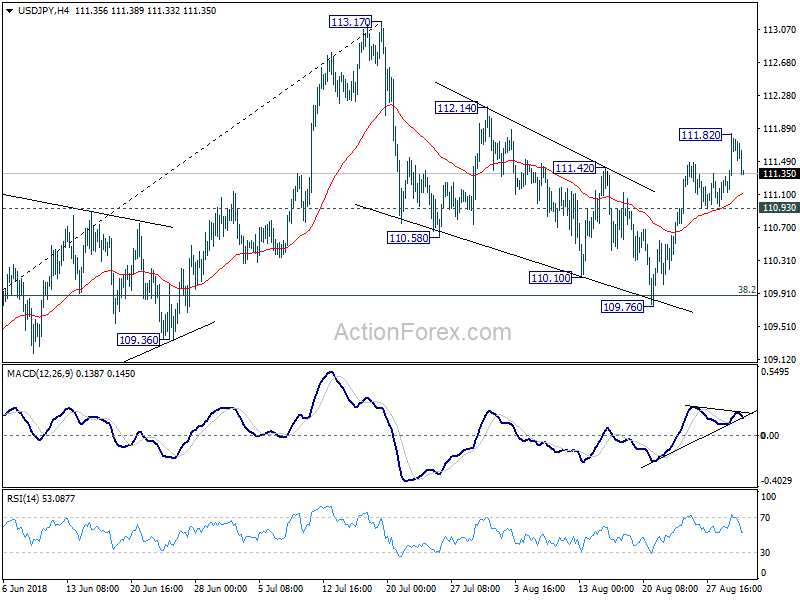
In the bigger picture, corrective fall from 118.65 (2016 high) should have completed with three waves down to 104.62. Decisive break of 114.73 resistance will likely resume whole rally from 98.97 (2016 low) to 100% projection of 98.97 to 118.65 from 104.62 at 124.30, which is reasonably close to 125.85 (2015 high). This will stay as the preferred case as long as 109.36 support holds. However, decisive break of 109.36 will mix up the outlook again. And deeper fall should be seen back to 61.8% retracement of 104.62 to 113.17 at 107.88 and below.
Economic Indicators Update
| GMT | Ccy | Events | Actual | Forecast | Previous | Revised |
|---|---|---|---|---|---|---|
| 22:45 | NZD | Building Permits M/M Jul | -10.30% | -7.60% | -8.20% | |
| 23:50 | JPY | Retail Trade Y/Y Jul | 1.50% | 1.30% | 1.80% | 1.70% |
| 01:00 | NZD | ANZ Business Confidence Aug | -50.3 | -44.9 | ||
| 01:30 | AUD | Building Approvals M/M Jul | -5.20% | -1.90% | 6.40% | |
| 07:00 | CHF | KOF Leading Indicator Aug | 100.3 | 101.2 | 101.1 | 101.7 |
| 07:55 | EUR | German Unemployment Change (000's) Aug | -8K | -8K | -6k | |
| 07:55 | EUR | German Unemployment Claims Rate Aug | 5.20% | 5.20% | 5.20% | |
| 08:30 | GBP | Mortgage Approvals Jul | 65K | 65K | 66K | |
| 08:30 | GBP | Money Supply M4 M/M Jul | 0.90% | 0.20% | -0.30% | |
| 09:00 | EUR | Eurozone Business Climate Indicator Aug | 1.22 | 1.25 | 1.29 | |
| 09:00 | EUR | Eurozone Economic Confidence Aug | 111.6 | 112.2 | 112.1 | |
| 09:00 | EUR | Eurozone Industrial Confidence Aug | 5.5 | 5.9 | 5.8 | |
| 09:00 | EUR | Eurozone Services Confidence Aug | 14.7 | 15.2 | 15.3 | |
| 09:00 | EUR | Eurozone Consumer Confidence Aug F | -1.9 | -0.6 | -1.9 | |
| 12:00 | EUR | German CPI M/M Aug P | 0.10% | 0.10% | 0.30% | |
| 12:00 | EUR | German CPI Y/Y Aug P | 2.00% | 2.00% | 2.00% | |
| 12:30 | CAD | Quarterly GDP Annualized Q2 | 2.90% | 3.00% | 1.30% | 1.40% |
| 12:30 | CAD | GDP M/M Jun | 0.00% | 0.20% | 0.50% | |
| 12:30 | USD | Initial Jobless Claims (AUG 25) | 213K | 214K | 210K | |
| 12:30 | USD | Personal Income Jul | 0.30% | 0.30% | 0.40% | |
| 12:30 | USD | Personal Spending Jul | 0.40% | 0.40% | 0.40% | |
| 12:30 | USD | PCE Deflator M/M Jul | 0.10% | 0.10% | 0.10% | |
| 12:30 | USD | PCE Deflator Y/Y Jul | 2.30% | 2.20% | 2.20% | |
| 12:30 | USD | PCE Core M/M Jul | 0.20% | 0.20% | 0.10% | |
| 12:30 | USD | PCE Core Y/Y Jul | 2.00% | 2.00% | 1.90% | |
| 14:30 | USD | Natural Gas Storage | 58B | 48B |
The Real Meaning of “No Deal” Brexit
The market is thrilled by comments from Michel Barnier, EU chief negotiator on Brexit, who noted that the EU is “prepared to offer Britain a partnership such as there never has been with any other third country”. We do not see any breakthrough from those comments, just as we find nothing new in media reports days ago, suggesting the so-called Brexit deadline could be postponed to mid-November from October.
What does “No Deal” Mean?
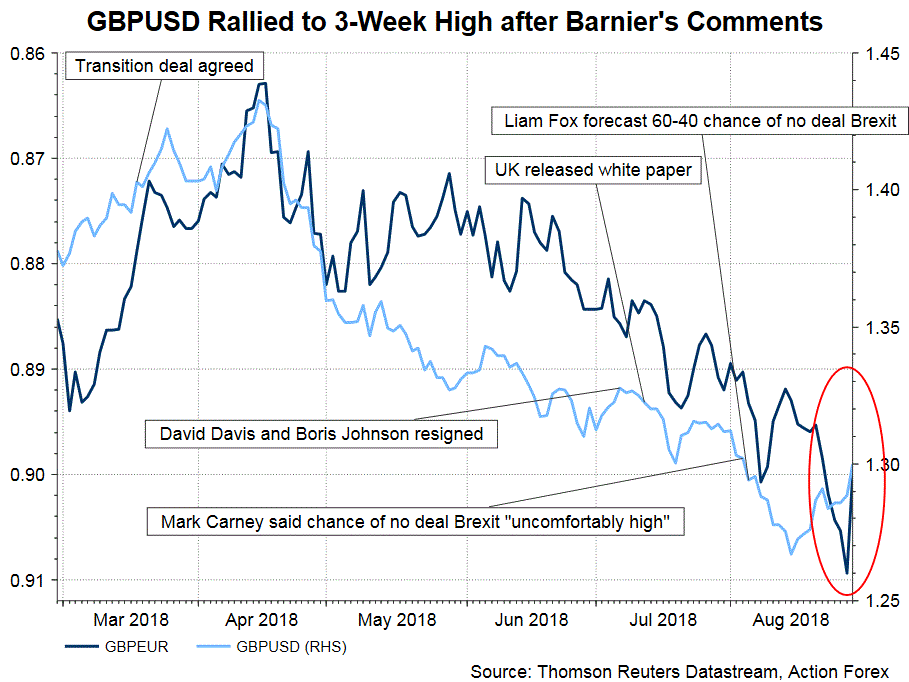
Talks of “no deal” have intensified over the past several weeks. For instance, UK Trade Secretary Liam Fox suggested earlier this month that he sees a “60-40” chance of a “no deal” Brexit while BOE governor Mark Carney noted that such chance is “uncomfortably high”. Last week, the Department for Exiting the European Union (DexEU) has started releasing technical notices for “preparedness” for no deal. These gestures have caused great misunderstanding to the market. It is generally believed that if the two counterparts fail to make a deal by October (or November), then the UK, by March 2019, would leave the single market without a trade agreement and fully expose to EU’s tariffs applied to general trading partners under WTO rules.
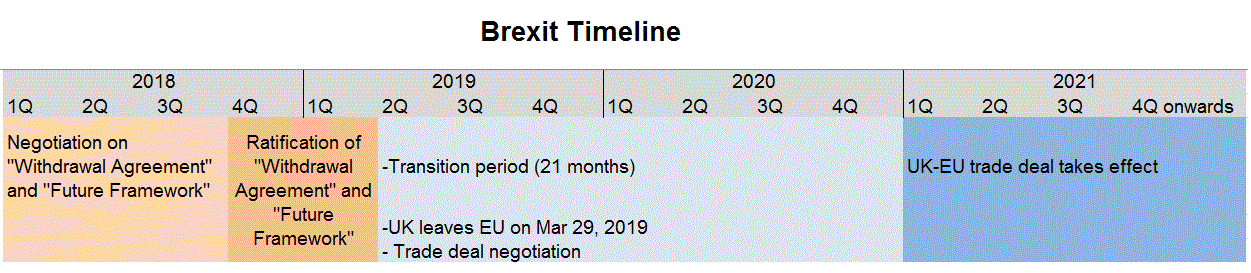
In fact, this is not the case. Broadly speaking, Brexit negotiations contain two most important parts: “Withdrawal Agreement” and the “Future Framework” before March 2019, and comprehensive negotiations on trade relations during the transition period. The October/ November deadline refers to the former only. In UK government's notice on preparations for a 'no deal' scenario, it stated that a “no deal” scenario is one “where the UK leaves the EU and becomes a third country at 11pm GMT on 29 March 2019 without a Withdrawal Agreement and framework for a future relationship in place between the UK and the EU”. It added that, in a “no deal” scenario, there would be “no agreement to apply any of the elements of the Withdrawal Agreement described above”.
UK’s Bundling Strategy
We are not too pessimistic to believe that the above “no deal” scenario would materialise. The “Withdrawal Agreement” includes 3 issues: the financial settlement, citizens’ rights and, and the status of the border between Northern Ireland and the Republic of Ireland. According to Barnier around 80% of the questions here has been resolved. The final 20%, mainly concerning Irish border, is undoubtedly the most difficult part. While admitting that a long-term solution to this issue is extremely challenging, we believe both the UK and the EU are keen on finding a temporary fix, sticking to the “backstop” solution agreed in June during the transition period.
There is no requirement that the “Future Framework” has to contain details trade terms and rules. Under the terms of Article 50(2) TEU, the “Withdrawal Agreement must take account of the framework for the future relationship between Britain and the UK”. In this regard, the UK has published a detailed white paper (about 100 pages), trying to cover all aspects of the future relationship, while the EU has been intentionally brief with its 6-page document. We find the implications of the divergent attitude of the two parties as follows: Detailed discussion and conclusion of future trade relations is not a prerequisite for ratification of the Withdrawal Agreement and the Future Framework. EU aims at fulfilling the minimum requirement of European Council’s guideline on Article 50 negotiation: providing “overall understanding of the framework for the future relationship”. On the other hand, the UK attempts to tie the payment of the financial settlement and/ or Irish border with a satisfactory agreement on future trade relations.
We believe it is likely that a deal - for parliamentary ratification (UK and EU) on “Withdrawal Agreement” and the “Future Framework”- would be reached by year-end. This would pave the way for the next phase – the 21-month transition period starting March 29, 2019. This is also where comprehensive negotiation on future trade relations begins. We believe that negotiation during the transition period is the real challenge and a no (trade) deal scenario cannot be ruled. Yet, the recent volatility of British pound is front-loaded, mainly driven by misunderstanding of the real meaning of “no deal”.
EU Malmström willing to scrap auto tariffs if US does the same
EU Trade Commissioner for Trade Cecilia Malmström told the European Parliament's trade committee that they are willing to scrap auto tariffs in the negotiation with the US. She noted "we said that we are ready from the EU side to go to zero tariffs on all industrial goods, of course if the U.S. does the same, so it would be on a reciprocal basis."
And, "we are willing to bring down even our car tariffs down to zero … if the U.S. does the same," she said, adding that "it would be good for us economically, and for them."
But she also emphasized that it's not about "restarting TTIP" but aiming for "a more limited trade agreement." And more importantly, "agriculture would not be in the agreement, nor public procurement as it looks to today."
US PCE inflation accelerated, jobless claims stay low, Canada GDP missed
US personal income rose 0.3% in July, spending rose 0.4%, both matched expectations. Headline PCE accelerated to 2.3% yoy, up from 2.2% yoy and beat expectation of 2.2%. PCE core also accelerated to 2.0% yoy, up from 1.9% yoy and matched expectation of 2.0% yoy. Core inflation now formally meet Fed's target.
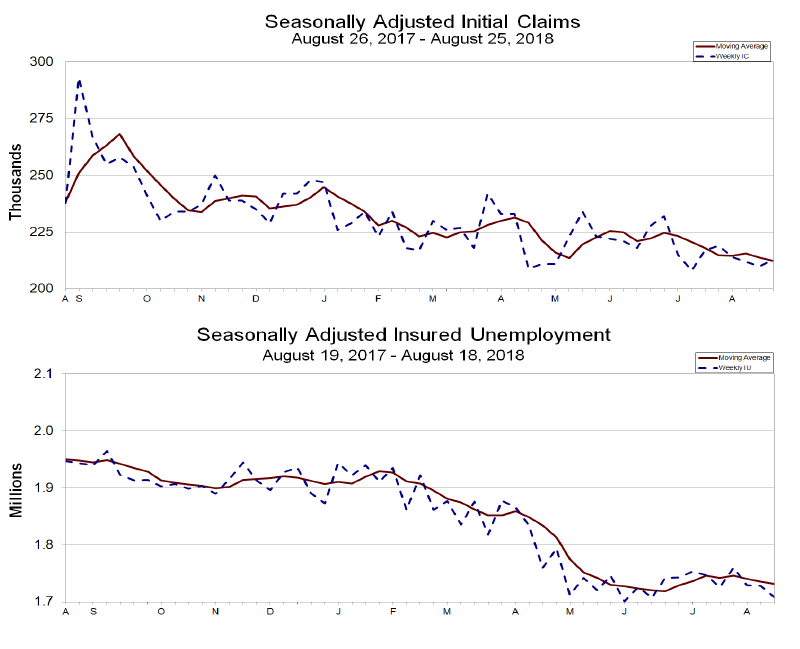
Initial jobless claims rose 3k to 213k in the week ended August 25, below expectation of 214k. Four-week moving average dropped -1.5k to 212.25k. That's the lowest level since December 13, 1969. Continuing claims dropped -20k to 1.708m in the week ended August 18. Four-week moving average of continuing claims dropped -4.5k to 1.73125m.
Canada data was slightly less impressive. GDP rose 0.0% mom in June versus expectation of 0.2% mom. For Q2, GDP grew 2.9% annualized, slightly below expectation of 3.0%. Exports was the main driver to Q2's growth, up 2.9%. Consumer spending growth also rose 0.6%. However, there was deceleration in business investments, contraction in inventories and imports. The set of data doesn't add any additional reason for BoC to hike in September instead of October.
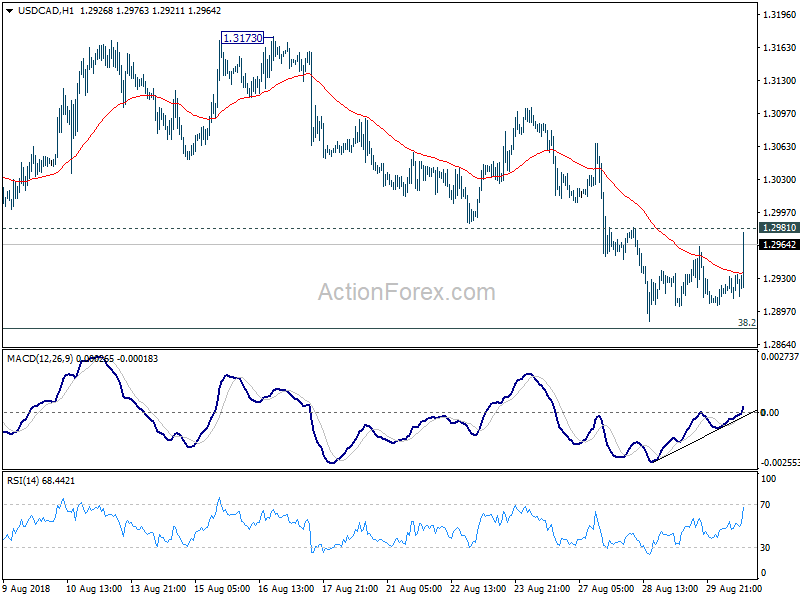
USD/CAD recovers strongly after the release with focus now back on 1.2981 minor resistance Break will bring stronger rebound.
Risk Sentiment Wavers on Trade Fears, Gold Sinks
Market players remain in a cautious mood as lingering concerns over trade tensions between the United States and China dent risk appetite.
Asian stocks relinquished earlier gains to close in negative territory this morning while European shares declined as simmering trade tensions prompted investors to offload riskier assets. With Donald Trump’s upcoming tariffs on $200 billion worth of Chinese goods likely to deteriorate US-China economic ties even further, resumed fears over trade remains a driving concern for investors.
Sterling boosted by Barnier, bulls capture 1.3000
The Pound experienced a sudden change of fortune after encouraging comments from Brexit negotiator Michel Barnier eased fears of a “hard Brexit”.
Bernier's comments that the European Union was “prepared to offer a partnership with Britain such as has never been with any other third party country” has made music to the ears of Pound traders. This positive development has boosted confidence over the direction of Brexit talks. The Pound’s aggressive appreciation following Barnier’s comments continues to highlight how the currency remains extremely sensitive to positive Brexit headlines.
Focusing on the technical picture, the GBPUSD is turning increasingly bullish on the daily charts. There have been consistently higher highs and higher lows created since the middle of August while prices are trading above the daily 20 Simple Moving Average. A weekly close above 1.3000 could seal the deal for bulls for prices to attack 1.3070 and 1.3130, respectively. If 1.3000 proves a stubborn resistance, Sterling could sink back to 1.2900.
South African Rand tumbles as Argentina Peso slides
The South African Rand has received another battering during trading on Thursday with the currency being hit from multiple directions.
The resumption of what very much could become another crisis for the Turkish Lira complimented by the Argentine Peso situation taking another dive for the worse, combined by prolonged concerns over trade tensions between the United States and China, is spelling out to investors a very reluctant environment for them to invest in high-yielding assets.
I would keep a very close eye on the situation with the currencies of Argentina and Turkey because it represents a major risk to deterring traders away from investing in any high-yielding assets, meaning that the situation for the South African Rand could get a lot worse due to external headwinds.
Commodity spotlight – Gold
Gold’s trajectory continues to be heavily influenced by the Dollar’s performance and US interest rate hike expectations.
The yellow metal depreciated today after reports of US economic growth expanding faster than expected during Q2 cemented market expectations of a US interest rate hike in September. With the Dollar likely to stabilize on Fed rate hike speculation and safe-haven demand, Gold could resume the downtrend.
In regards to the technical picture, the yellow metal needs to break back below the $1,200 level for bears to attack $1,190 and $1,182, respectively. If the $1,200 support holds, then prices could retest $1,214.