Sample Category Title
Pound’s Rally Takes a Breather after Barnier’s Cautious Remarks; US Core PCE Inflation Pending
Here are the latest developments in global markets:
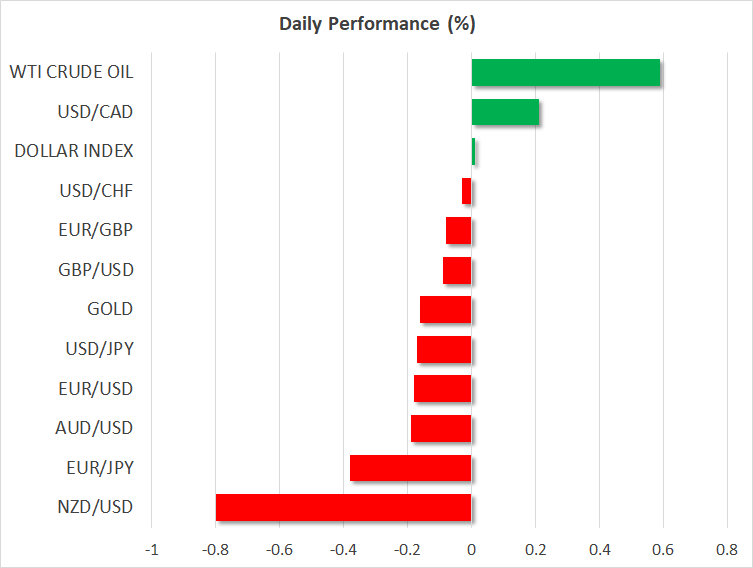
FOREX: Pound/dollar stalled yesterday’s rally, trading at 1.3016 (-0.08%) as the EU’s Brexit negotiator Michel Barnier talked down expectations of a Brexit deal today, saying that the bloc must be prepared for a “disorderly” exit. His comments came a day after he said that the UK could be offered a special partnership “such that has never been with any other country”. Euro/dollar was struggling to overcome the 1.1700 level, last seen at 1.1694 (-0.09%) despite a report by Politico stating that the EU is willing to remove tariffs on US industrial products, including cars, a move that could bring the sides close to a trade deal. In data, the Eurozone Economic Sentiment appeared unexpectedly weaker at 111.6 in August compared to a forecast of 111.9, at the lowest level reached since July 2017. That was the fourth straight month of declining sentiment. Euro/pound slipped to 0.8982 (-0.06%), while euro/yen fell to 130.27 (-0.35%). Dollar/yen fell below 1-month highs reached yesterday to touch 111.48 (-16%) ahead of the release of the core PCE inflation index later today. The dollar index was flat at 94.60. In the antipodean space, aussie/dollar and kiwi/dollar were underperforming, changing hands at 0.7296 (-0.15%) and 0.6661 (-0.80) respectively. Dollar/loonie was the best performer, rising to 1.2923 (+0.21%) a few hours before the Canadian Q2 GDP growth figures come into light.
STOCKS: European stocks followed Asian equities lower on Friday. The pan-European STOXX 600 and the blue-chip Euro STOXX 50 were down by 0.50% at 1000 GMT, with all sectors being in the red. The German DAX 30 declined by 0.95%, the French CAC 40 fell by 0.43%, while the Italian FTSE MIB retreated by 0.52%. The UK’s FTSE 100 was also trading in negative territory, losing 0.64%. Futures tracking the S&P 500, Dow Jones and the Nasdaq 100 were pointing to a marginally lower open later today.
COMMODITIES: WTI crude climbed to a 3-week high of $69.92/barrel (+0.60%) and London-based Brent surged to a 1 ½ -month high of $77.60 (+0.60%) on concerns that global supply could fall on the back of US renewed sanctions against Iran and disruptions in oil operations in Venezuela. On Wednesday, the EIA weekly report enhanced these worries, showing a larger decline in US crude inventories than analysts forecasted, while estimations that Iranian crude oil and condensate exports could fall to the lowest since April 2017 added further evidence that global supply is tightening. In precious metals, gold pulled back to $1,204.73/ounce (-0.13%).
Day ahead: US core PCE index & German CPI figures in focus; Canadian Q2 GDP growth under the spotlight too
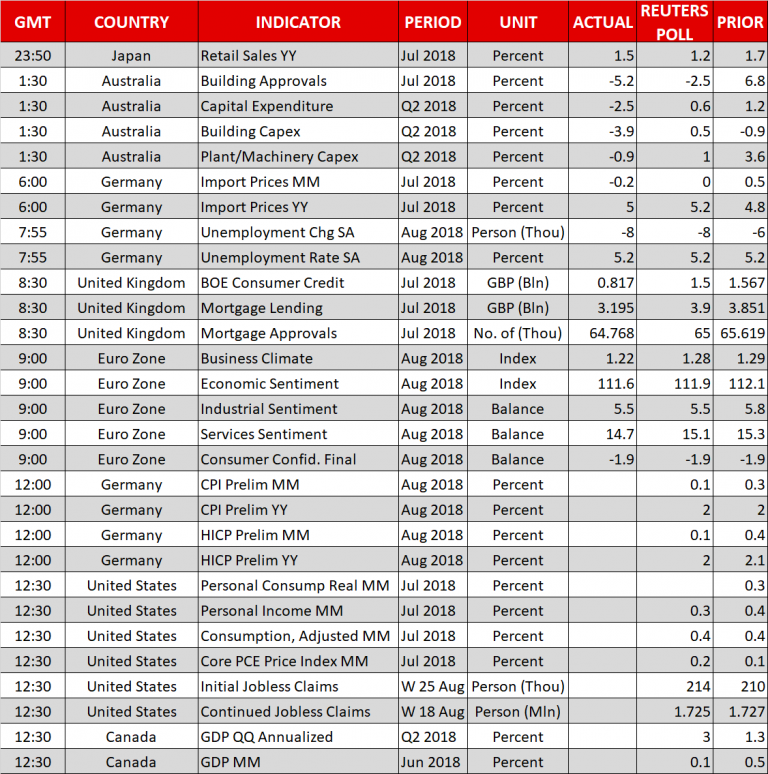
Germany, the biggest economy in the Eurozone, will deliver preliminary inflation figures for the month of August at 1200 GMT and traders may perceive the numbers as a precursor to Eurozone inflation data due on Friday. According to analysts, month-on-month (m/m) German consumer prices grew at a slower pace of 0.1% after rising by 0.3% in July, while in yearly terms the gauge stood flat at 2.0%. The Harmonized Consumer Price Index (HICP) which uses a common methodology across EU countries is expected to show that inflation in Germany softened to 0.1% m/m compared to 0.4% seen previously, while the yearly gauge also eased, edging down by 0.1 points to 2.0%. Should the data miss expectations, the euro could move south in speculation that tomorrow’s inflation data out of the Eurozone could also show some weakness, reducing pressure on ECB policymakers to raise interest rates sooner in time. Note, that German import prices, another proxy for the inflation trend, came in lower than forecasts.
Meanwhile in the US, inflation will also make the headlines as the Bureau of Economic Analysis is scheduled to release the Fed’s preferred inflation gauge, the core Personal Expenditure Index at 1230 GMT. Any upside surprise in the data could stoke market expectations for two more rate hikes by the Fed in 2018 and hence drive the dollar higher. The core PCE index is projected to gain 0.1 percentage points both in monthly and yearly terms in July, inching up to 0.2% m/m and 2.0% y/y. Stats on personal income and consumption accompanying the inflation report will also be of importance as any unexpected improvement on this front may prove that the US economy could afford further rate increases. Forecasts for personal income expect it to slip from 0.4% m/m to 0.3% in July, while consumption growth is said to remain flat at 0.4% m/m.
Initial jobless claims out of the US will come into light at 1230 GMT as well.
In Canada, the focus will shift to GDP growth data for the second quarter due at 1230 GMT. In the three months to June, the Canadian economy is expected to have picked up steam on a yearly basis, with economic activity picking up from 1.3% y/y to 3.0%. However, in monthly terms, GDP growth is estimated to drop from 0.5% to 0.1%. The loonie which has been gaining ground on hopes that a new NAFTA deal could be formed before Friday’s deadline could see a downside if GDP figures disappoint. Still, any positive trade news could provide some support to the currency, limiting the negative impact from the data.
Elsewhere, Japan will see the release of employment figures at 2330 GMT, with the jobs/applications ratio and the unemployment rate projected to remain steady at 1.62 and 2.4% respectively in July. A few minutes later at 2350 GMT, July’s flash reading on industrial production for July will gather interest as well, as analysts believe that after contracting for two months, Japanese industrial output has entered into positive territory again, reaching an expansion of 0.2% m/m. In June, production declined by 1.8%. Tokyo’s core CPI will come under the spotlight at 2330 GMT.
Staying in Asia, early on Friday at 0200 GMT, Chinese manufacturing and non-manufacturing PMIs published by the National Bureau of Statistics will hit the markets, probably bringing some volatility to the Chinese yuan as well as to other currencies depending on the Chinese economy such as the Australian dollar. The Bureau is expected to report that manufacturing activity in China was slightly lower in August, with the index sliding by 0.2 points to 51.
Brexit developments during the day would be closely monitored.
Into US session: Risk aversion back on Turkey and China, Lira down another 4.5%
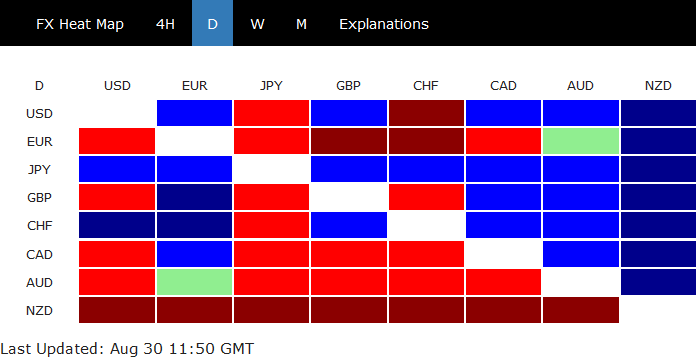
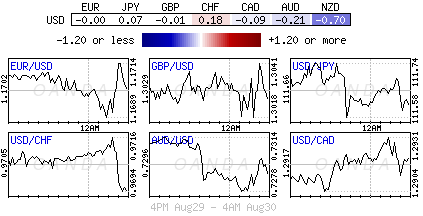
Entering into US session, Yen is trading as the strongest one for today, followed by Swiss Franc as markets are back in risk averse mode. Commodity currencies are generally lower. In particular, New Zealand Dollar's selloff is rather serious after terribly bad business confidence data. Canadian Dollar also turns soft as US-Canada trade negotiation is still in progress even though signs are optimistic. Euro follows commodity currencies as weakest as Turkish Lira crisis might be deepening again.
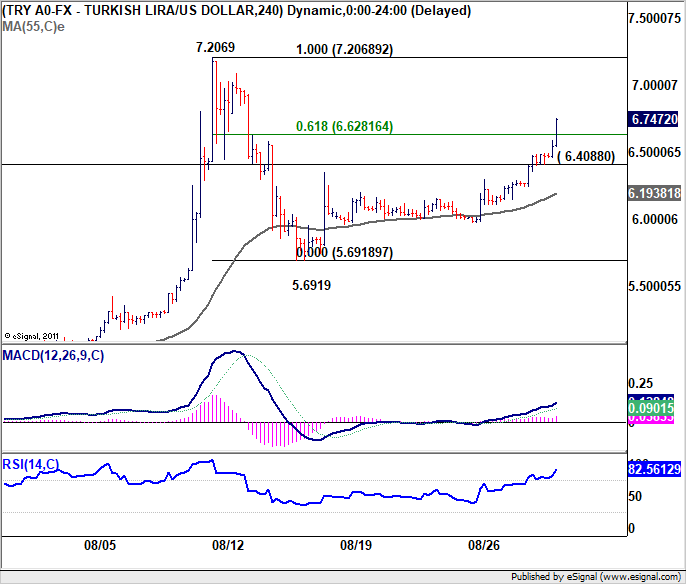
USD/TRY is up another 4.5% for today, above 6.72. 61.8% retracement of 7.2068 to 5.6919 at 6.6281 is taken out rather decisively. Now, USD/TRY could head to retest 7.2069 high. Break of today's low at 6.4088 is needed to be the first sign of stabilization. Otherwise, the Lira will continue to face selling pressure.
In the stock markets, major European indices are generally in red. FTSE is down -0.52%, DAX is down -0.45%. CAC is down -0.28%. Renewed selloff in China is rightfully blamed as a reason, as there is no war near an end of US-China trade war. Nonetheless, worries over Turkey should have played an important part too. Earlier today Nikkei closed up 0.09%, Hong Kong HSI down -0.89%, China Shanghai SSE down -1.14% and Singapore Strait Times down -0.56%.
EM Currencies Feel The Heat
Thursday August 30: Five things the markets are talking about
Emerging currencies have sold off sharply again overnight after Argentina's peso suffered its biggest one-day decline in three-years, with Turkey's lira, the South African rand and the Indian rupee all feeling the heat.
The dollar is under some pressure starting Thursday as easing concerns over trade conflicts has some investors increasing their risk appetite, however, month-end rebalancing may limit the 'big' dollars fall.
For N. American investors, the current state of Canada-U.S trade negotiations top the agenda. Both negotiation teams expressed optimism yesterday that they could reach a new NAFTA deal by Friday, although PM Trudeau indicated that a number of 'delicate' issues remained.
Elsewhere, sterling has been the big winner in the past 24-hours, finding support on hopes that Britain and the E.U will agree on future trade ties before Brexit takes effect. The E.U indicated yesterday that it's prepared to offer Britain an “unprecedentedly close relationship, but that the bloc must prepare for a no-deal Brexit.'
In equities, European shares are tracking a decline in Asian trading, as weakness in Chinese markets overnight seems to be, for now, overshadowing any optimism that a NAFTA deal could be struck by the end of the week.
On tap: Canada GDP and U.S core-PCE are due at 08:30 am EDT.
1. Stocks see red
In Japan, the Nikkei thrashed out small gains after touching a three-month high overnight as positive developments in trade talks supported sentiment. Nevertheless, the sessions closed out with some month-end profit taking. The Nikkei share average ended +0.1% higher, while the broader Topic ended flat.
Down-under, Australian shares gave up early gains to finish largely unchanged. The benchmark S&P/ASX 200 index finished marginally lower, down -0.1%. On the economic front, reports on new building approvals and private capital expenditure painted a glum picture of the Australian economy. In S. Korea, the Kospi index stock index ended flat, giving up early gains and tracked the declines in China.
In Hong Kong and China, fears of slower Chinese growth amid an escalating trade war with the U.S is keeping investor sentiment fragile. The Hang Seng index fell -0.9%, while the China Enterprises Index dropped -1%. In China, the blue-chip CSI300 index fell -1%, while the Shanghai Composite Index also closed down -1.1%.
In Europe, regional bourses trade lower across the board following weakness in Asia overnight and weaker U.S futures. The FTSE remains an underperformer as sterling (£1.3011) trades atop the key £1.30 level.
U.S stocks are set to open in the 'red' (-0.2%).
Indices: Stoxx600 -0.6% at 384.0, FTSE -0.8% 7505, DAX -1.2% at 12413, CAC-40 -0.5% at 5473, IBEX-35 -0.7% at 9497, FTSE MIB -0.6% at 20626, SMI -0.7% at 9021, S&P 500 Futures -0.2%
2. Oil prices rally on decline in U.S inventories, looming Iran sanctions
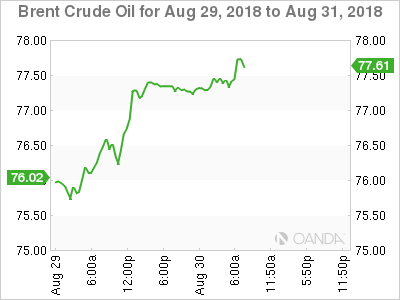
Oil prices have inched higher; extending Tuesday's solid gains on a fall in U.S crude inventories and expected market disruptions to supply from Iran and Venezuela.
Brent crude oil futures are at +$77.21 per barrel, up +7c from the close, while U.S. West Texas Intermediate (WTI) crude futures are up +14c at +$69.65 a barrel.
EIA data yesterday showed that U.S commercial crude inventories fell by -2.6M barrels in the week to Aug. 24, to +405.79M barrels, while U.S production was flat from last week's record +11M bpd.
This week, the IEA has warned of a tightening market towards the end of the year, due to a combination of supply concerns. OPEC will discuss in December whether it can compensate for a sudden drop in Iranian oil supply after U.S sanctions start in November.
Note: Iran's August crude oil exports is expected to drop to just over +2M bpd, versus a peak of +3.1M bpd in April, as importers adhere to U.S pressure to cut imports.
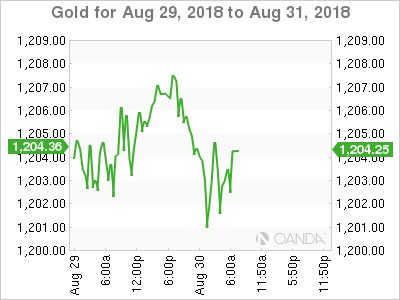
Ahead of the U.S open, gold prices ease a tad as the dollar firms amid expectations of higher U.S interest rates – positive U.S GDP data has boosted rate hike views – but the 'yellow' metal continues to hold above the key support level of +$1,200. Spot gold is down -0.4% at +$1,202.02 an ounce, while U.S gold futures are down -0.3% at +$1,207.80 an ounce.
3. U.S yield curve – rising rates resemble pre-2008
For fixed income dealers a narrowing Treasury bond yield curve between the two-year and 10-year bonds suggests a rising risk of recession.
The U.S 2's/10's spread is currently around +20 bps – it last traded here in 2005, three-years before the crisis took hold and seven interest rate increases before the Fed Funds rate peaked. Curve inversion happened for the first time in January 2006, with four further rate hikes to follow. The 2007-2008 financial crisis was followed by a global economic downturn.
Elsewhere, Germany's 10-year Bund yield has increased less than +1 bps to +0.41%, reaching the highest yield in more than three-weeks. In the U.K the 10-year Gilt yield has advanced +1 bps to +1.489%, hitting the highest yield in more than three-months.
The spread of Italy's 10-year bonds over Germany's has declined -3 bps to +2.6937% points to the smallest premium in more than a week.
4. EM pairs plunge
The Argentine peso has plummeted over -7% after a collapse in investor confidence in President Macri's government. The central bank has intervened to try and stabilize the peso and the IMF said it was studying Argentina's request to speed up disbursement of a +$50B loan programme. The knock on effect from the peso's decline is hurting TRY, ZAR and INR.
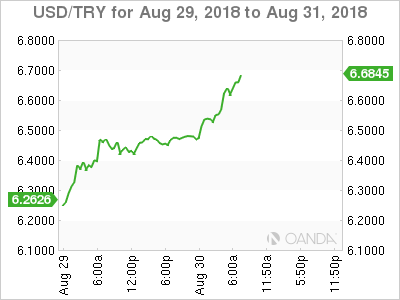
USD/TRY has rallied +2.6% to $6.6342, bringing it closer towards its recent record high of $7.1310. Analysts continue to see more upside over the coming weeks -Turkish inflation data is due next Monday and is widely expected to show a big increase, given that the lira has weakened significantly recently.
Note: Last month, Turkish inflation stood at +15.85% year-on-year and market odds of significant hike by the Central Bank of the Republic of Turkey (CBRT) next month are very low.
Sterling (£1.3014) jumped yesterday after E.U negotiator Michel Barnier said he is prepared to offer the U.K. a trade deal that has never been offered to a third country. The market has taken this as a sign that an agreement between the two sides has a greater likelihood of being achieved.
Note: The date to reach an agreement has been pushed back to mid-November.
5. NZ business confidence weaker
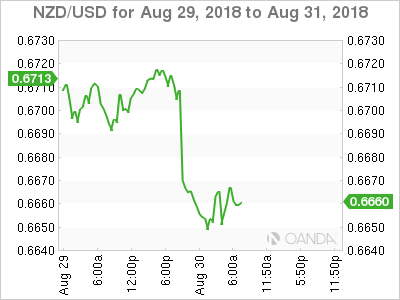
Data overnight showed that New Zealand business confidence remained weak this month.
The general business sentiment fell further to -50.3%, the lowest headline print in a decade as firms' own-activity expectations, which correspond more closely with GDP growth, was unchanged for the month.
A large part of the fall in business sentiment reflects individual firms' discomfort with the new government's policies, especially the planned changes to labor laws.
NZD fell as much as -1% to NZ$0.6645 after the release.
Turkish Lira| Increasing Bearish Momentum
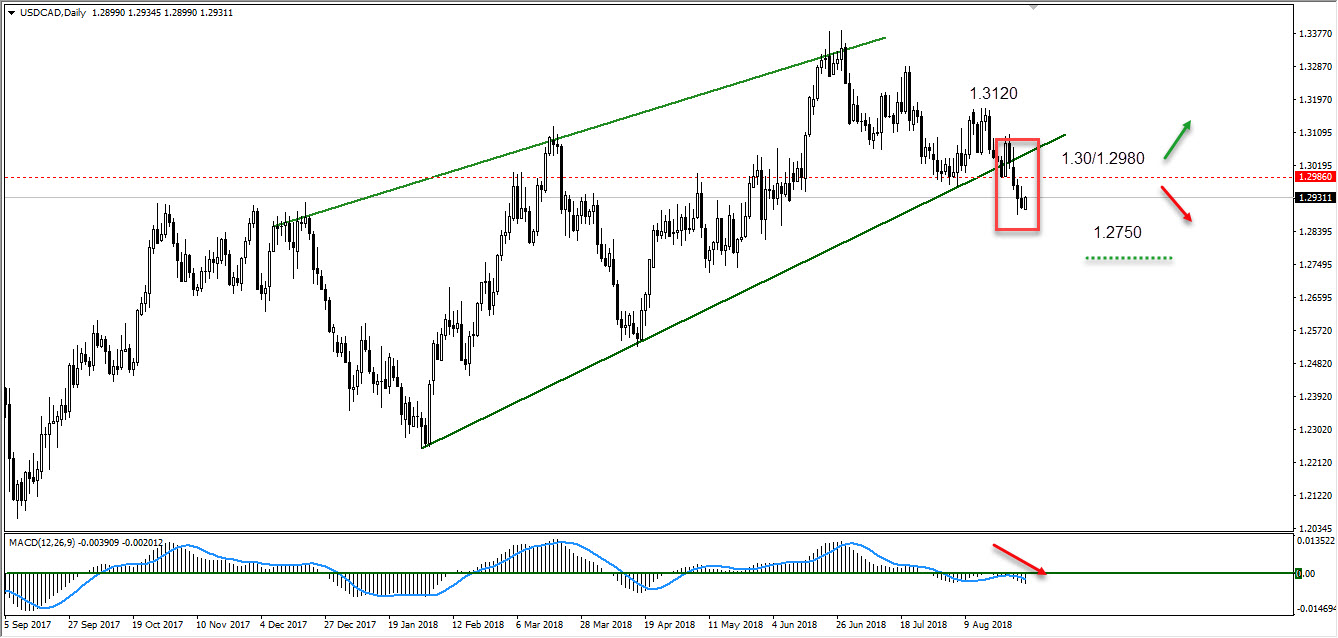
The chart below on a daily time-frame shows the pair USD/CAD trading in a down trend. In addition, it shows that the pair over the past month had begun to gradually decrease and as of now this movement is in full momentum.
The price which is currently at $1.2931 clearly shown on the chart had recently experienced a bearish breakout and is now expected to trade towards the support zone (colored in green) which is priced at $1.2750. The chart shows that the bears are in full dominance and control which is highly likely to continue as the price declines.
Major support: 1.2750
Major resistance: 1.30/1.2980
USDTRY
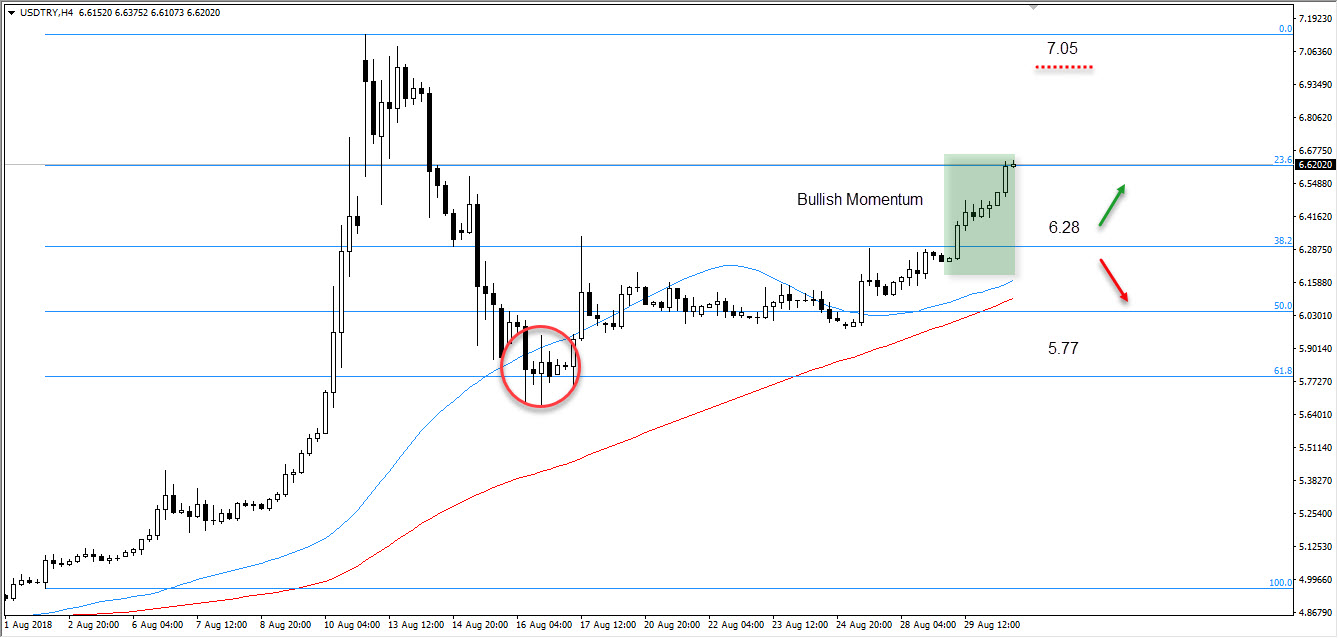
chart shows a similar pattern circled in red on the chart where a downside retracement had taken place. It is highly expected that a similar pattern may be taking place at present where the price is expected to continue to trade up towards the resistance zone (colored in red) which is priced at $7.05.
Moreover, there may also be a retest at this point of resistance. Additionally, this is evidently backed up by the green rectangle on the chart which signifies the bullish momentum taking place amongst the markets for the pair USD/TRY.
Major support: 5.77
Major resistance: 7.05
Strong US GDP Data Pushed Gold Lower | Iran Remain The Focal Point
Gold price is under pressure as traders digest the strong US GDP numbers released yesterday. The strong data has further confirmed that the fed is likely to stay on the path of interest rate hike for the rest of the year. However, considering gold is on a decline in terms of price the yellow metal has been able to grip and float above the $1,200 mark which is a strong support level for the precious metal.
The US GDP data which had been released on the 29th of August quarter enabled investors to have a strong mindset that the feds interest rate hikes will take place and in turn this will drive the gold price lower. Increasing probabilities of higher rates weaken the non-interest yielding gold. Moreover, this leads to investors constantly moving towards the dollar.
The consequences to the rate hikes are heavily injuring for gold as the yellow metal is on its way to the fifth straight monthly fall. As the days pass and we come closer to the next rate hike, gold is likely to fall. Yes, we may see slight increases. However, overall it is expected to see an increase in lows. The fifth straight monthly fall will result to golds longest streak in terms of a decline dating back to early 2013.
The precious metal at present for this year is approximately at a 7.4 percent decline, while the dollar increases to be a safe-haven for more investors.
Oil:
Oil prices continue to rise as sanctions on Iran’s oil continue to affect supply. The price for oil has experienced strong gains while U.S. continue to prepare sanctions on Tehran. The demand for gasoline reaching record highs rises while the supply decreases, this alone is benefiting oil prices continuously.
Oil supply is a concern for the industry. However, investors are being mindful that The Organization of the Petroleum Exporting Countries will be discussing its plans to substitute its loss in supply in September because of the planned sanctions on Iran. Therefore, as of now we are seeing an increase in price consistently in the markets.
However, it must be kept in mind that oil supply may have a backup plan to cover losses from the decline in supply. On the other hand, the oil industry goes beyond The Organisation of the Petroleum Exporting Countries where there are various other countries that supply oil which could be utilised to compensate for the loss the markets are currently facing. Additionally, as of now the bullish sentiment in the markets does remain. However, investors will be mindful of the upcoming discussion about oil supply.
Furthermore, it is highly likely that Iran’s oil supply will drop to around 2million bpd (barrels per day) which would be a major drop considering the production levels were at 3.1 million bpd in April this year. Therefore, the comparison between these figures alone emphasis the hit the oil industry is taking which at the same time drives the oil price higher which is currently priced at 477.32 per barrel for Brent crude oil.
DAX Slips On U.S-China Concerns
The DAX index has posted considerable losses in the Thursday session. Currently, the index is at 12,505, down 0.45% on the day. Earlier in the day, the DAX was more than 1.0 percent lower. In economic news, German Preliminary CPI is expected to dip to 0.1%. On Friday, Germany releases retail sales and the eurozone publishes CPI Estimate.
Inflation will be in focus for the rest of the week, and the strength of the data could determine the direction of German stock markets. The markets are braced for a weak gain of 0.1% from German Preliminary CPI, but Eurozone CPI Flash Estimate is expected to post a second straight gain of 2.1%. The indicator has climbed sharply in the second half of 2018 – back in May, CPI came in at 1.2%.
The U.S-China trade spat remains unresolved, as low-level talks between the sides last week proved inconclusive. The sides have swapped tariffs against each other, and unless there is some significant progress, the U.S will impose further tariffs on some $200 billion in Chinese products. With China likely to retaliate in kind, this would mark a major escalation in the trade war and could dampen risk appetite and weigh on the equity markets.
It has been a rough August for the DAX, which has dropped 2.2%. Still, with the ECB unlikely to raise interest rates in the near future, investors may prefer the equity markets over the euro. The currency was last above the 1.20 line in May, and this symbolic level could remain elusive for quite some time. The reason? Mario Draghi and his ECB colleagues continue to send out the message that the ECB has no plans to raise rates until after the summer of 2019. The markets are not expecting a rate hike before October 2019, which means that the euro is not particularly attractive unless there is an unexpected improvement in the German and eurozone economies.
EUR/USD – Euro Ticks Lower, Investors Await German CPI
EUR/USD is showing little movement in the Thursday session. Currently, the pair is trading at 1.1695, down 0.11% on the day. On the release front, German Preliminary CPI is expected to dip to 0.1%. The US will release key consumer spending and inflation reports, as well as unemployment claims. On Friday, Germany releases retail sales and the eurozone publishes CPI Estimate. In the U.S, the key event is UoM Consumer Sentiment, which is expected to drop to 95.5 points.
The U.S economy continues to fire on all cylinders. GDP for Q2 was revised upwards to 4.2%, edging above the estimate of 4.0%. This reading was above the initial GDP release of 4.1% back in July. Growth in the second quarter was much stronger than in Q1, which posted a gain of 2.2%. Will the strong data continue in the third quarter? Consumer spending has been strong early in the quarter, but housing data has disappointed, with recent key indicators missing expectations. Although the GDP release beat the estimate, the US dollar failed to gain ground as the euro held its own on Wednesday.
The euro was last above the 1.20 line in May, and this symbolic level could remain elusive for quite some time. The reason? Mario Draghi and his ECB colleagues continue to send out the message that the ECB has no plans to raise rates until after the summer of 2019. The markets are not expecting a rate hike before October 2019, which means that the euro won’t be able to attract investors based on higher interest rates. This means that the euro is not particularly attractive unless there is an unexpected improvement in the German and eurozone economies.
Eurozone economic sentiment dropped for the eighth straight month
Eurozone economic sentiment dropped -0.5 to 111.6 in August, down from 112.1 and below expectation of 112.2. That's also the eighth straight month of deterioration. Industrial confidence dropped to 5.5, down from 5.8 and below expectation of 5.5. Services confidence dropped to 14.7, down from 15.3 and below expectation of 15.2. Consumer confidence was finalized at -1.9.
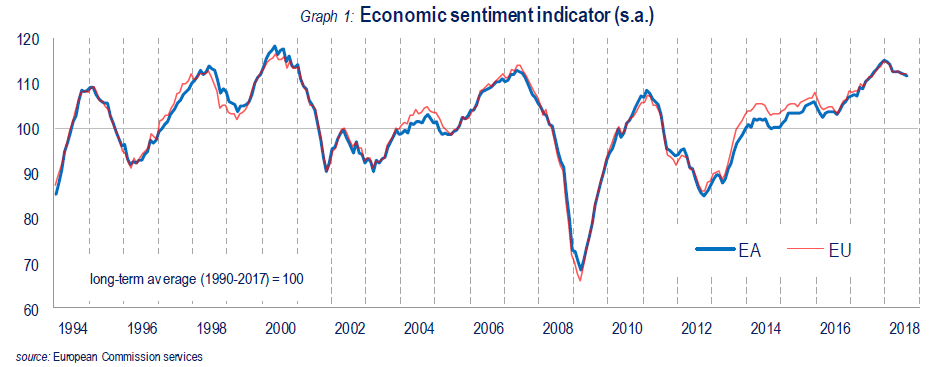
Eurostats noted that "the decrease in the euro-area sentiment indicator resulted from a marked deterioration of confidence among consumers and a milder decrease in the services sector, which were only partly offset by increases in the retail trade and construction sectors." Meanwhile, "confidence in the industry sector remained broadly stable".
Also, the sentiment indicator was virtually unchanged in Germany, which was down by -0.1. But notable decreases are seen in France (-1.3), Italy (-0.8), Spain (-0.7) and the Netherlands (-0.5).
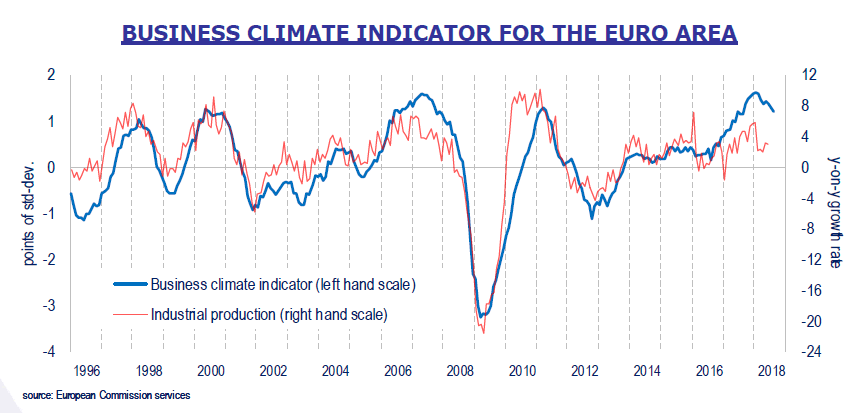
Business climate indicator dropped to 1.22, down from 1.29 and missed expectation of 1.25.
Also released in European session, German unemployment dropped -8k in August, matched expectation. Unemployment rate was unchanged at 5.2%. UK Mortgage approvals was unchanged at 65k in July. M4 money supply rose 0.9% mom in July.
GBPUSD Testing 1.3000 Support Level
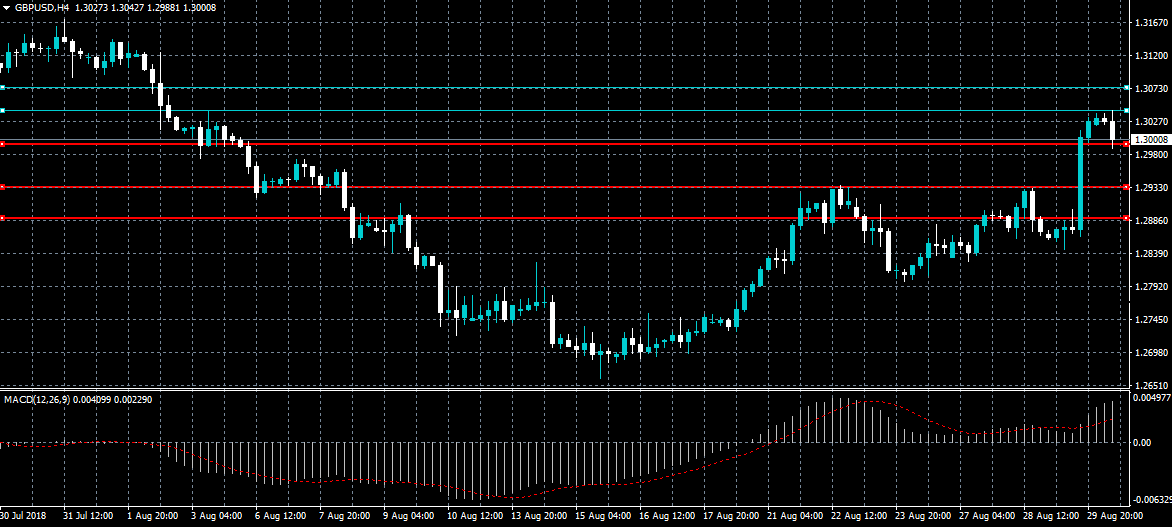
The British pound is testing the 1.3000 support level against the US dollar, after finding strong technical resistance from the 1.3040 level during the European trading session. Despite the pullback price, the GBPUSD pair remains bullish while trading above the 1.2930 level and continues to trend higher on the MACD indicator across the four-hour time frame.
The GBPUSD pair remains bullish while trading above the 1.2930 level, key resistance is now found at the 1.3040 and 1.3080 levels.
If the GBPUSD pair moves below the 1.2930 level, key support is found at the 1.2900 and 1.2850 levels.
EURUSD Watching Bearish Pattern
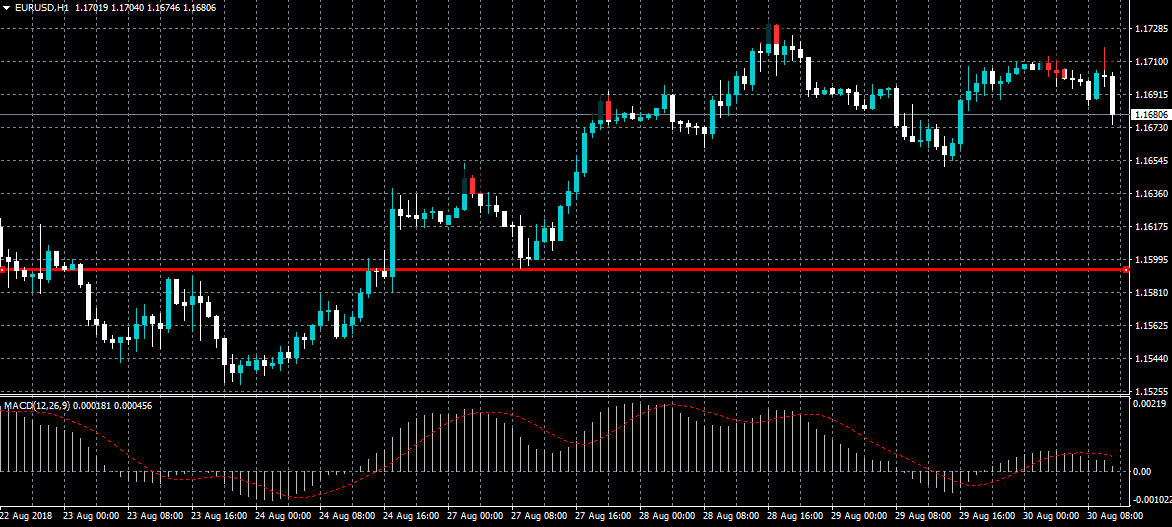
The euro currency is starting to trade lower against the US dollar after once again being sold sharply from the 1.1700 level this morning. The recent rejection from the 1.1700 level has created a bearish head and shoulders pattern across the lower time frames. Traders now look to the release of PCE data from the United States economy, which is the Federal Reserve’s preferred measure of US inflation.
The EURUSD pair is only intraday bullish while trading above the 1.1730 level, key resistance is found at the 1.1750 and 1.1800 levels.
If the EURUSD pair moves under the 1.1650 level, sellers will likely target the 1.1590 and 1.1525 support levels.