

Sample Category Title
Germany CPI Data Keeps ECB Patience Intact On Any Exit
Notes/Observations
- Germany Aug CPI slows and backs ECB view that yet to any convincing signs of inflation return
- EU Chief Brexit Negotiator Barnier tones down expectations for a Brexit agreement
- Awaiting to see if Canada joins the US/Mexico trade agreement
Asia:
- Australia Q2 Capex for -2.5% v +0.6%e
- China PBoC again skipped its Open Market Operation (OMO) for the 7th straight session as it saw reasonable and ample banking liquidity
- PBOC sets USD/CNY reference rate at 6.8113 vs 6.8072
Europe:
- France President Macron reportedly proposed a new structure for EU alliance and preparing to push other EU leaders into agreeing a close relationship with Britain after Brexit as part of his united Europe vision
Americas:
Canada PM Trudeau: Canada needed to reach the 'right deal' on NAFTA; saw possibility of deal being reached by Friday (Aug 31st)
- Mexico Econ Min Guajardo: confirmed US and Mexico came to deal on side letter that revamped NAFTA on autos and Sec 232
- US Sec of State Pompeo reportedly asked for meeting with Russia Foreign Min Lavrov to ease tensions ahead of new planned sanctions but prospect for successful rapprochement 'remained slim'
Economic Data:
- (NL) Netherlands Aug Producer Confidence: 5.9 v 6.3 prior
- (DE) Germany July Import Price Index M/M: -0.2% v 0.0%e; Y/Y: 5.0% v 5.2%e
- (NO) Norway July Retail Sales W/Auto Fuel M/M: 0.7% v 1.0%e
- (ZA) South Africa July M3 Money Supply Y/Y: 6.0% v 5.7%e; Private Sector Credit Y/Y: 5.4% v 5.9%e
- (DE) Germany Aug CPI Saxony M/M: 0.0% v 0.4% prior; Y/Y: 2.0% v 2.2% prior
- (ES) Spain Aug Preliminary CPI M/M: 0.2% v 0.2%e; Y/Y: 2.2% v 2.2%e
- (ES) Spain Aug Preliminary CPI EU Harmonized M/M: 0.1% v 0.2%e; Y/Y: 2.2% v 2.3%e
- (AT) Austria July PPI M/M: 0.2% v 0.4% prior; Y/Y: 3.4% v 3.0% prior
- (SE) Sweden Aug Consumer Confidence: 102.6 v 100.0e, Manufacturing Confidence: 121.8 v 116.9e; Economic Tendency Survey: 111.5 v 109.0e
- (CH) Swiss Aug KOF Leading Indicator: 100.3 v 101.3e
- (SE) Sweden Jun Non-Manual Workers Wages Y/Y: 2.5% v 2.1% prior
- (DE) Germany Aug Unemployment Change: -8K v -8Ke; Unemployment Claims Rate: 5.2% v 5.2%e
- (DE) Germany Aug CPI Bavaria M/M: 0.2% v 0.2% prior; Y/Y: 2.2% v 2.2% prior
- (DE) Germany Aug CPI Brandenburg M/M: -0.1% v +0.4% prior; Y/Y: 2.0% v 2.2% prior
- (DE) Germany Aug CPI Hesse M/M: -0.1% v +0.4% prior; Y/Y: 1.7% v 1.8% prior
- (DE) Germany Aug CPI Baden Wuerttemberg M/M: 0.0% v 0.2% prior; Y/Y: 2.1% v 2.2% prior
- (DE) Germany Aug CPI North Rhine Westphalia M/M: 0.1% v 0.3% prior; Y/Y: 2.0% v 2.0% prior
- (UK) July Mortgage Approvals: 64.8K v 65.0Ke
- (UK) July Net Consumer Credit: £0.8B v £1.5Be; Net Lending: £3.2B v £3.9Be
- (UK) July M4 Money Supply M/M: +0.9% v -0.3% prior; Y/Y: 2.1% v 1.7% prior; M4 ex-IOFCs Annualized: 3.5% v 3.5% prior
- (PT) Portugal Aug Consumer Confidence: -0.5 v +1.3 prior; Economic Climate Indicator: 2.5 v 2.5 prior
- (HK) Hong Kong July Retail Sales Value Y/Y: 7.8% v 9.7%e; Retail Sales Volume Y/Y: 5.9% v 7.5%e
- (IL) Israel July Unemployment Rate: 4.2% v 4.0% prior
- (EU) Euro Zone Aug Business Climate Indicator: 1.22 v 1.26e; Consumer Confidence (Final): -1.9 v -1.9e, Economic Confidence: 111.6 v 111.9e, Industrial Confidence: 5.5 v 5.5e, Services Confidence: 14.7 v 15.2e
- (IS) Iceland Aug CPI M/M: 0.1% v 0.0% prior; Y/Y: 1.3% v 2.7% prior
Fixed Income Issuance:
- (DK) Denmark sold total DKK10.28B in 3-month and 6-month Bills
- (SE) Sweden sold SEK500M vs. SEK500M indicated in 0.125% I/L Dec 2027 Bond; Avg Yield: -1.5155% v -1.5104% prior; Bid-to-cover: 3.34x v 5.53x prior
SPEAKERS/FIXED INCOME/FX/COMMODITIES/ERRATUM
Equities
- Indices [Stoxx600 -0.6% at 384.0, FTSE -0.8% 7505, DAX -1.2% at 12413, CAC-40 -0.5% at 5473, IBEX-35 -0.7% at 9497, FTSE MIB -0.6% at 20626, SMI -0.7% at 9021, S&P 500 Futures -0.2%]
Market Focal Points/Key Themes:
- European Indices trade lower across the board following weakness in Asia overnight and weaker US futures. The FTSE remains an underperformer as Cable remains pinned to the 1.30 level following Brexit commentary from EU's Barnier. On the earnings front, Bouygues outperforms after an earnings beat, with HSS hire, and Hunting other notable risers after earnings. Hays, EVS broadcast, Elekta and Hochdorf trade lower after earnings. Xaar trades over 30% lower after a profit warnings, with Scout24 lower after the CEO may step down early. Looking ahead retail earnings continue with A&F, Dollar General, Dollar Tree, Burlington and Kirkland among others.
Movers
- Consumer Discretionary Hays [HAS.UK] -4.6% (Earnings), Scout 24 [G24.DE] -4.6% (CEO may tender early resignation), HSS Hire [HSS.UK] +4.5% (Earnings)
- Industrials Bouygues [EN.FR] +3.3% (Earnings)
- Healthcare Elekta [EKTAB.SE] -6% (Earnings)
- Technology Xaar [XAR.UK] -33% (Trading update, profit warning), EVS Broadcast [EVS.BE] -6% (Earnings)
- Consumer Staples Hochdorf [HOCN.CH] -4% (Earnings)
- Energy Gulf Keystone Petroleum [GKP.UK] -6.3% (Holder sells stake), Hunting [HTG.UK] +10% (Earnings)
Speakers
- EU Chief Brexit Negotiator Barnier reiterated view that could not speak about success regarding Brexit. “No-deal' Brexit was one scenario we are preparing for. Solution seen possible to avoid a hard border with Northern Ireland
- EU said to consider full summit in Nov to discuss Brexit (in-line with recent speculation)
- German Fin Min Scholz: Domestic banks must be able to support the export industry. Disorderly Brexit remained a possibility
- Germany Deputy Fin Min Kukies said to play down the importance of Euro Zone budget
- France Fin Min Le Maire stated that the govt was determined to meet budget deficit goals as economic growth remained solid
- Spain govt said to be considering raising the income tax for top wage earners
- Fitch: Italy planned spending could raise its debt level; govt measures seen totaling €75B
- Norway Oil Min said to be to stepping down
- Russia Foreign Ministry: Potential meeting between Lavrov and US Sec of State Pompeo could occur on the sidelines of the Sept UN General Assembly
- Japan rating agency R&I affirmed Japan sovereign rating at AA+; revises outlook to Stable
- South Korea President Moon replaced Defense Minister and nominated the current Chairman of the Joint Chiefs of Staff Jeong Kyeong-doo as the replacement
- China Commerce Ministry (MOFCOM) reiterates its stance that US hardline and bullying tactics would not work and confident of stable and sound trade in 2018. stated that loans to other nations did not attach political strings. Some Chinese companies were affected by the trade war and that it also affected US auto exports to China
Currencies
- The release of Germany Aug CPI data in the session seemed to back ECB rhetoric that patient, prudent and persistent monetary policy approach was still needed. Inflation slowed in the month and backed ECB view that yet to any convincing signs of inflation return. EUR/USD
- GBP/USD was softer after EU Chief Brexit Negotiator Barnier stated that EU was prepared for a disorderly Brexit. GBP/USD hovering around the 1.30 level.
- Continued jitters in emerging market currencies saw some safe-haven flows into the CHF currency (Franc) with USD/USD lower by 0.1% to test under 0.97 and EUR/CHF cross off 0.3% to test 1.1325.
- Emerging market currencies remained under pressure in the session with USD/ZAR higher by almost 2% towards the 14.60 area and USD/TRY higher by 2% at 6.56 area
Fixed Income
- Bund Futures trades at 162.43 up 18 ticks retracing some of the move as European Indices trade lower amid NAFTA negotiations . Resistance moves to 163.82 then 164. A downside break of 163.00 sees 162.69 initially.
- Gilt futures trades at 122.79 up 10 ticks as the British pound spikes after EU official points to progress in Brexit talks. Continued support at 122.50, with a continued move higher targeting 123.93 then 124.00.
- Thursday 's liquidity report showed Wednesday's excess liquidity rose from €1.854T to €1.867T. Use of the marginal lending facility fell from €75M to €47M.
- Corporate issuance saw no deals priced in the high-grade primary market
Looking Ahead
- (IT) Italy Fin Min Tria in China to help build economic dialogue (thru Sept 1st
- (IT) Italy Debt Agency (Tesoro) to sell €4.75-6.0B in 5-year and 10-year BTP bonds)
- (IT) Italy Debt Agency (Tesoro) to sell €1.25-1.75B in 2024 and 2025 CCTeu (Floating Rate Notes)
- (BE) Belgium Aug CPI M/M: No est v 0.4% prior; Y/Y: No est v 2.2% prior
- (BR) Brazil July Central Govt Budget Balance (BRL): No est v -16.4B prior
- (CA) Canada Aug CFIB Business Barometer: No est v 56.8 prior
- (MX) Mexico July YTD Budget Balance (MXN): No est v -206.7B prior
- 05:30 (ZA) South Africa July PPI M/M: 0.5%e v 0.9% prior; Y/Y: 6.0%e v 5.9% prior
- 05:30 (HU) Hungary Debt Agency (AKK) to sell bonds (3 tranches)
- 06:00 (PT) Portugal July Industrial Production M/M: No est v 1.1% prior; Y/Y: No est v -0.9% prior
- 06:00 (PT) Portugal July Retail Sales M/M: No est v -1.2% prior; Y/Y: No est v 3.3% prior
- 06:45 (US) Daily Libor Fixing
- 07:00 (BR) Brazil Aug FGV Inflation IGPM M/M: 0.6%e v 0.5% prior; Y/Y: 8.8%e v 8.2% prior
- 07:30 (CL) Chile Central Bank Traders Survey
- 08:00 (DE) Germany July Preliminary CPI M/M: 0.1%e v 0.3% prior; Y/Y: 2.0%e v 2.0% prior
- 08:00 (DE) Germany July Preliminary CPI EU Harmonized M/M: 0.2%e v 0.4% prior; Y/Y: 2.1%e v 2.1% prior
- 08:00 (ZA) South Africa July Budget Balance (ZAR): No est v 33.8B prior
- 08:00 (BR) Brazil July National Unemployment Rate: 12.3%e v 12.4% prior
- 08:00 (CL) Chile July Industrial Production Y/Y: 1.9%e v 5.0% prior; Manufacturing Production Y/Y: 4.0%e v 7.2% prior; Total Copper Production: No est v 479.1K tons prior
- 08:05 (UK) Baltic Dry Bulk Index
- 08:30 (US) July Personal Income: 0.4%e v 0.4% prior; Personal Spending: 0.4%e v 0.4% prior; Real Personal Spending (PCE): No est v 0.3% prior
- 08:30 (US) July PCE Core M/M: 0.2%e v 0.1% prior; Y/Y: 2.0%e v 1.9% prior
- 08:30 (US) July PCE Deflator M/M: 0.1%e v 0.1% prior; Y/Y: 2.3%e v 2.2% prior
- 08:30 (US) Initial Jobless Claims: 213Ke v 210K prior; Continuing Claims: 1.73Me v 1.727M prior
- 08:30 (CA) Canada Jun GDP M/M: 0.1%e v 0.5% prior; Y/Y: 2.3%e v 2.6% prior, Quarterly Q2 GDP Annualized: 3.1%e v 1.3% prior
- 08:30 (US) Weekly USDA Net Export Sales
- 09:00 (RU) Russia Gold and Forex Reserve w/e Aug 24th: No est v $452.2B prior
- 10:30 (US) Weekly EIA Natural Gas Inventories
- 12:00 (CA) Canada to sell 2-year notes
WTI Oil Outlook: Bulls Eye Levels Above $70, Helped By Fears Over Iran / Lower Crude Stocks
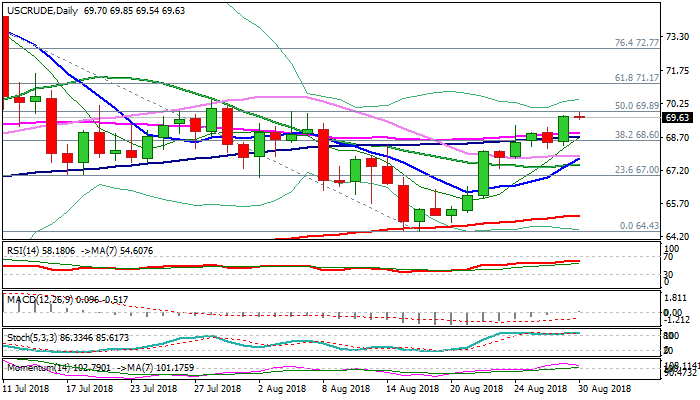
WTI oil price consolidates within narrow range above thin daily cloud on Thursday, after strong rally previous day, which eventually broke and closed above pivotal barriers at $68.60/92 zone (Fibo 38.2% of $75.34/$64.43 descend, 100/55SMA's).
EIA report released on Wednesday showed much bigger than expected fall in crude inventories past week (-2.26 million barrels vs -0.68 million barrels f/c) which added to negative API report on Tuesday and boosted oil prices.
Concerns about shortage in global supply, due to sanctions on Iran and situation in Venezuela are also supportive factors for oil prices.
Meanwhile, overbought slow stochastic and fading bullish momentum suggest bulls may take a breather and consolidate before probes through psychological $70 barrier and extension towards target at $71.17 (Fibo 61.8% of $75.34/$64.43).
Broken barriers now offer good supports at $68.97/$68.60 zone, where extended dips are expected to find ground.
Res: 70.00, 70.42, 71.17, 71.64
Sup: 69.54, 68.97, 68.60, 68.20
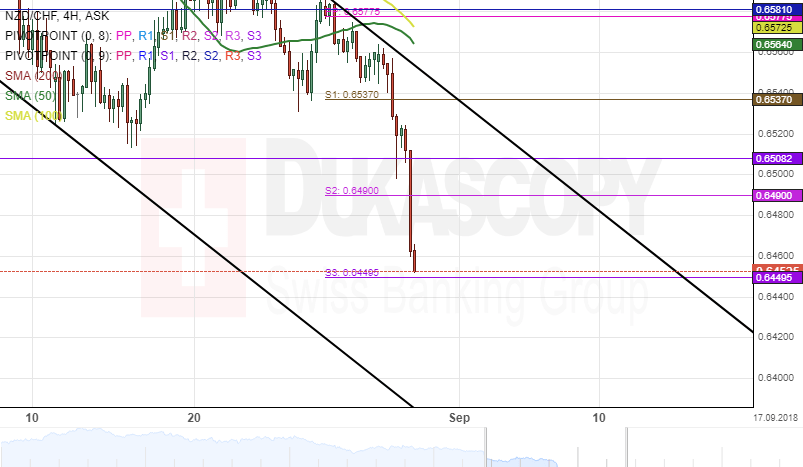
NZD/CHF 4H Chart: Sets For Further Decline
The NZD/CHF currency pair has been moving in a descending channel since late July. The exchange rate pullback from the upper boundary of a junior descending channel on July 31 and followed by a period of decline.
The New Zealand Dollar tested a resistance cluster formed by the 50-hour simple moving average and the combination of the weekly and the monthly PPs at 0.6581 on August 28 and made a U-turn south.
When looking at the currency exchange rate settings, the pair is likely to continue its southern journey during the following trading session for a potential target at the lower boundary of the descending channel.
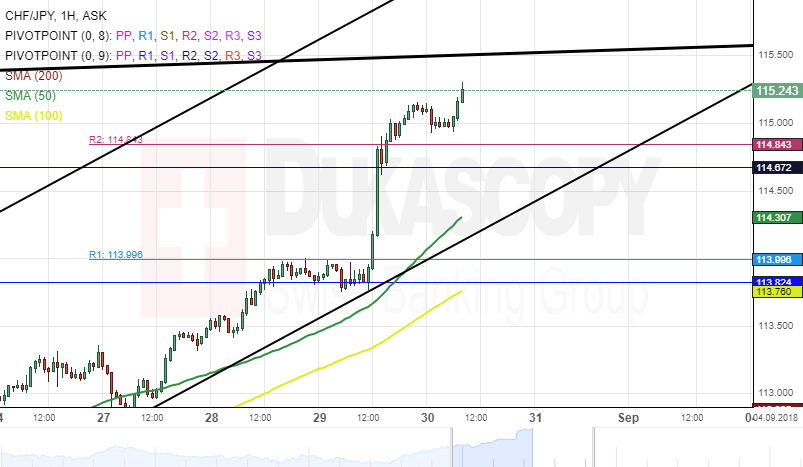
CHF/JPY 4H Chart: Bullish Markets
The Swiss Franc has strengthened its position against the Japanese Yen since mid-August. This upside movement has sent the currency pair to six months highs at the 115.14 marks.
During this period of surged, the exchange rate dashed through the three SMAs. Moreover, the 50-hour simple moving average has been guiding the price higher since August 20.
Technical Indicators suggest that the bullish sentiment is likely to continue during the following trading sessions. If the aforementioned bullish momentum continues, a breakout through the upper boundary of a junior ascending channel is expected to occur within the coming days.
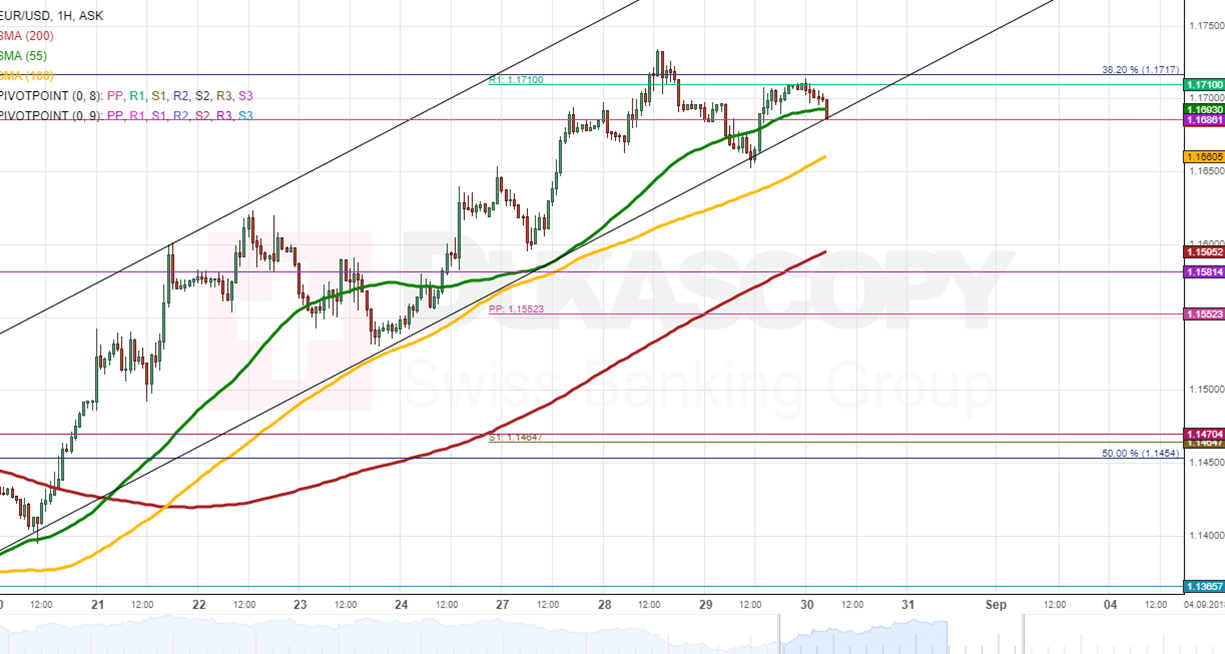
EUR/USD Analysis: Meets Monthly PP At 1.1690 Level
The European Single Currency depreciated against the US Dollar on Thursday morning. The currency pair bounced off the bottom of the trend line and the monthly pivot point near 1.1690. In addition, the currency pair was supported by 55-hour SMA. The EUR/USD rate was trading lower than the previous high of 1.1730 which we could see on Tuesday at noon.
The technical indicators were flashing bullish signal, and it was expected that the rate might break the weekly resistance level R1 and Fibonacci retracement level of 38.20% near 1.1715 level during Thursday's trading session.
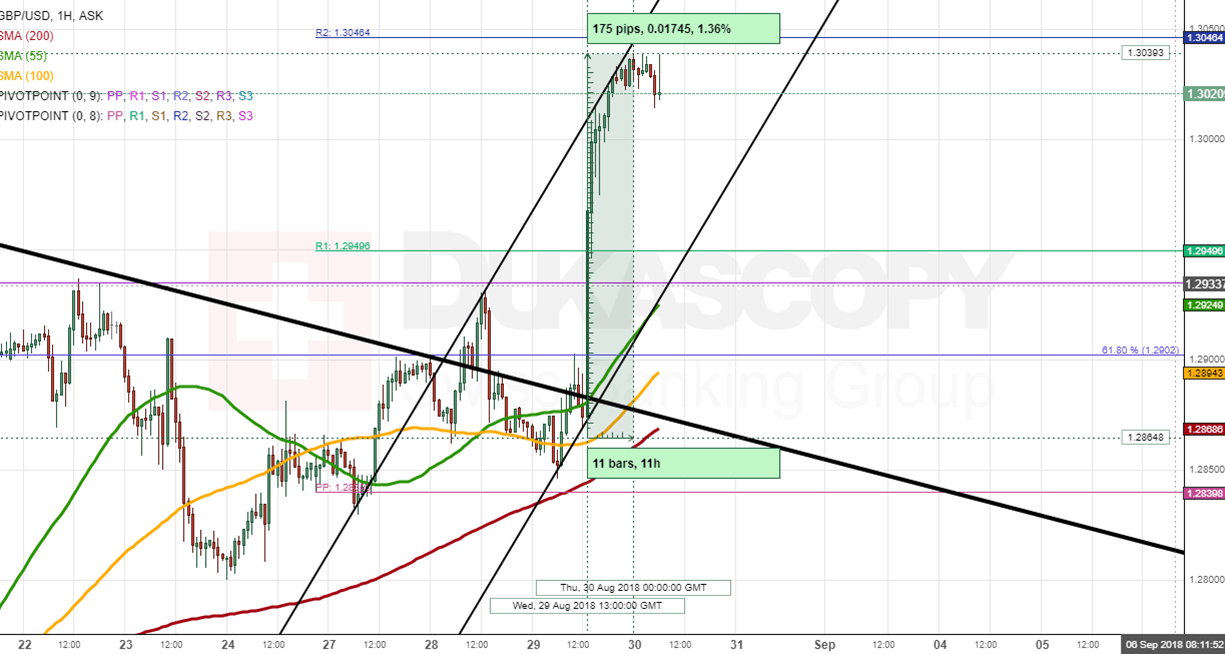
GBP/USD Analysis: Meets A New High At 1.3041 Level
The British Pound experiences a significant surge upwards during the last two days of trading. The rate broke the senior descending pattern as well as the Fibonacci retracement level of 61.80% during Wednesday's trading session passing through the monthly pivot point at 1.2930.
Moreover, Wednesday's trading session ended up with a new high of 1.3041, not seen since the beginning of August. On Thursday morning the rate was at 1.3030.
The 55-hour SMA tried to catch the rate to play a role of support for the currency pair. The nearest support level is the weekly R1 at 1.2950, while the nearest resistance level is the weekly R2 at 1.3047.
USD/JPY Analysis: Breaks Dominant Descending Pattern
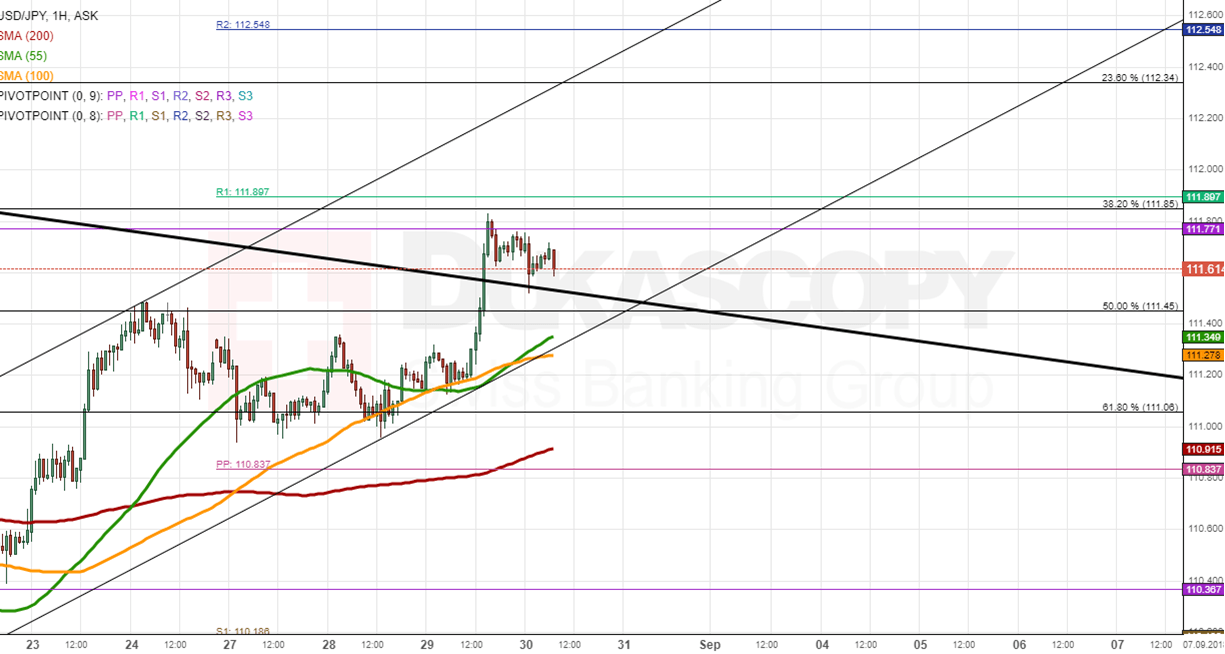
The USD/JPY appreciated 0.36% since Wednesday's trading session, locating at the 111.63 level on Thursday morning. The currency pair broke the speculated resistance of a dominant descending pattern.
Moreover, the rate tested the monthly pivot point at 111.77 trying to break through the resistance on Wednesday, but the resistance is too strong to break due to Fibonacci 38.20% side support. On Thursday, the nearest support level was the Fibonacci 50.00%, while the nearest resistance level was the monthly PP at 111.77 level.
Most likely the rate will attempt a push higher as soon as the hourly SMAs and the lower trend line of a junior pattern catch up to the surge.
XAU/USD Analysis: Remains Near 1,200 Level
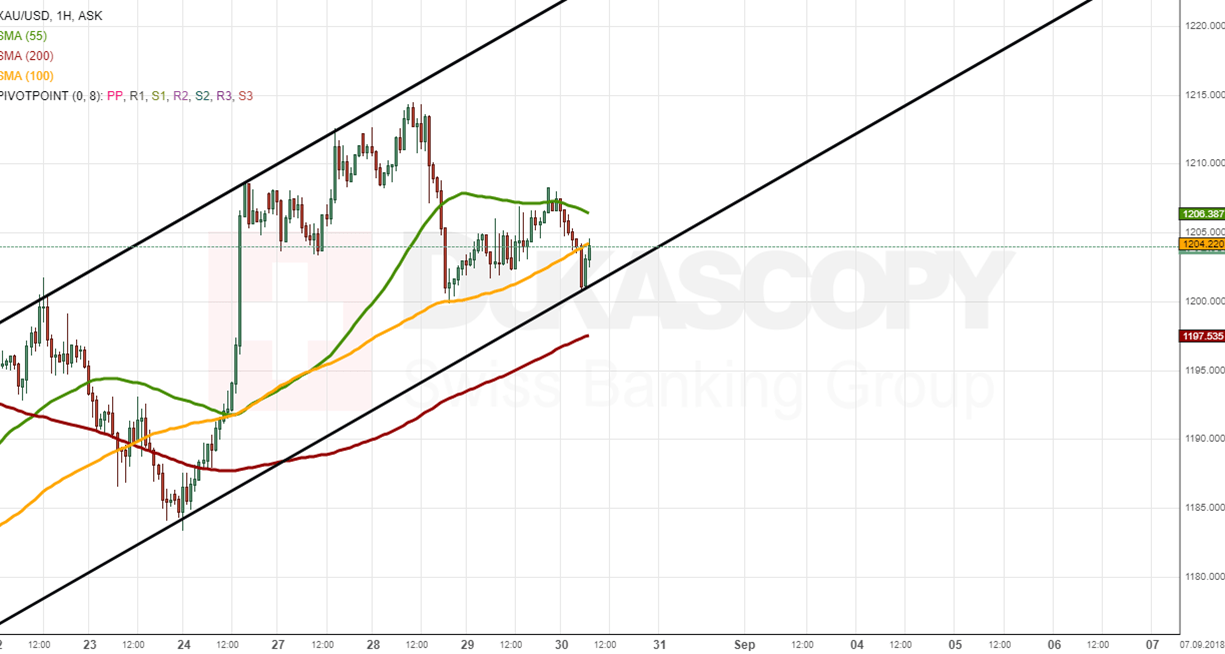
The gold price decreased to the 1,200.00 mark again on Thursday morning, which was the same price level as it was for the previous trading session on Wednesday. Meanwhile, note that the yellow metal bounced off the bottom of the junior ascending line during the morning hours on Thursday.
The rate is still waiting for the squeeze of the 55– hour and the 100-hour SMA's which might force the rate to breakout upwards or downwards. The 200-hour SMA is below the rate which signals traders that changes are going to perform soon.
Markets Pare Gains As NAFTA Talks Continues
US futures are lower ahead of the open on Thursday, with indices paring gains that have seen the S&P 500 hit record highs and the Dow come within touching distance of doing the same.
Positive developments on NAFTA have aided the climb, with this being one of a number of trade battles that US President Donald Trump has engaged in since his election victory. With officials talking up the potential for a resolution by the end of the week, this would be an important and timely victory for Trump, ahead of the mid-term elections in November. Clearly China is his main target in the war on trade deficits but this could be enough for him to convince voters that the more hard-line approach is working.
With talks progressing well, attention will now briefly turn back to the US economy with the release of income, spending and inflation data from the world’s largest economy. The US consumer has been a key driver of continued growth in the US economy and the latest spending figures are expected to confirm this, with 0.4% growth expected in July, along with income growth of 0.3% which will also be welcomed.
Inflation is expected to rise slightly to 2% in July, in line with the Federal Reserve’s target which will only encourage it to continue down the path of regular rate hike despite the ongoing criticism from the White House.
The pound is paring gains but continues to trade around four week highs against the dollar, with the currency having been buoyed on Wednesday by comments from Michel Barnier who claimed to be open to the idea of a bespoke Brexit deal for the UK, something the EU had appeared averse to previously. The apparent softening in the language, combined with French President Emmanuel Macron’s desire to maintain close ties, come at a time when a no deal Brexit was looking increasingly likely.
The latest comments suggest there is a strong desire within the EU to find a solution and avoid a no deal Brexit which is understandably good for the UK and the pound. Sterling had come under pressure in recent months as the prospect of no deal became more of a possibility but this is hopefully the first step towards it not becoming a reality. We’ve seen a small relief rally but we’ll need to see many more positive steps before traders get carried away.
Chinese PMIs Coming Up With Trade Concerns Still In The Background
Chinese official PMI data for August are due on Friday at 0100 GMT. Manufacturing activity, which is expected to gather the most interest, is anticipated to ease for the third straight month, though to yet again remain in growth territory. Beyond data releases, US-China trade considerations are still at play, with any updates likely to prove market-moving.
Figures out of the world's second largest economy are projected to show manufacturing PMI standing at 51.0 in August, below July's 51.2 and at its lowest since February. Despite declining in recent months, it is notable that last month's reading constituted the 24th straight print that exceeded the 50 level that distinguishes sectoral expansion from contraction. Meanwhile, August's non-manufacturing (services) PMI is forecast to slightly weaken to 53.8, from July's 54.0. Most attention out of Friday's releases is likely to again fall on manufacturing numbers. This, despite the Chinese services sector coming under greater prominence over the last few years on the back of state efforts to rebalance as well as diversify the economy, rendering it more dependent on services and consumer spending, as opposed to relying almost entirely on investments and export-driven growth for its economic development.
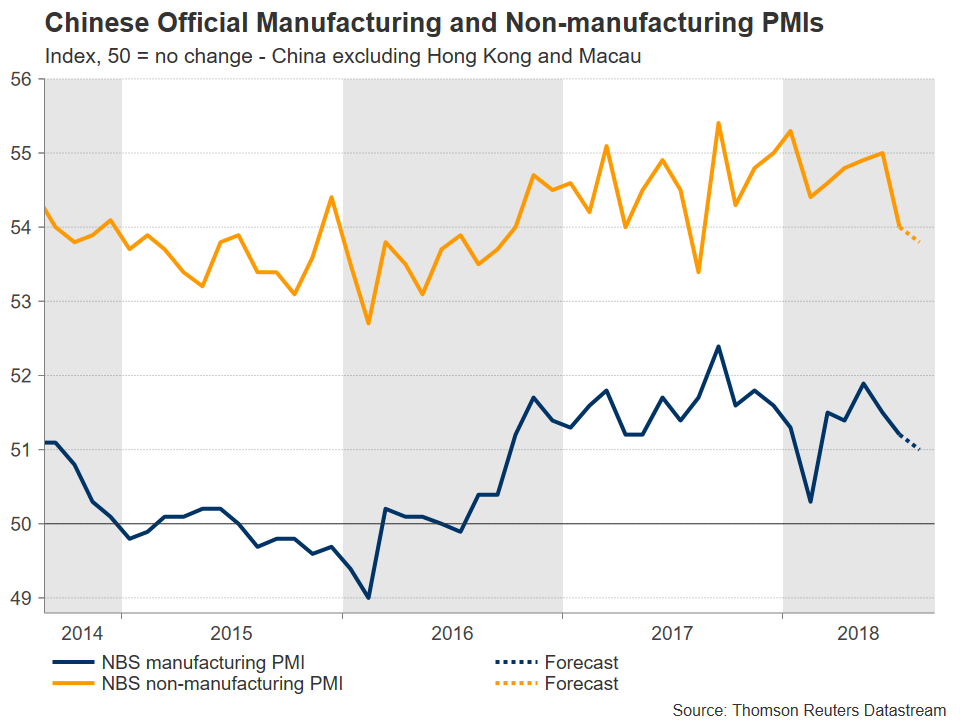
China's trade spat with the US was one of the factors leading to the fall in July's manufacturing activity, though it also bears mention that continuing efforts by policymakers to reduce financial risks stemming from rising debt and unfavorable weather conditions were mostly to blame for the slowdown. Still, the ongoing dispute between the world's two biggest economies continues to pose risks for the outlook of manufacturing and the economy overall and has contributed to the onshore and offshore yuan's slide to its lowest since January 2017 versus the greenback in mid-August; the chart below shows the onshore yuan against the dollar. 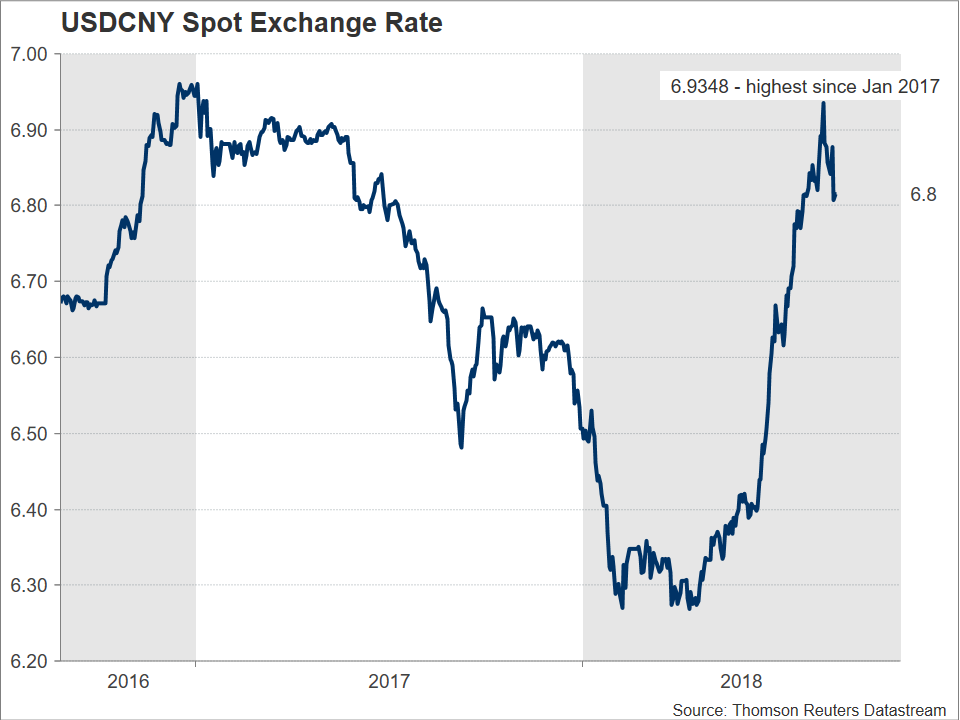
While further escalation in the Sino-US trade spat has not taken place recently, last week's talks between the two sides do not appear to have provided much “tangible” outcomes, with the risk being that the next round of tariffs – 25% on $200 billion of Chinese imports – is implemented over the coming weeks, with China responding in retaliatory fashion. The risk for a tough stance and rhetoric by the US may also be tilted to the upside, in light of the midterm elections taking place in November, as President Trump and the hawks in his administration may view such an approach as resonating well with the Republican base. On the other side of the spectrum, there is also talk of a Trump-Xi meeting later in the year that may alleviate tensions. However, nothing concrete has been announced thus far.
Elsewhere, Trump accusing China of undermining US efforts to pressure North Korea to end its nuclear plans may be an indication that the trade confrontation is moving into other directions. It remains to be seen whether another chapter in the “US vs China” saga will be written soon, something which would most probably weigh on market sentiment and thus risk-on plays.
In FX markets, besides the yuan, the Australian dollar is also generating attention ahead of the upcoming Chinese readings, as well as concerns over trade. This is owed to the fact the Australian economy heavily depends on commodity exports, with its economy seen as losing in the event of a less rosy outlook for global trade. Additionally, Australia shares close economic ties with China – a strong Chinese economy is seen as Aussie-positive and vice versa – which have rendered the Aussie as a liquid proxy for China's economy.
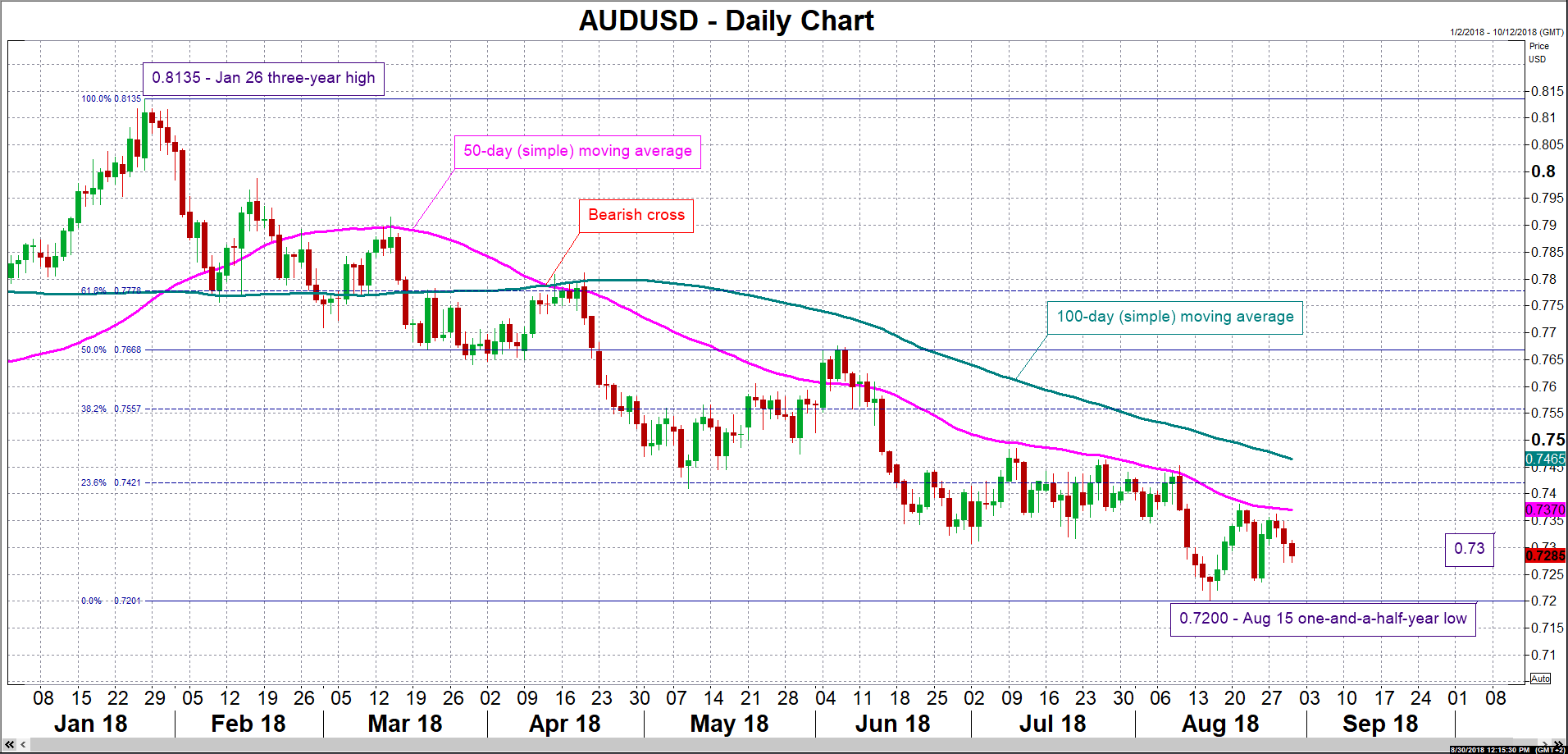
Technically, an advancing AUDUSD on the back of upbeat Chinese numbers or easing trade worries may meet resistance from the zone around the current level of the 50-day moving average at 0.7370 and the 23.6% Fibonacci retracement level of the January 26 to August 15 downleg at 0.7421. Notice that the area around this zone was congested in the past, as well as that it encapsulates the 0.74 round figure. Also, this area would come into scope given that a break above the 0.73 handle takes place first. Further above, the 100-day MA at 0.7465 would be eyed. On the downside and in the event of disappointing figures or a deteriorating trade outlook, support could come around the one-and-a-half year low of 0.72 recorded on August 15, with steeper losses potentially finding support around the 0.71 mark.
It should be kept in mind that China will also be on the receiving end of Caixin's respective prints on the manufacturing and services sectors on Monday and Wednesday correspondingly. These focus on small and medium size businesses, with Friday's official data being broader in nature.
Lastly, there have been some recent policy adjustments on China's fiscal and monetary front meant to support the economy. It will be interesting to see whether the effects from these start to feed into the data soon, and in particular in the above mentioned releases.