

Sample Category Title
Gold breached 1200 but quickly recovered, near term outlook stays bullish
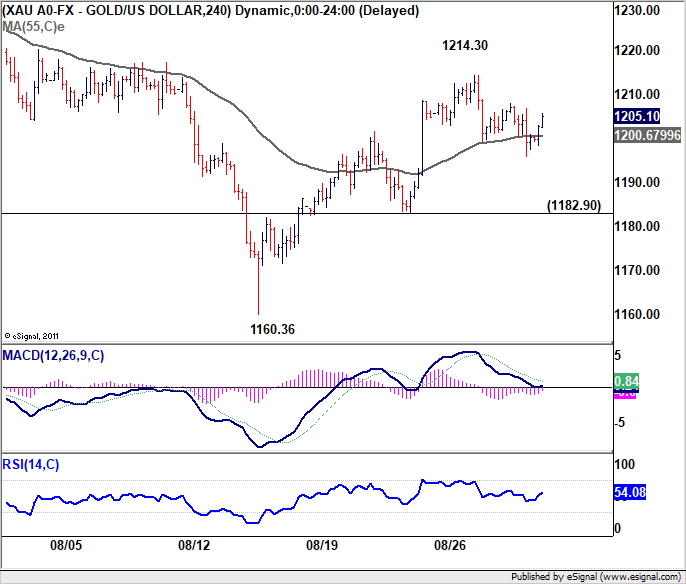
Gold breached 1200 handle to 1195.61 as consolidation from 1214.30 continues, but quickly recovered. Outlook is unchanged that price actions from 1214.30 are merely a correction. And, as long as 1182.90 support holds, rebound from 1160.36 is expected to resume sooner or later. Break of 1214.30 will target 55 day EMA (now at 1226.49) and above.
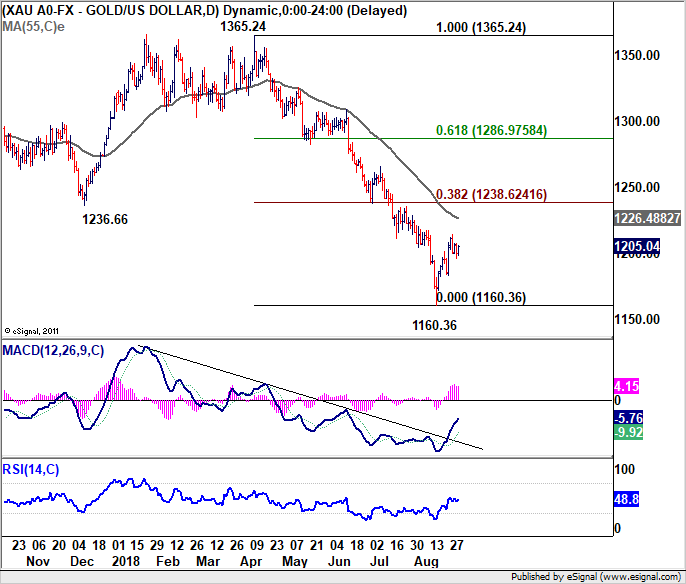
Overall, 1160.36 is viewed as a medium term bottom the down trend from 1365.24 took a breath. While stronger rebound would be seen, upside should be limited by 38.2% retracement of 1365.24 to 1160.36 at 1238.62 to bring near term reversal. Down trend from 1365.24 is expected to resume later after the consolidation from 1160.36 completes.
Trump: Rejected EU offer to scrap auto tariffs, said EU is as bad as China
Trump rejected EU's offer to scrap auto tariffs on cars if US does the same. He said "it's not good enough" and added that "Their consumer habits are to buy their cars, not to buy our cars." He also added that EU is "almost as bad as China, just smaller."
European Trade Commissioner Cecilia Malmstrom told the European parliament yesterday that "we are willing to bring down even our car tariffs down to zero … if the U.S. does the same." Nonetheless Malmstrom also expressed that "we do not agree with their methods of imposing massively billions of tariffs on China, as they have also done with Turkey. We do not share U.S. view that trade wars are good and easy to win."
If Trump is going to, as his supporters believe, tear down tariffs and trade barriers, EU's offer is certainly a step in the right direction. Now it seems Trump is simply using something else as an excuse for not doing it.
Trump said China devaluating Yuan while PBoC is lifting it
Trump complained in a Bloomberg interview that China is trying to devalue it's currency, and his administration is studying whether to name China as a currency manipulator. Additionally, he's looking into the "formula" for deciding who's doing currency manipulation. Separately, it's reported that Trump is ready to impose 25% tariffs on USD 200B in Chinese goods as soon as public hearing ends next week. And he told Bloomberg that, "we are a much stronger country," and "nobody's waiting us out. Our country is stronger than it's ever been financially."
At the same time, the People's Bank of China set the reference rate stronger than estimates for 17 days in a row, to slow the Yuan's decline. The currency's fixing was 0.1% stronger than the average forecast in a Bloomberg survey. It's a consensus among traders and analysts that the market doesn't want to bet against PBoC for now, as the central bank and the government are ready to deploy further "manipulative" policies to support Yuan's exchange rate and stabilize it.
Trump is either living in an alternative world, or his compulsive lying is again in effect.
Btw, here a report of a former top treasury official blasting Trump as woefully wide of the mark on Yuan manipulation.
Canada Freeland: No agreement yet and trade talk with US to continue on Friday
Canadian Foreign Affairs Minister Chrystia Freeland had four meetings with US Trade Representative Robert Lighthizer yesterday, yet there was no conclusion in trade negotiation yet. Freeland said "no, we don't have an agreement," and talks would "reconvene in the morning" on Friday.
She added that "we continue to be encouraged by the constructive atmosphere," and "there's a lot we're trying to do in a short period of time." And for now, Freeland is "focused on working hard on our issues with the United States", not the Mexico yet.
Diary is a key topic in the negotiation and Labour Congress President Hassan Youssef hinted that "the Canadian public should expect the American dairy industry will probably have more access to Canada by the time this agreement is concluded and we should not lose sleep over it,"
Prime Minister Justin Trudeau's spokesman reiterated his stance that " the federal government remains committed to ensuring that any agreement is in the best interests of Canadians."
The United States, Canada and Mexico are trying to come up with at least a preliminary agreement in principle by Friday, a deadline unilaterally set by Trump.
Market Morning Briefing: Euro Yen Has Dipped Back Below 130 And Now Has Crucial Support Near 129.25
STOCKS
Dow (25986.92, -0.53%) has dipped slightly. Although there is some more room on the upside on the daily chart, the resistances on the 3-day and the weekly candle charts are likely to hold in the near term dragging the Dow to lower levels of 25500-25000.
Dax (12494.24, -0.54%) tested 12400 on the downside before again bouncing back to close higher. Resistance near 12650 is holding for now but there is scope for a rise in the medium term.
Nikkei (22827.79, -0.18%) has come off from 23000, the rise above 28500 being a false break on the upside. While below 23000, the upside could be limited and the index could possibly come off towards 22600-22400 levels in the near term.
Shanghai (2717.75, -0.73%) has fallen as expected and could continue towards 2650 support. Next 1-2 sessions look bearish.
Nifty (11676.80, -0.13%) has resistance on the 3-day charts near 11800 and if that holds, Nifty could see a dip to 11500-11400 before again bouncing back towards 11800.
COMMODITIES
Brent (77.95) has risen towards immediate resistance above 78 and this is likely to hold in the near term, bringing back the prices down to 76-75 soon.
Nymex WTI (70.24), on the other hand looks bullish and has scope of rising towards 72 before coming off in the near term. In the longer run, WTI looks more bullish than Brent.
Gold (1207.80) is likely to remain below 1225 just now. While the price looks likely to remain above 1200, there could be some chances of re-testing 1180 on the downside in the coming week.
Copper (2.69) has important resistance and is coming off from there. While below 2.70, the price may fall towards 2.65-2.62 in the near term.
FOREX
The Argentinian Peso (37.96) has crashed almost 33% from levels near 31.30 to 41.46 in the last 2 sessions. Moreover, the Turkish Lira (6.737) has weakened by 8%-9% in the last couple of sessions – both these developments could take USDINR towards 71.50 very quickly. A gap up opening for USDINR above 71 is possible.
Euro (1.1665): Although Euro has come off from levels near 1.1733, there are still some chances of it moving up beyond 1.175 over the next week. Above 1.175, there could be an important resistance near 1.178, and then near 1.1825-1.185. A decisive break below 1.163 would however negate the above view.
Dollar Index (94.73) : Dollar Index’s break of supports on daily and 3 day candles suggests that it could move down atleast till the 21 weeks MA (93.91) in the coming week. A decisive break above 95 could however negate that view for next week.
Dollar Yen (111.01): Against expectation, Dollar Yen again dipped from levels near 111.8, failing to cross above 112. There is immediate support near 110.9 and lower down near 110.50, and then, 110.20. The path of least resistance still points upward for Dollar Yen in the weeks ahead.
Euro Yen (129.49): Euro Yen has dipped back below 130 and now has crucial support near 129.25 on daily candles. A week close below the 21 weeks MA (129.60) would be an important medium term bearish indicator. However, let’s note that our next week’s forecasts for Euro and Dollar Yen are both bullish – thereby implying a possible retest of 130-131 for Euro Yen again.
Pound (1.3009): As per our expectation, the resistance zone of 1.303-1.305 is currently holding. Current preference is for this resistance to push Pound downward – however, if the resistance is breached, an upmove towards the 21 weeks MA near 1.3315 could be seen – which would be a crucial resistance level.
Dollar Rupee (70.745): Trading near 71.15-16 on offshore NDF. The Argentinian Peso’s (37.96) crash from 31.30 to 41.46 in the last 2 sessions seems to be affecting the Rupee adversely. Caution for a rise towards 71.50 if USDINR opens above 71.00 (high possibility).
Important Trigger in the immediate scenario could also be the Turkish Lira.
INTEREST RATES
Repeating yesterday’s comment: US GDP growth in Apr-Jun was revised higher from its earlier 4% estimate to 4.2%. This, along with new Treasury note auctions of approx $31 bn haf helped in raising the US 10 year yield slightly. Ongoing progress on trade deals between US-Mexico-Canada is also leading to some positive sentiment which could help in a rise in US yields.
Last week, the US Fed Chairman's comments in the Jackson Hole Conference led some analysts to interpret that a December rate hike by the US Fed might get delayed to 2019. As we have been saying, we need to watch out for whether this belief grows stronger in the markets – if it does, then the May high of 3.125% for the US 10 year yield would be confirmed as the year's top.
US 10 Year Yield (2.85%) : Has dipped back towards 2.82% again. Only on a breach above 2.9% before will we abandon the possibility of a downmove below 2.82% in this move. Current preference still remains bearish for the near term. A breach above 2.9% could however lead to another upmove to 3% and then, a dip from there.
German 10 Year Bond Yield (0.35%) has again dipped from resistance near 0.4% and could move further lower now.
USD/JPY Remains Bullish Above 110.80
Key Highlights
- The US Dollar traded higher this week and settled above the 110.80 resistance against the Japanese Yen.
- There was a break above an important bearish trend line with resistance at 110.86 on the 4-hour chart of USD/JPY.
- The US Personal Income in July 2018 increased 0.3% (MoM), less than the last increase of 0.4%.
- Tokyo’s Consumer Price Index ex Fresh Food in August 2018 increased 0.9% (YoY), more than the +0.8% forecast.
USDJPY Technical Analysis
The US Dollar formed a key bottom at 109.77 recently against the Japanese Yen and started an upward move. The USD/JPY pair broke the 110.50 and 110.80 resistances to move into a positive zone.
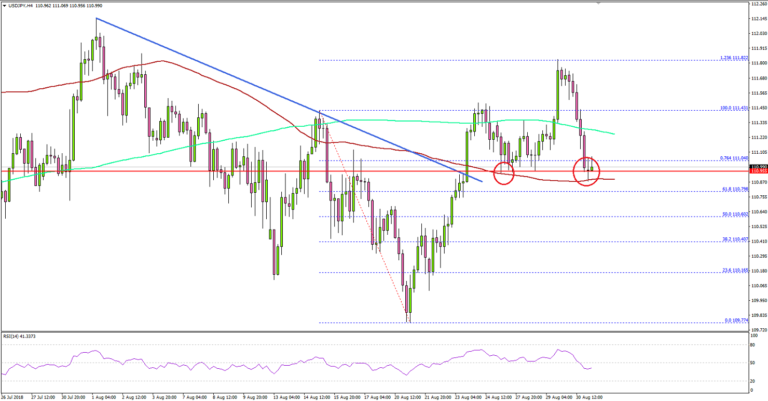
Looking at the 4-hours chart, the pair traded above the 111.00 resistance and settled above the 100 simple moving average (red). There was even a break above the last swing high at 111.43.
The pair climbed higher and tested the 1.236 Fib extension level of the last slide from the 111.43 high to 109.77 low. It acted as a resistance area near 111.80, resulting in a short-term correction. On the downside, there are many supports above 110.80 and the 100 SMA.
Recently, the pair broke an initial support near the 200 simple moving average (green, 4-hours) and 111.20. It is currently testing the 100 SMA (currently at 110.87) and the 110.80 support area. Below 110.80, the pair could move back towards the 110.50 level.
On the upside, the pair may struggle to break the 111.70-80 resistance zone. Once buyers succeed, the pair could trade towards the 112.00 level in the near term.
Fundamentally, the US Personal Income report for July 2018 was released by the Bureau of Economic Analysis, Department of Commerce. The market was looking for a rise of 0.3% in income compared with the previous month.
The actual result was similar to the forecast, but it was less than the last increase of 0.4%. Looking at the personal spending, there was a rise of 0.4%, similar to the forecast and the last reading.
Overall, the US Dollar remains supported on dips versus the Japanese Yen, but pairs like EUR/USD and GBP/USD are likely to continue their upward move in the coming sessions.
Economic Releases to Watch Today
- German Retail Sales for July 2018 (MoM) – Forecast 0%, versus +1.2% previous.
- Euro Zone CPI for August 2018 (YoY) (Prelim) – Forecast +1.1%, versus +1.1% previous.
- Euro Zone Core CPI for August 2018 (YoY) (Prelim) – Forecast +2.1%, versus +2.1% previous.
- Chicago Purchasing Manager’s Index for August 2018 – Forecast 63.0, versus 65.5 previous.
Another Brick In The Tariff Wall?
Another brick in the tariff wall?
Not entirely unexpected, President Trump is looking to thwack China with the US 200 billion in tariff as early as next week. Equities have predictably taken it on the chin as the market has that distinct taste of risk off. But this reaction is likely magnified by weekend profit taking and the emerging market tumult that continues to weigh on overall sentiment. While a reality check for some, the pessimist in me was still expecting this level of trade escalation given that the administration will not give up on their view that China is a currency manipulator view. However, the optimist in me suggests this may be little more than another in a long line of a friend of foe psychological tactics that the President is well known to use. Indeed, the markets are a bit discouraged, but we are far from meltdown status as investor and traders alike consider all possibilities.
Im not even going to touch the Trumps WTO threat to pull out of the organisation.
Asia Equity Markets
We should expect some losses on the back of the latest China trade headlines, but with US markets not overly de-risking, the sell-off may not be that deep. After all the escalation is not that unexpected
Oil Markets
Oil markets are being pressured a tad by a stronger dollar and little sign of progress on the USD-China trade front. But there remains that underbelly of support from inventory reports that showed declines in US and Antwerp crude. Despite the unnerving prospects of the trade war escalation, dips are being supported as the impact of US sanctions on Iran is still dominating views encouraging traders to stay long. And while OPEC and their allies are thought to be in the process of agreeing to a price stability pact, there's enough doubt and scepticism on oil trading desks that the extra supplies will not offset the demise of Iranian output.
Gold Prices
Gold continues to be Mr Irrelevant when it comes to a go-to risk hedge. No bid on the Trump tariff headline and nary a look from hedgers on the recent emerging markets tumult. With the Feds on the move and real yields moving higher, investors prefer the umbrella of US treasuries to sit out the storm. Gold remains on the outside looking in.
Currency Markets
Chinese Yuan
Predictably the Yuan finds itself at ground zero once again. Smart money has positioned long USDCNH early in the week and heading into today's key China PMI later in the session there is the real possibility we could be in for a decent wave of volatility. I'll issue some views on the release.
Assuming the line in the sand for the Pboc is 6.90, we should expect longs to reduce positions if we push higher on a negative PMI.
The antipodeans are looking oh so shaky.
The New Zealand Dollar
The Kiwi is G-10's latest whipping boy, and sentiment soured further on today Fonterra auction, but the ANZ August consumer sentiment came in close to expectation and triggered some profit-taking. I don't think the market is looking to extend any downside risk ahead of the weekend, so we could see more profit taking as the session wears on.
The Australian Dollar
Housing market concerns and political turbulence should keep the pressure on the Aussie.
Westpac adjusting their variable mortgage rates higher due to funding costs abrading margins does raise the spectre of mortgage defaults, and one would assume the RBA is less than happy. I expect Westpac rivals to follow so this could get interesting as it may cause another negative repricing of RBA policy.
We're certainly on the edge of a slippery slope amid this bearish Aussie backdrop with a brewing political hotpot threatening a cherished AAA sovereign rating, but the RBA will ultimately struggle to hold their neutral tilt should any signs of housing meltdown materialise.
Turkish Lira
The Lira has traded poorly throughout the NY session on and was basted after yet to be confirmed report that the deputy Central Bank Governor has resigned to join the Development Bank of Turkey. Indeed, when it rains, it pours.
Argentia Peso
The Argentina markets are a” Messi” and with the Central bank about to fall on the sword by buying hiking the repo rates to an ungodly 60% while digging into their reserves in an attempt to add some modicum of stability. In my view, nothing good ever comes from aggressive intervention. A short-term reprieve allows traders to short at better levels. Deputy Central Bank Governor has resigned to join the Development Bank of Turkey. Indeed when it rains, it pours.
USD/CAD Canadian Dollar Falls As Global Trade Concerns Rise
The USD/CAD rose 0.62 percent on Thursday. The currency pair is trading at 1.2987 after the loonie fell on the back of disappointing GDP data and Prime Minister Justin Trudeau’s comments of “no deal is better than a bad deal” on NAFTA. The Canadian PM has been optimistic about the fate of the trade agreement and now with a deal between the US and Mexico in place he said that the Canadian government is working towards reaching a deal before Friday.
The arbitrary Friday deadline might not be reached, as according to Foreign Affairs Minister Chrystia Freeland there are still a lot of specific issues to be worked out. Since Friday is not a hard deadline there is an opportunity that negotiations spill over to next week, where a deal might be reached. The review process from the US congress means that there won’t be any changes to the current NAFTA deal until the middle of 2019 at the earliest.
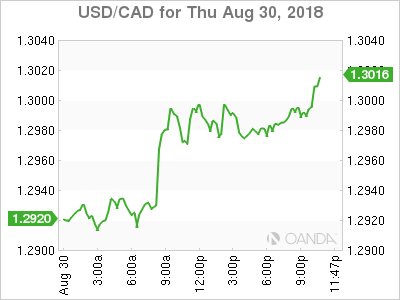
Canadian growth data disappointed with a flat reading. The market anticipated a 0.1 percent gain and with a final datapoint of 0, the Canadian economy accelerated 2.9 percent on a yearly basis. The miss could be taken as a cooling of economic strength, with the market now forecasting the Bank of Canada (BoC) to hold its interest rate in September. The October monetary policy meeting could bring a better scenario with the U.S. Federal Reserve September rate hike out of the way and the benefit of having more data releases.
BoC Governor Stephen Poloz has been known to surprise the market, but this time he might consider patience and issue further guidance in October where he is scheduled to follow the monetary policy decision with a press conference where he can address questions form the financial press.
Eco Data 8/31/18
[php_everywhere instance="1"]
British Pound Pauses after Sharp Gains
GBP/USD has recorded slight losses in the Thursday session, after sharp gains on Wednesday. In North American trade, the pair is trading at 1.2996, down 0.25% on the day. On the release front, British Net Lending to Individuals dropped to GBP 4.0 billion, missing the estimate of GBP 5.5 billion. This marked the lowest level since July 2016. Later in the day, the UK releases GfK Consumer Confidence, which is expected to come in at -10 points for a second straight month. In the U.S, Core PCE Price Index edged up to 0.2%, while Personal Spending remained pegged at 0.4%. Both indicators matched the forecasts. Unemployment claims rose to 213 thousand, just below the forecast of 214 thousand.
The British pound jumped on Wednesday, climbing 1.2% percent. Nervous investors, looking for some good news in the Brexit gloom, snapped up the pound after positive comments from Michel Barnier, chief Brexit negotiator for the EU. Barnier said that the bloc was prepared to offer Britain a special relationship, which could include foreign and security ties. At the same time, Barnier warned that “there is no single market a la carte”, referring to proposals by the U.K government to cherry pick, such as implementing new immigration rules while retaining access to the single market. With only seven months before the UK departs from the EU, there are a host of unresolved issues, including the Irish border. If there is no significant progress in the next few months, the pound could lose ground.
The U.S economy continues to sparkle. Preliminary GDP for Q2 was revised upwards to 4.2%, edging above the estimate of 4.0%. This reading was above the initial GDP release of 4.1% back in July. Growth in the second quarter was much stronger than in Q1, which posted a gain of 2.2%. Will the strong data continue in the third quarter? Consumer spending has been strong early in the quarter, but housing data has disappointed, with recent key indicators missing expectations. The strong GDP has not affected the likelihood of rate hikes in the second half of 2018. The Fed has already raised rates twice this year, and a September hike is practically a given, with the CME Group estimating the odds of a hike at 96%. The odds of a December hike currently stand at 70%.