Sample Category Title
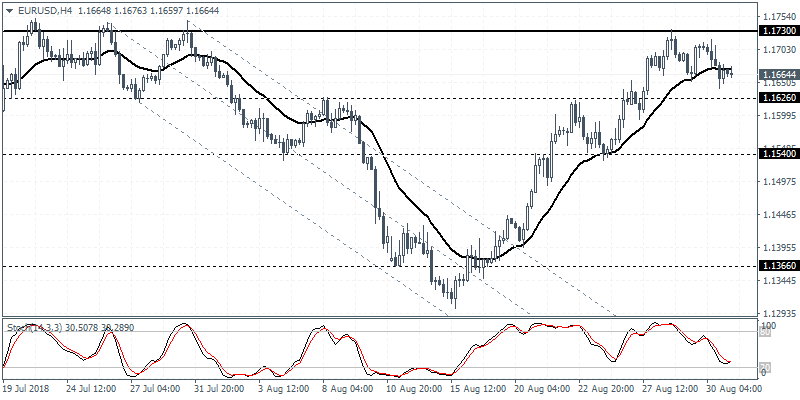
EUR/GBP Key Resistance At 0.8990
Pivot (invalidation): 0.8990
Our preference Short positions below 0.8990 with targets at 0.8945 & 0.8925 in extension.
Alternative scenario Above 0.8990 look for further upside with 0.9005 & 0.9025 as targets.
Comment The RSI lacks upward momentum.
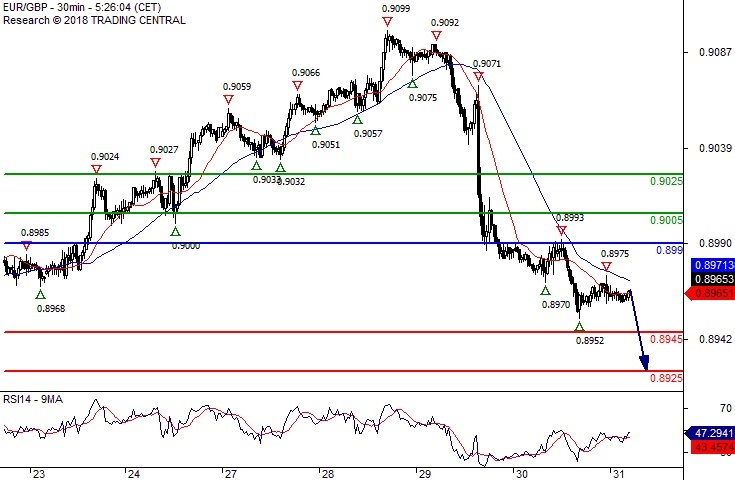
Bitcoin/Dollar Key Resistance At 7035
Pivot (invalidation): 7035 Our preference
Short positions below 7035 with targets at 6875 & 6805 in extension.
Alternative scenario Above 7035 look for further upside with 7130 & 7235 as targets.
Comment The RSI is mixed with a bearish bias.
The US Dollar Has Recovered Some Of The Losses
During yesterday's trading, the US dollar rose slightly against the basket of major currencies. The US dollar index (#DX) closed in the positive zone (+0.13%). The US currency strengthened due to the weakness of other currencies. Thus, the Canadian dollar fell significantly after the publication of weak data on Canada's GDP. The index counted to 0.0% in June, while investors expected a value of 0.1%. The single currency has moved away from the monthly highs. This movement was mostly caused by technical factors.
The Japanese yen is strengthening against the US dollar, as demand for safe assets has increased again. Today, the base consumer price index was published in Tokyo, which counted to 0.9% and was above the expected value of 0.8%. Also, the index of economic activity in the non-manufacturing sector of China was released, its value was 51.3 instead of the predicted value of 51.0. We expect economic statistics from the Eurozone.
The "black gold" prices are rising. At the moment, futures for the WTI crude oil are testing a mark of $70.25 per barrel.
Market Indicators
Yesterday, the bearish sentiment was observed in the US stock market: #SPY (-0.40%), #DIA (-0.51%), #QQQ (-0.18%).
At the moment, the yield of 10-year US government bonds is at the level of 2.86% -2.87%.
The news feed on 31.08.2018:
The consumer price index in the Eurozone at 12:00 (GMT+3:00).
USDCAD Extends Recovery Above 1.30, Looks Neutral In Short-Term
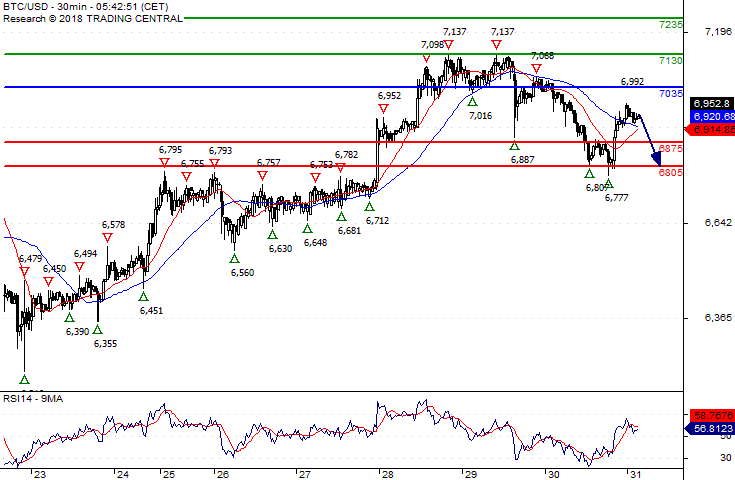
USDCAD managed to spike slightly above the 1.30 key level today after the rebound on the 2 ½ -month low of 1.2886, maintaining its downward pattern started from 1.3276 in late June. The RSI has changed direction as well, moving towards its neutral threshold of 50, a sign that the market could continue to recoup the pair’s previous losses in the short-term. However, as long as the RSI indicator holds in bearish territory, downside corrections cannot be ruled out.
Should the market extend gains, immediate resistance could come between 1.3076, the 38.2% Fibonacci level of the downleg from 1.3276 to 1.2886, and the August peak of 1.3173. A break above that frequently approached area could then open the way towards July’s high of 1.3289, located slightly above the 78.6% Fibonacci.
On the downside, the pair could look for support at the 1.2886 low before touching the 200-day simple moving average (SMA) at 1.2846. However, if the latter fails to halt downside movements, leaving the price to slip significantly below it, bears could line up their next target between 1.2776 and 1.2700.
In the medium-term picture, the market turned neutral after the downward reversal from the 1-year high of 1.3276 and should negative actions resume below the 1.2700 key-level the outlook could deteriorate to bearish.
To sum up, the market outlook is neutral both in the short and the medium-term.
Risk Appetite Turns Sour On Trade Angst, Eurozone Inflation Due With Brexit Also In Focus
Here are the latest developments in global markets:
FOREX: The dollar index was down on Friday, albeit by less than 0.1%, giving back some of the gains it posted in the previous session. Elsewhere, the Japanese yen advanced across the board on Thursday, as trade concerns led investors to increase their exposure to the safe-haven currency. Meanwhile, the euro and the loonie retreated, weighed on by concerns surrounding Italy and disappointing Canadian data respectively.
STOCKS: US equities fell for the first time in five days as trade worries came back to the surface, with the S&P 500 (-0.44%) and the Nasdaq Composite (-0.26%) pulling back from their all-time highs. The Dow Jones underperformed its US peers, edging lower by 0.53%. The S&P, Dow, and Nasdaq 100 are all expected to open practically flat today, futures suggest. The negative sentiment spilled over into Asia on Friday. Japan’s Nikkei 225 was little changed (-0.02%), while the Topix was down by 0.22%. In Hong Kong, the Hang Seng dropped 1.11%. Meanwhile in Europe, futures tracking all the major benchmarks were pointing to a notably lower open today.
COMMODITIES: Oil prices were steady on Friday, holding onto gains from the previous session. The precious liquid is caught between two conflicting narratives, with supply outages in Venezuela acting as a floor below prices, but signs of escalating trade tensions between the US and China capping any material gains. WTI and Brent crude were trading at $70.26 and $77.72 per barrel respectively, practically flat on the day. In precious metals, gold was up by 0.33% at $1,205 per troy ounce.
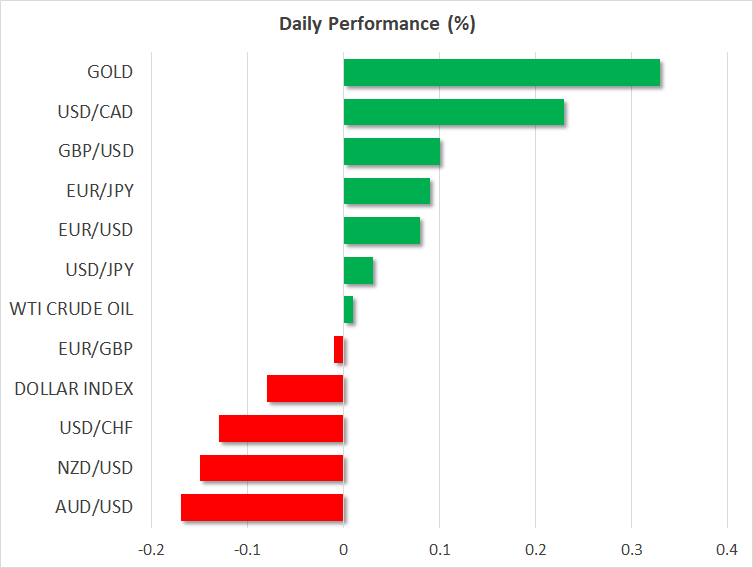
Major movers: Dollar & yen bounce amid renewed trade concerns and EM angst
The dollar rebounded on Thursday, snapping a four-day losing streak as risk appetite turned sour again, amid fresh signs of escalation in the US-China trade standoff and renewed concerns around emerging market economies. The Japanese yen and the Swiss franc – both of which are considered haven currencies –, also came under buying interest as investors sought shelter from growing risks, with the yen advancing against all its major peers.
The catalyst for these moves were comments by President Trump that he plans to proceed with new tariffs on $200bn of Chinese goods next week, something China previously threatened it would retaliate to. Furthermore, he rejected an “olive branch” proposal from the EU for both sides to completely eliminate tariffs on imported cars, noting that “it’s not good enough”. Both developments probably poured some cold water on recent hopes that with the NAFTA renegotiations likely drawing to an end, trade frictions with other economies could subside soon as well.
Fresh troubles in emerging markets likely amplified the cautious sentiment. The Argentinian peso’s collapse accelerated yesterday, falling by nearly 12% against the dollar. The plunge came despite the nation’s central bank raising interest rates to a global high of 60% – from 45% previously – in an attempt to inspire confidence, which was seemingly viewed more as a “panic move” and hence backfired. The angst spilled into other emerging currencies, most notably the Turkish lira and South African rand, with the former approaching its all-time lows again.
The euro, meanwhile, retreated across the board. Not only has the single currency been highly sensitive to worrisome trade news in recent months, but yesterday, it likely felt additional pressure by a spike higher in Italian bond yields – similar to what occurred in late May. The Italian budget, which is due at the end of September, is surrounded by concerns that the government and the EU may cross swords over fiscal rules. On this front, and in the more immediate term, it will be interesting to see whether Fitch downgrades Italy’s sovereign credit rating today. If so, that could add further pressure on the euro.
In Canada, the loonie dropped after GDP data for Q2 came a touch softer than anticipated, with growth clocking in at an annualized rate of 2.9% instead of the expected 3.0%. Market-implied odds for a BoC rate hike next week dropped to a mere 20% in the aftermath. On the NAFTA front, today is the unofficial deadline for Canada and the US to reach a deal. Hence, the loonie’s intraday direction may be decided by whether or not an accord is finalized.
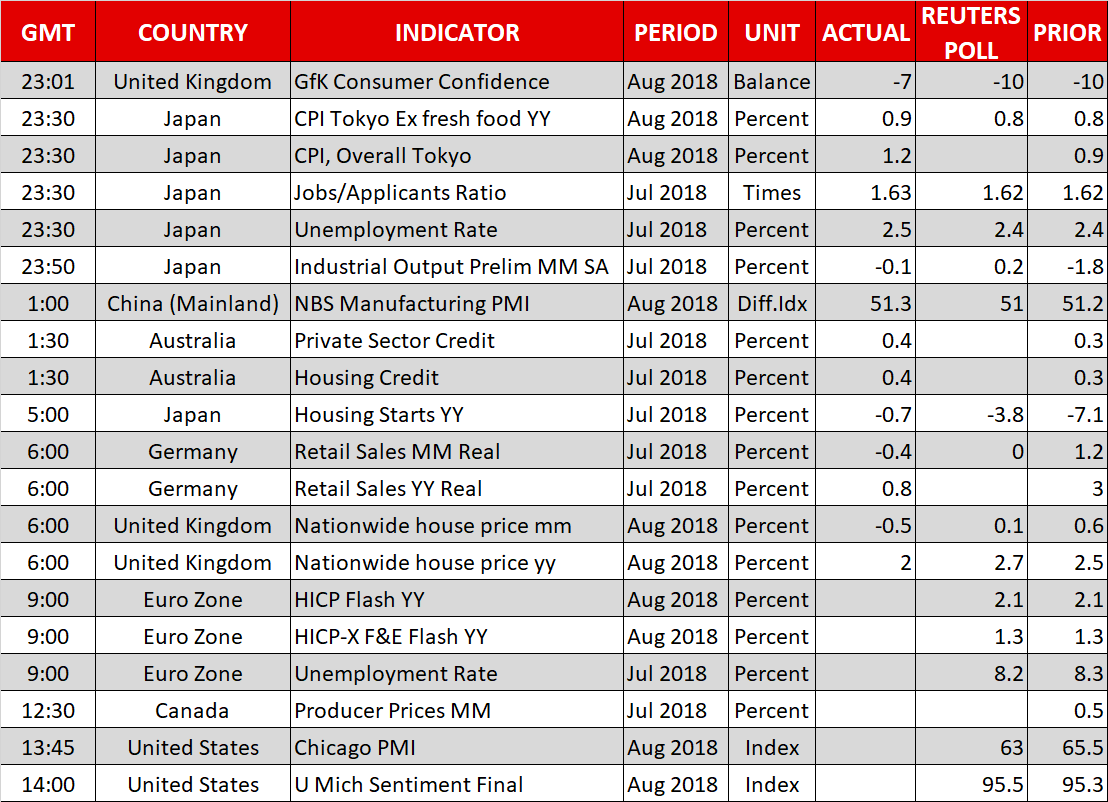
Day ahead: Eurozone flash inflation due; Brexit & trade developments eyed
Eurozone flash inflation figures for August are the highlight out of Friday’s calendar. Beyond releases, other events will be attracting attention, including Brexit and trade.
The preliminary reading on August eurozone inflation is expected to show the Harmonised Index of Consumer Prices (HICP) growing by 2.1% y/y, the same as in July. This is above the ECB’s annual target for inflation of “below but close to 2%”. Still, the central bank’s policymakers may downplay the significance of the above-target rise when they next meet around mid-September, given that that is likely to be largely owed to elevated energy prices. Supporting this, the core measure of inflationary pressures that excludes food and energy is predicted to expand by 1.3% y/y, again matching July’s pace of growth. In the meantime, the eurozone’s unemployment rate due at the same time is projected to fall to 8.2% in July – its lowest in around a decade –, from June’s 8.3%.
Out of the US, the Chicago PMI and the University of Michigan’s final survey on August consumer sentiment are slated for release at 1345 GMT and 1400 GMT correspondingly. The former is forecast to ease a bit after touching its highest since January in July, while the U of M’s survey is anticipated to revise the final print of the relevant index gauging consumer morale slightly upwards to 95.5 from 95.3 – this would still be below July’s 97.1.
Canadian producer prices are due at 1230 GMT. However, of more significance for the loonie are ongoing efforts for a new North American trade deal; the parties involved indicated that they may come to an agreement as soon as later on Friday.
Remaining on trade, President Trump, in a Bloomberg interview yesterday, showed willingness to impose tariffs on an additional $200 billion in Chinese imports as soon as next week. The trade war saga thus appears to have much more room to run. Moreover, the US president rejected the EU’s offer for zero tariffs on autos, calling the block “almost as bad as China” on trade. He also threatened to withdraw from the WTO, unless the organization “shapes up”.
On the Brexit front, negotiations will be taking place today and there are growing expectations for a deal after Barnier’s recent comments.
Meanwhile, Italian budget angst remains in the background and could well weigh on the euro should debt sustainability concerns rise.
In EM space, currencies such as the Argentine peso continue to retreat sharply – the Turkish lira is higher today versus the greenback though overall it’s been losing considerable ground as well. The trajectory of these currencies will be monitored, as well as any spillover effects to other markets.
A public appearance by ECB Vice President Luis de Guindos is on the agenda at 1700 GMT.
In energy markets, the weekly Baker Hughes report on active US oil rigs is due at 1700 GMT.
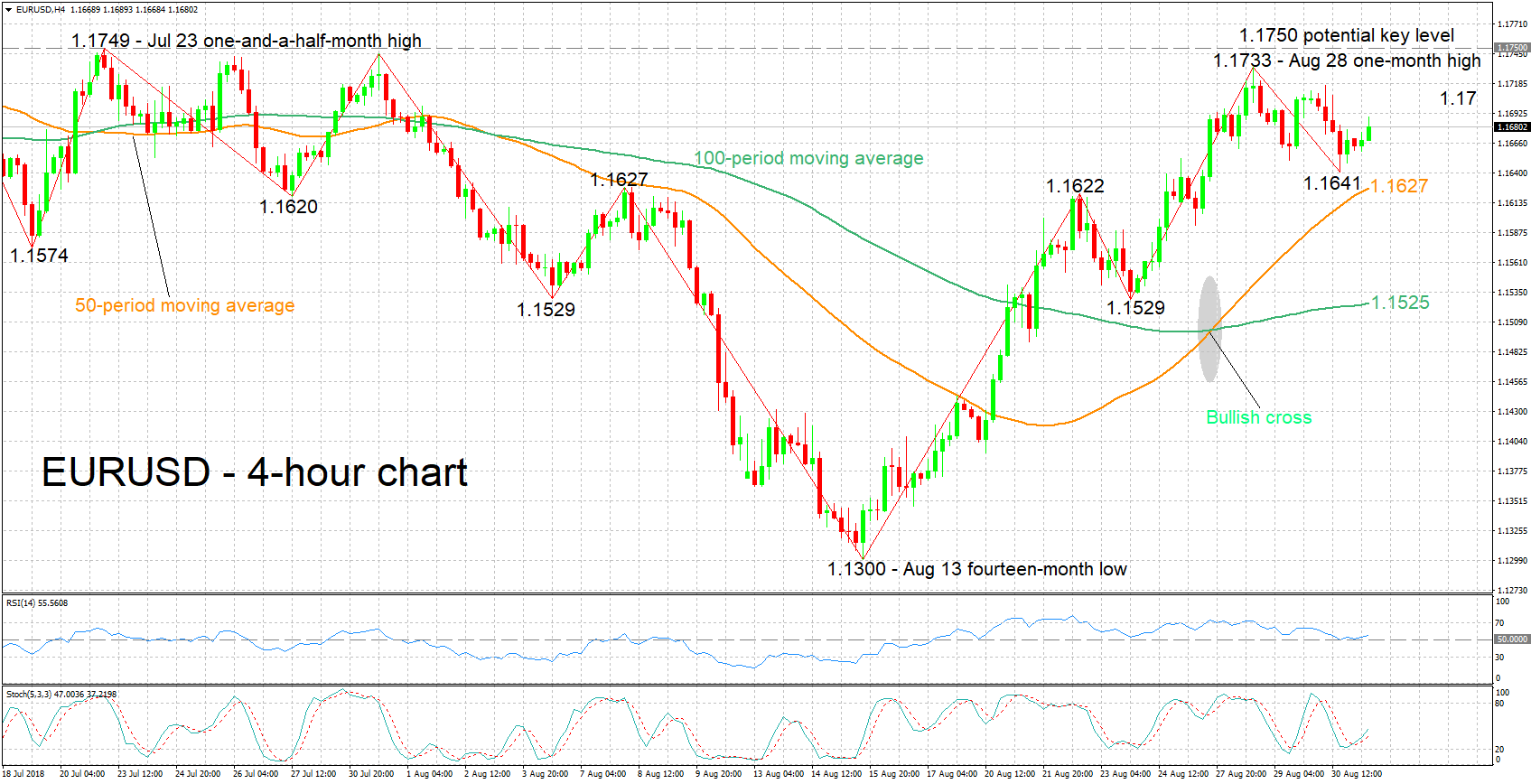
Technical Analysis: EURUSD looking mostly neutral in near-term; stochastics give bullish signal in very short-term
EURUSD is trading roughly 50 pips below the one-month high of 1.1733 hit on Tuesday. The RSI is in large part moving sideways, projecting a mostly neutral short-term picture. The stochastics however, are giving a bullish signal in the very short-term, as the %K line has moved above the slow %D one.
Stronger-than-anticipated eurozone inflation data later today may boost the pair. Given a move above the 1.17 round figure, resistance could come around the one-month peak of 1.1733 recorded earlier in the week. Notice that 1.1750 lies not far above; the zone around it encapsulates numerous tops from the recent past.
Conversely, weak eurozone numbers are likely to exert selling pressure on EURUSD. Support to declines may come around the current level of the 50-period moving average line at 1.1627; the area around this includes numerous tops and bottoms, while the 1.16 handle lies not far below. Steeper losses would bring the region around the 100-period MA at 1.1525 into scope.
Trade developments can also move the pair.
Sentiment Bruised By Tariff Plans, Emerging Markets Tumble
Asian stocks were under renewed selling pressure this morning as global trade concerns and chaos across emerging markets weighed on risk appetite.
Global trade developments have certainly placed investors on an emotional roller-coaster ride this week with the initial optimism over NAFTA talks outweighed by US-China concerns. Market sentiment is likely to remain cautious, especially after President Trump threatened to withdraw the US from the World Trade Organisation. With recent reports of Trump voicing his support to impose new tariffs on China, possibly intensifying concerns over US-China trade tensions, risk aversion could remain a dominant theme in the short to medium term.
Emerging market currencies have been beaten black and blue by investors following a brutal selloff in the Argentine Peso and Turkish Lira. The Argentine Peso collapsed after Argentina requested for the International Monetary Fund (IMF) to speed the release of a $50 billion loan, while the Lira crumbled on reports of the Turkish central bank’s deputy governor Erkan Kilimci resigning. Although the Lira stabilized against the Dollar this morning, gains may be capped by concerns over double-digit inflation, a deepening account deficit, and looming US sanctions. Emerging market currencies are likely to remain pressured by the economic turmoil in Argentina and Turkey, while external factors ranging from global trade tensions and prospects of higher rates could intensify the pain.
The Dollar edged higher against a basket of major currencies during early trade, as US-China trade tensions boosted its safe-haven appeal. With the US economy growing faster than initially estimated during the second quarter, market expectations remain elevated over a rate hike in September.
There could be some action with the British Pound as Brexit Secretary Dominic Raab meets Michel Barnier in Brussels today for further Brexit talks. If the talks end on a positive note and fears of a “hard Brexit” ease further, the Pound could receive a solid boost.
In the commodities arena, Gold prices inched higher as global trade tensions and renewed turmoil in emerging markets encouraged investors to seek safe-haven assets. However, the yellow metal still remains on course for its longest monthly losing streak since 2013. With the Dollar supported by the bullish sentiment towards the US economy and expectations heightened over higher interest rates, the outlook for Gold remains tilted to the downside. Focusing on the technical picture, prices have scope to challenge $1,214 if the $1,200 support holds. Alternatively, a breakdown below $1,200 could encourage a decline to $1,190 and 1,182, respectively.
Currencies: Dollar Hardly Profits From Rising Global Tensions
Rates: Safe haven flows ahead of the long US weekend?
Core bonds profited from disappointing EMU inflation data and safe haven flows stemming from stress on EM FX markets and from US President Trump's latest hawkish trade rhetoric. The latter two topics might continue to influence trading today. US Treasuries could receive additional support ahead of the long weekend.
Currencies: dollar hardly profits from rising global tensions
Yesterday, the dollar (ex USD/JPY) gained modest ground on EM stress and US president Trump stepping up its trade rhetoric against China and Europe. However, the USD rebound had no strong legs. The themes of EM stress and trade will continue to dominated FX trading today. Will the dollar 'rectify' current unconvincing performance?
The Sunrise Headlines
- US stock markets responded to President Trump's new wave of threats, with all indices losing ground at closure. Most Asian markets prolong this sentiment and start the day in red as well with Hong Kong underperforming (-0.91%).
- US President Trump has repeated his threat to pull the US out of the World Trade Organization. His comments came as Nafta talks with Canada continue today and he considers expanding tariffs on $200bn of Chinese imports.
- Cecelia Malmstrom, EU trade commissioner, said the EU is willing to remove all tariffs on cars in a trade deal with the US, only if the US would do the same. Trump already reacted the offer is “not good enough”.
- The Argentine peso fell another 12% yesterday, despite its central bank effort to raise interest rates to 60%. A two-day sell-off was triggered by President Macri's request to the IMF to speed up the release of its $50bn bailout package.
- China's manufacturing PMI unexpectedly rose in August picking up from 54.0 to 54.2, despite new export orders decreasing at the fastest pace in six months. In Japan, industrial production decreased by 0.1% in July (+0.2% expected).
- ECB policy maker Ewald Nowotny has said the laggard economy of Italy should not slow down plans to tighten euro-area monetary policy and start raising interest rates. He added Italy's problems cannot be solved by monetary policy.
- Today's eco calendar is richly filled, with in the US the Chicago Purchasing Manager index for August. The EMU releases its inflation numbers for this month. ECB's Guindos speaks in Asturias (Spain).
Currencies: Dollar Hardly Profits From Rising Global Tensions
Dollar hardly profits from rising tensions
Yesterday, the US dollar finally gained some ground, amongst others, supported by emerging market tensions (Argentina, Turkey). Later, trade tensions (Bloomberg report indicating that Trump might impose more tariffs on Chinese imports soon) caused selling of risky assets and a run to safe haven assets. However, overall USD gains were modest. The trade-weighted dollar closed at 94.72 (from 94.60). EUR/USD finished at 1.1671 (from 1.1710). The yen outperformed with USD/JPY closing at 110.98 (from 111.68). This morning, Asian equities mostly trade in the red, but losses remain modest. Several regional currencies including the Indonesian rupiah and Indian rupee are setting multi-year/record lows. Interesting, the yuan gains slightly and EUR/USD (1.1665) is holding up well. The yen remains well bid with USD/JPY hovering in the 111 area. Today, EMU CPI inflation and the Chicago PMI deserve attention. Soft EMU inflation is in theory euro negative, but the focus probably returns to global trade. Trade tensions mostly favoured the dollar (ex USD/JPY). However, the overnight market reaction to Trump's latest trade-threats is modest. US equity futures are tentatively rebounding and the dollar doesn't make any broad-based gains. Do markets think that Trump's comments are mainly tactics? Or do they acknowledge his call for a weak USD as he criticized Europe and China on their FX policies? The jury is still out. Recently, the USD reversed the early August gain but the USD decline showed signs of levelling off this week. EUR/USD returned in the 1.15/1.1850 consolidation range. However USD gains were modest given EM uncertainty and negative headlines on Italy. Eco fundamentals and the trade narrative in theory look USD supportive. However, the USD performance remains mediocre. We keep the working hypothesis that the EUR/USD rebound might slow and that a EUR/USD break beyond 1.1791/1.1850 might be difficult. That said, we cannot but take notice of current unconvincing USD performance.
Yesterday, sterling kept the gains after Wednesday's short squeeze even as eco data and brexit headlines were sterling negative. Today, markets look out for comments from EU's Barnier and UK's Raab as they meet in Brussels. We don't expect high profile positive news yet. However, with the market apparently still positioned GBP-short, the time is maybe not yet ripe for a new GBP down-leg. We still assume a break of EUR/GBP below 0.8850 is difficult unless there is real progress on Brexit
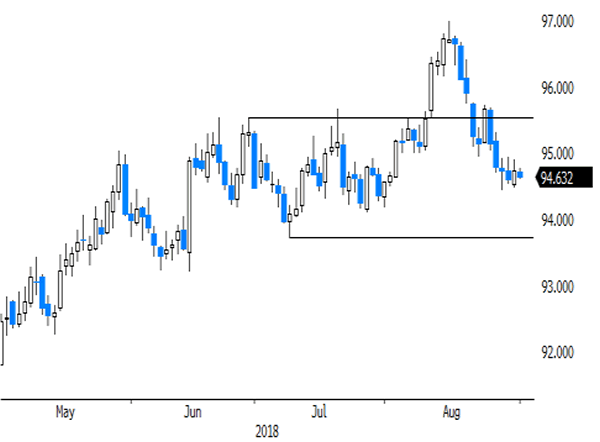
USD (trade-weighted-DXY): dollar hardly profits from rising global (trade) tensions
XAUUSD Intraday Analysis
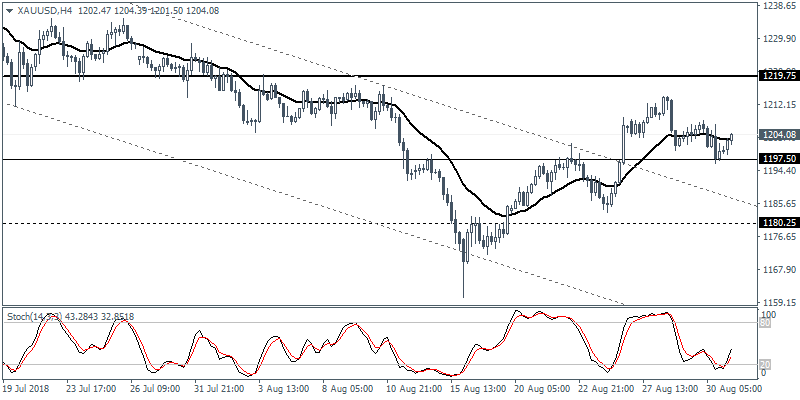
XAUUSD (1204.08): Gold prices were seen correcting to the downside after the previous rally saw price rising to a three week high. The retest of the support at 1197.50 indicates a potential reversal that could likely happen. The next main target to the upside is 1219.75 resistance. To the downside, in the event that the support gives way, gold prices could extend lower toward the 1180.25 level.
GBPUSD Intraday Analysis
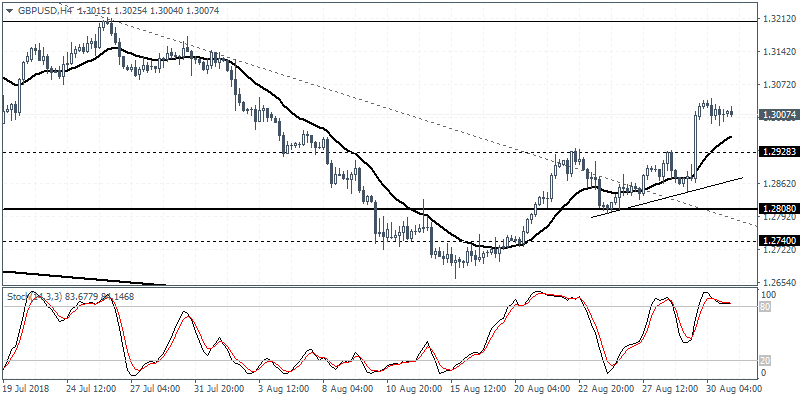
GBPUSD (1.3007): The GBPUSD was seen easing back from the strong bullish momentum from Wednesday. Price action is currently trading flat on the 4-hour chart. There is scope for the GBPUSD to retrace the gains back to 1.2928 level to establish support. A retest of this level could renew the bullish momentum as GBPUSD is on track for targeting 1.3205 resistance.
EURUSD Intraday Analysis
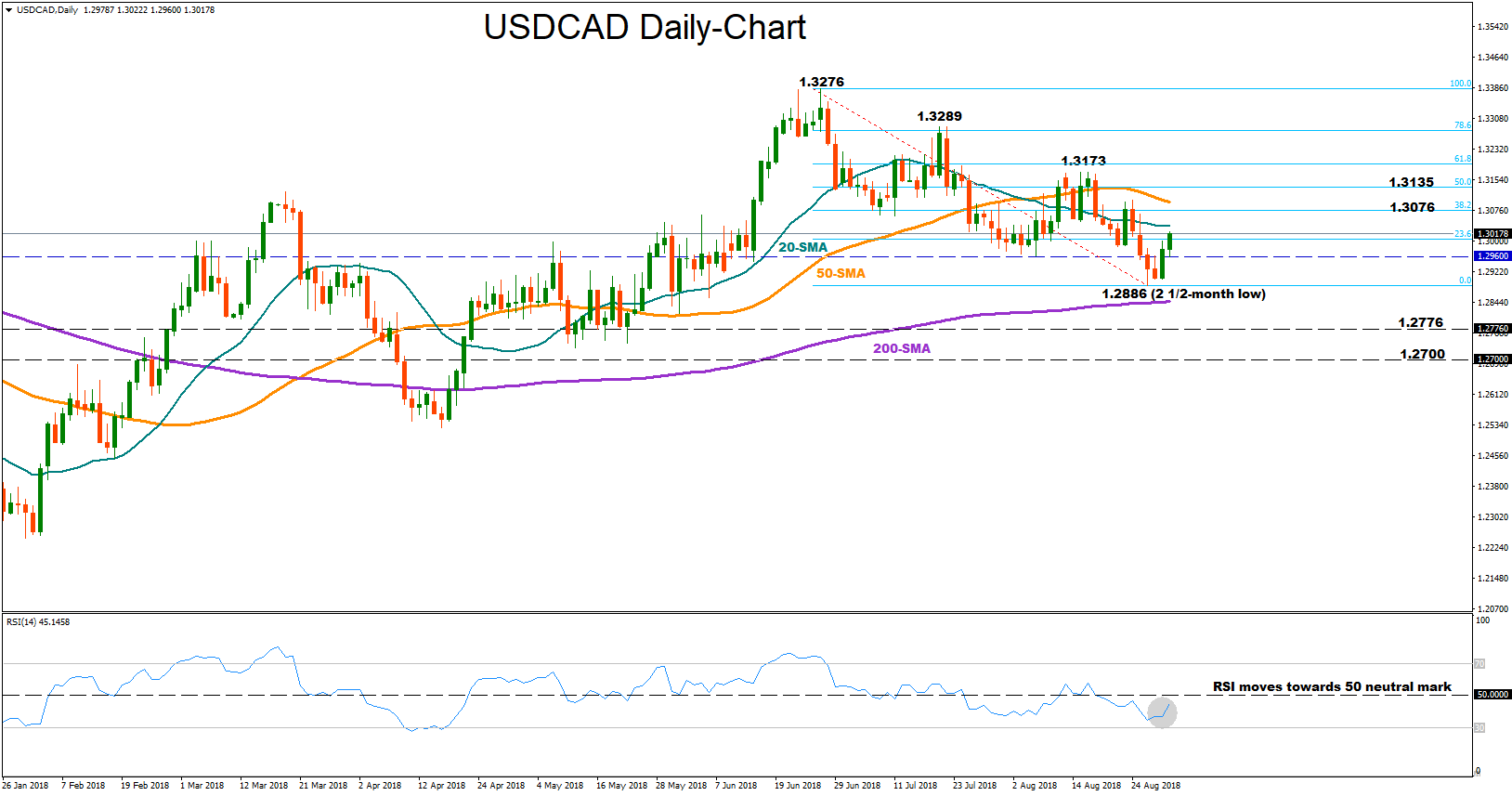
EURUSD (1.1664): The euro currency closed with a bearish engulfing candlestick on Thursday. This comes after the common currency posted a strong rally over the past few weeks. Price action remains trading just below the main daily resistance level of 1.1730. On the 4-hour chart, price action is consolidating around the 20-period EMA. The immediate support is seen at 1.1626 which could be tested in the near term. A break down below this level could however send the EURUSD lower toward 1.1540 support.