Sample Category Title
RBA minutes: El Niño risks increased, no strong case for a near term rate move
Minutes of August RBA meeting noted that drought conditions affected the timing of crop harvest. And the "probability of an El Niño event, which would typically be associated with low rainfall in eastern Australia, had increased over 2018". That implies " downside risks to the forecasts for farm output and exports."
Otherwise, the minutes came in basically as expected. They noted that global economic expansion continued but "direction of international trade policy in the United States continued to be a source of uncertainty for the global outlook."
Australian Dollar had "depreciated a little" against the US dollar. However, "in trade-weighted terms it had remained within its trading range of the previous two years."
Domestic forecasts were largely unchanged. GDP is projected to be a little above 3% over 2018 and 2019. Inflation would dip "temporarily" in September quarter due to some administered prices. But it's expected to be at around 2.25% in 2020.
On interest rates, the next move "would more likely be an increase than a decrease". But there was "no strong case for a near-term adjustment".
Former top treasury official blasts Trump as woefully wide of the mark on Yuan manipulation
Mark Sobel, a former top US Treasury Official criticized Trump's remark regarding Chinese currency manipulation as "woefully wide of the mark". And, Trump's focus on bilateral balances as "silly". And, to suspect a country of currency manipulation, there are criteria of "material 'excessive' current account surplus, an undervalued currency, and ample and rising reserves".
In an article titled "Trump wide of mark on 'manipulation'", Sobel point to facts that "China's current account surplus is falling to under 1% of GDP. The renminbi, hit by capital outflows between early 2015 and the end of 2016, rose sharply against the dollar up to April 2018. The renminbi trade-weighted index rose too. Since then, the renminbi has fallen on both measures, but the depreciation reflects the dollar's strength across the board. There is little evidence of more than scant Chinese foreign exchange market intervention."
He noted "a currency manipulating country should have a significant current account surplus". And, "the US Treasury in its foreign exchange reports uses a 3% of GDP threshold." While a currency manipulating country might also have an "undervalued currency" one should "look at a country's real effective exchange rate, not its bilateral dollar rate." Additionally, the country may intervene heavily in the markets, "buying dollars to hold its currency down, resulting in an increase in its foreign reserve holdings." But there might be "good reasons" to do so such as building up of reserves. There are many useful gauges of reserve adequacy to examine – reserves/GDP; reserves/short-term maturing debt; reserves/imports.
Sobel also completed that "a focus on bilateral balances is silly, even if the US Treasury is required to do so by statute and the president seems obsessed with them. Such an emphasis neglects to consider that certain countries specialize in certain goods and hold comparative advantage in such spheres."
Mark Sobel is US Chairman of OMFIF. He is a former Deputy Assistant Secretary for International Monetary and Financial Policy at the US Treasury and until earlier this year US representative at the International Monetary Fund.
Trump didn’t anticipate much from this week’s US-China trade talk
On trade dispute with China, Trump said he had "no time frame" for ending it. While the Chinese delegation is arriving the US soon, Trump said he did not "anticipate much" from the discussions.
He emphasized that the resolution will "take time" because "China's done too well for too long, and they've become spoiled. They dealt with people that, frankly, didn't know what they were doing, to allow us to get into this position."
Can GBP/USD Continue To Rebound Toward 1.2900?
Key Highlights
- The British Pound found support near the 1.2660 level and recovered nicely against the US Dollar.
- There was a break above a connecting bearish trend line at 1.2720 on the 4-hours chart of GBP/USD.
- Recently, the German PPI for July 2018 posted a 0.2% rise (MoM), less than the last +0.3%.
- Today, the UK CBI Industrial Trends Orders for August 2018 will be released, which is forecasted to decline from 11 to 8 (MoM).
GBPUSD Technical Analysis
The British Pound was under a lot of pressure until buyers appeared near the 1.2660 level against the US Dollar. The GBP/USD pair started an upward move and corrected above the 1.2700 level.
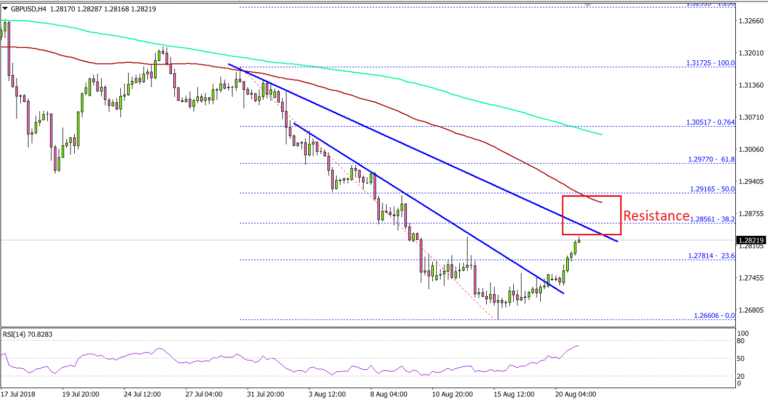
Looking at the 4-hours chart, the pair gained traction and moved above the 1.2700 and 1.2725 resistances. More importantly, there was a break above a connecting bearish trend line at 1.2720.
It has opened the doors for more gains above the 1.2780 level, which is the 23.6% Fib retracement level of the last decline from the 1.3172 high to 1.2660 low. However, there is a crucial resistance and a bearish trend line waiting near the 1.2820 level.
Moreover, the 38.2% Fib retracement level of the last decline from the 1.3172 high to 1.2660 low is positioned near the 1.2850 level. Therefore, should the pair continue to move higher from the current levels, it could face a strong resistance near the 1.2840 and 1.2850 levels.
On the downside, the 1.2740 level is a decent support, below which, the recent low of 1.2660 is likely to prevent losses. If the pair break the 1.2660 low, there could be more losses towards the 1.2600 level in the near term.
Economic Releases to Watch Today
- UK's CBI Industrial Trends Survey Orders August 2018 (MoM) – Forecast 9, versus 11 previous.
- Swiss Trade Balance for July 2018 – Forecast 2,850M, versus 2,591M previous.
Dollar extends decline as Trump blames Fed Chair Powell for rate hikes
Dollar stays generally weak in Asian session and extends Monday's selloff, on Trump's attack on Fed. In a Reuters interview, Trump reiterated his comments last month that "I'm not thrilled with his raising of interest rates, no. I'm not thrilled," referring to Fed Chair Jerome Powell.
He complained the the US is not getting any support from the Fed during his negotiation with other countries. Trump noted, "we're negotiating very powerfully and strongly with other nations. We're going to win. But during this period of time I should be given some help by the Fed. The other countries are accommodated."
Trump also fingered pointed Eurozone and China for currency manipulation to give them an advantage over the US on trade. He said . "I think China's manipulating their currency, absolutely. And I think the euro is being manipulated also."
USDJPY – Remains Vulnerable, Eyes More Downside Pressure
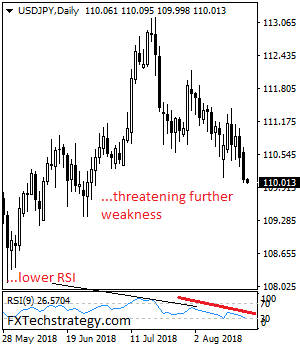
USDJPY - The pair looks to extend its downside pressure. On the downside, support lies at the 109.00 level where a break if seen will aim at the 109.00 level. A cut through here will turn focus to the 108.50 level and possibly lower towards the 108.00 level. On the upside, resistance resides at the 110.50 level. Further out, we envisage a possible move towards the 111.00 level. Further out, resistance resides at the 111.50 level with a turn above here aiming at the 112.00 level. On the whole, USDJPY faces further downside pressure.
USD Eases On Trump Comments
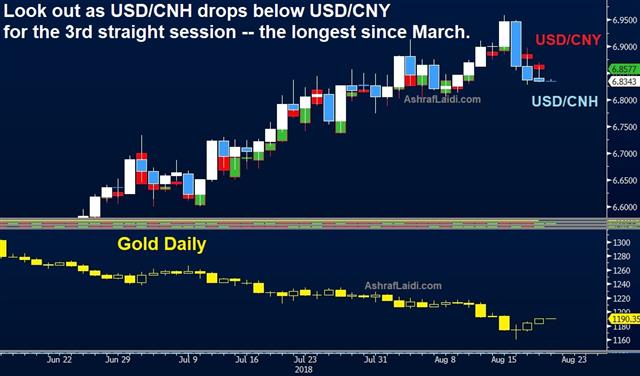
The US dollar was broadly lower on a slow Monday session following Trump comments on Friday indicating he expected Jerome Powell to be a "cheap-money" Fed chairman. The comments were made at a fund-raiser for wealthy Republican donors at the Hamptons. There were no specific USD comments but the greenabck dropped off on the interest rate side of it.CFTC positioning showed a net euro short for the first time in 15 months.The Premium short in USDJPY was closed at 110.00 for 120 pt gain as the remarkable divergence between USDJPY and USDX continued. The chart below indicates that the USD/CNH has fallen below the USD/CNY for the 3rd straight session, meaning a lower USD exchange rate against the offshore yuan than the USD rate vs onshore yuan (more managed). This may indicate that the PBOC is more successful at swaying speculating selling against the CNY in the hard-to-control offshore market. More on this in tomorrow's Premium video.
The first steps toward ending the China-US trade fight boosted risk assets on Friday but that hope could quickly unravel.The week ahead ends with the Jackson Hole symposium in what's traditionally a major event for markets but instead it may be a lower-level US-China meeting that will determine sentiment in the week ahead.
On Tuesday and Wednesday a delegation led by Chinese Vice Minister of Commerce Wang Shouwen will meet U.S. representatives led by Treasury Under Secretary for International Affairs David Malpass in Washington.
On Friday, the WSJ reported that this is part of a roadmap towards a November summit and trade deal between Trump and Xi. That sparked speculation that a true trade war can be avoided. Other reports suggested that the US is currently focused on the yuan but a rise in 12-month forward rates and a reversal in the yuan Friday could be China showing some flexibility.
Or it could be nothing. The market is clinging to some dim signs of hope here when all actions point to a fraying relationship. On August 1, Trump announced hearings on tariffs of 25% on more than $200 billion Chinese imports.
Hearings and consultations on those tariffs start Monday and continue until the public comment period ends September 5. That's the key day on the calendar and could mark a watershed moment in markets this year. If this week's summit ends badly, markets may jump to conclusions about what's coming.
CFTC Commitments of Traders
Speculative net futures trader positions as of the close on Tuesday. Net short denoted by - long by +.
EUR -2K vs +11K prior GBP -61K vs -59K prior JPY -58K vs -63K prior CHF -46K vs -46K prior CAD -26K vs -25K prior AUD -51K vs -54K prior NZD -27K vs -25K prior
The euro has dropped to 1.14 from 1.26 in the past 5 months in a painful move for euro longs. They packed it in last week and are now net short for the first time since May 2017. Other moves were relatively minor.
(RBA) Minutes of the Monetary Policy Meeting of the Reserve Bank Board
Sydney - 7 August 2018
Members Present
Philip Lowe (Governor and Chair), Guy Debelle (Deputy Governor), Mark Barnaba AM, Wendy Craik AM, Philip Gaetjens, Ian Harper, Allan Moss AO, Carol Schwartz AM, Catherine Tanna
Others Present
Luci Ellis (Assistant Governor, Economic), Christopher Kent (Assistant Governor, Financial Markets), Alexandra Heath (Head, Economic Analysis Department), Ellis Connolly (Deputy Head, Domestic Markets Department)
Anthony Dickman (Secretary), Andrea Brischetto (Deputy Secretary)
International Economic Conditions
Members commenced their discussion by noting that the global economy had continued to grow above trend. Indicators of global industrial production and trade had remained at relatively high levels, as had surveyed business conditions. Spare capacity had continued to be absorbed, especially in the major advanced economies. Headline inflation had moved a little higher since the beginning of the year, primarily as a result of higher oil prices. Core inflation had also increased in a few economies, including the United States, but had remained low elsewhere.
The Bank's forecast was for global growth to ease a little over the following few years, but to remain above trend. Members noted that, although this forecast was broadly unchanged from three months earlier, the risks to the international economic outlook had shifted. Although the direct effects of trade protectionism measures that had been implemented and further measures that had been proposed were expected to be small, the broader risk of adverse effects on investment decisions and confidence had increased. On the other hand, members observed that the large fiscal stimulus in the United States was occurring in a period of little spare capacity in the US economy. It was therefore possible that US growth and inflation could be stronger than expected. This could prompt a faster withdrawal of monetary stimulus than markets expected and lead to a broad-based appreciation of the US dollar. This scenario implied stronger global growth than forecast and could be associated with a depreciation of the Australian dollar, both of which would support the Australian economy.
The near-term outlook for growth had remained positive for the United States and Japan. In the June quarter, the US economy had received a boost from recent tax cuts and a pick-up in export growth, while growth in Japan was expected to have picked up, partly reversing the weak outcome in the March quarter. Both economies were expected to continue growing at an above-trend pace over 2018 and 2019; survey data had indicated that investment growth was expected to remain strong and labour market conditions were expected to support consumption growth. By contrast, in the euro area there had been signs that consumption growth and investment intentions had moderated a little since the beginning of 2018, although GDP growth was still expected to remain above trend over the forecast period. Across the advanced economies, unemployment rates had trended lower and surveys had suggested that more firms were facing labour shortages. Wages growth had picked up noticeably over the preceding few years, although it remained relatively low compared with its historical levels.
In China, GDP growth had eased slightly relative to a year earlier and growth had been weaker than expected in a number of sectors, including infrastructure construction. Nonetheless, steel production and prices had been high, which had supported Australian exports of bulk commodities. The Chinese authorities had tightened some regulations to reduce the build-up of financial stability risks, but had also introduced targeted fiscal stimulus and eased monetary policy to counter slowing growth in some sectors of the economy. Elsewhere in east Asia, year-ended output growth had been steady in the first half of 2018. Export growth had remained high and domestic demand had been increasingly contributing to growth. Members noted that many economies in the region were vulnerable to an escalation in trade tensions, given their high trade exposures and integration with global supply chains.
Domestic Economic Conditions
Members commenced their discussion of the domestic economy by observing that the outlook had not changed materially over the preceding three months. Growth was forecast to strengthen to be a bit above 3 per cent over 2018 and 2019, before easing to a little above trend towards the end of 2020 as the ramp-up in liquefied natural gas (LNG) production came to an end.
Non-mining business investment was expected to continue to grow over the forecast period, but at a more moderate pace than over the previous year. While quite lumpy, non-residential building approvals had fallen in trend terms since their peak in mid 2017. However, members noted that there was still a reasonable pipeline of building construction work, which should support growth in the near term. Work yet to be done on private infrastructure investment had also increased. Growth in investment in machinery and equipment was forecast to pick up further, consistent with an ongoing economic expansion. Mining investment was still expected to trough in coming quarters, but beyond that was expected to increase moderately as companies invested to sustain production.
Public demand was expected to make a significant contribution to growth over the period to the end of 2020, based on information provided in the state and federal budgets. Further expansion of the National Disability Insurance Scheme was expected to support public consumption, while infrastructure projects were expected to support public investment spending.
Drought conditions, particularly in New South Wales and southern Queensland, had affected the timing of crop harvests and had led to an increase in slaughter rates. This was expected to have contributed to a rise in rural exports in the June quarter. Members noted that the probability of an El Niño event, which would typically be associated with low rainfall in eastern Australia, had increased over 2018, implying downside risks to the forecasts for farm output and exports. Resource export volumes were expected to have been higher in the June quarter and to contribute to growth over the subsequent year or so, as LNG production continued to ramp up.
Commodity prices were little changed over the previous month. Trade tensions had contributed to falls in oil and base metals prices. Coking coal prices had fallen, partly as a result of Australian supply coming back on line, while prices of iron ore had risen and thermal coal prices had remained at a high level. Many rural commodity prices had increased, partly because drought conditions had restricted the supply of some rural commodities from Australia and other countries. Over the previous year, the terms of trade had held up at a higher level than previously forecast, largely reflecting higher thermal coal prices than had been expected. The terms of trade were expected to remain around their current level for a few quarters or so before declining moderately over the medium term.
In established housing markets, prices in Sydney and Melbourne had declined further in July and across a broader range of properties. Housing prices had also declined in Perth, but had increased in Hobart and been relatively stable in Adelaide and Canberra. Rental vacancy rates had been little changed in Sydney and Brisbane, and had continued to fall in Melbourne, where strong population growth had continued to outpace additions to the rental stock. Rental vacancies had remained high in Perth, but were lower than the peak in the previous year.
Despite the easing of conditions in the established housing market, dwelling investment was expected to remain at a high level, but not to contribute to growth, over coming quarters. Residential building approvals had trended lower, which was consistent with information from liaison contacts that there had been a decline in off-the-plan sales of apartments. Nevertheless, a significant pipeline of work remained to be done, particularly in Sydney and Melbourne. Liaison contacts had continued to report that capacity constraints had been limiting the pace at which the pipeline could be worked through, particularly in Sydney.
Recent data on consumption showed that retail sales in the June quarter had been consistent with steady growth in consumption in year-ended terms. Liaison contacts had also reported that retail trading conditions had been stable. Overall growth in consumption in the June quarter was expected to have been supported by growth in labour income. Growth in household disposable income had picked up over the year to the March quarter, reflecting an increase in growth in average earnings per hour and hours worked. Members noted that these increases, in combination with the more recent increase in minimum wages, the announcement of future tax cuts and expectations of a further tightening in labour market conditions, had reduced some of the uncertainty around the outlook for consumption.
Employment had increased by 51,000 in July, and employment growth had been a little above average over the first six months of 2018, although it had slowed from the very strong rate over 2017. The unemployment rate had declined slightly in recent months, but had remained around 5½ per cent since mid 2017. Leading indicators suggested that employment could be expected to grow at an above-average pace in the second half of 2018.
Members noted that the unemployment rate forecast profile was unchanged from three months earlier. With the extension of the forecast period to the end of 2020, the unemployment rate was expected to reach around 5 per cent by the end of the forecast period. Based on historical relationships, members noted that the level of vacancies was consistent with the forecast for a further gradual decline in the unemployment rate over the second half of 2018. However, there continued to be uncertainty about the extent of spare capacity in the labour market and how quickly this would translate into higher wage and price inflation over the forecast period. It was possible that ongoing above-trend growth in output could see the unemployment rate fall faster than expected and wages growth pick up more strongly as a result. Alternatively, it was possible that the flow of new entrants to the labour force could be stronger than usual, such that unemployment would decline more slowly than expected and wage pressures would take longer to emerge.
Headline and underlying inflation had both been around ½ per cent in the June quarter, in line with earlier forecasts. In year-ended terms, headline inflation had picked up a little to 2.1 per cent, while underlying inflation had remained close to 2 per cent. Strong competitive pressures and low growth in wage costs had been placing downward pressure on retail prices for some time. In an environment of falling wholesale prices and heightened competition in the retail energy sector, energy providers had reduced some retail prices in the June quarter and there had also been an unusually small increase in private health insurance premiums. Rents, which are a large item in the CPI basket, had been flat in the June quarter and year-ended rent inflation had been at its lowest rate since the mid 1990s. By contrast, inflation in new dwelling costs had risen.
Members noted that inflation in the September quarter was likely to be lower than previously forecast because of new government measures, including changes to childcare subsidies and TAFE and car registration fees, as well as some recent reductions in utilities prices. The forecast profile for inflation had otherwise been unchanged. Taking these effects into account, headline and underlying inflation were expected to be around 1¾ per cent over 2018, and then increase to around 2¼ per cent in 2020, in line with previous forecasts. Members noted that there was some risk that the recent decline in wholesale electricity prices could have more persistent effects on utilities prices than had been factored into the forecasts. At the same time, members noted that these price declines would boost real household disposable income.
Financial Markets
Members were briefed on developments in Australian dollar short-term money markets. Interest rates in these markets had been rising sharply towards the end of recent quarters, and only part of the rise had subsequently been unwound following the end of each quarter. As a result, the level of interest rates in these markets had been higher than in 2017, despite market expectations for the path of the cash rate having changed little over this period.
Members discussed a range of factors that may help to explain these outcomes, noting that it was difficult to be definitive about the cause. Around the end of the March quarter, the rise and fall of Australian dollar money market rates had been associated with a similar pattern for US dollar money market spreads, but in the June quarter the movements had been specific to Australia. Members noted that banks had become less inclined to supply liquidity to money markets in light of regulatory developments, although this development had also been experienced in money markets in other countries. As a result, interest rates appeared to have become more responsive to changes in demand and supply than had been the case previously. In particular, portfolio reallocation had lowered demand for bank bills issued by major Australian banks, which had contributed to the increase in the bank bill swap rate. In foreign exchange swap markets, where structural changes in liquidity conditions had also been apparent, interest rates had increased as a result of stronger demand for Australian dollars, partly reflecting the conversion back to Australian dollars of increased offshore bond issuance by Australian banks.
Notwithstanding these developments, domestic funding conditions had remained generally accommodative. Members noted that funding costs for the major banks had risen a little in 2018 as a result of the increase in short-term money market rates, but had remained low relative to history, consistent with the low level of the cash rate. In particular, the higher money market rates had to date not been reflected in significant changes in retail deposit rates. Banks' net bond issuance had remained strong in 2018 and bond spreads had remained low.
Members noted that the average interest rate on outstanding variable-rate housing loans had declined by around 10 basis points since August 2017. Some smaller lenders had increased their standard variable interest rates more recently, although other lenders had reduced interest rates on some mortgage products.
Housing credit growth had continued to ease over the first half of 2018, driven by a decline in credit growth for investors. Members noted that this appeared to have been mainly due to softening demand from investors in an environment of declining housing prices in some markets, although it was likely that there had also been some reduction in the supply of credit associated with tighter lending standards.
Turning to developments in global financial markets, members noted that global financial conditions continued to support economic growth. Monetary policy in the major economies remained accommodative, although central banks were at different stages of their monetary policy cycles.
In the United States, the Federal Reserve had continued to indicate that further gradual increases in the federal funds rate were likely over the next couple of years. Market pricing implied that the next policy rate increase was expected in September, but, beyond that, market expectations for the federal funds rate remained below those implied by the median projection of the members of the Federal Open Market Committee. The Bank of Canada and Bank of England had both raised their policy interest rates at their most recent meetings, as had been widely expected. Market pricing implied that the Bank of Canada would increase policy rates further over the coming year. The European Central Bank had indicated that negative policy rates were likely to remain in place until the latter half of 2019 and that it planned to end its net asset purchases by the end of 2018. At its July meeting, the Bank of Japan introduced forward guidance to the effect that its stimulatory policy settings will remain in place for an extended period. In an effort to help improve market functioning, the Bank of Japan had also announced a slightly wider trading range for 10-year government bond yields to meet its target of around 0 per cent.
Members noted that government bond yields in the major markets had risen moderately over the preceding month, but had generally remained low. In the United States, markets had continued to focus on the flattening of the US Treasury yield curve. Members noted that this flattening had been driven largely by rising short-end rates (consistent with increases in the federal funds rate) and a decline in the term premium for bonds, rather than by expectations for slower growth or lower inflation.
Equity prices had risen further in the advanced economies over the preceding month, supported by strong corporate earnings. US share prices had outperformed other markets over recent months, following particularly strong corporate earnings in the United States, share buybacks and merger and acquisition activity. Australian share prices, when compared on the basis of accumulation indices (which take account of dividend payments), had also outperformed other markets over recent months. By contrast, in China, equity prices had fallen sharply over recent months in response to slowing growth and rising international trade tensions.
Major advanced economy exchange rates had generally been stable since the previous meeting. This had followed a broad-based appreciation of the US dollar over the course of 2018. The Chinese renminbi had depreciated since May, in part reflecting the general appreciation of the US dollar, but international trade tensions, moderating growth and a targeted easing in monetary policy by the People's Bank of China were also likely to have contributed.
Conditions in some emerging financial markets had stabilised somewhat since the previous meeting. Earlier localised financial market stresses relating to country-specific concerns had eased in some markets in July, although concerns had remained in some others. Overall, most emerging markets had experienced capital outflows and a depreciation of their exchange rates relative to the US dollar in 2018.
The Australian dollar had been little changed against the US dollar since the previous meeting, but had appreciated slightly on a trade-weighted basis, reflecting the recent depreciation in the renminbi. The Australian dollar had remained within its trading range of the previous few years.
Financial market pricing implied that the cash rate was expected to remain unchanged for a considerable period.
Members concluded their review of developments in financial markets with a discussion of access to finance for small businesses. Members reviewed the issues raised by participants at the Bank's Small Business Finance Advisory Panel and two special roundtable events involving representatives from small business, lenders and the public sector. They noted that many small businesses looking to expand still found it challenging to access finance, particularly without providing real estate as security. Lenders had highlighted that they were keen to lend to small businesses, and that the higher cost of unsecured finance mainly owed to the associated risk. Members noted that there had been more funding available from private equity sources recently, but that the supply of venture capital remained small compared with some other markets.
Members discussed some initiatives suggested by market participants that could potentially improve access to finance for small businesses. Members were encouraged by the potential for comprehensive credit reporting and open banking to lower the cost of credit risk assessment for lenders. They also noted efforts to improve the financial capability of small businesses by encouraging better financial record-keeping. They observed that the reliance on real estate as collateral in small business lending could be reduced by making it easier to use other assets as security, such as machinery and equipment. Finally, members noted private sector initiatives in other jurisdictions designed to provide more equity funding for small businesses seeking to expand.
Considerations for Monetary Policy
In considering the stance of monetary policy, members noted that the global economic expansion had continued. This had contributed to higher commodity prices in 2018, which had increased upstream inflationary pressures globally and boosted Australia's terms of trade. A number of advanced economies were growing at above-trend rates and were experiencing increasingly tight labour market conditions. There had been further evidence of rising wage pressures in these economies. Although core inflation had remained below most central banks' targets, it had increased to be around the US Federal Reserve's target. Growth in the Chinese economy had slowed a little and the authorities had eased fiscal and monetary policy in a targeted way to support near-term growth, while continuing to pay close attention to risks in the financial sector. The direction of international trade policy in the United States continued to be a source of uncertainty for the global outlook.
Against this backdrop, global financial conditions had remained expansionary, although they were gradually becoming less so in some economies, most notably the United States where the Federal Reserve was expected to increase the federal funds rate further over 2018 and 2019. This had contributed to a broad-based appreciation of the US dollar. Although the Australian dollar had depreciated a little against the US dollar, in trade-weighted terms it had remained within its trading range of the previous two years.
The forecasts for the Australian economy were largely unchanged. GDP growth was expected to be a little above 3 per cent over 2018 and 2019, supported by strong public demand, resource exports, further growth in non-mining business investment and steady consumption growth. Business conditions remained positive, while recent data on wages growth and expectations of a further tightening in labour market conditions had provided more comfort that household income growth would continue to increase gradually and support the outlook for consumption. Members were cognisant of the effect of drought conditions on the rural sector.
Forward-looking indicators of labour demand, including vacancy rates, continued to point to above-average growth in employment in the near term. The unemployment rate was expected to decline gradually towards 5 per cent. Wages growth was expected to increase gradually as spare capacity in the labour market is absorbed over the forecast period. Year-ended inflation had been close to 2 per cent in the June quarter, which was in line with previous forecasts. Although inflation was expected to be temporarily lower in the September quarter, owing to falls in some administered prices, inflation was still expected to be around 2¼ per cent in 2020.
Housing prices had fallen moderately in Sydney and Melbourne, following significant growth over preceding years, while housing prices had been relatively stable in most other capital cities. Rent inflation had remained low. Housing credit growth had declined, mainly because investor demand had slowed noticeably. Lending standards were tighter than they had been a few years previously, partly reflecting the Australian Prudential Regulation Authority's earlier supervisory measures to help contain the build-up of risk in household balance sheets. Some further tightening of lending standards by banks was possible, although competition for borrowers of high credit quality remained strong.
Based on the forecasts, members assessed that the current stance of monetary policy would continue to support economic growth and allow further progress to be made in reducing the unemployment rate and returning inflation towards the midpoint of the target. In these circumstances, members continued to agree that the next move in the cash rate would more likely be an increase than a decrease. However, since progress on unemployment and inflation was likely to be gradual, they also agreed there was no strong case for a near-term adjustment in monetary policy. Rather, members assessed that it would be appropriate to hold the cash rate steady and for the Bank to be a source of stability and confidence while this progress unfolds.
Taking account of the available information, the Board judged that holding the stance of monetary policy unchanged at this meeting would be consistent with sustainable growth in the economy and achieving the inflation target over time.
The Decision
The Board decided to leave the cash rate unchanged at 1.5 per cent.
Eco Data 8/21/18
[php_everywhere instance="1"]
Mid-US udpate: Dollar lower as Trump criticizes Fed Powell, Gold to break 1190
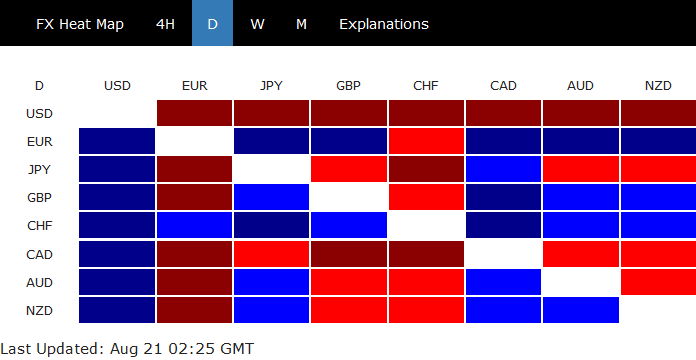
A rather boring trading day is fired up after Bloomberg reported that Trump criticized Fed's rate hike again. And this time, he specifically complained that Fed Chair Jerome Powell is not the "cheap money" Fed chair he expected. Dollar is currently trading as the third weakest for today, just next to New Zealand Dollar and Canadian Dollar.
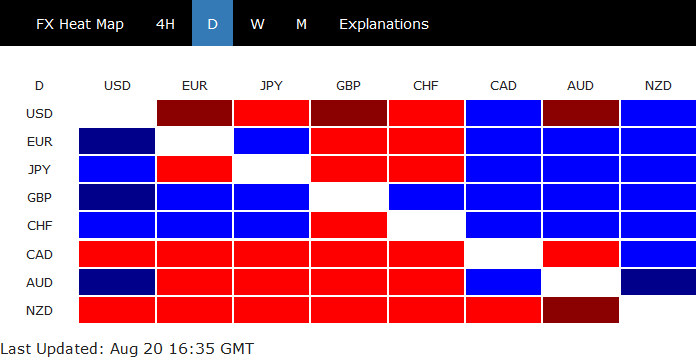
And the greenback has finally got out of Friday's range against Euro and Australian Dollar. GBP/USD extended the recovery earlier today already. On the other hand, Sterling is trading as the strongest one for today while Swiss Franc follows. But these two are rather close.
In other markets, FTSE closed up 0.43% at 7591.26, DAX gained 0.99% to 12331.30, CAC rose 0.65% to 5379.65. At the time of writing, DOW is up 0.40% or 100 pts, S&P 500 is up 0.25%. NASDAQ is down -0.06% (that is, nearly flat). It still a bit early to tell. But S&P 500 at 2857 is rather close to 2872.87 record high, which the index may challenge later in the week. 10 year yield extends recent decline and is down -0.04 at 2.833.
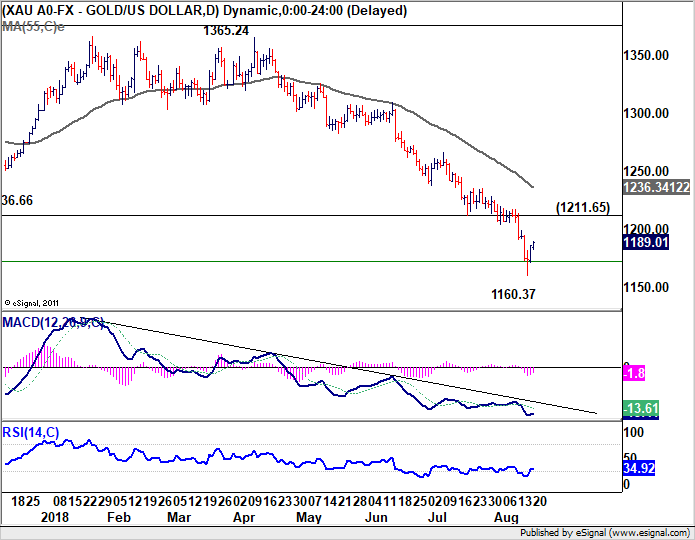
Gold is finally having some momentum for extending last week's rebound from 1160.37 low. And, 1190 is within touching distance. Eyes, will be on 1200. Nonetheless, break of 1211.65 support turned resistance is needed to indicate short term bottoming. Or, outlook will remain bearish, in spite of the current rebound.