

Sample Category Title
USD/CHF Mid-Day Outlook
Daily Pivots: (S1) 0.9931; (P) 0.9954; (R1) 0.9979; More...
No change in USD/CHF's outlook. Intraday bias remains neutral for consolidation below 0.9984 temporary top. With 0.9920 minor support intact, further rise is mildly in favor. Above 0.9984 will target a test on 1.0067 key resistance next. On the downside, break of 0.9920 minor support will turn bias to the downside, to bring another decline to extend the consolidation pattern from 1.0056.
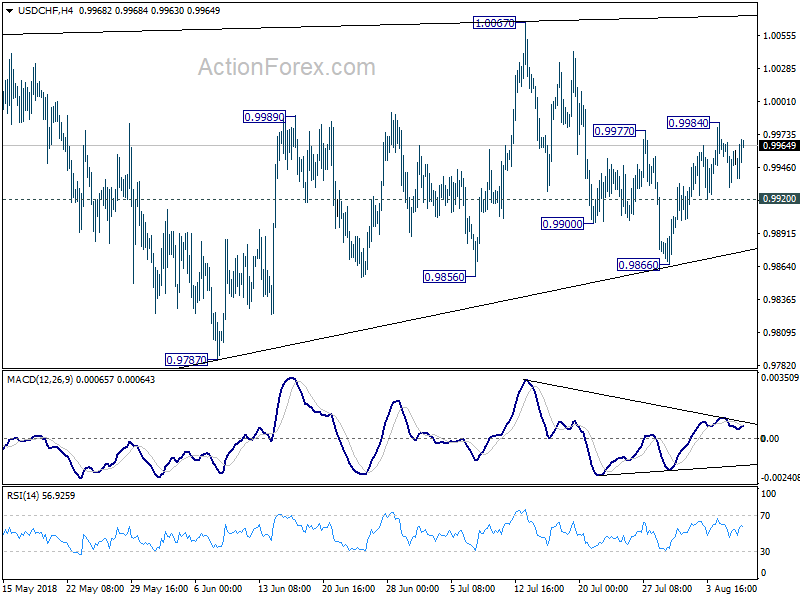
In the bigger picture, current development suggests that the consolidation pattern from 1.0056 is extending with another leg. As long as 38.2% retracement of 0.9186 to 1.0056 at 0.9724 holds, we'd expect rise from 0.9186 to resume at a later stage to retest 1.0342 key resistance (2016 high). However, sustained break of 0.9724 fibonacci level will bring deeper fall, as another declining leg in the long term range pattern.
EUR/USD Mid-Day Outlook
Daily Pivots: (S1) 1.1562; (P) 1.1586 (R1) 1.1622; More.....
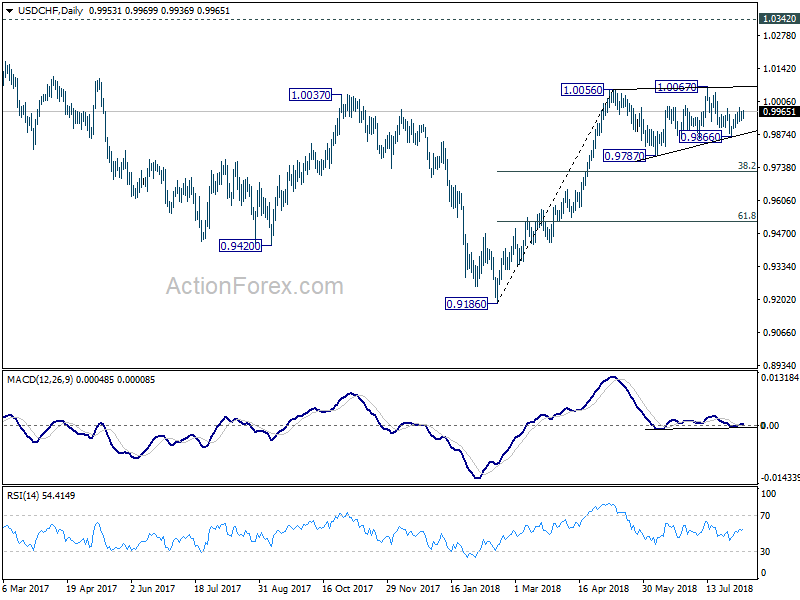
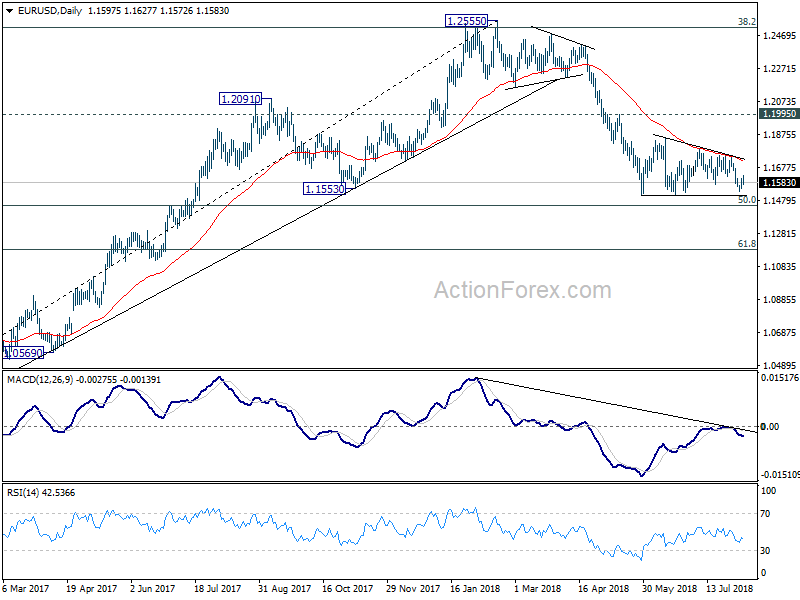
EUR/USD faced some resistance from 4 hour 55 EMA and retreated. But for now, further rise is in favor. Rebound from 1.1529 is seen as another leg inside the consolidation pattern from 1.1509. Further rise could be seen towards 1.1745 resistance. But even in case of stronger than expected rebound, upside should be limited by 1.1851 to bring down trend resumption eventually. On the downside, decisive break of 1.1507 key support will resume larger down trend from 1.2555 through 50% retracement of 1.0339 to 1.2555 at 1.1447.
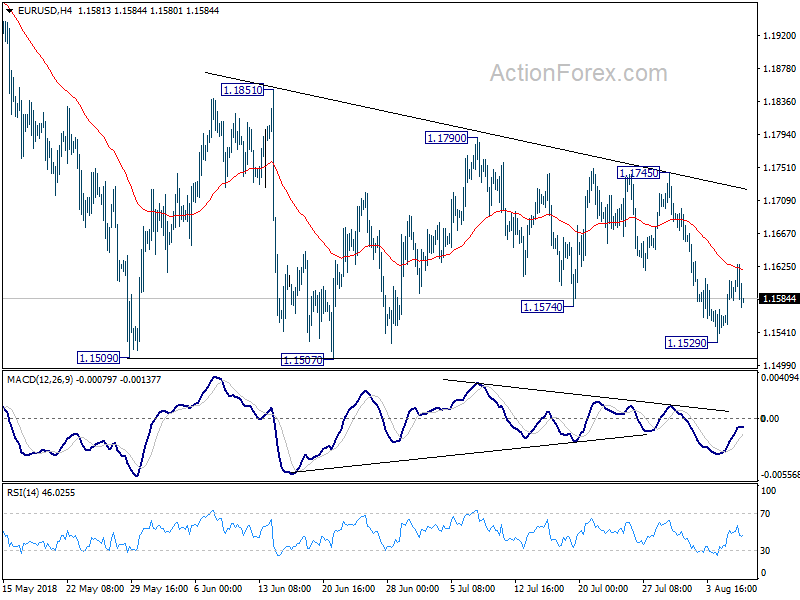
In the bigger picture, EUR/USD was rejected by 38.2% retracement of 1.6039 (2008 high) to 1.0339 (2017 low) at 1.2516. And, a medium term top was formed at 1.2555 already. Decline from there should extend further to 61.8% retracement of 1.0339 to 1.2555 at 1.1186 and below. For now, even in case of rebound, we won't consider the fall from 1.2555 as finished as long as 1.1995 resistance holds.
GBP/USD Mid-Day Outlook
Daily Pivots: (S1) 1.2917; (P) 1.2945; (R1) 1.2968; More...
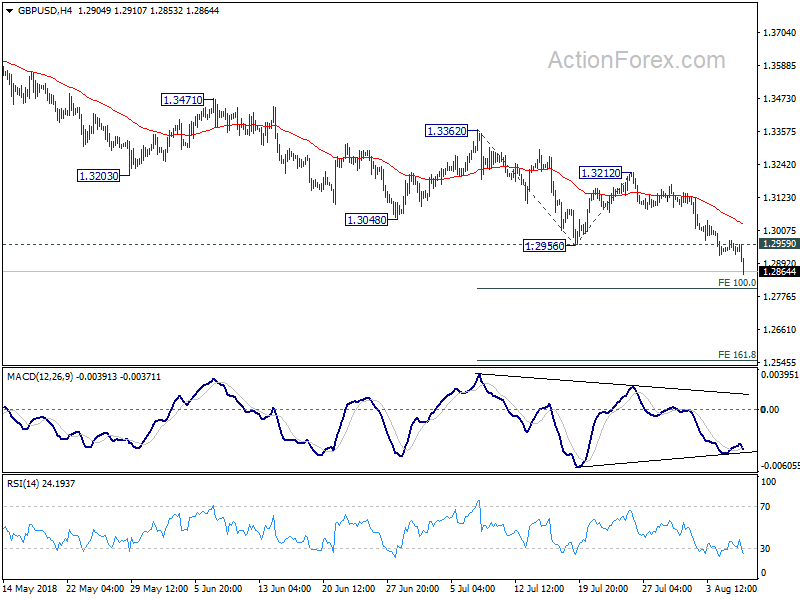
GBP/USD drops to as low as 1.2853 so far today and breaks 1.2874 fibonacci level already. There is no sign of bottoming but only sign of downside acceleration. Intraday bias remains on the downside for 100% projection of 1.3362 to 1.2956 from 1.3212 at 1.2806 first. Break will target 161.8% projection at 1.2555 next. On the upside, above 1.2959 minor resistance will turn bias neutral and bring consolidation. But upside should be limited below 1.3212 resistance to bring fall resumption.
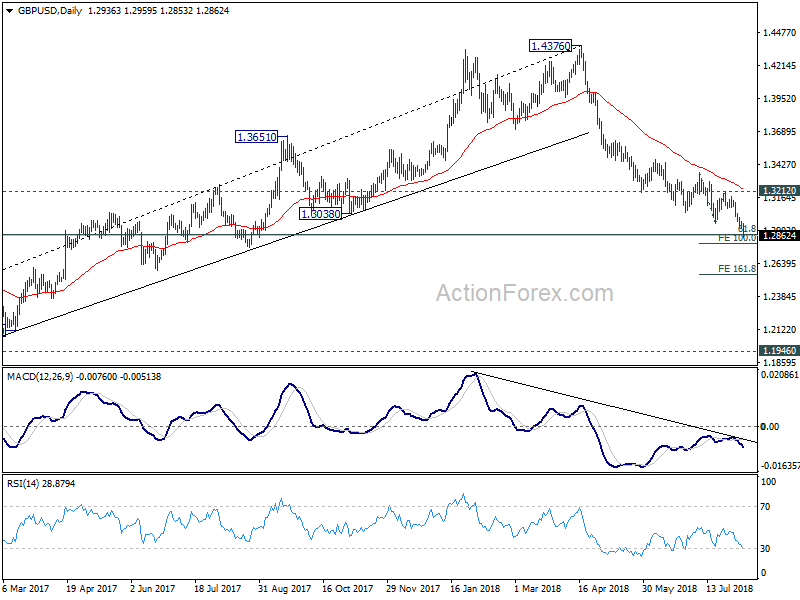
In the bigger picture, whole medium term rebound from 1.1946 (2016 low) should have completed at 1.4376 already, after rejection from 55 month EMA (now at 1.4141). Fall from 1.4376 should extend to 61.8% retracement of 1.1946 (2016 low) to 1.4376 at 1.2874 next. Decisive break of 1.2874 will raise the chance of long term down trend resumption through 1.1946 low. On the upside, break of 1.3212 resistance is needed to be the first indication of medium term bottoming. Otherwise, outlook will remain bearish even in case of strong rebound.
Sterling Plunges as No-Deal Brexit Becoming More Likely, Yen Shows Broad Based Strength
Sterling plunges sharply today as markets are seeing increasing change of a no-deal Brexit. Adding that, GBP/USD's break of 1.2956 earlier this week and EUR/GBP's break of 0.8957 resistance yesterday also adds to broad based pressure on the Pound. Australian Dollar follows as the second weakest at this point. Market sentiments were weighed down generally by escalation in US-China trade war. Following US announcement of the effective date on 25% tariffs on Chinese imports, China MOFCOM announced retaliation data in parallel. Yen is so far trading as the strongest one, followed by Dollar which usually benefits from trade war. Euro pares some of this week's gain but remains resilient.
In other markets, sentiments are mixed only, not too day. FTSE is trading up 0.74% at the time of writing, once again thanks to Pound's depreciation. DAX is reversing earlier loss and is up 0.16%. CAC is down -0.1%. Earlier in Asia, China Shanghai SSE lost -1.27%. But Hong Kong HSI gained 0.39%. Nikkei closed down -0.08% while Singapore Strait Times lost -0.4%. WTI crude oil is back below 69 as recent sideway trading continues. There is no strength whatsoever for regaining 70 handle. Gold is hovering around 1210 as sideway trading extends. It's just a matter of time for Gold to break through 1200 decisively.
Technically, GBP/JPY's break of 143.18 confirms resumption of medium term fall from 156.69. Next target is 139.29 key cluster support. EUR/GBP is heading to 0.9043 fibonacci level. But based on current momentum, it's possibly having 0.9305 (2017 high) in sight. GBP/USD also breaks a key medium term fibonacci level at 1.2874. Now it's the time to monitor the momentum to gauge the chance of hitting 2016 low at 1.1946.
No-deal Brexit seems increasingly possible
Now, it seems a no-deal Brexit is an acceptable fact. It started last week when BoE Governor Mark Carney said risk of no-deal Brexit is "uncomfortably high". Then Trade Minister Liam Fox assigned a 60-40 chance of it. Scotland's First Minister Nicola Sturgeon also jumps in, blasting Prime Minister Theresa May's handling of Brexit negotiation. Sturgeon said that "with every day that passes, the prospect of a no deal Brexit or a Brexit with very, very little information about the future relationship seems to become more and more likely." She added that "both of those outcomes would be completely unacceptable, absolutely disastrous for our economy, so I hope she (Theresa May) can reassure me that neither of those things are going to happen." "But if she can't, then I hope she will outline her plan B, because we cannot simply take a step off that Brexit cliff-edge next March without knowing what comes next."
ECB policy contributed considerably to private consumption growth
ECB released a bulletin article "Private consumption and its drivers in the current economic expansion" today. It argues that private consumption has been a main driver of growth in the current cycle that started back in 2013. And this has been "largely driven by the recovery in the labour market". And, as labor markets continue to improve, "consumer confidence should remain elevated and private consumption should rise further"
At the same time, the article said that ECB's accommodative monetary policy has "contributed considerably to the expansion of private consumption". At the same time, the policies have also "directly decreased income and wealth inequality". There is little evidence that low interest rates have led to generalized increases in household indebtedness. And therefore, the overall economic expansion is "sustainable".
Italy Tria revised down 2018 and 2019 growth forecasts
Italian Economy Minister Giovanni Tria told the parliament said the government have downgraded growth forecast for both this year and next. 2018 GDP growth is projected to be 1.2%, down from prior forecast of 1.5%. 2019 GDP growth is projected to be at 1-1.1%, down from prior forecast of 1.4%.
Tria added that the slowdown would bring deficit to 1.2% in 2019, higher than deficit target of 0.8% of GDP, drawn up by prior administration. A more clearer estimate of the deficit will be available later in September. The figures will depend on the cost of servicing the debts and spending cuts. While the plan appears to be at odds with EU rules, Tria emphasized that it's still "compatible" with Italy's commitment to EU on its public finances.
China MOFCOM to start retaliatory tariffs on $16B US imports on Aug 23
China Ministry of Commerce announced to start to impose 25% retaliatory tariffs on USD 16B in US goods starting August 23, "in parallel with the US. The MOFCOM condemned that the US "once again overrides international law: as a very unreasonable practice. And Chin's countermeasures were to safeguard its own "legitimate rights and interest and global multilateral trading system".
USTR: 25% tariffs on $16B of Chinese goods to start on Aug 23
Yesterday, the US Trade Representative announced to start to collect 25% tariffs on USD 16B of Chinese imports starting August 23. The announced lists contains 279 of the original 284 tariff lines that were proposed back on June 15. This is the second tranche of tariffs as part of the Section 301 intellectual property investigations. The first tranche of 25% tariffs on USD 34B of Chinese goods already took effect on July 6. The upcoming 25% tariffs on USD 200B in Chinese goods are work in progress.
China's import from EU jumped 20.5% mom, trade surplus shrank -31.0% mom, as US-China trade war starts
China's July trade data revealed some interesting findings as US-China trade war formally started. Import from the EU jumped as massive 20.5% mom, 19.7% yoy. Trade surplus with EU dropped -31.0% mom, -7.9% yoy. On the other hand, trade surplus with US dropped a mere -3.0%, with -2.5% decline in export and -1.5% mom fall in imports. Looks like the EU could have the last laugh over Trump's trade policy. More in the comments here.
BoJ: Allowing long-term yields to rise may contribute to sluggish prices
BoJ released the Summary of Opinions at the July 30/31 monetary policy meeting today. There the central bank noted that it's "extremely important" to introducing forward guidance as a new measure. And, that would strengthen its commitment to achieving the price stability target, in order to ensure public confidence in its strong stance toward achieving the target."
Also, the summary noted that "controlling the long-term yields in a flexible manner is likely to contribute to maintaining and improving market functioning." it can be considered appropriate for interest rate control in Japan to allow the yields to move upward and downward by around 0.25 percent." Though, most member agreed that it should be "made clear at the press conference" that currently yield may move between -0.1% to 0.1%.
But it's also noted that "when medium- to long-term inflation expectations are weak, making policy adjustments that could allow the long-term yields to rise may lead to an increase in real interest rates and thereby contribute to sluggish prices."
RBA Lowe reiterated next move is up not down
RBA Governor Philip Lowe delivered a speech titled "Demographic Change and Recent Monetary Policy" today. There he reiterated that "the next move in interest rates to be up, not down". But the timing will depends upon the "speed of the progress" in "reducing the unemployment rate and having inflation return to around the midpoint of the target range on a sustained basis." And in the Q&A, Low also noted that there is no strong case for a near term move.
RBNZ to stand pat with slightly dovish statement
RBNZ is widely expected to leave the OCR unchanged at 1.75% in the upcoming Asian session. The central bank might deliver a neutral to slightly dovish policy statement. We expect policymakers to look through the improvement in inflation data and maintain accommodative monetary policy at least until late 2019. The central bank will likely reiterate that the next move in the OCR could be "up or down". On the updated economic forecasts, we expect the central bank to downgrade the GDP growth projection in light of recent slowdown.
More on RBNZ:
- RBNZ Preview – Policy Rate On Hold, Overall Tone Neutral or Slightly Dovish
- RBNZ to Maintain Flexible Stance, Downside Risks Linger for Kiwi
GBP/USD Mid-Day Outlook
Daily Pivots: (S1) 1.2917; (P) 1.2945; (R1) 1.2968; More...
GBP/USD drops to as low as 1.2853 so far today and breaks 1.2874 fibonacci level already. There is no sign of bottoming but only sign of downside acceleration. Intraday bias remains on the downside for 100% projection of 1.3362 to 1.2956 from 1.3212 at 1.2806 first. Break will target 161.8% projection at 1.2555 next. On the upside, above 1.2959 minor resistance will turn bias neutral and bring consolidation. But upside should be limited below 1.3212 resistance to bring fall resumption.
In the bigger picture, whole medium term rebound from 1.1946 (2016 low) should have completed at 1.4376 already, after rejection from 55 month EMA (now at 1.4141). Fall from 1.4376 should extend to 61.8% retracement of 1.1946 (2016 low) to 1.4376 at 1.2874 next. Decisive break of 1.2874 will raise the chance of long term down trend resumption through 1.1946 low. On the upside, break of 1.3212 resistance is needed to be the first indication of medium term bottoming. Otherwise, outlook will remain bearish even in case of strong rebound.
Economic Indicators Update
| GMT | Ccy | Events | Actual | Forecast | Previous | Revised |
|---|---|---|---|---|---|---|
| 23:50 | JPY | BOJ Summary of Opinions Jul | ||||
| 23:50 | JPY | Current Account (JPY) Jun | 1.76T | 1.84T | 1.85T | |
| 23:50 | JPY | Bank Lending incl Trusts Y/Y Jul | 2.00% | 2.30% | 2.20% | |
| 1:30 | AUD | Home Loans M/M Jun | -1.10% | 0.10% | 1.10% | 1.00% |
| 3:05 | CNY | Trade Balance (USD) Jul | 28.1B | 39.1B | 41.6B | |
| 3:05 | CNY | Trade Balance (CNY) Jul | 177B | 255B | 262B | |
| 5:00 | JPY | Eco Watchers Survey Current Jul | 46.6 | 47.8 | 48.1 | |
| 12:30 | CAD | Building Permits M/M Jun | -2.30% | -2.70% | 4.70% | |
| 14:30 | USD | Crude Oil Inventories | 3.8M | |||
| 21:00 | NZD | RBNZ Rate Decision | 1.75% | 1.75% |
China MOFCOM to start retaliatory tariffs on $16B US imports on Aug 23
China Ministry of Commerce announced to start to impose 25% retaliatory tariffs on USD 16B in US goods starting August 23, "in parallel with the US. The MOFCOM condemned that the US "once again overrides international law: as a very unreasonable practice. And Chin's countermeasures were to safeguard its own "legitimate rights and interest and global multilateral trading system".
Full short statement in simplified Chinese.
This is in response to US Trade Representative's announcement yesterday, to start to collect 25% tariffs on USD 16B of Chinese imports starting August 23. The announced lists contains 279 of the original 284 tariff lines that were proposed back on June 15.
As a recap, this is the second tranche of tariffs as part of the Section 301 intellectual property investigations. The first tranche of 25% tariffs on USD 34B of Chinese goods already took effect on July 6. The upcoming 25% tariffs on USD 200B in Chinese goods are work in progress.
Sterling Plunges Amid Worries of No Brexit Deal; RBNZ Rate Announcement Pending
Here are the latest developments in global markets:
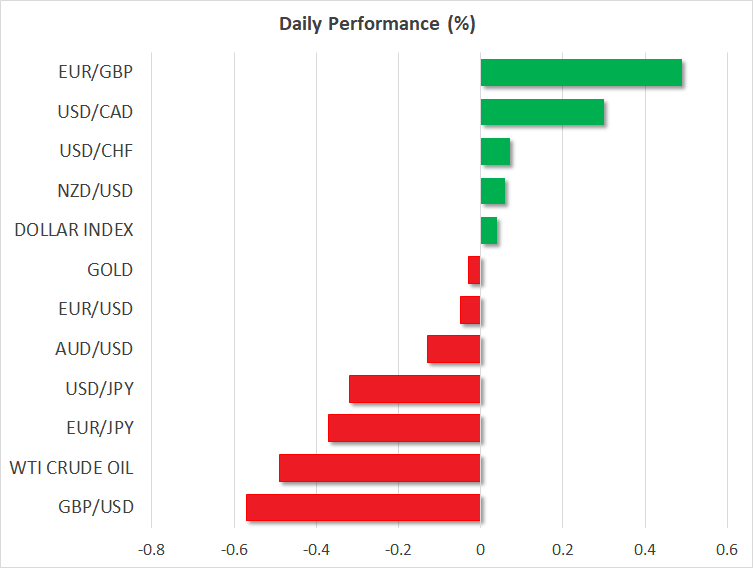
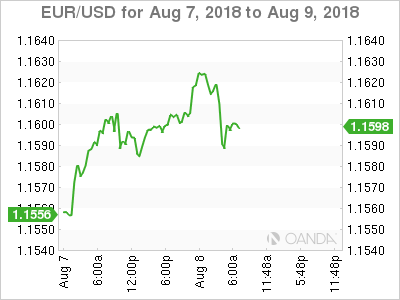
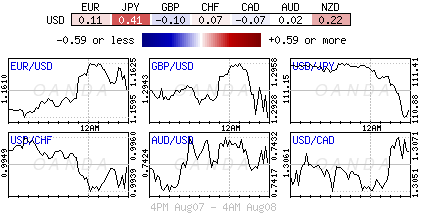
FOREX: The US dollar weakened by 0.27% versus the Japanese yen on Wednesday, with dollar/yen trading near 111.00, while the US dollar index, which gauges the greenback’s strength against a basket of six major currencies, held near its opening level. Euro/dollar returned to 1.1600 (+0.03%) after reaching an intraday high of 1.1628, while euro/yen dived by 0.38%. Moving to the UK, a no-deal Brexit scenario has been growing in investors’ minds, as less than eight months remain for the UK to leave the EU, and there are still no signs of an agreement. Brexit fears escalated further after the BoE chief, Mark Carney, said that chances for such an occasion are “uncomfortably high” and Britain’s international trade secretary, Liam Fox, supported on Sunday, that a failure to reach an agreement is more likely than reaching one, sending pound/dollar to a new almost 1-year low of 1.2892 (-0.24%) today.The pound’s weakness helped euro/pound to climb to a new 8-month high of 0.8991 (+0.22%). The antipodean currencies were trading mixed, with aussie/dollar being down by 0.15% and kiwi/dollar up by 0.10%. Dollar/loonie added 0.25% to its performance, hitting a fresh 1-week high at 1.3085.
STOCKS: European equities traded mixed on Wednesday morning, as investors turned their focus on corporate earnings and trade tensions. The pan-European STOXX 600 and the blue-chip Euro STOXX 50 declined marginally by 0.04% and 0.07% respectively at 1030 GMT, with pharmaceuticals driving the losses after earnings results in the industry disappointed. The German DAX 30 was steady, the French CAC 40 moved slightly up by 0.04%, while the Spanish IBEX 35 was down by 0.17%. However,the UK’s FTSE saw an advance of 0.87% on the back of a weaker pound, while the Italian FTSE MIB rose by 0.37%.
COMMODITIES: Oil prices were trading lower, with WTI crude falling to $68.78/barrel (-0.64%) and Brent retreating to $74.26 (-0.52%). While US sanctions against Iran were threatening oil activities in the region, China’s foreign minister said on Wednesday that business ties with Iran are “open and transparent”, likely tempering the bullish sentiment.Recall that Iran refused the US offer for talks, claiming that it could not enter negotiations under renewed sanctions from Washington. Earlier data showed that China’s crude oil imports had rebounded in July but remained the third lowest this year. Gold was flat at $1,210.5 an ounce.
Day ahead: RBNZ announces its rate decision; Trade continue to linger in the background
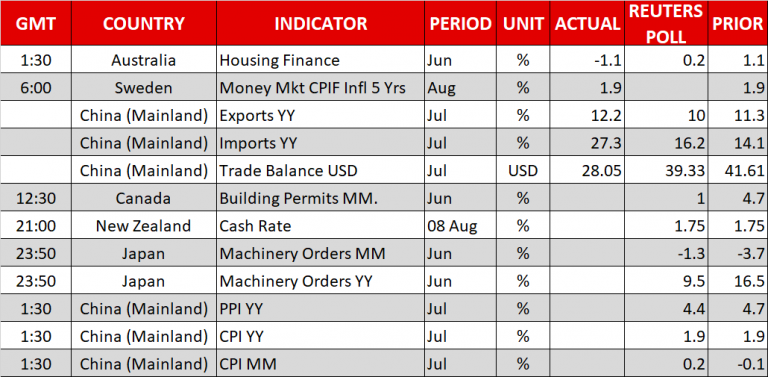
Wednesday will be quiet in terms of data releases, with the focus turning to New Zealand late in the day, where the Reserve Bank will conclude its policy meeting at 2100 GMT. Analysts are widely expecting policymakers to keep interest rates unchanged at a record low of 1.75%. Recall that at the latest meeting, the central bank signaled that borrowing costs could move both up or down, if necessary. While today a survey showed that RBNZ inflation projections for the next year have increased to an average of 1.86% from 1.8% seen previously and 2-year expectations have risen slightly to 2.04%, policymakers could opt to hold stimulus in place for now amid an uncertain global trade environment. A slowdown in GDP growth in the first quarter could also cause policymakers to refrain from raising rates. Should the central bank put more weight on downside risks, including a potential deterioration in trade conditions due to the US’s rising protectionist appetite, a fact that could dampen hopes for a rate hike in the future, the kiwi could lose ground against the greenback. A press conference is scheduled to follow the rate announcement.
Meanwhile in the US, Trump’s administration continues to pressure China, saying late on Tuesday that it is planning to activate a 25% import tariff on an additional $16 billion Chinese goods in two weeks. But earlier today stats out of China indicated that US import tariffs did not restrict trade activities in July, with both exports and imports rising faster than analysts estimated and China’s wide trade surplus with the US edging slightly lower from $28.97 billion to $28.09bn. On Wednesday at 0130 GMT, China will also see the release of CPI and PPI readings for the month of July, where any surprise in the data could move the Chinese yuan, and perhaps the Australian dollar as well, given the close economic ties between the two nations.
In Canada, loonie traders will pay attention to housing building permits due at 1230 GMT. Forecasts are for the measure to lose strength, posting a growth of 1.0% month-on-month in June after expanding by 4.7% in May. The EIA report on oil inventories delivered at 1430 GMT could also move the loonie. In case US crude stocks have declined more than 3.33 million barrels analysts forecast in the week ending Aug 3, oil prices could increase positive momentum and the commodity-linked loonie could enjoy some gains.
In other data of interest, June’s core machinery orders will be available in Japan at 2350 GMT.
In the Eurozone, fiscal reforms in Italy could keep investors cautious. Government officials will be meeting today to discuss on the budget, which needs to be finalized by the end of September and before the meeting with the rest of the EU leaders in October.
Brexit talks will resume on August 16-17 but any headline giving evidence on the Brexit situation could move the pound.
Into US session: Sterling selloff intensifies as Scottish Sturgeon talks no-deal Brexit
Entering US session, Sterling is trading as the weakest one today and selling has indeed intensified. Canadian Dollar follows Sterling as the second weakest for today. Japanese Yen surges broadly in early European and is trading as the strongest one for today so far. Euro pares back some gains today but it's still the strongest one for the week.
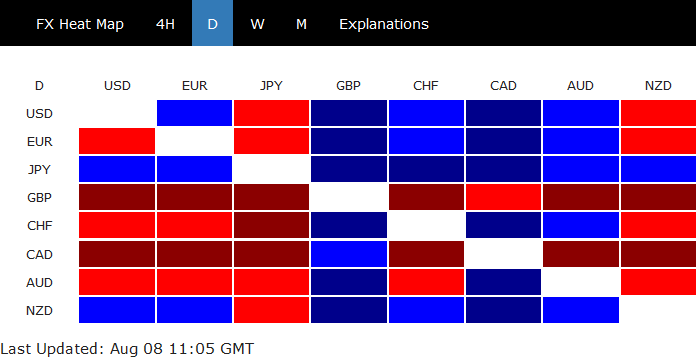
Now, it seems a no-deal Brexit is an acceptable fact. It started last week when BoE Governor Mark Carney said risk of no-deal Brexit is "uncomfortably high". Then Trade Minister Liam Fox assigned a 60-40 chance of it. Scotland's First Minister Nicola Sturgeon also jumps in, blasting Prime Minister Theresa May's handling of Brexit negotiation. Sturgeon said that "with every day that passes, the prospect of a no deal Brexit or a Brexit with very, very little information about the future relationship seems to become more and more likely." She added that "both of those outcomes would be completely unacceptable, absolutely disastrous for our economy, so I hope she (Theresa May) can reassure me that neither of those things are going to happen." "But if she can't, then I hope she will outline her plan B, because we cannot simply take a step off that Brexit cliff-edge next March without knowing what comes next."
Politics Takes Down The Pound
Wednesday August 8: Five things the markets are talking about
Trade concerns continue to hover over capital markets. Yesterday, the U.S indicated that it will begin imposing another +25% duties on an additional +$16B in Chinese imports beginning in a fortnight. On the first go around, China swore to retaliate, they have yet to give specifics, but at the very least, it will be an in-kind retaliation.
Data overnight showed that China’s exports grew faster than expected last month and imports surged, which suggest that the “ongoing” trade war has yet to have a material impact on the worlds second largest economy’s bottom line.
Nevertheless, the prospects for a full blown trade war has the U.S dollar remaining better bid on pullbacks in a relative tight summer range.
Sovereign yields, further out the curve, trade a tad higher as dealers make room to take down today’s record amount of 10-year Treasury debt worth +$26B, and an all-time high of +$18B in 30-year bonds tomorrow.
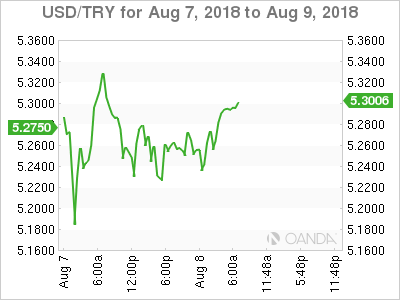
In currencies, the market is focused on sterling (£1.2904) as it encroaches on its 11-month low as politics continues to provide the overriding direction for the currency. And then there is the Turkish lira ($5.2923) as it makes it way towards record lows on market worries about President Erodgan’s grip on monetary policy.
On tap: The Reserve Bank of New Zealand’s (RBNZ) official cash rate decision and monetary policy statement is due this afternoon (05:00 pm EDT). No change in rates or accompanying statement is expected.
1. Stocks mixed overnight session
In Japan, the Nikkei edged lower overnight as the market waits for the start of U.S-Japan trade talks. Will the U.S be taking a hard stance, similar to that of China and Europe? Both the Nikkei and broader Topix ended -0.1% lower.
Down-under, Aussie shares rallied overnight, with financials higher after reporting a smaller fall in profit than expected, and while miners gained on strong import data from China. The benchmark S&P/ASX 200 index rose +0.2%, erasing most of Tuesday’s losses. In S. Korea, the Kospi index rose modestly, closing out 0.06% higher.
In Hong Kong, shares rise on tech and energy boost, but fears of a deeper trade war is capping gains. At close of trade, the Hang Seng index was up + 0.39%, while the Hang Seng China Enterprises index rose +0.32%. In China, the Shanghai Composite index closed down -1.23% while its blue-chip CSI300 index ended down -1.59% mostly on profit taking after Tuesday stellar session.
In Europe, regional bourses trade mostly lower, pressured generally by weaker earnings out of Europe.
U.S stocks are set to open little changed (+0.0%).
Indices: Stoxx600 -0.2% at 389.8, FTSE +0.3% at 7742, DAX -0.2% at 12627, CAC-40 -0.1% at 5517, IBEX-35 -0.10% at 9762, FTSE MIB +0.0% at 21863, SMI -0.4% at 9167 S&P 500 Futures 0.0%
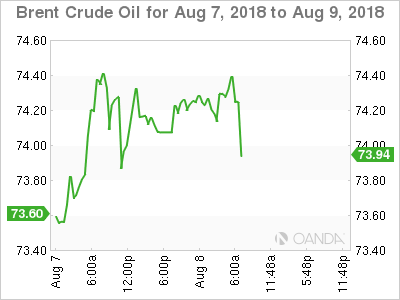
2. Oil dips on weak China imports, but sanctions and weak U.S stocks support
Oil prices have dipped a tad overnight, pressured by Chinese weaker import data, although the market remains well supported on pull backs by falling U.S crude inventories and the introduction of sanctions against Iran.
Brent crude oil futures are at +$74.50 per barrel, down -15c, or -0.2% from Tuesday’s close. U.S West Texas Intermediate (WTI) crude futures are at +$69.15 per barrel, down -2c.
Data shows that China’s July crude oil imports recovered slightly last month after falling for the previous two-months, but are still amongst the lowest due to a drop-off in demand from the independent Chinese refineries.
With U.S sanctions against Iran, which shipped out +3M bpd of crude in July, officially came into effect yesterday midnight and the market is anticipating that supply losses could range from +600K to +1.5M bpd.
Dealers are also focusing on the U.S market, where yesterday’s API data showed that crude inventories fell by -6M barrels in the week to Aug. 3 to +407.2M.
The market will take its cues from today’s EIA inventory report (10:30 am EDT).
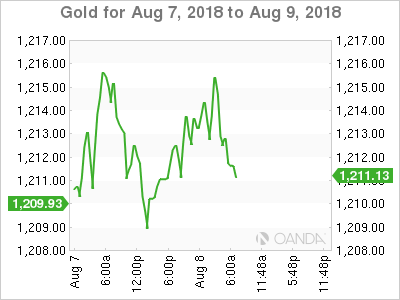
Ahead of the U.S open, gold prices are better bid, supported by a mixed U.S dollar. Spot gold is up +0.2% to +$1,213.02 an ounce, after rising +0.4% in Tuesday’s session.
3. Sovereign yields could back up further
Yesterday, the U.S Treasury Department sold +$34B three-year notes and it was the largest three-year auction in eight-years. Later today, the Treasury will sell a record amount of 10-year debt worth +$26B (1:01 pm EDT) and tomorrow an all-time high of +$18B in 30-year bonds. With so many products on offer, dealers are expected to again cheapen up the curve to make room ahead of the deadline.
The yield on 10-year Treasuries has rallied +1 bps to +2.97%, while Germany’s 10-year bund yield is holding steady at +0.403%. In the U.K, the 10-year Gilt yield has rallied +1 bps to +1.314%.
4. Sterling’s Wild West
Trading GBP/USD (£1.2903) is proving to be a bit like the Wild West – unpredictable – the pound is again threatening to penetrate yesterday’s record 12-month low now that its failed to benefit from last week’s Bank of England rate rise. Markets are now turning their attention to the Brexit process, which will likely dominate trends in GBP for the remainder of this year.
The Turkish lira ($5.2920) has recovered some lost ground after plummeting to new record lows Monday ($5.42), helped by the Central Bank of the Republic of Turkey (CBRT) announcing a cut in the foreign exchange reserve requirement ratio (RRR) for commercial banks, a measure which should boost dollar liquidity. However, this week’s necessary course of action reaffirms the central banks reluctance to hike rates. Nevertheless, the plunge in the currency over the past few weeks is now on a scale, which has, in the past, prompted the CBRT to hike interest rates aggressively.
Will the CBRT hike the repo rate this week? They need to, but will they dare defy President Recep Tayyip Erdogan?
Note: A Turkish delegation is visiting Washington this week to discuss the friction between both countries. But the U.S has stated that they remain at odds on its core demand that Turkey free American an evangelical pastor.
5. China’s trade balance tightens
Data overnight showed that China’s trade surplus narrowed sharply in July, with imports surging as trade tensions with the U.S escalated.
China reported a trade surplus of +$28.05B in July, compared with a surplus of +$41.61B in June. The market was expecting a surplus of +$39.10B.
Digging deeper, exports rose +12.2% y/y, following June’s +11.3% increase. The market was looking for a +10% growth number.
Imports were up +27.3% in July y/y, accelerating from a +14.1% increase the previous month.
China’s trade surplus with the U.S. narrowed to +$28.09B in July from a record monthly high of +$28.90B in June.
Trump Escalates Trade War, Pound Dips While Bitcoin Sinks
Fears of a full-blown trade war between the world’s two biggest economies are set to intensify after the Trump administration announced another round of tariffs on Chinese products on Tuesday.
In a move that is likely to cause the further deterioration of US - China trade relations, the United States will begin imposing 25% tariffs on $16 billion of Chinese imports starting from 23 August. With Beijing expected to fight back by targeting $16 billion worth of US goods with equal tariffs, the US - China trade saga could get even messier.
Asian stocks closed mixed on Wednesday as investors focused on positive US earnings and expectations that China will stimulate its economy amid the deepening trade tensions. In Europe, shares have already edged lower this morning and could remain pressured as US - China trade tensions encourage market players to adopt a guarded approach to riskier assets.
Pound gripped by Brexit no-deal fears
Sterling was pounded by the Dollar and most of its major counterparts on Wednesday as fears heightened over the UK exiting the European Union without a trade deal in place.
Concerns of a potential hard Brexit scenario have haunted investor attraction towards the Pound and have left the currency vulnerable to downside shocks. The currency is likely to remain depressed ahead of Friday’s second quarter UK GDP report, which could offer fresh insight into the health of Britain’s economy. While a solid GDP print could throw the bruised Pound a short-term lifeline, any meaningful gains may be obstructed by Brexit-related uncertainty and an appreciating Dollar.
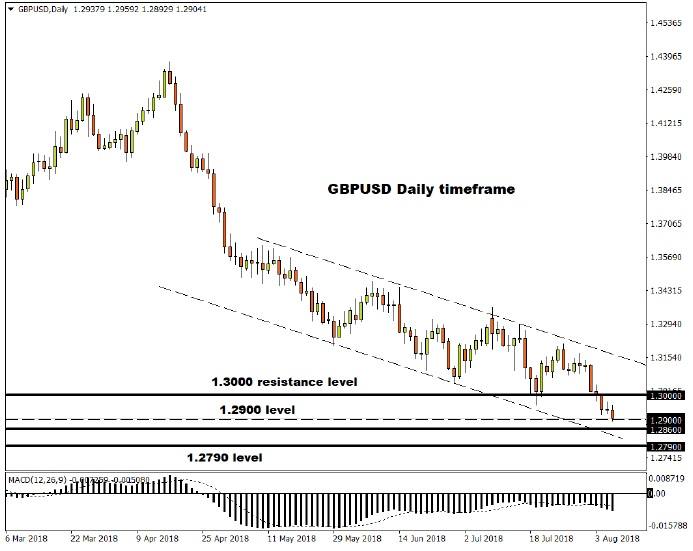
Regarding the technical picture, we remain bearish on the GBPUSD on the daily charts. Bears have maintained firm control under the 1.3000 level with prices currently challenging 1.2900. A solid daily close below this level could encourage a decline towards 1.2860 and 1.2790, respectively.
Bitcoin tumbles below $6500
Investors who were looking for a fresh opportunity to attack Bitcoin were given the thumbs up after the US Security and Exchange Commission (SEC) postponed its decision on approving the first ever Bitcoin ETF.
The selloff witnessed on Bitcoin continues to highlight how extremely sensitive the cryptocurrency remains to the ETF developments. Cryptocurrencies could receive a solid boost and end up becoming the main talking point across financial markets if the SEC approves a Bitcoin ETF in September.
Taking a look at the technical picture, Bitcoin is under pressure on the daily charts with prices trading marginally below $6500 as of writing. Sustained weakness below $6500 could encourage bears to drag prices towards $6250.
Although the current trajectory for Bitcoin is tilted to the downside, the outlook could change if a Bitcoin ETF becomes reality.
Currency spotlight – EURUSD
The medium to longer-term outlook for the EURUSD remains bearish due to the monetary policy divergence between the Federal Reserve and European Central Bank.
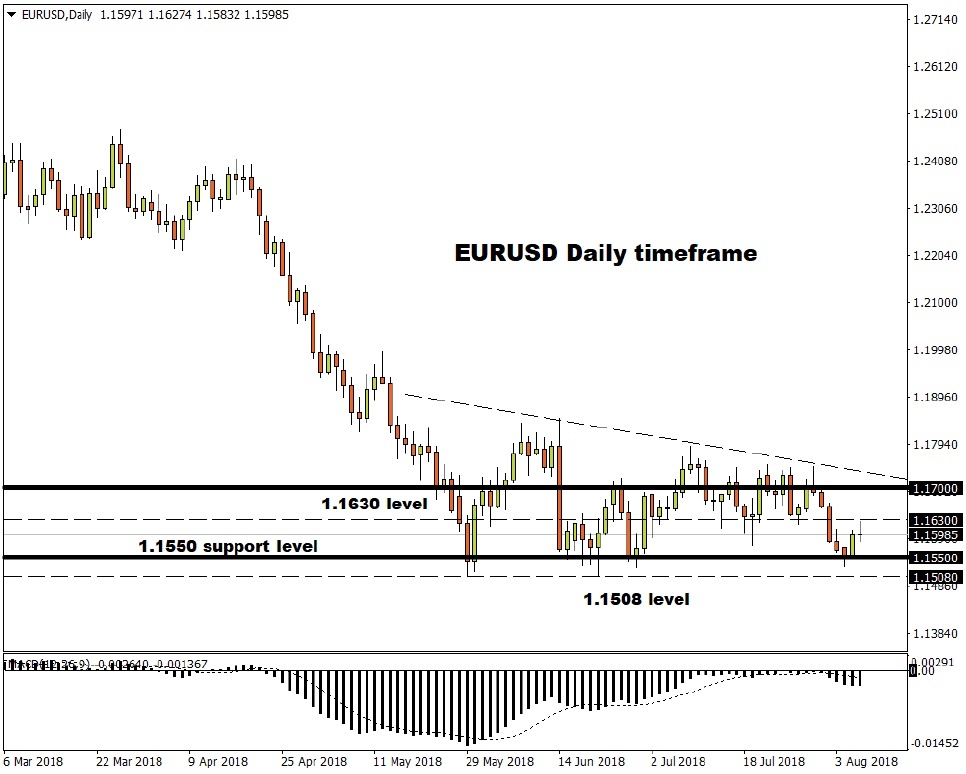
Regarding the technical picture, a rebound seems to be in process on the daily charts with prices trading towards the 1.1630 dynamic resistance. Sustained weakness below this level could encourage a decline back towards 1.1550 and 1.1508, respectively. If bulls are able to break above 1.1630, then prices have scope to challenge the 1.1700 level.
Summer Markets Keeps Session Quiet But Focus Remains On Italian Budget Outlook
Notes/Observations
- Quiet EU session but market focus on developments in Italy (on budget), Turkey (on US sanctions) and the trade spat between China and the US.
Asia:
- China July Trade Balance: $28.1B v $38.9Be with better components
- China State Planner (NDRC): To use monetary policy including targeted RRR cuts to support debt to equity swaps
- China State Researcher: H2 GDP may reach 6.7% (in line with Q2 GDP)
- Japan Jun Current Account Balance: ¥1.18T v ¥1.222Te; Adj Current Account: ¥1.76T v ¥1.867Te, Trade Balance: ¥820.5B v +¥826.8Be
- BOJ July Summary noted that it must continue powerful monetary easing as momentum for hitting target on a sustained basis. BOJ should allow long-term rates to move at range of around -0.25% to 0.25%
- RBA Gov Lowe reiterated stance that the Board saw no strong case for near term rate move; reiterated next rate move likely to be up if economy evolved as expected
Europe:
- BOE's McCafferty reiterated MPC view that was reasonable to expect a couple more small interest rate hikes in the next couple of years
Americas:
- US Trade Rep Lighthizer: Trump administration has finalized the second tranche of $16B tariffs on Chinese products (in addition to the initial $34B in tariffs implements last month)
- President Trump says GDP could 'be in the fives' next quarter Energy: - Weekly API Oil Inventories: Crude: -6.0M v +5.6M prior
Economic Data:
- (FR) Bank of France (Industrial) Sentiment: 101 v 101e - (CZ) Czech July Unemployment Rate: 3.1% v 3.0% prior
- (HU) Hungary July CPI M/M: 0.3% v 0.2%e; Y/Y: 3.4% v 3.3%e (5th straight month with target range but highet annual reading since Jan 2013)
- (ES) Spain Jun Industrial Output NSA Y/Y: -2.0% v +1.3% prior; Industrial Output SA Y/Y:0.5% v 1.9%, Industrial Production M/M: -0.6% v -0.2%e v +0.9% prior
- (TH) Thailand Central Bank (BOT) left its Benchmark Interest Rate unchanged at 1.50%, as expected
Fixed Income Issuance:
- (IN) India sold total INR180B vs. INR180B indicated in 3-month, 6-month and 12-month bill
- (DK) Denmark sold DKK0M (nil) in 6-month Bills (rejected all bids)
SPEAKERS/FIXED INCOME/FX/COMMODITIES/ERRATUM
Equities
- Indices [Stoxx600 -0.2% at 389.8, FTSE +0.3% at 7742, DAX -0.2% at 12627, CAC-40 -0.1% at 5517, IBEX-35 -0.10% at 9762, FTSE MIB +0.0% at 21863, SMI -0.4% at 9167 S&P 500 Futures 0.0%]
- Market Focal Points/Key Themes: European Indices trade mostly lower after a mixed session in Asia overnight and generally weaker earnings out of Europe. Notable decliners include EON, Ahold Delhaize, Munich Re, Bellway, Novo Nordisk, Glencore, Lunbeck and Hill and Smith following earnings; Paddy Power declines after cutting outlook. ABN Amro trades sharply higher following a earnings beat, while Prudential reversed earlier losses to trader higher after an earnings beat. Looking ahead notable earners include CVS, Michael Kors, Mylan and Mangna International.
Movers
- Consumer Discretionary Ahold Delhaize [AD.NL] -1.7% (Earnings), Air France [AF.FR] -1.1% (Earnings), Paddy Power [PPB.UK] -2.6% (Earnings, Cuts outlook)
- Utilities EON [EOAN.DE] -1.5% (Earnings)
- Materials Glencore [GLEN.UK] -1.5% (Earnings)
- Financials ABN Amro [ABN.NL] +3.7% (Earnings), Munich Re [MUV2.DE] -3.6% (Earnings), Hill and Smith [HILS.UK] -21% (Earnings), Vifor Pharma [VIFN.CH] -1.6% (Earnings)
- Industrials Nokian Renkaat [NRE1V.FI] +3.8% (Earnings)
- Healthcare Novo Nordisk [NOVOB.DK] -5.0% (Earnings), Lundbeck [LUN.DK] -8.6% (Earnings)
- Real Estate Bellway [BWY.UK] -4.3% (Earnings)
- Energy FLSmitth [FLS.DK] -2.4% (Earnings)
Speakers
- Italy Fin Min Tria reiterated that the gov't was not questioning euro membership as its main measures of were compatible with public finance commitments. It was in the interest of both Italy and EU Commission not to create financial instability. Govt planned to simplify the country's VAT tax system. Govt forecasted 2018 GDP growth at 1.2% and saw growth between 1.0-1.1% range for 2019
- Romania Central Bank Gov Isarescu reiterated view that believed inflation would move back within the target range by end-2018
- Thailand Central Bank Policy Statement noted that the vote to keep policy steady was 6-1 (dissenter calling for 25bps hike). Reiterated stance that monetary policy remained accommodative. Domestic economy continued to gain further traction with exports seen rising more than forecasts. Reiterated view that THB currency (Baht) price movement is in-line with regional peers
- China Securities Regulatory Commission (CSRC): To promote healthy development in capital markets
Currencies
- The USD initially drifted lower for a 2nd straight day in another lackluster session as sleepy summer markets appeared to be in full ?ow
- EUR/USD hovered around the 1.16 handle and remained locked within its summer trading range. Focus remained on the Italian government’s budget intentions for 2019 as another senior meeting held on Wed.
- USD/JPY moved back below the 111 level for 2-week lows
Fixed Income
- Bund Futures trades at 162.18 up 16 ticks as European stocks trade lower on earnings and new trade tariffs. A move back above 162.75 would target 163.47 then 163.63, with a move below 161.75 targeting 161.45 then 160.45.
- Gilt futures trades at 122.82 up 10 ticks, as Gilts continue to hover around 123 with continuing upside targeting 123.18 then 124.44, with a move lower seeing initial support at 122.23 then 121.85.
- Wednesday 's liquidity report showed Tuesday's excess liquidity fell from €1.905T to €1.902T. Use of the marginal lending facility fell from €190M to €90M.
- Corporate issuance saw 12 issuers raise $16.5B in the primary market
Looking Ahead
- (IT) Italy budget meeting
- 05:30 (UK) DMO to sell £2.5B in 1.625% Oct 2028 Gilts
- 06:00 (PT) Portugal Q2 Unemployment Rate: No est v 7.9% prior
- 06:30 (ZA) South Africa July Sacci Business Confidence: No est v 93.7 prior
- 07:00 (BR) Brazil July FGV Inflation IGP-DI M/M: 0.4%e v 1.5% prior; Y/Y: 8.5%e v 7.8% prior
- 07:00 (US) MBA Mortgage Applications w/e Aug 3rd: No est v -2.6% prior
- 07:00 (RU) Russia to sell combined RUB25B in 2022 and 2024 OFZ bonds
- 07:30 (CL) Chile Central Bank (BCCh) July Minutes
- 08:00 (BR) Brazil July IBGE Inflation IPCA M/M: 0.4%e v 1.3% prior; Y/Y: 8.5%e v 4.4% prior
- 08:00 (CL) Chile July CPI M/M: 0.3%e v 0.1% prior; Y/Y: 2.7%e v 2.5% prior, CPI Ex Food and Energy M/M: +0.3%e v -0.1% prior; Y/Y: No est v 1.9% prior
- 08:00 (HU) Hungary Central Bank (MNB) July Minutes
- 08:05 (UK) Baltic Dry Bulk Index
- 08:30 (CA) Canada Jun Building Permits M/M: -1.2%e v +4.7% prior
- 08:45 (US) Fed’s Barkin (voter)
- 10:30 (US) Weekly DOE Crude Oil Inventories
- 12:00 (CA) Canada to sell 2-year notes
- 13:00 (US) Treasury to sell 10-Year Notes
- 17:00 (NZ) New Zealand Central Bank (RBNZ) Interest Rate Decision: Expected to leave Official Cash Rate unchanged at 1.75%