Sample Category Title
USD/JPY Bearish Channel But Price Action Remains Choppy
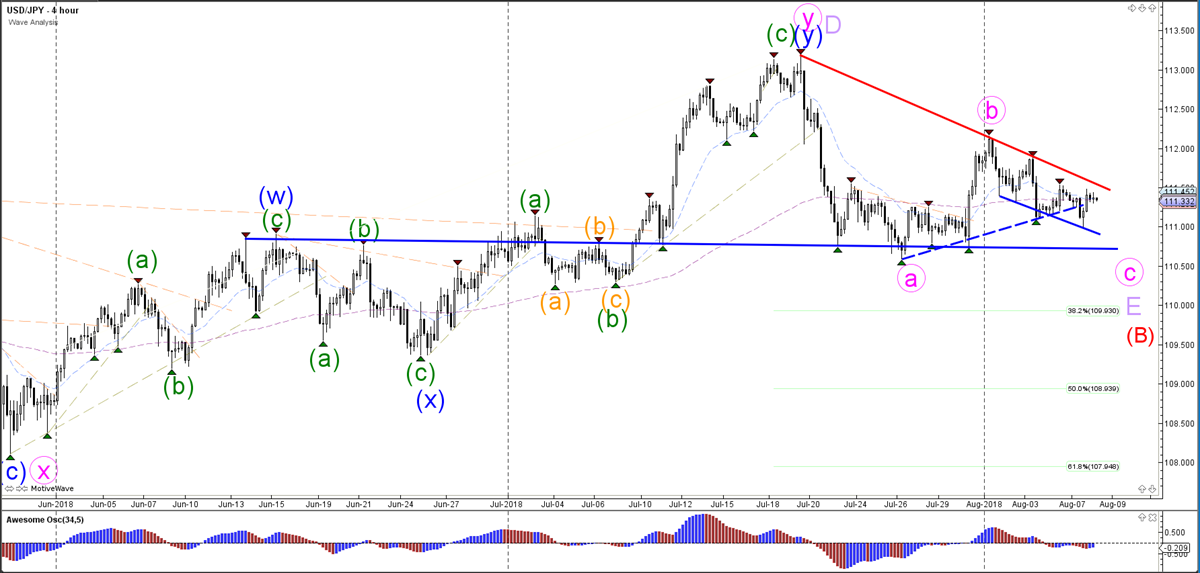
The USD/JPY broke below the support trend line (dotted blue) but the breakout was short as price retraced back to the resistance trend line (red). Overall, price is in a bearish channel at the moment, which seems to be part of a larger bearish ABC (pink) pattern. A break below support confirms the potential wave C (pink) whereas a bullish breakout indicates a deeper wave B (pink).
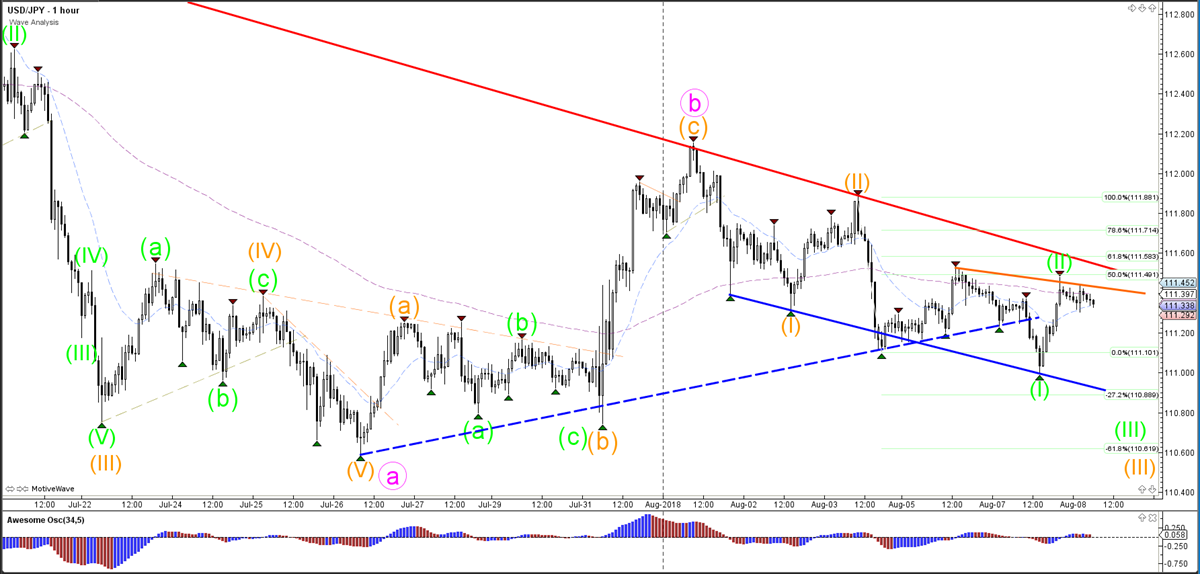
The USD/JPY is showing corrective and choppy price action as it's moving lower. This could either be multiple wave 1-2s (orange/green) if price breaks below the channel support (blue), or price is building a bullish correction as part of larger wave B (pink) if price breaks above the channel resistance (red).
GBP/USD Challenges Resistance Fib Levels Of Wave-4
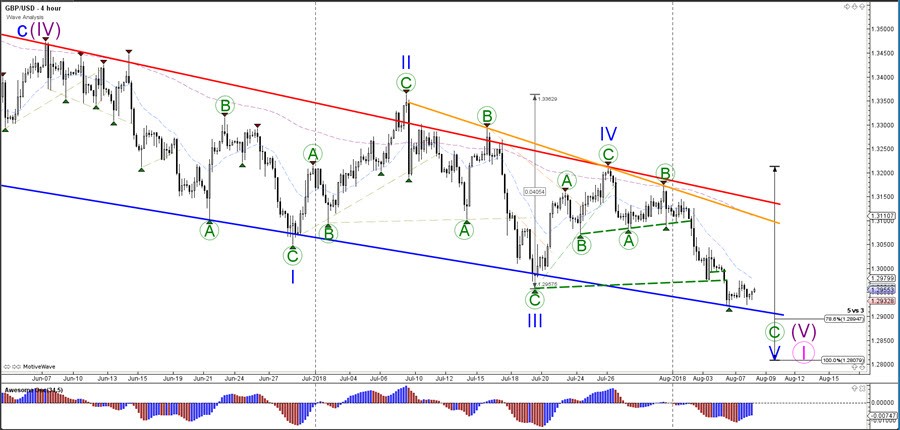
The GBP/USD stopped its bearish momentum at the support (blue) trend line of the downtrend channel, which is a new decision zone for a breakout or bounce.
The GBP/USD has reached the 78.6% Fibonacci target. A bearish breakout could see price fall below the channel towards the 100% Fibonacci target whereas a strong bullish bounce could indicate the end of the wave C (green) pattern.
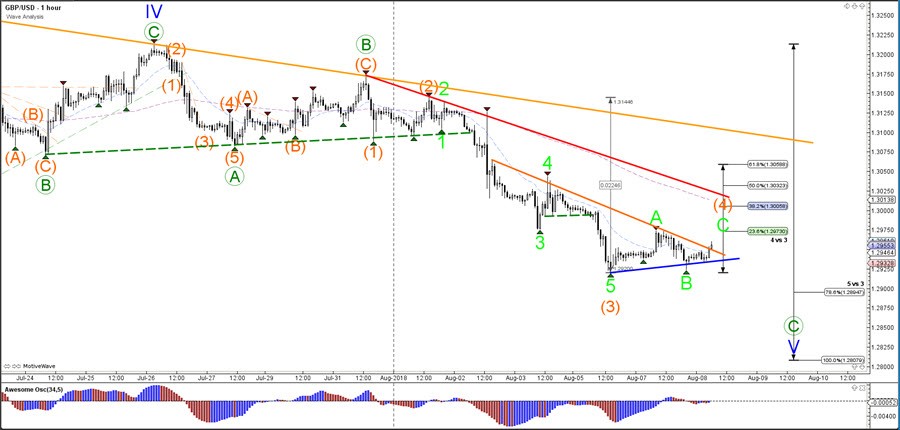
The GBP/USD is probably building a bullish wave 4 (green). This wave pattern remains valid as long as price stays below the Fibonacci levels of wave 4 vs 3. A bearish breakout below the support trend line (blue) could see a wave 5 develop to complete potential wave C(green). A break above the 50% Fibonacci level makes a wave 4 (orange) less likely.
Elliott Wave Analysis: GBPUSD Right Side Calling Lower
GBPUSD short-term Elliott Wave analysis suggests that the decline from 7/09/2018 peak (1.3361) is unfolding as Elliott wave zigzag when Minor wave A ended in 5 waves structure at 1.2956 low. Up from there, the bounce to 1.3214 high ended Minor wave B. The internals of that bounce unfolded as a Double three structure where Minute wave ((w)) ended at $1.3157. Minute wave ((x)) ended at 1.3070 low. And Minute wave ((y)) of B ended at 1.3214 high.
Down from there, Minor wave C remains in progress in another 5 waves. The internals of wave C is unfolding as an impulse & decline to 1.3081 ended Minute wave ((i)) in 5 waves. Up from there, the bounce to 1.3173 high ended Minute wave ((ii)) in 3 waves. Afterwards, pair declined lower in another 5 waves structure with lesser degree cycles showing sub-division of 5 waves structure. And ended Minute wave ((iii)) at 1.2918 low. Above from there, Minute wave ((iv)) is proposed complete at 1.2974 high. At this stage, a break below 1.2919 low remains to be seen for final confirmation and to avoid double correction in Minute wave ((iv)).
Near-term, while bounces fail below 1.2974 high and more importantly the pivot from 1.3214 high stays intact, expect pair to resume lower in Minute wave ((v)) before ending Minor wave C. The minimum extension area for Minute wave ((v)) i.e inverse 1.236%-161.8% Fibonacci extension area of Minute wave ((iv)) comes at 1.2906 – 1.2884. In case of further extension, Minute wave ((v))=((i)) target area can reach 1.2842 – 1.2810 before ending the zigzag structure & a bounce could then take place. We don’t like buying the pair as the right side tag is calling the pair lower.
GBPUSD 1 Hour Elliott Wave Chart

RBA Gov Lowe Reiterates Next Policy Move A Ways Off
General Trend:
- Asian equity markets trade mixed
- Shanghai Composite declines following over 2.5% gain on Tuesday’s session
- Australia’s Commonwealth Bank rises over 2%, FY profits above ests
- Japanese insurance companies are expected to start reporting financial results
- China Tower’s shares begin trading in Hong Kong
- China’s July trade surplus with the US narrows from the record high seen in June
- RBA Gov Lowe reiterated no strong case for near term rate move
- RBNZ to hold policy meeting on Thursday's session
- The US and Japan are expected to hold trade talks in Washington on Aug 9th.
Headlines/Economic Data
Japan
- Nikkei 225 opened flat
- TOPIX Marine Transportation index +2.2%, Info & Communication +1.8%, Retail Trade +0.7%, Electric Appliances +0.7%, Securities +0.5%
- Megabanks trade generally higher
- (JP) Tokyo Stock Exchange (TSE) and Nikkei announced that they will reshuffle certain components of the JPX-Nikkei Index 400 and the JPX-Nikkei Mid and Small Cap Index after the periodic review - Japanese Press
- (JP) JAPAN JUN BOP CURRENT ACCOUNT BALANCE: ¥1.18T V ¥1.22TE; ADJ CURRENT ACCOUNT: ¥1.76B V ¥1.87TE
- (JP) Bank of Japan (BoJ) Summary of Opinions from July 30-31st Policy Meeting: Policy framework strengthened to maintain powerful easing
- Toshiba, 6502.JP Reports Q1 Net ¥1.02T v ¥50.3B y/y; Op ¥730M v 13.2B¥ y/y; Rev ¥842.3B v ¥908.4B y/y; to release mid-term plan in November
Korea
- Kospi opened +0.2%
- Hyundai Motors, 005380.KR Responds to press: No decision made on restructuring
- Samsung: 005930.KR Announces investment plan worth KRW180T over 3-years that includes CAPEX and R&D
China/Hong Kong
- Hang Seng opened +0.8%, Shanghai Composite -0.3%
- Hang Seng Info Tech index +1.5%, Energy +1.5%, Services +0.9%, Industrial Goods +0.9%, Property/Construction +0.4%, Financials +0.1%
- (CN) China State Researcher: H2 GDP may reach 6.7% - China Securities News
- (CN) China State Planner (NDRC): To use monetary policy including targeted RRR cuts to support debt to equity swaps
- (CN) CHINA JULY TRADE BALANCE: $28.1B V $38.9BE; Exports Y/Y: 12.2% v 10.0%e; Imports Y/Y: 27.3% v 16.5%e
- (CN) CHINA JULY TRADE BALANCE (CNY): 176.9B V 227.1BE; Exports Y/Y: 6.0% v 5.6%e; Imports Y/Y: 20.9% v 12.5%e; YTD Trade balance with US 1.04T
- (CN) China PBoC Open Market Operation (OMO): Skips OMO for the 14th straight session
- (CN) CHINA PBOC SETS YUAN REFERENCE RATE AT 6.8313 V 6.8431 PRIOR
- (CN) China to make trial related to reverse mortgages nationwide - Chinese Press
- (CN) US Trade Rep Lighthizer: Trump administration has finalized the second tranche of $16B tariffs on Chinese products (in addition to the initial $34B in tariffs implements last month); to start collecting tariffs on these goods on Aug 23rd
- (CN) CHINA JULY FOREIGN RESERVES: $3.118T V $3.107TE (2nd straight monthly rise) (yesterday after the close)
Australia/New Zealand
- ASX 200 opened +0.1%
- ASX 200 Resources index +0.7%; Utilities -0.5%
- (AU) AUSTRALIA JUN HOME LOANS M/M: -1.1% V 0.0%E; INVESTMENT LENDING: -2.7% V -0.1% PRIOR; Owner Occupied Loan Value m/m: -1.0% v 0.7% prior
- CBA.AU Reports FY18 (A$) Cash Net profit 10.0B v 9.6Be; net interest income 18.3B v 18.4Be
- AMP.AU Reports H1 (A$) underlying Net 495M v 533M y/y; Rev 7.17B v 7.61B y/y
- (AU) Reserve Bank of Australia (RBA) Gov Lowe: Natural for rates to eventually return to more "normal" levels; reiterates next rate move likely to be up if economy evolves as expected
- (NZ) New Zealand Q3 2-yr Inflation Expectation: 2.0% v 2.0% prior; 1-yr inflation expectations 1.85% v 1.85% prior
Other Asia
- (ID) Indonesia Finance Ministry: cuts 2018 gross bond issuance to IDR799T; cuts net bond issuance to ~IDR384T
- (IN) IMF: India monetary policy needs further gradual tightening
- (SG) Markets in Singapore are closed for holiday on Thursday
North America
- US equity markets ended higher: Dow +0.5%, S&P500 +0.3%, Nasdaq +0.3%, Russell 2000 +0.2%
- S&P500 Industrials +0.7%, Energy +0.7%
- TSLA CEO Musk letter to employees: Final decision on going private has not yet been made; proposal would require shareholder approval; would allow Tesla to operate at its "best"; could go public again in the future
- AET Review of merger transaction with CVS said to focus on overlapping prescription drugs and will not focus on antitrust issues AT&T dealt with - US financial press
- (US) US President Trump: GDP could be 5% range next quarter; will make an announcement on bringing drug prices down next week
Europe
- (UK) BOE's McCafferty (hawk): BOE is not sure of the impact of QE withdrawal
Levels as of 01:30ET
- Hang Seng +0.3%; Shanghai Composite -0.3%; Kospi +0.1%; Nikkei225 0.0%; ASX 200 +0.2%
- Equity Futures: S&P500 0.0%; Nasdaq100 -0.1%, Dax -0.1%; FTSE100 +0.1%
- EUR 1.1595-1.1628; JPY 111.25-111.44; AUD 0.7416-0.7434;NZD 0.6725-0.6763
- Dec Gold +0.4% at $1,222/oz; Sept Crude Oil +0.2% at $69.28/brl; Sept Copper +0.7% at $2.77/lb
Today, The US Treasury Will Continue With The 10Y Auction
Market movers today
Another quiet day on the data front, but there will be substantial market focus on developments in Italy, Turkey and the trade spat between China and the US.
In Italy, the government's budget intentions for 2019 are catching the attention of the market. Today, there is going to be another government meeting on the budget. Over the past few days, various members of the new government have stated that EU budget rules may not hold back the government's fiscal plans.
In Turkey, the lira has stabilised, but the market remains nervy and additional pressures on the currency may prompt central bank action if sustained. See our views on the situation in Flash Comment - Turkish lira: perfect storm deepens around the TRY , 7 August.
In China, the number for the producer price inflation in July is due to be released overnight. Inflation is set to decline modestly to 4.5% in July from 4.7% in June.
Selected market news
It has been a mixed picture for Asian equities this morning where markets in Japan, Hong Kong and Korea have edged higher, while China has moved lower.
10Y JGBs continue to range trade around 10bp. The investor flow data from Japan released this morning showed that Japanese investors sold Italian government bonds in July and buying French government bonds.
The 3Y US Treasury bond auction was a bit 'soft' and US Treasury yields moved modestly higher. Today, the US Treasury will continue with the 10Y auction, where it will sell a record amount of 10Y bonds.
The situation continues to deteriorate in Turkey and the currency continues to be under pressure on the back of the political stand-off with the US. A Turkish delegation is travelling to the US for talks, but for now the market pressure continues.
Finally, the US will raise tariffs to 25% on an additional USD16bn of imports from China. This is the second time the US has raised tariffs to 25% on Chinese goods and China has stated that it will retaliate.
EUR/USD Daily Outlook
Daily Pivots: (S1) 1.1562; (P) 1.1586 (R1) 1.1622; More.....
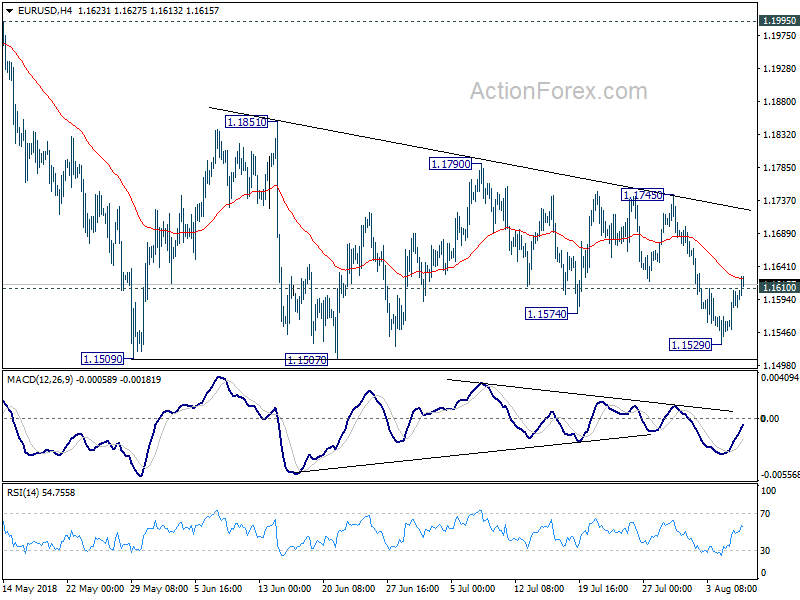
EUR/USD's break of 1.1610 minor resistance confirms bottoming at 1.1529. And, the consolidation pattern from 1.1509 has started another rising leg. Intraday bias is mildly on the upside for the moment. Stronger rise could be seen back to 1.1745 resistance. But after all, upside should be limited by 1.1851 to bring down trend resumption eventually. On the downside, decisive break of 1.1507 key support will resume larger down trend from 1.2555 through 50% retracement of 1.0339 to 1.2555 at 1.1447.
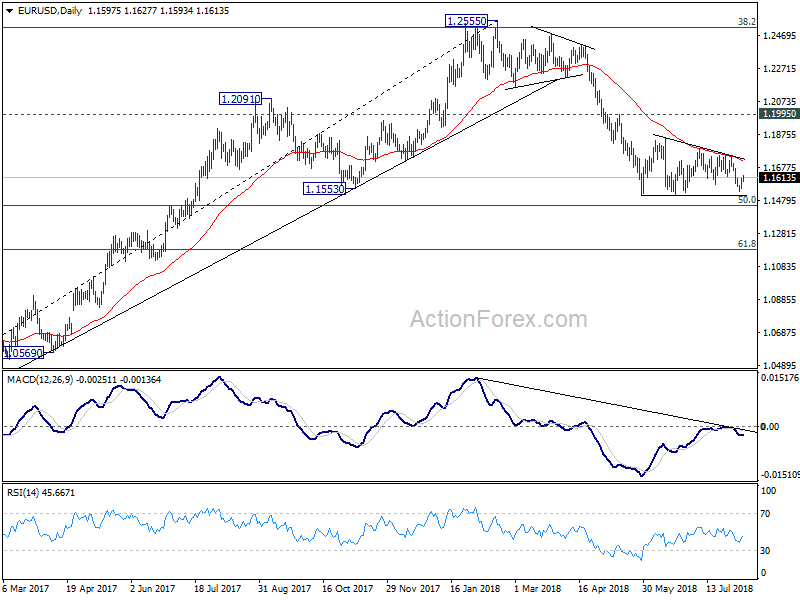
In the bigger picture, EUR/USD was rejected by 38.2% retracement of 1.6039 (2008 high) to 1.0339 (2017 low) at 1.2516. And, a medium term top was formed at 1.2555 already. Decline from there should extend further to 61.8% retracement of 1.0339 to 1.2555 at 1.1186 and below. For now, even in case of rebound, we won't consider the fall from 1.2555 as finished as long as 1.1995 resistance holds.
Euro Rebound Accelerates as China Turned to EU for Imports Overwhelmingly Amid Trade War with US
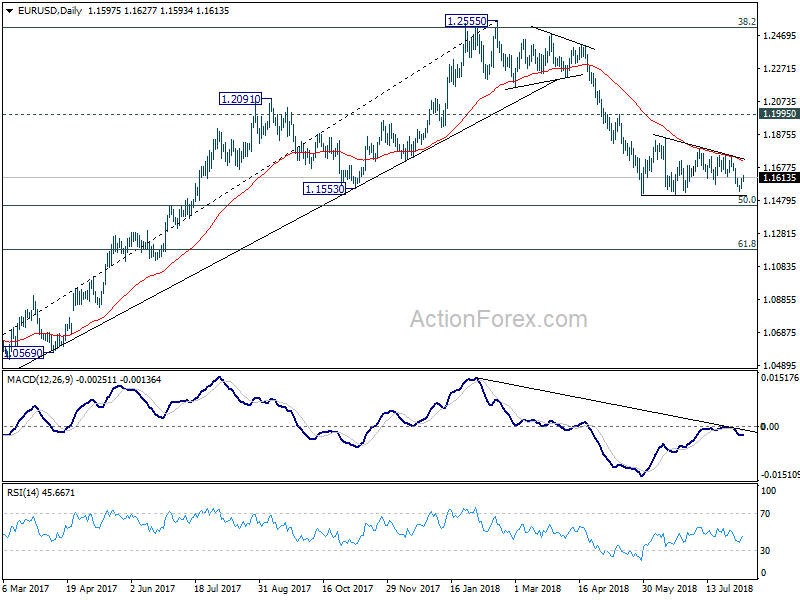
Euro trades broadly higher in Asian session today, except versus New Zealand Dollar. The common currency is extending this week's powerful rebound. Meanwhile, Canadian Dollar is trading as the weakest one, followed but Dollar as the second weakest. For the week, Euro remains the strongest one on a powerful rebound. It's followed by Australian Dollar as the second strongest. Canadian Dollar is the weakest one, paring back some of this month's gain. Sterling is the second weakest on worries over no-deal Brexit.
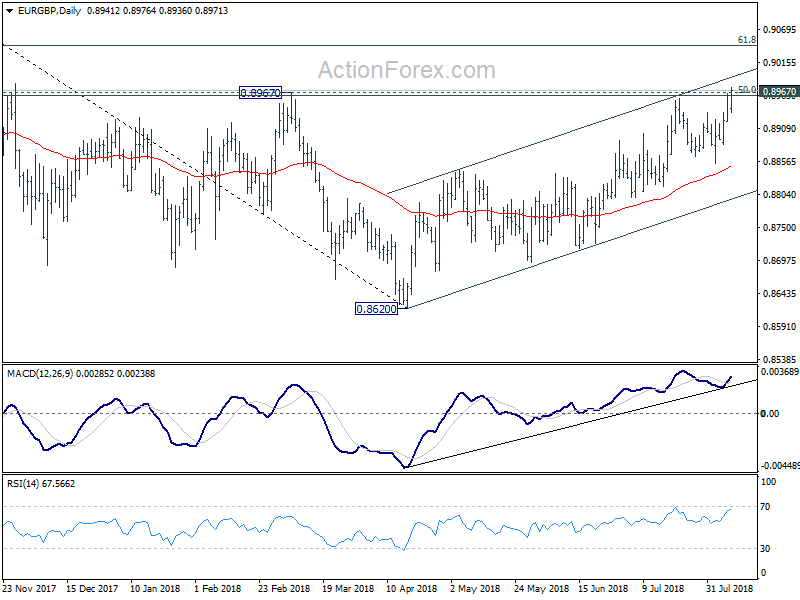
The strength in Euro can firstly be explained by Dollar's failure in breaking through key resistance level. That is, EUR/USD rebounded strongly after defending 1.1507 key support level. The greenback is apparently troubled by the recovery in the Chinese Yuan follow PBoC measure. EUR/GBP also takes advantage of the no-deal Brexit worries to surge through 0.8967 key resistance level. Resumption of medium term rise from 0.8620 in EUR/GBP could help lift Euro elsewhere.
Thirdly, the common currency appears to be benefited from China trade data. The set of data clearly showed that China is turning to the EU for trade, in rather drastic and speedy way in July. Since early part of the year, Dollar has always benefit from Trump's escalation in trade conflicts. But going forward, it's worth a watch on Euro's reactions to Trump's comments on trade with China.
China's import from EU jumped 20.5% mom, trade surplus shrank -31.0% mom, as US-China trade war starts
China's July trade data revealed some interesting findings as US-China trade war formally started. Import from the EU jumped as massive 20.% mom, 19.7% yoy. Trade surplus with EU dropped -31.0% mom, -7.9% yoy. On the other hand, trade surplus with US dropped a mere -3.0%, with -2.5% decline in export and -1.5% mom fall in imports. Looks like the EU could have the last laugh over Trump's trade policy.
Here are the details:
Overall -
- China trade surplus in CNY term narrowed to CNY 177B in July, down from CNY 262B, missed expectation of CNY 225B. Exports rose 6.0% yoy to CNY 1390B while imports jumped 20.9% yoy to CNY 1213B. Year-to-Jul, exports rose 5.0% yoy to CNY 8894B while imports rose 12.9% yoy to CNY 7826B, with CNY 1068B surplus.
- In USD term, trade surplus narrowed to USD 28.1B, down from USD 41.6B and missed expectation of USD 39.1B. Exports rose 12.2% yoy to USD 215.6B while imports rose 27.3% yoy to USD 187.5B. Year-to Jul, exports rose 12.6% yoy to USD 1387B while imports rose 21.0% yoy to USD 1221B, with USD 166B surplus.
With EU -
- EU remains China's largest trading partner with total trade risen 5.9% mom, 13.4% yoy to USD 60.7B in July. Exports dropped -2.3% mom, rose 9.4% yoy to USD 35.9B. Imports rose a massive 20.5% mom and 19.7% yoy to USD 24.7B. For July, trade surplus with EU dropped -31.0% mom, -7.9% yoy to USD 11.2B.
- For year-to-July, China's total trade with EU rose 12.7% yoy to USD 383B. Exports rose 10.8% yoy to USD 227B. Imports rose 15.6% yoy to USD 155B. Total trade surplus merely grew 1.6% yoy to USD 72.1B.
With US -
- With the US, total trade dropped -2.3% mom, rose 11.2% yoy to USD 55.0B in July. Exports dropped -2.5% mom rose 11.2% yoy to USD 35.9B. Imports dropped -1.5% mom, rose 11.1% yoy to USD 24.7B. Trade surplus dropped -3.0% mom, rose 11.3% yoy to USD 28.1B.
- For year-to July, China's total trade with US rose 12.2% yoy USD 357B. Exports rose 12.5% yoy to USD 259.1B. Imports rose 11.4% yoy to 97.5B. Trade surplus rose 13.2% yoy to USD 161.6B.
USTR: 25% tariffs on $16B of Chinese goods to start on Aug 23
The US Trade Representative announced to start to collect 25% tariffs on USD 16B of Chinese imports starting August 23. The announced lists contains 279 of the original 284 tariff lines that were proposed back on June 15. This is the second tranche of tariffs as part of the Section 301 intellectual property investigations. The first tranche of 25% tariffs on USD 34B of Chinese goods already took effect on July 6. The upcoming 25% tariffs on USD 200B in Chinese goods are work in progress.
In the statement, USTR reiterated China's bad practices as revealed by Section 301 investigation. The practices include:
- China uses joint venture requirements, foreign investment restrictions, and administrative review and licensing processes to require or pressure technology transfer from U.S. companies.
- China deprives U.S. companies of the ability to set market-based terms in licensing and other technology-related negotiations.
- China directs and unfairly facilitates the systematic investment in, and acquisition of, U.S. companies and assets to generate large-scale technology transfer.
- China conducts and supports cyber intrusions into U.S. commercial computer networks to gain unauthorized access to commercially valuable business information.
BoJ: Allowing long-term yields to rise may contribute to sluggish prices
BoJ released the Summary of Opinions at the July 30/31 monetary policy meeting today. There BoJ added forward guidance to " maintain the current extremely low levels of short- and long-term interest rates for an extended period of time". Also, BoJ is allowing 10 year JGB yield to move between -0.1% and +0.1%, as Governor Haruhiko Kuroda noted in the press conference.
The summary of opinions noted that it's "extremely important" to introducing forward guidance as a new measure. And, that would strengthen its commitment to achieving the price stability target, in order to ensure public confidence in its strong stance toward achieving the target."
Also, the summary noted that "controlling the long-term yields in a flexible manner is likely to contribute to maintaining and improving market functioning." Rise in interest rates "is expected to be effective in alleviating the cumulative impact on the functioning of financial intermediation and enhancing the sustainability of the Bank's policy.
Additionally, "referring to the recent developments in long-term interest rates in major economies, it can be considered appropriate for interest rate control in Japan to allow the yields to move upward and downward by around 0.25 percent." Though, most member agreed that it should be "made clear at the press conference" that currently yield may move between -0.1% to 0.1%.
However, the summary also noted concerns that " when medium- to long-term inflation expectations are weak, making policy adjustments that could allow the long-term yields to rise may lead to an increase in real interest rates and thereby contribute to sluggish prices."
RBA Lowe reiterated next move is up not down
RBA Governor Philip Lowe delivered a speech titled "Demographic Change and Recent Monetary Policy" today. There he reiterated that "the next move in interest rates to be up, not down". But the timing will depends upon the "speed of the progress" in "reducing the unemployment rate and having inflation return to around the midpoint of the target range on a sustained basis." And in the Q&A, Low also noted that there is no strong case for a near term move.
On the economy, Lowe's comments were similar to those in yesterday's RBA statement. That is, GDP is expected to average a bit above 3% in 2018 and 2019. Unemployment rate is expected to drop over time to 5% at some point over the next few years. And Australia could "go lower than this on a sustained basis". Due to once-off factors, inflation could slow to 1.75% in 2018. But over the forecast period, inflation is projected to rise to 2.5% in 2020.
Lowe also pointed to steady increased in job vacancies with vacancy rate hitting highest level in many years. And, there was an increased in number of businesses reporting hiring difficulties. The tightening of labor market will lead to higher wages as a "more general story".
On financial market risks, Lowe noted that borrowing by investors has "slowed considerably" because of "reduced demand" and "tightening of credit standards". And the change in financial trends has helped reduce the build-up of risk."
Released from Australia, home loans dropped -1.1% mom in June versus expectation of 0.1% mom rise.
Looking ahead
The economic calendar is rather empty today with Canada building permits and US crude oil inventories as main feature.
EUR/USD Daily Outlook
Daily Pivots: (S1) 1.1562; (P) 1.1586 (R1) 1.1622; More.....
EUR/USD's break of 1.1610 minor resistance confirms bottoming at 1.1529. And, the consolidation pattern from 1.1509 has started another rising leg. Intraday bias is mildly on the upside for the moment. Stronger rise could be seen back to 1.1745 resistance. But after all, upside should be limited by 1.1851 to bring down trend resumption eventually. On the downside, decisive break of 1.1507 key support will resume larger down trend from 1.2555 through 50% retracement of 1.0339 to 1.2555 at 1.1447.
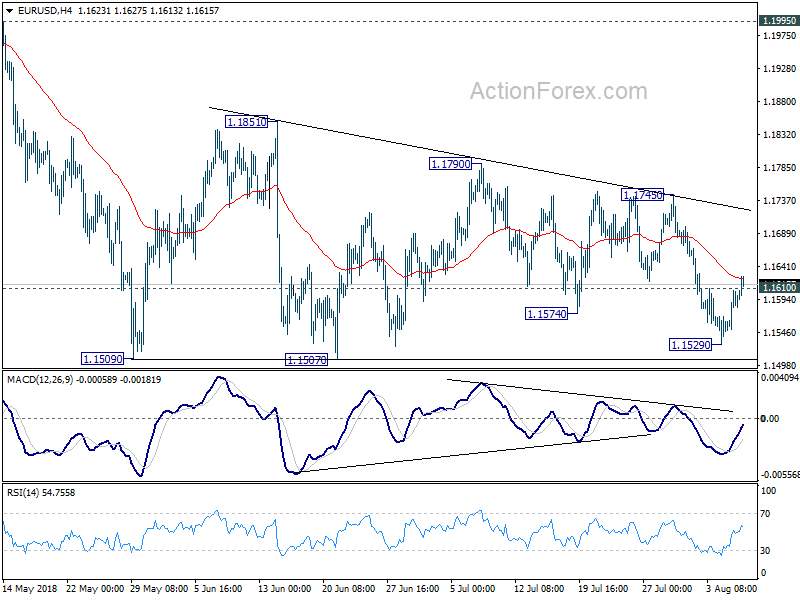
In the bigger picture, EUR/USD was rejected by 38.2% retracement of 1.6039 (2008 high) to 1.0339 (2017 low) at 1.2516. And, a medium term top was formed at 1.2555 already. Decline from there should extend further to 61.8% retracement of 1.0339 to 1.2555 at 1.1186 and below. For now, even in case of rebound, we won't consider the fall from 1.2555 as finished as long as 1.1995 resistance holds.
Economic Indicators Update
| GMT | Ccy | Events | Actual | Forecast | Previous | Revised |
|---|---|---|---|---|---|---|
| 23:50 | JPY | BOJ Summary of Opinions Jul | ||||
| 23:50 | JPY | Current Account (JPY) Jun | 1.76T | 1.84T | 1.85T | |
| 23:50 | JPY | Bank Lending incl Trusts Y/Y Jul | 2.00% | 2.30% | 2.20% | |
| 1:30 | AUD | Home Loans M/M Jun | -1.10% | 0.10% | 1.10% | 1.00% |
| 3:05 | CNY | Trade Balance (USD) Jul | 28.1B | 39.1B | 41.6B | |
| 3:05 | CNY | Trade Balance (CNY) Jul | 177B | 255B | 262B | |
| 5:00 | JPY | Eco Watchers Survey Current Jul | 46.6 | 47.8 | 48.1 | |
| 12:30 | CAD | Building Permits M/M Jun | -2.70% | 4.70% | ||
| 14:30 | USD | Crude Oil Inventories | 3.8M | |||
| 21:00 | NZD | RBNZ Rate Decision | 1.75% | 1.75% |
China’s import from EU jumped 20.5% mom, trade surplus shrank -31.0% mom, as US-China trade war starts
China's July trade data revealed some interesting findings as US-China trade war formally started. Import from the EU jumped as massive 20.5% mom, 19.7% yoy. Trade surplus with EU dropped -31.0% mom, -7.9% yoy. On the other hand, trade surplus with US dropped a mere -3.0%, with -2.5% decline in export and -1.5% mom fall in imports. Looks like the EU could have the last laugh over Trump's trade policy.
Here are the details:
Overall -
China trade surplus in CNY term narrowed to CNY 177B in July, down from CNY 262B, missed expectation of CNY 225B. Exports rose 6.0% yoy to CNY 1390B while imports jumped 20.9% yoy to CNY 1213B. Year-to-Jul, exports rose 5.0% yoy to CNY 8894B while imports rose 12.9% yoy to CNY 7826B, with CNY 1068B surplus.
In USD term, trade surplus narrowed to USD 28.1B, down from USD 41.6B and missed expectation of USD 39.1B. Exports rose 12.2% yoy to USD 215.6B while imports rose 27.3% yoy to USD 187.5B. Year-to Jul, exports rose 12.6% yoy to USD 1387B while imports rose 21.0% yoy to USD 1221B, with USD 166B surplus.
With EU -
EU remains China's largest trading partner with total trade risen 5.9% mom, 13.4% yoy to USD 60.7B in July. Exports dropped -2.3% mom, rose 9.4% yoy to USD 35.9B. Imports rose a massive 20.5% mom and 19.7% yoy to USD 24.7B. For July, trade surplus with EU dropped -31.0% mom, -7.9% yoy to USD 11.2B.
For year-to-July, China's total trade with EU rose 12.7% yoy to USD 383B. Exports rose 10.8% yoy to USD 227B. Imports rose 15.6% yoy to USD 155B. Total trade surplus merely grew 1.6% yoy to USD 72.1B.
With US -
With the US, total trade dropped -2.3% mom, rose 11.2% yoy to USD 55.0B in July. Exports dropped -2.5% mom rose 11.2% yoy to USD 35.9B. Imports dropped -1.5% mom, rose 11.1% yoy to USD 24.7B. Trade surplus dropped -3.0% mom, rose 11.3% yoy to USD 28.1B.
For year-to July, China's total trade with US rose 12.2% yoy USD 357B. Exports rose 12.5% yoy to USD 259.1B. Imports rose 11.4% yoy to 97.5B. Trade surplus rose 13.2% yoy to USD 161.6B.
Here are the links to:
Euro surges broadly, EURGBP upside breakout
Euro records broad based gains in Asian session today and is trading as the second strongest for today. It's indeed the strongest one for the week so far. We not seeing any apparent fundamental reason of the Euro's own for the rally. But the EUR/USD's reject from 1.1507 support thanks to Dollar's pullback is a factor. Sterling's persistent weakness in worries on no-deal Brexit is another favorable factor for Euro.
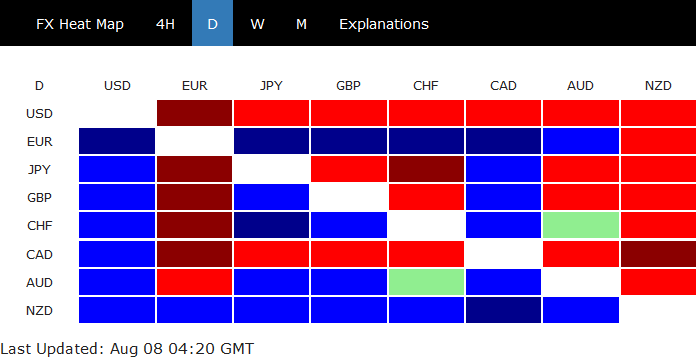
Technically, EUR/USD's break of 1.1610 minor resistance should indicate near term bottoming at 1.1529, ahead of 1.1507 key support. The consolidation pattern from 1.1509 is starting another rising leg. EUR/USD would be targeting 1.1745 resistance next as the pattern extends.
EUR/GBP also finally breaks 0.8967 key cluster resistance level. The upper channel resistance might be an obstacle for the near term. But we'd expect rise from 0.8620 to extend to 61.8% retracement of 0.9305 to 0.8620 at 0.9043. The rise in EUR/GBP would help support Euro elsewhere.
ECB: QE And Redemption Details
Finland, Ireland and Portugal 'over-bought' in July. Germany also 'over-bought' due to 'redemption effects
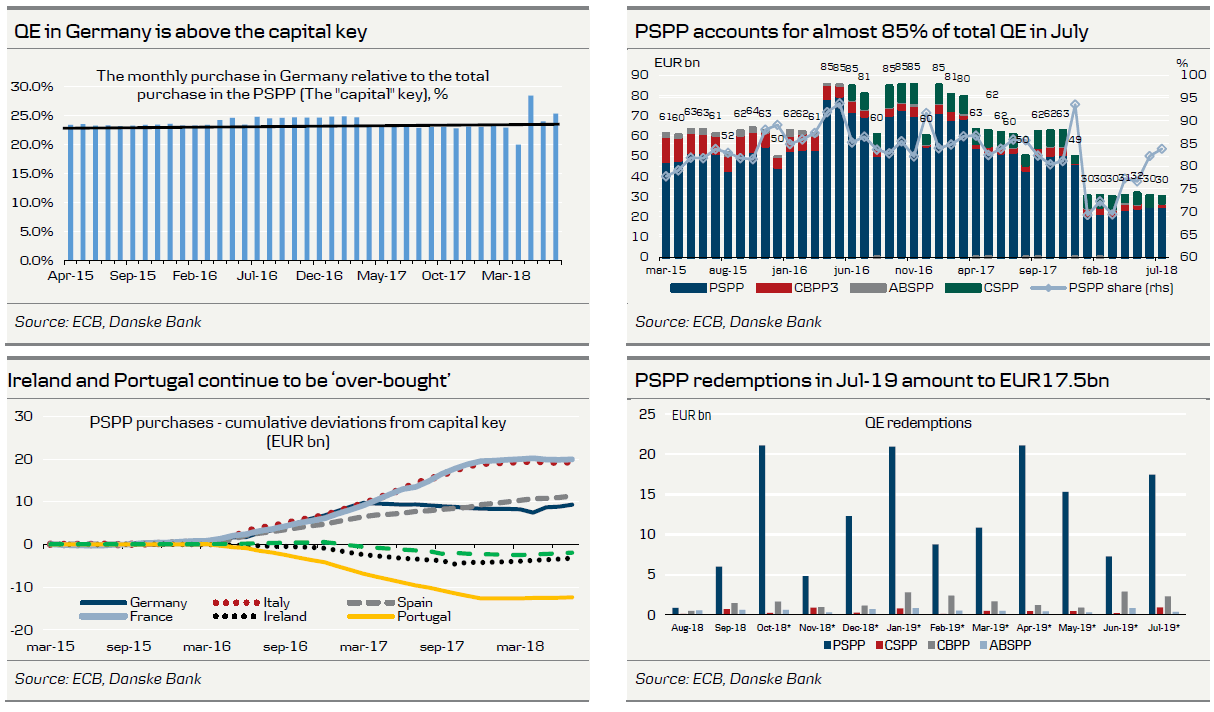
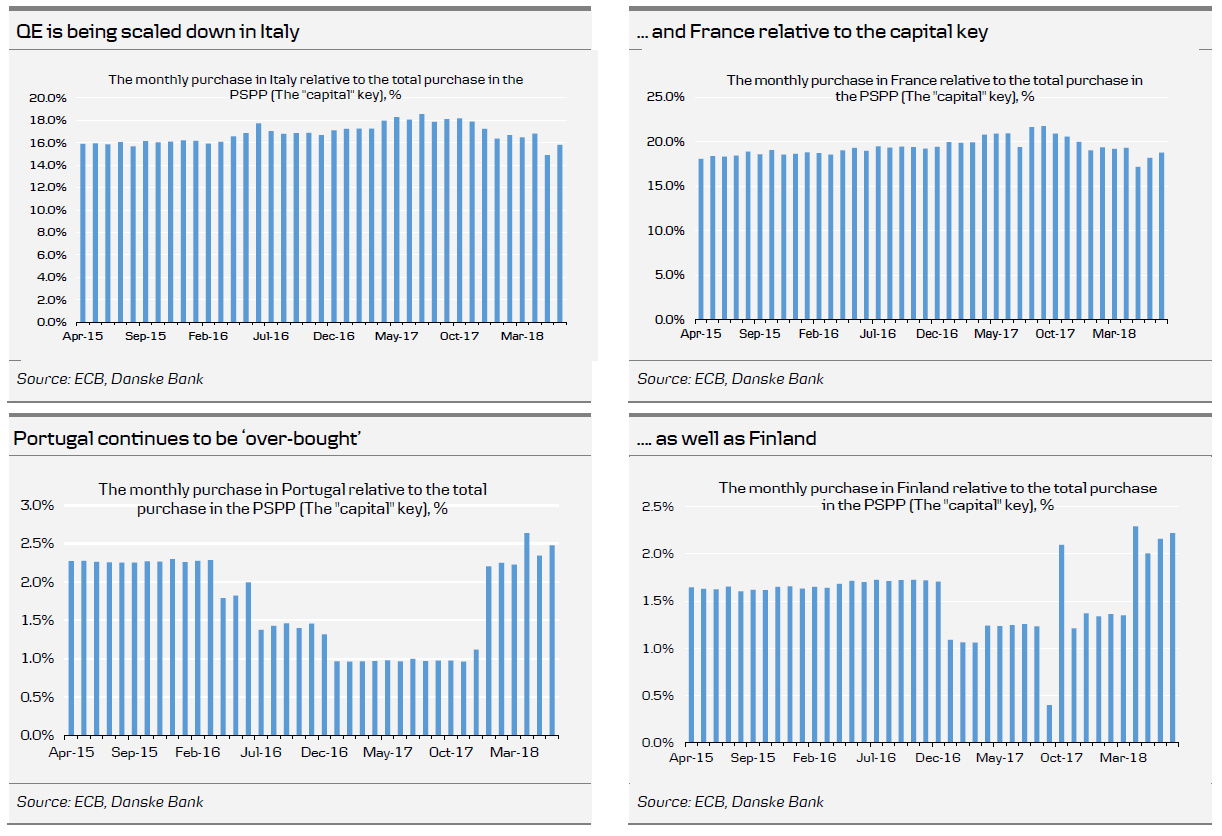
The QE figures for July showed an increase in the PSPP (public sector purchase programme) purchases relative to the private sector programmes (CBPP3, ABPP, CSPP). Hence, almost 85% of the monthly QE of EUR30bn was spent on the public sector rather than the private sector. The increase is driven by major countries such as Germany. The PSPP purchases have increased from EUR20bn in January 2018 to EUR25bn in July 2018. The main beneficiary of this increase in the PSPP purchases has been Germany, where the ECB is buying above the capital key, while it is below in e.g. Italy and France. The PSPP purchases are also above the capital key in Finland and Portugal – see charts on page 2. However, the numbers are 'blurred' by the redemptions and since there have been large redemptions in Germany, there has to be an additional purchase in German government bonds as reinvestments are done in the same country.
This is different for Spain and Italy, where part of the redemptions is related to the SMP programme. This is very visible in the redemptions from the last week's financial statement from the ECB. Here, there were redemptions of EUR7.3bn from the SMP programme and redemptions of EUR5bn in the PSPP programme. Given that there are almost no redemptions in August in the PSPP, the ECB holdings of the Italian government bond that matured on 1 August are almost entirely held by the SMP programme. The Spanish bond that matured on 31 July was held by the PSPP programme as there were redemptions in Spain and EFSF