Sample Category Title
EUR/AUD Daily Outlook
Daily Pivots: (S1) 1.5716; (P) 1.5753; (R1) 1.5785; More....
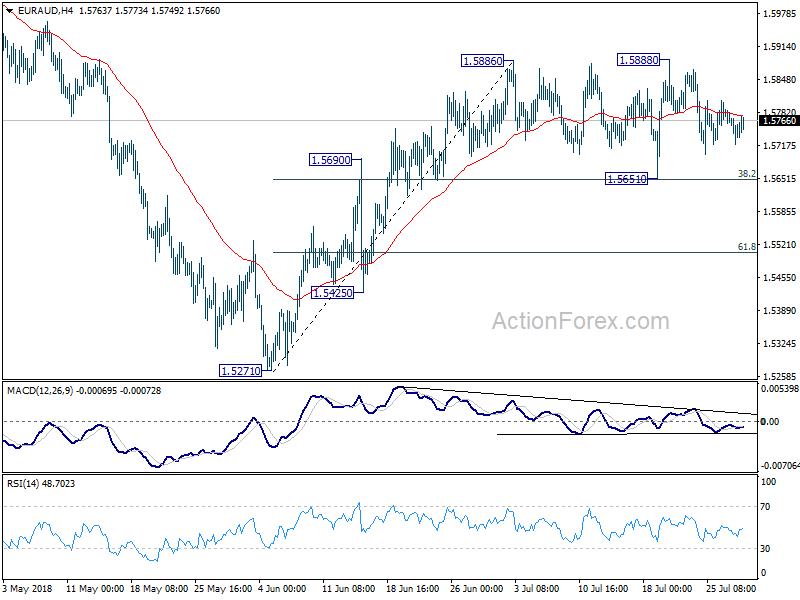
Intraday bias in EUR/AUD remains neutral as consolidation from 1.5886 is still in progress. With 1.5651 minor support intact, further rise is expected in the cross. On the upside, break of 1.5888 resistance will extend rise from 1.5271 towards 1.6139/89 resistance zone. However, break of 1.5651 cluster support (38.2% retracement of 1.5271 to 1.5886 at 1.5651) will indicate near term reversal and turn bias back to the downside for 1.5271 low.
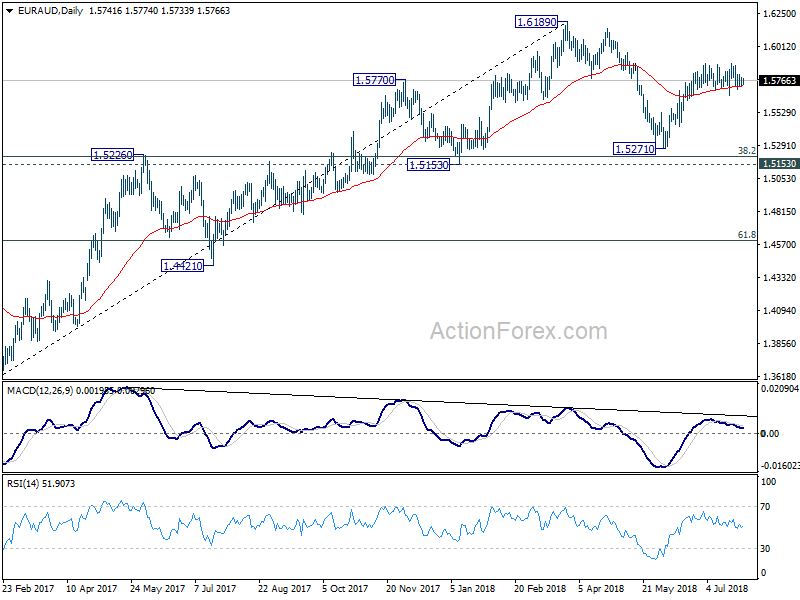
In the bigger picture, current development suggests that fall from 1.6189 is a corrective move and has completed at 1.5271 already. Key support levels of 1.5153 and 38.2% retracement of 1.3624 to 1.6189 at 1.5209 were defended. And medium term rise from 1.3624 (2017 low) is still in progress. Break of 1.6189 will target 1.6587 key resistance (2015 high).
EUR/CHF Daily Outlook
Daily Pivots: (S1) 1.1574; (P) 1.1590; (R1) 1.1614; More...
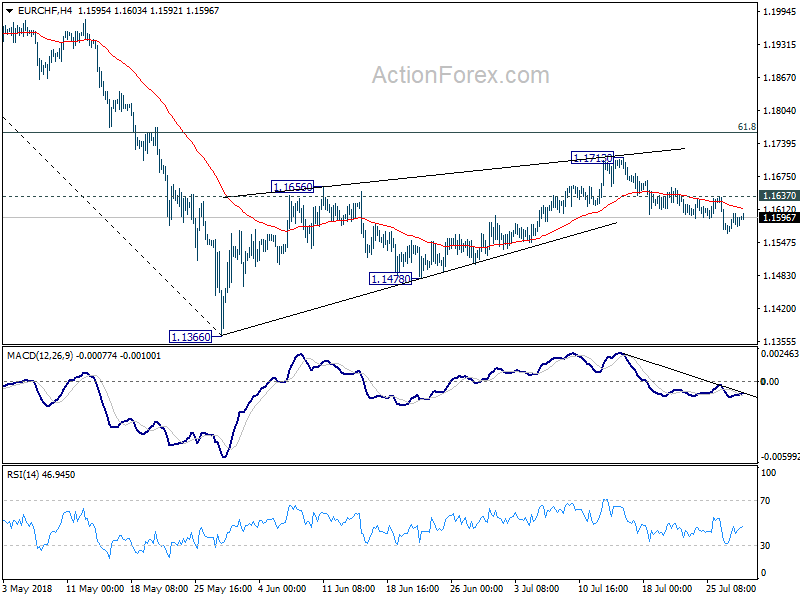
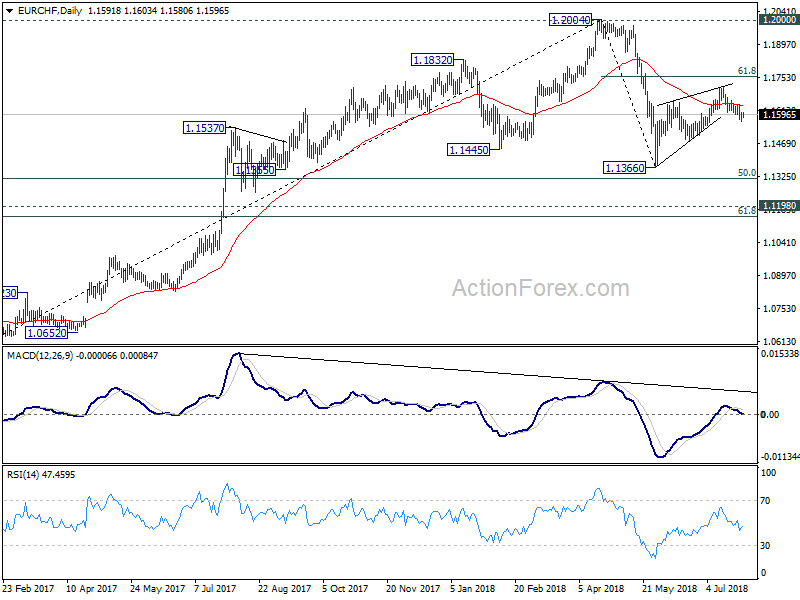
No change in EUR/CHF's outlook. The corrective rebound from 1.1366 should have completed with three waves up to 1.1713 already. Deeper fall is expected this week for 1.1478 support first. Break there will confirm our bearish view and target 1.1366 low and below. Nonetheless, on the upside, above 1.1637 minor resistance will turn bias back to the upside and could extend the rise from 1.1366. But even in that case, we'd expect strong resistance from 61.8% retracement of 1.2004 to 1.1366 at 1.1760 to bring near term reversal.
In the bigger picture, 1.2004 is seen as a medium term top with bearish divergence condition in daily and weekly MACD. 1.2000 is also an important resistance level. Hence, the corrective pattern from 1.2004 is expected to extend for a while before completion. We're not anticipating a break of 1.2004 in near term. Another decline cannot be ruled out yet. But in that case, strong support should be seen at 1.1198 (2016 high), 61.8% retracement of 1.0629 to 1.2004 at 1.1154 to contain downside.
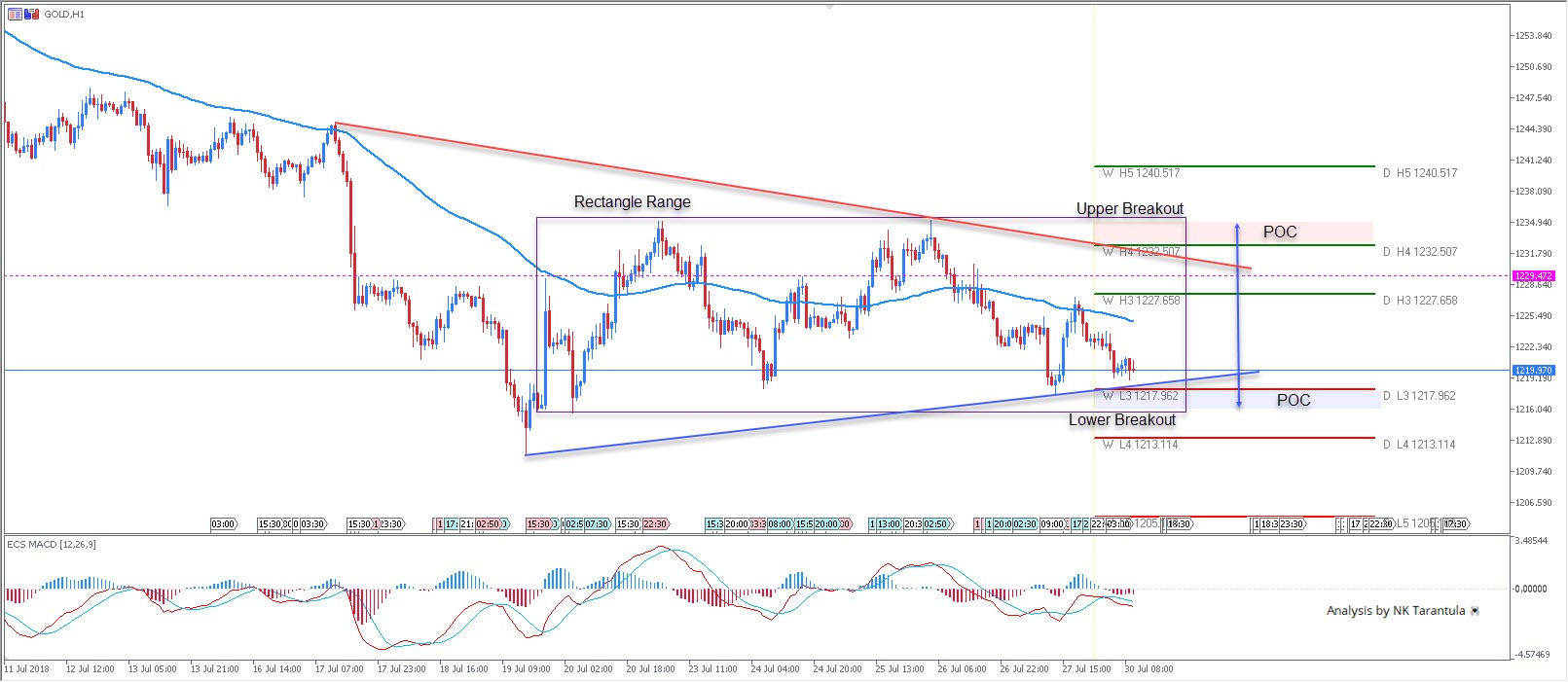
GOLD Is Trapped Within The Rectangle Range
Gold has been trapped within a rectangle range between the two POC zones. Trend lines are also marking congestion that follows the range play. There are two possible scenarios inside the range. A rejection from the lower POC 1216-1218 zone towards 1227.65-1230 and the rejection from the upper POC zone 1230-1232.50 towards 1220. The rectangle will be broken if the price makes a clear close below the lower or upper boundaries. Breakout below should aim for 1213 and 1205. The upper breakout should target 1240.50.
W L3 - Weekly Camarilla Pivot (Weekly Interim Support)
W H3 - Weekly Camarilla Pivot (Weekly Interim Resistance)
W H4 - Weekly Camarilla Pivot (Strong Weekly Resistance)
D H4 - Daily Camarilla Pivot (Very Strong Daily Resistance)
D L3 – Daily Camarilla Pivot (Daily Support)
D L4 – Daily H4 Camarilla (Very Strong Daily Support)
POC - Point Of Confluence (The zone where we expect price to react aka entry zone)
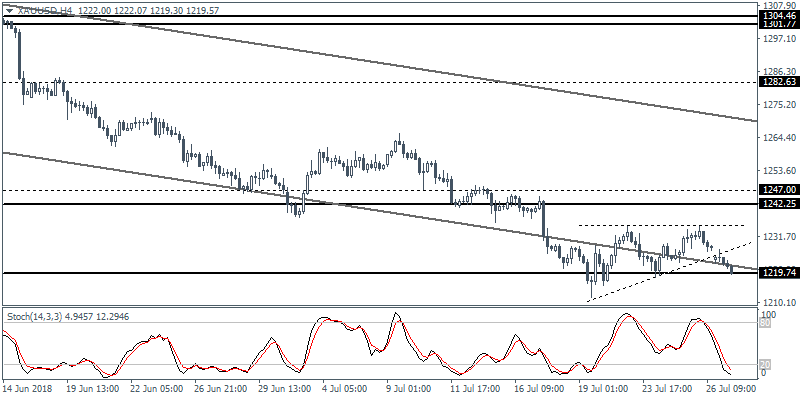
XAUUSD Intraday Analysis
XAUUSD (1219.57): Gold prices are trading back the support level of 1219. The downside breakout from the minor ascending triangle pattern signals a possible move to the downside. If gold prices clear the support at 1219, we could expect the losses to push lower to the previously established lows of 1211 region. To the upside, a rebound is required in order to clear the upside toward 1242 resistance.
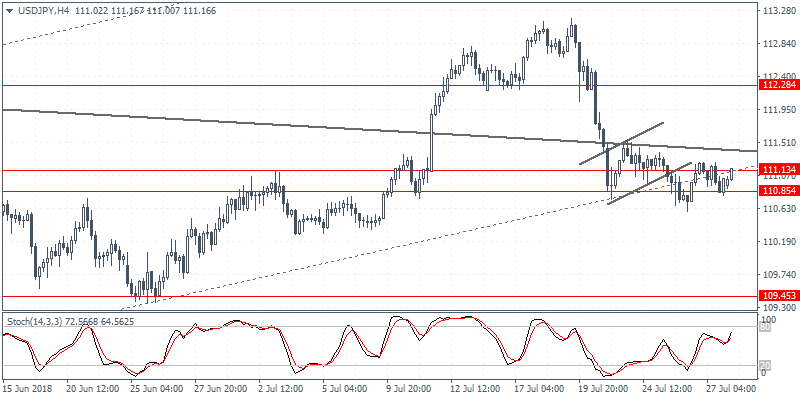
USDJPY Intraday Analysis
USDJPY (111.16): The USDJPY currency pair has been consolidating strongly near the support level of 111.13 - 110.85. The failure to extend the declines is likely to keep the USDJPY currency pair to trade sideways. There is a risk of an upside breakout if price clears the falling trend line. A close above this trend line could trigger gains that could keep the USDJPY biased to the upside. The previous resistance level at 112.28 remains the key level of interest that could be targeted
EURUSD Intraday Analysis
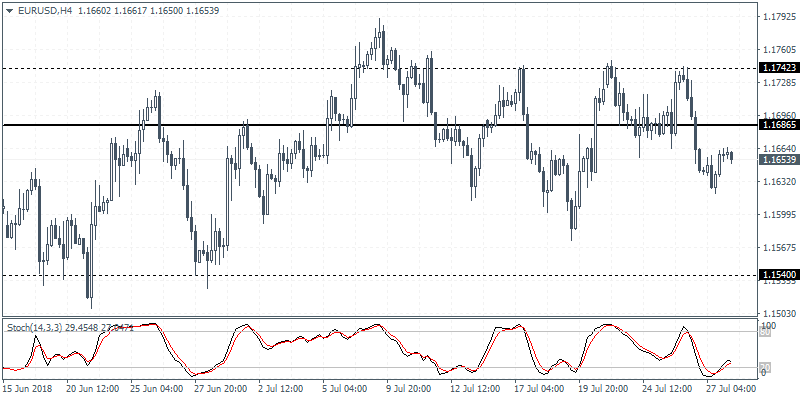
EURUSD (1.1653): The EURUSD was seen posting modest gains on Friday. The EURUSD remains trading within a range and following the close below the support/resistance level of 1.1686, we expect further declines. The lower support at 1.1540 remains a key level of interest in the near term. Any retracements in the short term could stall back near 1.1686 level where resistance could be established. Any gains can be expected only on a close above 1.1686 which would target the next resistance level at 1.1742.
U.S. GDP Rises 4.1% In Q2 2018
The U.S. dollar was trading mixed on Friday despite a higher GDP report for the second quarter.
The U.S. department of commerce released the preliminary GDP report for the second quarter. As expected, the GDP in the second quarter advanced at a pace of 4.1%. It was however slightly lower than the 4.2% forecast. The data marked the strongest pace of GDP growth since Q3 of 2014.
Earlier in the day, the flash GDP reports from France showed that the economy advanced at a slower pace of just 0.2% on the quarter. This was below estimates of a 0.3% increase.
Looking ahead, the economic data today will see the release of the German preliminary inflation report. Forecasts point to a 0.4% increase in headline inflation on a month over month basis.
Earnings And Central Banks To Take Center Stage This Week
Asian equities kicked off the week in negative territory following the declines on Wall Street on Friday.
The solid U.S. GDP data did little to support markets. The economy expanded at its quickest pace since 2014 in the second quarter, growing 4.1%, almost double the first quarter’s growth. However, investors have already priced in the positive news and so it came as no surprise. In fact, the surprise was in some of the big tech earnings results, in particular Facebook, Twitter and Intel, which led to declines of more than 2.4% on the Nasdaq Composite Index on Thursday and Friday. The disappointing guidance from these big tech firms followed poorly received results from Netflix in the previous week, leading to the question whether FAANG stocks can continue to drive equities higher in the coming quarters, or whetherit’s time to reassess their current valuations.
Earnings announcements will continue this week, with more than 140 companies due to report results. Apple will take the spotlightafter the market closes on Tuesday, with its sales forecast, dates for the next iPhone release, pricing and service momentum expected to be carefully scrutinized by investors.
This week is also packed with monetary policy decisions. The Federal Reserve, Bank of England and Bank of Japan are all set to meet this week.
Although all central bank decisions may lead to volatility in financial markets, the BoJ may carry the most significant influence when it announces its latest monetary policy decision on Tuesday. This is because several reports have indicated that the central bank is considering tweaks to its stimulus program. The 10-year Japanese government bond yields hit 0.11% today, their highest level since January 2017, as investors began pricing in an expected change in BoJ’s yield curve control policy which was implemented to keep yields at 0%. A shift in this policy will not only lead to a spike in Japanese bond yields but it will also have a global effect that will lead to further tightening in credit conditions. However, I think there’s a higher chance that the BoJ will not make any significant changes on this front and will instead try to calm markets, by bringing the 10-year JGB’s back to 0%. If this is true, expect USDJPY to strengthen again toward 113.
The Federal Reserve, which meets on Wednesday, is expected to leave policy unchanged. Many traders want to know whether Trump’s criticism of the Fed will lead to a change in language;I believe there will be no change in guidance and the Fed will continue sending the message that more rate hikes are on the way.
The BoE is the only major central bank that is expected to raise rates on Thursday, but the recent fall in inflation levels and continued Brexit drama have led some market participants to believe the central bank will delay this action. However, I think the BoE will deliver a 0.25% rate hike and hint that it’s the only one expected for 2018.
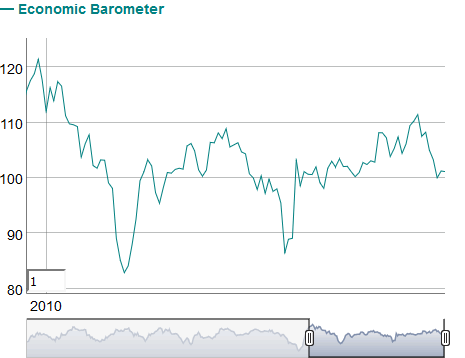
Swiss KOF dropped to 101.1, still slightly above long term average of 100
Swiss KOF Economic Barometer dropped -0.2 to 101.1 in July, below expectation of 101.5. The reading still sit slightly above the long-term average of 100, indicating a slightly above-average economic development in Switzerland in the coming months.
KOF noted in the release that "negative indicators for manufacturing, the export industry and the accommodation and food service activities sector were mainly responsible for the slight decrease." On the other hand, "positive signals come from the banking and the construction sectors.".
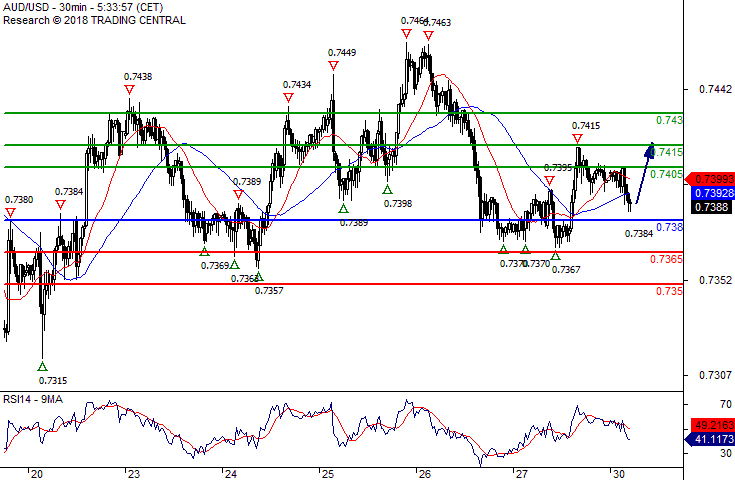
AUD/USD Bullish Bias Above 0.7380
Pivot (invalidation): 0.7380
Our preference Long positions above 0.7380 with targets at 0.7405 & 0.7415 in extension.
Alternative scenario Below 0.7380 look for further downside with 0.7365 & 0.7350 as targets.
Comment Even though a continuation of the consolidation cannot be ruled out, its extent should be limited.