Sample Category Title
Aussie Westpac consumer sentiment slumps post-tariff shock; RBA seen tilting toward May rate cut
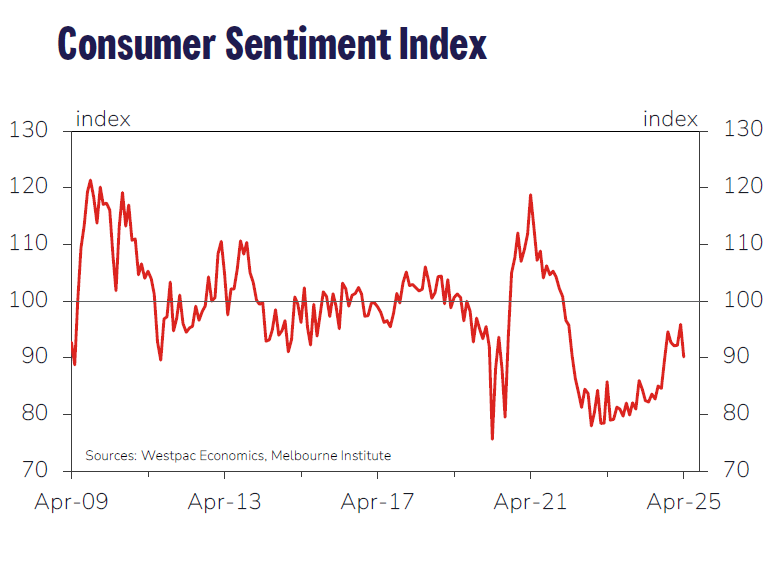
Australia’s Westpac Consumer Sentiment index plunged -6.0% in April, dropping from 95.9 to 90.1. The steep fall was notably skewed by the timing of the survey in relation to US announcement of reciprocal tariffs on April 2.
Respondents surveyed before the announcement showed only a modest dip in sentiment to 93.9. Those surveyed after reported a sharp drop of nearly 10% to 86.6. .
The sub-indices measuring sentiment towards the economy were particularly hard-hit, with the outlook for the next 12 months falling -5.7% to 90.5, and the 5-year outlook slipping back by -3.0%
With RBA set to meet on May 19-20, Westpac believes the weakening external backdrop, coupled with softer inflation, will push RBA to deliver another 25 bps rate cut. RBA is likely to become "much more focused on downside risks to growth than lingering questions about inflation".
Fed’s Goolsbee: Must rely on hard data, no simple playbook for stagflation risks
Chicago Fed President Austan Goolsbee expressed concern that escalating trade tensions—through tariffs, retaliations, and potential counter-retaliations—could recreate the turbulent economic conditions of 2021–2022 when inflation was "raging out of control."
In an interview with CNN, he warned that if the tariff threats materialize to their full extent, especially if met with proportionate responses, the US economy risks slipping back into a period of high inflation and stagnating growth.
However, Goolsbee also acknowledged that the situation remains fluid. He noted that negotiations could yet defuse the tension, especially if they result in new trade agreements. Referring to Treasury Secretary Scott Bessent’s optimism about a coming “golden age of trade.”
If stagflation begins to take hold, Goolsbee stressed, the Fed's response would not be straightforward. The appropriate policy path would depend heavily on how growth and inflation evolve in the coming months.
“Our job is to look at the hard data,” he said, underlining that in a scenario where both growth weakens and prices surge, there’s no “generic answer” to guide monetary policy.
Fed’s Kugler: Anchoring inflation expectations must remain top priority
Fed Governor Adriana Kugler emphasized the importance of keeping inflation expectations well anchored in comments delivered to a Harvard economics class.
She reaffirmed the Fed’s commitment to the 2% inflation target and stressed "It should be a priority to make sure that inflation doesn't move up".
Kugler also noted that economic activity in the first quarter may have been stronger than previously anticipated, driven by consumer front-loading ahead of expected tariff hikes.
While the full extent of tariff-related cost pass-through is yet to be seen, she acknowledged the financial strain such developments could place on households. That, she argued, is "exactly why we think we need to keep focus on that."
RBNZ April Monetary Policy Review Update
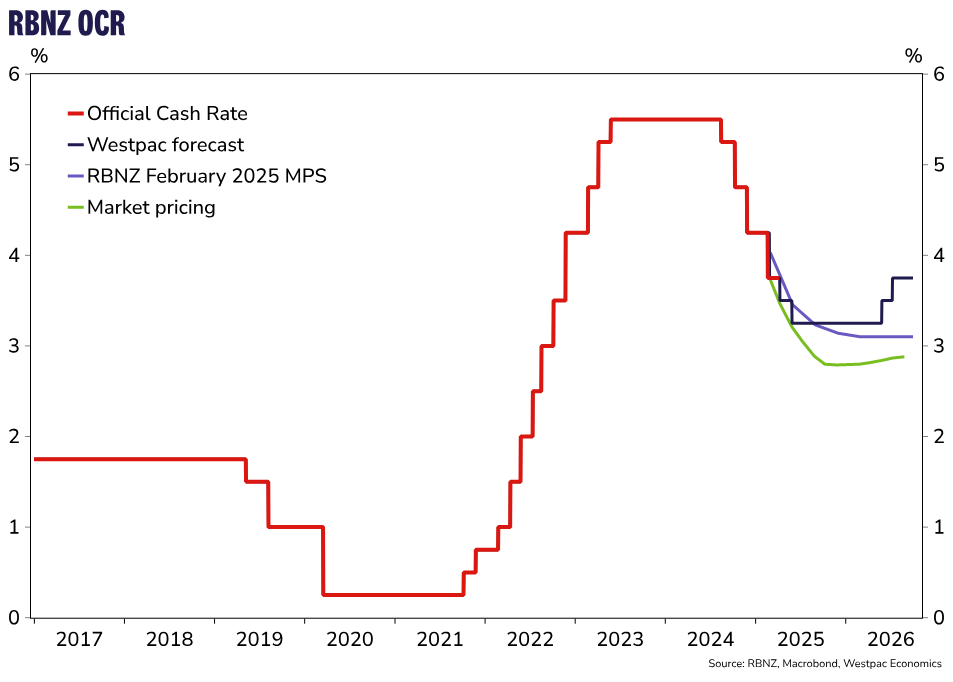
We continue to see the RBNZ cutting the OCR 25bp to 3.5% tomorrow. But the risks around the outlook have increased, especially due to the darkening global outlook.
Key points:
- We continue to see the RBNZ cutting the OCR 25bps to 3.5% tomorrow.
- Today’s sluggish QSBO and the darkening global outlook imply a less positive forward economic view.
- There are risks of a larger cut – but uncertainties should see the RBNZ keep that powder dry.
- We expect commentary indicating a firm intention to get the OCR to 3% soon.
- The risks of a sub 3% OCR are real, but no judgement will be made on that tomorrow.
Recent developments
Last Wednesday we released our Monetary Policy Review preview, and we forecast a 25bps cut in the OCR to 3.5%. We also indicated a risk of a pause to allow the RBNZ to assess the impacts of past easing. The balance of risks has shifted a lot in just one week. Hence, it’s important to update the view.
Markets have moved to price in risks of a much lower OCR over 2025 as the bomb that the US administration detonated on global trade reverberates. The news of rounds of retaliation between China and the US imply very elevated global growth risks. And that bodes poorly for the New Zealand outlook.
Today we also received the results of one of the more reliable domestic business surveys. We expected a decent bounce in activity indicators and an increase in pricing pressures. In actuality, the growth indicators still look fairly flat. Our GDP Nowcast indicator for Q1 GDP growth was pinned back to around 0.2% - somewhat weaker than our 0.4% forecast and certainly lower than the RBNZ’s 0.6% expectation.
We continue to expect the RBNZ to cut the OCR 25bps to 3.5% tomorrow. But the balance of risks lies clearly to the downside now – especially after the April MPR.
There are a wide range of outcomes for New Zealand interest and exchange rates from here. It’s likely the RBNZ will feel very keen to get the OCR to their estimate of neutral of 3% soon. They will likely indicate this intention in tomorrow’s statement. The meeting statement of record will also likely contain a discussion on the potential need to take the OCR below neutral at some point. But the MPC will likely not draw any conclusions on this point and leave that for discussion at the May Monetary Policy Statement.
In these circumstances the imperative for the central bank is to position policy as well as they can for the uncertainties ahead and ensure financial stability goals are met. We suspect the RBNZ will not want to scare the horses with a large policy shift after being so definitive about a 25bps cut at the February Monetary Policy Statement. Triggering large further falls in interest rate expectations and the exchange rate, both of which have moved in the right direction, and raising speculation that the economic outlook is dramatically weaker would be undesirable.
We suspect the big update will be in May where a wide range of outcomes look more feasible (the RBNZ will know the outcome of Budget 2025 by then also). Of course, the domestic and global outlook could look quite different by then. And the risk genuinely lies in both directions. NZ Inc could come off not too badly when all is said and done – but that doesn’t mean we will win outright either. The RBNZ will likely leave that assessment for May. We will update our own OCR forecasts when we review our forecasts at the May Economic Overview. But there are clear downside risks to our current 3.25% OCR forecast trough.
WTI Crude Oil Tanks To $60—Is Deeper Energy Market Shakeup Ahead?
Key Highlights
- WTI Crude Oil prices started a major decline below $68.00 and $65.00.
- It traded below a key contracting triangle with support at $68.50 on the 4-hour chart.
- Gold prices corrected gains and traded below the $3,020 support.
- Bitcoin took a major hit and traded below the $80,000 level.
WTI Crude Oil Price Technical Analysis
WTI Crude Oil price started a major decline from $72.50 against the US Dollar. It declined heavily below the $68.00 and $65.00 support levels.
Looking at the 4-hour chart of XTI/USD, the price traded below a key contracting triangle with support at $68.50. The bears even pushed the price below the $62.00 mark. Finally, the price found some support near the $59.00 level.
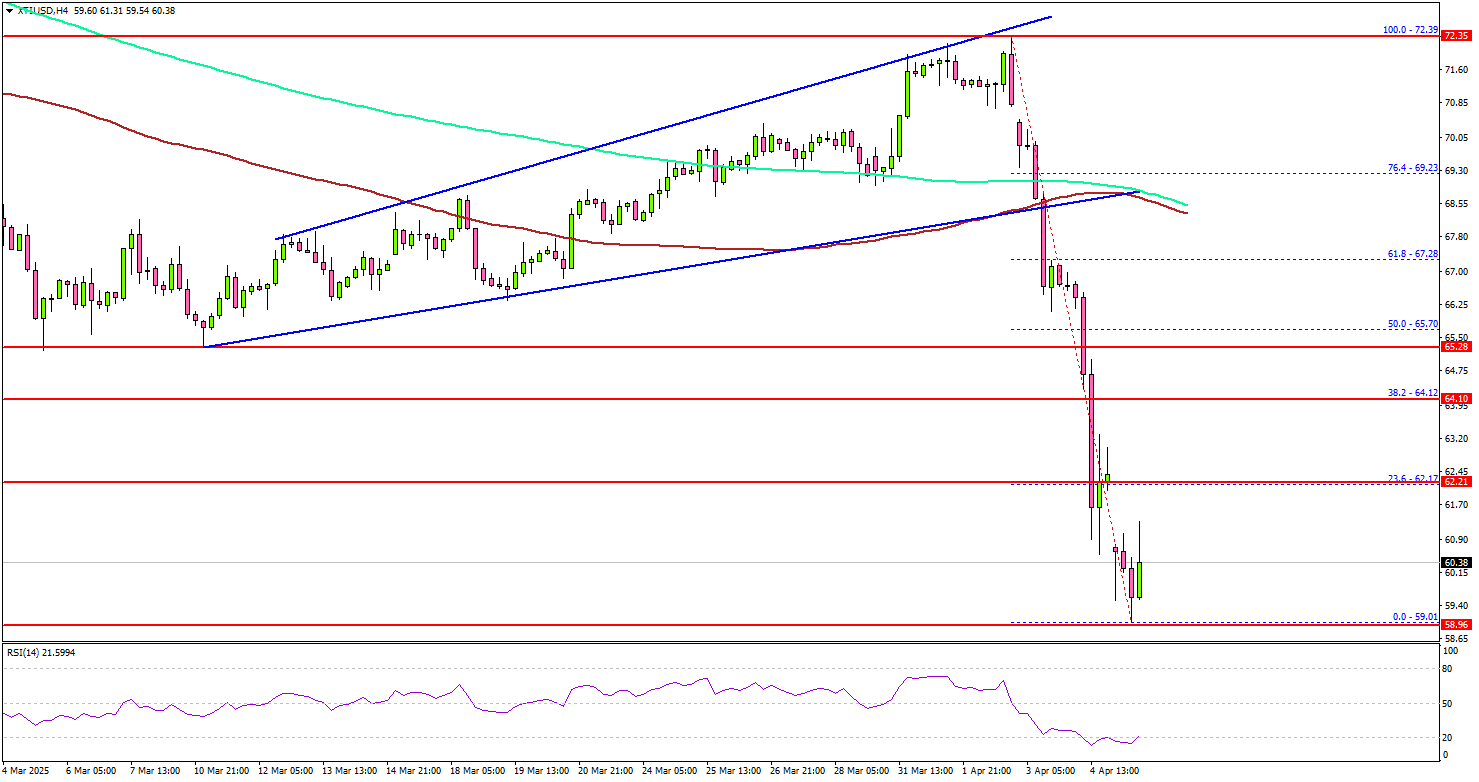
The price started a consolidation zone, but remained below the 23.6% Fib retracement level of the downward move from the $72.39 swing high to the $59.01 low.
It is also well below the 100 simple moving average (red, 4-hour) and the 200 simple moving average (green, 4-hour). On the upside, the price is facing hurdles near the $61.80 level. The first key resistance sits near the $62.20 level.
The main hurdle is now near the $64.00 zone, above which the price may perhaps accelerate higher. In the stated case, it could even visit the $67.50 resistance. Any more gains might call for a test of the $70.00 resistance zone in the near term.
On the downside, the first major support sits near the $59.00 zone. A daily close below $59.00 could open the doors for a larger decline. The next major support is $57.40. Any more losses might send oil prices toward $55.00 in the coming days.
Looking at Gold, there was a strong downside correction, and the bears pushed the price below the $3,050 and $3,020 support levels.
Economic Releases to Watch Today
- NFIB Business Optimism Index for March 2025 – Forecast 101.3, versus 100.7 previous.
Stock Market Today: S&P 500, Dow Jones Find Support, Tariff Clouds Linger
- The S&P 500 and Dow Jones experienced volatile trading due to ongoing tariff concerns, with initial losses followed by gains on EU counter-tariff news.
- Major tech stocks like NVIDIA, Amazon, and Meta Platforms saw gains, while Tesla and Apple struggled due to their China exposure.
- The Market Greed/Fear Index indicates significant fear among investors, but historical data suggests sharp market declines can be followed by strong recoveries. Is it to soon?
- Expect continued market volatility and whipsaw price action in the short term as tariff news develops.
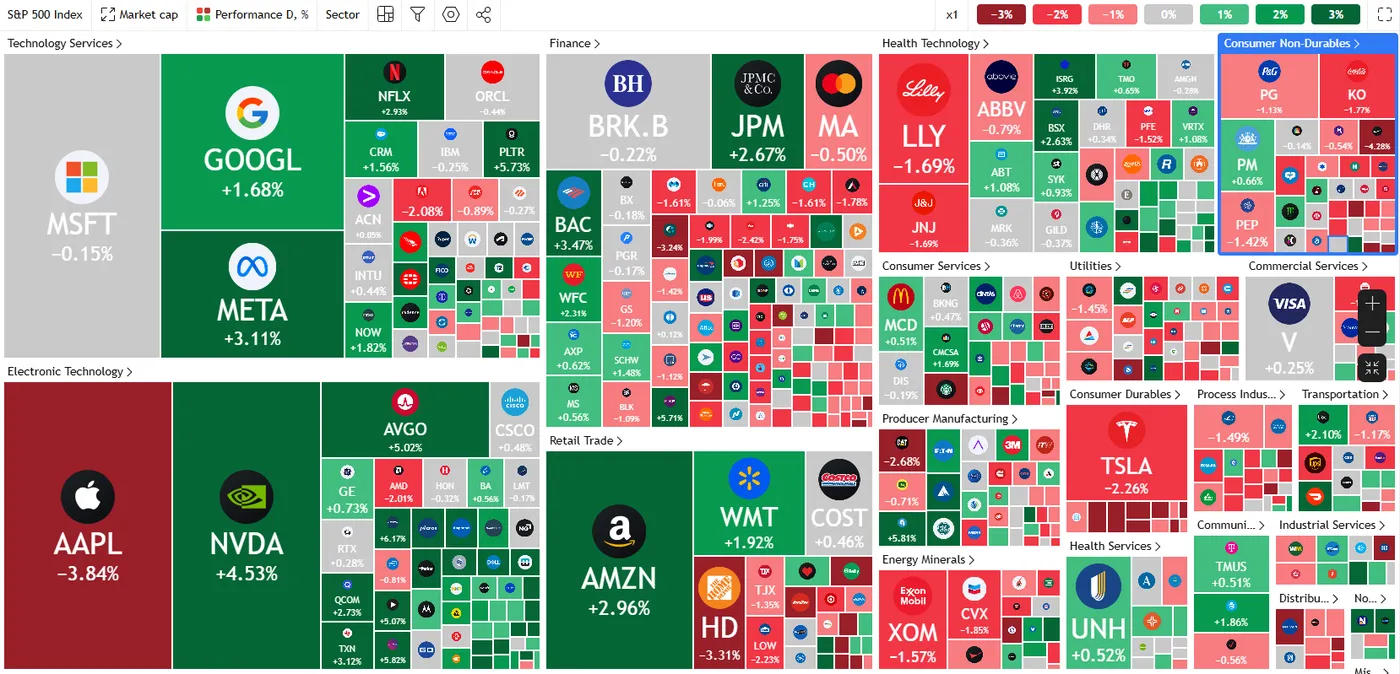
Wall Street Indexes have seen a mixed bag today with wild swings from fresh lows to small gains at the time of writing. After starting the week in the red early in the session, the S&P 500 gained on news of a document which showed the EU has proposed counter tariffs on a range of US imports at 25%.
This is in response to US steel duties while also removing US bourbon from its list of goods to face counter tariffs. About 200 or so of the S&P 500 constituents are now either flat or in positive territory.
Source: TradingView
Among the notable heavyweights, NVIDIA is up 4.53%, Amazon is up 2.92% and Meta Platforms is trading 3% higher at the time of writing.
Tesla and Apple continue to feel the weight of further trade war developments due to their heavy exposure to China. The US-China situation continues to develop as earlier in the day U.S. President Donald Trump said he will impose an additional 50% tariff on China if Beijing does not withdraw its retaliatory tariffs on the United States.
Sentiment remains fragile but is there a case for optimism?
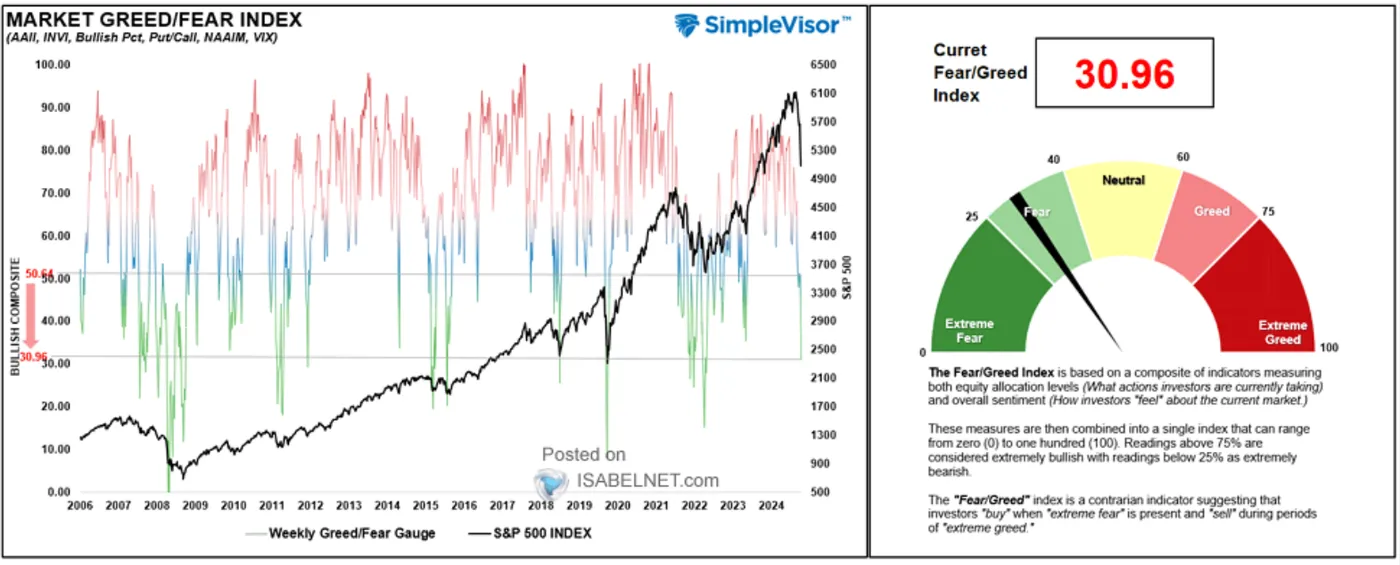
The Market Greed/Fear Index at 30.96 signals significant fear among investors, reflecting heightened concerns about a recession and economic damage from the ongoing trade war.
Source: IsabelNet
There are also growing rumors and concerns of more US troops and military equipment heading to the Middle East which has stoked fears of an attack on Iran at a crucial time for global markets.
This begs the question, is there any reason for optimism?
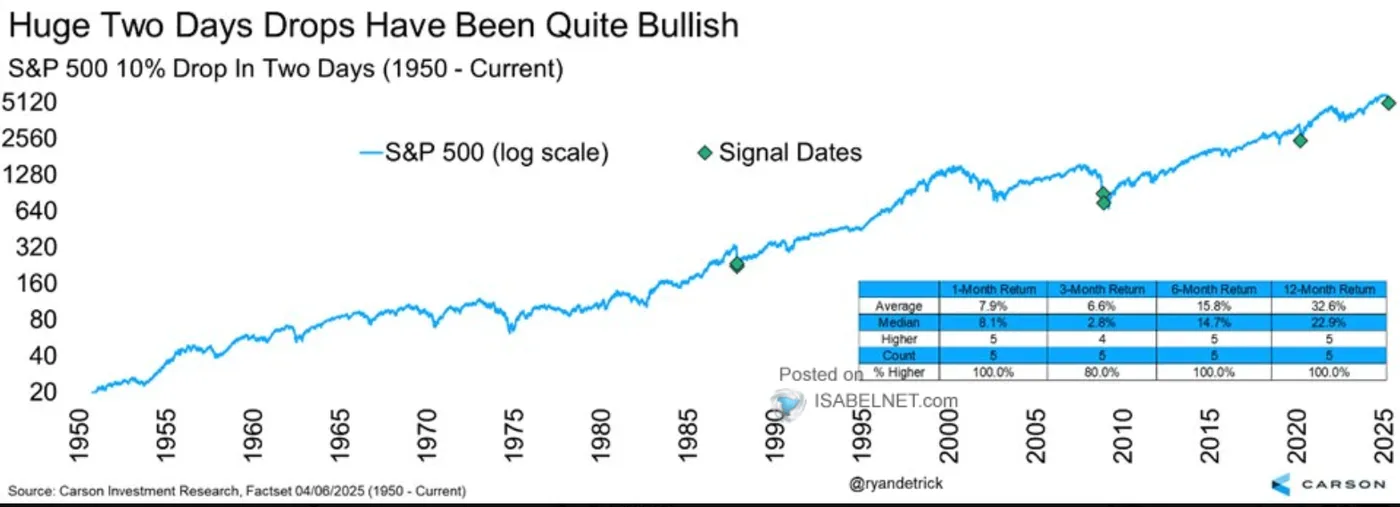
Historical data may not always be 100% accurate in predicting future movements but they do provide us with valuable insights. With that in mind, a 10% drop in the S&P 500 over two days is unusual, but history shows that sharp declines are often followed by strong recoveries, giving investors reason for optimism.
As you can see from the chart below such movements are usually followed by strong performance in the days and weeks ahead.
Source: IsabelNet
Will history repeat itself or is it too early to tell?
What can we expect moving forward?
There does seem to be a lot of conflicting views as to how markets may shape up tomorrow and the days ahead. However, if there is one thing that seems certain it is volatility.
In the short-term I expect more wild price swings as news and developments around tariffs filter through. Traditional trend trading may prove extremely difficult in the days ahead given the sharp decline and selloff last week.
A bounce cannot be ruled out as evidenced by today's move but dynamics are shifting so quickly that sustainability of such moves are likely to prove challenging.
Technical Analysis - Dow Jones
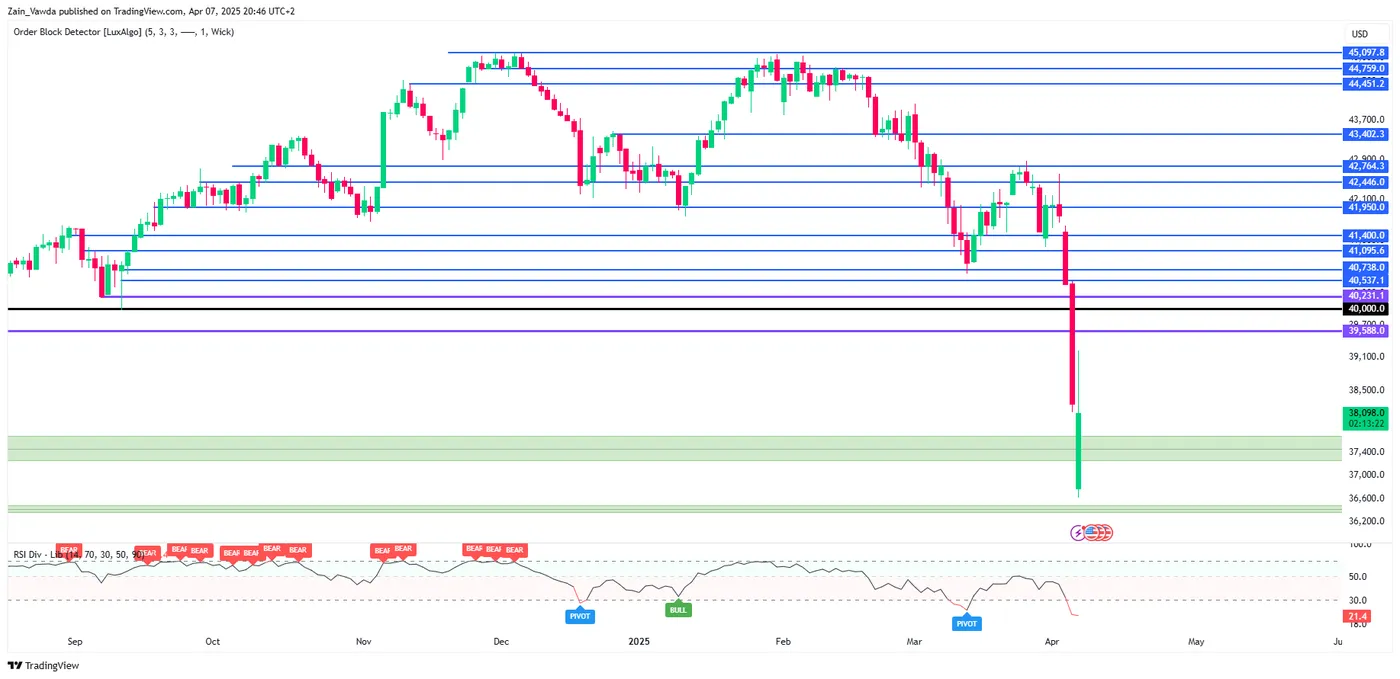
From a technical standpoint, the Dow Jones opened with a gap to the downside something which we saw across a host of markets.
The recent recovery on Wall Street Indexes has seen the Dow close the gap and record some gains before sellers returned. At the time of writing, the Dow Jones is trading 0.57% down for the day.
The 14-period RSI on a daily timeframe remains in extremely oversold territory which means a bounce remains very much in play.
Immediate resistance rests at 38256 before the 39000 handle and the psychological 40000 come into focus.
On the downside support has been found at 36600 with the next areas of support at 35700 and 35000.
Dow Jones (US30) Daily Chart, April 7, 2025
Source: TradingView (click to enlarge)
Support
- 36600
- 35700
- 35000
Resistance
- 38256
- 39000
- 40000
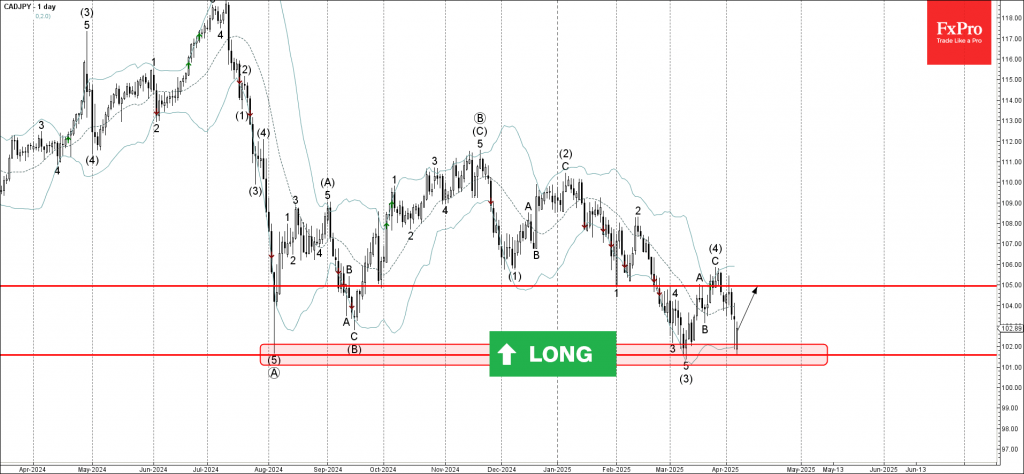
CADJPY Wave Analysis
CADJPY: ⬆️ Buy
- CADJPY reversed from strong support 101.60
- Likely to rise to resistance level 105.00
CADJPY currency pair recently reversed from the support zone surrounding the strong support 101.60 (which has been reversing the price since last August). This support zone was strengthened by the lower daily Bollinger Band.
The upward reversal from support 101.60 stopped the earlier intermediate impulse wave (5) from the end of March.
Given the strength of the support 101.60 and the bullish Canadian dollar sentiment seen today, CADJPY currency pair can be expected to rise to the next resistance level 105.00.
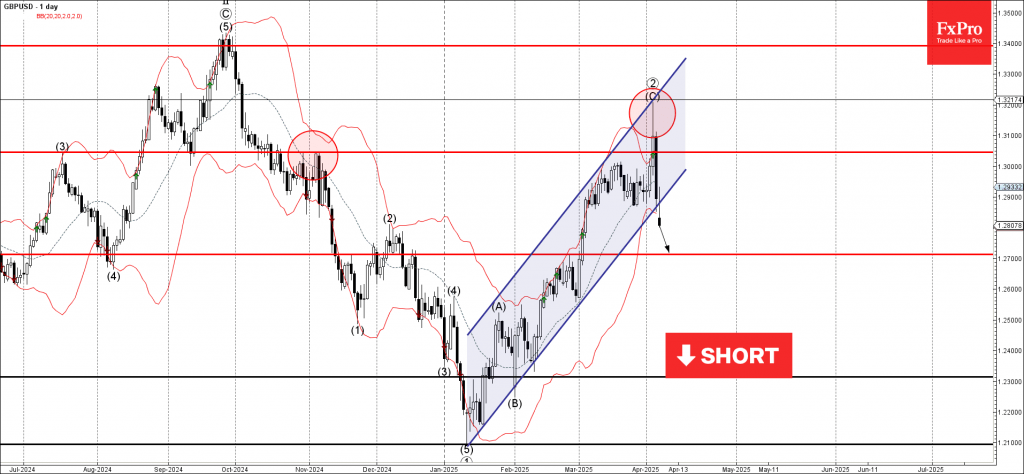
GBPUSD Wave Analysis
GBPUSD: ⬇️ Sell
- GBPUSD reversed from resistance area
- Likely to fall to support level 1.2700
GBPUSD currency pair recently reversed down from the resistance area between the resistance level 1.3050 (which reversed the price in October and November), upper daily Bollinger Band and the resistance trendline of the daily up channel from January.
The pair just broke the aforementioned daily up channel – which should accelerate the active impulse wave 1.
Given the moderately bullish US dollar sentiment seen today, GBPUSD currency pair can be expected to fall to the next support level 1.2700.
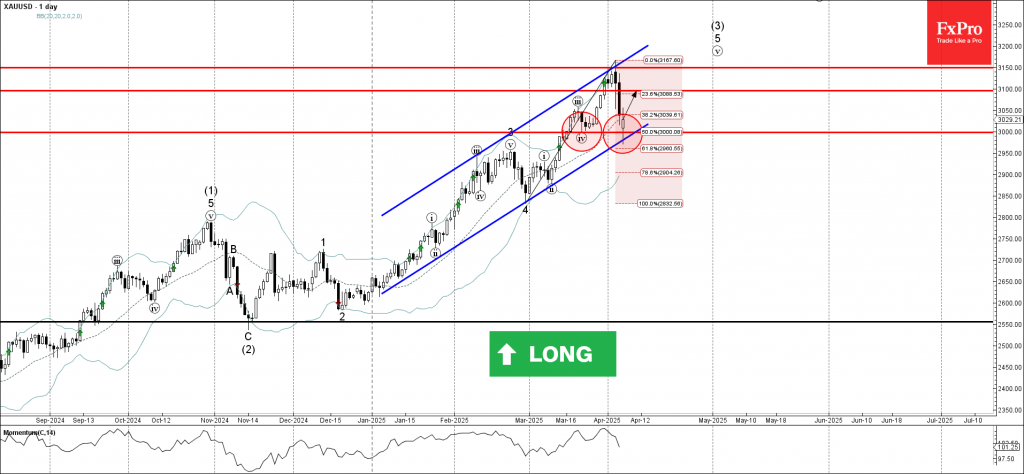
Gold Wave Analysis
Gold: ⬆️ Buy
- Gold reversed from round support level 3000.00
- Likely to rise to resistance level 3100.00
Gold recently reversed up from the support area between the round support level 3000.00 (which stopped the earlier minor correction iv in the middle of March) and the lower daily Bollinger Band.
This support area was further strengthened by the support trendline of the daily up channel from January and by the 50% Fibonacci correction of the sharp upward impulse from February.
Given the strong uptrend on the daily and weekly charts, Gold can be expected to rise to the next resistance level 3100.00.