Sample Category Title
EU preparing tariffs on USD 20B in US imports, as counter measures to auto tariffs
Ahead of the meeting with Trump, European Trade Commissioner Cecilia Malmstrom said that "we hope that it doesn't come to that and that we can find a solution. If not, the EU Commission is preparing a rather long list of many American goods. It would be around $20 billion." But the next round of EU tariffs will not target specific US states. Malmstrom said "it's more general goods such as agricultural products, machinery, high-tech products and other things."
According to reports, the EU originally considered tariffs on EUR 9B of US imports. But now, they're looking at going after double that amount, but at half the tariff rate. Also, such tariffs are expected to come into effect at least after US completes its section 232 national security probe on autos. It's expected to be completed in weeks, probably by late August/early September.
With QE Exit Plans Laid Out, ECB To Offer Little New At July Meeting
The European Central Bank will announce its latest policy decision on Thursday at 11:45 GMT. After last month's big decisions when the Bank outlined its monetary policy course until at least the summer of 2019, the upcoming meetings, including this week's gathering, look set to be uneventful ones. However, with some confusion surrounding the ECB's forward guidance on interest rates, markets will be seeking clarification from President Mario Draghi at his press conference.
In June, the Bank shocked the markets by accompanying the decision to end its asset purchase program (APP) with a dovish rate guidance. The updated forward guidance to keep interest rates at present levels “at least through the summer of 2019” was open to differing interpretations but ultimately pushed out rate hike expectations towards the end of 2019, sending the euro plummeting. The single currency plunged by about 2% from the announcement time to when Draghi's press conference ended as investors pared back expectations that the ECB would begin hiking rates before the summer of 2019.
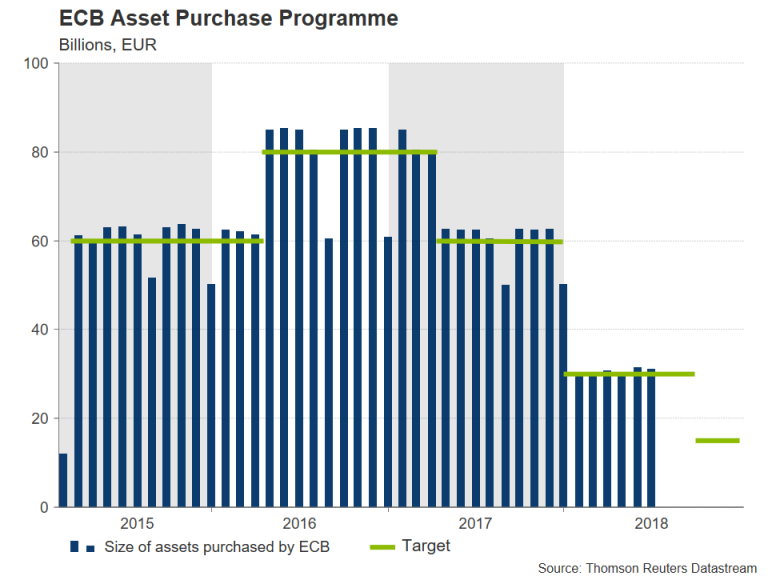
Further underlining the Bank's dovish tone was tying the winding down of QE to “incoming data confirming the Governing Council's medium-term inflation outlook”. Although there's only a low probability that the ECB would decide to extend QE beyond 2018 even if growth and inflation didn't evolve quite as expected, and it would require a major crisis to derail its plans, it nevertheless places the Bank on the side of caution. With Eurozone data still pointing to a deceleration in growth momentum, the euro's outlook isn't about to change to a more positive one anytime soon, as the ECB is unlikely to signal a steeper rate path until downside risks have subsided substantially.
Should the Eurozone economy gather some steam in the coming months, it's possible the ECB may yet bring forward the timing of a rate hike. For now, though, investors will have to guess whether “through the summer of 2019” means July, September or later. Reporters are sure to seek more clarity from Draghi about the timeframe at Thursday's press conference. However, it's likely that this was a carefully crafted wording to give the ECB flexibility to raise rates during or after the summer depending on how the economy performs. Traders should therefore not get their hopes up in expecting Draghi to clear up the ambiguity in the language.
Another point to consider are fresh views by Draghi on heightened trade risks. Fears of increased trade barriers have already started to hurt Eurozone business confidence even though China has so far been the United States' primary target. Any deep concerns about the potential impact of a trade war would cloud investors' outlook further and weigh on the euro.
However, with no new quarterly staff projections at hand, Draghi is not expected to deviate much from the last meeting on his views, with the euro probably seeing only limited reaction. A reiteration of his dovish stance could see euro/dollar slipping towards the 1.16 level, with immediate support coming around 1.1650. A breach of the 1.16 handle would take the pair closer to the 3-week low of 1.1572 set on July 19.
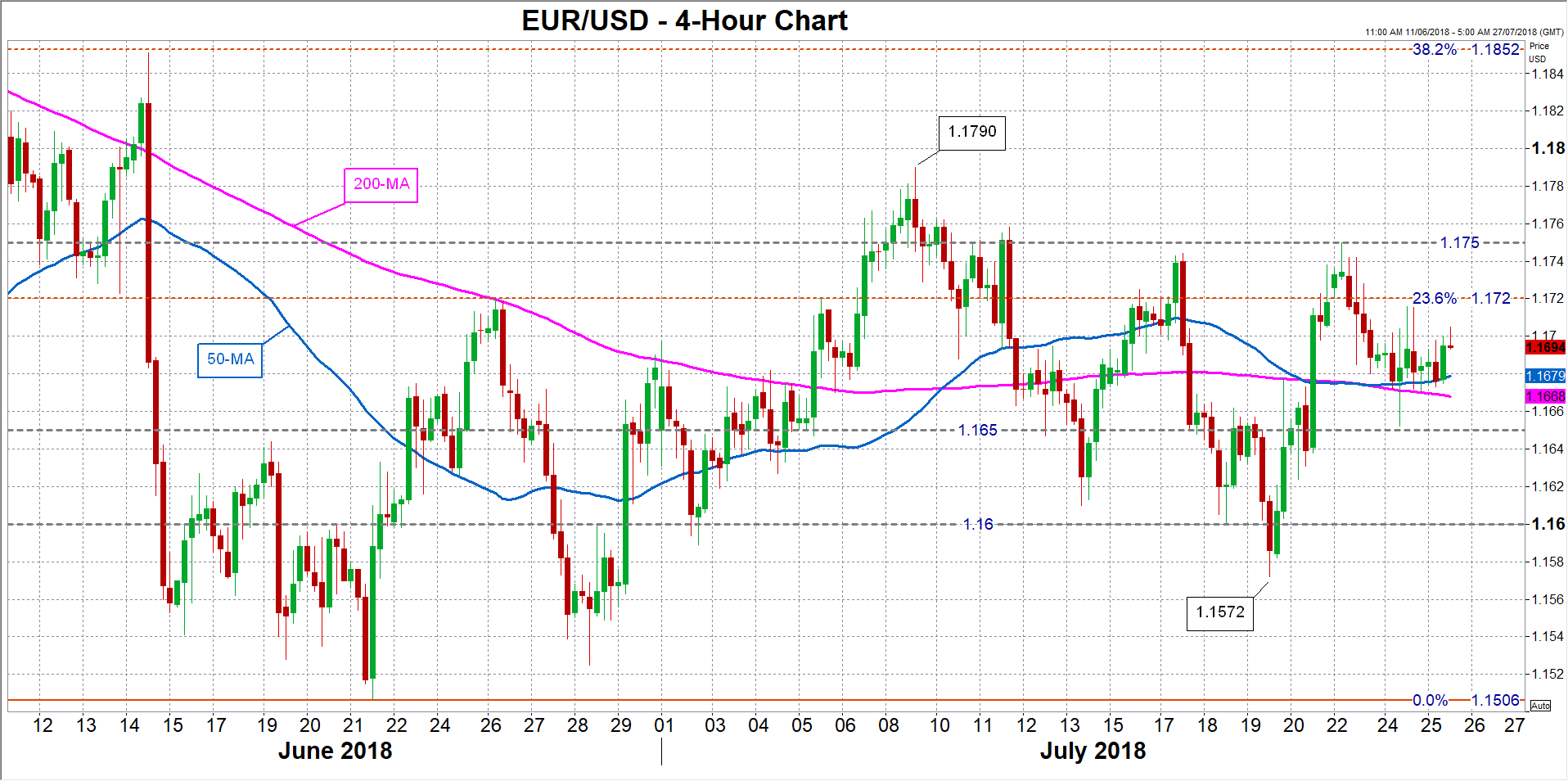
An upside push could come from Draghi possibly hinting that a rate hike in the third quarter of 2019 is more likely than the fourth quarter. Euro/dollar could see immediate resistance coming in the region between 1.1720 and 1.1750. The 1.1720 level is the 23.6% Fibonacci retracement of the downleg from 1.2413 to 1.1506, while the 1.1750 mark halted the pair's advances on Monday. A break above this resistance area would clear the way to the July peak of 1.1790 and bring into focus the 38.2% Fibonacci level of 1.1852.
WTI OIL Outlook: Directionless Mode Extends But Bias Turns Positive On Fall Of Crude Stocks
WTI oil moved slightly lower in Wednesday’s mid-European session trading but remains constructive following strong rally on Tuesday.
Oil prices are supported by strong concerns about oil production in Venezuela and were additionally boosted by fall in US crude inventories.
API report, released late Tuesday showed stronger than expected fall in crude inventories (3.16 million barrels vs forecasted draw for 3 million barrels.
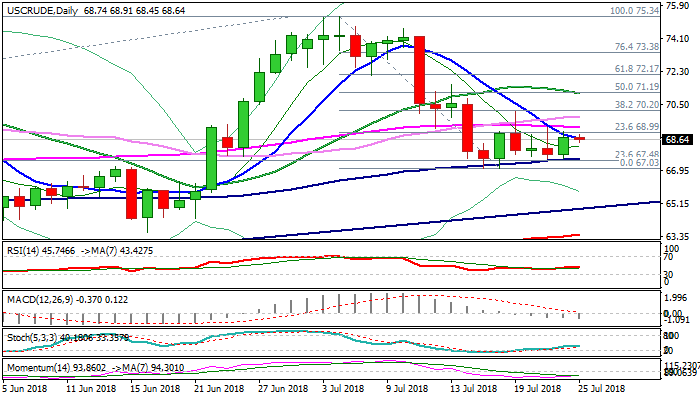
Daily chart shows oil price entrenched within narrowing range between 100SMA ($67.58) and 55SMA ($69.26) which extends into seventh straight day and maintaining directionless mode. Daily techs remain mixed as positive signals from bullish stochastic and improving momentum are offset by negative configuration of MA’s.
Oil price looks for stronger catalyst which would establish near-term action in fresh direction.
Moving averages off 100 and 55 days act as initial pivots and break of either side would generate fresh direction signals.
EIA crude oil stocks report is due later today and will be closely watched for fresh signals. Draw of 2.33 million barrels is forecasted for the week behind vs previous week’s result which showed a build of 5.83 million barrels.
Stronger fall in oil inventories would offer fresh support to oil prices, while disappointing results would turn near-term bias negative.
Res: 69.03, 69.26, 70.00, 70.16
Sup: 68.45, 68.04, 67.57, 67.02
Juncker/Trump Meeting Eyed As Tariff Threats Weigh On German Outlook
- Investors look for another boost from earnings;
- Juncker heads to Washington in attempt to cool trade conflict;
- German IFO beats expectations but business worried about outlook.
US futures are pointing slightly higher again on Wednesday as indices look to extend the winning streak to three sessions on the back of strong earnings reports.
Investors have been encouraged by the results we’ve seen so far, with lower taxes not the only thing providing a big lift to the bottom line, although they are obviously a considerable contributor. Another 52 companies are preparing to report on the second quarter today, including Facebook, the second of three FANG stocks reporting this week and investors will be hoping for more strong figures after Alphabet’s report was so well received, despite the $5 billion fine that was imposed on it last week.
One of the few pieces of data that was scheduled for release today was the German Ifo business climate survey and the results were broadly as expected, with businesses feeling positive about the current climate and anxious about the outlook. Overall, the index fell marginally to 101.7 which was slightly higher than expectations and signals continued decent growth in the eurozone’s largest economy.
The continued decline in the expectations component of the survey is likely being driven by the ever-increasing threat of a trade war, with US President Donald Trump now taking aim at the eurozone as the conflict with China heats up. Germany has been a particular focal point of his attacks on the eurozone, with the country benefiting from a weaker euro which is more a reflection of the region as a whole rather than its own economy.
Trump has repeatedly threatened tariffs on the European car industry which would disproportionately hit Germany and is likely factoring into businesses less optimistic outlook. It will be interesting to see if anything can be achieved during Jean-Claude Junckers visit to Washington today, with the European Commission President hoping to convince Trump to drop plans to impose tariffs on the EU, something I am not hopeful he will be able to achieve.
The IFO number did lift the euro in early European trade and it now finds itself around a tenth of one percent higher against the dollar on the day. This comes ahead of the ECB meeting tomorrow, which could be one of the less eventful gatherings after the central bank last month laid out plans for the end of quantitative easing this year and made clear that interest rates will not start to rise until at least the middle of next year. Nothing that has happened since is likely to have changed this view.
Markets Froze Before Trump-Juncker Meeting On International Trade, RUB, TRY Sharply Fell On Tuesday
The US stock markets were marked by Tuesday's growth in strong earnings reports, which allowed S&P500 to add 0.3% on Tuesday's results. On Wednesday, by the beginning of Europe session the futures for S&P index remains near the closing levels of the previous day. It is also worth mentioning the growth of companies' shares in the agricultural sector thanks to Trump's pledges to help farmers in case of full-scale trade war with the EU and China.
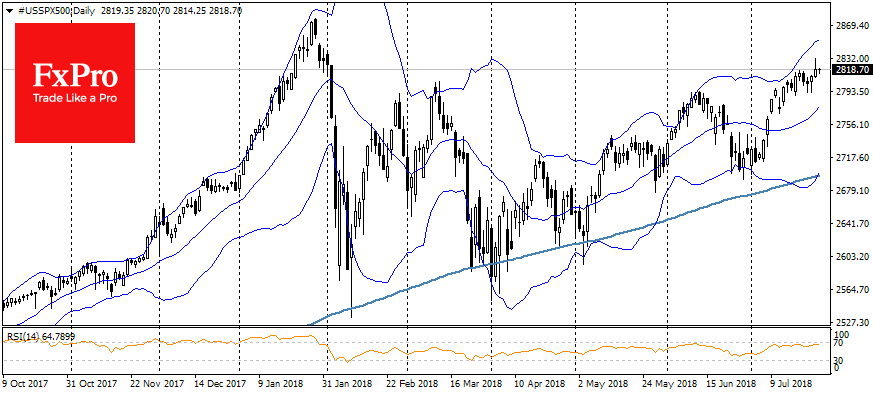
Trade wars will be in the spotlight of markets again. The negotiations between Juncker and Trump focusing on international trade issues will be held on Wednesday.
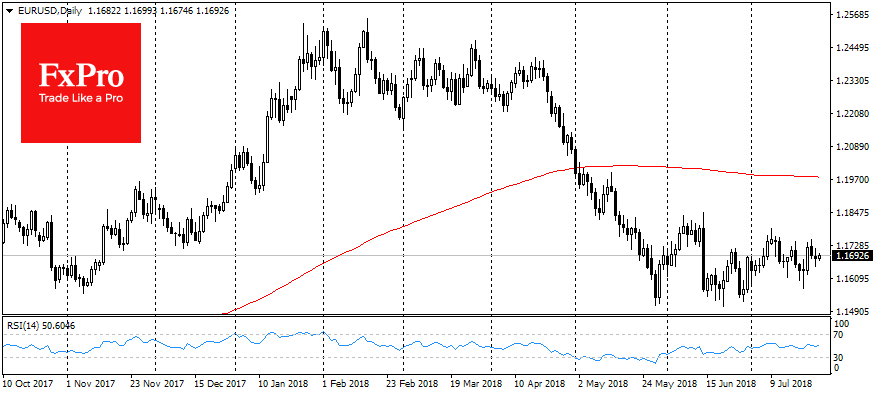
The EURUSD have traded in a narrow range for the second day in a row, remaining close to 1.17 level in anticipation of important comments in the second half of the week. In addition to the meeting of Trump and Juncker, it is also worth highlighting tomorrow's ECB meeting, where the markets will try to grasp how seriously the central bank estimates the economic damage from already introduced measures and uncertainty around the future tariff policy.
Among the currencies of emerging markets is to highlight yesterday's weakening of the Russian rouble and the Turkish lira, despite the overall increase in demand for risks. TRY lost more than 4% and returned to the area of historical lows to the dollar after Central Bank of the Republic of Turkey had kept the policy rate at 17.75%. The markets considered this as a strengthening of Erdogan's power, as he earlier had expressed publicly his preference for a less stringent policy despite inflation. 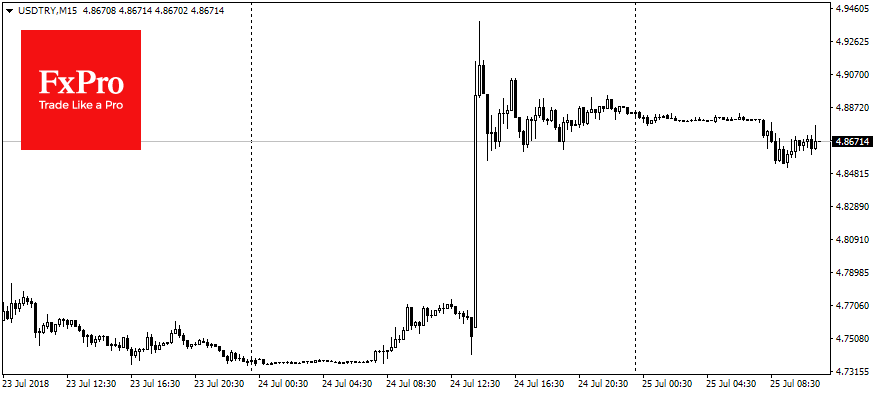
The Russian rouble lost almost 1.5% last night after Trump's tweet stating that Russia “will be pushing very hard for the Democrats” in the upcoming elections. These words were perceived by the market as Trump's willingness to support new sanctions against Russia. Up to these words, the Russian market almost ignored the reports of a new U.S. Senate sanctions package.
Nor can it be ruled out that the current negotiations may also be of a positive nature. It is very likely that the stakes are high enough and the time has come to negotiate. Yet the main expectations of bidders are that the world's largest economies can avoid full-fledged trade wars and protectionism.
EUR/USD Remains Near Strong Support
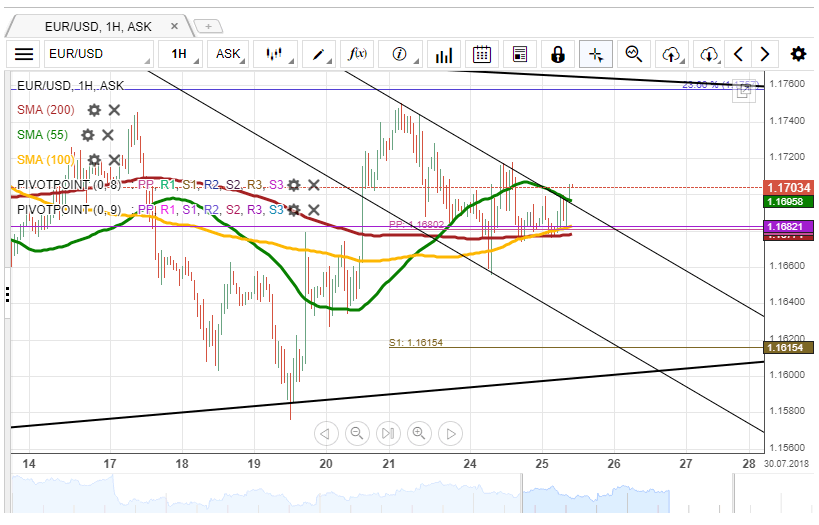
Tuesday's trading session lacked volatility, as various moving averages were limiting strong up– or down-moves. The pair, however, still remains trading in a minor descending channel which is a part of a senior symmetrical triangle.
The pair's movement today should depend on its ability to breach the important support cluster located at 1.1680. If this barrier is breached, the Euro is expected to move closer to the senior pattern line and the weekly S1 near 1.1620. The Euro's movement in the senior pattern and technical indicators support this bearish scenario.
On the other hand, resistance should be found at the weekly R1 at 1.18. By and large, this session could be relatively calm, as no significant data releases are scheduled for today.
GBP/USD Fails To Surge After Breakout
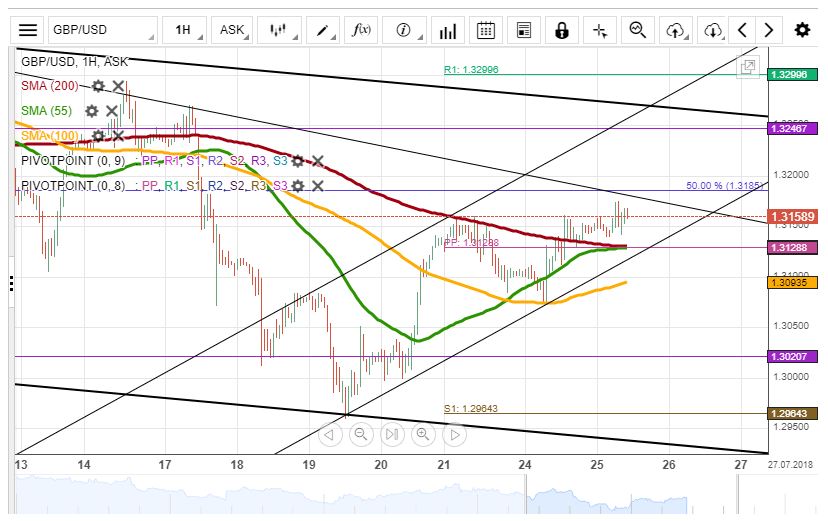
The Sterling found support at the 100-hour SMA early on Tuesday and consequently began appreciating. Bulls managed to push the rate through the weekly PP and the 55-period (4H) and 200-hour SMAs at 1.3130; however, a surge did not follow.
It is likely that the pair finds support at this cluster and thus continue moving higher during the following sessions. The ultimate near-term target is the upper boundary of a three-month channel down and the 200-period SMA near 1.3120.
A one important resistance level to take into account today is 1.3180 where a trend-line and the 100-period SMA are located.
Given that there are no important fundamental releases today, the rate might lack the necessary momentum to break any of the aforementioned support and resistance clusters.
USD/JPY Trades Near 111.20
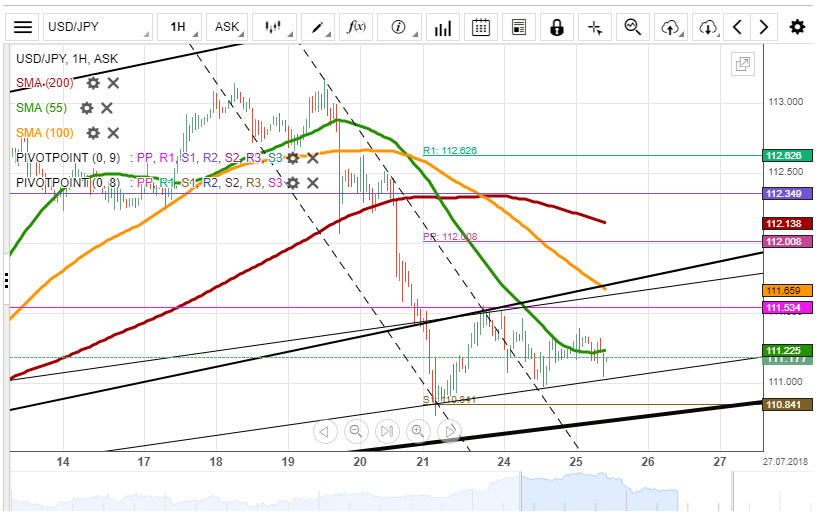
The US Dollar has gained slightly against the Yen during the previous two sessions. Despite fluctuating near the 55-hour SMA for most of the session, the pair finally managed to overcome this weekly resistance late on Tuesday.
This development allows to think that appreciation could follow today. The upward tendency of technical indicators is likewise confirming this scenario. However, this up-move is likely to be limited due to several important resistance levels located nearby.
Two important ones is the breached ascending channel and the 200-period SMA at 11.80 and 112.20, respectively. The latter is unlikely to surrender today.
If looking at support, the Greenback has still room for a decline down to the senior channel at 110.50. This line might be reached within the following trading sessions.
XAU/USD Fails To Accelerate
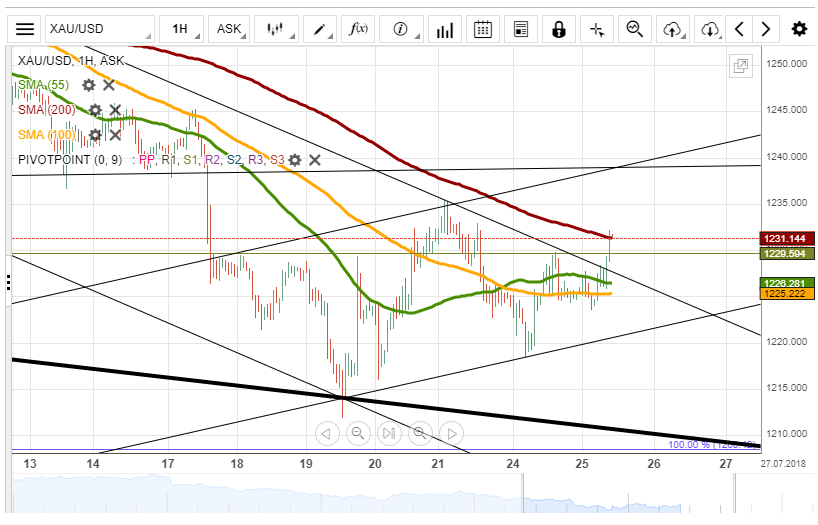
Gold remained stable against the US Dollar on Tuesday. It tried to edge higher during the first part of the day, but was stopped by the combined resistance of the monthly S1 and the 55– and 100-hour SMAs.
Technical signals on longer time-frames indicate that the yellow metal is likely to strengthen in the medium term and thus move towards the senior channel. This up-ward trend could be maintained today, as well, in case the 200-hour and 55-period (4H) SMAs are breached at 1,232.00.
Meanwhile, no support is restricting a fall until the senior channel line circa 1,210.00 if the nearest support surrenders.
Bitcoin Ready To Rock And Roll
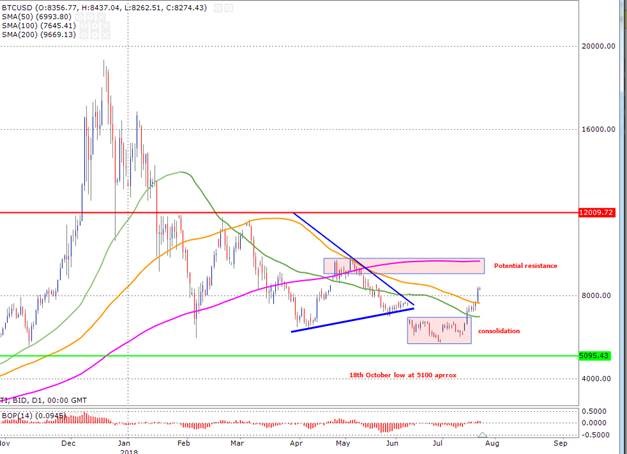
Bitcoin is ready to rock and roll, it is up nearly over 41% in nearly 25 days. This kind of performance certainly tells us one word; Bitcoin. The cryptocurrency has the potential to touch $50K by the end of this year given the previous history it has.
The are three major reasons which are driving this move, ETF speculation, more friendly regulatory news and bulls are back in town. For bulls, this is like fresh air.
From a technical perspective, we have broken out of the wedge pattern and the price has moved above the important moving averages; 50 and 100. We think that the target of $12,100 could easily be reached in the next few weeks.
On a daily time frame, the price has broken out of the consolidation pattern and the measured move of this consolidation pattern is complete. However, we think traders still want to push this further and it is likely that we could the 10K mark very soon. More bullish signals are coming from the moving averages, the price is above the 100 & 59-day moving averages