

Sample Category Title
GBP/USD Daily Outlook
Daily Pivots: (S1) 1.3089; (P) 1.3125; (R1) 1.3177; More...
No change in GBP/USD's outlook as corrective pattern from 1.2956 is extending. Intraday bias remains neutral. Stronger rise cannot be ruled out. But upside should be limited below 1.3362 resistance to bring fall resumption eventually. On the downside, break of 1.2956 will resume the decline from 1.4376 to 1.2874 fibonacci level.
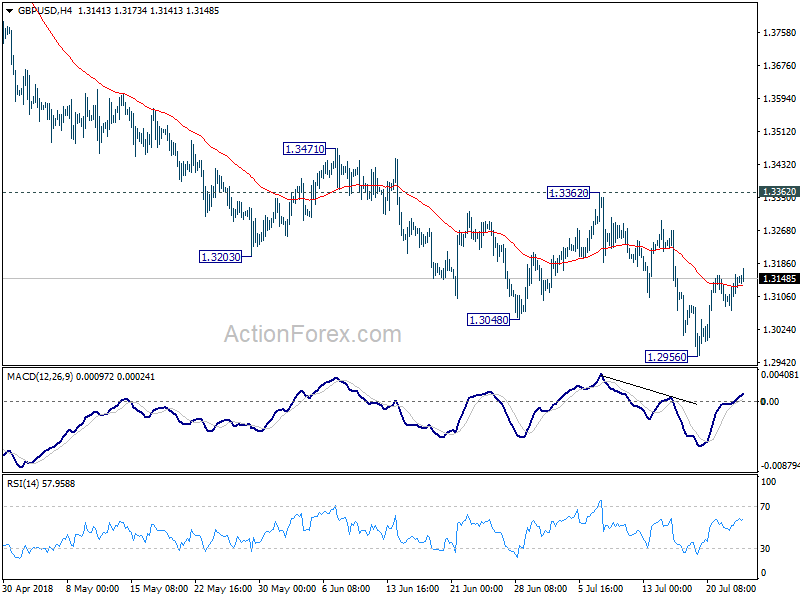
In the bigger picture, whole medium term rebound from 1.1946 (2016 low) should have completed at 1.4376 already, after rejection from 55 month EMA (now at 1.4179). Fall from 1.4376 should extend to 61.8% retracement of 1.1946 (2016 low) to 1.4376 at 1.2874 next. Decisive break of 1.2874 will raise the chance of long term down trend resumption through 1.1946 low. On the upside, break of 1.3362 resistance is needed to be the first indication of medium term bottoming. Otherwise, outlook will remain bearish even in case of strong rebound.
AUDUSD Outlook: Aussie Stands At The Back Foot After Weak CPI Data, Strong 0.7440 Resistance Zone Continues To Cap
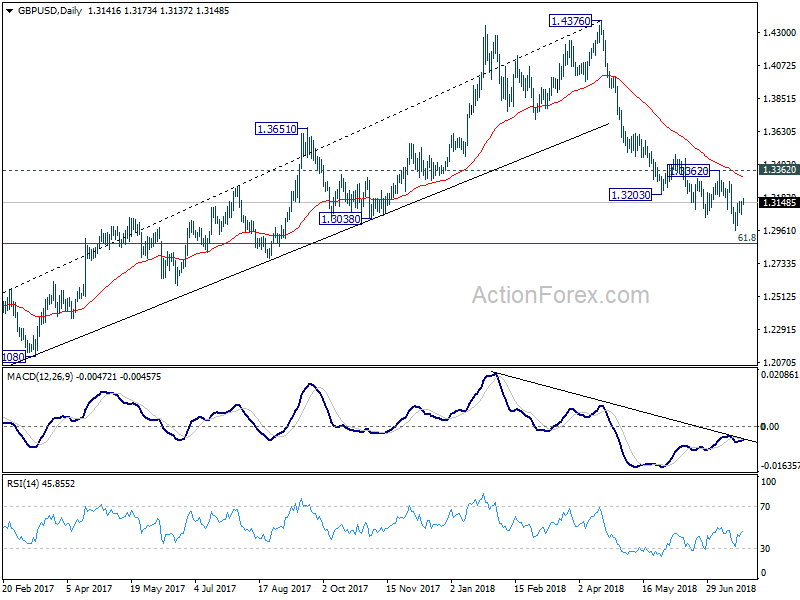
The Australian dollar dipped below 0.74 handle after another failure at strong 0.7440 zone, which marked the sixth consecutive upside rejection.
The pair briefly touched new two-week high at 0.7448, but gains were short-lived, confirming the strength of resistance.
Australian inflation data missed forecasts in Q2 (headline q/q CPI rose 0.4% vs 0.5% f/c, while annual figure was up 2.1% VS 2.2% f/c).
Subdued inflation suggests the RBA would stay on record low cash rate at 1.5% for the third straight year.
Policymakers expect inflation to rise gradually towards central bank’s 2-3% target, as weak labor sector is seen as one of main obstacles for economy growth.
The Aussie showed little benefit from bullish signal on Tuesday’s bullish outside day, remaining congested within 0.7360/0.7440 range for the third day, despite CPI data which were expected to be a catalyst.
Mixed signals from daily techs (cluster of converged daily MA’s still holds but momentum and slow stochastic are negatively aligned) lacks clearer direction signal for now
Res: 0.7404, 0.7431, 0.7448, 0.7474
Sup: 0.7391, 0.7359, 0.7343, 0.7317
EURUSD Outlook: Tight Ranges Ahead Of German Ifo Data, Thick Daily Cloud Continues To Cap
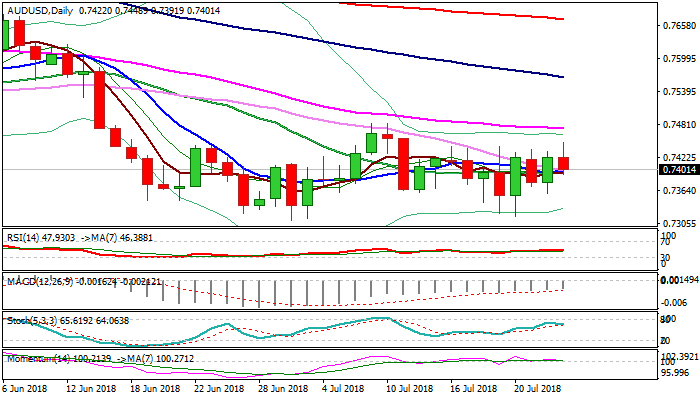
The Euro remains in a quiet mode at the beginning of European session, after Tuesday’s trading ended in Doji candle.
The action remains capped by falling 55SMA (1.1701) and heavily weighed by falling thick daily cloud (cloud base lays at 1.1706).
Daily studies remain mixed and lacking clearer direction signal, with price action holding within triangular consolidation.
German Ifo data are in focus today (business climate 101.6 f/c vs 101.8 prev) with weak reading expected to keep the price at the back foot.
The ECB is meeting tomorrow and expected to stay unchanged, according to their previous comments when the central bank announced that no rate hikes could be expected until the summer 2019 and no reduction in QE expected until the end of this year.
This suggests that the single currency be looking for other catalysts to eventually break out of current narrowing range and generate fresh direction signals.
Res: 1.1701,1.1716,1.1750,1.1790
Sup: 1.1675,1.1654,1.1616,1.1574
EUR/USD Daily Outlook
Daily Pivots: (S1) 1.1652; (P) 1.1685 (R1) 1.1715; More.....
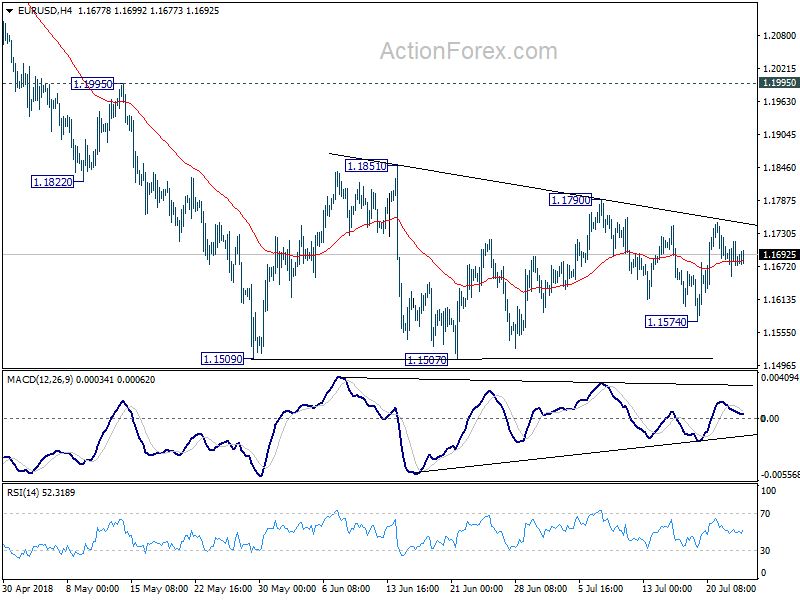
EUR/USD continues to be bounded in consolidation from 1.1509 and intraday bias stays neutral. Stronger recovery cannot be ruled out as the consolidation extends. But in that case, upside should be limited by 1.1851 resistance to bring fall resumption eventually. On the downside , firm break of 1.1507 will resume larger down trend through 50% retracement of 1.0339 to 1.2555 at 1.1447.
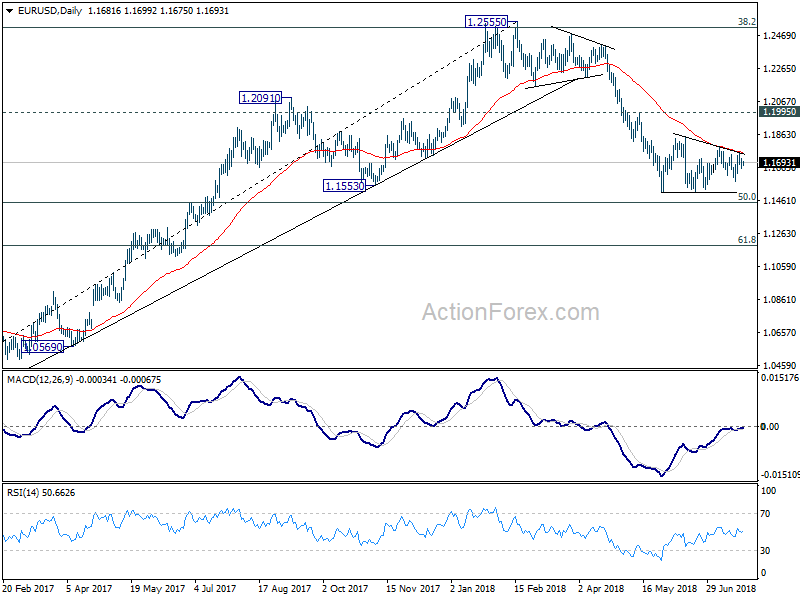
In the bigger picture, EUR/USD was rejected by 38.2% retracement of 1.6039 (2008 high) to 1.0339 (2017 low) at 1.2516. And, a medium term top was formed at 1.2555 already. Decline from there should extend further to 61.8% retracement of 1.0339 to 1.2555 at 1.1186 and below. For now, even in case of rebound, we won't consider the fall from 1.2555 as finished as long as 1.1995 resistance holds.
Trump-Juncker Meeting In Focus, Lira Crumbles
Asian stocks have commenced on a positive note this morning, as strong US corporate earnings and optimism over China boosting fiscal support for its economy rekindled risk appetite.
European markets could benefit from the risk-on sentiment; however, gains may be limited as investors adopt a guarded approach ahead of a meeting between the EC President Jean-Claude Juncker and US President Donald Trump. With escalating trade tensions between the European Union and the United States still a key theme that continues to weigh on global sentiment, the outcome of today’s meeting could leave a lasting impact on the markets. If the talks prove unsuccessful and trade tensions end up escalating further, risk sentiment is likely to be negatively impacted. Market players should be prepared to expect the unexpected from the talks, especially when considering how highly unpredictable the Trump administration can be.
Turkish Lira crumbles after central bank holds rates
The Turkish Lira depreciated heavily against the Dollar yesterday after the nation’s central bank defied market expectations by leaving interest rates unchanged at 17.75%, despite inflation soaring.
This move immediately raised questions over the central bank’s independence, a month after President Recep Tayyip Erdogan’s re-election under an amended constitution that enabled him to follow through on his promise to take more direct control over monetary policy. Outside of Turkey, global trade tensions, a broadly stronger Dollar and expectations of higher US interest rates have exposed to the Lira to downside risks. With a combination of external and domestic factors eroding buying sentiment towards the Lira, the local currency remains at risk of depreciating towards 5.00 and beyond against the Dollar.
Currency spotlight – EURUSD
The EURUSD was on standby on Wednesday morning, as investors positioned ahead of the anticipated meeting betweenUS President Trump and European Commission President Jean-Claude Juncker.
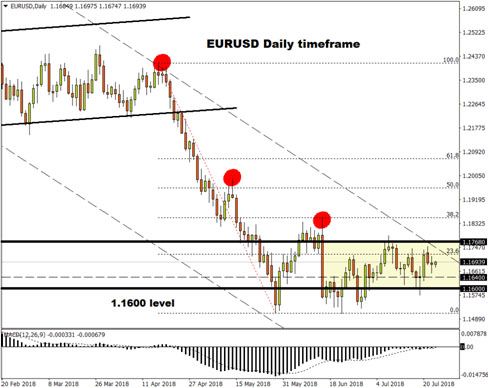
Heightened concerns over a trade war with the United States have shaved some attraction away from the Euro and this can be reflected in the bearish price action. There could be some action on the EURUSD today depending on the outcome of the meeting. Focusing on the technical picture, the EURUSD remains in a wide range on the daily charts. Sustained weakness below 1.1700 could inspire a decline towards 1.1640 and 1.1600, respectively. In regards to the longer-term outlook, the divergence in monetary policy between the European Central Bank and the Federal Reserve could ensure the currency pair remains depressed for prolonged periods.
Commodity spotlight – Gold
It has been a quiet start for Gold this morning as bulls and bears were both missing in action. Regardless, the yellow metal remains bearish on the daily charts and has scope to extend losses as the Dollar stabilizes. Although global trade tensions could accelerate the flight to safety and support appetite for safe-haven Gold, any meaningful gains are likely to be threatened by US rate hike expectations. Gold bears need to attack and conquer $1213 for prices to sink towards the psychological $1200 level.
Daily Report: Euro and Dollar Mixed ahead of the Juncker-Trump Meeting
Sterling appears to be lifted by the news that UK Prime Minister Theresa May has taken over Brexit negotiation. That raised the chance of some speedier conclusions as well as more unified position, as least in front of the EU. The pound is trading as the strongest one for today and the week. On the other hand, Australian Dollar is trading as the weakest one for today after a slightly miss in CPI. It's not a disastrous piece of data but it neither give RBA any reason to pull ahead a rate hike.
Euro and Dollar are mixed as eyes are on the meeting between European Commission European Commission President Jean-Claude Juncker's meeting with Trump on trade. It's a highly anticipated event, yet the expectations are low. Trump continued to play victim with he tweets and said the Americans are the "piggy bank" that's being robbed by others. And he bluffed the EU to drop all tariffs, barriers and subsidies but said "they won't". That's not seen as an attitude for negotiation with sincerity.
On the other hand, it's clear that Juncker and European Union trade commissioner Cecilia Malmstrom will not bring another offer to the US. It's just a meeting to "de-escalate the present situation and prevent it from worsening". Comments from EU Oettinger also suggested that there is no common ground for any breakthrough. So, let's see how it goes.
EU Oettinger to Trump: Drop your punitive tariffs, and we can talk about all tariff reductions
European Union Budget Commissioner Guenther Oettinger commented regarding EU-US trade relationship, ahead of Juncker's meeting with Trump. Oettinger said "firstly, our common line is that we expect the existing punitive tariffs to be lifted", referring the section 232 national security steel and aluminum tariffs. And, "then we are ready to discuss a reduction and restructuring of all tariffs in all sectors."
He added that "in this way, we want to avoid a further escalation of the trade conflict, and to avoid a trade war/" And, "one could try to untangle the existing tariffs and then ... reduce tariffs for various goods and services." He added that " would be a negotiation that would be possible in half a year, and which we could start with the U.S. in the autumn."
Trump's USD 12B aid to tariffs affected farmers … very temporary bandage to a self-inflicted wound
Overnight, Trump administration announced to offer up to USD 12B in aid to farmers that are affected by the the US trade war with other countries, notably China. The program included a mix of measures overseen by the USDA, including director payments to soybean producers, distribution assistance and international marketing. Trump said in the farmers will be the "biggest beneficiary" in what he's doing on trade and " watch, we are opening up markets, you watch what is going to happen, just be a little patient."
The program is not generally welcomed by the industry though. Zippy Duvall, president of the American Farm Bureau Federation, the largest American farmer group said, "we cannot overstate the dire consequences that farmers and ranchers are facing in relation to lost export markets … and we will continue to push for a swift and sure end to the trade war."
American Soybean Association said in a statement that "the announced plan provides only short-term assistance … ASA continues to call for a longer-term strategy to alleviate mounting soybean surpluses and continued low prices, including a plan to remove the harmful tariffs."
Blake Hurst, a corn and soybean farmer and president of the Missouri Farm Bureau said "the payments will be helpful to farmers facing overdue loans and angry bankers, but are completely insufficient if they mean that tariffs and the trade war will last for the foreseeable future". "They are a very temporary bandage to a self-inflicted wound."
IMF: Escalation of protectionist policies will not help current account imbalances
IMF warns in its latest 2018 External Sector Report (ESR) that "excess imbalances are increasingly concentrated in advanced economies" that "both deficits and surpluses—pose risks for individual countries, and for the global economy." Global current account surpluses and deficits "remained relatively unchanged over the past five years" at around 3.25% of global GDP. And 40-50% is concentrated in advanced economies.
Higher-than-desirable current account balances prevail in northern Europe—in countries such as Germany, the Netherlands, and Sweden—as well as in parts of Asia—in economies like China, Korea, and Singapore. Lower-than-desirable balances remain largely concentrated in the United States and the United Kingdom.
IMF also pointed out that "persistence of global imbalances and mounting perceptions of an uneven playing field for trade are fueling protectionist sentiment." And "these impulses are misguided. It warned that "escalation of protectionist policies would mainly hurt domestic and global growth, without much of an effect on current account imbalances, as this year's report also finds."
It urged countries to tackle imbalances together. In particular:
- Countries with lower-than-warranted external current account balances should reduce fiscal deficits and encourage household saving, while monetary normalization proceeds gradually.
- Where current account balances are higher than warranted, the use of fiscal space, if available, may be appropriate to reduce excess surpluses.
- Well-tailored structural policies should play a more prominent role in tackling external imbalances, while boosting domestic potential growth. In general, reforms that encourage investment and discourage excessive saving—through the removal of entry barriers or stronger social safety nets—could support external rebalancing in excess surplus countries, while reforms that improve productivity and workers' skill base are appropriate in countries with excess external deficits.
UK PM May takes over Brexit negotiations from now on
UK Prime Minister Theresa May said she will lead the Brexit negotiation with EU from now on. In a written statement to the Parliament, May said that "I will lead the negotiations with the European Union, with the Secretary of State for Exiting the European Union deputizing on my behalf."
"DExEU (Department for Exiting the EU) will continue to lead on all of the government's preparations for Brexit: domestic preparations in both a deal and a no deal scenario, all of the necessary legislation, and preparations for the negotiations to implement the detail of the Future Framework."
Australian dollar lower after CPI miss, NZD down on trade deficit
Both Australian Dollar and New Zealand Dollar are trading lower today after release of economic data.
Australia CPI rose 0.4% qoq, 2.1% yoy in Q2. The annual rate accelerated from Q1's 1.9% yoy but missed expectation of 2.2% yoy. RBA trimmed mean CPI was unchanged at 1.9%, inline with expectation. RBA weighted median CPI slowed to 1.9% yoy, down from 2.0% yoy, matched expectation. RBA is very clear with its stance that there is no compelling reason to raise interest rate in near term. And the inflation data certainly won't alter that position.
New Zealand trade balance came in at surprised NZD -113 deficit in June, versus expectation of NZD 200m surplus. Exports dropped from NZD 5.35B to NZD 4.91B. Imports also dropped from NZD 5.15B to 5.02B.
Elsewhere
Eurozone will release M3 money supply and German IFO business climates. US will release new homes sales and crude oil inventories.
EUR/USD Daily Outlook
Daily Pivots: (S1) 1.1652; (P) 1.1685 (R1) 1.1715; More.....
EUR/USD continues to be bounded in consolidation from 1.1509 and intraday bias stays neutral. Stronger recovery cannot be ruled out as the consolidation extends. But in that case, upside should be limited by 1.1851 resistance to bring fall resumption eventually. On the downside , firm break of 1.1507 will resume larger down trend through 50% retracement of 1.0339 to 1.2555 at 1.1447.
In the bigger picture, EUR/USD was rejected by 38.2% retracement of 1.6039 (2008 high) to 1.0339 (2017 low) at 1.2516. And, a medium term top was formed at 1.2555 already. Decline from there should extend further to 61.8% retracement of 1.0339 to 1.2555 at 1.1186 and below. For now, even in case of rebound, we won't consider the fall from 1.2555 as finished as long as 1.1995 resistance holds.
Economic Indicators Update
| GMT | Ccy | Events | Actual | Forecast | Previous | Revised |
|---|---|---|---|---|---|---|
| 22:45 | NZD | Trade Balance Jun | -113M | 200M | 294M | 208M |
| 01:30 | AUD | CPI Q/Q Q2 | 0.40% | 0.50% | 0.40% | |
| 01:30 | AUD | CPI Y/Y Q2 | 2.10% | 2.20% | 1.90% | |
| 01:30 | AUD | CPI RBA Trimmed Mean Q/Q Q2 | 0.50% | 0.50% | 0.50% | |
| 01:30 | AUD | CPI RBA Trimmed Mean Y/Y Q2 | 1.90% | 1.90% | 1.90% | |
| 01:30 | AUD | CPI RBA Weighted Median Q/Q Q2 | 0.50% | 0.50% | 0.50% | |
| 01:30 | AUD | CPI RBA Weighted Median Y/Y Q2 | 1.90% | 1.90% | 2.00% | |
| 08:00 | EUR | Eurozone M3 Money Supply Y/Y Jun | 4.00% | 4.00% | ||
| 08:00 | EUR | German IFO Business Climate Jul | 101.7 | 101.8 | ||
| 08:00 | EUR | German IFO Current Assessment Jul | 98.7 | 98.6 | ||
| 08:00 | EUR | German IFO Expectations Jul | 105.1 | 105.1 | ||
| 14:00 | USD | New Home Sales Jun | 668K | 689K | ||
| 14:30 | USD | Crude Oil Inventories | -3.4M | 5.8M |
EURUSD Sellers Testing Key Support Again
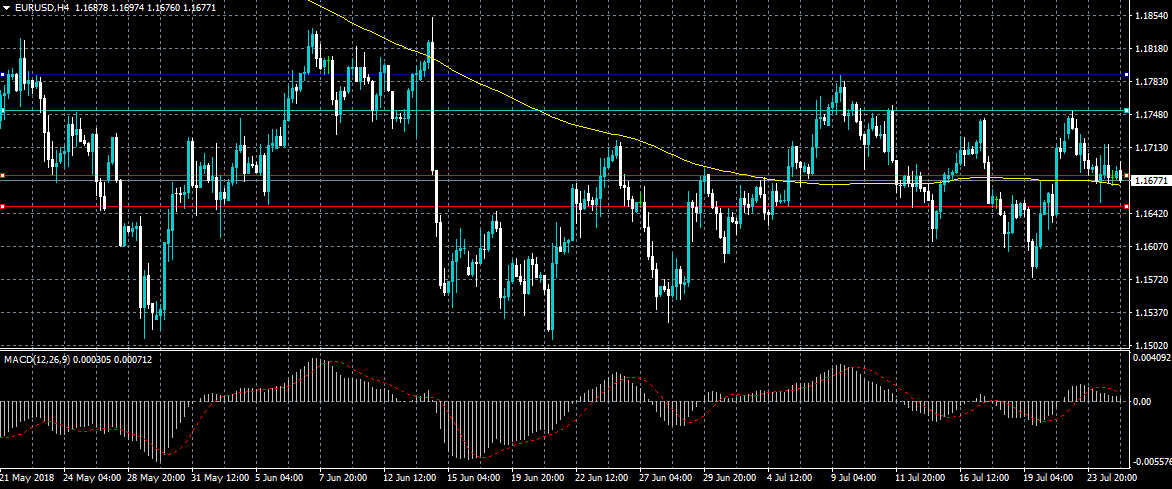
The euro has fallen back towards key weekly support against the US dollar as traders book profits ahead of a number of key risk-events for the single currency. EURUSD traders await Thursday’s ECB policy decision and US President Donald Trump’s scheduled meeting with European trade officials. Buyers now need to keep the price above the 1.1724 resistance level, while sellers now need to hold price below the 1.1650 level.
The EURUSD pair is only intraday bullish while trading above the 1.1724 level, key resistance above the 1.1724 level is found at the 1.1750 and 1.1790 levels.
If the EURUSD pair falls below the 1.1650 level, key technical support is found at the 1.1630 and 1.1600 levels.
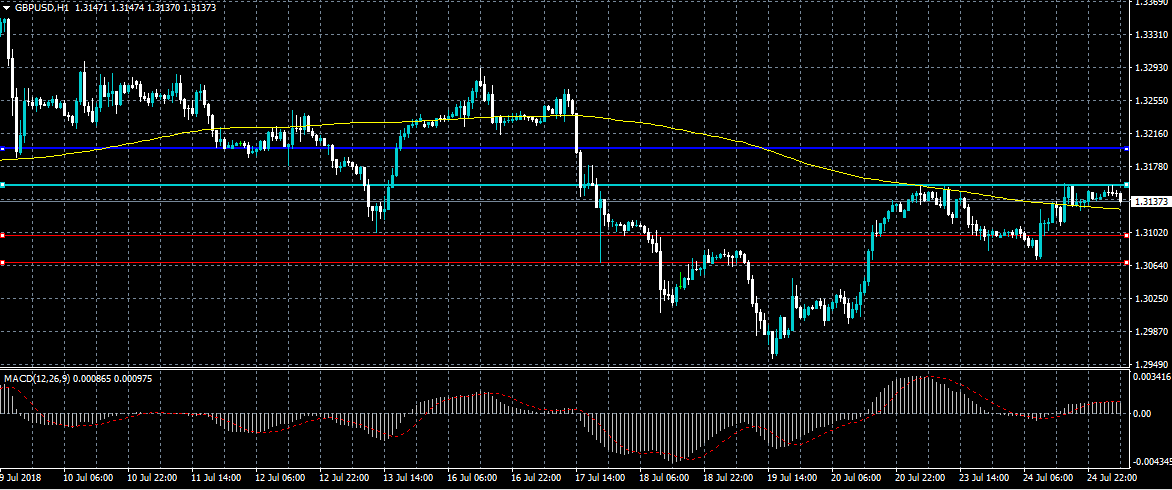
GBPUSD Further Upside Expected Above 1.3155
The British pound continues to press higher against the greenback on Wednesday, with short-term bulls retaining control of the GBPUSD pair. Further intraday upside now seems likely if buyers can sustain the price above the key 1.3155 resistance level. The 1.3205 level remains a major target for sterling bulls, while sellers will look to take back short-term of the GBPUSD pair below the 1.3080 level.
The GBPUSD pair is strongly bullish while trading above the 1.3155 level, key resistance is found at the 1.3205 and 1.3235 levels.
If the GBPUSD pair falls below the 1.3100 level, key support is found at the 1.3080 and 1.3050 levels.
Bitcoin Bullish Momentum Continues As Price Passes $8,000
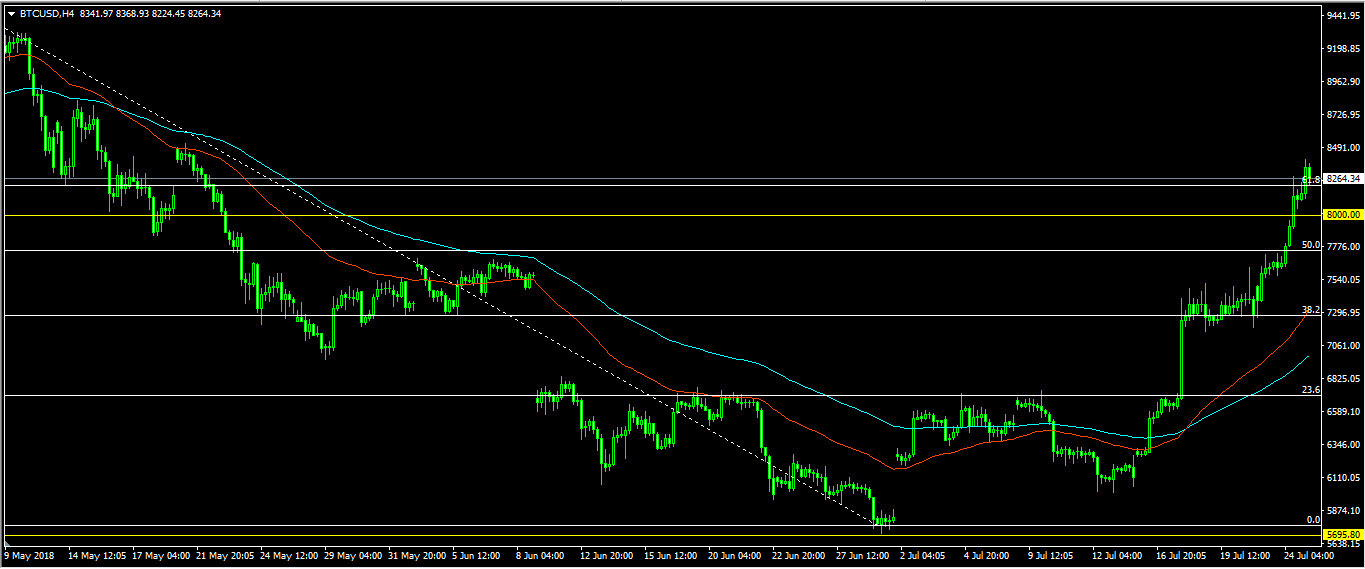
Last week, the price of bitcoin soared by more than 20%. This rally is continuing this week, with the price currently at $8290. This is the highest level for the cryptocurrency since May 24.
The rally has happened due to the increased demand for Bitcoin. The so-called Bitcoin dominance rate has soared from 40% a week ago to more than 47%. This dominance measures the volume of the total cryptocurrency market controlled by Bitcoin.
The biggest driver for this surge is the news that Blackrock was exploring investing in the cryptocurrencies space. Blackrock is one of the biggest investors in the world with stakes in more than 80% of all public companies.
Another bullish factor for Bitcoin is that the SEC is nearing the approval of a Bitcoin Exchange Traded Fund (ETF). The ETF has been proposed by asset manager Van Eck Associates Corp and startup SolidX Management LLC. Another company, Bitwise Asset Management has applied for an ETF that will track the top ten cryptocurrencies.
In the past, the SEC has resisted approving such products because of the fear that they put individual traders at risk. The three organizations claim that their ETFs will address the concerns raised by the SEC.
The BTC/USD pair is now trading at $8290. This price is above the 50 and 100-day moving averages. It is also an important price because it is above the important resistance level of $8,000. As the good news for Bitcoin continues, the pair is likely to continue moving higher. However, traders should be cautious because as the news fades, the pair could potentially fall back to the $7290 level. This is the 38.2% Fibonacci Retracement level and the 50-day EMA level.
EU Oettinger to Trump: Drop your punitive tariffs, and we can talk about all tariff reductions
European Union Budget Commissioner Guenther Oettinger commented regarding EU-US trade relationship, ahead of European Commission President Jean-Claude Juncker's meeting with Trump. Oettinger said "firstly, our common line is that we expect the existing punitive tariffs to be lifted", referring the section 232 national security steel and aluminum tariffs. And, "then we are ready to discuss a reduction and restructuring of all tariffs in all sectors."
He added that "in this way, we want to avoid a further escalation of the trade conflict, and to avoid a trade war/" And, "one could try to untangle the existing tariffs and then ... reduce tariffs for various goods and services." He added that " would be a negotiation that would be possible in half a year, and which we could start with the U.S. in the autumn."